Science in Evangelii Gaudium

The apostolic exhortation published by Pope Francis yesterday has received widespread scrutiny already, with two foci being its critique of unbridled market capitalism and its equally sharp-tongued critique of the Church’s shortcomings and a call to greater mercy and closeness to all. Both of these topics are close to my heart and I hope to return to them in due course.

Instead, I’d here like to focus on the references to science that Francis made in Evangelii Gaudium – effectively as a follow-on to an analogous analysis I applied to his interview given to Jesuit publications some months ago. As I noted there, Francis placed science on par with theology, both as informing the Church from within, and I was curious to see how that – to my mind daring – positioning would hold up in this formal exposition of his vision for the Church.

The first mention of science comes up early on in the document and is well in line with the sketch from “the” interview:

“The Church […] needs to grow in her interpretation of the revealed word and in her understanding of truth. It is the task of exegetes and theologians to help “the judgment of the Church to mature”. The other sciences also help to accomplish this, each in its own way.”

Science – in fact, “the sciences” – is placed explicitly among the sources of understanding that the Church needs to take advantage of, even in the context of making sense of revelation. Francis follows this up by stating that:

“Differing currents of thought in philosophy, theology and pastoral practice, if open to being reconciled by the Spirit in respect and love, can enable the Church to grow, since all of them help to express more clearly the immense riches of God’s word. For those who long for a monolithic body of doctrine guarded by all and leaving no room for nuance, this might appear as undesirable and leading to confusion. But in fact such variety serves to bring out and develop different facets of the inexhaustible riches of the Gospel.”

The sciences and their “differing currents of thought” are shown here to lead to a nuanced, varied understanding of a multi-faceted reality. In fact, towards the end of the exhortation, Francis makes a very important point about the Gospel – and by extension reality too – being like a polyhedron:

“Here our model is not the sphere, which is no greater than its parts, where every point is equidistant from the centre, and there are no differences between them. Instead, it is the polyhedron, which reflects the convergence of all its parts, each of which preserves its distinctiveness.”

Returning to the presentation of science in Evangelii Gaudium, the strongest point is made about half-way through the document, where science is even positioned as “an instrument of the Spirit for enlightening and renewing the world,” in the context of its capacity to shed light on Jesus’ message. This is very strong stuff and, I believe, part of a much broader move by Francis to emphasize the ubiquity of God’s speaking to us. Also in the context of inter-religious dialogue, Francis proclaims that non-Christian religions too “can be channels which the Holy Spirit raises up” – again a very bold claim, like in the case of science. In effect, Francis is saying not to look for God only in the zones explicitly demarcated for it, but to realize that He can be accessed in many more ways. In fact, his words about non-believers round out this picture very clearly: “We consider [all who sincerely seek the truth, goodness and beauty] as precious allies in the commitment to defending human dignity, in building peaceful coexistence between peoples and in protecting creation.”

Next, Francis returns to the key point from “the” interview – that theology and science need to work in tandem:

“It is not enough that evangelizers be concerned to reach each person, or that the Gospel be proclaimed to the cultures as a whole. A theology […] which is in dialogue with other sciences and human experiences is most important for our discernment on how best to bring the Gospel message to different cultural contexts and groups.”

However, it is a relationship among equals that he is after – among all the sciences and rational modes of equiry and thought, which is in contrast with an absolutization of positivist science in the form of scientism:

“Dialogue between science and faith also belongs to the work of evangelization at the service of peace. Whereas positivism and scientism “refuse to admit the validity of forms of knowledge other than those of the positive sciences”, the Church proposes another path, which calls for a synthesis between the responsible use of methods proper to the empirical sciences and other areas of knowledge such as philosophy, theology, as well as faith itself, which elevates us to the mystery transcending nature and human intelligence. Faith is not fearful of reason; on the contrary, it seeks and trusts reason, since “the light of reason and the light of faith both come from God” and cannot contradict each other.”

Again, this is not a new position – drawing explicitly on John Paul II’s Fides et Ratio – but an important facet of Francis’ vision of how science is part of a Christian world-view.

Finally, Francis re-iterates the fundamental compatibility of Christianity and science, by underlining the goodness of scientific progress. At the same time he warns against an ideologisation of science too and against a jumping to conclusions or an overconfidence in emerging theories:

“The Church has no wish to hold back the marvellous progress of science. On the contrary, she rejoices and even delights in acknowledging the enormous potential that God has given to the human mind. Whenever the sciences – rigorously focused on their specific field of inquiry – arrive at a conclusion which reason cannot refute, faith does not contradict it. Neither can believers claim that a scientific opinion which is attractive but not sufficiently verified has the same weight as a dogma of faith. At times some scientists have exceeded the limits of their scientific competence by making certain statements or claims. But here the problem is not with reason itself, but with the promotion of a particular ideology which blocks the path to authentic, serene and productive dialogue.”

In summary, I find Francis’ views on science deeply positive and see them as both building on his predecessors’ emphasis on rationality and going beyond even the extent to which they saw science as a good. To declare science as an instrument of the Holy Spirit is to give it the highest possible accolade.

Science grows Church’s understanding

350px God the Geometer0

As was immediately clear from a first reading, “the” interview given by Pope Francis last Thursday to Jesuit magazines is a text rich both in spiritual and intellectual treasures and will be a prominent trigger of reflection for a long time to come.

Today I’d like to take a closer look at a passage from it that has immediately caught my eye, but that received little attention so far. It addresses the relationship between science and religion in a, to my mind, very positive way:

“[H]uman self-understanding changes with time and so also human consciousness deepens. Let us think of when slavery was accepted or the death penalty was allowed without any problem. So we grow in the understanding of the truth. Exegetes and theologians help the church to mature in her own judgment. Even the other sciences and their development help the church in its growth in understanding. There are ecclesiastical rules and precepts that were once effective, but now they have lost value or meaning. The view of the church’s teaching as a monolith to defend without nuance or different understandings is wrong.”

While the opposition between science and religion certainly does not apply to the Catholic Church – with Blessed Pope John Paul II’s landmark encyclical Fides et Ratio being a categorical statement of the mutual benefits of faith and reason and with Pope Benedict XVI having spoken of the necessity of dialogue between science and faith 1 – Francis’ positioning of science as “helping the church in its growth in understanding” is a significant move. Like with many of Francis’ statements, it could be argued that they contain nothing new (Fides et Ratio already saying that “science can purify religion from error and superstition”) or that they are only new in style – and in some sense that is true, since he is firmly rooted in the Church, but it would, I believe, also miss an important nuance.

While I have always read Fides et Ratio as positioning faith and reason as separate, but mutually “strengthening” entities,2 here I see Francis presenting theology and science as two activities whose results both help the Church, the former leading to mature judgment while the latter resulting in increased understanding. This is a picture that does not place theology in a privileged, internal position with regard to the Church, and science as an external, while admittedly positive, activity, but positions both as engines of progress that deepen our humanity.3

While the above is clearly my reading and attempted unpacking of Francis’ condensed thought, I believe it is compatible with another of the important points he makes in “the” interview, namely that the Church is the “faithful people of God,”4 and that “‘thinking with the church’ [does not mean] only thinking with the hierarchy of the church,” that it “does not concern theologians only.” Seen in this way, “[t]he church is the totality of God’s people” and is therefore formed as much by theology as by science. Science becomes an internal concern of the Church – the People of God – and its advances and insights form her teaching from within.5 In many ways this also reminds me of Francis’ address to Brazil’s “leaders of society” during his visit in July, where he emphasizes that Christianity “combines transcendence and incarnation” and “faith and reason unite, the religious dimension and the various aspects of human culture – art, science, labour, literature…”

The above sketch, which I don’t believe I am bolting on to Francis’ thought, strikes me as a natural evolution of the solid foundations that John Paul II laid down, and I am curious to see whether it will find support in his future teaching.


0 I don’t mean to distract, but note the fractal in this 13th century illuminated illustration!
1 “In the great human enterprise of striving to unlock the mysteries of man and the universe, I am convinced of the urgent need for continued dialogue and cooperation between the worlds of science and of faith in the building of a culture of respect for man, for human dignity and freedom, for the future of our human family and for the long-term sustainable development of our planet. Without this necessary interplay, the great questions of humanity leave the domain of reason and truth, and are abandoned to the irrational, to myth, or to indifference, with great damage to humanity itself, to world peace and to our ultimate destiny.” (Pope Benedict XVI, Address To The Pontifical Academy Of Sciences, 8 November 2012)
2 As Lumen Fidei puts it in §32.
3 Echoing the affirmation in Fides et Ratio that “Men and women have at their disposal an array of resources for generating greater knowledge of truth so that their lives may be ever more human.”
4 The definition presented in Lumen Gentium, as Francis points out.
5 This is not a conflation of the two – theology and science – but a recognition of their equal import for the Church’s progress.

The inescapable indulgence of philosophy

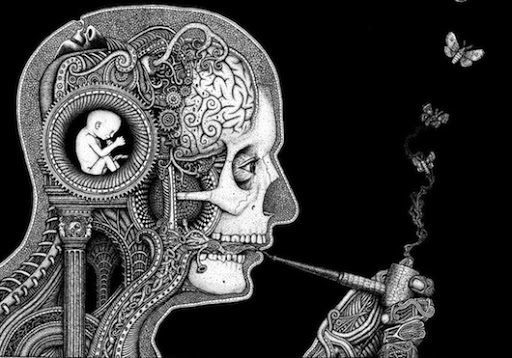
Homunculus drawing s

If you are not in the mood for reading a rant, please, kindly, move along to some calmer, more edifying post.

OK, so, for those of you who are reckless with you blood pressure, the topic of today’s rant is, yet again, the “Faith and Reason” section of the the “Our Faith on Sunday” leaflet that now accompanies my parish’s newsletter (for a previous run in with it see here). This time the topic is none other than philosophy, and it gets disposed of in less than 150 words.1 You’d think that those few words would have to be carefully chosen to say anything meaningful about a complex topic like this. Yet, instead, the opening words are the following:

“Every person will at some stage in life indulge that inescapable curiosity which seeks answers to philosophical questions; even small children exhibit impressive levels of philosophical inquiry when, during the so called ‘Why Stage’, they demonstrate an insatiable desire to know the causes of things.”

The unidentified author of the above wisdom then drops gems like: “[h]ow articulate and explicit each person’s philosophical investigation is will depend on circumstances,” “there is in human nature a questioning quality, an irresistible urge to find out” and “although no single philosophical system can claim to give us a complete account of reality, some do reflect it more fully than others.”

Two words: WOW! Where do you even start in the face of such platitudes and inanity? First, let’s just spell out what the above actually implies about philosophy:

  1. The opening line makes philosophy sound like sneezing, a temporary infatuation with Brad Pitt or the onset of puberty. It makes philosophy seem like something that may one day overcome you, out of the blue. You’ll have no control over it and you’ll just have to indulge it. But, don’t worry – it will pass …
  2. Philosophy may also have the hallmarks of a disease – how serious its symptoms will be in your case (and at some point it will wash over you for sure) depends “on circumstances.” It would have been useful to get at least at hint of what it is about “circumstances” that may make a philosophy attack more or less severe. Is it open spaces, high altitudes, allergens or the presence of nanosphere complexes that one should watch for?
  3. The paragon of philosophical activity is a small child asking “why?”. Having actually been at the receiving end of barrages of “why”s by small children (and having greatly enjoyed the game), I am therefore inferring that the purpose of philosophy is entertainment, attention-seeking and maybe in 1/10 of its instances an actual desire for an answer. [Well, this one may not be that far off :)]
  4. You may find this hard to believe, but some philosophical systems reflect reality more fully than others … Mind. Blown. I would love to see the unidentified author of this gem of a treatise on philosophy sketch out how one might go about determining the extent to which a given philosophical system reflects reality. Maybe we could have a star rating in next week’s newsletter. (Dialectical materialism: x stars, Neoplatonism: y stars, Deconstructivism: z stars … You didn’t think I’d actually assign specific values, did you?)

“It is easy to be critical,” I hear you think. So, let me show you how I would use a ~100 word limit to talk about philosophy (and I’d do so by letting another, far better qualified mind, speak):

“Men and women have at their disposal an array of resources for generating greater knowledge of truth so that their lives may be ever more human. Among these is philosophy [meaning “love of wisdom”], which is directly concerned with asking the question of life’s meaning and sketching an answer to it. Philosophy emerges, then, as one of noblest of human tasks [… and] shows in different modes and forms that the desire for truth is part of human nature itself. […] Through philosophy’s work, the ability to speculate […] produces a rigorous mode of thought; and then in turn, through the logical coherence of the affirmations made and the organic unity of their content, it produces a systematic body of knowledge.” (John Paul II, Fides et Ratio)


1 I owe it at least to my überbestie MR (née MM) to rush to the defense of philosophy. Not that it is being attacked particularly efficaciously here, but an attack is an attack and this one is bringing the game into disrepute … its a matter of principle!

What do I believe?

Trying to answer this question is hopelessly ambitious and as unlikely to be precise or comprehensive as trying to exhaustively describe someone. Nonetheless, I’d like to take a first stab at it and probably return to it as the Year of Faith kicks off and progresses. The following then would be a couple of the highlights:

  1. I believe in doing to others what I would have them do to me. (Mathew 7:12)
  2. I believe there is a God who is Love (1 John 4:8).
  3. I believe God so loved the world that he gave his only Son to us (John 3:16).
  4. The beliefs of the Nicene Creed are mine.
  5. I believe the truth will set us free (John 8:32).
  6. I believe that beauty stands equal alongside goodness and truth and that they all are how God shows himself to us.
  7. I believe there is goodness and truth to be found in all religions (Catechism of the Catholic Church, § 843) and that they all “reflect a ray of that truth which enlightens all men” (Nostra Aetate 2).
  8. I believe that agnostics and atheists are my brothers and sisters.
  9. I believe in defending the right of others to say things I disapprove of. (Voltaire)
  10. I believe there are motives worth dying for but none worth killing for. (See: “The way we came to know love was that he laid down his life for us; so we ought to lay down our lives for our brothers.” (1 John 3:16))
  11. I believe in being strict to myself and lenient to others. (John Paul II)
  12. I believe that “faith and reason are like two wings on which the human spirit rises to the contemplation of truth” (Fides et Ratio) and that the scientific method not only holds utility but also opens our eyes to God’s creation.

Twelve being a good number to stop at, I’d say that’s it for now :).