Enfleshment

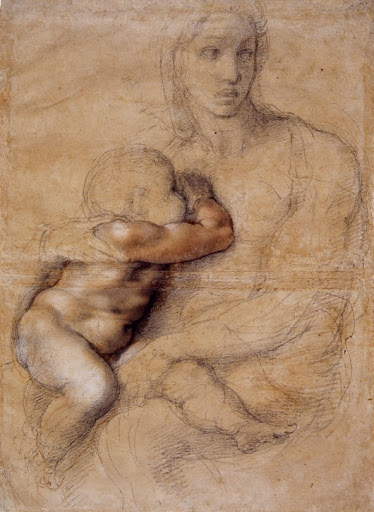
Michelangelo drawing

1221 words, 6 min read

Are there some places or objects that are more sacred than others? Is there anything special about the spot where Jesus was entombed after Joseph of Arimathea obtained his dead body from Pontius Pilate? How about the relics of saints, do they deserve special reverence? Or the cell where St. Theresa of Ávila spent her life, the patch of soil where St. Francis is buried or the spots where Dietrich Bonhoeffer was hanged or St. Thomas More beheaded? Are they any different from your local supermarket?

Before a hasty “yes” to the above, let’s approach the question from the other end too. Isn’t all of creation, the entire Universe made holy because it has been created and is being sustained by God, because it has being only insofar as God makes it participate in His own? Isn’t God present everywhere and always? Isn’t it the case that wherever I may go, God is already there, awaiting me and waiting for me to discover him and relate to him there? Isn’t each person equally loved by God and therefore given equal dignity and worth? Shouldn’t we see His presence everywhere, always, in everything and everyone? Doesn’t that result in universal equality and equivalence?

As with very many questions of this kind, I believe the answer is a resounding “both” and the template in this case could be Patriarch Athenagoras’ saying: “God loves everyone equally, but secretly each one of us is his favorite.” It is both a confirmation of universal equality and of individual exceptionality and I believe that both are needed in equal measure. Focusing only on the former, universal aspect brings with it a danger of declaring a love of humanity while not particularly liking any one person, a danger of emphasizing the general principle while loosing sight of the instances in ought to be applied to. The risk here is an idealism that lacks flesh. A focus on the latter, instead risks an idolization of some while looking down upon others, a schizophrenia of reverence for people and objects that ostensibly possess special qualities while walking past the poor, the “ordinary”, the “everyday” whose dignity is equipollent. The risk here is a materialism – even when it may appear as sacred – that lacks soul.

What does a “both” attitude look like though, in the face of these seemingly polar opposites. Here, I believe the answer is the incarnation – and if you are not a Christian, please, bear with me, because I believe that the pattern of thought that it represents (and embodies!) is more broadly relevant.

Let’s see first how Pope Benedict XVI explains what “incarnation” means:

“Incarnation derives from the Latin incarnatio. St Ignatius of Antioch — at the end of the first century — and, especially, St Irenaeus used this term in reflecting on the Prologue to the Gospel according to St John, in particular in the sentence “the Word became flesh” (Jn 1:14). Here the word “flesh”, according to the Hebrew usage, indicates man in his whole self, the whole man, but in particular in the dimension of his transience and his temporality, his poverty and his contingency. This was in order to tell us that the salvation brought by God, who became man in Jesus of Nazareth, affects man in his material reality and in whatever situation he may be. God assumed the human condition to heal it from all that separates it from him, to enable us to call him, in his Only-Begotten Son, by the name of “Abba, Father”, and truly to be children of God. […]

The Logos, who is with God, is the Logos who is God, the Creator of the world (cf. Jn 1:1) through whom all things were created (cf. 1:3) and who has accompanied men and women through history with his light (cf. 1:4-5; 1:9), became one among many and made his dwelling among us, becoming one of us (cf. 2:14).

The Second Vatican Ecumenical Council said: “The Son of God… worked with human hands, he thought with a human mind. He acted with a human will, and with a human heart he loved. Born of the Virgin Mary, he has truly been made one of us, like to us in all things except sin” (Constitution Gaudium et Spes, n. 22). Thus it is important to recover our wonder at the mystery, to let ourselves be enveloped by the grandeur of this event: God, the true God, Creator of all, walked our roads as a man, entering human time to communicate his own life to us (cf. 1 Jn 1:1- 4). And he did not do so with the splendour of a sovereign who dominates the world with his power, but with the humility of a child.”

At the heart of Christianity there is a co-existence, a simultaneity between the eternal and the transient, the splendid and the humble, the self-sufficient and the contingent, which invests the latter with the former. It elevates material reality to a status that is inseparable from the uncreated, the eternal, since the uncreated made Himself created, while retaining His uncreatedness.

Elevating the material through the incarnation also elevates the specific to the status of the general. Material being brings with it Leibniz’s principle of identity, whereby no two entities can be the same since they will always differ at least in temporal and or spatial location. Since no two material entities can be the same, their distinction and specificity is intrinsic to material being, whose elevation through God’s incarnation also raises the specific, delimited to the level of the general and infinite.

Because God became flesh, flesh becomes not only a signifier of His presence, a token, but His actual presence. The value that materialist atheism attributes to matter is therefore in no way undermined or diminished by the Christian’s belief in its being in relationship with God, its being a manifestation of His presence. Both can, and the Christian ought, lest they deny the reality of the incarnation, value the physical, without caveats.

Pope Francis, in fact, makes Christian love conditional on being connected to Jesus’ flesh, which the flesh of the poor, the suffering and the needy makes present today, and he has harsh words for those who de-flesh the Church:

“A love which does not acknowledge that Jesus came in the flesh is not the love with which God commands us: it is a worldly love, it is a philosophical love, it is an abstract love, it is a somewhat failed love, it is soft love. No! The criterion for Christian love is the Incarnation of the Word. […]

[W]hoever wishes to love not as Christ loves his spouse, the Church, with his own flesh and giving life, loves ideologically: they do not love with the all their body and with all their soul. And this way of theorizing, of being ideological, as well as the proposals of religiosity which removes the flesh of Christ, which removes the flesh of the Church, going beyond and ruining the community, ruining the Church.”

Instead of distancing Christians from atheist materialists, the incarnation makes every Christian be as much of a materialist as their atheist brothers and sisters. It makes them be both materialists and theists, fully materialist so as to be fully theist.

Marriage after death

Adam

1621 words, 8 min read

Last Saturday I attended a wedding during which the priest conducting the ceremony started his sermon by addressing the bride and groom with: “Today is the greatest day of your lives.” While this was undoubtedly well intentioned and said in the spirit of underlining the goodness of marriage and the joy of the occasion, my mind – and I am not proud of this – immediately transformed itself into a hatchet and shredded that statement to smithereens. “Do you mean that it is downhill from here?” “They haven’t even gotten married yet and you are telling them that any attempt at growth and development is doomed?”

Thankfully I then turned to one of my favorite kōans that I reached for with the intention of weaponizing it (not a nice thing to do to a kōan), but whose memory derailed my rage as I remembered it’s beautiful twist.

The kōan in question is about a famous general, who went to see a zen master to ask him for a nice piece of calligraphy to use as interior decoration. The zen master happily agreed and, when the general returned a week later, presented him with a beautifully executed inscription that read: “Father dies, son dies, grandson dies.” The general exploded with rage, drew his sword and, before cleaving the zen master in half, gave him an opportunity to explain himself. The zen master, all surprised, looked at the general and said: “What don’t you like about the inscription? Would you prefer to see your son die and for your father to see both his and your death? What I have written for you is the natural progression of life, which is true happiness and prosperity.” The general, ashamed about his hasty rage, left with his sword unused and grateful for the master’s good wishes.

Suitably calmed, and recognizing a fellowship with the kōanic general, I asked myself what I would have wished the couple to be their greatest day – if I had to, although that is not something that would have come to me naturally. And I arrived at: “May the greatest day of your marriage be the day one of you dies.” Thankfully I wasn’t asked for my opinion and, even if I had been and if I had said what I thought, the bride and groom are, to the best of my knowledge, not versed in martial arts or marksmanship. Nonetheless, if I had been asked and if there had been the inevitable, outraged call for an explanation, I would have pointed to my wish being one for maximum greatness. Wishing for the last day of a marriage to be its greatest is both a wish for continuous growth in greatness and, at the same time, a suggestion that every day of a marriage contains the greatness of all the days that preceded it and that the last day is therefore going to be the greatest by definition.

This lead me to thinking about the end of marriage, which the Catholic Church teaches comes with the death of one of the spouses,1 and to wondering about what that meant. How do I, a married person, relate to my spouse once they or I die? Is that it? In the next life, will we, who are one flesh now, be strangers? If I survive my spouse, will they, who have already passed into life everlasting, be there without being one with me? Somehow that did not seem right at all, since it violates the central Christian understanding of who God is. The God who is Love and who is Three and One. How could the God of Love dissolve the bond of love that marriage effects? How could the God of unity wish for the oneness of husband and wife to be annulled at the point of unity with Him? No, that didn’t seem right at all.

The obvious thing to do was to go back to where Jesus spoke about marriage to the Sadducees, who tried to set him a trap by running a hypothetical scenario past him and asking him a question designed to undermine the idea of the resurrection:

“Teacher, Moses said, ‘If a man dies without children, his brother shall marry his wife and raise up descendants for his brother.’ Now there were seven brothers among us. The first married and died and, having no descendants, left his wife to his brother. The same happened with the second and the third, through all seven. Finally the woman died. Now at the resurrection, of the seven, whose wife will she be? For they all had been married to her.” (Matthew 22:24-28)

What a nice, little trap! If Jesus says that she is the wife of all of the brothers, he says that in the next life there is polyandry, which, like polygamy, was against the Law, and he therefore undermines the credibility of the resurrection that the Sadducees denied. Alternatively, if he says that she isn’t anyone’s wife (or only the wife of one of the brothers) then he puts the solidity of marriage into question, which is also enshrined in the Law, and the Sadducees win again.

So, let’s see what Jesus said to them in reply:

“You are misled because you do not know the scriptures or the power of God. At the resurrection they neither marry nor are given in marriage but are like the angels in heaven.” (Matthew 22:29-30)

Now, the way this is typically read is to say that there is no marriage in Paradise, however, I would like to argue, that such an interpretation is not a particularly close reading of Jesus’ words. Jesus didn’t say “At the resurrection she won’t be anyone’s wife.” Instead, he said: “At the resurrection they neither marry nor are given in marriage.” In other words, no marriage is contracted in the next life. And, let’s not forget his admonition: “You are misled because you do not know the scriptures or the power of God.” I.e., the way you are looking at marriage is not from God’s point of view.

I believe that there is another reading of what Jesus’ words about marriage mean, which we can get to by the light of St. Paul saying:

“For no one hates his own flesh but rather nourishes and cherishes it, even as Christ does the church, because we are members of his body. “For this reason a man shall leave [his] father and [his] mother and be joined to his wife, and the two shall become one flesh.” This is a great mystery, but I speak in reference to Christ and the church.” (Ephesians 5:29-32)

Notice how St. Paul parallels first, a person’s love for their own flesh, second, Christ’s love for the Church, who is His flesh (body), made up by us, and, third, husband and wife becoming one flesh in marriage. This, indeed is the sacrament of marriage, that the “one flesh” of married spouses is sacrament (“efficacious sign of grace”2) of the “one body” of Christ and us, His Church.

Therefore, I believe that what happens at the death of one of the spouses is that the unity of flesh that previously resided in the created, passes, with the now ever-alive spouse, into the uncreated, where the unity of Christ’s Body dwells. Instead of suggesting that the bond, which ontologically makes the spouses one, breaks at the point of one of their deaths, I believe that Jesus’ and St. Paul’s words point to another reading: that this bond persists; no longer only as a bond between the spouses, but now also as an eternal constituent of the Body of Christ. The bond of marriage, contracted on Earth, remains both the force that made the spouses one here and, at the same time, becomes like the bonds of unity that in Paradise will bind us to Christ and to all other members of his body.

Finally, I also believe that the above reading is consistent with what the Church teaches, since it does not argue for a multiplicity of marriage bonds on Earth, but only for a recognition of their persistence in and subsummation into the bonds that make up the Body of Christ in Paradise. What ends with death is the exclusivity of the bond of one man and one woman, but not the bond itself, which now becomes one with the oneness of Christ and His Church.

So, maybe a better wish for newlyweds would be: “May every day be the greatest day of your lives.” The sequential days of chronos now, and the eternal day of kairos then.


1 “A marriage that is ratum et consummatum can be dissolved by no human power and by no cause, except death.” (Can. 1141) This is also related to St. Paul saying the following about death ending the bond of marriage: “Thus a married woman is bound by law to her living husband; but if her husband dies, she is released from the law in respect to her husband. Consequently, while her husband is alive she will be called an adulteress if she consorts with another man. But if her husband dies she is free from that law, and she is not an adulteress if she consorts with another man.” (Romans 7:2-3).
2 “The sacraments are efficacious signs of grace, instituted by Christ and entrusted to the Church, by which divine life is dispensed to us. The visible rites by which the sacraments are celebrated signify and make present the graces proper to each sacrament. They bear fruit in those who receive them with the required dispositions.” (Catechism of the Catholic Church, §1131)

Serra: space in the flesh

Serra threats of hell

[Warning: long read – again]

It might seem strange to start a post about the sculptor Richard Serra by referring to Pope Francis’ homily from last Friday morning, but I hope you’ll bear with me while I do it anyway and that you won’t interpret it as an attempt to imbue Serra’s work with religious motives, which I believe it does not have. Instead, my reason for starting out with the following quote is that I believe both Richard Serra and Pope Francis give great importance to physicality, as is apparent from the examination of conscience proposed here by the pope and as I will try to spell out in greater detail with regard to Serra’s work:

“Am I embarrassed by the flesh of my brother or sister? When I give alms, do I let the coins fall without touching his hand? And if by chance I touch him, do I do this? [he asked mimicking a gesture of repulsion with his hand] When I give alms, do I look my brother or sister in the eyes? When I know a person is sick do I visit him or her? Do I greet them with tenderness?”

That the pope emphasizes physicality – using the word “flesh” 13 times last Friday morning – is, I believe, motivated by a desire to counter the ever-recurrent dualist distortion of Christianity that considers only the spirit to be good while equating matter with evil. This is categorically not Jesus’ message and, to my mind, Serra’s work is a great way also for a Christian (and everyone else too) to understand why, in an experiential rather than a moral or intellectual way.

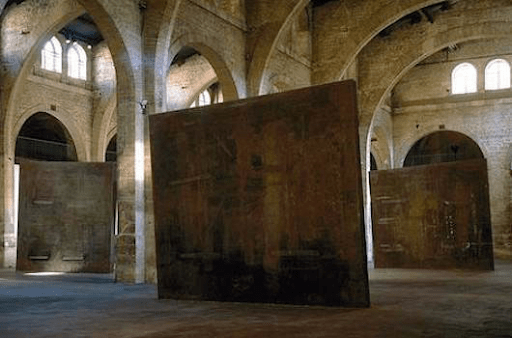
What Richard Serra does, in my opinion, is to heighten the potential for an immediate experience of space, mass, scale, orientation and matter in a way that is difficult to be had directly in nature, where these experiences are admixed with those of other properties or qualities. The result can be awe and an experience of profound beauty (that is not to be sought only in the superficially aesthetic), which – while, as far as I can tell, not intended by their author – make Richard Serra’s work precisely what the composer James MacMillan pinpointed as the key feature of art: “a window on to the mind of God.”

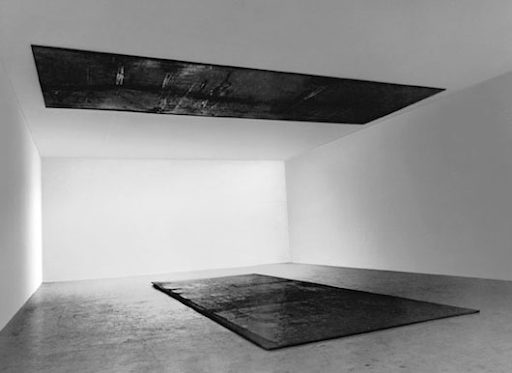
To begin with, speaking about Richard Serra’s work faces the same challenges as appreciating any piece of art, in that no verbal account is going to suffice as a surrogate for direct experience. In fact, Serra himself argues this point very starkly, when asked to describe his “Delineator” (shown next):1

Serra delineator

“What happens with Delineator is that the only way to understand this work is to experience the place physically, and you can’t have an experience of space outside of the place and the space you’re in. Any linguistic mapping or reconstruction by analogy, or any verbalization or interpretation or explanation, even of this kind, is a linguistic debasement, in a sense, because it isn’t even true in a parallel way.”

Nonetheless, Serra does say more about Delineator elsewhere, which highlights some of his concerns and the mental model he uses for thinking about his own work:

“The sculpture defines a definite space inside the room. […] The juxtaposition of steel plates forming this open cross generates a volume of space which has an inside and an outside, openings and directions, aboves, belows, rights, lefts – coordinates to your body that you understand when you walk through it. Noe you might say that that sounds quite esoteric. Well, one of the things that you get into as you become more in tune with articulating space is that space systems are different than linguistic systems in that they are nondescriptive. The conclusion I’ve come to is that philosophy and science are descriptive disciplines, whereas art and religion are not.”

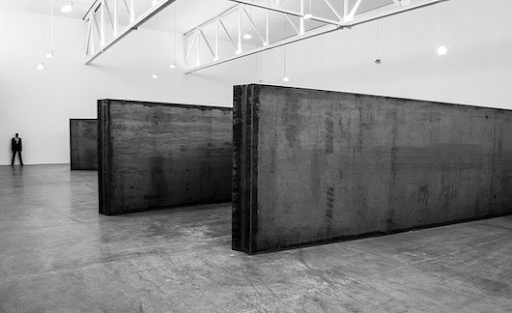
So, if you haven’t seen any of his work and tried to circumnavigate and “inhabit” it, I would very much encourage you to try to do so, if you get a chance. Personally, I have had experiences akin to what Serra speaks about above, when I saw his “Seven plates, six angles” (below) at the Gagosian in New York. The overwhelming sensation I had was of a heightened awareness of scale, volume and proportion, but also – unexpectedly – of space and mass. In some sense, my extensive use of photos in this post is futile – like showing you images of alien foodstuffs that you have not tasted, so, please, consider them tokens or bookmarks – i.e., pointers for your own future experience.

Serra 7 plates 6 angles

When asked about the relation of one of his pieces, shown at the Tate in London, to the building it was exhibited in, Serra made another important observation about what his work intends to be (and one that rang very true to me in retrospect):

“I did not want to enter into an affirmative dialogue with the building. I did not want to mirror face-value language, the physiognomy of the architecture. I wanted to deal with the volume, weight, mass and directionality of the space. [… I] wanted to make a sculpture out of the whole volume […] I wanted to make the volume of the space tangible, so that it is understood immediately, physically, by your body.”

The idea that the sculpture is not solely the object Serra created, but that it is that object in relation to the space it is situated in, is a paradigm shift and the key to understanding his insistence on making site-specific work even in the case of indoor sculptures. And even when a piece is shown in multiple locations over time, its placement in every one of those spaces results in multiple sculptures involving the one Serra-made object (that naïvely might be identified as the sculpture in full).

Beyond the paradigm shift from objects to entire spaces, Serra also broadens the palette of sculptural considerations:

“There’s a difference between walking into a telephone booth and a football stadium. If you take those two extremes and make the idea very subtle, then you can say there’s a difference between walking to the left and walking to the right, between the experience of the concave and convex, between something leaning right and something leaning left. How do you know that to be a different experience in terms of your daily life? And if it is, is it meaningful? The degree of meaningfulness depends on the limitations of the viewer. I think it is very difficult to introduce large-scale works into the public arena inasmuch as I am not interested in complicity or affirmation.

[…]

Compared to that of vertical sculpture, the ideas of sculpture existing horizontally are basically different concepts about construction, are basically different concepts about how we live in the world. On a simple, perceptual level, a modular unit extending above your eye-level becomes foreshortened as it rises, while the horizontal modular unit implies an infinite vanishing point. […] The cultural symbolic iconography of verticality versus horizontality is most apparent in the cross, where the vertical expresses transcendence and the horizontal expresses materiality.”

While Serra is clear about his interests being “nonutilitarian, nonfunctional” and declaring that “any use [of sculpture] is a misuse,” as well as anticipating limited audience appreciation (likening it to “poetry and experimental film” :)), he at the same time has a profound message behind his work:

“We are all restrained and condemned by the weight of gravity. […] The constructive process, the daily concentration and effort appeal to me more than the light fantastic, more than the quest for the ethereal. Everything we choose in life for its lightness soon reveals its unbearable weight. We face the fear of unbearable weight of repression, the weight of constriction, the weight of government, the weight of tolerance, the weight of resolution, the weight of responsibility, the weight of destructions, the weight of suicide, the weight of history which dissolves weight and erodes meaning to a calculated construction of palpable lightness.”

In many ways, the above strikes me as having affinities with Christianity, where Serra’s “Everything we choose in life for its lightness soon reveals its unbearable weight.” can be seen as a complement of Jesus’ “But seek first the kingdom of God and his righteousness, and all these things will be given you besides.” (Matthew 6:33).

A further aspect of Serra’s weight versus lightness statement (made in 1988) is its echoing of Milan Kundera’s novel “The Unbearable Lightness of Being,” published only four years earlier, where its author too makes a play for weight over lightness:2

“The heaviest of burdens is therefore simultaneously an image of life’s most intense fulfillment. The heavier the burden, the closer our lives come to the earth, the more real and truthful they become. Conversely, the absolute absence of burden causes man to be lighter than air, to soar into heights, take leave of the earth and his earthly being, and become only half real, his movements as free as they are insignificant. What then shall we choose? Weight or lightness?”

What, you may ask, is my point though? I hope that the above highlighted a couple of aspects of Serra’s work, which I have found to be deeply engaging and appealing. First, that he has invented a whole new concept of sculpture whose building blocks are not only form, texture, composition and proportion, but also mass, space, directionality and orientation, rendering an entire space a sculpture. Second, that his work is deeply rooted in the entirety of art and philosophy, without these being prerequisites for its appreciation and experience. Third, that experiencing his work, which explicitly shuns religious motives, does shed light on deeply Christian concepts and is therefore also of spiritual value to a Christian viewer at least.

As such, it shouldn’t come as a surprise to you, when I tell you that Richard Serra is probably my favorite sculptor (alongside Michelangelo, Rodin and Giacometti) and I hope that you will appreciate his work too when you next see one of his pieces.


1 All Richard Serra quotes here are from “Writings/Interviews.”
2 Both, probably, derived from Nietzsche’s concept of eternal recurrence, where the permanent (heavy) is contrasted against the fleeting (light).