Mary Magdalene: eyewitness of the resurrection

Noli me tangere fresco by Fra Angelico

On Wednesday is the feast of St. Mary of Magdala, who was one of Jesus’ disciples and the first eyewitness of His resurrection. Because of this, and because it was her who brought the news of the resurrection to the apostles, St. Thomas Aquinas called her “apostolorum apostola”1 – “apostle of the apostles.”

St. John Paul II also highlighted her importance in his 1988 apostolic letter Mulieris Dignitatem, where he argued that Christ “entrust[ed] divine truths to women as well as men” and that His “attitude to women confirms and clarifies, in the Holy Spirit, the truth about the equality of man and woman.” There John Paul II writes:

“The Gospel of John (cf. also Mk 16:9) emphasizes the special role of Mary Magdalene. She is the first to meet the Risen Christ. At first she thinks he is the gardener; she recognizes him only when he calls her by name: “Jesus said to her, ‘Mary.’ She turned and said to him in Hebrew, ‘Rabbuni’ (which means Teacher). Jesus said to her, “Do not hold me, for I have not yet ascended to the Father, but go to my brethren and say to them, I am ascending to my Father and to your Father, to my God and your God.” Mary Magdalene went and said to the disciples, “I have seen the Lord”; and she told them that he had said these things to her” (Jn 20:16-18). Hence she came to be called “the apostle of the Apostles.” Mary Magdalene was the first eyewitness of the Risen Christ, and for this reason she was also the first to bear witness to him before the Apostles.”

But who was Mary Magdalene, and how well does her image of a repentant prostitute actually agree with the Gospels? Here, let’s turn to a great article by Cardinal Gianfranco Ravasi, who – as a professional biblical scholar – provides a clear scriptural analysis of this disciple of Jesus and debunks distortions that have been introduced later and for a variety of ignoble motives. Ravasi starts out by providing some background on her origin, her first mention in the Gospels and the source of an early misidentification with another, anonymous character:2

“Magdala (from the Hebrew “migdol” – “tower”) [was] a village located on the west coast of the Sea of ​​Galilee, at the time a center of the fishing trade, to the point where in Greek it was called Tarichea, that is, “salted fish”. What we know about it has been revealed by archeology, although the village itself today is sunk beneath the waters of the lake.

Well, from this location, Mary suddenly emerges in the Gospel of Luke (8:1-3), in a list of disciples of Christ. Her portrait is sketched out with a single brush stroke, “Mary, called Magdalene, from whom seven demons had gone out.”

The “demon” in the language of the Gospel is not only the root of moral evil but also of physical ailment that can pervade a person. ‘Seven’, then, is the number symbolic of fullness.

We cannot, therefore, know much about the grave evil, moral or psychological or physical, that struck Mary and that Jesus had eliminated. Popular tradition, however, had no hesitation in later centuries to call Mary Magdalene a prostitute. But why? The answer is simple: on the previous page, in chapter 7 of the Gospel of Luke there is the story of an anonymous “sinful woman in the (unnamed) city.” Making the connection was easy but unfounded: this public “sinful woman” had to be Mary Magdalene, presented a few lines later! She was, then, attributed the whole story told by the evangelist that followed. Having learned of the presence of Jesus at a banquet at the house of a prominent Pharisee, she had made a gesture of reverence and love that was especially appreciated by Christ: she anointed with perfumed oil the feet of the rabbi of Nazareth, she bathed them with her tears and dried them with her hair.”

Ravasi also presents a number of other misidentifications of Mary Magdalen with others, including Mary, the sister of Martha and Lazarus, Mary the mother of Jesus, and even with Wisdom, as her personification. Instead of reviewing the details – and refutations – of these as presented by Cardinal Ravasi, let me just focus on the profile he presents that is based on the Gospel accounts:

“All the evangelists are, in fact, agreed on indicating her presence at the crucifixion and burial of Christ. And it is right next to that tomb in the still-pale dawn light of Easter that the Gospel of John (20:11-18) places the famous meeting between Christ and Mary of Magdala.

As is known, Mary confuses the Christ with the guardian of the cemetery. Now, such “blindness” is typical of some appearances of the Risen One: just think of the disciples of Emmaus who are walking together with him for hours without recognizing him (Luke 24:13-35). Naturally, the significance is theological: although still Jesus of Nazareth, the glorious Christ transcends human, historical and physical coordinates. To be able to “recognize” him, one need to get oneself onto a channel of transcendent knowledge, that of faith. That’s why it is only when she feels called by name in personal dialogue, that Mary “recognizes” him and calls him Rabbuní, “my teacher” in Aramaic. […]

Fortunately the only one who called her by name, Mary, and who recognized her and confirmed her as his disciple was Jesus of Nazareth, her Teacher, the Rabbuní. And it is precisely on the basis of that Easter meeting that her presence reappears each year in the Catholic liturgy in the beautiful Gregorian melody of Victimae paschali and in that Latin dialogue that we’ll exempt from translating:

«Dic nobis, Maria, quid vidisti in via?»
«Surrexit Christus spes mea!»3


1Note the grammatical gender of “apostola” being female.
2 Note that the above quotes are from two versions of essentially the one article – one available here, and the other here – and their English translation is mine.
3 While Cardinal Ravasi’s original audience may have been
au fait with Latin, let us exempt ourselves from that translating exemption and look at an English rendition of those two lines:
“Tell us, Mary, what did you see on the road?”
“Christ my hope is arisen.”
Contemporary art and its enemies

To paraphrase Karl Popper, let me start by saying that it is “impossible to make art in such a way that it cannot be misunderstood.” Over the course of this last week I have come across no less than three articles in which Christian authors denounce the evils of contemporary art.

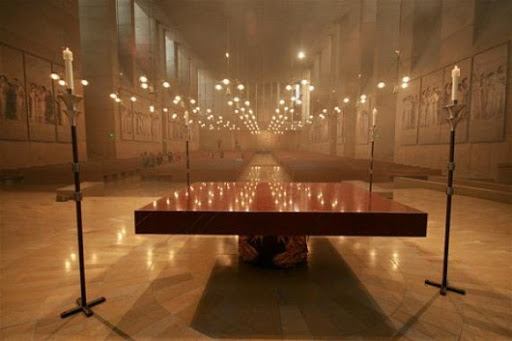
Cathedral our lady angels 4961 large slideshow

First, there is our old friend Nikos Salingaros – of Oakland Cathedral review fame, who has a go at the Cathedral of Our Lady of the Angels this time. His argument is again the same: “We have here a celebration of asymmetry, which might be understandable if there were a sound reason for it coming either from design necessities, or from religion.1 But there is none. The building’s asymmetry serves an essentially negative purpose: to deny coherence and harmony.2” And there is the usual litany of nonsensical gems like: “geometrical fundamentalism,” “naked concrete walls [being] ultimately unpleasant,” lacking “connective ornament,” and claiming that religion “has a natural affinity with traditional architectural expressions of coherence” before taking Antoni Gaudí’s3 name in vain. There is only one thing to say in response to this: bullspit! Instead of trying to debunk this junk head on, I think that I have a sense of the root cause of his confused misreading of this piece of architecture: an expectation of the literal. God is perfect harmony, so churches need to be perfectly symmetrical; the Church values continuity, so a church needs to look old; the soul needs to ascend to God, so there need to be vertical lines in the church’s geometry (and the list of naïveté goes on and on). What I believe this approach entirely misses are two key aspects of beauty: mystery and surprise! Why is it that an object evokes emotions, triggers reflection, prompts insight and delivers aesthetic joy and pleasure? Sure, there are plenty of theories, but periodically an artist comes along and creates a piece that breaks them, yet that is unmistakably appreciated as art. Surprise too is a key element of art, in my opinion, and the kind of literal expectations that Salingaros relies on would entirely eradicate it.

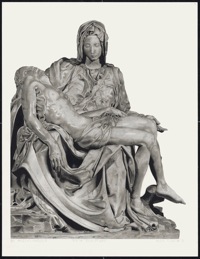
Second, I have made the virtual acquaintance of another budding art critic: Jimmy Akin, who takes it upon himself to have a go at the Vatican’s touring art exhibit: “The Vatican Splendors: A Journey Through Faith and Art,” exclaiming that the works “from the mid-2oth [sic] century onward were terrible.”4 Akin is much more to the point than Salingaros and doesn’t even feel the need to back up his claims – the art of the last 60+ years is just “terrible.” But what he lacks in specificity, he certainly makes up for in initiative, with the “brilliant” idea to do something about “all the lousy Catholic art” by “supporting Catholic art education so that we can get better Catholic artists.” So far so good – I am filled with anticipation of the centre of excellence he’ll propose to support and the examples of their great Catholic art, done right [no, not really]. Instead, Akin unveils the following “stupendously amazing” piece by a 12th grader:

Pieta drawing

And, just to underline the horrors of the “lousy” art we have had to put up with, he pulls out Pericle Fazzini’s “The Resurrection” situated in the Vatican’s Paul VI’s hall:

Paul vi resurrection

I am stunned by this guy’s barefacedness. How can he put a school-kid’s (admittedly skillfully executed) drawing of Michelangelo’s Pieta beside Fazzini’s masterpiece (a 66×23 foot bronze created it in 1977 and showing Jesus rising from the crater of a nuclear bomb) and say: more of the former and less of the latter, please! The mind boggles!

Third, I have come across a far more cogent, yet – to my mind – still misguided, piece by Francis Phillips. Here the composer James MacMillan is first quoted as saying that “[a]rt can be a window on to the mind of God. Through this window we can encounter beauty and divine truth” and I am thinking that I have finally come across a good piece on the subject, following the arid head banging of Salingaros and Akin. Sadly, Phillips decides to take us down a frustrating route too, by turning a promising piece into a crusade against the National Gallery in London showing Richard Hamilton’s “The Passage of the Angel to the Virgin.” The piece is a giclée photomontage that bases itself on Fra Angelico’s Annunciation, but with two female nudes where Fra Angelico has the angel Gabriel and the Virgin Mary. Phillips proceeds to label it as “scandalous,” as “shocking to Catholics, who have a particular reverence for the Virgin Mary,” as skewed for “[p]ortraying the Angel Gabriel as a young woman [since] the traditional Christian understanding of angels [is] as sexless spiritual beings”5 and as “desecrating.” Personally, I have a profound love for Mary and a deep gratitude to her for being the model of the perfect Christian, but I have to say that I disagree with all of the above. Since some of you may side with Phillips in your reaction to this piece, I will not reproduce it here, but only provide this (NSFW) link for those of you who choose to follow it. I have to say that I am not a fan of this piece by any means, but my reaction is one of curiosity about why Hamilton made the choices he made in it. Instead of a feeling of indignation, my response is more one of boredom and I would just walk past it and enjoy the rest of the National Gallery’s exquisite collection, instead of mounting a (failed) attempt to have it taken down, as Phillips did.

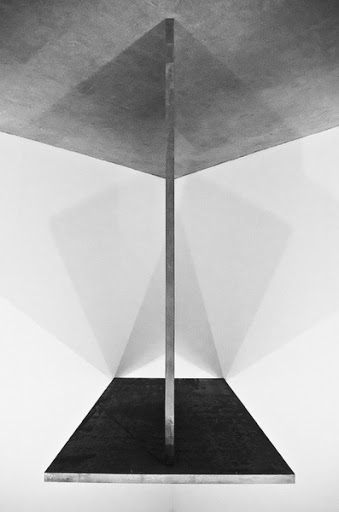
A point that seems to emerge to me from these last two articles is one of a decorative and exegetical role for art. A looking for pieces that would be good interior decoration for a church or that would illustrate a passage from Scripture or the Catechism. While some great art can certainly do that, it will do so in a way that transcends the simple, literal and functional. Other, equally great art would be entirely out of place as decoration though, yet would have the capacity to “be a window on to the mind of God.” I am certainly not thinking of Hamilton’s piece here, but more of something along the lines of Richard Serra’s work, such as his “Trip Hammer”:

Serra

Relegating “the mind of God” to decoration just seems like something that not even a heathen would do …

UPDATE (12/11/2012): My bestie JM went to visit the Cathedral of our Lady of the Angels, with my über-besties MR and RR, and had the following to say:

I went to visit the Cathedral last weekend, in anticipation of coming down either on the side of its supporters or detractors. Instead, while I am undeniably an outright fan of it as a place of worship, I have to say that it is so ugly on the outside that only its mother could love it. You would be forgiven for mistaking it for a car park or a storage facility, if it wasn’t for the separate bell tower carrying a cross and the rather beautiful statue of Mary above its main entrance.

The interior is another story and is an unreserved and total success. The space is vast without being overpowering; it is light and welcoming and beautifully laid out not only in the main nave but also with its numerous chapel-like spaces that face out and away from the building’s main volume. They, like the whole church, are bathed in natural light and house content as diverse as a shrine to Our Lady of Guadalupe, a Día de los muertos arrangement, a temporary exhibit by a local painter, artifacts from Pope John Paul II’s visit to LA and the confessionals. Outside too, the space is at the service of the community, with a great playground and a cafe/grill on the other side of a large square adjacent to the Cathedral.

In many ways this church is like one of those great Northern European cathedrals turned inside out. Instead of an ornate exterior and a plainer interior, here money has been spent on the interior space that church goers enjoy (including a great set of tapestries showing the communion of saints – and not only of canonized ones) while leaving the exterior plain and purely functional. Would I have preferred a more pleasing external architecture? No doubt! But, I believe the diocese spent their money where it matters to its members and visitors. This is a church that embraces those who come to it, instead of advertising itself to all. Not that the latter has little value, but I see why they would have favored the former. For some photos of my visit, see this Flickr set.


1 I wasn’t going to engage with this nonsense, but – come on! – to claim that there is no “religious” reason for asymmetry! How about the following (vastly incomplete) examples: good – evil, infinite – finite, uncreated – created, selfless – selfish. And the list could go on and on.
2 How about: to show movement, ascent, growth, a pull towards God?
3 To invoke Gaudí in an argument for traditional, symmetrical, literal architecture is just beyond nuts!
4 The hubris here would easily make Achilles’ dragging Hector’s lifeless body behind his chariot in front of the gates of Troy an act of level-headed diplomacy.
5 Not noticing the irony of this objection. Would the sexless angel better be portrayed as a man? Why?