1260 words, 6 min read
The Codex of Canon Law presents the salvation of souls as the supreme law of the Church (cf. Canon 1752), a principle that has its roots in the Roman law: “Salus populi suprema lex esto” (Cicero, De Legibus, Book III, Part III, Sub. VIII). As such, this law is designed to be invoked when choices are to be made about conflicting alternatives, as happens almost universally in the life not only of each individual, family, society but also of the Church. Does A contribute to the salvation of souls more or is it B? What is the objective of a project in terms of its impact on the salvation of souls? What role does some object, process, practice, building, etc. play from this perspective?
Before getting to the events that lead me to reflecting on this topic, it might be worth spelling out what constitutes the “salvation of souls” that ought to be the first priority. Here the Catechism of the Catholic Church speaks very plainly: “All who die in God’s grace and friendship […] are indeed assured of their eternal salvation.” (§1030). Making the “salvation of souls” the “supreme law” therefore ought to be about inviting, encouraging, supporting God’s friendship. But, I hear you ask, what is it that merits God’s friendship? Like all good friendship, it is, in fact, unmerited and offered gratuitously. God does not have favourites or a predilection for certain “types” of people – put even better, and in the beautiful words of Patriarch Athenagoras: “God loves everyone equally, but secretly each one of us is his favourite.” However, like all friendship, friendship with God too requires work and a desire to please and bring joy to my friend. If I know that a friend likes the Big Lebowski, I quote from it to delight them (and myself), if they are into football, I show interest (even if my own is limited). So, the obvious question is: what is it that my friend, God, delights in and is passionate about? Again, like with all friends, it pays to listen closely, since they do drop hints here and there or even say outright what they like (marmalade, chocolate with hazelnuts, Camus and Hesse, walking, …). God is no different. He tells us that he likes it when we offer drinks to the thirsty, food to the hungry, to welcome strangers, clothe the naked and visit prisoners (cf. Matthew 25:31-46). He also has a preference for mercifulness, peace-making, meekness, justice and accepting unpleasantness for his sake (cf. Matthew 5:1-12), for not judging (cf. Matthew 7:1), for not returning violence with violence (cf. Matthew 5:39) and he is keen to have children be close to him (cf. Matthew 19:14). My reading of the “supreme law” therefore is that it calls for the Church to prioritise inviting, facilitating, supporting everybody’s friendship with God.
Against this, at the time implicit, background, I set out to mass in Milan’s cathedral on Tuesday morning, since I am at a conference here during these days. As I walked out of the Duomo underground station, I entered a square jam-packed with people behind whom the magnificent structure of the Cathedral’s pentagonal shape protruded into a dazzling blue sky. An ideal setting for friendship, no doubt. Getting closer to the church, I saw the first warning signs that the lex suprema might not be in force: a board displaying a complex, multi-SKU product portfolio of entrance fees and multi-destination ticket packages that offer access to the Cathedral for between 12 and 16 Euros (as it turns out, on the website there is a 3 Euro alternative, but this was not apparent from the information on display). Since I was on my way to mass first, I looked for a way to join it without paying for a ticket, since paying for mass is about as acceptable as paying my own children for a hug.
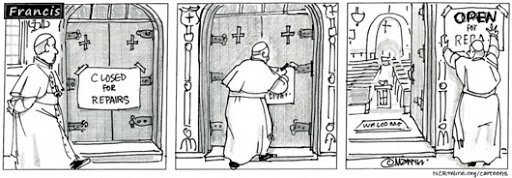
Sure enough, in one corner of the Cathedral’s facade, there was a barrier with a sign saying “confessione” with an official standing next to it and only letting those who say the right things join that queue. Past the barrier, a soldier with a machine gun across his back stops me and searches me with a hand-held metal detector, from the front and from the back. He wants to see the phone in my pocket and then waves me past. Next, still before entering the church, I have to open my bag and have its compartments reviewed by two more armed soldiers. Now I am ready to enter the Father’s house. Before reaching the holy water font at the entrance, I am welcomed by a sign reminding me that there is to be strictly no photography in this part of the church, reserved to those who have not paid for a ticket. Just in case those pesky faithful were to dilute the value offered to paying customers, I presume.
So, I’m in, but where is the mass? The vast central nave of the cathedral is reserved for visitors (not worshipers) and, with the exception of three people, is empty. Jam-packed square outside, empty cathedral inside. Revenue stream inside, potential friends outside. Lex suprema?
Asking two more officials along the way, I finally arrive in the space behind the main altar, originally designed for the choir, where a small contemporary-looking altar, lectern and tabernacle are tacked onto the back of the beautifully and ornately decorated main altar, of which we only see the (surprisingly detailed) backs of the saints adorning it. I am the third person to arrive for mass in a congregation that at its peak hits around 35 souls. The mass is beautiful in its intimacy and by virtue of the, to me, novelty of the Ambrosian rite. Nonetheless, I feel like we are tolerated instead of being at home, like we are allowed to share a museum’s facilities, out of the way of the revenue-generating visitor flow. How does this let us, the Church, be the salt and leaven that Jesus calls us to be (cf. Matthew 5:13, 13:33)? How is this choice of access to and utilisation of the cathedral a consequence of a preference for the salvation of all? What would Jesus say if he turned up here today? Would he calmly proceed through the security checks, or would he reach for a length or rope? (cf. John 2:13-16)
As you can tell, I wasn’t best pleased. I have to say though that my main reason for writing this is not to have a go at Milan cathedral or to suggest that the above is an insurmountable obstacle. Certainly, my issue here is not exclusively with the Archdiocese of Milan – this approach to managing church buildings is, sadly, pretty wide-spread (with differing degrees of objectionability), and I am also aware of the financial challenges and responsibilities of maintaining such buildings. Most importantly though, I also believe that the above is not an inhibitor to being Church, but rather a – in my opinion unnecessary – obstacle. In spite of such a presentation of a museum-management face of the Church, I and my fellow Church members are still free to invite others to friendship with God by how we relate to those who throng outside our cathedrals. While unpleasant, this experience has also been a wake-up call for me to look at those I walk past in this great city as brothers and sisters rather than as an anonymous mass, and with that disposition to be open to discerning God’s will in every present moment.
 eyebeleave