Ceaselessly re-expressing the universal

Trinity

For several years now I have kept coming across articles by George Weigel, the US author and political and social activist, all of which have to my mind been misguided and lacking in insight. This undoubtedly makes me biased, which may be why I have not responded to his writings here before, and his latest piece – “The deeper issue at the Synod” – was destined to join that growing rank of articles to which I turned with silence. It is not like his latest feuilleton is any more objectionable than its predecessors, but, since it addresses a point that I do agree is pivotal for the upcoming Synod on the Family, and now that I have put my cards clearly on the table, I will spell out my disagreement in this case.

Weigel in this piece starts with recalling opposing positions before Paul VI issued Humanae Vitae, where the losers “argued, moral choices should be judged by a “proportional” calculation of intention, act, and consequence” while the winners – who upheld “tradition” – “held that some things were always and everywhere wrong, in and of themselves.” He then cites John Paul II’s Veritatis Splendor as reinforcing this position and moves on to recounting an analysis of the pre-Synod battle-lines by Prof. Thomas Stark, likely from this article – although without referring to it directly, where he argues that the real opposition at the Synod will be between two camps. The first, who, like Cardinal Walter Kasper, effectively believe that there are no “sacred givens”:

“Professor Stark argues that, for Kasper, the notion of what we might call “sacred givens” in theology has been displaced by the idea that our perceptions of truth are always conditioned by the flux of history – thus there really are no “sacred givens” to which the Church is accountable. To take a relevant example from last year’s Synod: on Kasper’s theory, the Lord Jesus’s teaching on the indissolubility of marriage, seemingly “given” in Scripture, should be “read” through the prism of the turbulent historical experience of the present, in which “marriage” is experienced in many different ways and a lot of Catholics get divorced.”

This, in Weigel’s reading of Stark results in Kasper denying human nature or there even being “Things As They Are”, since the attitude they attribute to Kasper is one where “what happens in history does not happen atop, so to speak, a firm foundation of Things As They Are; there are no Things As They Are.”

The second camp, instead believes that “the “truth of the Gospel” is a gift to the Church and the world from Jesus Christ: a “sacred given.”” Weigel then concludes that Kasper “absolutizes history to the point that it relativizes and ultimately demeans revelation – the “sacred givens” that are the permanent structure of Christian life.” The opposition, in Weigel’s view, is between an absolutization of history at the expense of relativizing revelation and tradition, versus a – in Weigel’s view – appropriate absolutization of the latter.

Instead of retracing Weigel’s steps through Stark’s article, which quotes from Kasper’s 1972 (!) book, An Introduction to Christian Faith, let me instead look at how well invoking John Paul II’s Veritatis Splendor as a rod for Kasper’s back holds up, and then proceed to argue for Weigel’s point being built on category mistakes.

Let’s begin by looking at Veritatis Splendor though, and test the strength of Weigel citing it as an argument for “sacred givens” and for “Things [Being] As They Are” as opposed to historical interpretation [I am sure St. John Paul II is slowly shaking his head in disbelief, looking down on this spectacle from the Father’s house.]

In Veritatis Splendor John Paul II kicks off with the following preamble:

“The splendour of truth shines forth in all the works of the Creator and, in a special way, in man, created in the image and likeness of God (cf. Gen 1:26). Truth enlightens man’s intelligence and shapes his freedom, leading him to know and love the Lord. Hence the Psalmist prays: “Let the light of your face shine on us, O Lord” (Ps 4:6).”

From the get go he speaks about a process: Truth leading to knowledge and love of God, rather than “givens” no matter how “sacred” they may be. Not a good start for the “Things As They Are” team.

Already in the second paragraph, John Paul II presents the teaching of the Church to be not words, but the Word – a person:

“Christ is “the way, and the truth, and the life” (Jn 14:6). Consequently the decisive answer to every one of man’s questions, his religious and moral questions in particular, is given by Jesus Christ, or rather is Jesus Christ himself.”

Then comes the killer (and we are still just in paragraph 2 of this 45K word gem of clear thinking by one of the 20th century’s greatest minds):

“The Church remains deeply conscious of her “duty in every age of examining the signs of the times and interpreting them in the light of the Gospel, so that she can offer in a manner appropriate to each generation replies to the continual human questionings on the meaning of this life and the life to come and on how they are related” (Gaudium et Spes, 4).”

Oh … “interpreting … in every age” … “manner appropriate to each generation” …

But, let’s take a closer look at how John Paul II thinks about permanence versus historicity, by reading the opening lines of §25:1

“Jesus’ conversation with the rich young man [Mt 19:16-21] continues, in a sense, in every period of history, including our own. The question: “Teacher, what good must I do to have eternal life?” arises in the heart of every individual, and it is Christ alone who is capable of giving the full and definitive answer. The Teacher who expounds God’s commandments, who invites others to follow him and gives the grace for a new life, is always present and at work in our midst, as he himself promised: “Lo, I am with you always, to the close of the age” (Mt 28:20). Christ’s relevance for people of all times is shown forth in his body, which is the Church. For this reason the Lord promised his disciples the Holy Spirit, who would “bring to their remembrance” and teach them to understand his commandments (cf. Jn 14:26), and who would be the principle and constant source of a new life in the world (cf. Jn 3:5-8; Rom 8:1-13).”

Jesus, who is alive in His Church today, continues to converse with us and continues to supply us both with reminders of what He has already told us and with “new life” too through the Holy Spirit. Jesus’ words today are not mere mindless, mechanical repetitions of what he said 2000 years ago, but instead His continuing and evolving desire to lead us to an understanding and love of Himself, who is Truth, Goodness and Beauty.

To avoid giving a distorted impression about what John Paul II is saying here, it is important not to confuse the above process of renewal, of being up to date, of – as he himself later says – “doctrinal development” and “renewal of moral theology” (§28), with some giving in to the World. No, this being in the presence of the living Christ and under guidance from the Holy Spirit also means not to be “conformed to this world” (Rom 12:2):

“Assisted by the Holy Spirit who leads her into all the truth (cf. Jn 16:13), the Church has not ceased, nor can she ever cease, to contemplate the “mystery of the Word Incarnate”, in whom “light is shed on the mystery of man”. [… The Church needs to undertake] discernment capable of acknowledging what is legitimate, useful and of value in [contemporary tendencies], while at the same time pointing out their ambiguities, dangers and errors.”

John Paul II also speaks directly about how the divine and the human interplay in this context:

“The teaching of the Council emphasizes, on the one hand, the role of human reason in discovering and applying the moral law: the moral life calls for that creativity and originality typical of the person, the source and cause of his own deliberate acts. On the other hand, reason draws its own truth and authority from the eternal law, which is none other than divine wisdom itself. At the heart of the moral life we thus find the principle of a “rightful autonomy” of man, the personal subject of his actions. The moral law has its origin in God and always finds its source in him: at the same time, by virtue of natural reason, which derives from divine wisdom, it is a properly human law.”

Human reason discovers (imperfect historical process) divine wisdom (perfect atemporal). This leads us directly to the question of immutability that Weigel sees threatened by Kasper. Here John Paul II first insists on the reality of “permanent structural elements”:

“To call into question the permanent structural elements of man which are connected with his own bodily dimension would not only conflict with common experience, but would render meaningless Jesus’ reference to the “beginning”, precisely where the social and cultural context of the time had distorted the primordial meaning and the role of certain moral norms (cf. Mt 19:1-9). This is the reason why “the Church affirms that underlying so many changes there are some things which do not change and are ultimately founded upon Christ, who is the same yesterday and today and for ever”. Christ is the “Beginning” who, having taken on human nature, definitively illumines it in its constitutive elements and in its dynamism of charity towards God and neighbour.” (§53)

However, the very next lines distinguish the above, permanent structure from how it is expressed:

“Certainly there is a need to seek out and to discover the most adequate formulation for universal and permanent moral norms in the light of different cultural contexts, a formulation most capable of ceaselessly expressing their historical relevance, of making them understood and of authentically interpreting their truth. This truth of the moral law — like that of the “deposit of faith” — unfolds down the centuries: the norms expressing that truth remain valid in their substance, but must be specified and determined “eodem sensu eademque sententia” [“with the same meaning and the same judgment”] in the light of historical circumstances by the Church’s Magisterium.”

And John Paul II proceeds to refer to John XXIII’s words at the opening of the Second Vatican Council, saying that:

“This certain and unchanging teaching (i.e., Christian doctrine in its completeness), to which the faithful owe obedience, needs to be more deeply understood and set forth in a way adapted to the needs of our time.” (L’Osservatore Romano, October 12, 1962, p. 2.)

Looking back over St. John Paul II’s words and those of George Weigel, the funny aftertaste that the latter left in my mind crystalizes and, I believe, boils down to the following: a confusion of being with knowing and a mistaken assumption that attributes of the latter transfer to beliefs about the former. Weigel, taring with a broad brush, effortlessly transposes Kasper’s talking about a historicity of knowing (“perceptions of truth … conditioned … by history”) to an alleged historicity, or indeed total absence, of being (“there really are no “sacred givens””). This, even with a strained desire to apply the Principle of Charity, is a fundamental category mistake. Epistemological constraints do not ontological ones make.

Accepting an evolving, changing understanding and expression of Truth, as is consistent with John Paul II’s teaching, also has a corollary that may have irked Weigel, which is that past expressions and understanding have use-by dates and expiring validity in the present (without this implying a change of underlying reality). In one of the passages that Stark quotes from Kasper’s 1972 book, and identifies as a serious problem, Kasper expresses this situation as follows:

“Whoever believes that in Jesus Christ hope has been revealed for us and for all mankind, and whoever ventures on that basis to become in real terms a figure of hope for others, is a Christian. He holds in a fundamental sense the whole Christian faith, even though he does not consciously accept all the deductions which in the course of almost two thousand years the Church has made from this message.”

Yes, what was the best the Church could do to understand and express the Truth in the past may no longer be the best it can do today. And, just in case this interpretation of the renewal argument sounds dodgy or misguided, let’s hear it also from Pius XII, who has the following to say about his own teaching in view of his successors’ words, in his Mediator Dei:

“Clearly no sincere Catholic can refuse to accept the formulation of Christian doctrine more recently elaborated and proclaimed as dogmas by the Church, under the inspiration and guidance of the Holy Spirit with abundant fruit for souls, because it pleases him to hark back to the old formulas.”

“Old formulas” are no guarantee of holding on to “sacred givens,” whose expressions today need instead to be sought by living with the Jesus who walks among us today. A less obvious and easily testable answer to what doing the right thing means and one that requires courage, but one that leads to the Truth, however imperfectly we understand Her or adhere to Her.


1 Note that the italics in quotes from Veritatis Splendor are John Paul II’s own, who liked to use them for emphasis in all his writings.
I’m with O’Malley: the Mexican border mass

Omalley 1

When an idea or an event that pushes the envelope (in the parlance of our times) arises, the most immediate reaction from some people is to oppose it instinctively, on the grounds of it just not making sense or being the done thing. This is pretty much ubiquitous in science, where new theories initially tend to be ridiculed or at least approached with skepticism, and no less at home in the Church, where new expressions of imitating Jesus often fall on deaf ears or are met with some form of the “crimes against tradition” objection.

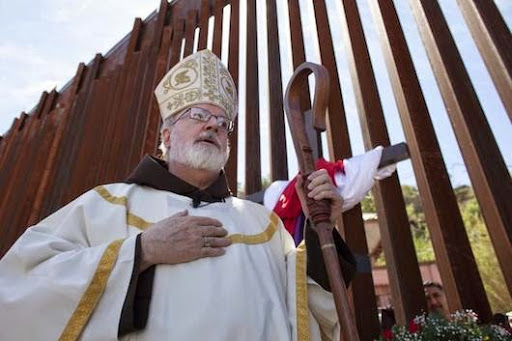
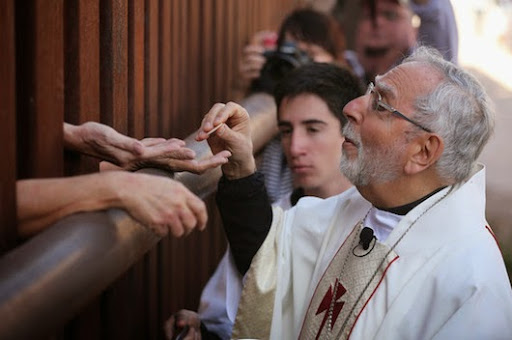
Last week saw an event exactly like that – a mass celebrated at the Mexican-US border, where the concelebrands, Cardinal Sean O’Malley, Bishop Gerald Kicanas, and a dozen other bishops, were on the US side of the 20-foot-tall, metal-fenced border, while the congregation around them, numbering in excess of 500, was partly on US and partly on Mexican soil. The occasion was a two-day visit of the US Conference of Catholic Bishops’ Migration Committee to the border, to experience first hand the conditions under which immigrants risk their lives on their way to the US and to mourn the loss of the many who die in the process. It was also an expression of the many divisions that emigration and deportations bring to families and a clear move to be with those at the peripheries, in imitation also of Pope Francis’ mass at Lampedusa.

During his homily, Cardinal O’Malley, puts the objectives of the event very clearly:

“We come to the desert today because it is the road to Jericho; it is traveled by many trying to reach the metropolis of Jerusalem. We come here today to be a neighbor and to find a neighbor in each of the suffering people who risk their lives and at times lose their lives in the desert. […] We are here to discover our own identity as God’s children so that we can discover who our neighbor is, who is our brother and sister.”

Omalley 2

And he then proceeds to illustrate the scale of the tragedy:

“Last year about 25,000 children, mostly from Central America arrived in the US, unaccompanied by an adult. Tens of thousands of families are separated in the midst of migration patterns. More than 10 million undocumented immigrants are exposed to exploitation and lack access to basic human services, and are living in constant fear. They contribute to our economy by their hard work, often by contributing billions of dollars each year to the social security fund and to Medicare programs that will never benefit them. […] We have presently over 30,000 detainees, most of whom have no criminal connections. The cost of these detentions is about $2 billion a year.”

When I first heard about the event, I was very impressed by it, as an expression of solidarity and closeness to those who suffer and are excluded from society, as Pope Francis put it so clearly in Evangelii Gaudium:

“We have created a “throw away” culture which is now spreading. It is no longer simply about exploitation and oppression, but something new. Exclusion ultimately has to do with what it means to be a part of the society in which we live; those excluded are no longer society’s underside or its fringes or its disenfranchised – they are no longer even a part of it. The excluded are not the “exploited” but the outcast, the “leftovers”.” (§53)

Imagine then my disappointment and disbelief, when I came across a condemnation of the border mass by George Weigel (introduced there as “papal biographer”), whose reaction was:

“It’s not clear to me how holding Mass in these circumstances can be anything other than politicized. […] To turn the Mass into an act of essentially political theater is something I thought we had gotten over in the Church, no matter how noble the cause might be.”

And by the canon lawyer Ed Peters, who made the following assessment of the event:

“Canon 932 § 1 […] states that “The eucharistic celebration is to be carried out in a sacred place unless in a particular case necessity requires otherwise; in such a case the celebration must be done in a decent place”. Obviously, no one suggests that the border is a “sacred place” in the canonical meaning of that term, so the question becomes whether necessity required holy Mass to be celebrated at the border. I think not. The intentions for which this Mass was offered (immigration reform and in memory of those who died crossing the border, both legitimate intentions of course) could have been amply asserted at a Mass celebrated in a sacred place as envisioned by c. 932 […] Thus, the kinds of factors commonly invoked to justify Mass outside of a sacred space do not support this Mass at the border.”

It’s hard to know where to start in the face of such rule-based, status quo thinking – not for want of counterarguments, but for their excess. From among several alternatives, I could go down the Scriptural route, pointing to the instances of Jesus’ own “political theater” (did anyone say Caesar? (cf. Mark 12:17)) or to his take on “necessity” (did you say “withered hand” (cf. Mark 3:4)), but I wont :). Instead I’d like to re-tell a story about one of the Desert Fathers that I came across a while ago, but whose source eludes me now.1

“A poor couple came to Abba Irenaeus to cancel their wedding, since they were unable to find a venue for the reception that they could afford. Upon seeing their sadness, Abba Irenaeus felt moved by compassion and said to them: “Why don’t you hold your wedding celebration in our church?” The couple were overjoyed and accepted the offer. On their wedding day, well into the party, the local bishop happened to walk past, and when he heard music and cheers coming from the church, he stopped and proceeded to investigate. Upon entering the church he saw dancing and food being served to a merry crowd. Filled with indignation he sought out Abba Irenaeus and proceeded to scold him: “How can you desecrate this church by allowing such profanity? And in the presence of the Eucharist!” To which Abba Irenaeus calmly replied: “Wasn’t Jesus himself a wedding guest at Cana? Wouldn’t he have celebrated the wedding of this couple just as much if he were here today in person?””

[UPDATE (11/04/14): Within a couple of hours of publishing this post, my überbestie ML sent me another version of the above wedding story – thank you! This one is told by Anthony de Mello (re-telling Cardinal Martini’s story), is set in Italy, and the two takes on the Eucharist are embodied by the parish priest and his assistant pastor. The whole article that contains it is very much worth reading!]


1 If you do know where the story is from (and its above version is very much just from my imperfect memory), I’d be very grateful if you’d let me know so I could credit it’s source – and you :).

Just war?

Ploughshares

[Warning: long read :)]

Jesus was a pacifist. To deny this in the face of his own words – “But I say to you, whoever is angry with his brother will be liable to judgment.” (Matthew 5:22), “But I say to you, love your enemies, and pray for those who persecute you.” (Matthew 5:44), “But I say to you, offer no resistance to one who is evil. When someone strikes you on (your) right cheek, turn the other one to him as well.” (Matthew 5:39) and “Put your sword back into its sheath, for all who take the sword will perish by the sword.” (Matthew 26:52) – would be sheer dishonesty.

How about the Church though, has it stuck to Jesus’ pacifist position? Let’s see what it says in the Catechism:

“(§2304) Respect for and development of human life require peace. Peace is not merely the absence of war, and it is not limited to maintaining a balance of powers between adversaries. Peace cannot be attained on earth without safeguarding the goods of persons, free communication among men, respect for the dignity of persons and peoples, and the assiduous practice of fraternity.

(§2307) The fifth commandment forbids the intentional destruction of human life. Because of the evils and injustices that accompany all war, the Church insistently urges everyone to prayer and to action so that the divine Goodness may free us from the ancient bondage of war.

(§2308) All citizens and all governments are obliged to work for the avoidance of war. However, “as long as the danger of war persists and there is no international authority with the necessary competence and power, governments cannot be denied the right of lawful self-defense, once all peace efforts have failed.” (Gaudium et Spes, 79 § 4)

(§2309) The strict conditions for legitimate defense by military force require rigorous consideration. The gravity of such a decision makes it subject to rigorous conditions of moral legitimacy. At one and the same time:

  • the damage inflicted by the aggressor on the nation or community of nations must be lasting, grave, and certain;
  • all other means of putting an end to it must have been shown to be impractical or ineffective;
  • there must be serious prospects of success;
  • the use of arms must not produce evils and disorders graver than the evil to be eliminated.

The power of modern means of destruction weighs very heavily in evaluating this condition. These are the traditional elements enumerated in what is called the “just war” doctrine. The evaluation of these conditions for moral legitimacy belongs to the prudential judgment of those who have responsibility for the common good.

(§2314) “Every act of war directed to the indiscriminate destruction of whole cities or vast areas with their inhabitants is a crime against God and man, which merits firm and unequivocal condemnation.” (Gaudium et Spes, 80 § 3)”

While the above does talk about circumstances under which war is justified, it is a last resort, acceptable under the simultaneous satisfaction of specific conditions listed above, and has self-defense as its purpose, with indiscriminate destruction and the devastating effects of modern means of warfare ringing alarm bells. During the progress of such self-defense (the only possible trigger for just military action), the Catechism further emphasizes that “The Church and human reason both assert the permanent validity of the moral law during armed conflict. “The mere fact that war has regrettably broken out does not mean that everything becomes licit between the warring parties.” (Gaudium et Spes, 79 § 4)” and proceeds to warn against the abuses so endemic in war and against the accumulation of arms. Finally, the Catechism draws attention to the root causes, of which war can be a symptom, and calls for their treatment:

“(§2317) Injustice, excessive economic or social inequalities, envy, distrust, and pride raging among men and nations constantly threaten peace and cause wars. Everything done to overcome these disorders contributes to building up peace and avoiding war.”

And Pope Francis, where does he stand? There can be no doubt here that he, like Jesus, is an absolute pacifist:

“War is madness. It is the suicide of humanity. It is an act of faith in money, which for the powerful of the earth is more important than the human being. For behind a war there are always sins. [… War] is the suicide of humanity, because it kills the heart, it kills precisely that which is the message of the Lord: it kills love! Because war comes from hatred, from envy, from desire for power, and – we’ve seen it many times – it comes from that hunger for more power.” (Homily at Domus Sanctae Marthae, 2 June 2013).

“We have perfected our weapons, our conscience has fallen asleep, and we have sharpened our ideas to justify ourselves. As if it were normal, we continue to sow destruction, pain, death! Violence and war lead only to death, they speak of death! Violence and war are the language of death! […]

My Christian faith urges me to look to the Cross. How I wish that all men and women of good will would look to the Cross if only for a moment! There, we can see God’s reply: violence is not answered with violence, death is not answered with the language of death. In the silence of the Cross, the uproar of weapons ceases and the language of reconciliation, forgiveness, dialogue, and peace is spoken. […]

violence and war are never the way to peace! Let everyone be moved to look into the depths of his or her conscience and listen to that word which says: Leave behind the self-interest that hardens your heart, overcome the indifference that makes your heart insensitive towards others, conquer your deadly reasoning, and open yourself to dialogue and reconciliation. Look upon your brother’s sorrow and do not add to it, stay your hand, rebuild the harmony that has been shattered; and all this achieved not by conflict but by encounter! […]

Let the words of Pope Paul VI resound again: “No more one against the other, no more, never! … war never again, never again war!” (Address to the United Nations, 1965).” (Prayer Vigil for Peace, 7 September 2013)

And Francis is not alone is his radical stance against war, Blessed Pope John Paul II said that “War should belong to the tragic past, to history: it should find no place on humanity’s agenda for the future” and that “Humanity should question itself, once more, about the absurd and always unfair phenomenon of war, on whose stage of death and pain only remain standing the negotiating table that could and should have prevented it.” Benedict XVI too was clear about war being a failure: “War, with its aftermath of bereavement and destruction, has always been deemed a disaster in opposition to the plan of God, who created all things for existence and particularly wants to make the human race one family.”

So, you may ask, what is the point of writing about the attitude of Jesus, the Church and recent popes with regard to war, when it is so obviously pacifist and admitting of military self-defense only under almost theoretical, extreme conditions and applying to specific parts of an armed conflict? Sadly there are other, vocal proponents of a very different take on this topic, who – to my mind unbelievably – present their positions as Catholic and who tend to trace them to statements like the following one by George Weigel, who feels supported by Sts. Augustine and Thomas Aquinas:

“Thus those scholars, activists, and religious leaders who claim that the just war tradition “begins” with a “presumption against war” or a “presumption against violence” are quite simply mistaken. It does not begin there, and it never did begin there. To suggest otherwise is not merely a matter of misreading intellectual history (although it is surely that). To suggest that the just war tradition begins with a “presumption against violence” inverts the structure of moral analysis in ways that inevitably lead to dubious moral judgments and distorted perceptions of political reality.”

With Jesus and the Church’s position having been stated with such force and clarity over the last decades, I won’t even go to the trouble of addressing positions like Weigel’s point-by-point and would just like to note that they are akin to reading St. Paul and arguing in favor of slavery today. Positions that may be textually consistent with the source they claim justifies them, but that both miss the original author’s intentions (just think about what slavery would be like if “master” and “slave” followed St. Paul’s advice1) and the fact that the Church is the living Mystical Body of Jesus that has considerably matured over the last 2000 years.


1 “Slaves, be obedient to your human masters with fear and trembling, in sincerity of heart, as to Christ, not only when being watched, as currying favor, but as slaves of Christ, doing the will of God from the heart, willingly serving the Lord and not human beings, knowing that each will be requited from the Lord for whatever good he does, whether he is slave or free. Masters, act in the same way toward them, and stop bullying, knowing that both they and you have a Master in heaven and that with him there is no partiality.” (Ephesians 6:5-9) A classic “infiltrate and destroy from within” tactic if ever I saw one.