Freedom, with and without God

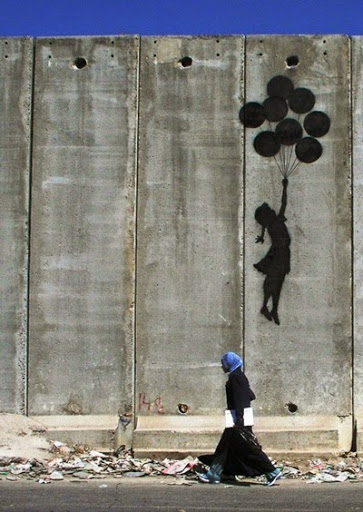
Banksy westbank wall balloon girl1

[Warning: very long read :)]

A video that has been burning a hole in my pocket since last November is the recording of the opening evening of the Berlin Courtyard of the Gentiles, that I already wrote about in a previous post.1 While I focused on Cardinal Ravasi’s talk on beauty and art there, today I’d like to cover the opening session’s discussion of morality, which was conducted under the title “Freedom, with and without God” and where Dostoevsky’s controversial dictum: “If God does not exist, everything is permitted” provided the initial impetus.

To open the evening’s dialogue, Cardinal Gianfranco Ravasi starts with a quote from Albert Camus’ The Plague, which says: “Can one be a saint without God? That’s the problem, in fact the only problem, I’m up against today.” and then proceeds to set the scene by being critical of the obstacles to open and fruitful dialogue between those who hold religious beliefs and those who do not:2

“These days a kind of fog engulfs both true religion and rigorous atheism. This is more of a sociological than an ideological phenomenon. It is an indifference, a superficiality, a banality, a sarcastic derision. In this atmosphere of indifference, mythos rules over logos, the pamphlet replaces the analytical essay, a fundamentalist approach is stronger than a critical weighing of alternative positions, jeering conflict is valued over a calm exchange of ideas, faith gives way to a spiritual collage. Syncretism uses a spiritual menu from which to compose an a la carte offering from which everyone can pick and choose what happens to suit him or her. These pathologies both of unbelief and of religion can benefit from a response in the form of the following dialogue.”

Ravasi then acknowledges the differences of the two positions and proposes that they nonetheless share a common element:

“In fact, the two logoi, the two argumentative positions that will be presented next, have an intrinsic difference, an objective difference. The secular non-believer takes the individual as their point of reference – the subject who seeks their own, personal and social, ethical orientation. The religious person, on the other hand, is convinced that truth, nature and moral order precede and exceed us. To use a famous image from Plato’s Phaedros, these realities are like a plane that stretches out in front of the chariot of the human soul, which proceeds through it towards discovering its objective foundations. A first point of agreement between these obviously differing perspectives – one which is predominantly subjective and the other objective – could be the thoughts of St. Augustine, who claimed that in each one of us there is an innate, original knowledge of good and evil, which enables the capacity for moral judgment. […] A reference to conscience is not a optional call to situational subjectivism, but a return to this radical anthropological structure, which is our conscience. At the same time we have to constantly bear in mind the limitedness of the human subject inherent in its being a creature.”

The opening remarks are then followed by two talks, one by a non-believer and the other by a believer. The first speaker was Prof. Herbert Schnädelbach, an agnostic philosopher whose work has included social philosophy and theories of rationality, epistemology, free will and values. Here Schnädelbach kicks off with an anecdote:

“A friend of mine, who is also a philosopher, said: “This sentence should be place on a list of the most stupid sentences ever – and fairly high up. Even in the absence of the existence of God, I am not allowed to break a red light, to withhold the payment of my taxes or to hit my wife, if that were even physically possible for me. And it is irrational to think that all of this were permitted without God.””

And proceeds to argue that the Dostoevsky quote is meant to teach us a fear of atheism and of atheists, and a fear of what supposedly follows: senselessness and anarchy. Dostoevsky’s quote implies that all rules and norms cease to have power in the absence of God. However:

“we live in a whole network of rules that we adhere to because we consider following them to be rational (e.g., the highway code), or because we want to avoid penalties imposed if they are broken (e.g., paying taxes). I can’t imagine though that Dostoevsky would not have know this. […] Dostoevsky claims that reason is an insufficient basis for our normative culture, that its normative power is too weak, that a more resilient basis is needed to hold up their edifice and that this foundation can only be God.”

This leads Schnädelbach to asking whether “God is even a suitable foundation for norms and who this God is?” and to drawing a parallel with Plato’s dialogue about the nature of piety in his Euthyphro: ““Is the pious loved by the gods because it is pious? Or is it pious because it is loved by the gods?” (10a). By analogy, Schnädelbach asks “is what is good and right for humans, good and right because God commanded it, or did God command it because it is good and right for humans?” and argues that there are two possible answers, using the Ten Commandments of the Old Testament as context:

  1. In the first case, God is sovereign and can freely choose what is good and right and no one can hold him to account. This is a voluntaristic image of God, which is closely related both to fundamentalism and to normative nihilism. They are two faces of the same coin. They rely on the same model of thinking of the all or nothing: either there is an ultimate justification or there is no justification, which is why systematic philosophers, at least since Descartes and until Hegel, have always looked for an absolute first justification for knowledge and claimed that the alternative is skepticism.
  2. In the second case, if God commands what is good and right, he is not an unaccountable tyrant, who could, at will, one day, make law what is evil and unjust. He commands what every person can see to be good and right with their own, healthy reason. This makes commandments 4-10 merely God teaching the People of Israel what they themselves could have discovered with their own reason, and the same would hold true for all of humanity too. This God, who commands what is rational because it is rational, and for no other reason, is the God of the Johannine Logos.”

Schnädelbach then proceeds to argue that only one of the above scenarios is problematic:

“If one assumes a sovereign God who commands without it being possible to ask them for reasons, i.e., where norms are divorced from reason, and if one then denies their existence, then truly everything is permitted. Then our normative culture would have its foundations removed. This danger does not exist, however, if the God who commands what is right and just, because it is right and just for humans, does not exist, since there is still the chance that people will discover it with their own reason and will make it hold even without God’s teaching.”

And, finally, the argument is brought to its logical conclusion, which, along the above lines or reasoning leads to a redundancy of God:

“Why should the practical reason of people and their free consent to what they discover to be normative in the process of rational discourse not be sufficient? Admittedly, this does presuppose the mutual recognition of discourse participants as free and equal partners, and their uninhibited participation in processes where public will is built and set. My final questions is: what could an transcendent God add at this point?”

I have to say that I find Schnädelbach’s reasoning very clear and compelling. There is a basis for morality derived from reason and consensus that is well-founded without the need for God. As a Christian I see this is as being extremely positive, and consistent with my belief in a loving God, who does not make a pursuit of what is good contingent on a person believing in His existence. There’d be more to say regarding the idea of a God who “can freely choose what is good and right,” but I’ll leave that for another time :).

Returning to the Berlin event, the second speaker of the evening was Prof. Hans Joas, a Catholic sociologist, who has worked in areas like social philosophy and the history of values. Joas first appeals for specificity, arguing that there isn’t a single religious or even Christian position, like there isn’t a homogeneous secular or atheist position and that “the level of discussion on this topic rises as the level of abstraction is lowered.” He then proceeds to present his view of the role played by morality in atheism:

“In the 20th century the vast majority of thinkers and writers who have self-identified as atheists did so for strong moral reasons. Often their arguments against faith were moral arguments: a focus on the afterlife would limit one in working for the good here on earth, one would do good only in the hope of a reward in the afterlife, or, a focus on the afterlife inhibits living this life to the full. Religions lead to unnecessary feelings of guilt, risk leading to hypocrisy in interpersonal relationships, or to a denial of one’s corporeality. For those who thought or think in this way, the absence of God is even a heightening of morality. This has to be taken seriously and I have high esteem for philosophers or writers who thought in this way, such as Ludwig Feuerbach or George Eliot. These are people who understood an exceptionally great deal about faith and who were exceptionally serious about going beyond what religion and Christianity had to offer.

For us Christians, it is necessary to look at the history of these views as a history of our failures. These weren’t lunatics, but people who understood certain things very precisely, and it was a failure of Christians to present their faith to them. An example is also the strong secularization of the workers’ movement in 19th century Germany, instead of its alignment with the Church. When asked, some of its members said that they didn’t go to church because they didn’t have the right clothes … This is an actual quote from a survey of Protestant pastors about dwindling numbers at the time. What shocked me here is that the pastor in question didn’t think, “What can I change about the Sunday service, so that people don’t stay away for a stupid thing like clothes.”

The atheism that had such strong moral motives in the beginning, has in some instances also degenerated, as in the case of the German Democratic Republic (GDR), where its leading philosopher claimed that the supreme moral point of reference was the wellbeing of the GDR. And today, there is often a tiredness on the side of non-militant atheism and a rigidity on the militant side. The first challenge, in my opinion, is to reopen a dialogue between believers and non-believers and a mutual awareness.”

Joas then moves on to distancing himself from the Dostoevskian quote and from belief in God being a prerequisite for morality, and instead argues for a developmental and experiential basis, from which God can then be sought:

“I don’t agree with the statement “Values need God.” Many findings in the context of developmental psychology and cultural anthropology point to another source, which has nothing whatsoever to do with religion, and which consists in experiences of reciprocity. Already games played by children point to fundamental rules that underlie human coexistence. Reflecting on them points to the value of justice, to the value of fairness in interpersonal relationships. At the same time, such relationships are under threat of falling apart if one of the participants chooses not to adhere to the rules, e.g., when these are to their disadvantage.

It is therefore useful to think about what it could be that would make humans adhere to moral rules, other than rational appeal, and what could make them adhere to them even when these are to their short-term detriment. What motivates the start of moral reasoning, what makes one start thinking about moral questions, what makes one adhere to shared moral rules? This still doesn’t bring us to God though. I believe we arrive at strong values, at intense convictions of there being such a thing as the good. This can be rooted in positive experiences, such as an encounter with someone who lives in an exemplary way, or in negative experiences, such as wanting to make sure that something doesn’t ever happen again the way that it happened before. For example, on German soil, National Socialism was an obvious, direct experience of evil itself, without the need for rational underpinnings. Then, a long journey can begin that can lead to an understanding how God relates to these values and rules.”

The position of Joas is very clear here: morality played a strong role in early atheism and is in no way in need of divine justification. Even the simple experiences of children lead to a recognition of the good of justice and fairness. My takeaway here is the importance of the emphasis of our common ground, which is what Joas chose to do here – an emphasis of the role of experience and the innate ability to identify good and evil, with only a hint of how God relates to morality for a Christian.

In the discussion that followed, Joas returned to the role of reason in morality, and emphasized the psychological perspective:

“Many things appear as obviously good or evil to us; reasons for why that is are needed when we encounter others who don’t share these evidential experiences with us and challenge us to explain why we value certain things. If we are honest with ourselves, we can see that whether something is good or evil is a matter that does not require rational justification to ourselves – it is obvious to us, and even in the face of counterarguments from others, instead of changing our minds about what appeared good to us from the start, we will look for reasons to support our original intuition. Note that this is a psychological, not a philosophical argument.”

The final contribution to the discussion was Schnädelbach’s sharing his personal experience of what it is like to be a – as he self-labeled himself – “pious atheist”:

“I have great respect for personal piety and for religious experiences, but personally I have to say that I can’t connect these to the God of the Bible – neither the Old nor the New Testament. At times, when something very good happens, I feel the desire to thank someone. But whom? And when something bad happens, I feel – like Job – the urge to argue with someone. But there is no one. I think though that this is the point that makes me who I am – a pious atheist.”

And to conclude the evening, Cardinal Ravasi was invited to share his thoughts, which he prefixed with saying that he is resisting the temptation to join the conversation between Schnädelbach and Joas or even to summarize it. Instead, he decided to present his understanding of the verb “to know”:

“In Hebrew the verb is yada, which has the same meaning as the New Testament Greek word genoskein, which reflects very well the polymorphism of anthropological knowledge, of human knowledge. Knowledge, according to this view, which is a symbolical view that is important also in the current dialectic or counter-positioning of faith and science, arrives along four ways. There is first the intellective, rational way. Added to it is the volitive way; decision, the willed intensity of knowing. The third line then is that of affectivity, of feeling. And the last, the fourth way, is that of action – knowing, which, e.g., in the Bible also means a completion of the sexual act. In other words, an encounter between two people in the fullness also of corporeality.

At this point, knowledge arrives in diverse ways, and each of these ways may lead to different stages. However, all of the stages are necessary. Hence the knowledge of the horizon of God, of transcendence, is a knowledge that has to pass through all of this, this whole itinerary. Therefore, the scientific way is certainly also relevant, as is a well-elaborated theology. But what is also indispensable is a knowledge of the esthetic kind, also of the spiritual kind, of a mystical kind. And this is why individual concepts and individual disciplines reveal themselves to be insufficient if they don’t travel along all the four ways.

This is also true of human experience itself, in general; To know a reality fully, it is not enough to only have knowledge of the phenomenon, knowledge of the context, knowledge of the “documentation.” A knowledge of love is also necessary, a knowledge that is substantially narrative. This knowledge that is also historical is the one that predisposes us to the ultimate foundations, to extreme questions.”

Since this post is massively long as is, I’ll refrain from attempting to present my own understanding of this topic, and will defer to do so at a later time. In any case, my intention with this post was just to share with you the above conversation among Cardinal Ravasi and Profs. Joas and Schnädelbach, which was such a joy to follow and whose availability only in German has been bugging me over this last half year.


1 It may come as a surprise to long-time readers of this blog, but I am actually following up on a strand from a previous post that I said I’d follow up on :).
2 All quotes from the event here are my crude translations from the evening’s recording in German.
The salvific atheism of Christ

Jf

[Warning: Long read.]

The title of this post is a quote from a conversation between Cardinal Gianfranco Ravasi and the journalist and atheist Eugenio Scalfari. There, Ravasi argued that Jesus’ cry on the cross: “My God, my God, why have you forsaken me?” (Matthew 27:46) can be described as a “salvific atheism.” An atheism that is juxtaposed with the Resurrection, where Jesus remains the Son even when He doesn’t feel the Father and thereby “plants the seed of the infinite in mortality.” Many shy away from attributing atheism to Jesus in this moment, where He laments His being abandoned by God, with a lot of hand-waving and “as if”s or appeals to reason along the lines of “how could Jesus, who is God, have been abandoned by God?!” Such attempts at denying Jesus’ profound experience of the absence of God may have good motives, but they have always struck me as being misguided, since they obscure the extreme nature of this most important moment of Jesus’ life.

That Jesus underwent a trial of this magnitude, where his suffering drove him to a loss of feeling united with the Father – i.e., the very heart of the Trinity, is the most powerful indication of how far God is willing to go towards us, whose faith is limited at the best of times. He is showing us that He is our brother also in darkness and during experiences of the absence of God.

The importance of this nadir in Jesus’ life (and pinnacle of His self-noughting love) was profoundly understood also by Chiara Lubich, the founder of the Focolare Movement who is now on the path of being considered for sainthood, and by the agnostic Swedish film director, Ingmar Bergman.

For Lubich, who with her first companions has spent years focused on putting the Gospel into practice, the realization of the importance of Jesus’ forsakenness on the cross came, when – in 1944 – her spiritual director asked her when Jesus suffered most and declared that he thought it was in his cry of forsakenness on the cross. Looking back to that moment some 56 years later, Lubich described it as follows:

“Right from the start we understood that fullness had another side to it, the tree had its roots. The Gospel covers you in love, but demands everything from you. “If the grain of wheat doesn’t fall to the earth and die – we read in the Gospel of John – it remains just a grain of wheat, but if it dies, it bears much fruit” (Jn 12:24). And the personification of this is Jesus Crucified, whose fruit was the redemption of humankind. […] Through a particular circumstance, we came to know that the greatest suffering of Jesus and, therefore, his greatest act of love, was when on the cross he experienced the abandonment by the Father: “My God, my God, why have you abandoned me?” This touched us to the depths. And our young age, our enthusiasm, but especially the grace of God, urged us to choose only him in his abandonment, as the means to realize our ideal of love.”

Having identified Jesus’ forsakenness as the pinnacle of his love, Lubich and her companions sought to find, love and console Him in the sufferings of all around them and in themselves:

“From that moment on, we seemed to discover his countenance everywhere. He had experienced within himself people’s separation from God and from each other, and he had felt the Father far from him. We saw him not only in all our personal sufferings, which were never lacking, but in those of our neighbor, often alone, abandoned, forgotten, in the separation between generations, between rich and poor, within the very Church at times, and, later, between churches, then between religions and between persons of different convictions.

But these wounds didn’t frighten us. On the contrary, because of our love for him in his abandonment, they attracted us. He had shown us how to face them, how to live them, how to cooperate in overcoming them when, after the abandonment, he placed his spirit in his Father’s hands: “Father, into your hands I commend my spirit” giving to humankind the possibility of being restored to itself and to God, and he showed us the way. And so he manifested himself to be the key to unity, the remedy for every disunity. He was the one who recomposed unity between us each time it cracked. In him we recognized and loved the great and tragic divisions of humankind and of the Church. He became our only Spouse.”

During Lent that same year, Lubich meditated on Jesus’ forsakenness in this way:

“He who is life itself was giving himself completely. It was the culmination of his love, love’s most beautiful expression.

All the painful aspects of life conceal his face: They are nothing other than him.

Yes, because Jesus, crying out in his abandonment, is the image of those who are mute: He no longer knows how to speak.

He is the image of one who is blind – he cannot see; of one who is deaf – he cannot hear.

He is the weary person, moaning.

He is on the brink of desperation.

He is hungry … for union with God.

He is the image of one who has been deceived, betrayed; he seems a failure.

He is fearful, timid, disoriented.

Jesus forsaken is darkness, melancholy, contrast. He is the image of all that is strange, indefinable, that has something monstrous about it. Because he is God crying out for help!

He is the lonely person, the derelict. He seems useless, an outcast, in shock.

Consequently we can recognize him in every suffering brother or sister.”

Finally, Lubich, who has made love of Jesus forsaken her life, describes the following effects of identifying and loving Him in others: “after each encounter in which we have loved Jesus forsaken, we find God in a new way, more face-to-face, with greater openness and fuller unity. Light and joy return; and with the joy, that peace which is the fruit of the spirit.”

To get another, deeply insightful, perspective on this key moment in Jesus’ life, Bergman’s “Winter Light,” that premiered in 1962, has its characters speak about it twice. First, when the pastor of a town, plagued by doubt, breaks down in front of a parishioner who comes to him for help, saying, with obvious anguish and torment throughout:

“If there is no God, would it really make any difference? Life would become understandable. What a relief!

And thus death would be a snuffing out of life. The dissolution of body and soul. Cruelty, loneliness and fear … all these things would be straightforward and transparent.

Suffering is incomprehensible, so it needs no explanation.

There is no creator. No sustainer of life. No design.

My God…

Why have you forsaken me?

I’m free, free at last.”

Before giving thought to the above, let’s look at the second reference to Jesus’ forsakenness, which comes later, when the disabled sacristan (who didn’t hear the pastor’s lament) shares the following reflection with him:

“Wouldn’t you say the focus on [Christ’s] suffering is all wrong? This emphasis on physical pain. It couldn’t have been all that bad. It may sound presumptuous of me – but in my humble way, I’ve suffered as much physical pain as Jesus.

And his torments were rather brief. Lasting some four hours, I gather? I feel that he was tormented far worse on an other level.

Maybe I’ve got it all wrong. But just think of Gethsemane, Vicar. Christ’s disciples fell asleep. They hadn’t understood the meaning of the last supper, or anything. And when the servants of the law appeared, they ran away. And Peter denied him. Christ had known his disciples for three years. They’d lived together day in and day out – but they never grasped what he meant.

They abandoned him, to the last man. And he was left alone. That must have been painful. Realizing that no one understands. To be abandoned when you need someone to rely on – that must be excruciatingly painful. But the worse was yet to come. When Jesus was nailed to the cross – and hung there in torment – he cried out: “God, my God! Why hast thou forsaken me?” He cried out as loud as he could. He thought that his heavenly father had abandoned him. He believed everything he’d ever preached was a lie. The moments before he died, Christ was seized by doubt. Surely that must have been his greatest hardship? God’s silence.”

To my mind, the above are two great attempts at an identification with the forsaken, crucified Jesus. The first, the pastor’s, is an identification from within – a re-experiencing of Jesus’ forsakenness at first hand, that leads the protagonist to a wishing away of it all, to a denial of the problem’s reality and a subsequent, forced declaration of freedom (forced and strained because of how it is portrayed in the movie). The second is an identification from the position of compassion and intuition – the disabled sacristan takes his own physical and psychological sufferings as a basis for inferring the greater magnitude of the latter, and – by extrapolation – intuiting that Jesus’ forsakenness on the cross – the experience of “God’s silence” – must have been most severe.

In many ways it is the pastor’s experience that gives the greatest sense of what it may have been like for Jesus himself, by the anguish and despair that it presents. The sacristan’s monologue, in turn, is – to my mind – already a source of hope in that it demonstrates another’s capacity to intuit my despair and therefore be lead to compassion.

The demon of distance

Demon of distance

A couple of weeks ago, Cardinal Gianfranco Ravasi lead another of the “courtyard of the gentiles” events, aimed at providing a space for dialogue between non-believers and Catholics. This time it took place in Budapest and Cardinal Ravasi’s address focused on the fundamental Christian principles, from which its understanding of morality, economy and society derives.

These principles include those of the person (created in the image of God and intrinsically being in relationship with others), of autonomy (of the civil and religious spheres, following Jesus’ words: “Then repay to Caesar what belongs to Caesar and to God what belongs to God.” (Matthew 22:21)), of solidarity and of truth (that precedes and exceeds us and that we inhabit rather than possess1). Each of these four principles is insightfully presented and analyzed by Ravasi and I would recommend anyone to read his talk in full (at the time of writing this post, only available in Italian). Here, however, I would like to focus only on the principle of solidarity, which Ravasi further differentiates into its aspects of justice and love.

The starting point of the principle of solidarity in Christianity, like that of the other three principles too, is the incarnation: “And the Word became flesh” (John 1:14), as a result of which there is a link between faith and history, between religion and political and social life. Cardinal Ravasi also emphasized this point during his brief opening remarks of the entire event, where he pointed out that, while in Eastern religions saints tend to be depicted with closed eyes (indicating an interiority of focus), in Christian art saints are typically shown with their eyes wide open – projecting out into the world around them. What is needed, Ravasi concludes, is both an interiority and a having one’s eyes open to see the great political, economic, social and cultural problems of the world.

In this context, the principle of solidarity in Christianity has its roots already in the Genesis account of creation, where

“the fact of all of us being human is expressed by the noun “Adam,” which in Hebrew is ha-’adam,2 with the article (ha-) that simply means “the human.” is used to refer to humanity. Therefore there is in all of us a shared “adamness.” Solidarity is, therefore, structural to our fundamental anthropological reality. Religion expresses this anthropological unity using two terms that are two moral categories: justice and love. Faith takes solidarity, which is also at the basis of lay philanthropy, but goes beyond it. In fact, staying with John’s Gospel, during the last evening of his earthly life Jesus says a wonderful phrase: “No one has greater love than this, to lay down one’s life for one’s friends.” (John 15:13).”

To illustrate the two aspects of solidarity – justice and love, Ravasi takes advantage not only of Christian tradition, but also makes reference to Eastern thought, in the spirit of inter-religious dialogue.

To present the essence of justice, Ravasi quotes the 4th century saint, Ambrose of Milan:

“The earth was created as a common good for all, for the rich and for the poor. Why, then, O rich, do you usurp an exclusive right to the soil? When you help the poor, you, rich, don’t give them from your own, but you return to them their own. In fact, you alone use the common property, given for the use of all. The earth belongs to all, not only to the rich, therefore when you help the poor you give them back their due, instead of providing them with a gift of your own.” (On Naboth)

Turning to the second aspect of solidarity – love, Ravasi takes advantage of the following Tibetan parable, showing that religious cultures, that are undoubtedly diverse, do at their bases have touch-points and contacts:

“A man, walking through the desert, spots something strange in the distance. Fear starts welling up in him, since, in the absolute solitude of the steppe, such an obscure and mysterious reality – maybe an animal, a dangerous wild beast – can’t but unsettle. Moving ahead, the traveller discovers that he is not approaching a beast, but a person instead. But his fear does not pass. If anything, it grows, thinking that the person could be a robber. Nonetheless, he has no choice but to proceed, until arriving in the presence of the other. At this moment, the traveller lifts his gaze and, to his surprise, exclaims: “It is my brother, whom I haven’t seen for many years!””

Ravasi concludes his reflection on solidarity by noting that “distance generates fears and demons; one has to get close to the other to overcome fears, no matter how understandable they may be. Refusing to get to know the other and to encounter the other is the same as saying no to the love that springs from solidarity and that dissolves terror and generates a true society.”

Personally, I have found Cardinal Ravasi’s reflection highly compelling and enlightening, both due to its deep roots in Scripture and its open and broad perspective that is equally at ease with drawing on the rich sources of Christianity as it is to benefit from the insights of other religions, even in matters as fundamental and core to Christianity as its understanding of love. Specifically, I have also found the Tibetan parable to be a great reminder to attempt closeness with all, instead of remaining at a distance and being put off by distorted, prejudice-filled, blurry perception.


1 Ravasi addressed this concept of the truth several times already, e.g. see also its coverage in a previous post here.
2 For more on the Genesis account and ha-’adam, see John Paul II’s “Man and Woman He Created Them,” discussed here.

Possessed by truth: a journey

Color of truth

[Warning: long read.]

One of the points made by Pope Francis in his letter to Eugenio Scalfari at the beginning of September regarded the nature of truth, which he likened to a relationship and which he argued “embraces and possesses us” instead of us possessing it. In this post, I would like to revisit this passage and look at it, and related statements made by Cardinal Gianfranco Ravasi, through the lens of philosophy.

The question of truth is one of the central concerns of philosophy and theories about it impact a vast variety of other aspects of rational enquiry. Since it is such a central theme, my attempt to look at Francis’ and Ravasi’s words from the point of view of philosophy will necessarily be in the form of a very roughly-ground lens1 indeed and all that I can hope to convey are blurry silhouettes. To keep the argument at a high level (as much as I would love to delve into the depths, e.g., of Alfred Tarski’s approach), I will mostly stick to summaries provided in the Stanford Encyclopedia’s “truth” entry and round it out by headlines from the “truth” entry in the Wikipedia.

With the caveats out of the way, let’s first look at the concept of truth most akin to what is typically meant by this word in “ordinary language” (i.e., language as used without the machinery of technical definitions – effectively the language spoken by “the man on the Clapham omnibus” to borrow an expression from English law). Here, an expression, statement, declaration, description, account, etc. is true if it matches how things actually are. If I say “there is a cat on the mat” and there actually is a cat on the mat then what I have said is true. What does philosophy make of the concept though and how does it deal with the pandora’s box that spills out left, right and center, when a basic idea like truth is subjected to scrutiny and deconstruction (in “ordinary language” terms).

As the King said to Alice, very gravely, let’s begin at the beginning – or at least reasonably close to it – and look at how Aristotle (who had something to say about pretty much everything) thought of the truth. In his Metaphysics, he declares: “to say of what is that it is, and of what is not that it is not, is true” (Book 4, Part 7). This, in fact, is close to the everyday meaning of the word and a variant of what today would be called the correspondence theory of truth – a theory still adhered to by many philosophers today and a theory (or class of theories) that I too consider to be best representative of my own understanding.

Put in more contemporary terms, “[a] belief is true if and only if it corresponds to a fact.” There is immediately a host of questions that spring up: is belief the only possible “truth-bearer” or are there others, what is the nature of correspondence, and what is a fact and can there be other “truth-makers”? Put in more generic terms, the above definition becomes: “a truth-bearer is true if and only if it corresponds to a truth-maker.” Here truth-bearers include entities like beliefs, propositions, sentences or utterances, truth-makers can be entities like a world that exists objectively (i.e., independently of the ways we think about it or describe it), electrodes connected to a brain’s nerve endings in a jar, states of a self’s consciousness and correspondence can refer to a match on the truth-bearer’s structure to the truth maker’s structure or just to convention (i.e., the “situationist” argument). As is obvious, a sprawling tree of choices grows from under our feet even just by enumerating some of the options, never mind engaging with them.

As should be obvious from the “truth is truth-bearer corresponding to truth-maker” way of posing of the correspondence theory of truth, the schema lends itself to modification and also to analysis using mathematical, formal languages methods (as Tarski did – more about that in a future post …). Still using my ultra-rough lens, let’s next look at G. E. Moore and Bertrand Russell’s identity theory of truth, where “corresponding” becomes “being identical to” – i.e. “a true proposition is identical to a fact […] Propositions are what are believed, and give the contents of beliefs. They are [..] the primary bearers of truth. When a proposition is true, it is identical to a fact, and a belief in that proposition is correct.” This is essentially a flavor of the correspondence theory, cutting out the bearer-maker dichotomy.

The most substantial competing theory of truth though is the coherence theory, whose basic idea can be put as: “A belief is true if and only if it is part of a coherent system of beliefs.” Truth here is not constrained to individual truth-bearers (instead whole systems of beliefs are the primary truth-bearers) and is “not simply a test or criterion for truth. Far from being a matter of whether the world provides a suitable object to mirror a proposition, truth is a matter of how beliefs are related to each-other. [… It] insists that truth is not a content-to-world relation at all; rather, it is a content-to-content, or belief-to-belief, relation.”

Extending the two basic concepts of correspondence versus coherence are a host of other, more recent approaches. Here pragmatist theories (e.g., as propagated by C. S. Peirce) make truth be about its practical value, since “[t]rue beliefs are guaranteed not to conflict with subsequent experience.” Verificationism instead “holds that a claim is correct just insofar as it is in principle verifiable, i.e., there is a verification procedure we could in principle carry out which would yield the answer that the claim in question was verified. [.. T]ruth just is verifiability.” Deflationist theories (e.g., as put forward by Gotlob Frege) argue that there is no property of something being true – that the concept is redundant. “[A]ppearances of the expression ‘true’ in our sentences are redundant, having no effect on what we express.” Constructivist theories instead hold “that truth is constructed by social processes, is historically and culturally specific, and that it is in part shaped through the power struggles within a community.” This is, e.g., the truth theory that underlies gender theory. A related, democratized, alternative is consensus theory where “truth is whatever is agreed upon.”

In summary, and in Cardinal Ravasi’s words:

“There are essentially two opposing approaches to the concept. The first is a relativistic, subjective view which sees Truth as a sort of Medusa‐like figure, constantly changing appearance depending on the circumstances. [… This view argues] that Truth does not in itself have any ontological basis and, for this reason, should be left free to follow the course of continual change.

The second approach to Truth […] holds that there is an objective – or rather, transcendent – Truth. [… Here] an emblematic image is provided in Plato’s Phaedrus, where the soul is likened to a chariot that flies across the plain of Truth. […] Adorno, in interpreting one of the aphorisms of Truth in his Minima Moralia, maintained that “one does not have [the Truth], but is in it.” Hence, humanity, finding itself within the womb of Truth, uses the mind to take it in, to become familiar with it, to investigate and illuminate it. There is clearly an attempt to combine the two aspects: on the one hand, a Truth which precedes us; on the other, a Truth which the individual must choose to enter. We read in Robert Musilʹs The Man Without Qualities that: “The Truth is not a precious stone to be kept in a casket, but a sea in which to immerse oneself”. This approach emphasizes the primacy – or precedence – of Truth, which is to be understood not as dominion but rather as illumination: a Truth more complex than mere rational knowledge.”

In fact, it is the above concepts – from a talk by Ravasi in 2009 – that, to my mind, underpin Pope Francis’ response to Eugenio Scalfari a couple of months ago and already the positioning of truth in Francis and Benedict XVI’s Lumen Fidei: “truth leads to humility, since believers know that, rather than ourselves possessing truth, it is truth which embraces and possesses us. Far from making us inflexible, the security of faith sets us on a journey; it enables witness and dialogue with all.”

With all of that under our belts, let’s take a fresh look at Francis’ response to Scalfari:

“I would not speak about “absolute” truths, even for believers, in the sense that absolute is that which is disconnected and bereft of all relationship. Truth, according to the Christian faith, is the love of God for us in Jesus Christ. Therefore, truth is a relationship. As such each one of us receives the truth and expresses it from within, that is to say, according to one’s own circumstances, culture and situation in life, etc. This does not mean that truth is variable and subjective, quite the contrary. But it does signify that it comes to us always and only as a way and a life. Did not Jesus himself say: “I am the way, the truth, and the life?” In other words, truth, being completely one with love, demands humility and an openness to be sought, received and expressed. Therefore, we must have a correct understanding of the terms and, perhaps, in order to overcome being bogged down by conflicting absolute positions, we need to redefine the issues in depth. I believe this is absolutely necessary in order to initiate that peaceful and constructive dialogue.”

Armed with my rough, philosophical lens, the above looks to me very much like a correspondence theory: correspondence here is the relationship Francis speaks about, the truth-maker is God and his creation and the truth-bearer are my own, circumstance-, culture-, language-relative beliefs, thoughts and utterances. The truth-maker is absolute and objective, while the truth-bearer is ultimately its opposite: relative, in flux and existentially subjective. The image of a journey and of being embraced express the entities of this scheme in an intuitive way. On the one hand, the givenness and quiddity of the landscape, which envelops the traveller, and on the other hand, the subjective, observer-dependent experiences of it, had by the pilgrim (the “For now we see through a glass, darkly.” of St. Paul (1 Corinthians 13:12)). What makes this paradigm profoundly Christian though is what Francis points to when he identifies truth with “the love of God for us in Jesus Christ.” The truth-maker is reaching out to the truth-bearer across the absolute-relative chasm, placing himself in relationship with His creatures, who are to Him like a dimensionless point is to the unbounded hyper-dimensional space.

Before you change channels, just bear with me while I try to put the above in other, less faith-dependent words. The concept of truth presented by Francis, as I understand it, is one that maintains the realism2 of a classical correspondence theory of truth, while acknowledging elements of contemporary truth theories that point to the impact of social, historical, conventional, linguistic and individually-subjective factors on the truth-bearers. Unlike truth theories that are marked by an absence of realism (e.g., coherence, pragmatist, verificationist and constructivist ones), here the imperfect and inherently subjective truth-bearers are still in relationship with their truth-makers. Up to this point, the theory does not make recourse to Christian beliefs and could just as easily be held by an atheist, in my opinion. Where it diverges is then in the belief that the truth-maker is not only an objective reality but also a personal agent who actively seeks to relate to the subject owning the truth-bearers. I didn’t say I’d put it more simply 🙂


1 Apologies to my überbestie MR – a fully-qualified and practicing professional philosopher – for bringing the name of philosophy into disrepute. I am sure she could have done a far superior job of the following.
2 And by “realism” I mean that the truth-makers are posited to exist independently of the truth-bearer’s circumstances – not the typical, ordinary-language meanings of the term.

Beauty wounds

Give or take

The latest in a series of “Courtyard of the Gentiles” events took place in Berlin this week and I have to say that I have been very impressed with the little of it that I have managed to follow via its livestreaming. The discussion between Profs. Joas and Schnädelbach (masterfully moderated by Prof. Markschies) was a particular gem, to which I definitely hope to return at a later date (with a highlight being Joas’s call for a confederacy of the “ethically universalist”1 – very much along a previous post here). If you understand German, I very much recommend the recordings of the event, as they represent a, to my mind, exemplary instance of dialogue between Christians and non-believers.

In this post, however, I’d like to share some of my favorite parts of Cardinal Gianfranco Ravasi’s opening address of the “Religion on stage” session that took place at the Deutsches Theater Berlin and where he spoke about beauty, a topic that is very close to my own heart. The text of his talk is available both in German and Italian on-line and the following excerpts will be my own, crude translations from both versions combined.

Ravasi opens by pointing to Judeo-Christian religions representing God Himself by analogy to the aesthetic and to drama,2 which can be seen in the Old Testament in the book of Wisdom: “For from the greatness and the beauty of created things their original author, by analogy, is seen.” (13:5) and already in Genesis, where “God saw that it was good.” (1:10) when looking at what he has created. Here Ravasi makes an important observation about the Genesis text, where the Hebrew adjective tôb, which is rendered as “good,” has not only ethical and utilitarian, but also aesthetic meaning. This would allow for the phrase to be put also as “God saw that it was beautiful.” His final Old Testament reference with regard to this idea is my favorite and points to the book of Proverbs, where God’s creative Wisdom is represented as a girl who “was his delight day by day, playing before him all the while, Playing over the whole of his earth, having my delight with human beings.” (8:30-31). I like this image very much since it ties together creativity, wisdom, play and joy and since already as an image – beyond its metaphorical content – it is beautiful.

The above leads Ravasi to the realization that faith and art are sisters by nature, since – in the words of Paul Klee about art – “they don’t represent the visible, but the invisible that is in the visible.”3 Another dichotomy that is at play both in life and in art (specifically the theater) is that of suffering and joy – of drama and comedy, which Fyodor Dostoyevsky explains by saying: “tragedy and satire [comedy] are sisters, who walk hand in hand and who together are called truth.” To this, Ravasi adds that “authentic art seeks to express also the dark side of this truth,” which he then expands on by first quoting Rainer Maria Rilke: “The beautiful is nothing but the beginning of the terrifying” and then Virginia Woolf: “The beauty of the world has two edges, one of laughter, one of anguish, cutting the heart asunder.” Finally, this line of reasoning is pushed even further through the words of the then-Cardinal Ratzinger from 1992: “beauty wounds, but precisely by doing so, it awakens man to his highest calling.”

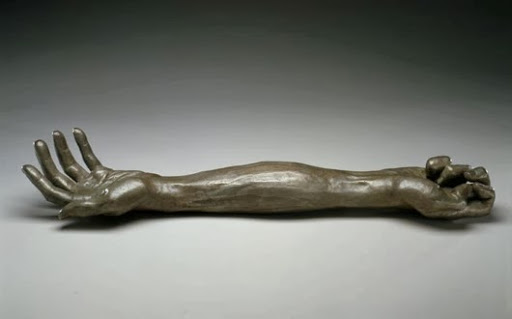
This emphasis on the integrity and comprehensiveness of art with respect to the full spectrum of human emotion is an important move away from the backward-looking, formulaic, stylized or solely artisanal nature of sacral “art” that Ravasi bemoans (and he is equally critical of contemporary attempts that result in “sacral garages where God is parked and the faithful are lined up”). Such failures lead to the divorce between art and faith that has been the case since the last century and that Ravasi has clearly spoken about already during the announcement of the Vatican pavilion a this year’s Venice Biennale. In contrast to its pathologies, Ravasi points to the importance of the cuts that authentic art can inflict and emphasizes that they can be “slits that open onto the infinite and eternal, the absolute, the mystery and the divine,” regardless of the faith of the artist, e.g., as with Lucio Fontana’s – a contemporary of Marcel Duchamp – “Tagli” or “Concetto spaziale” pieces, and – in my opinion – in a less literal way in the work of Louise Bourgeois (e.g., see her “Give or Take”).

Ravasi notes that the separation between art and faith has also, naturally, lead to a shelving of the themes, symbols and narratives of the Bible, which, e.g., Chagall held in very high regard: “For centuries painters dipped their brushes into this colorful alphabet, that of the Holy Scriptures.” Next, Ravasi makes the – to me – most interesting move by a virtuoso application of the principle of charity: “Even certain desecrating and blasphemous expressions4 that have recently elicited strong responses ultimately show not only the strong impact that religious symbols and themes maintain even in a secularized society, but perhaps they also manifest a nostalgia for the signs and images that have been such an extraordinary source of art and culture for two millennia.”

To sum up, I’d like to take advantage of Prof. Dr. Hans Joas’ words from his remarks of the opening session of the Berlin Courtyard of the Gentiles, where he called for “curiosity with regard to the other and humility with regard to oneself,” as a basis for authentic dialogue. I believe Cardinal Ravasi has taken great steps towards a new relationship between the Catholic Church and contemporary art, both in the practical move of participating in the Venice Biennale earlier this year, and in his clear attempts to recognize value and goodness even in art that at first sight is opposed to faith and in being explicit about the breadth of expression that authentic art requires.


1 As opposed to an “ethical particularism” that distinguishes between religious and secular ethics.
2 E.g., for a recent example, see also Hans Urs von Balthasar’s five-volume work “Theo-Drama: Theological Dramatic Theory.”
3 This seems to be related to the following, more extensive quote: “Art does not reproduce the visible; rather, it makes visible…. My aim is always to get hold of the magic of reality and to transfer this reality into painting – to make the invisible visible through reality. It may sound paradoxical, but it is, in fact, reality which forms the mystery of our existence.”
4 Characterized as “desecrating and blasphemous,” the most obvious example that springs to mind is Andres Serrano’s photograph [view at your own discretion].

Athena and/or Jesus?

Athena

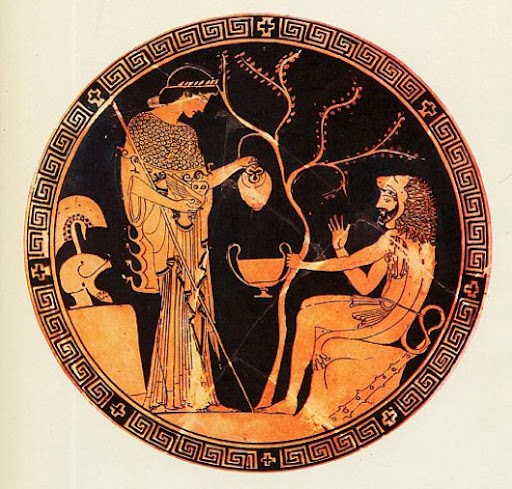
The other day I watched a greatly edifying and enjoyable video of Eugenio Scalfari and Cardinal Gianfranco Ravasi having a chat about a variety of topics in the context of the Courtyard of the Gentiles initiative launched by Pope Benedict XVI – a forum for dialogue between catholics and non-believers. What struck me in particular was a train of thought triggered by Scalfari commenting on Ravasi quoting him as having said that he was “in love” with Jesus. To this Scalfari responds:1

“Maybe it is an exaggerated phrase, but it is true. I have been following the life and preaching of Jesus ever since I was a kid, since I abandoned the faith. I grew up in a Catholic family […] but then I met Athena, together with Italo Calvino, with whom I shared a desk for three years at school …”

This follows the pattern I have seen so many times among my friends: I grew up a Catholic (or member of another church), but then I realized that belief in God was not reasonable and I became an atheist or agnostic. Scalfari tells the same story: upon encountering Athena (the Greek goddess of wisdom) his religious beliefs crumbled. Faced with a choice between faith and reason, he opted for the latter and while he still admires Jesus, he does so without any accompanying – irrational or at least arational – religious beliefs.

I particularly liked the posing of the above process with rationality personified by Athena, as it gave it a symmetry that less poetic accounts lack, and I was looking forward to Ravasi’s response, as this was a statement that he was sure to react to:

“[You tell the story of how you] made the choice of Athena, in a certain sense abandoning the choice of Christ in that moment at least. I think though that this choice, these two choices are not necessary and divisive, that they would split a person. Because I am firmly convinced, I personally, that, even though I have made the choice of Christ, I have not renounced my choice of Athena. Athena, reason, has always interested me.”

Ravasi then – very compellingly – proceeds to expand on Pope Francis’s speaking about the Truth in relational terms in his letter to Scalfari, and then shares the following, personal reflection:

“I, for myself, can’t say that I have the Truth, that I have God. I, every day, have to return – and in some moments it is likely that I drift into a territory where the heavens seem devoid of divinity … [pause] Precisely because there is this dimension of the subject [pointing at himself], that is limited and that walks in a reality that exceeds me. This is why I believe that the element of seeking, searching is fundamental.”

I believe Ravasi is absolutely spot-on here – faith is not an alternative to reason, but a position that requires reason for the sake of remaining authentic. Ravasi presents his relationship with God as a dynamic, persistent search for the infinite, transcendent-immanent by a limited and finite self contained by it. This is no rejection of reason, blind adherence to tradition or irrational ignorance of evidence that are often the objections leveled at faith, but a sincere, dynamic relationship with God, as experienced through the limited, fallible, imperfect consciousness of a human person.

Having focused on Ravasi – whose fan I admit I am, I would also like to express my admiration for Scalfari, who comes across as a highly intelligent, sincere and compassionate person and whose atheism I don’t in any way find issue with. If anything, the fact that shines through their conversation is that both are open and honest about their own understanding of reality and that both value the other’s thoughts and find inspiration in them.

To conclude, I’d like to share my motivation for this post, which was my überbestie, PM’s saying that he didn’t get why I keep talking about faith and reason as being opposed, when in fact they are not. This certainly made me stop, since I completely agree with him, and I in fact proceeded to read up on more formal treatments of rationality, reason and faith, with the desire to get to some low-level mixup that would explain the mistaken perception of this fictitious opposition. I very quickly realized though (how could I not have seen that straight-away?!) that such efforts lead me down the well-trodden, lengthy and criss-crossing paths of epistemology and ontology, for whose considerations the terms “reason” and “rational” were a lax shorthand. Not wanting to attempt a synthesis of a vast field of investigation here, I’d just like to argue again that faith and reason are not opposed – they are both means for making sense of our conscious experiences in ways which I (and the Catholic Church) believe to be complementary and fundamentally incapable of contradicting each other in their perfect instantiations.

Seeing the sincere experiences of Scalfari and many of my friends, who arrive at a different conclusion – i.e., of faith being opposed to reason – instead leads me to an examination of conscience. Why is it that the Church and I fail to present the inherent compatibility of faith and reason compellingly enough? Has too much baggage accumulated over the centuries? Have ulterior motives obscured the profound purity and rationality of Christian faith, motivated by insecurity and lack of trust in God’s love? Maybe the answer lies in personal dialogue though, instead of an attempt to address the question via some new systematic exposition. And Pope Francis’ clear, blunt and razor-sharp directness will help too, of that I am sure …


1 This is around 21:50 in the video (in Italian) and Ravasi’s reaction around 43:00.

Pope Francis’ letter to non-believers

Pope 2509845b

That Pope Francis cares deeply for non-believers1 is nothing new, with his previous declaration that Jesus has redeemed atheists too having lead both to very positive responses and to a great media muddle. In today’s issue of the Italian newspaper La Repubblica, Francis continues in this dialogue with non-believers by responding to questions sent to him by the atheist journalist Eugenio Scalfari regarding Francis’ encyclical Lumen Fidei, and I would like to share my favorite parts of his letter with you here.2

Francis starts out by arguing that dialogue between the followers of Jesus and non-believers is “necessary and valuable” today for two reasons: First, the paradox that “Christian faith, whose novelty and impact on human life have since the beginning been expressed through the symbol of light, has become branded as the darkness of superstition that is opposed to the light of reason,” resulting in an absence of communication between Christian and Enlightenment-based contemporary culture. Second, for those who seek “to follow Jesus in the light of faith, […] this dialogue is not a secondary accessory[, but …] an intimate and indispensable expression of faith instead.” This, Francis argues, is expressed by §34 of Lumen Fidei, from which he proceeds to quote:

“Clearly, then, faith is not intransigent, but grows in respectful coexistence with others. One who believes may not be presumptuous; on the contrary, truth leads to humility, since believers know that, rather than ourselves possessing truth, it is truth which embraces and possesses us. Far from making us inflexible, the security of faith sets us on a journey; it enables witness and dialogue with all.”

After a beautiful exposition of how Francis himself came to believe in God and how the Christian faith has Jesus’ incarnation and resurrection at its heart, through which all of humanity is shown God’s love and connectedness to each other – to every single human being,3 he proceeds to answering the three questions Scalfari put to him.

The first of Scalfari’s questions regards whether “the God of Christians forgives those who don’t believe and don’t seek faith.” Here Francis’s response, which I particularly like, is the following:

“Given that – and this is the fundamental point – the mercy of God has no limits if one turns to Him with a sincere and contrite heart, the question for those who don’t believe in God is about obeying one’s own conscience. Sin, also for those who don’t have faith, occurs when one goes against conscience. Listening and obeying to it means, in fact, taking decisions in the face of what becomes understood as good or as bad. And it is on the basis of this decision that the goodness or evil of our actions plays out.”

Wow! While this is in some sense nothing more than what the Catechism has been saying explicitly since Vatican II, having it presented in the above universal way is great. I have often argued in exactly these terms and have faced quizzical looks from other Catholics, who wouldn’t quite believe it. It also confirms me in the answer I have given to several of my best, atheist or agnostic friends when they have asked me whether they should want to believe in God, which was “no,” with the caveat of seeking to be honest in front of their consciences.

Scalfari’s second question asks whether “thinking that there is no absolute and therefore no absolute truth either, but only a series of relative and subjective truths, is a mistake or a sin.” Great question! 🙂 To this Francis responds by saying:

“To begin with, I wouldn’t talk, not even to those who believe, about “absolute” truth, in the sense that the absolute is that which is disconnected, which is devoid of any relation. Now, the truth, according to Christian faith, is the love of God for us in Jesus Christ. Therefore, the truth is a relationship! It is also true that each one of us takes it, the truth, and expresses it by departing from oneself: from one’s history and culture, the circumstances in which one lives, etc. This does not mean though that the truth is variable and subjective. Instead, it means that it gives itself to us always and only as a journey and a life. Didn’t maybe Jesus say the same: “I am the way and the truth and the life.”?4 In other words, truth, being ultimately all one with love, requires humility and openness when sought, accepted and expressed. Therefore, it is necessary to understand each other’s terminology better, and, maybe, to avoid the constraints of an opposition that is … absolute, deepen the framing of the question. I believe that this is absolutely necessary today, so that a serene and constructive dialogue can take place.”

Another fantastic answer! Anyone who has tried to pigeonhole Francis as a populist, as opposed to the thinker that Benedict XVI undoubtedly is, can proceed to eat their own words …

The third, and final of Scalfari’s questions asks whether “the disappearance of humans from Earth would also mean a disappearance of thought that is capable of thinking God.” Here, Francis’ answer, which I won’t translate in full, revolves around arguing that, in his experience and those of many others, God is not an idea, but a “reality with a capital ‘R’.” Instead of going into more detail here, I’d instead like to translate Francis’ closing thoughts, before which he expresses his hope that his reflections would be “received as a tentative and provisional response, but one that is sincere and faithful to the invitation of walking along a stretch of road together.”:

“The Church, believe me, in spite of all the slowness, the unfaithfulness, the mistakes and sins that it may have committed and may yet commit in those who compose it, has no other meaning and end than that of living and giving testimony to Jesus: Him who has been sent by the Father “to bring glad tidings to the poor, to proclaim liberty to captives and recovery of sight to the blind, to let the oppressed go free, and to proclaim a year acceptable to the Lord” (Luke 4:18-19).”

I have to say I am delighted by these words of Pope Francis – both the emphasis on conscience that I have held dear for a long time and the insights about truth as relationship and love – and I would be keen to hear from my atheist, agnostic, humanist (and even Christian 🙂 friends what they made of them.

UPDATE (12 Sept. 2013): This morning Vatican Radio broadcast a short interview with Cardinal Gianfranco Ravasi on the topic of Pope Francis’ letter discussed above (which is now available in an official English translation here). Ravasi, who leads the Pontifical Council for Culture and in its context the “Courtyard of the Gentiles” initiative, whose aim is dialogue with non-believers, naturally welcomed Francis’ letter with great positivity, including it among the initiatives foundational documents. He then also proceeds to elaborate on the, to my mind key, point Francis made about the truth being a relationship:

“Already Plato affirmed [that the truth is a relationship] when he said that the chariot of the soul runs along the plane of truth, which means that the truth is not a cold reality like a precious stone that you can put in your pocket. Instead, it is an immense plane, a horizon – or, to use another image by a writer from the last century5 – we can say that the truth is a sea that one enters and navigates. So, in this light, I believe that the concept of truth not as absolute, but personal, interpersonal, will be very fruitful for dialogue, without losing the dimension of objectivity, of identity in itself, typical of the truth.”


1 Picking what term to use to refer to those who do not believe in God is tricky and I am going with the term Francis is using himself, not necessarily because I believe it is the most appropriate one, but because my aim here is to share his message with you today. I am mindful though of Prof. Cox’s point about the undesirability of negative labels, but since the positive alternatives (e.g., humanist) may not be self-applied by all whom the Pope intends to address here, I am sticking with his terminology. If you belong to his target audience (and to some extent everyone does – including me, a Catholic) and have a suggestion for what term to use, please, let me know.
2 Since I haven’t found an English translation of this article yet, the following quotes are my own crude translations, for which I apologize in advance.
3 I’d like to return to this great synthesis of Christianity in a future post and, if you understand Italian, I’d wholeheartedly recommend reading the full letter to you straight-away.
4 John 14:6.
5 Ravasi refers to this quote in an earlier talk, where he attributes it to Musil’s The Man Without Qualities, although I couldn’t find it there.

Camus on dialogue, revolt, beauty and love

Camus

One of the features of Pope Francis’ first encyclical, Lumen Fidei, that stood out for me most is its constant reference to love, regardless of the specific subject of its reflection. This certainly is not surprising in the context of Christian theology – a theology that is all about God, who is Love – but it’s all-pervasiveness nonetheless made me think. In particular, it made me think about what someone who is not a Christian, who is an atheist or humanist, would say on the subject.

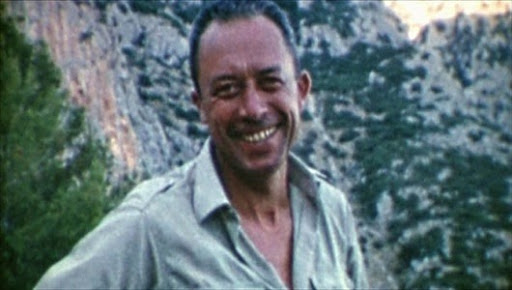
With these questions in mind, I turned to my “read later” reading list and my eyes landed on a piece by Cardinal Gianfranco Ravasi, where he speaks about how Albert Camus‘ thought is a confrontation with the same questions that Christianity grapples with. Questions of meaning, purpose, suffering, revolt, hope and love.

Ravasi there starts with quoting from a talk Camus gave to a group of Dominicans in 1948, where he says to his hosts that “the world of today needs Christians who remain Christians” and where he declares:

“I shall not, as far as I am concerned, try to pass myself off as a Christian in your presence. I share with you the same revulsion from evil. But I do not share your hope, and I continue to struggle against this universe in which children suffer and die.”

This directness and honesty of Camus has always been very attractive to me, which made me look for the full text of his talk to the Dominicans and I found a fairly extensive set of fragments from it here. What struck me there is how I find myself very much agreeing with him, where what he says is in fact a very powerful examination of conscience for Christianity and also for me personally.

From these fragments it is explicit that the Dominicans invited Camus to talk to them about what “unbelievers expect of Christians,” which makes me very impressed with them too, and for which Camus also acknowledged their “intellectual generosity.” He then proceeds to set out the following principles of dialogue:

that “if I allowed myself at the end of this statement to demand of you certain duties, these could only be duties that it is essential to ask of any man today, whether he is or is not a Christian.”

that “I shall never start from the supposition that Christian truth is illusory, but merely from the fact that I could not accept it.”

and that “I shall not try to change anything that I think or anything that you think (insofar as I can judge of it) in order to reach a reconciliation that would be agreeable to all. On the contrary, what I feel like telling you today is that the world needs real dialogue, that falsehood is just as much the opposite of dialogue as is silence, and that the only possible dialogue is the kind between people who remain what they are and speak their mind.”

These are an excellent set of principles: do to others as you would want them to do to you, the principle of charity and respect for the other being who they are, not setting out to change them. In fact, they seem to me to be very much in sync with what Pope Francis said on the same topic: “Dialogue is born of an attitude of respect towards another person, of a conviction that the other has something good to say; it requires that we make space in our heard their point of view, their opinion and their position.”

With these principles as the basis, Camus proceeds to spelling out his expectations:

“What the world expects of Christians is that Christians should speak out, loud and clear, and that they should voice their condemnation in such a way that never a doubt, never the slightest doubt, could rise in the heart of the simplest man. That they should get away from abstraction and confront the blood-stained face history has taken on today. The grouping we need is a grouping of men resolved to speak out clearly and to pay up personally. When a Spanish bishop blesses political executions, he ceases to be a bishop or a Christian; even a man; he is a dog just like the one who, backed by an ideology, orders that execution without doing the dirty work himself. We are still waiting, and I am waiting, for a grouping of all those who refuse to be dogs and are resolved to pay the price that must be paid so that man can be something more than a dog. […]

Perhaps we cannot prevent this world from being a world in which children are tortured. But we can reduce the number of tortured children. And if you don’t help us, who else in the world can help us do this? […]

But it may be […] that Christianity will insist on maintaining a compromise or else on giving its condemnations the obscure form of the encyclical. Possibly it will insist on losing once and for all the virtue of revolt and indignation that belonged to it long ago. In that case Christians will live and Christianity will die. In that case the others will in fact pay for the sacrifice. [… I]f Christians made up their minds to it, millions of voices—millions, I say—throughout the world would be added to the appeal of a handful of isolated individuals who, without any sort of affiliation, today intercede almost everywhere and ceaselessly for children and for men.”

When I read this, it really stopped me in my tracks. This is the kind of dialogue that we, Christians need – someone from the “outside” shaking us, pointing to our errors and doing so not for the sake of some propagandist point-scoring, but out of a genuine concern for our returning to our roots and maintaining our identity. In many ways, what Pope Francis is doing now from the “inside” is similar – the call to poverty, to the “existential peripheries” and to respect for and collaboration with atheists are all examples of it and I am deeply grateful to him and to Camus.

Returning to Ravasi’s discourse, he steers it to another very interesting point of common interest to Christianity and Camus, by quoting from “Helen’s Exile” and then from “The Rebel”:

“Man cannot do without beauty, and this is what our era pretends to want to disregard. It steels itself to attain the absolute and authority; it wants to transfigure the world before having exhausted it, to set it to rights before having understood it. Whatever it may say, our era is deserting this world.”

“Beauty, no doubt, does not make revolutions. But a day will come when revolutions will have need of beauty.”

Here the connection between beauty and the revolt Camus speaks about to the Dominicans is clear – both are set against an exploitation and ignoring of the world. Revolt is directed against suffering while beauty is aimed at appreciating existence.

Ravasi then makes the, to me at first surprising, summary of the above as being “the way of love.” To get a sense of why he may have interpreted it as such, Camus’ own words in “The Rebel” point to the key: “The procedure of beauty, which is to contest reality while endowing it with unity, is also the procedure of rebellion.” Rebellion and beauty bring about unity, which in turn is synonymous with love in Christianity – the Persons of the Trinity being One is their love for each other; Jesus-Love is present among his followers if they are united in his name (cf. Matthew 18:20), etc.

Finally, to underline the importance Camus gives to love, Ravasi quotes the following from his “Notebooks” from 1937:

“If someone told me to write a book on morality, it would have a hundred pages and ninety-nine of them would be blank. On the last page I would write, “I recognize only one duty and that is to love.” And as far as everything else is concerned, I say no.”

St. Augustine would be pleased, as am I 🙂

Art’s dialogue: Vatican @ Venice Biennale

“It’s Sandro, about the Biennale.” was the first thought that entered my mind when I heard about the Vatican’s latest plans to engage with contemporary art, followed by an “Phew!” as soon as I read the details. While the Church has been a patron of the arts during many centuries, it would be fair to say that it’s ties with contemporary art have slipped of late. While still proclaiming the importance of art as such, the picture it portrayed was one of art having expired after the Renaissance.

It was therefore great to see the announcement yesterday by Cardinal Ravasi that the Holy See is going to present a pavilion at this year’s Venice Biennale and to hear about the artists commissioned for it: Studio Azzurro (a Milanese group of video and performance artists), Josef Koudelka (a highly respected Czech photographer, represented by Magnum Photos) and Lawrence Carroll (Australian-born, American painter whose work is in the permanent collections of galleries like the MOCA). Before taking a closer look at these artists, it is worth noting the theme of the pavilion: “In the Beginning.”1 The focus here is on the first 11 chapters of Genesis as an inspiration for the exploration of man’s origins (“Creation”), the introduction of evil into history (“Un-creation”) and the hope that enters the world via the New Man (“Re-creation”). In Ravasi’s words:

“Creation concentrates on the first part of the biblical narrative, when the creative act is introduced through the Word and the breath of the Holy Spirit, generating a temporal and spatial dimension, and all forms of life including human beings.

Un[-]creation, on the other hand, invites us to focus on the choice of going against God’s original plan through forms of ethical and material destruction, such as original sin and the first murder (Cain and Abel), inviting us to reflect on the “inhumanity of man.” The ensuing violence and disharmony trigger a new start for humanity, which begins with the punitive/purifying event of the Flood.

In this biblical story, the concept of the voyage, and the themes of seeking and hope, represented by the figure of Noah and his family and then by Abraham and his progeny, eventually lead to the designation of a New Man and a renewed creation, where a profound internal change gives new meaning and vitality to existence.”

By the sounds of it, this is a very broad brief, which Ravasi underlines by saying that “each of these aspects was only a starting point for the selected artists. A vital, rich, and elaborate dialogue has been established with them and is a sign of a renewed, modern patronage.” And the aim of such patronage? “[I]nstituting and promoting occasions of dialogue within an ever broader and diversified context,” which sounds exactly like the mission statement of Ravasi’s Pontifical Council for Culture and a natural extension to the dialogue already in progress with intellectuals of all faiths an none, promoted via the Courtyard of the Gentiles initiative.

So, who are the three artists chosen for the first Vatican presence at a Venice Biennale?

Studio azzurro

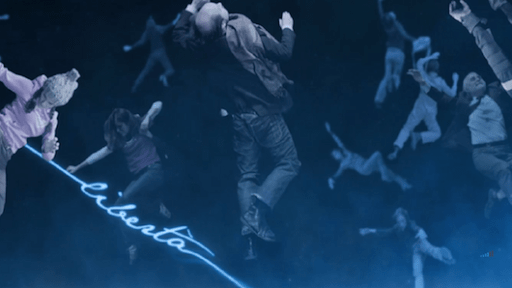
Of the three, the only one I didn’t know of is Studio Azzurro, who have been given the first of the three themes: “Creation” and who place “light, sound, and sensory stimuli at the center of their artistic investigation,” in the words of the art historian and director of the Vatican Museums Prof. Antonio Paolucci. He adds that “[t]heir work triggers a dialogue, awash with echoes and reverberations, between the vegetable and animal kingdoms and the human dimension, which leads, via memory, to other personal narrations.” In broad strokes this sounds like their “Fare gli Italiani” installation in Turin two years ago (a video of which can be seen here) or their earlier “Meditazioni Mediterraneo.” From the perspective of the artists themselves, their interests lie in the “values of memory, places and communities” and their use in “strongly participatory” ways.

Koudelka slovacchia 1963

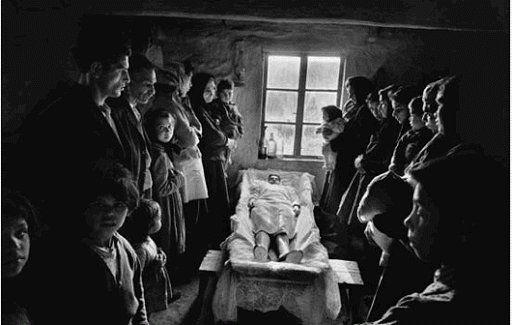
“Un-creation” is entrusted to the photographer Josef Koudelka, whose work is described by Paolucci as follows: “themes such as the destruction brought about by war, the material and conceptual consumption of history through time, and the two opposing poles of nature and industry are made to emerge. The photographer’s images expose an abandoned, wounded world, and at the same time are able to transform fragments of reality into works of art bordering on abstraction.” In many ways this sounds like the “redeeming ugliness” also explored by Michel Pochet, mentioned in an earlier post. To my mind this part of the theme is of great importance as it underlines the being “in the world but not of the world” (cf. John 15:19) of Christianity and a readiness to engage with all of reality. This is an attitude that is at the heart of Koudelka’s approach, who says that “I would like to see everything, look at everything, I want to be the view itself.” His portfolios covering the 1968 invasion of Prague by the Soviet army, the lives of gypsies in Eastern Europe in the ’70s (from which the above photo is taken) and the Welsh landscape in the late ’90s are all great examples of his desire to “be part of everything that is around [him].”

Lawrence carroll

Finally, “Re-creation” will be taken up in the work of the painter Lawrence Carroll, who uses “salvaged materials and the processes of transfiguration, which [he] presents both realistically and symbolically together. His is an elaboration that, meditating on the experiences of Arte Povera, actualizes a continuous and cyclical action of recovery and erosion, of suspension and decline, and of pause and reactivation through the reintroduction of objects into a temporal circuit, forcing fragility and monumentality to coexist” (Paolucci). Carroll himself says that his work “is about the idea that ideas and things have the possibility of having another life” carried from generation to generation of artists. In many ways his work is not only about the transformative, transcendent aspects of art but also its interconnectedness both with past and present ideas, forms and objects.

I believe Cardinal Ravasi has achieved something very impressive here. First, he has chosen a theme with universal appeal and accessible to believers and non-believers alike. Second, he has chosen a set of three artists who are very different from each other, who are respected in and representative of the contemporary art world (insofar as that is possible) and who have a great sense personal freedom (both Koudelka and Carroll have been emphasizing their commitment to their own independence over the year, e.g., with Koudelka saying: “I refuse assignments, even for projects that I have decided to do anyhow […] the idea that no one can buy me is important for me”). Third, he has steered clear of art “destined for the liturgy and sacred spaces” – this is not about interior decoration or illustration but about “rebuild[ing] relations between art and faith.” While not overtly religious, the works commissioned by the Vatican nonetheless speak to themes that are core to Christianity, since – as Cardinal Ravasi puts it – “they should raise questions in people’s minds about their origins and the origins of the world, about sin and destruction, about suffering, but also about hope for a new creation and new way of living.”


1 A theme dear to this blog, where it was covered in the context of the Johannine prologue, the perspective of the roots of science in Genesis and of John Paul II’s Theology of the Body among others.

Breathe, think, struggle, love: pray

Job

To me one of the highlights of the last weeks has been the ability to follow Cardinal Gianfranco Ravasi’s Lenten spiritual exercises, delivered to the Vatican’s staff and to Pope Benedict XVI before his resignation. Being able to download them as podcasts, or purchasing their text in book form, means that anyone (who understands Italian :|) can follow them and in effect participate in an event that in the past would have been open to only a very select audience. I don’t mean to dwell on the fact of this new openness and would instead like to focus on the specific content that Cardinal Ravasi created and shared.

I have to admit that I am a huge fan of Cardinal Ravasi and have been ever since I first found out about the Courtyard of the Gentiles initiative launched by Benedict XVI and executed by the Pontifical Council for Culture under Ravasi’s leadership. The Courtyard fosters dialogue between believers and non-believers and has resulted in multiple events already at which Christian, agnostic and atheist speakers were invited to speak about different topics (the first one was in Paris and subsequent ones took place also in Stockholm and Assisi). Instead of just being a job that Ravasi has to oversee, this open, broad dialogue comes across as a core passion of his and a thread that can be traced through his publications and talks. In many ways Ravasi takes a similar view of the believer/non-believer dichotomy as Cardinal Martini did (who asserted that there is a part of both in each one of us, including himself), by declaring it as unhelpful and quoting Nietzsche, who said that “Only a person of deep faith can afford the luxury of skepticism.” Ravasi has also been quoted as saying that “[h]alf of my friends are non-believers” and answering “Absolutely not.” when asked whether he wanted to convert atheists. In short – a cardinal very much after my own heart and one who, I believe, embodies the following verse from the Gospel: “For whoever is not against us is for us.” (Mark 9:40).

Let me now return to the Lenten spiritual exercises that Cardinal Ravasi lead in the Vatican only a couple of weeks ago. Their theme was “The Face of God and the Face of the Human Person in the Prayers of the Psalms” and they consisted of 17 half-hour talks delivered over the course of a week. The topics spanned a very broad spectrum from creation, via wisdom, suffering and happiness to the family and immortality, to name but a few. While their backbone were the Psalms, Ravasi – in his characteristically open-minded style – took advantage of the insights of sources as diverse as Kierkegaard, Planck, Evdokimov, Bloch and the Egyptian pharaoh Thutmose III – just to give you a flavor …

The first thing that attracted me to this theme, beyond being delighted that it was Ravasi whom Benedict XVI picked to deliver it, is the fact that the Psalms are essentially the collection of prayers that Jesus himself used. Jesus, being a Jew, grew up with the Psalms as his prayer book, which means that when I pray with their help, I am following his example and am united with him. As soon as I heard that these spiritual exercises were centered around the Psalms, my first thought was immediately directed to prayer, which made it particularly pleasing that this was precisely the subject of Ravasi’s first talk too.

That’s where my ability to anticipate Ravasi’s moves ended though and his take on prayer was both novel, greatly thought provoking and deeply enjoyable. Instead of trying to give you an overview of all 17 talks, which I highly recommend in full, let me at least share what to me were the first talk’s highlights.1

To begin with, Ravasi approaches prayer by setting out to “outline the essential map of its structure,” which he does by identifying the four verbs of prayer. The first is “breathing,” which he kicks off by quoting Kierkegaard: “Rightly the ancient peoples used to say that praying is breathing. It shows how foolish it is to talk about whether one has to pray. Why do I breathe? Because, otherwise I would die. That is also how it is with prayer.” The link to the Psalms then comes in the form of highlighting that there is a single Hebrew word – nefesh – for “soul” and “throat,” which allows for a dual reading, e.g., of Psalm 42:3 “My soul/throat thirsts for God, the living God.” This in turn emphasizes a “physicality,” which leads Ravasi to the following exhortation:

“We, therefore, have to recover that spontaneity and constancy of an explicit, praying breath that the woman of the Song of Songs [… expressed as] “I was sleeping, but my heart was awake.” (5:2). Faith, like love, does not take up only some hours of existence, but is its soul, a constant breathing.”

The second verb of prayer is “thinking,” which leads Ravasi to the following affirmation: “Prayer is not simply an emotion. It has to involve reason and the will, reflection and passion, truth and action.” The model here is Mary, who, after giving birth to Jesus is reported by Luke to have “kept all these things, reflecting on them in her heart.” (Luke 2:19). Ravasi then digs deeper into the Greek word symballousa that is translated in the Gospel as “reflecting” and points out that its meaning is more of a “joining together in transcendent unity,” which is the “true “thinking” according to God.” The part on prayer as thinking concludes with a quote from Wittgenstein’s notes from World War I, where he says: “Praying is thinking about the meaning of life.”

“Struggling” is then the third verb of prayer, which has its roots in Jacob, Job and Jesus. Jacob, who at Penuel (Genesis 32:23-33) wrestled a mysterious, unknown being, so strong that it not only changed Jacob’s life and mission, but even his name (to Israel). This struggle is later referred to by Hosea as a cry to God and therefore a prayer: “He contended with an angel and prevailed, he wept and entreated him.” (Hosea 12:5). Job’s struggling prayer even refers to God as follows: “He pierces me, thrust upon thrust, rushes at me like a warrior.” (Job 16:14). Finally, in Jesus this aspect of prayer finds its peak on the cross, where he cries out: “My God, my God, why have you forsaken me?” (Mathew 27:46), quoting verse 2 of Psalm 22 in his moment of extreme suffering.

The verbs of prayer culminate in “loving,” which Ravasi introduces by quoting from St. John of the CrossSpiritual Canticle and thereby smoothly transitioning from struggle:

“Where have You hidden Yourself,
And abandoned me in my groaning, O my Beloved?
You have fled like the hart,
Having wounded me.
I ran after You, crying; but You were gone.”

Next, Ravasi introduces the transcendence and inaccessibility of God that is prominent in some religions and starts with the example of the Sumerians, who said about their chief deity, Enlil, that he was “like a knotted bundle of yarn than no one could untangle, like jumbled-up threads where no end is to be seen.” In Christianity the relationship is one of intimacy instead, since God is addressed as “abba” – Father (or more precisely, “daddy”) and this closeness can also be seen in some aspects of Islam, from where Ravasi quotes the 8th century Muslim mystic Rābiʿah al-Baṣrī:

“My Lord,
Each love is now alone with his beloved.
And I am alone with You.”

Finally, Ravasi concludes by the following passage from Psalm 123:1-2 and leaves us in a “silent meeting of gazes, where prayerful contemplation blossoms”:

“To you I raise my eyes,
to you enthroned in heaven.
Yes, like the eyes of servants
on the hand of their masters,
Like the eyes of a maid
on the hand of her mistress,
So our eyes are on the LORD our God,
till we are shown favor.”


1 All quotes from Ravasi’s talks here are my own translations from Italian – their crudeness is all mine.