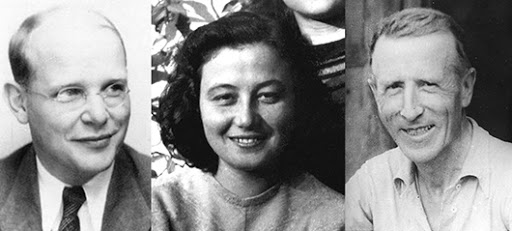
Bonhoeffer, Lubich, Teilhard: A world luminous from within

Bonhoeffer lubich teilhard s

Sixty eight years ago yesterday, in the Flossenbürg concentration camp, the Lutheran pastor and theologian Dietrich Bonhoeffer was martyred. His opposition to Nazi euthanasia and genocide directed against the Jewish people, born of his discipleship of Jesus, earned him the gallows. While I have long been an admirer of Bonhoeffer’s witness and theology, I have only now come across the following passage from his Letters and Papers from Prison, where he points particularly lucidly to the alternative to the God of Gaps caricature still popular today:

“How wrong it is to use God as a stop-gap for the incompleteness of our knowledge. If in fact the frontiers of knowledge are being pushed further and further back (and that is bound to be the case), then God is being pushed back with them, and is therefore continually in retreat. We are to find God in what we know, not in what we don’t know.”

This emphasis on the presence of God in what we know made me think of Chiara Lubich’s mystical experience that started during the summer of 1949.1 There, before the start of the actual “intellectual visions,” she recounts the following:

“[N]ature seemed to me to be enveloped totally by the sun; it already was physically, but it seemed to me that an even stronger sun enveloped it, saturated it, so that the whole of nature appeared to me as being “in love.” I saw things, rivers, plants, meadows, grass as linked to one another by a bond of love in which each one had a meaning of love with regard to the others. […] I had seemed to see the blossom of a horse chestnut tree alive with a higher life that sustained it from beneath so that it seemed to be coming out towards me.” (Paradise ’49)

How is it though that one comes to seeing God “in what we know,” as “sustain[ing everything] from beneath”? Here, in the paragraphs preceding the above quote, Lubich says that “[for about five years w]e had been trying with great intensity to live [… communion] with Jesus in the Eucharist, with our brother or sister, with the Word of God […] constantly in the present moment.” Her answer then is that this experience of God “enveloping” all has for her and her companions followed a putting of the Gospel into practice.

This in turn made me think of Pierre Teilhard de Chardin’s “The Divine Milieu,” where he sets out “a way of teaching how to see” and starts by posing a challenge:

“God is as pervasive and perceptible as the atmosphere in which we are bathed. He encompasses us on all sides, like the world itself. What prevents you, then, from enfolding him in your arms? Only one thing: your inability to see him.”

Reflecting on the above near the end of his life, Teilhard shares the following:

“Throughout my life, by means of my life, the world has little by little caught fire in my sight until, aflame all around me, it has become almost completely luminous from within. … Such has been my experience in contact with the earth — the diaphany of the Divine at the heart of the universe on fire … Christ; his heart; a fire: capable of penetrating everywhere and, gradually, spreading everywhere.”

Again the vision of God illuminating the world “from within” follows a life focused on seeking Him, as Teilhard says in “The Divine Milieu,” both in what we do and what happens to us – both the active and the passive, and therefore in life as a whole:

“It is the whole of human life, down to its most “natural” zones, which, the Church teaches, can be sanctified. […] “So whether you eat or drink, or whatever you do, do everything for the glory of God.” (1 Corinthians 10:31).”


1 For previous mentions of “Paradise ’49” see the following posts here and here.

Divergent rays

Nasa sun

The Gospel verse “In the beginning was the Word” has been going around in my head, ever since it dawned on me last weekend that it clearly points to something having preceded it. Thinking more about it made me revisit a text (actually, various fragments of it, since it has, as yet, not been published in full) where Chiara Lubich recounts her “intellectual visions” of Paradise that started in 1949. In particular, I wanted to re-read how she described Jesus, the Word:

“I found myself […], as in a vision seen with the eyes of the soul, having come into the Bosom of the Father, who showed me, as it were, the inside of a sun that was all gold or flames of gold, infinite, but not frightening.”

“[F]rom the walls inside the Sun, the Father pronounced the word: Love, and this Word, concentrated in the heart of the Father, was his Son.”

The picture here is very vivid and in many ways like those of St. Hildegard of Bingen’s visions. It transmits a very clear sense of what it may have seemed like to be there “in the beginning.” Reading on, Chiara also shares the following vision of creation:

“When God created, He created all things from nothing because He created them from Himself: from nothing signifies that they did not pre-exist because He alone pre-existed (but this way of speaking is inexact as in God there is no before and after). He drew them out from Himself because in creating them He died (of love), He died in love, He loved and therefore He created.

As the Word, who is the Idea of the Father, is God, analogously the ideas of things, that “ab aeterno” are in the word, are not abstract, but they are real: word within the Word.

The Father projects them — as with divergent rays — “outside Himself,” that is, in a different and new, created dimension, in which he gives to them “the Order that is Life and Love and Truth.” Therefore, in them there is the stamp of the Uncreated, of the Trinity.”

I find the above paragraphs particularly important since they indicate several key ways of thinking about how God and the universe are related:

  1. That God (the Trinity, the Uncreated) can be found in nature since it bears His “stamp,”
  2. that Jesus – the Word – is not only God who made himself present in the world as a human being 2000 years ago, but is the very means by which the Father goes “outside Himself” in His Creation,
  3. that creation is an act of self-noughting love, and
  4. that creation can be thought of as a new dimension of God.

This relationship is clearly not that of a “God of gaps,” cobbled-on caricature, but a tightly-interwoven, integral, first-person communion. Creation is to God as the rays of the sun are to the sun.

In fact, the picture of the sun and its divergent rays (and the use of “picture” is very deliberate, given what follows), is also very much consonant with Wittgenstein’s thoughts on how a system (the world) and its meaning relate:

“The sense of the world must lie outside the world. In the world everything is as it is and happens as it does happen. In it there is no value—and if there were, it would be of no value.

If there is a value which is of value, it must lie outside all happening and being-so. For all happening and being-so is accidental.

What makes it non-accidental cannot lie in the world, for otherwise this would again be accidental.

It must lie outside the world.” (Tractatus Logico-Philosophicus, 6.41)

Where does this leave a Christian in terms of how science and revelation make sense of the world? I believe, James Clerk Maxwell put it very well: “I think Christians whose minds are scientific are bound to study science that their view of the glory of God may be as extensive as their being is capable.” It is with this mindset that Prof. John Lennox commented on the Higgs Boson discovery by saying “God created it, Higgs predicted it and Cern found it.” Instead of a conflict, the advances of science are as much a source of wonder and joy to a Christian as are the visions of those who seek God and to whom he makes himself known in entirely unscientific ways.