Mary Magdalene: eyewitness of the resurrection

Noli me tangere fresco by Fra Angelico

On Wednesday is the feast of St. Mary of Magdala, who was one of Jesus’ disciples and the first eyewitness of His resurrection. Because of this, and because it was her who brought the news of the resurrection to the apostles, St. Thomas Aquinas called her “apostolorum apostola”1 – “apostle of the apostles.”

St. John Paul II also highlighted her importance in his 1988 apostolic letter Mulieris Dignitatem, where he argued that Christ “entrust[ed] divine truths to women as well as men” and that His “attitude to women confirms and clarifies, in the Holy Spirit, the truth about the equality of man and woman.” There John Paul II writes:

“The Gospel of John (cf. also Mk 16:9) emphasizes the special role of Mary Magdalene. She is the first to meet the Risen Christ. At first she thinks he is the gardener; she recognizes him only when he calls her by name: “Jesus said to her, ‘Mary.’ She turned and said to him in Hebrew, ‘Rabbuni’ (which means Teacher). Jesus said to her, “Do not hold me, for I have not yet ascended to the Father, but go to my brethren and say to them, I am ascending to my Father and to your Father, to my God and your God.” Mary Magdalene went and said to the disciples, “I have seen the Lord”; and she told them that he had said these things to her” (Jn 20:16-18). Hence she came to be called “the apostle of the Apostles.” Mary Magdalene was the first eyewitness of the Risen Christ, and for this reason she was also the first to bear witness to him before the Apostles.”

But who was Mary Magdalene, and how well does her image of a repentant prostitute actually agree with the Gospels? Here, let’s turn to a great article by Cardinal Gianfranco Ravasi, who – as a professional biblical scholar – provides a clear scriptural analysis of this disciple of Jesus and debunks distortions that have been introduced later and for a variety of ignoble motives. Ravasi starts out by providing some background on her origin, her first mention in the Gospels and the source of an early misidentification with another, anonymous character:2

“Magdala (from the Hebrew “migdol” – “tower”) [was] a village located on the west coast of the Sea of ​​Galilee, at the time a center of the fishing trade, to the point where in Greek it was called Tarichea, that is, “salted fish”. What we know about it has been revealed by archeology, although the village itself today is sunk beneath the waters of the lake.

Well, from this location, Mary suddenly emerges in the Gospel of Luke (8:1-3), in a list of disciples of Christ. Her portrait is sketched out with a single brush stroke, “Mary, called Magdalene, from whom seven demons had gone out.”

The “demon” in the language of the Gospel is not only the root of moral evil but also of physical ailment that can pervade a person. ‘Seven’, then, is the number symbolic of fullness.

We cannot, therefore, know much about the grave evil, moral or psychological or physical, that struck Mary and that Jesus had eliminated. Popular tradition, however, had no hesitation in later centuries to call Mary Magdalene a prostitute. But why? The answer is simple: on the previous page, in chapter 7 of the Gospel of Luke there is the story of an anonymous “sinful woman in the (unnamed) city.” Making the connection was easy but unfounded: this public “sinful woman” had to be Mary Magdalene, presented a few lines later! She was, then, attributed the whole story told by the evangelist that followed. Having learned of the presence of Jesus at a banquet at the house of a prominent Pharisee, she had made a gesture of reverence and love that was especially appreciated by Christ: she anointed with perfumed oil the feet of the rabbi of Nazareth, she bathed them with her tears and dried them with her hair.”

Ravasi also presents a number of other misidentifications of Mary Magdalen with others, including Mary, the sister of Martha and Lazarus, Mary the mother of Jesus, and even with Wisdom, as her personification. Instead of reviewing the details – and refutations – of these as presented by Cardinal Ravasi, let me just focus on the profile he presents that is based on the Gospel accounts:

“All the evangelists are, in fact, agreed on indicating her presence at the crucifixion and burial of Christ. And it is right next to that tomb in the still-pale dawn light of Easter that the Gospel of John (20:11-18) places the famous meeting between Christ and Mary of Magdala.

As is known, Mary confuses the Christ with the guardian of the cemetery. Now, such “blindness” is typical of some appearances of the Risen One: just think of the disciples of Emmaus who are walking together with him for hours without recognizing him (Luke 24:13-35). Naturally, the significance is theological: although still Jesus of Nazareth, the glorious Christ transcends human, historical and physical coordinates. To be able to “recognize” him, one need to get oneself onto a channel of transcendent knowledge, that of faith. That’s why it is only when she feels called by name in personal dialogue, that Mary “recognizes” him and calls him Rabbuní, “my teacher” in Aramaic. […]

Fortunately the only one who called her by name, Mary, and who recognized her and confirmed her as his disciple was Jesus of Nazareth, her Teacher, the Rabbuní. And it is precisely on the basis of that Easter meeting that her presence reappears each year in the Catholic liturgy in the beautiful Gregorian melody of Victimae paschali and in that Latin dialogue that we’ll exempt from translating:

«Dic nobis, Maria, quid vidisti in via?»
«Surrexit Christus spes mea!»3


1Note the grammatical gender of “apostola” being female.
2 Note that the above quotes are from two versions of essentially the one article – one available here, and the other here – and their English translation is mine.
3 While Cardinal Ravasi’s original audience may have been
au fait with Latin, let us exempt ourselves from that translating exemption and look at an English rendition of those two lines:
“Tell us, Mary, what did you see on the road?”
“Christ my hope is arisen.”

The light of the world

Zen photon garden

[Guest post: The following is an extended version of an article prepared for publication in print by Dr. Ján Morovič, which is reproduced here with the author’s permission.]

By pronouncing “Let there be light.” (Genesis 1:3), God spoke it into being and when he became incarnate in the person of Jesus, he identified himself with it by proclaiming: “I am the light of the world. Whoever follows me will not walk in darkness, but will have the light of life.” (John 8:12). Jesus even attributed that same nature to us, when turning to the crowd who had just heard him preach the beatitudes, and saying: “You are the light of the world.” (Matthew 5:14-15). Light was also the sign by which Jesus’ divinity was manifested to Peter, James and John on Mount Tabor, an event about which Matthew wrote: “[H]e was transfigured before them; his face shone like the sun and his clothes became white as light.” (17:2). Finally, completing the arc started in Genesis, the New Testament ends by foretelling – in its last chapter – a definitive victory of light, where those gathered around God at the end of time are described as follows: “Night will be no more, nor will they need light from lamp or sun, for the Lord God shall give them light, and they shall reign forever and ever.” (Revelation 22:5).

Not only is light singled out in Scripture, and existentially identified with God and his sons and daughters, but it is also presented as the means by which understanding comes about. St. Paul exhorts the first Christians in Ephesus to “[l]ive as children of light” (5:8) and emphasizes the tight link between light and vision: “But all things become visible when they are exposed by the light, for everything that becomes visible is light. […] Watch carefully then how you live, not as foolish persons but as wise.” (5:13,15).

Such an understanding of light is, in fact, very close to how contemporary science defines it: as “radiation […] considered from the point of view of its ability to excite the human visual system” (CIE, 2011). Light is fundamentally about the effect of matter on human sensory perception. The only thing that makes the range of electromagnetic radiation with wavelengths between around 400 and 700 nanometers be light is that our eyes are lined with cells in which oxidation takes place when such radiation is incident on them. This, in turn, triggers an electrical signal that passes through an interconnected sequence of neural layers, leading to the back of the brain, where such signals are further processed in dramatically complex and varied ways that lead to our visual experiences.

The evolution of vision, which originated during the lower Cambrian period 508 million years ago (Parker, 2009) in the photoreceptor proteins of single-cell organisms, has reached a remarkable degree of sensitivity to light in humans. For a start, our eyes go to extraordinary lengths to detect light. A single photon incident on a photoreceptive rod cell in a human retina triggers a signal, and even though it takes five to nine photons landing on such a cell for at least 100 milliseconds for the signal to make it past the visual system’s noise suppression, reach the brain and result in conscious perception (Hecht et al., 1942), the staggering degree of the eye’s sensitivity becomes clear when these numbers are put into perspective: a single candle emits 5 million billion (i.e., 5×10¹⁵ – a quadrillion!) photons during such a 100 millisecond period. Put differently, a single candle could be seen in complete darkness from a distance of 30 miles between two mountaintops.

As if this wasn’t enough, our eyes go further still. Instead of simply relaying signals from the array of light-sensitive cells that line their backs, such signals are first combined so that the relationships of a signal from one cell with those from cells around it are amplified. This center-surround mechanism (Wandell, 1995) means that the boundaries between differently-colored regions in our environment are emphasized. Further down the neural pathway from the eyes to the brain, in the lateral geniculate nucleus, the signals from cells sensitive to different ranges of radiation wavelengths are again processed and differences between opponent colors: red-green, yellow-blue and black-white are also enhanced (de Valois et al., 1966). As a result, the signal that originates in the light-sensitive cells of our eyes is enhanced both for spatial and color discrimination, even before it is reaches and is processed and interpreted by the brain and leads to a conscious experience.

What does all of the above mean though, and how can we even begin to reflect on Scripture and the findings of contemporary science side-by-side? Even though Scripture is not and does not claim to be science, and, e.g., the Genesis account of creation is better thought of as symbolical (like the Catechism of the Catholic Church teaches (§337)) or as myth, this does not mean that it “refer[s] to fictitious-fabulous content, but simply to an archaic way of expressing deeper content.” (John Paul II, 2011). The truth revealed in Scripture, the truth sought by empirical and scientific means and even the truth expressed in art are not distinct truths though, and instead present different modes of knowledge of the one reality. John Paul II derives this position from the principle of non-contradiction, whereby truth cannot contradict truth. Hence, the truth, which

“God reveals to us in Jesus Christ, is not opposed to the truths which philosophy perceives. On the contrary, the two modes of knowledge lead to truth in all its fullness. The unity of truth is a fundamental premise of human reasoning, as the principle of non-contradiction makes clear. Revelation renders this unity certain, showing that the God of creation is also the God of salvation history. It is the one and the same God who establishes and guarantees the intelligibility and reasonableness of the natural order of things upon which scientists confidently depend, and who reveals himself as the Father of our Lord Jesus Christ.” (John Paul II, 1998)

During this Year of Light, proclaimed by the United Nations for 2015, we can look at the insights about it both from Scripture and science, and form a picture that is richer than either of them would provide by themselves. Instead of considering these two modes of knowledge as competing with each other, or requiring each other for justification, they stand on their own feet and complement each other. With respect to light, science shows us its fundamentally relational nature – both because of its very definition pointing to the relationship between humans and the world around us, and because of how human vision is tuned to the perception of relationships among the matter that acts upon it. Science also underscores the importance that light has for life, by showing the extraordinary sensitivity that has evolved to it. Scripture, in turn, identifies light with God, with those who follow him, and with the destiny of creation, and it points to light as a means for attaining wisdom and persistence in living as God’s children.


References
CIE (2011) CIE S 017/E:2011 ILV: International Lighting Vocabulary, CIE, Vienna, Austria
De Valois R. L., Abramov I., Jacobs G. H. (1966) Analysis of Response Patterns of LGN Cells, Journal of the Optical Society of America, 56:966–977.
Hecht S., Schlaer S., Pirenne M. H. (1942) Energy, Quanta and vision, Journal of the Optical Society of America, 38:196-208.
John Paul II (2011) Man and Woman He Created Them, Pauline Books and Media
John Paul II (1998) Fides et Ratio, Encyclical Letter, §34
Parker, A. R. (2009) On the origin of optics, Optics & Laser Technology 43(2):323–329.
Wandell B. A. (1995) Foundations of Vision, Sinauer Associates, Sunderland, MA. [UPDATE on 2nd July 2015: An abridged version of this post has now been published in New City Magazine.]


A marriage and family questionnaire

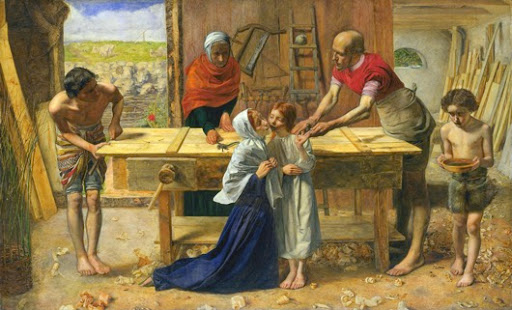
John Everett Millais Christ in the House of His Parents `The Carpenter s Shop Google Art Project s

Ahead of this October’s Synod on the Family, the Bishops of England and Wales have published a questionnaire about marriage and the family, in line with the recommendations issued at the end of last year’s Extraordinary Synod on the same subject. If you reside in England or Wales, I would very much encourage you to complete it, and if you live elsewhere, you might like to find out whether your local bishops’ conference is doing something similar.

Finally, in case you are interested, I would also like to share my own responses to this questionnaire, which I found to be a good opportunity for stopping and reflecting (although not in one go, obviously – I wrote these lines while taking a break from a basketball game with my sons, later while having a couple of minutes to myself before a supper and finally while waiting for a flight – continuity, sadly, is the stuff of fairytales :).

What are your joys and hopes of marriage and family life today?

To me the greatest source of joy with regard both to the family and marriage is the warmth and tenderness that can be experienced there. The family is where all its members can be free to express themselves unreservedly, to share their joys and sorrows, to develop their love for others and to know that their welcome by all in the family is unconditional. It is a place where difficulties can be overcome without judgment and where successes can be shared without envy. Above all though, marriage and the family are an openness to participating in the life of the Trinity: in mutual self-giving, in loving and being loved, that invite Jesus’ presence among those gathered together in His name

What are your struggles and fears of marriage and family life today?

The struggles and challenges that each member of a family faces individually are also a challenge for the family as a whole. Self-centeredness, isolation, indifference, consumerism, a lack of concern for the poor and a tendency to see what distinguishes at the expense of what unites are all prominent dangers. What makes them worse is if they are faced individually and without the benefit of the family or the relationship between spouses. And what makes them even more serious is if a family closes itself, instead of sharing its warmth and tenderness with those around it, if it only looks inside, instead of recognising the presence of God in all around them. These are the greatest dangers and fears I see today. 

How can we better understand marriage as a vocation?

By first understanding and responding to the vocation that follows from baptism and that consists in participation in Christ’s priestly, prophetic and royal nature. Only then can the membership in the mystical body of Christ that the Eucharist gives life to and the access to the Holy Spirit that follows from confirmation be understood and lived. And only on the basis of a conscious experience of these sacraments can an understanding of the sacramentality and vocational nature of marriage be understood and its choice, instead of the choice of other vocations, be discerned and made in alignment with the will of God. Both the putting into practice of the Gospel and a life-long learning of the faith are indispensable here.

  How does your marriage enrich you?

This is a question akin to asking about the benefits derived from oxygen. Getting married is an existential transformation that is followed by a new, joint being where the spouses are one. It is a monologue becoming dialogue, an individual participating in communion and a one that is not alone. It is a complementarity that is not self-sufficient or self-fulfilling but oriented towards God and neighbours instead. 

How does your family life enrich those around you?

This question would better be addressed to those around my family, while for us it is more of an examination of conscience. I hope those around us feel welcomed by us as they are and feel that we understand and don’t judge them. If we keep Jesus’ words and He makes His home with us, I hope we are able to share Him with those whom we meet. 

In what way, through the abiding presence of God, is your family “salt of the earth and light to the world,” and a place of and for handing on our faith?

By placing the Gospel at the heart of our family’s life: as a guiding light and explicit interpretative key for the events in our family and the world at large, as the motivation for our actions, as a mirror in which to identify our failings and as the inspiration for starting again and again with putting it into practice. 

Do you have any other comments?

I would like to express my wholehearted agreement with and support for Pope Francis’ words at the close of last year’s Extraordinary Synod on the Family, where he emphasised the need for the Church to be open to all, not ashamed of the wounds of our fallen brothers and sisters, and be “[t]he Church that has doors wide open to receive the needy, the repentant and not only the righteous or those who think they are perfect!”

Asymmetry

Polyhedron2

In Manila, Pope Francis returned to a concept that he first introduced in Evangelii Gaudium – that of the polyhedron being the ideal of social interaction instead of the, seemingly more perfect, sphere. There, speaking about “ideological colonization,” he said:

“[W]hen conditions are imposed by […] colonizing empires they seek to make peoples forget their own identity and make them (all) equal. This is the globalization of the sphere – all the points are equidistant from the center. But the true globalization […] is not the sphere. It is important to globalize […] not like the sphere, but like the polyhedron. Namely that every people, every part, conserves its own identity without being ideologically colonized.”

To make more sense of the sphere-polyhedron distinction, let’s go back to Evangelii Gaudium, where it is presented in the context of strategies for contributing to the common good and peace in society. There, Francis gives preference to time over space (§222-225), unity over conflict (§226-230), realities over ideas (§231-233) and finally the whole over the part. However, he is quick to argue that the part is not negated or subsumed in the whole, but that they mutually enrich each other (§235):

“The whole is greater than the part, but it is also greater than the sum of its parts. There is no need, then, to be overly obsessed with limited and particular questions. We constantly have to broaden our horizons and see the greater good which will benefit us all. But this has to be done without evasion or uprooting. We need to sink our roots deeper into the fertile soil and history of our native place, which is a gift of God. We can work on a small scale, in our own neighborhood, but with a larger perspective. Nor do people who wholeheartedly enter into the life of a community need to lose their individualism or hide their identity; instead, they receive new impulses to personal growth. The global need not stifle, nor the particular prove barren.”

And it is in the context of how the whole and its parts can be thought of without the former stifling the latter that the concept of the polyhedron comes into play (§236):

“Here our model is not the sphere, which is no greater than its parts, where every point is equidistant from the centre, and there are no differences between them. Instead, it is the polyhedron, which reflects the convergence of all its parts, each of which preserves its distinctiveness. Pastoral and political activity alike seek to gather in this polyhedron the best of each. There is a place for the poor and their culture, their aspirations and their potential. Even people who can be considered dubious on account of their errors have something to offer which must not be overlooked. It is the convergence of peoples who, within the universal order, maintain their own individuality; it is the sum total of persons within a society which pursues the common good, which truly has a place for everyone.”

Reading the above, I believe, that the image of a polyhedron also points to another fundamental feature, implicit in the distinction between sphere and polyhedron, which is that of asymmetry.

Purely on geometric grounds, an obvious distinction between a sphere and any polyhedron is that the former abounds in symmetry: an infinity of rotation symmetries around the sphere’s center, an infinity of reflection symmetries with respect to any plane containing the sphere’s center and a central point symmetry, also with respect to its center, not to mention a host of other symmetry groups. On the other hand, a polyhedron, in general, has no guaranteed symmetry whatsoever, where each of its vertices may relate to all the others in a unique way and where even subsets of the polyhedron’s vertices may form geometries distinct from those of other vertex subsets. As a result, the polyhedron formed by a set of vertices, edges and faces is both a unique whole and one whose nature depends on where each one of its components is located, potentially without any symmetry at all. In fact, the absence of symmetry can also be though of as an expression of the non-redundancy of the polyhedron’s parts, since any, even partial symmetries or repetitions would allow for a representation of the polyhedron that no longer requires a reliance on all of its parts. The sphere here represents an extreme, where the infinite continuum of points that form its surface can be reduced just to the coordinates of its center and its radius. Incidentally this line of thinking also resonates with Pope Francis’ early insistence on the importance of peripheries, expressed by him saying that “We understand reality better not from the center, but from the peripheries.” To understand a polyhedron requires traversing its vertices, edges and faces that form its perimeter, while a sphere can be “understood” from its center and radius, since its surface can be inferred from them, without ever being traversed.

Asymmetry not only means that each member is necessary for the identity of the resulting whole, but it is also a principle that is deeply embedded in Jesus’ life and teaching. His incarnation itself is vastly asymmetrical, since it is the infinite, unbounded God making Himself spatiotemporally finite, as is His death on the cross, where his one life is given “so that everyone who believes in him might not perish but might have eternal life.” (John 3:16). The all becomes one to save the many.

Jesus’ teaching too is full of asymmetry, starting with the following, emphatic passage:

“But to you who hear I say, love your enemies, do good to those who hate you, bless those who curse you, pray for those who mistreat you. To the person who strikes you on one cheek, offer the other one as well, and from the person who takes your cloak, do not withhold even your tunic. Give to everyone who asks of you, and from the one who takes what is yours do not demand it back.” (Luke 6:27-30)

In St. Matthew’s account of the same speech, we then hear Jesus adding: “If anyone wants to go to law with you over your tunic, hand him your cloak as well. Should anyone press you into service for one mile, go with him for two miles.” (Matthew 5:40-41).

Love-hate, bless-curse, pray-mistreat, strike-offer, take-give, tunic-tunic+cloak.

And the madness doesn’t stop there! The asymmetrical rewards offered in the parable of the workers in the vineyard have those who have worked a full day complain to the owner: “These last ones worked only one hour, and you have made them equal to us, who bore the day’s burden and the heat.” (Matthew 20:12). The pittance offered by a poor widow is valued above the large sums contributed by the rich (cf. Mark 12:41-44) and asymmetry is also at the heart of Jesus’ exhortation to “be shrewd as serpents and simple as doves” (Matthew 10:16).

Not only are action and reaction, action and reward asymmetrical, but asymmetry is at the very heart of God’s own inner life and at the core of love as such. The gratuity of love and the very concept of a gift hinge on asymmetry. I give without expecting anything in return, for if I did, my gift would not be a gift at all, but – at least implicitly – an exchange, a transaction, a symmetrical process. In the Trinity the Father gives all of Himself to the Son, without holding back or without requiring prior guarantees of equal recompense. The Son too gives Himself to the Father unreservedly and totally, making Himself nothing to Himself and all as gift to the Father. The Holy Spirit makes Himself empty unconditionally to allow for the love of the Father and the Son to find space in Him. Each Person of the Trinity is ultimately asymmetrical: a gift of self outside oneself, for the other; nothing and everything. It is only on this asymmetry that Father, Son and Holy Spirit are one – a one that is dynamic (instead of being static), varied (instead of being monotonous) and communion (instead of being regimented).

A consequence of the asymmetry of love is also a difference in what to expect of oneself versus others. For my actions to be gratuitous and an expression of love, their end must remain their being love, gift and a benefit for the other. If they get reciprocated, my neighbor and I share in the life of the Trinity and we become one without either of us being annihilated.

I believe it is for these same reasons that St. John Paul II used to say: “Be strict to yourself and lenient with everyone else.” and that I choose to constrain what I say and do, out of love for my neighbors, without wanting to impose those same constraints on them. For by imposing them, I would preclude them from freely choosing to self-apply them out of love for me.

Jesus the blasphemer

After the Charlie Hebdo attack, I was struck by a tweet from the Protestant theologian and Yale professor, Miroslav Volf:

“Jesus was crucified for “blasphemy.” Blasphemers should not be crucified, or killed, or punished in any way.”

This assertion of Jesus having been a blasphemer stopped me in my tracks, as I have never thought of him in that way. Good Shepherd, Son of God, Paschal Lamb, and Word Made Flesh would ring a bell, but not Blasphemer. Then, I started thinking about all the offense Jesus has caused during his lifetime: fraternizing with tax collectors and prostitutes (cf. Luke 5:27-32), healing the sick on the Sabbath (cf. Mark 3:1-6), having his disciples eat corn without washing their hands (cf. Mark 7:2), making ludicrous claims about rebuilding the temple in Jerusalem in three days (cf. John 2:19), and even his death on a cross was perceived as a scandal (cf. 1 Corinthians 1:23) … And how did his listeners react? Exactly as Pope Francis suggested recently – with threats and violence, to the point of dragging Jesus to the edge of a cliff and wanting to throw him to his death (cf. Luke 4:29), or to making him fear for his life to the point of deciding to hide from the people he scandalized and who were about to stone him (cf. John 8:59).

Suddenly adding blasphemy to the list doesn’t seem like such a stretch, and in fact the Gospel accounts of Jesus’ trial clearly state that this was the charge brought against him.

When questioned by the Sanhedrin during the night at the start of Good Friday, the high priest commanded Jesus: “I order you to tell us under oath before the living God whether you are the Messiah, the Son of God.” (Matthew 26:63), to which Jesus responded: “You have said so. But I tell you: From now on you will see ‘the Son of Man seated at the right hand of the Power’ and ‘coming on the clouds of heaven.’” (Matthew 26:64). Jesus’ words then triggered the following scene:

““Then the high priest tore his robes and said, “He has blasphemed! What further need have we of witnesses? You have now heard the blasphemy; what is your opinion?” They said in reply, “He deserves to die!” (Matthew 26:65-66)

The determination of Jesus’ blasphemer status is then presented to Pilate by his accusers as the grounds for having the secular powers of the Roman Empire put him to death: “We have a law, and according to that law he ought to die, because he made himself the Son of God.” (John 19:7)

The above may seem pretty cut-and-dried, but, like all legal arguments, it too is just that – arguable. Here the New American Bible has the following, interesting note on Jesus’ blasphemy, as a commentary on the passage about his hearing before the Sanhedrin:

Blasphemed: the punishment for blasphemy was death by stoning (see Leviticus 24:10–16). According to the Mishnah, to be guilty of blasphemy one had to pronounce “the Name itself,” i.e., Yahweh […]. Those who judge the gospel accounts of Jesus’ trial by the later Mishnah standards point out that Jesus uses the surrogate “the Power,” and hence no Jewish court would have regarded him as guilty of blasphemy; others hold that the Mishnah’s narrow understanding of blasphemy was a later development.”

The spirit of what Jesus said certainly qualified as blasphemy, while the letter may have been arguable. Nonetheless, this guy, who was going around Galilee and Judea, telling everyone he was the Son of God, was guilty – a blasphemer! – and had to be killed. It’s the law. The Bible say so …

Now, you may ask yourself, where am I going wit all of this? And that brings us to Charlie Hebdo and other brutal murders of those who speak out against oppressors of free speech, whether they be religious or atheist regimes (and, sadly, there are plenty of examples of both, both in the present and the past). In the case of Charlie Hebdo too we have a bunch of blasphemers, depicting what the law decries as insulting and blasphemous, and law-abiding believers doing their bit for the law’s just punishment being meted out.

Is what the Charlie Hebdo murderers have done consistent with how the vast majority of Muslims understand Islam? Is what Charlie Hebdo have been publishing detestable, crude and inciting of hatred?

Regardless of how those questions are answered (and I’d say “no” and “in some cases, yes”), the first order of business has to be a defense of the freedom of speech – and not just the freedom of “good” speech. Is this an argument for all speech being equal? Absolutely not! And neither is it an expression of support for what publications like Charlie Hebdo have been doing. Instead it is an insistence on the absolute value of free speech. And once that is given, arguments against expressions like Charlie Hebdo can be made (and must be made). Arguments to convince their listeners and readers of such offensive expressions being contrary to the common good, risking an angry (albeit wrong!) response, and not being the most efficacious ways of fighting against oppression, corruption or bigotry. But these must be arguments made on the foundation of free speech where its limiting to “good” free speech becomes a choice of the individual and not the imposed dictate of a legislative regime that is enforced at all cost, including the administration of death.

Making freedom of speech about “good” speech turns it into its opposite, as is clear both from fictional (although chillingly prophetic) accounts like George Orwell’s 1984 and the enforced superficial innocuousness of public speech in 20th century communist regimes, where everything was wonderful, according to plan, fraternal and equal. Unless you made fun of it that is … in which case you’d qualify for a “Golden Bars” award (bars that were not golden, but embedded in prison walls instead). And the distortions of political correctness that grip many countries today are a scarily similar phenomenon. Only two days ago did I hear the following here in the US, in response to showing a historical photo of a Native American during a presentation to illustrate that a certain process was native to its context: “Um … You should be careful about saying “native.” It is a very sensitive term here. Saying Red Indian or chief or similar can be offensive. Some sports teams here have already changed their names not to offend.” My colleague then proceeded to tiptoe around such a sensitive topic and ended up using the term “native” as a non-offensive way of referring to this whole faux pas of mine – the exact term that initially triggered the friendly advice.

Freedom of speech is clearly a complex question and it is easy to come up with examples of things that shouldn’t be said (e.g., racist slurs), that shouldn’t be made fun of (e.g., genocide), that should not be promoted (e.g., violence or exploitation). And I would unquestionably agree with that and support very specific, narrow constraints on freedom of speech. However, the easy solution of criminalizing whole categories of verbal expression brings with it great dangers in that those same legal instruments may be abused for very different ends. The extremes here are totalitarian regimes that criminalize any criticism of themselves and that consider any such criticism an offense against the common good that their leaders embody. In our democratic societies too there are dangers, where governments have been prone to overstep their remits and where legislation to prevent terrorism has enabled infringements of privacy and the gagging or undermining of critical voices. A society that cannot handle hearing ideas it disagrees with will eventually descend into fear and caution, rendering speech lukewarm. Speech that becomes barely worthy of being spat out.

I am therefore wholeheartedly with Volf: “Blasphemers should not be crucified, or killed, or punished in any way.” Instead, they should be challenged and engaged with in the same free speech context they employ and, who knows, maybe such engagement (instead of a silencing by law or bullets) could let all discover each other’s brothers and sisters on the other side of the argument.

The Parable of the Good Lesbian

Good samaritan

A very good friend of mine, MK, wrote the following on Facebook a couple of days ago: “I think that if Jesus was telling the parable of the good Samaritan today, maybe it would be the parable of the good gay.” And, as soon as I saw it, I “liked” it, since it seemed to fit Jesus’ choice of profile for that particular parable character like a glove – i.e., as someone who is frowned upon, mistrusted and seen as repulsive by “good” God-fearing folk, and with whom there is an us-versus-them that needs to be undermined.

A short while later I noticed that MK’s Facebook status had received 43 comments, dominated by outrage, exhortations to read St. Paul (undoubtedly a good idea, and one, which that comment’s author should also self-apply) and a bandying-about of phrases like “the truth of Christ” (as if there were different flavors of truth). There were also reasonable comments, but these formed a small minority among the sea of tirades that followed the outrageous suggestion that homosexuals could be thought of as today’s equivalent of first-century Judea’s Samaritans.

My immediate reaction to seeing this was to look more closely at the Good Samaritan parable and get a sense of how well founded MK’s suggestion for its contemporary adaptation is – not so much for the sake of assessing its reasonableness (which had intuitive appeal to me from the start), but to get a more specific sense of its context and exegesis.

To get an idea of how Jews and Samaritans got on with each other, Blessed John Henry Newman provides the following summary, after giving an account of mutual killings between the two peoples:

“[… T]he strongest expression of hatred the Jews could invent against Christ was ‘Thou art a Samaritan and hast a devil’ (John 8:48). [… I]f a Jew and a Samaritan met in a narrow way, they were particularly careful to avoid touching each fearing to receive pollution from the other.”

Saying “Samaritan” in the first century AD to an audience of Jewish lawyers (as Jesus – and, lets not forget, himself a Jew, did), seems to have been the same kind of trigger as saying “gay” is today to my friend’s “Christian” contacts. 1:0 to MK – the glove does indeed seem to fit.

Let me next take a look at how the last three popes have read this parable and see whether that sheds light on the transposition proposed by my friend.

St. John Paul II spoke at length about the Parable of the Good Samaritan in his apostolic letter on suffering, Salvifici Doloris (§28):

“The parable of the Good Samaritan belongs to the Gospel of suffering. For it indicates what the relationship of each of us must be towards our suffering neighbour. We are not allowed to “pass by on the other side” indifferently; we must “stop” beside him. Everyone who stops beside the suffering of another person, whatever form it may take, is a Good Samaritan. This stopping does not mean curiosity but availability. It is like the opening of a certain interior disposition of the heart, which also has an emotional expression of its own. The name “Good Samaritan” fits every individual who is sensitive to the sufferings of others, who “is moved” by the misfortune of another. If Christ, who knows the interior of man, emphasizes this compassion, this means that it is important for our whole attitude to others’ suffering. Therefore one must cultivate this sensitivity of heart, which bears witness to compassion towards a suffering person. Some times this compassion remains the only or principal expression of our love for and solidarity with the sufferer.

Nevertheless, the Good Samaritan of Christ’s parable does not stop at sympathy and compassion alone. They become for him an incentive to actions aimed at bringing help to the injured man. In a word, then, a Good Samaritan is one who brings help in suffering, whatever its nature may be. Help which is, as far as possible, effective. He puts his whole heart into it, nor does he spare material means. We can say that he gives himself, his very “I”, opening this “I” to the other person. Here we touch upon one of the key-points of all Christian anthropology. Man cannot “fully find himself except through a sincere gift of himself” (Gaudium et Spes, 24). A Good Samaritan is the person capable of exactly such a gift of self.”

What strikes me here immediately are two things: first, the deep-seated universality of St. John Paul II’s words, addressed to “each of us,” “everyone,” “every individual,” where “Good Samaritan” status is predicated only on one’s capacity for “a gift of self.” Second, the imperative nature of his words which insist both on what we must do (being sensitive to, moved by and helping our suffering neighbors; being compassionate and self-giving) and what we are not allowed to do: be indifferent. This exegesis too easily extends to homosexuals, who are undoubtedly in a position of showing compassion to those around them and of selflessly coming to their aid.

Pope Benedict XVI adds further clarity to this universally-predicated imperative to love, in his exceptional piece of thinking: the encyclical Deus Caritas Est:

“14. […] Union with Christ is also union with all those to whom he gives himself. I cannot possess Christ just for myself; I can belong to him only in union with all those who have become, or who will become, his own. […] We become “one body”, completely joined in a single existence. Love of God and love of neighbour are now truly united: God incarnate draws us all to himself. […] the “commandment” of love is only possible because it is more than a requirement. Love can be “commanded” because it has first been given.

15. This principle is the starting-point for understanding the great parables of Jesus. […] The parable of the Good Samaritan (cf. Lk 10:25-37) offers two particularly important clarifications. Until that time, the concept of “neighbour” was understood as referring essentially to one’s countrymen and to foreigners who had settled in the land of Israel; in other words, to the closely-knit community of a single country or people. This limit is now abolished. Anyone who needs me, and whom I can help, is my neighbour. The concept of “neighbour” is now universalized, yet it remains concrete. Despite being extended to all mankind, it is not reduced to a generic, abstract and undemanding expression of love, but calls for my own practical commitment here and now. The Church has the duty to interpret ever anew this relationship between near and far with regard to the actual daily life of her members.”

For me, the most significant aspect of this passage is Benedict’s insistence on love being a commandment and on the justification of its imperative status being the precedent of God’s love. Since the source of this “obligation” to love is inexhaustible, its scope too is universal (as St. John Paul II already made clear). Furthermore, Benedict also calls for a keeping current of what such universality means in the present. This is very much in line with the current process of discernment underway in the Catholic Church, which is on the road to the second Synod on the Family this October. Specifically, the challenges of how to provide opportunities for homosexuals to feel part of the Church are on the table there too, which is easily read as an instance of Benedict’s “interpret[ing] ever anew this relationship between near and far.”

Finally, let’s hear what Pope Francis has to say about this parable:

“The Gospel passage from St Luke (10:25-37) tells of a certain man, half dead, who had been thrown into the street. Now by chance a priest was going down that road. A good priest, in his cassock: good, very good. He saw him and looked: I’ll be late for Mass, and he went on his way. He didn’t hear the voice of God there”. […] It is curious to note that only a man who habitually fled from God, a sinner, the Samaritan, was the very one who perceived the voice of God. He drew near to the man. He bound up his wounds, pouring on oil and wine; then he set him on his own beast. Oh how much time he lost: he brought him to an inn, and took care of him. He lost the whole evening! In the meantime, the priest arrived in time for the Holy Mass and all the faithful were content.

Why did the priest flee from God? Because his heart was closed. When your heart is closed you cannot hear the voice of God. Instead, it was a Samaritan on a journey who saw the wounded man and had compassion. His heart was opened, he had a human heart. His humanity enabled him to draw near.

The priest had a plan for his life: he wanted to write his own history well, according to God’s ways. But he was the one writing it. However, this other sinner allowed God to write the history of his life. He changed all his plans that evening because the Lord placed before him this poor, wounded man who had been thrown out onto the street.

I ask myself and I also ask you: do we allow God to write the history of our lives or do we want to write it? This speaks to us of docility: are we docile to the Word of God? Yes, I want to be docile, but are you able to listen to his Word, to hear it? Are you able to find the Word of God in the history of each day, or do your ideas so govern you that you do not allow the Lord to surprise you and speak to you?”

What strikes me here is the supremacy of openness over righteousness. Making oneself the ultimate judge (+ jury & executioner), instead of opening oneself up to discerning the will of God and listening to the promptings of the Holy Spirit through one’s conscience, leads to a spoiling even of things that are good in themselves and to an assumption of ultimate power by an imperfect subject. Instead, the admission of sinfulness, that Pope Francis (and before him the saints universally) has made for himself and that each one of us can recognize in our own lives, if we are sincere enough, helps us both to recognize brothers and sisters in all, without exception, and to open ourselves up to God’s surprises.

Pope Francis’ Universe

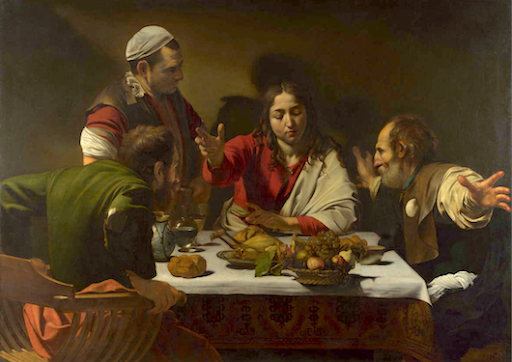
Caravaggio

As I outlined in the first installment of this series, I am in the process of looking at how the universe is being thought of from different perspectives and by thinkers of different backgrounds. After a brief look at Chiara Lubich’s intellectual visions concerning creation, I would now like to share a high-level view of how Pope Francis has been speaking about this topic.

The first thing to note is that he uses the terms “universe,” “creation,” and “nature” (with the odd mention of “cosmos”) interchangeably, while referring to social, economic and cultural spheres when speaking about the “world.” With this categorization, we can look at what Francis thinks the universe is, how he speaks about approaching and understanding it, what value he gives it and what relationship he proposes for us to have with it.

The most important point in terms of which to read all that follows is the intimate relationship Francis sees between God and “the universe, the precious gift of the Creator”:

“[T]he Holy Trinity […] leads us to contemplate and worship the divine life of the Father, the Son and the Holy Spirit: a life of communion and perfect love, origin and aim of all the universe and of every creature: God.” (Angelus, 15th June 2014)

Not only is the universe God’s gift to us and a gift that has both source and destination in the inner life of the Trinity, but it is also permeated by God’s presence:

“God and Christ walk with us and are present also in nature, as the Apostle Paul affirmed in his address at the Areopagus: “In Him we live and move and have our being” (Acts 17:28). When we read in Genesis the account of Creation, we risk imagining that God was a magician, with such a magic wand as to be able to do everything. However, it was not like that. He created beings and left them to develop according to the internal laws that He gave each one, so that they would develop, and reach their fullness. He gave autonomy to the beings of the universe at the same time that He assured them of his continual presence, giving being to every reality.” (Address to Pontifical Academy of Sciences, 27th October 2014)

God is paradoxically, simultaneously present throughout the universe, giving it being, and at the same time investing it with laws and autonomy. He desires its development, but remains close to his creation. Francis then, in the same speech, elaborates on the significance of these God-given laws of nature:

“The beginning of the world was not the work of chaos, which owes its origin to another, but it derives directly from a Supreme Principle who creates out of love. The Big-Bang, that is placed today at the origin of the world, does not contradict the divine intervention but exacts it. The evolution in nature is not opposed to the notion of Creation, because evolution presupposes the creation of beings that evolve.”

The world is not arbitrary, but has order, which it turn leads to repeatability and therefore rationality, making the universe knowable – an aspect of God’s gift that Francis values highly, and about which he speaks in the context of its relationship with faith and truth in the encyclical Lumen Fidei (§34):

“A common truth intimidates us, for we identify it with the intransigent demands of totalitarian systems. But if truth is a truth of love, if it is a truth disclosed in personal encounter with the Other and with others, then it can be set free from its enclosure in individuals and become part of the common good. [… F]aith is not intransigent, but grows in respectful coexistence with others. One who believes may not be presumptuous; on the contrary, truth leads to humility, since believers know that, rather than ourselves possessing truth, it is truth which embraces and possesses us. Far from making us inflexible, the security of faith sets us on a journey; it enables witness and dialogue with all. Nor is the light of faith, joined to the truth of love, extraneous to the material world, for love is always lived out in body and spirit; the light of faith is an incarnate light radiating from the luminous life of Jesus. It also illumines the material world, trusts its inherent order and knows that it calls us to an ever widening path of harmony and understanding. The gaze of science thus benefits from faith: faith encourages the scientist to remain constantly open to reality in all its inexhaustible richness. Faith awakens the critical sense by preventing research from being satisfied with its own formulae and helps it to realize that nature is always greater. By stimulating wonder before the profound mystery of creation, faith broadens the horizons of reason to shed greater light on the world which discloses itself to scientific investigation.”

Believing in God being the creator of the universe is not an alternative to a scientific world view, but its enabler for the Christian scientist, who trusts in the inherent order of their object of inquiry and who responds to God’s invitation to know Him also through His creation. Francis elaborates on this point in his apostolic exhortation Evangelii Gaudium (§242-243), also calling for a multidisciplinary approach to understanding the universe:

“Whereas positivism and scientism “refuse to admit the validity of forms of knowledge other than those of the positive sciences”,[190] the Church proposes another path, which calls for a synthesis between the responsible use of methods proper to the empirical sciences and other areas of knowledge such as philosophy, theology, as well as faith itself […]. Faith is not fearful of reason; on the contrary, it seeks and trusts reason, since “the light of reason and the light of faith both come from God”[191] and cannot contradict each other. […]

The Church has no wish to hold back the marvellous progress of science. On the contrary, she rejoices and even delights in acknowledging the enormous potential that God has given to the human mind. Whenever the sciences – rigorously focused on their specific field of inquiry – arrive at a conclusion which reason cannot refute, faith does not contradict it. […]”

In fact, on a separate occasion, Francis puts the Church’s appreciation of science in maternal terms: “as a mother rejoices and is rightly proud as her children grow “in wisdom, and age and grace” (Lk 2:52)” and adds art to the modes of engagement with the universe, saying:

“In every age the Church has called upon the arts to give expression to the beauty of her faith and to proclaim the Gospel message of the grandeur of God’s creation, the dignity of human beings made in his image and likeness, and the power of Christ’s death and resurrection to bring redemption and rebirth to a world touched by the tragedy of sin and death.”

The sense of awe and wonder that drive both rational and artistic engagement with the universe (for believers and non-believers alike) is further emphasized in one of Francis’ catecheses about the Holy Spirit:

“When our eyes are illumined by the Spirit, they open to contemplate God, in the beauty of nature and in the grandeur of the cosmos, and they lead us to discover how everything speaks to us about Him and His love. All of this arouses in us great wonder and a profound sense of gratitude! It is the sensation we experience when we admire a work of art or any marvel whatsoever that is borne of the genius and creativity of man: before all this, the Spirit leads us to praise the Lord from the depths of our heart and to recognize, in all that we have and all that we are, an invaluable gift of God and a sign of his infinite love for us.”

And to round out this picture of how a knowledge of the universe complements faith, it is worth reading Pope Francis’ words from this year’s Epiphany homily, where he places the two side-by-side as “great books”:

“[O]ur life is a journey, illuminated by the lights which brighten our way, to find the fullness of truth and love which we Christians recognize in Jesus, the Light of the World. [… E]very person has two great “books” which provide the signs to guide this pilgrimage: the book of creation and the book of sacred Scripture. What is important is that we be attentive, alert, and listen to God who speaks to us, who always speaks to us.”

Pope Francis also points to Jesus himself having made use of this “book of creation” in his own teaching:

“When he speaks to the people, Jesus uses many parables: in language understandable to everyone, with images from nature and from everyday situations.”

Far from being optional or even frowned upon, knowledge of the material world is a guide to the Christian as is that of Scripture, which is further underlined by the universe being seen as good (as opposed to evil or even just neutral):

“In the first Chapter of Genesis, right at the beginning of the Bible, what is emphasized is that God is pleased with his creation, stressing repeatedly the beauty and goodness of every single thing. At the end of each day, it is written: “God saw that it was good” (1:12, 18, 21, 25): if God sees creation as good, as a beautiful thing, then we too must take this attitude and see that creation is a good and beautiful thing.” (General Audience, 21st May 2014)

““And God saw that it was good” (Gen 1:12, 18, 21, 25). The biblical account of the beginning of the history of the world and of humanity speaks to us of a God who looks at creation, in a sense contemplating it, and declares: “It is good”.” (Vigil for Peace, 7th September 2013)

What then ought to be our attitude towards a universe that we can relate to in truth (through knowledge), beauty (through the senses and art) and goodness (through contemplation)? Francis’ answer, unsurprisingly, is “respect and gratitude”:

“[I]f God sees creation as good, as a beautiful thing, then we too must take this attitude and see that creation is a good and beautiful thing. […] Creation is not some possession that we can lord over for our own pleasure; nor, even less, is it the property of only some people, the few: creation is a gift, it is the marvellous gift that God has given us, so that we will take care of it and harness it for the benefit of all, always with great respect and gratitude. […] We must protect creation for it is a gift which the Lord has given us, it is God’s present to us; we are the guardians of creation. When we exploit creation, we destroy that sign of God’s love. To destroy creation is to say to God: “I don’t care”. And this is not good: this is sin.”

An important aspect here is the harnessing of the universe for the good of all, which Francis also ties to the universe’s “grammar”:

“The human family has received from the Creator a common gift: nature. The Christian view of creation includes a positive judgement about the legitimacy of interventions on nature if these are meant to be beneficial and are performed responsibly, that is to say, by acknowledging the “grammar” inscribed in nature and by wisely using resources for the benefit of all, with respect for the beauty, finality and usefulness of every living being and its place in the ecosystem. Nature, in a word, is at our disposition and we are called to exercise a responsible stewardship over it.”

And on another occasion he then links the care for nature to the care we must have for one another:

“All of creation forms a harmonious and good unity, but above all humanity, made in the image and likeness of God, is one family, in which relationships are marked by a true fraternity not only in words: the other person is a brother or sister to love, and our relationship with God, who is love, fidelity and goodness, mirrors every human relationship and brings harmony to the whole of creation. God’s world is a world where everyone feels responsible for the other, for the good of the other.”

In summary, Francis’ universe is a gratuitous gift from God whose being He sustains and in which He is close to us, but also where He instituted laws and, at the same time, autonomy. It is a gift that has its origin and being in God and its destiny too, via its being harnessed for the good of all. It is a gift that exhibits goodness and beauty and whose nature can be expressed in truth. As a result it invites respectful stewardship for the good of all, contemplation and rational understanding. Francis, using a rich metaphor, therefore issues an “appeal for respect and protection of the entire creation which God has entrusted to man, not so that it be indiscriminately exploited, but rather made into a garden.”

Synod14: A reality check

Francis synod

If you are a regular on this blog, you’ll know that I have been following the Extraordinary Synod on the Family very closely. I have seen all the press conferences, read all the documents, watched all the interviews, waded through the, sadly mostly morass, of tweets tagged with #synod14, and have written blog posts daily. At the end of the Synod’s two weeks, I felt a great sense of joy and I delighted at the whole process, which, to my mind, was an example of a shared journey, of transparency, and of a group of bishops and lay people striving for the good of the family, with a tremendous sense of seriousness and honesty.

When I then read the first reports on Saturday evening, and then during the course of today in the general press, about what this Synod has arrived at, I have to admit that I came away from them with disappointment. I shouldn’t have been that naive, since this seems to be the norm in how anything moderately nuanced gets reported. From the perspective of the media, the result has been some variant of the following Guardian headline: “Catholic bishops veto gay-friendly statements leaving Pope Francis the loser.”

What I have seen over the last two weeks couldn’t be further from a loss for Pope Francis, first of all because that is a meaningless way of looking at the situation. And even if one were to apply the loss/victory categories to the Synod, the opposite would be my conclusion. Let me therefore lay out what I believe just happened, in as blunt terms as I can, and, please, bear with me while I take a couple of steps back to do this picture justice.

In the beginning was the Word …

No, let me not go back that far just yet (although that verse from the Johannine prologue is highly relevant to one of the keys to the Synod that I will return to in a later post) and instead start with a thought from Pope Benedict XVI’s resignation letter, where he assesses the current situation in the world as follows:

“[T]oday’s world [is] subject to so many rapid changes and shaken by questions of deep relevance for the life of faith”

Questions of deep relevance need to be addressed and Benedict does not have the strength to do it. So, he does what a true servant of servants must, and vacates the See of Peter. A conclave is called and cardinals present their visions for the Church. One Jorge Bergoglio presents the following program:

“Holy Week challenges us to step outside ourselves so as to attend to the needs of others: those who long for a sympathetic ear, those in need of comfort or help. We should not simply remain in our own secure world, that of the ninety-nine sheep who never strayed from the fold, but we should go out, with Christ, in search of the one lost sheep, however far it may have wandered.”

He gets elected Pope Francis and, the next day, in his first address to the cardinals since his election he declares:

“[A]ll together, pastors and faithful, we will make an effort to respond faithfully to the eternal mission: to bring Jesus Christ to humanity, and to lead humanity to an encounter with Jesus Christ: the Way, the Truth and the Life, truly present in the Church and, at the same time, in every person.”

Then follow months of Francis putting his mission to welcome and accompany not only every single person who comes his way, but to go out of his way to reach out to those who may feel far from the Church. His correspondence with the atheist Eugenio Scalfari, his iPhone video to Evangelical Christians in the US and his resounding “Who am I to judge them?” with regard to gays are just a couple of examples off the top of my head.

Eight months after his election and to drive home the message that being a Church that is open and welcoming of all is a must, Francis pens the magnificent apostolic exhortation Evangelii Gaudium – a magisterial document of the Catholic Church, where he declares in the section entitled “A mother with an open heart” that:

“Everyone can share in some way in the life of the Church; everyone can be part of the community, nor should the doors of the sacraments be closed for simply any reason. This is especially true of the sacrament which is itself “the door”: baptism. The Eucharist, although it is the fullness of sacramental life, is not a prize for the perfect but a powerful medicine and nourishment for the weak.[51] These convictions have pastoral consequences that we are called to consider with prudence and boldness. Frequently, we act as arbiters of grace rather than its facilitators. But the Church is not a tollhouse; it is the house of the Father, where there is a place for everyone, with all their problems.” (§47)

A whole year later, and a year where an outreach to the peripheries, an openness to all, regardless of how “proper” or well-ordered their lives are, have been Francis’ daily mission, he has the following to say on the eve of the Synod – just in case someone hasn’t been listening during the preceding year and a half:

“The temptation to greed is ever present. We encounter it also in the great prophecy of Ezekiel on the shepherds (cf. ch. 34), which Saint Augustine commented upon in one his celebrated sermons which we have just reread in the Liturgy of the Hours. Greed for money and power. And to satisfy this greed, evil pastors lay intolerable burdens on the shoulders of others, which they themselves do not lift a finger to move (cf. Mt 23:4)

We too, in the Synod of Bishops, are called to work for the Lord’s vineyard. […] We are all sinners and can also be tempted to “take over” the vineyard, because of that greed which is always present in us human beings. God’s dream always clashes with the hypocrisy of some of his servants. We can “thwart” God’s dream if we fail to let ourselves be guided by the Holy Spirit. The Spirit gives us that wisdom which surpasses knowledge, and enables us to work generously with authentic freedom and humble creativity.

My Synod brothers, to do a good job of nurturing and tending the vineyard, our hearts and our minds must be kept in Jesus Christ by “the peace of God which passes all understanding” (Phil 4:7). In this way our thoughts and plans will correspond to God’s dream: to form a holy people who are his own and produce the fruits of the kingdom of God (cf. Mt 21:43).”

Note two things about what Francis says here: First, God’s dream is a holy people who are his own and who are looked after by his servants, servants who are not to overburden them. Second, he quotes Scripture and a saint to them [remember this for contrast with how he speaks to the Synod Fathers after the Synod].

A week of the Synod later, during which Francis attends almost every single session (skipping one due to the General Audience on the Wednesday), but during which he does not intervene, the interim report of the Synod is published – written by Archbishop Bruno Forte, whom Francis directly appointed to the job of doing so. What does the interim report (the “relatio post disceptationem”) say? Well, amongst other things:

“[I]t is the task of the Church to recognize those seeds of the Word that have spread beyond its visible and sacramental boundaries. Following the expansive gaze of Christ, whose light illuminates every man (cf. Jn 1,9; cf. Gaudium et Spes, 22), the Church turns respectfully to those who participate in her life in an incomplete and imperfect way, appreciating the positive values they contain rather than their limitations and shortcomings. […]

In this respect, a new dimension of today’s family pastoral consists of accepting the reality of civil marriage and also cohabitation, taking into account the due differences. Indeed, when a union reaches a notable level of stability through a public bond, is characterized by deep affection, responsibility with regard to offspring, and capacity to withstand tests, it may be seen as a germ to be accompanied in development towards the sacrament of marriage. […]

Homosexuals have gifts and qualities to offer to the Christian community: are we capable of welcoming these people, guaranteeing to them a fraternal space in our communities? Often they wish to encounter a Church that offers them a welcoming home. Are our communities capable of providing that, accepting and valuing their sexual orientation, without compromising Catholic doctrine on the family and matrimony?”

The Pope listened to everyone speaking their mind and then had “his man” pen the key takeaways – recognize a participation in the life of the Gospel no matter under what circumstances it happens, be welcoming, look for ways for everyone, who wants to, to find their place in the Church.

A week later, during which significant resistance is shown by some cardinals to the interim report, a final report is produced that tones down the interim reports’ language, but that still speaks about all the topics mentioned in the interim report. The final report is voted on paragraph by paragraph, but instead of only those paragraphs that have reached the 2/3 majority needed for them to be official proposals from the Synod to the Pope, all paragraphs are published on the Pope’s orders, including the data on how many votes each paragraph received. The purpose of this final document of the Extraordinary Synod on the Family is that it sets the agenda for the work of this, next year that leads to the Ordinary Synod on the Family in October 2015. Keeping all topics from the interim report in the final report means that they will get discussed both over the course of this year and at the next Synod.

Is that the end of the story? Not at all! What Pope Francis does next is to completely upstage the final report of the Synod, by delivering an amazing closing speech. Why does he do that? Because this Synod is not about its final document – it is the kick-off for a year of discernment and work towards the next Synod, after which proposals are going to be made to the Pope.

So, what did Pope Francis say at the end of this year’s Synod? First, he thanked all for their great effort and then he moved straight to telling them the temptations he saw them struggle with: “the temptation of hostile rigidity,” “the temptation of destructive do-goodery,” “the temptation to turn stone into bread and also to turn bread into stone,” “the temptation to come down from the cross” and “the temptation to neglect the “deposit of faith” and the temptation to ignore reality.” Ouch!

Then he proceeds to spell out, yet again!, what he is looking for:

“And this is the Church, the Lord’s vineyard, the fertile Mother and caring [female] Teacher, who is not afraid to roll up her sleeves to pour oil and wine on the wounds of men (cf. Lk 10: 25-37); who does not look at humanity from a glass castle to judge or categorize people. This Church is the One, Holy, Catholic, Apostolic and composed of sinners, in need of His mercy. This is the Church, the true bride of Christ, seeking to be faithful to her spouse and to his doctrine. It is the Church who is not afraid of eating and drinking with prostitutes and tax collectors (Luke 15). The Church that has doors wide open to receive the needy, the repentant and not only the righteous or those who think they are perfect! The Church that is not ashamed of the fallen brother and does not pretend not to see him, what’s more, she feels involved and almost obliged to raise him and encourage him to continue his journey, and she accompanies him to the final encounter with her ​​Spouse, in the heavenly Jerusalem.”

But he doesn’t leave it there and in true Steve Jobs fashion pulls a “one more thing”:

“We will speak a little bit about the Pope, now, in relation to the Bishops [laughing]. So, the duty of the Pope is that of guaranteeing the unity of the Church; it is that of reminding the faithful of their duty to faithfully follow the Gospel of Christ; it is that of reminding the pastors that their first duty is to nourish the flock – to nourish the flock – that the Lord has entrusted to them, and to seek to welcome – with fatherly care and mercy, and without false fears – the lost sheep. I made a mistake here. I said welcome: [rather] to go out and find them.”

Francis pulls a great in-joke here, since the word “welcome” as applied to homosexuals was one of the most contested points in the interim report. Note the serrated edge that the above (“I made a mistake here. I said welcome”) gets in light of what Francis says at the end of his speech. First, however, he reads to them from one of Benedict XVI’s General Audiences:

“His duty is to remind everyone that authority in the Church is a service, as Pope Benedict XVI clearly explained, with words I cite verbatim: “The Church is called and commits herself to exercise this kind of authority which is service and exercises it not in her own name, but in the name of Jesus Christ… through the Pastors of the Church, in fact: it is he who guides, protects and corrects them, because he loves them deeply. But the Lord Jesus, the supreme Shepherd of our souls, has willed that the Apostolic College, today the Bishops, in communion with the Successor of Peter… to participate in his mission of taking care of God’s People, of educating them in the faith and of guiding, inspiring and sustaining the Christian community, or, as the Council puts it, ‘to see to it… that each member of the faithful shall be led in the Holy Spirit to the full development of his own vocation in accordance with Gospel preaching, and to sincere and active charity’ and to exercise that liberty with which Christ has set us free (cf. Presbyterorum Ordinis, 6)… and it is through us,” Pope Benedict continues, “that the Lord reaches souls, instructs, guards and guides them. St Augustine, in his Commentary on the Gospel of St John, says: ‘let it therefore be a commitment of love to feed the flock of the Lord’ (cf. 123, 5); this is the supreme rule of conduct for the ministers of God, an unconditional love, like that of the Good Shepherd, full of joy, given to all, attentive to those close to us and solicitous for those who are distant (cf. St Augustine, Discourse 340, 1; Discourse 46, 15), gentle towards the weakest, the little ones, the simple, the sinners, to manifest the infinite mercy of God with the reassuring words of hope (cf. ibid., Epistle, 95, 1).”

In other words, Francis is saying: what I have set out before you at the beginning of the Synod is pretty much what Benedict asked of you four years ago and what I have been telling you day in, day out, for the last year and a half.

And, just to sharpen the point a touch – and make it more directly understandable for those who have been misusing the law as a veto against accepting change – Francis concludes by quoting canon law to them (a. k. a. reading them the riot act!):

“So, the Church is Christ’s – she is His bride – and all the bishops, in communion with the Successor of Peter, have the task and the duty of guarding her and serving her, not as masters but as servants. The Pope, in this context, is not the supreme lord but rather the supreme servant – the “servant of the servants of God”; the guarantor of the obedience and the conformity of the Church to the will of God, to the Gospel of Christ, and to the Tradition of the Church, putting aside every personal whim, despite being – by the will of Christ Himself – the “supreme Pastor and Teacher of all the faithful” (Can. 749) and despite enjoying “supreme, full, immediate, and universal ordinary power in the Church” (cf. Cann. 331-334).”

Boom! Oh, you think my saying “welcoming” was a “mistake”? Think again.

“Catholic bishops veto gay-friendly statements leaving Pope Francis the loser.” Not even close.

Synod14: Truly love families in difficulty

Francis at synod

Continuing with my coverage of the Extraordinary Synod on the Family (see the other posts here), today I’d like to pick out some passages from the Vatican’s official notes on the discussions of yesterday afternoon’s 2nd session of the Synod, where important points were made, first on the need to engage with the world as it is today, also adapting our language in response to it – and, I’d argue, also our understanding, since a simple rephrasing is not going to be sufficient, or even possible, since true dialogue alters all parties involved in it:

“[T]here has emerged the need to adapt the language of the Church, so that doctrine on the family, life and sexuality is understood correctly: it is necessary to enter into dialogue with the world, looking to the example offered by the Vatican Council, or rather with a critical but sincere openness. If the Church does not listen to the world, the world will not listen to the Church. And dialogue may be based on important themes, such as the equal dignity of men and women and the rejection of violence.”

The importance of sharing lived experiences of putting the Gospel into practice, instead of dry and dead theory, was emphasised next:

“The Gospel must not be explained, but rather shown – it was said in the Assembly – and above all, the lay faithful must be involved in the proclamation of the Good News, demonstrating the missionary charism. Evangelisation must not be a depersonalised theory, but must instead ensure that families themselves give concrete witness to the beauty and truth of the Gospel. […] The Church, instead, must be “magnetic”; it must work by attraction, with an attitude of friendship towards the world.”

Next, a point from the opening document was underlined, by returning to the importance of recognising the good there is in every situation, and making reference to the law of gradualness that Cardinal Kasper spoke about in his now-famous speech during the last consistory, that St. John Paul II also put forward in his Familiaris Consortio, and whose basic idea is to recognise the need to gradually approach a desired end state, as if following stepping stones from wherever a person or family is in the present:

“[E]ven imperfect situations must be considered with respect: for instance, de facto unions in which couples live together with fidelity and love present elements of sanctification and truth. It is therefore essential to look first and foremost at the positive elements, so that the Synod may infuse with courage and hope even imperfect forms of family, so that their value may be recognised, according to the principle of graduality. It is necessary to truly love families in difficulty.”

Worth noting is also the variant on the above that Fr. Rosica reported during the press conference, where he quoted a Synod Father as saying: “There are different expressions of what is family today and we have to be sensitive to that.”

Finally, the notes also addressed the need to present the good of sexuality: “[T]he essential value of sexuality within marriage was also considered: sexuality outside marriage is discussed so critically that married sexuality can appear almost as a concession to imperfection.”

The discussions from this morning’s session are then summed up in a separate note, where the fist point raised was a call for emphasising the positive and the vocational nature of marriage:

“The suggestion was to look not only towards remedies for failure of the conjugal union, but also to focus on the conditions that render it valid and fruitful. It is necessary to transmit a vision of marriage that does not regard it as a destination, but rather as a path to a higher end, a road towards the growth of the person and of the couple, a source of strength and energy. The decision to marry is a true vocation and as such requires fidelity and coherence in order to become a true locus for the growth and the protection of the human being.”

Next, the need for extensive preparation and accompaniment was stated, also with the consequences of failure bluntly put on the table:

“[M]arried couples must be accompanied throughout their path in life, by means of intense and vigorous family pastoral care. The path of preparation for the marriage sacrament, must therefore be long, personalised and also severe, without the fear of eventually leading to a reduction in the number of weddings celebrated in Church. Otherwise, there is the risk of filling the Tribunals with marriage cases.”

The importance of appropriate language and of dialogue surfaced again this morning:

“[T]he debate focused on the need to renew the language of the proclamation of the Gospel and the transmission of doctrine: the Church must be more open to dialogue, and must listen more frequently (and not only in exceptional cases) to the experiences of married couples, because their struggles and their failures cannot be ignored; on the other hand, they can be the basis of a real and true theology.”

To flesh out some of the above points, the press conference that followed at 1 pm Roman time included specific examples of what such a renewal of language needs to address. Fr. Rosica, the English language Vatican spokesperson, noted that terms like “Living in sin,” “intrinsically disordered,” and “contraceptive mentality” were singled out by the Synod Fathers as examples of “harsh language” where there was a need for change that would demonstrate the Church’s openness and love. Cardinal Nichols, who was also present at the press conference, characterized the atmosphere at the Synod as one where bishops are “speaking as priests, members of families, and not as academics,” adding that “It’s very lovely.” 🙂 On the same note, the Jesuit Fr. Antonio Spadaro – also a participant of the Synod – noted that “the attempts to paint a picture of fighting among cardinals melt like snow in the sun. At the Synod what is lived is an experience of Church …”

Like a tax collector

Publicanus

Tom and Jack are standing at the back of the crowd that had gathered to listen to their beloved master. At these events you just never know when some old lady would faint and need of a drop of water, or even the healing hands of Luke. Having a medic with them was a real blessing – and such good planning! In any case, keeping to the peripheries afforded an easy view of anything that needed attention and cut out the jostling that would otherwise be inevitable even for the simplest of things. To be honest, however, having Tom wasn’t always an asset, with his quick temper and occasional outbursts of proselytism. He was a solid guy though and his total commitment beyond question.

“Can you hear him?” an old man whisper-shouted at Tom. “Barely. Try to squeeze closer to the center, if you can. Let the man through, people – at his age you’d appreciate the kindness too!”

“If your brother does something wrong, have it out with him alone, between your two selves. If he listens to you, you have won back your brother.”1

“Classic Jesus!” whispers Jack to Tom. “I love this guy …”

“If he does not listen, take one or two others along with you: the evidence of two or three witnesses is required to sustain any charge. But if he refuses to listen to these, report it to the community.”2

“And, see how he advocates due process and checks and balances. This is exactly what we need!” Jack continues to Tom.

“And if he refuses to listen to the community, treat him like a pagan or a tax collector.”3

“That’s it!” exclaims Tom. “See, justice will catch up with transgressors.” he adds, turning to Jack.

“Sure.” admits Jack flatly, with a mischievous smile only just detectable on his lips, and thinks to himself: “Teaching moment coming up.”

“Listen, Tom, can you remind me, how are we to treat ‘pagans and tax collectors’ again?” “Like scum! Why? Because they are scum! Just look at them. Pagans give offense to God and all who worship Him, and tax collectors … Don’t get me started on tax collectors! They are what’s wrong with this country! Sowing misery wherever they go, adding to the Empire’s extortion and getting fat and lazy, heads deep in the trough. They give pigs a bad name!”

“Interesting …” Jack pretends to ponder Tom’s words and, with the most innocent expression he can muster, turns to him with the killer question: “Remind me, Tom, how is it that our Master treats these “offenders” and “pigs,” as you put it?” “What do you mean?!” Tom snaps back, blood visibly rushing to his head.

“Let me tell you a story,” Jack says calmly, while enjoying himself just a tad too much. “Remember that fella, Zac?4 A tax collector par excellence! Fat little chap. Cheating and thieving left, right and center. And what does Jesus do? Homes in on the wretch, looking past all the good people lining his path, calls him down from a tree he climbed up – the grotesque fool, and – to freak the respectable citizenry out even more – invites himself to his place for dinner! Jesus may as well have hugged him … That’s what “treating someone like a tax collector” looks like!” finishes Jack with a flourish.

“Well said kiddo,” adds Jesus who suddenly appears next to our lads, so deep in conversation they were oblivious to everyone else having left, “but there’s no need to be smug about it. Tom is a hothead, yet he is just as much my favorite as you are!”


1Matthew 18:15.
2Matthew 18:16-17a.
3Matthew 18:17b.
4 Cf. Luke 19:1-10.