Probably the best movie about Jesus

Il vangelo

Franco Zefirelli’s “Jesus of Nazareth”? No. (Phew!)

Mel Gibson’s “The Passion of the Christ”? No, not that one either. (Phew, again!)

No, “probably the best movie about Jesus” is Pier Paolo Pasolini’s “The Gospel According to St. Matthew.”

“Says who?,” you ask.

Well, none other than the Vatican’s own newspaper, l’Osservatore Romano, which in a review on the 50th anniversary of the movie’s premiere had the following to say (in the words of Emilio Ranzato):

“Whether it be a movie about a crisis in progress or about its overcoming, The Gospel according to Matthew remains a masterpiece, and probably the best movie about Jesus ever made. It is certainly the one in which his words ring out most fluidly, in the most elevated and the most powerful way. Hewn out of bare rock, like the best moments of Pasolinian cinema.”

But, what makes this movie the pinnacle of depicting Jesus’ life? The l’Osservatore Romano review elaborates:

“The director follows the Gospel pages to the letter and doesn’t shy away even from talking about miracles, which he presents with an inspiration worthy of a believer. In this way, on the one hand confirming the validity and power of the Christian word, but, on the other hand, giving it a more down-to-earth context in which to spread, the director clearly intends to give a thrust both towards the marxist and ecclesial worlds. At the same time, however, and maybe unexpectedly, he finds peace in a place that is equidistant from these two poles. Surely there have been few other times in the history of cinema where a representation that plays on sacred strings, or even only mythical and epic ones, has been built on such a sincere realism.”

So, what drove this marxist (and atheist and gay) director to making a movie about Jesus? He explains this himself – during the year before the movie’s release – in a letter to Lucio Caruso of the Pro Civitate Christiana of Assisi (a Christian volunteer organization):

“The first time I visited all of you in Assisi, I found the Gospels at my bedside: your diabolical calculation!

That day, in your place, I read them from beginning to end, like a novel.

And in the exaltation of reading – as you know, it’s the most exalting thing one can read! – there came to me among other things, the idea of making a film… as the days and later the weeks went by, the idea kept getting more overwhelming and exclusive. It threw in the shade all the other ideas for work I had in my head, it weakened and devitalised them.

And it alone remained, alive and thriving within me… my idea is this: to follow the Gospel according to Saint Matthew, point by point, without making a script or adaptation of it. To translate it faithfully into images, following its story exactly without any omissions or additions.

The dialogue too should be strictly that of Saint Matthew, without even a single explanatory or connecting sentence, because no image or inserted word could ever attain the poetic heights of the text… to put it very simply and frankly, I don’t believe that Christ is the son of God, because I am not a believer – at least not consciously. But I believe that Christ is divine. I believe that is, that in him humanity is so kind and ideal as to exceed the common terms of humanity. For this reason I say “poetry” – an irrational instrument to express this irrational feeling of mine for Christ.”

His answer to the question of why he, a non-believer, had made a film which dealt with religious themes, at a press conference in 1966, is also illuminating:

“If you know that I am an unbeliever, then you know me better than I do myself. I may be an unbeliever, but I am an unbeliever who has a nostalgia for a belief.”

But, how does one who is not a Christian create a piece of art that is recognized by Christians as their own, and not only that, but a masterpiece? Here Pasolini’s answer is very telling:

“[T]he rule that dominated the making of the film was the rule of analogy. That is, I found settings that were not reconstructions but that were analogous to ancient Palestine. The characters, too—I didn’t reconstruct characters but tried to find individuals who were analogous. I was obliged to scour southern Italy, because I realized that the pre-industrial agricultural world, the still feudal area of southern Italy, was the historical setting analogous to ancient Palestine. One by one I found the settings that I needed for The Gospel. I took these Italian settings and used them to represent the originals. I took the city of Matera, and without changing it in any way, I used it to represent the ancient city of Jerusalem. Or the little caverns of the village between Lucania and Puglia are used exactly as they were, without any modifications, to represent Bethlehem. And I did the same thing for the characters. The chorus of background characters I chose from the faces of the peasants of Lucania and Puglia and Calabria. […]

In reality, my method consists simply of being sincere, honest, penetrating, precise in choosing men who psychological essence is real and genuine. Once I’ve chosen them, then my work is immensely simplified. I don’t have to do with them what I have to do with professional actors: tell them what they have to do and what they haven’t to do and the sort of people they are supposed to represent and so forth. I simply tell them to say these words in a certain frame of mind and that’s all. And they say them.”

Whether intentionally or not, this way of analogy is precisely Jesus’ own method. The employment of parables, and his teaching in its entirety rely fundamentally on analogy. Here is God – the infinite, omnipotent, omniscient, wholly transcendent and other – speaking to his creatures, who are addled with limitations, and the only possible way is that of analogy, since the listeners have no direct access to the ultimate realities that the speaker is trying to convey. At the heart of this method is in fact the very life of the Trinity, where each Person empties itself so as to receive the other and fully gives itself to the other that is ready to receive them. This self-othering1 nature of God is the basis of analogy, which Pasolini applied masterfully and I would like to argue that his work resonates with Christians not only because of the subject matter, but because of the method that begot it. And I have to say that I am a great fan of it too!

To conclude, I’d just like to share a fragment of the dialogue between the Franciscan Fr. Ugolino Vagnuzzi and Pier Paolo Pasolini that took place in June ’68 and that Fr. Vagnuzzi published a couple of days ago. It starts with Pasolini’s words:

““I saw Christ with two “eyes,” one being mine – of a rational man, modern and a lay person; the other being the look of a simple person with great faith. These two visions complement each other, I’ll explain: I saw him as the Son of God, mystically, religiously, but at the same time I saw him as a revolutionary.”

I asked him [writes Fr. Ugolino] whether before or after that Christ was so successful in the cinema, he had said something to him.

“Religious convictions or non-belief are like blocks of quartz. The reasons that make these blocks dissolve is always mysterious, so I can say neither yes nor no to you.”

I was deeply moved when he then turned to me with these words:

“You see, dear Brother, you and I are one on one and the other on the other bank of a river. A bridge unites us where we can meet. Both of us must travel some distance. I am certain that you will not say no to taking these steps, which are precious to me.””


1 A term coined by my überbestie CS.

Who are children of God?

45460002 aboud mustafa jamie areen avery2

Catholics? Christians? “Good” people?

No.

In total disagreement with the author of yesterday’s “Thoughts on today’s Mass,” distributed in my parish, who said that “we are not naturally children of God: we become so by baptism, when God adopts us as his own. Otherwise to call God our Father would be a bold presumption,” I would like to show that the Catholic Church teaches that every single human being is a child of God. Using the idea of being God’s child as the basis of separation, the basis of an “us,” as opposed to a ”them,” is perverse and absolutely not what the Catholic Church teaches, in spite of the official-looking material handed out in some of its parishes.

To begin with, Jesus – the Son of God – himself recognizes familial status universally, when he says that “whoever does the will of my heavenly Father is my brother, and sister, and mother” (Matthew 12:50) and St. Paul too picks up on the key being adherence to God’s will: “For those who are led by the Spirit of God are children of God” (Romans 8:14).

That such adherence to the will of God is open to everyone – whether they believe in God or not – and that it is at the heart of what the Catholic Church believes, is very clear from Nostra Aetate, the declaration issued during the Second Vatican Council by Pope Paul VI, which says in its closing paragraph:

“We cannot truly call on God, the Father of all, if we refuse to treat in a brotherly way any man, created as he is in the image of God. Man’s relation to God the Father and his relation to men his brothers are so linked together that Scripture says: “He who does not love does not know God” (1 John 4:8).

No foundation therefore remains for any theory or practice that leads to discrimination between man and man or people and people, so far as their human dignity and the rights flowing from it are concerned.

The Church reproves, as foreign to the mind of Christ, any discrimination against men or harassment of them because of their race, color, condition of life, or religion. On the contrary, following in the footsteps of the holy Apostles Peter and Paul, this sacred synod ardently implores the Christian faithful to “maintain good fellowship among the nations” (1 Peter 2:12), and, if possible, to live for their part in peace with all men, so that they may truly be sons of the Father who is in heaven.”

And this is also reflected in what the Catechism teaches about the opening words of the Our Father, the prayer Jesus taught:

“God’s love has no bounds, neither should our prayer. Praying “our” Father opens to us the dimensions of his love revealed in Christ: praying with and for all who do not yet know him, so that Christ may “gather into one the children of God.” God’s care for all men and for the whole of creation has inspired all the great practitioners of prayer; it should extend our prayer to the full breadth of love whenever we dare to say “our” (§2793)

Note in particular the thought-provoking idea in the above of Catholics praying with those who don’t know Jesus. Even in a fundamentally religious act the desire of Catholics is to be united with those who don’t share their beliefs!

And if the above weren’t enough to categorically declare that Catholics consider every human being to be a child of God and therefore also their brother or sister, let’s see what the last three popes had to say on the subject:

  1. “We must never forget that every person, from the moment of conception to the last breath, is a unique child of God and has a right to life.” Pope Saint John Paul II (Address at the Ceremony of the Anointing Of The Sick, Southwark’s Cathedral, London, 28 May 1982)
  2. “God is the origin of the existence of every creature, and the Father in a unique way of every human being: he has a unique, personal relationship with him or her.” Pope Benedict XVI (Sunday Angelus address, 8 January 2012)
  3. “Since many of you are not members of the Catholic Church, and others are not believers, I cordially give this blessing silently, to each of you, respecting the conscience of each, but in the knowledge that each of you is a child of God. May God bless you!” Pope Francis (Audience to Representatives of the Communications Media, 16th March 2013 – the day after his election!)
  4. “Every human being is a child of God! He or she bears the image of Christ! We ourselves need to see, and then to enable others to see, that migrants and refugees do not only represent a problem to be solved, but are brothers and sisters to be welcomed, respected and loved.” Pope Francis (Message for the World Day of Migrants and Refugees, 5 August 2013)

I rest my case.

The Gospel for families “as they are”

Modern family

The Catholic Church is in the process of preparing for two synods of its bishops – one this autumn and the other the following year – during which questions to do with the family will be reviewed. As a basis for the discussions, the Vatican has issued an initial preparatory document last November, whose most novel feature was an extensive questionnaire addressed to the bishops conferences of the world, but open to completion by anyone. The questionnaire spanned topics like whether Church teaching about the family was known, whether marriage preparation and care for families were effective, how difficult marital situations were dealt with, how same-sex unions were approached, how procreation was understood, plus an open question about any other family-related challenges.A questionnaire of this scale and openness is unprecedented, and three days ago, a summary of its results was published in the form of the “instrumentum laboris” (i.e., working instrument) that will be used during this year’s synod. The document, which weighs in at 25K words is very much worth reading in its entirety, since it – in my opinion – presents a very interesting, world-wide and above all utterly frank look at the life of the family at the beginning of the 21st century and the Church’s relationship with it. Rather than an analysis or commentary, I would first just like to share with you the passages that found most important and that effectively are my favorite 10% of the text (each passage is prefixed with the number of the paragraph it was taken from; note that – with one exception for the sake of the extracts’ logic – the following is in the same order as in the original text):

Part I: Communicating the Gospel of the Family in Today’s World

(2) [T]he divine measure of conjugal love, to which spouses are called by grace, has its source in “the beauty of the saving love of God made manifest in Jesus Christ who died and rose from the dead” (EG, 36), the very heart of the Gospel.

(4) The “true love between husband and wife” (GS, 49) implies a mutual gift of self and includes and integrates the sexual and affective aspects, according to the divine plan (cf. GS, 48-49). […] Christ the Lord “comes into the lives of married Christians through the Sacrament of Matrimony,” and remains with them. In the Incarnation, he assumes human love, purifies it and brings it to fulfillment. Through his Spirit, he enables the bride and groom to live their love and makes that love permeate every part of their lives of faith, hope and charity. In this way, the bride and groom are, so to speak, consecrated and, through his grace, they build up the Body of Christ and are a domestic Church (cf. LG, 11), so that the Church, in order to fully understand her mystery, looks to the Christian family, which manifests her in a real way.

(6) “marriage based on an exclusive and definitive love becomes the icon of the relationship between God and his people and vice versa. God’s way of loving becomes the measure of human love” (DCE, 11).

(35) “Marriage is the icon of God’s love for us. Indeed, God is communion too: the three Persons of the Father, the Son and the Holy Spirit live eternally in perfect unity. And this is precisely the mystery of Matrimony: God makes of the two spouses one single life” (General Audience, 2 April 2014).

(36) A recurring subject in almost all the responses is the importance of the Holy Family of Nazareth as the model and example for the Christian family. The mystery of the Word of God’s becoming incarnate within a family reveals how it is the privileged place for God’s revelation to humanity. In fact, the family is acknowledged to be the ordinary and everyday place to encounter Christ. The Christian people look to the Holy Family of Nazareth as a model in relationships and love, as a point of reference for every family and as a comfort in time of trial.

(39) The role of parents as primary educators in the faith is considered vital and essential. Emphasis is often placed on their witness of fidelity, particularly on the beauty of their individuality and at times, simply on the importance of their distinctive roles as father and mother. At other times, the responses stress the positive character of the spouses’ freedom, equality and reciprocity. Still other responses, especially from Europe, stress the equal importance of both parents in the upbringing of their children and domestic responsibilities.

(43) The family is essential in the maturation of those cognitive and affective processes which are crucial to personal development. In addition to being a vital environment in personal formation, the family is also the place to experience the awareness of being not only a Child of God but also called to a vocation of love.

(7) Faith is no refuge for the fainthearted, but something which enhances our lives. It makes us aware of a magnificent calling, the vocation of love. (LF, 53)

(11) The People of God’s knowledge of conciliar and post-conciliar documents on the Magisterium of the family seems to be rather wanting.

(13) Church teaching is more widely accepted, when the faithful are engaged in a real journey of faith and are not just casually curious in what might be the Church’s thinking in the matter of sexual morality.

(14) Ultimately, the responses and observations call for the need of establishing real, practical formation programmes through which the truths of the faith on the family might be presented, primarily to appreciate their profound human and existential value.

(15) the reason for much resistance to the Church’s teaching on moral issues related to the family is a want of an authentic Christian experience, namely, an encounter with Christ on a personal and communal level, for which no doctrinal presentation, no matter how accurate, can substitute. In this regard, some responses point to the insufficiency of pastoral activity which is concerned only with dispensing the sacraments without a truly engaging Christian experience.

(18) [V]arious episcopal conferences recall the importance of developing the insights of Pope St. John Paul II in his “theology of the body” series, in which he proposes a fruitful approach to the topics of family through existential and anthropological concerns and an openness to the new demands emerging in our time.

(24) Furthermore, much attention is given in the responses to the fact that what becomes established in civil law — based on an increasingly dominant legal positivism — might mistakenly become in people’s mind accepted as morally right. What is “natural” tends to be determined by the individual and society only, who have become the sole judges in ethical choices. The relativization of the concept of “nature” is also reflected in the concept of stability and the “duration” of the relationship of marriage unions. Today, love is considered “forever” only to the point that a relationship lasts.

(29) [T]his tendency accentuates the absolute right to personal freedom without any compromise: people are “formed” on the basis of their individual desires only. What is increasingly judged to be “natural” is more of a reference-to-self only, when it comes to their desires and aspirations.

(30) [M]ore emphasis [is to] be placed on the role of the Word of God as a privileged instrument in the conception of married life and the family, and […] greater reference to the Bible, its language and narratives [is recommended …] Moreover, this proposal insists on using language which is accessible to all, such as the language of symbols utilized during the liturgy. The recommendation was also made to engage young people directly in these matters.

(31) [T]he family is experiencing very difficult times, requiring the Church’s compassion and understanding in offering guidance to families “as they are” and, from this point of departure, proclaim the Gospel of the Family in response to their specific needs.

Part II: The Pastoral Program for the Family in Light of New Challenges

62. [I]n cases where the faith of family members is either weak or non-existent, both the parish and the Church in general are not seen as supportive. […] Often, when the lay faithful sense the great distance between the ideal of family living and the impossibility of achieving that goal, the couple’s crisis in marriage and the family gradually becomes a crisis in faith. Therefore, the question arises on how to act pastorally in these situations, namely, how to make sure that the Church, in her variety of pastoral activities, can demonstrate that she has the ability of caring for couples in difficulty and families.

64. [O]ne of the many critical issues facing the family is a difficulty in relationships and communication. Whether it be tensions and conflicts in a marriage due to a lack of mutual trust and intimacy or the domination of one marriage partner over the other or the inter-generational conflict between parents and children, all hinder the building of family relationships and can even make them entirely impossible. The dramatic aspect of these situations is that they lead to the gradual disappearance of the possibility of dialogue as well as the time and opportunity to work on relationships. For want of sharing and communication, each one is forced to face difficulties in isolation without an experience of being loved and, in turn, loving others. […] People who do not witness, live and accept love on a daily basis find it particularly difficult to discover the person of Christ as the Son of God and the love of God the Father.

66. The responses unanimously make reference to psychological, physical and sexual violence and abuse in families which has a particularly damaging effect on women and children, a phenomenon which, unfortunately, is neither occasional nor isolated, particularly in certain parts of the world. [… T]he responses also mention the appalling phenomenon of the killing of women, often caused by deep emotional trouble in relationships. Arising from a false culture based on possessions, this is particularly disturbing and calls for action by everyone in society and by the Church in her ministry to the family. Sexual promiscuity and incest in the family are explicitly cited in certain parts of the world (Africa, Asia and Oceania), as well as pedophilia and child abuse. The responses also refer to authoritarianism by parents, expressed in the lack of care and attention given to their children, a situation often leading to their children’s abandonment, and, on the parents’s part, a want of a sense of responsible parenthood which causes them to refuse to not only care for their children but also educate them, thereby leaving them totally to their own devices.

70. Increasing job insecurity, together with the growth of unemployment and the consequent need to travel greater distances to work, have taken their toll on family life, resulting in, among other things, a weakening of family relationships and the gradual isolation of persons, causing even greater anxiety.

71. In dialoguing with the State and the related public entities, the Church is called to offer real support for decent jobs, just wages and a fiscal policy favouring the family as well as programmes of assistance to families and children. In this regard, laws protecting the family in relation to work are frequently wanting, particularly those affecting working mothers.

75. Responses from almost every part of the world frequently refer to the sexual scandals within the Church (pedophilia, in particular) and, in general, to a negative experience with the clergy and other persons. Sex scandals significantly weaken the Church’s moral credibility, above all in North America and northern Europe. In addition, a conspicuously lavish lifestyle by some of the clergy shows an inconsistency between their teaching and their conduct. Some lay faithful live and practice their faith in a “showy manner,” failing to display the truth and humility required by the Gospel spirit. The responses lament that persons who are separated, divorced or single parents sometimes feel unwelcome in some parish communities, that some clergy are uncompromising and insensitive in their behavior; and, generally speaking, that the Church, in many ways, is perceived as exclusive, and not sufficiently present and supportive. In this sense, an open and positive pastoral approach is needed, one which can restore confidence in the institution through a credible witness by all her members.

80. “The Church is called to be the house of the Father, with doors always wide open, […] where there is a place for everyone, with all their problems” (GE, 47). […] The mercy of God does not provide a temporary cover-up of personal misdeeds, but rather radically opens lives to reconciliation which brings new trust and serenity through true inward renewal. The pastoral care of families, far from limiting itself to a legal point of view, has a mission to recall the great vocation of love to which each person is called and to help a person live up to the dignity of that calling.

89. Generally speaking, the responses from various places in the world devote attention to divorced and remarried persons or those, at least, who have formed a different union. Those living in such canonically irregular situations display various attitudes ranging from their being entirely unaware of their irregular situation to their consciously enduring the difficulties created by their irregular situation.

90. A rather great number of people give no thought to their irregular situation.

91. Before treating the suffering associated with those who are unable to receive the sacraments due to their irregular union, the responses refer to a more basic suffering which the Church must take in hand, namely, the suffering of a breakdown in marriage and the difficulty of regularizing the situation.

92. Some Church members who are cognizant that they are in an irregular situation clearly suffer from the fact that they are unable to receive the sacraments. Many feel frustrated and marginalized. Some wonder why other sins can be forgiven and not theirs. Others cannot see how religious and priests can receive a dispensation from their vows and priestly obligations so they can marry, while divorced and remarried persons are unable to receive Holy Communion.

103. Pastoral charity impels the Church to assist people who have suffered the breakdown of their marriage and are living with their situation relying on the grace of Christ. A more painful wound results when these people remarry and enter a state of life which does not allow them to receive Holy Communion. Clearly, in these cases, the Church must not assume an attitude of a judge who condemns (cf. Pope Francis, Homily, 28 February 2014), but that of a mother who always receives her children and nurses their wounds so they may heal (cf. GE, 139-141). With great mercy, the Church is called to find forms of “accompaniment” which can support her children on the path of reconciliation. With patience and understanding, she must explain to these people that their not being able to celebrate the sacraments does not mean that they are excluded from the Christian life and a relationship with God.

109. Generally speaking, pastoral care, preparation and planning of formation sessions prior to marriage are having a limited and uneven success everywhere. In almost every case, everything depends, for good or for ill, on the initiatives of each priest.

110. On unions of persons of the same sex, the responses of the bishops’ conferences refer to Church teaching. “There are absolutely no grounds for considering homosexual unions to be in any way similar or even remotely analogous to God’s plan for marriage and family. […] Nonetheless, according to the teaching of the Church, men and women with homosexual tendencies ‘must be accepted with respect, compassion and sensitivity. Every sign of unjust discrimination in their regard should be avoided’” (CDF, Considerations regarding Proposals to Give Legal Recognition to Unions between Homosexual Persons, 4).

113. Every bishops’ conference voiced opposition to “redefining” marriage between a man and a woman through the introduction of legislation permitting a union between two people of the same sex. The episcopal conferences amply demonstrate that they are trying to find a balance between the Church’s teaching on the family and a respectful, non-judgmental attitude towards people living in such unions. On the whole, the extreme reactions to these unions, whether compromising or uncompromising, do not seem to have facilitated the development of an effective pastoral programme which is consistent with the Magisterium and compassionate towards the persons concerned.

115. Episcopal conferences supply a variety of information on unions between persons of the same sex. In countries where legislation exists on civil unions, many of the faithful express themselves in favour of a respectful and non-judgmental attitude towards these people and a ministry which seeks to accept them. This does not mean, however, that the faithful give equal status to heterosexual marriage and civil unions between persons of the same sex.

Part III: An Openness to Life and Parental Responsibility in Upbringing

122. The Church is called to proclaim the fruitfulness of love in light of that faith which “helps us grasp in all its depth and richness the begetting of children, as a sign of the love of the Creator who entrusts us with the mystery of a new person” (LF, 52).

131. The responses recommend that the synod can be of assistance in rediscovering the deep anthropological meaning of the moral character of conjugal life, which beyond every type of moralism, appears as a true desire to live the beauty demanded by the Christian love between a man and a woman and given value by considering the greatest act of love which comes from laying down one’s life for a friend (cf. Jn 15:13).

132. “Parents are called, as Saint Augustine once said, not only to bring children into the world but also to bring them to God, so that through baptism they can be reborn as children of God and receive the gift of faith” (LF, 43).

137. In general, families participating in ecclesial movements are the most active in seeking to transmit the faith to newer generations.

138. [F]amilies with children who may be particularly affected by the so-called “irregular” situation of their parents deserve greater pastoral attention in Christian education. In this regard, words and expressions need to be used which create a sense of belonging and not exclusion, ones that can better convey the warmth, love and the support of the Church, so as not to generate, especially in the children and young people involved, the idea of rejection or discrimination against their parents, fully aware that “irregular” is a word applied to situations, not persons.

146. When parents, usually after an absence from the Church for some time, request from the ecclesial community the sacramental preparation of their children, the most recommended approach in all the responses is to readily accept them without making any distinctions. Receiving them with a basic attitude of respect, a friendly disposition and a willingness to listen to their human and spiritual needs creates a proper and beneficial atmosphere for communicating the Gospel message.

159. After examining the responses and observations and gathering from them not only the hopes and joys but also the griefs and anxieties, this work concludes by returning to the sources of faith, hope and charity, namely, the Blessed Trinity which is the mystery of absolute love, revealed in Christ and made accessible by the Holy Spirit. The love of God shines in a particular way in the Holy Family of Nazareth, the sure point of reference and comfort for every family. The Holy Family, the beacon of true love, is to be contemplated in every family situation so as to draw light, strength and consolation.

I have to say that this document makes me very optimistic and it does so for three reasons: first, the complete frankness of the assessment of today’s reality that doesn’t shirk either from pointing out failings of the Church or from recognizing a disconnect with regard to some aspect of her teaching (the entire document being evidence for this), second, the insistence on the importance of mercy and accompanying: “With great mercy, the Church is called to find forms of “accompaniment” which can support her children on the path of reconciliation.” (§103), and, third, that what is at stake here is not some rejigging of rules, but the very heart of men and women being called to love: “The pastoral care of families, far from limiting itself to a legal point of view, has a mission to recall the great vocation of love to which each person is called and to help a person live up to the dignity of that calling.” (§80). A consequence of these three features is, in my opinion, a chance for the upcoming Synod to bring the joy of the Gospel to families “as they are.”

Gifts of the Holy Spirit

Mnemosyne

Pope Francis uses virtually every opportunity he gets to speak about the Holy Spirit, with whom he calls Christians to have a personal relationship:

“We believe in God who is Father, who is Son, who is Holy Spirit. We believe in Persons, and when we talk to God we talk to Persons: or I speak with the Father, or I speak with the Son, or I speak with the Holy Spirit. And this is the faith. [… Not, a]n ‘all over the place – god,’ a ‘god-spray’ so to speak, who is a little bit everywhere but who no-one really knows anything about.”

But, who is this third person of the Trinity? The most concise characterization that Francis provides here is that the Holy Spirit is “God active in us,” the one who, as Jesus said, “will guide [us] to all truth” (John 16:13), and he expands on this by saying that the Holy Spirit is:

“the soul, the life blood of the Church and of every individual Christian: He is the Love of God who makes of our hearts his dwelling place and enters into communion with us. The Holy Spirit abides with us always, he is always within us, in our hearts.”

Because of his being active in the present, the Holy Spirit “is always somewhat ‘the unknown’ of the faith,” and consequently the reactions to his promptings can at times be less than positive, to the point of annoyance:

“Even among us, we see manifestations of this resistance to the Holy Spirit. Actually, to say it clearly, the Holy Spirit annoys us. Because he moves us, he makes us journey, he pushes the Church to go forward. And we are like Peter at the Transfiguration: ‘Oh, how wonderful it is for us to be here, all together!’ But let it not inconvenience us. We would like the Holy Spirit to doze off. We want to subdue the Holy Spirit. And that just will not work. For he is God and he is that wind that comes and goes, and you do not know from where. He is the strength of God; it is he who gives us consolation and strengthen to continue forward. But to go forward! And this is bothersome. Convenience is nicer. You all could say: ‘But Father, that happened in those times. Now we are all content with the Holy Spirit’. No, that is not true! This is still today’s temptation.”

If the Church is guided by the promptings of the Holy Spirit, she too will exude courage, candor and freedom, as Francis said during the Regina Caeli address this Pentecost, adding:

“Take note: if the Church is alive, she must always surprise. It is incumbent upon the living Church to astound. A Church which is unable to astound is a Church that is weak, sick, dying, and that needs admission to the intensive care unit as soon as possible!”

But how can I tell whether I am listening to the Holy Spirit and allowing myself to be guided by him? Here a great check-list are his gifts, which Pope Francis spoke about in a series of Wednesday general audiences that concluded only last week.

The seven gifts of the Holy Spirit, as laid out in the Catechism (§1831) and as discussed by Francis, are: wisdom, understanding, counsel, fortitude, knowledge, piety and fear of the Lord, which “complete and perfect the virtues of those who receive them.” However, when Pope Francis met with a stadium-full of members of the Charismatic Renewal movement, and when he asked them which was the first gift of the Holy Spirit (an obvious trick question, that was met with embarrassed awkwardness :), he said: “It is the gift of himself, the one who is love and who makes us fall in love with Jesus.”

Instead of attempting a synthesis of the seven already synthetic general audience talks, I would just like to pick out my favorite passages from each one next:

  1. Wisdom “is the grace of being able to see everything with the eyes of God. It is simply this: it is to see the world, to see situations, circumstances, problems, everything through God’s eyes. [… T]his comes from intimacy with God, from the intimate relationship we have with God, from the relationship children have with their Father. [… T]he Holy Spirit thus makes the Christian “wise”. Not in the sense that he has an answer for everything, that he knows everything, but in the sense that he “knows” about God, he knows how God acts, he knows when something is of God and when it is not of God.”
  2. Understanding “is a grace which [… gives] the ability to go beyond the outward appearance of reality and to probe the depths of the thoughts of God and his plan of salvation. […] This of course does not mean that a Christian can comprehend all things and have full knowledge of the designs of God: all of this waits to be revealed in all its clarity once we stand in the sight of God and are truly one with Him. However, as the very word [“l’intelletto” in Italian] suggests, understanding allows us to “intus legere”, or “to read inwardly”: this gift enables us to understand things as God understands them, with the mind of God. […] Jesus himself told his disciples: I will send you the Holy Spirit and he will enable you to understand all that I have taught you [cf. John 16:13]. To understand the teachings of Jesus, to understand his Word, to understand the Gospel, to understand the Word of God.”
  3. Counsel “is the gift through which the Holy Spirit enables our conscience to make a concrete choice in communion with God, according to the logic of Jesus and his Gospel. […] In intimacy with God and in listening to his Word, little by little we put aside our own way of thinking, which is most often dictated by our closures, by our prejudice and by our ambitions, and we learn instead to ask the Lord: what is your desire? What is your will? What pleases you? In this way a deep, almost connatural harmony in the Spirit grows and develops within us and we experience how true the words of Jesus are that are reported in the Gospel of Matthew: “do not be anxious how you are to speak or what you are to say; for what you are to say will be given to you in that hour; for it is not you who speak but the spirit of your Father speaking through you” (10:19-20). It is the Spirit who counsels us, but we have to make room for the Spirit, so that he may counsel us. And to give space is to pray, to pray that he come and help us always.”
  4. Fortitude. “[T]hrough the gift of fortitude, the Holy Spirit liberates the soil of our heart, he frees it from sluggishness, from uncertainty and from all the fears that can hinder it, so that Lord’s Word may be put into practice authentically and with joy. The gift of fortitude is a true help, it gives us strength, and it also frees us from so many obstacles. […] The Apostle Paul said something that will benefit us to hear: “I can do all things in him who strengthens me” (Philippians 4:13). When we face daily life, when difficulties arise, let us remember this: “I can do all things in him who strengthens me”. The Lord always strengthens us, he never lets strength lack. The Lord does not try us beyond our possibilities. He is always with us.”
  5. Knowledge “is a special gift, which leads us to grasp, through creation, the greatness and love of God and his profound relationship with every creature. When our eyes are illumined by the Spirit, they open to contemplate God, in the beauty of nature and in the grandeur of the cosmos, and they lead us to discover how everything speaks to us about Him and His love. All of this arouses in us great wonder and a profound sense of gratitude! [… I]f God sees creation as good, as a beautiful thing, then we too must take this attitude and see that creation is a good and beautiful thing. […] Creation is ours so that we can receive good things from it; not exploit it, to protect it. God forgives always, we men forgive sometimes, but creation never forgives and if you don’t care for it, it will destroy you.”
  6. Piety “indicates our belonging to God and our profound relationship with Him, a bond that gives meaning to our life and keeps us sound, in communion with Him, even during the most difficult and tormenting moments. […] It is a relationship lived with the heart: it is our friendship with God, granted to us by Jesus, a friendship that changes our life and fills us with passion, with joy. Thus, the gift of piety stirs in us above all gratitude and praise. [… S]ome think that to be pious is to close one’s eyes, to pose like a picture and pretend to be a saint. In Piedmont we say: to play the “mugna quacia” [literally: the pious or serene nun]. This is not the gift of piety. The gift of piety means to be truly capable of rejoicing with those who rejoice, of weeping with those who weep, of being close to those who are lonely or in anguish, of correcting those in error, of consoling the afflicted, of welcoming and helping those in need. The gift of piety is closely tied to gentleness. The gift of piety which the Holy Spirit gives us makes us gentle, makes us calm, patient, at peace with God, at the service of others with gentleness.”
  7. Fear of the Lord reminds us “of how small we are before God and of his love and that our good lies in humble, respectful and trusting self-abandonment into his hands. This is fear of the Lord: abandonment in the goodness of our Father who loves us so much. […] It does not mean being afraid of God: we know well that God is Father, that he loves us and wants our salvation, and he always forgives, always; thus, there is no reason to be scared of him! […] It is precisely in experiencing our own limitations and our poverty, however, that the Holy Spirit comforts us and lets us perceive that the only important thing is to allow ourselves to be led by Jesus into the Father’s arms. […] When we are pervaded by fear of the Lord, then we are led to follow the Lord with humility, docility and obedience. This, however, is not an attitude of resignation, passivity or regret, but one of the wonder and joy of being a child who knows he is served and loved by the Father. Fear of the Lord, therefore, does not make of us Christians who are shy and submissive, but stirs in us courage and strength! It is a gift that makes of us Christians who are convinced, enthusiastic, who aren’t submissive to the Lord out of fear but because we are moved and conquered by his love! To be conquered by the love of God! This is a beautiful thing. To allow ourselves to be conquered by this love of a father, who loves us so, loves us with all his heart.”

What struck me first as I read Francis’ words is how the gifts of the Holy Spirit are extraordinary (knowledge of whether something is of God, an understanding with the mind of God, communion with God, freedom from uncertainty, contemplation of God, friendship with God, being led by Jesus) and how no sane person could claim to have the means of achieving them. Were I to say that I can “think with the mind of God,” I would be a good candidate for being committed to a mental asylum. That is precisely not what Francis is saying though. He is at pains to differentiate the gifts of the Holy Spirit from self-delusional claims of omniscience, “full knowledge of the designs of God,” or self-originating sanctity. The key idea here is that these extraordinary realities are gifts as opposed to achievements – and they are gifts whose effects come about “little by little,” as we make ourselves receptive of them, by putting aside our ways of thinking, our ambitions and prejudices. The relationship with the Holy Spirit is one of contradictions, of extremes: on the one hand it calls for child-like trust and self-effacing humility, on the other hand it brings passion, freedom and joy.

Men and women: towards unity in diversity

Chagall adam and eve

[Warning: Long read.]

My personal experience of having many good friends among both men and women is leading me to believe that differences between the two genders are real, but that their nature is very complex and that any attempt to characterize one versus the other ends up in traits that span some of both genders’ populations. No matter what profile is devised with the intention to characterize what a man’s trademark traits are, there will be women I know who excel at some of them, and, equally, I can think of men who excel at traits that would be attributed to the archetypal woman.

Claims that women are more intuitive while men are more rational have always struck me as simplistic and reductive in terms of their predictive capacity in the face of meeting a new person of either gender, and – more importantly, I have found them to be unhelpful, or even obstructive, when it comes to building relationships. Yet, the view of resolving the question about the differences between men and women by means of two list of ‘typical’ traits is very popular, as can also be seen from best-sellers like “Men are from Mars, Women are from Venus” (the first book I read that compelled me to write a review on Amazon :).

To counter this trend, I would like to sketch out my understanding of how men and women compare, and do so from two perspectives: the first one being science (both neuroscience and psychology) and the second one religion (specifically Christianity, and even more specifically Catholic exegesis, the Theology of the Body of St. John Paul II and the intellectual visions of the Servant of God, Chiara Lubich).

From the perspective of science, there is a growing body of work on quantifying both the neurological/physiological and psychological differences between men and women, where certain physical as well as behavioral differences have been measured repeatedly and for which evidence is mounting.

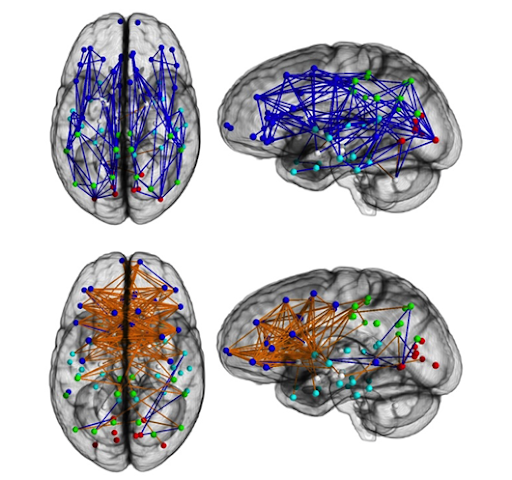
On the neurological and physiological side, there is strong evidence (obtained by a team from Oxford and Cambridge, who pooled together 126 studies, involving 43 000 subjects) to show that the brains of men are between 8% and 13% larger in volume than those of women. There is also evidence for there being significant differences between the relative volumes and densities of different regions in the brain between men and women. A recent example here is the work of Nopoulos et al. from the University of Iowa, who used functional Magnetic Resonance Imaging (fMRI) to study the ventral prefrontal cortex (VPC), a region involved in social cognition and interpersonal judgment. The findings, based on 30 men and 30 women, showed a relatively larger volume of this region in women, by 10%. In other words, relative to the total volume of a brain, the VPC region is 10% larger in women. Finally, there are not only volumetric differences between the brains of men and women, but also morphological ones. Here the most well-known, recent study is by Ingalhalikar et al., where the brains of 949 subjects (428 male and 521 female) were studied in terms of the nature of neural connections (connectome maps) between and within brain hemispheres (using diffusion tensor imaging). The results showed a systematic difference where male brains displayed a greater degree of intra-hemispherical synaptic connections (see top of following figure), while female brains had more prevalent inter-hemispherical links (see bottom of following figure). Interestingly, the authors of this study refer to the differences between the connectome maps of males and females as being a “complementarity” that makes them particularly suitable for collaboration …

Penn medicine

While there is strong evidence for systematic physiological differences between male and female brains, the question of what their consequences are remains far less clearly understood. E.g., taking the question of intelligence, there are studies whose results support all three of the possible outcomes: that there is no statistically significant difference, that men are more intelligent, or that women are more intelligent on average (e.g., see pp. 72 of the following paper). Even in the cases where a difference is shown, it tends to be small: 2-4 points in terms of the well known IQ test, and whether it is men or women who come out ahead depends on the specific test used. E.g., in a study involving 6780 subjects from Brazil, women came out ahead by 2 IQ points using Cambraia’s Attention Test, while men did better in Raven’s Standard Progressive Matrices test – by 1.8 IQ points. Similarly the behavioral consequences, from the perspective of differences between the sexes, of the VPC differences measured by Nopoulos et al., present a complex picture. There, no significant differences were found between men and women in terms of performing the Interpersonal Perception Task, which tests a subject’s ability to understand different types of social interaction. However, when the subjects were asked to complete a Personal Attributes Questionnaire (answering questions that lead to the subject’s self-perception in terms of two scales: “instrumentality” and “expressivity”, which are commonly taken to stand for masculinity and femininity and are used as a measure of gender identity), the resulting scores displayed strong correlation with the Interpersonal Perception Task outcomes.

The point of the above examples taken from recent findings in neuroscience and psychology, from studies that explore the differences between men and women, is to illustrate the complexity of the results obtained to date. On the one hand there is strong evidence for biological differences between male and female subjects, while on the other hand the specific nature of the differences and their impact on psychological traits or inclinations is complex and does not neatly divide along lines of a subject’s sex. While nature differs on average, an individual’s characteristics make them different from their sex’s average, with nurture and society further contributing to there being a continuum of states instead of a binary categorization of abilities, preferences, or traits. In my opinion, the psychology of personality, as opposed to that of gender, is a better means for understanding how one individual may differ from another in terms of their preferences and inclinations, which in turn can facilitate building mutually-fulfilling relationships.1

Turning to how the differences between men and women are understood in the context of Christianity, I would like to highlight three perspectives, as already mentioned at the beginning of this post.

First, there is St. John Paul II’s Theology of the Body, as set out in his “Men and Women He Created Them,” which I have already written about at length here. The only insight I’d like to point to here is John Paul II’s insistence on men and women being created “in the image of God” intrinsically referring to the communion of Persons in the Trinity. He makes this clear by saying that “man2 became the image of God not only through his own humanity, but also through the communion of persons, which man and woman form from the very beginning.” And it is in this context that the differences between men and women have a specific purpose, which is that these “two reciprocally completing ways of “being a body” [… are] complementary dimensions of self-knowledge and self-determination.” This in turn leads John Paul II to saying that a person’s “sex expresses an ever-new surpassing of the limit of man’s solitude [… and] always implies that in a certain way one takes upon oneself the solitude of the body of the second “I” as one’s own.” Men and women are different and complementary, but in profound, existential ways rather than as reducible to a trivial set of typical features or traits.

Second, the New Testament is rich in portraying different roles played by men versus women in the context of Jesus’ mission on Earth. Here Damiano Marzotto’s “Pietro e Maddalena” (mentioned by Pope Francis as being on his reading list), does a superb job of analyzing what these roles are in the Gospels, as a first step towards understanding how women could play the prominent role that they need to have in the Church, which they lack today. Marzotto summarizes his findings by first pointing out a greater propensity in women for welcoming Jesus’ teaching and making themselves available for a deepening and contemplation of his message (with men then acting on what the women understood). Mary’s keeping the events surrounding Jesus’ birth and “reflecting on them in her heart” (Luke 2:19) illustrates this very clearly. This places women in a position of welcoming novelty, of taking risks and of stepping out of line – traits not commonly associated with women in first century Palestine. The women of the Gospel, while having some common features, very much break the mold of societal stereotypes – another argument against characterizing men and women by sets of static, opposed features. The second aspect that Marzotto identifies in the women of the Gospel is an ability to anticipate Jesus’ actions and to provoke him or the apostles to action. Mary’s intervention at the wedding in Cana (John 2:1-12), or Mary Magdalene going to the apostles after meeting the risen Christ (John 20:1-3) are good examples here. Finally, Marzotto also argues that women have been responsible for a broadening of Jesus’ mission, for a greater universality of who it is addressed to. Here the woman suffering from hemorrhage (Mark 5:25-34), the Samaritan woman (John 4:4-42), the Canaanite woman (Matthew 15:21-28), or the widow of Nain (Luke 7:11-17) are great examples.

Third, the Servant of God, Chiara Lubich, in her intellectual visions (like those of Sts. Teresa of Ávila and Ignatius) during the summer of 1949 (referred to as the Paradise ’49), prefigures St. John Paul II’s interpreting the relationship between men and women from the perspective of the Trinity. As Giuseppe Maria Zanghí puts it, “this means that a meeting between the two “differences” requires, in each one of the two, a fullness of being: their synthesis is possible […] because, already before the two meet, each one of them is complete in themselves. Every form of weakness, every temptation of “subjection”, is overcome. […] True unity between man and woman can be achieved if each of the two realities is fulfilled in itself.” During her visions in 1949, Lubich recounts the following insight:

“The perfect man has the woman in him: he contains in his strength all of feminine sweetness, in his directness all of a woman’s suppleness. His character is unitarian, closed and severe like unity. But, if he is perfect (unitarian), he contains in himself the Trinity, who is a woman that is all open, caressing, loving. So the woman too, if she is perfect, encloses her open character in self-restraint that is reminiscent of the Madonna. She is man. Trinity in Unity.” (Paradise ’49, 1319-1320)3

The relationship between men and women, as understood also by Lubich in her mystical vision, is one of unity in distinction and distinction in unity, which is love. To reduce it only to distinction, and to a simplistic binary one at that, is to deny the Trinitarian image in which both men and women were made, and it is also to distort the complex and deeply beautiful picture that science is in the process of understanding as we speak.

[UPDATE on 17 November 2014:] Today Pope Francis opened a symposium on precisely the subject of how men and women relate, entitled “The Complementarity of Man and Woman in Marriage,” during which he had the following to say about the nature of differences between the sexes:

“Christians find [the] deepest meaning [of complementarity] in the first Letter to the Corinthians where Saint Paul tells us that the Spirit has endowed each of us with different gifts so that-just as the human body’s members work together for the good of the whole-everyone’s gifts can work together for the benefit of each. (cf. 1 Cor. 12). To reflect upon “complementarity” is nothing less than to ponder the dynamic harmonies at the heart of all Creation. […]

When we speak of complementarity between man and woman in this context, let us not confuse that term with the simplistic idea that all the roles and relations of the two sexes are fixed in a single, static pattern. Complementarity will take many forms as each man and woman brings his or her distinctive contributions to their marriage and to the formation of their children — his or her personal richness, personal charisma.”


1 But, we’ll have to leave that for another time …
2 “Man” here meaning the human person (as is clear from the context of the original text).
3 Apologies for the crude translation, the Italian original can be found in Zanghí’s “Leggendo un carisma” on pp. 149-150.

Serra: space in the flesh

Serra threats of hell

[Warning: long read – again]

It might seem strange to start a post about the sculptor Richard Serra by referring to Pope Francis’ homily from last Friday morning, but I hope you’ll bear with me while I do it anyway and that you won’t interpret it as an attempt to imbue Serra’s work with religious motives, which I believe it does not have. Instead, my reason for starting out with the following quote is that I believe both Richard Serra and Pope Francis give great importance to physicality, as is apparent from the examination of conscience proposed here by the pope and as I will try to spell out in greater detail with regard to Serra’s work:

“Am I embarrassed by the flesh of my brother or sister? When I give alms, do I let the coins fall without touching his hand? And if by chance I touch him, do I do this? [he asked mimicking a gesture of repulsion with his hand] When I give alms, do I look my brother or sister in the eyes? When I know a person is sick do I visit him or her? Do I greet them with tenderness?”

That the pope emphasizes physicality – using the word “flesh” 13 times last Friday morning – is, I believe, motivated by a desire to counter the ever-recurrent dualist distortion of Christianity that considers only the spirit to be good while equating matter with evil. This is categorically not Jesus’ message and, to my mind, Serra’s work is a great way also for a Christian (and everyone else too) to understand why, in an experiential rather than a moral or intellectual way.

What Richard Serra does, in my opinion, is to heighten the potential for an immediate experience of space, mass, scale, orientation and matter in a way that is difficult to be had directly in nature, where these experiences are admixed with those of other properties or qualities. The result can be awe and an experience of profound beauty (that is not to be sought only in the superficially aesthetic), which – while, as far as I can tell, not intended by their author – make Richard Serra’s work precisely what the composer James MacMillan pinpointed as the key feature of art: “a window on to the mind of God.”

To begin with, speaking about Richard Serra’s work faces the same challenges as appreciating any piece of art, in that no verbal account is going to suffice as a surrogate for direct experience. In fact, Serra himself argues this point very starkly, when asked to describe his “Delineator” (shown next):1

Serra delineator

“What happens with Delineator is that the only way to understand this work is to experience the place physically, and you can’t have an experience of space outside of the place and the space you’re in. Any linguistic mapping or reconstruction by analogy, or any verbalization or interpretation or explanation, even of this kind, is a linguistic debasement, in a sense, because it isn’t even true in a parallel way.”

Nonetheless, Serra does say more about Delineator elsewhere, which highlights some of his concerns and the mental model he uses for thinking about his own work:

“The sculpture defines a definite space inside the room. […] The juxtaposition of steel plates forming this open cross generates a volume of space which has an inside and an outside, openings and directions, aboves, belows, rights, lefts – coordinates to your body that you understand when you walk through it. Noe you might say that that sounds quite esoteric. Well, one of the things that you get into as you become more in tune with articulating space is that space systems are different than linguistic systems in that they are nondescriptive. The conclusion I’ve come to is that philosophy and science are descriptive disciplines, whereas art and religion are not.”

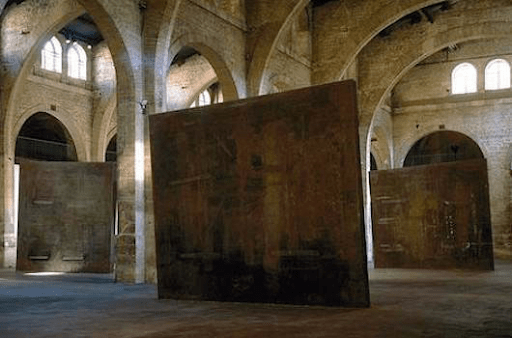
So, if you haven’t seen any of his work and tried to circumnavigate and “inhabit” it, I would very much encourage you to try to do so, if you get a chance. Personally, I have had experiences akin to what Serra speaks about above, when I saw his “Seven plates, six angles” (below) at the Gagosian in New York. The overwhelming sensation I had was of a heightened awareness of scale, volume and proportion, but also – unexpectedly – of space and mass. In some sense, my extensive use of photos in this post is futile – like showing you images of alien foodstuffs that you have not tasted, so, please, consider them tokens or bookmarks – i.e., pointers for your own future experience.

Serra 7 plates 6 angles

When asked about the relation of one of his pieces, shown at the Tate in London, to the building it was exhibited in, Serra made another important observation about what his work intends to be (and one that rang very true to me in retrospect):

“I did not want to enter into an affirmative dialogue with the building. I did not want to mirror face-value language, the physiognomy of the architecture. I wanted to deal with the volume, weight, mass and directionality of the space. [… I] wanted to make a sculpture out of the whole volume […] I wanted to make the volume of the space tangible, so that it is understood immediately, physically, by your body.”

The idea that the sculpture is not solely the object Serra created, but that it is that object in relation to the space it is situated in, is a paradigm shift and the key to understanding his insistence on making site-specific work even in the case of indoor sculptures. And even when a piece is shown in multiple locations over time, its placement in every one of those spaces results in multiple sculptures involving the one Serra-made object (that naïvely might be identified as the sculpture in full).

Beyond the paradigm shift from objects to entire spaces, Serra also broadens the palette of sculptural considerations:

“There’s a difference between walking into a telephone booth and a football stadium. If you take those two extremes and make the idea very subtle, then you can say there’s a difference between walking to the left and walking to the right, between the experience of the concave and convex, between something leaning right and something leaning left. How do you know that to be a different experience in terms of your daily life? And if it is, is it meaningful? The degree of meaningfulness depends on the limitations of the viewer. I think it is very difficult to introduce large-scale works into the public arena inasmuch as I am not interested in complicity or affirmation.

[…]

Compared to that of vertical sculpture, the ideas of sculpture existing horizontally are basically different concepts about construction, are basically different concepts about how we live in the world. On a simple, perceptual level, a modular unit extending above your eye-level becomes foreshortened as it rises, while the horizontal modular unit implies an infinite vanishing point. […] The cultural symbolic iconography of verticality versus horizontality is most apparent in the cross, where the vertical expresses transcendence and the horizontal expresses materiality.”

While Serra is clear about his interests being “nonutilitarian, nonfunctional” and declaring that “any use [of sculpture] is a misuse,” as well as anticipating limited audience appreciation (likening it to “poetry and experimental film” :)), he at the same time has a profound message behind his work:

“We are all restrained and condemned by the weight of gravity. […] The constructive process, the daily concentration and effort appeal to me more than the light fantastic, more than the quest for the ethereal. Everything we choose in life for its lightness soon reveals its unbearable weight. We face the fear of unbearable weight of repression, the weight of constriction, the weight of government, the weight of tolerance, the weight of resolution, the weight of responsibility, the weight of destructions, the weight of suicide, the weight of history which dissolves weight and erodes meaning to a calculated construction of palpable lightness.”

In many ways, the above strikes me as having affinities with Christianity, where Serra’s “Everything we choose in life for its lightness soon reveals its unbearable weight.” can be seen as a complement of Jesus’ “But seek first the kingdom of God and his righteousness, and all these things will be given you besides.” (Matthew 6:33).

A further aspect of Serra’s weight versus lightness statement (made in 1988) is its echoing of Milan Kundera’s novel “The Unbearable Lightness of Being,” published only four years earlier, where its author too makes a play for weight over lightness:2

“The heaviest of burdens is therefore simultaneously an image of life’s most intense fulfillment. The heavier the burden, the closer our lives come to the earth, the more real and truthful they become. Conversely, the absolute absence of burden causes man to be lighter than air, to soar into heights, take leave of the earth and his earthly being, and become only half real, his movements as free as they are insignificant. What then shall we choose? Weight or lightness?”

What, you may ask, is my point though? I hope that the above highlighted a couple of aspects of Serra’s work, which I have found to be deeply engaging and appealing. First, that he has invented a whole new concept of sculpture whose building blocks are not only form, texture, composition and proportion, but also mass, space, directionality and orientation, rendering an entire space a sculpture. Second, that his work is deeply rooted in the entirety of art and philosophy, without these being prerequisites for its appreciation and experience. Third, that experiencing his work, which explicitly shuns religious motives, does shed light on deeply Christian concepts and is therefore also of spiritual value to a Christian viewer at least.

As such, it shouldn’t come as a surprise to you, when I tell you that Richard Serra is probably my favorite sculptor (alongside Michelangelo, Rodin and Giacometti) and I hope that you will appreciate his work too when you next see one of his pieces.


1 All Richard Serra quotes here are from “Writings/Interviews.”
2 Both, probably, derived from Nietzsche’s concept of eternal recurrence, where the permanent (heavy) is contrasted against the fleeting (light).

The demon of distance

Demon of distance

A couple of weeks ago, Cardinal Gianfranco Ravasi lead another of the “courtyard of the gentiles” events, aimed at providing a space for dialogue between non-believers and Catholics. This time it took place in Budapest and Cardinal Ravasi’s address focused on the fundamental Christian principles, from which its understanding of morality, economy and society derives.

These principles include those of the person (created in the image of God and intrinsically being in relationship with others), of autonomy (of the civil and religious spheres, following Jesus’ words: “Then repay to Caesar what belongs to Caesar and to God what belongs to God.” (Matthew 22:21)), of solidarity and of truth (that precedes and exceeds us and that we inhabit rather than possess1). Each of these four principles is insightfully presented and analyzed by Ravasi and I would recommend anyone to read his talk in full (at the time of writing this post, only available in Italian). Here, however, I would like to focus only on the principle of solidarity, which Ravasi further differentiates into its aspects of justice and love.

The starting point of the principle of solidarity in Christianity, like that of the other three principles too, is the incarnation: “And the Word became flesh” (John 1:14), as a result of which there is a link between faith and history, between religion and political and social life. Cardinal Ravasi also emphasized this point during his brief opening remarks of the entire event, where he pointed out that, while in Eastern religions saints tend to be depicted with closed eyes (indicating an interiority of focus), in Christian art saints are typically shown with their eyes wide open – projecting out into the world around them. What is needed, Ravasi concludes, is both an interiority and a having one’s eyes open to see the great political, economic, social and cultural problems of the world.

In this context, the principle of solidarity in Christianity has its roots already in the Genesis account of creation, where

“the fact of all of us being human is expressed by the noun “Adam,” which in Hebrew is ha-’adam,2 with the article (ha-) that simply means “the human.” is used to refer to humanity. Therefore there is in all of us a shared “adamness.” Solidarity is, therefore, structural to our fundamental anthropological reality. Religion expresses this anthropological unity using two terms that are two moral categories: justice and love. Faith takes solidarity, which is also at the basis of lay philanthropy, but goes beyond it. In fact, staying with John’s Gospel, during the last evening of his earthly life Jesus says a wonderful phrase: “No one has greater love than this, to lay down one’s life for one’s friends.” (John 15:13).”

To illustrate the two aspects of solidarity – justice and love, Ravasi takes advantage not only of Christian tradition, but also makes reference to Eastern thought, in the spirit of inter-religious dialogue.

To present the essence of justice, Ravasi quotes the 4th century saint, Ambrose of Milan:

“The earth was created as a common good for all, for the rich and for the poor. Why, then, O rich, do you usurp an exclusive right to the soil? When you help the poor, you, rich, don’t give them from your own, but you return to them their own. In fact, you alone use the common property, given for the use of all. The earth belongs to all, not only to the rich, therefore when you help the poor you give them back their due, instead of providing them with a gift of your own.” (On Naboth)

Turning to the second aspect of solidarity – love, Ravasi takes advantage of the following Tibetan parable, showing that religious cultures, that are undoubtedly diverse, do at their bases have touch-points and contacts:

“A man, walking through the desert, spots something strange in the distance. Fear starts welling up in him, since, in the absolute solitude of the steppe, such an obscure and mysterious reality – maybe an animal, a dangerous wild beast – can’t but unsettle. Moving ahead, the traveller discovers that he is not approaching a beast, but a person instead. But his fear does not pass. If anything, it grows, thinking that the person could be a robber. Nonetheless, he has no choice but to proceed, until arriving in the presence of the other. At this moment, the traveller lifts his gaze and, to his surprise, exclaims: “It is my brother, whom I haven’t seen for many years!””

Ravasi concludes his reflection on solidarity by noting that “distance generates fears and demons; one has to get close to the other to overcome fears, no matter how understandable they may be. Refusing to get to know the other and to encounter the other is the same as saying no to the love that springs from solidarity and that dissolves terror and generates a true society.”

Personally, I have found Cardinal Ravasi’s reflection highly compelling and enlightening, both due to its deep roots in Scripture and its open and broad perspective that is equally at ease with drawing on the rich sources of Christianity as it is to benefit from the insights of other religions, even in matters as fundamental and core to Christianity as its understanding of love. Specifically, I have also found the Tibetan parable to be a great reminder to attempt closeness with all, instead of remaining at a distance and being put off by distorted, prejudice-filled, blurry perception.


1 Ravasi addressed this concept of the truth several times already, e.g. see also its coverage in a previous post here.
2 For more on the Genesis account and ha-’adam, see John Paul II’s “Man and Woman He Created Them,” discussed here.

This is what the Gospel looks like

Pope disfigured man

Pope Francis has given another interview – this time to Andrea Tornielli (a contributor to the always up-to-date Vatican Insider blog) at the Italian La Stampa newspaper – and the following are some of my favorite passages:1

“[Christmas] speaks to us of tenderness and hope. When God meets us, he tells us two things. The first one is: have hope. God always opens doors, he never closes them. He is the dad who opens doors for us. Second: don’t be afraid of tenderness. When Christians forget about hope and tenderness, they become a cold Church that doesn’t know where to go and that entangles itself into ideologies, into worldly attachments. Instead, God’s simplicity tells you: go forward, I am a Father who caresses you. I am scared when Christians lose hope and the capacity to embrace and caress.”

Christmas is about hope and warmth, fueled by and in imitation of God and directed towards others.

“What we read in the Gospels is an announcement of joy. The evangelists have described a joy. No consideration is given to the unjust world, to how God could be born into such a world. All this is the fruit of our own contemplations: the poor, the child that has to be born in uncertainty. is born into a precarious situation. Christmas was not a condemnation of social injustice, of poverty; instead, it was an announcement of joy. Everything else are conclusions that we draw. Some are correct, others are less so, and others still are ideologized. Christmas is joy, religious joy, God’s joy, interior, luminous, of peace.”

Christmas is, first and foremost, joy. Let’s not rush to its implications at the expense of overlooking that deep joy that it heralds.

“A teacher of life for me has been Dostoevskij, and a question of his, both explicit and implicit, has always gone around in my heart: “Why do children suffer?” There is no explanation. […] In front of a suffering child, the only prayer that comes to me is the prayer why. Why, Lord? He doesn’t explain anything to me. But I feel that he is looking at me. So I can say: You know the why, I don’t it and You don’t tell me, but You are looking at me and I trust You, Lord, I trust your gaze.”

Suffering can’t – and mustn’t! – be explained away, but it can be lived while trusting in God’s loving gaze.

“The other day at the Wednesday General Audience, there was a young mother with her baby that was only a few months old, behind one of the barriers. As I passed by, the baby cried a lot. The mother was caressing it. I said to her: madam, I think the little one is hungry. She replied: Yes, it’s probably time … I responded: But, give it something to eat, please! She was shy and didn’t want to breastfeed in public, while the Pope was passing. So, I wish to say the same to humanity: give something to eat! That woman had milk to give to her child, in the world we have enough food to feed everyone.”

There is food for everyone – let’s not make our shyness an obstacle for it to get to its rightful recipient.

“Marxist ideology is wrong. But in my life I have met many Marxists who are good people, so I don’t feel offended.”

Don’t conflate ideology with its adherents. Even wrong ideologies have good people following then.

“During these first nine months, I have received visits from many Orthodox brothers, Bartholomew, Hilarion, the theologian Zizioulas, the Copt Tawadros: this last one is a mystic, he’d enter the chapel, remove his shoes and go to pray. I felt like their brother. They have apostolic succession, I received them as brother bishops. It is painful that we are not yet able to celebrate the Eucharist together, but there is friendship. I believe that the way forward is this: friendship, common work, and prayer for unity. We blessed each other, one brother blesses the other, one brother is called Peter and the other Andrew, Mark, Thomas …”

I have no comment to add – only to say how it warms my heart to hear Francis refer to the Orthodox patriarchs as his brothers and liken their relationship to those among the apostles. This is very much in continuation of the tremendous advances made by John Paul II and Benedict XVI, but I am moved by the beauty of the simplicity with which Francis puts the situation.

“I knew a parish priest in Hamburg who was dealing with the beatification cause of a Catholic priest guillotined by the Nazis for teaching children the catechism. After him, in the line of condemned individuals, was a Lutheran pastor who was killed for the same reason. Their blood became mixed. That parish priest told me he had gone to the bishop and said to him: “I will continue to deal with the cause, but for both of them, not just the Catholic priest’s.” This is the ecumenism of blood.”

That we are followers of Jesus, regardless of what Church we belong to is a matter that goes to the bone, into our blood. There we are already one.

“We must try to facilitate people’s faith, rather than control it. Last year in Argentina, I condemned the attitude of some priests who would not baptize the children of unmarried mothers. This is a sick mentality.”

We are not gate-keepers, but each other’s brothers and sisters instead.

“A few months ago, an elderly cardinal said to me: “You have already started the reform of the Curia with your daily masses at St. Martha’s.” This made me think: reform always begins with spiritual and pastoral initiatives rather than with structural changes.”

Structures must be a consequence of life and the best leadership is by example. This point of Pope Francis’ is also in sync with my previous criticisms of his actions being explained away as only “pastoral” and with comments made by Fr. Antonio Spadaro in the New Yorker interview, where he says, when asked about the style-versus-substance debate concerning Pope Francis: “Style is not just the cover of the book. It’s the book itself! Style is the message. The substance is the Gospel. This is what the Gospel looks like.”


1 Please, note that the following quotes are close to the official English translation, but that I have modified them here and there based on the Italian original – not necessarily in the belief of making them “better” – only with the aim of preserving some of the nuances of how Pope Francis expresses himself.

The riches of poverty

Goodshepherd domitilla

The other day I came across a very interesting article shared by one of my besties – MS – on Facebook. It reproduced the text of a pact signed by 40 bishops in the catacombs of St. Domitilla (the oldest and most extensive of the Roman catacombs) shortly before the Second Vatican Council’s conclusion – “The Pact of the Servant and Poor Church,” also known as “The Pact of the Catacombs.” The core of this group was made up of Brazilian bishops, but it also included several from Europe, Africa, Asia and both North and South America.1 At its heart, this pact was a commitment made by each signatory to live the evangelical counsel of poverty in their position as bishop of their local church and it echoed a point also emphasized in Vatican II’s Lumen Gentium, which says:2

“Jesus, “though He was by nature God … emptied Himself, taking the nature of a slave”, and “being rich, became poor” for our sakes. Thus, the Church, although it needs human resources to carry out its mission, is not set up to seek earthly glory, but to proclaim, even by its own example, humility and self-sacrifice.”

The following then is my abbreviated version of the pact’s preamble and 13 points:

“We, Bishops meeting at Vatican Council II, being aware of the deficiencies of our life of poverty according to the Gospel, encouraged by one another in this initiative in which each one wants to avoid singularity and presumption, in union with all our brothers in the Episcopate; counting, especially, on the grace and strength of our Lord Jesus Christ, on the prayer of the faithful and priests of our respective diocese; putting ourselves in thought and prayer before the Trinity, commit ourselves to the following:

  1. We will seek to live in accordance with the ordinary manner of our people, regarding housing, food, means of transportation, etc.
  2. We renounce wealth and the appearance thereof, especially in clothing (expensive fabrics and garish colors), and insignia of precious metals.
  3. We will possess neither liquid nor fixed assets in our names; and if it is necessary to possess anything, we will place it under the name of our diocese or other social or charitable works.
  4. We will entrust the financial and material administration of our diocese to a commission of competent lay people conscious of their apostolic role, since we should be pastors and apostles rather than administrators.
  5. We refuse to be called by names or titles that signify grandeur and power. We prefer to be called by the Gospel name “Father”.
  6. We will avoid everything that could appear to confer privilege, priority, or even preference to the rich and powerful.
  7. We will also avoid fostering or flattering the vanity of anyone, whoever they might be, when rewarding or requesting donations, or for any other reason. We will invite our faithful to consider their gifts as normal participation in worship, ministry and social action.
  8. We will give our time, thought, heart, means, etc. to the service of working individuals and groups who are economically weak and underdeveloped, without this being at the expense of other people and groups in the diocese.
  9. We will seek to transform the works of charity into social works based on charity and justice that take everyone into account.
  10. We will endeavor to ensure that government and public services decide on and implement laws, structures and social institutions that are necessary for justice, equality and the full and harmonious development of the whole person and all people.
  11. We commit ourselves to share, according to our ability, in the urgent projects of the dioceses in poor nations; together to always give witness to the Gospel at the international level, by asking for the adoption of economic and cultural structures that do not create poor nations in an ever richer world, but that allow the poor majority to emerge from their poverty.
  12. We pledge to share our life with our brothers and sisters in Christ (priests, religious and laity), so that our ministry constitutes a real service. We will seek out partners so that we can be promoters according to the spirit rather than rulers according to the world. We will try to be present, to be welcoming. We will be open to everyone, whatever their religion.
  13. When we return to our diocese we will present these resolutions to our diocesan priests, asking them to help us with their understanding, collaboration and prayers.

God help us to be faithful.”

When I first read this pact, my immediate reaction was of great admiration for its signatories, who resolve in it to start afresh in their role as bishops, returning to what is fundamental in imitating Jesus and applying the resolutions of Vatican II to themselves with great specificity and individuality. I also appreciated their making this choice together and following the model of the Early Church. In essence, I saw – and see – here that going of an extra mile and that self-noughting that is also set out as an example in Lumen Gentium, where the whole Church is warned not to “[l]et [either] the use of the things of this world [or] attachment to riches, which is against the spirit of evangelical poverty, hinder them in their quest for perfect love.”

In the process of looking up some background on this pact, it has become clear to me that the vast majority of texts that refer to it are ones dissenting from the Catholic Church’s teaching and are critical of its conduct. On the one hand this is not difficult to understand – there are numerous bishops who behave in ways incompatible with this pact’s letter and spirit (or who at least seem to do so) and it can be used as a handy ruler by which to find them wanting. I find such a reading incongruous on two counts: First, this pact is one freely entered into by specific bishops who, probably as a result of participating in the Council, received the grace to impose on themselves specific measures that they felt called to follow. Second, it smacks of a basic disregard to the very spirit in which the pact’s signatories acted, whose desire was to “avoid presumption” and be “aware of the deficiencies of [their] life of poverty.” Furthermore, it flies in the face of Jesus’ own reprimand: “You hypocrite, remove the wooden beam from your eye first; then you will see clearly to remove the splinter from your brother’s eye.” (Matthew 7:5). This is in no way to deny or attempt to excuse the unchristian conduct of some bishops, but simply to recognize this document for what it is – the sincere resolution of a group of bishops to renew their commitment to Jesus, instead of waving it around like a weapon.


1 For scans of a reproduction of the original Portuguese text – Bonaventure Kloppenburg’s 1974 The ecclesiology of Vatican II – see here. While the above is based on the source from the first paragraph, I chose to translate some words differently, taking advantage of the original version’s scans (e.g., I translate “berrante” in point 2 as “garish” instead of “brilliant” and – in point 9 – “beneficência” as “charity”).
2 For a very interesting analysis that situates this pact in the context of Benedict XVI’s thought as well as of that of other post-conciliar theologians, see this article.

Lumen Gentium: On the People of God

Fish family

[Just a quick apology before you proceed – this post has turned out to be rather longer than I hoped for, but there was just so much of interest in this chapter of Lumen Gentium that I couldn’t be any more succinct. You may prefer to read it in parts rather than all in one go …]

To have any chance of reading the full set of 16 Vatican II documents during this Year of Faith, I need to press on and take a look at the second chapter of Lumen Gentium, the council’s dogmatic constitution on the Church. In the first chapter, we got a view of who the Church is, as seen from God’s perspective – i.e., what the ultimate end of the Church is, while here, in chapter two, the focus is more on a view from the trenches: the People of God.

If you are reading this as an agnostic or a non-Catholic, let me first point you to the caveat in my post on Dei Verbum (paragraph 2), and re-iterate how this particular document does not use the most accessible language (e.g., with sentences like “Fortified by so many and such powerful means of salvation, all the faithful, whatever their condition or state, are called by the Lord, each in his own way, to that perfect holiness whereby the Father Himself is perfect.”). While I would feel quite at ease recommending a direct reading of Dei Verbum to anyone interested in how the Church understands Scripture, I’d hesitate when it comes to Lumen Gentium. Nonetheless, if you consider Lumen Gentium to be like a patent is to a scientific paper and take the time to peel away its particular form, the substance it carries is well worth the effort.

The starting point of Chapter 2 is Jesus’ New Testament, which forms a new people (the People of God) by means not of genetics (as was the case in the Old Testament, where the Israelites are already called the “Church of God”) but of the Spirit. All who believe in Jesus, become members of His people through baptism and the actions of the Holy Spirit. “The state of this people is that of the dignity and freedom of the sons of God, in whose hearts the Holy Spirit dwells as in His temple. Its law is the new commandment to love as Christ loved us.” A clearer distinction is made here between those who are members of the People of God and those who are not than in the first chapter. The Church is presented as the salt or yeast from which the whole world can benefit: “although it does not actually include all men, and at times may look like a small flock, [the Church] is nonetheless a lasting and sure seed of unity, hope and salvation for the whole human race.” Looking back at chapter one and at Dei Verbum, this should not be taken as an indication of superiority, but simply as an attempt at specificity. Clearly not all of humanity believes that Jesus is God, who came to show us the way to Himself, and Lumen Gentium here strives to spell out what it is that those who hold this belief are like and how they live as a community. This positioning of the Church is particularly clear from the following: “Established by Christ as a communion of life, charity and truth, [the Church] is also used by Him as an instrument for the redemption of all.”

The role of the People of God is to “bear witness to Christ and give an answer to those who seek an account of that hope of eternal life which is in them.” This is done by all members of the Church by participating in the priesthood of Jesus, who is its head. Those consecrated to the “ministerial priesthood” “teach and rule the priestly people; acting in the person of Christ, making present the Eucharistic sacrifice, and offering it to God in the name of all the people.” The laity too participate in Jesus’ (“royal”) priesthood, which they exercise “in receiving the sacraments, in prayer and thanksgiving, in the witness of a holy life, and by self-denial and active charity.” The whole church therefore is a “priestly community.”

It is a community that operates through the “sacraments and the exercise of the virtues,” where members are “[i]ncorporated in the Church through baptism” (incorporated since the Church is the Body of Christ, as chapter one sets out). This membership is further perfected by confirmation, when “the Holy Spirit endows them with special strength so that they are more strictly obliged to spread and defend the faith, both by word and by deed.” The Eucharist, which is “the fount and apex of the whole Christian life” strengthens them and “manifest[s] in a concrete way [the] unity of the people of God.” Through the sacrament of Penance, they “obtain pardon from […] God for the offence committed against Him and are […] reconciled with the Church.” Through the anointing of the sick, the People of God “associat[e] themselves freely with the passion and death of Christ.” Those who are consecrated by “Holy Orders[,] are appointed to feed the Church in Christ’s name with the word and the grace of God,” while those who receive the sacrament of Matrimony, “partake of the mystery of that unity and fruitful love which exists between Christ and His Church, help each other to attain to holiness in their married life and in the rearing and education of their children.” “From the wedlock of Christians there comes the family, in which new citizens of human society are born, who by the grace of the Holy Spirit received in baptism are made children of God, thus perpetuating the people of God through the centuries. The family is, so to speak, the domestic church.” What is crystal clear from the above is that the sacraments (shown in bold) are the “means of salvation,” helping the members of the Church to “bear witness to Christ.”

So far, so good, but what comes next in §12 is to me the most interesting part of Chapter 2 (as the preceding paragraphs were edifying, but had a sense of the taxonomical about them):

“The entire body of the faithful […] cannot err in matters of belief. They manifest this special property by means of the whole peoples’ supernatural discernment in matters of faith when “from the Bishops down to the last of the lay faithful” they show universal agreement in matters of faith and morals. That discernment in matters of faith is aroused and sustained by the Spirit of truth. It is exercised under the guidance of the sacred teaching authority, in faithful and respectful obedience to which the people of God accepts that which is not just the word of men but truly the word of God. Through it, the people of God adheres unwaveringly to the faith given once and for all to the saints, penetrates it more deeply with right thinking, and applies it more fully in its life.”

This is strong stuff, both as it states that the entire body of the faithful “cannot err” when it comes to faith and morals and as it calls for careful thought being applied to these beliefs and for their ever more perfect putting into practice. To my mind the key takeaway here is that infallibility here is attributed to the “entire body of the faithful” – i.e., the Mystical Body of Christ that has Jesus as its head. If truly all the faithful hold a certain belief then I can well subscribe to that belief having to be taken seriously and having to be attributed to the Holy Spirit. What this view does is to place the whole of the Church in a position of tremendous importance and responsibility, far from the usual caricature where the hierarchy is seen as dictating to a flock that follows it blindly and unthinkingly. The flip side of such status is the responsibility we carry for disagreements and disunity within the Church, which prevents us from accessing the unerring insights that the Holy Spirit has prepared for us when we are united.1

Two aspects of the above strike me as relevant: first, that this is not a new idea, but instead a centuries-old idea that has had new light shed on it and second, that it again points to the continuing action of the Holy Spirit. In terms of the first aspect, the basic idea can be seen already in the Latin proverb: “Vox populi, vox Dei” (“The voice of the people is the voice of God”) which has been quoted as a proverb already in the 8th century AD. The second aspect then is particlarly clearly illuminated by what Pope Benedict XVI in fact said just today:

“This gift, the sensus fidei, constitutes in the believer a kind of supernatural instinct that has a connatural life with the same object of faith. It is a criterion for discerning whether or not a truth belongs to the deposit of the living apostolic tradition. It also has a propositional value because the Holy Spirit does not cease to speak to the Churches and lead them to the whole truth.”

To underline the profound vocation of every single member of the People of God, Lumen Gentium points to the Holy Spirit’s gifts being bestowed on anyone whom He chooses: “[T]he Holy Spirit sanctifies and leads the people of God and enriches it with virtues, “allotting his gifts to everyone according as He wills.” He distributes special graces among the faithful of every rank. By these gifts He makes them fit and ready to undertake the various tasks and offices which contribute toward the renewal and building up of the Church.” This acknowledges very clearly that it is not the hierarchy of the church alone who have a role of leadership in the Church, but that the Holy Spirit can choose anyone to contribute to its renewal, “but judgment as to their genuinity and proper use belongs to those who are appointed leaders in the Church, to whose special competence it belongs, not indeed to extinguish the Spirit, but to test all things and hold fast to that which is good.” A very careful balance is presented here between the hierarchical and the “charismatic” aspect of the Church, which underlines again the fact that the Church are all the People of God.

Paragraph 13 then focuses on there being only one People of God, “which takes its citizens from every race, making them citizens of a kingdom which is of a heavenly rather than of an earthly nature.” This “takes nothing away from the temporal welfare of any people. On the contrary it fosters and takes to itself, insofar as they are good, the ability, riches and customs in which the genius of each people expresses itself.” All the diversity in the Church then has as its goal the fulfillment of St. Peter’s words: “According to the gift that each has received, administer it to one another as good stewards of the manifold grace of God” (1 Peter 4:10).

In paragraph 14 we turn to the role of the Church in the context of salvation and we start with a warning: “Whosoever, […] knowing that the Catholic Church was made necessary by Christ, would refuse to enter or to remain in it, could not be saved.” Membership in the Church requires acceptance of “her entire system and all the means of salvation given to her, and [being] united with her as part of her visible bodily structure and through her with Christ, who rules her through the Supreme Pontiff and the bishops.” Even membership (for those who know that it is necessary for salvation) is not sufficient though: “He is not saved, however, who, though part of the body of the Church, does not persevere in charity. He remains indeed in the bosom of the Church, but, as it were, only in a “bodily” manner and not “in his heart.”” And it gets even worse! Those who “fail […] to respond to [the grace of Christ] in thought, word and deed, not only shall they not be saved but they will be the more severely judged.” Reading Chapter two very much gives you a sense of growing wonder as you proceed towards the end of §13, only to be followed by a cold shower and stark warnings!

So, what does §15 hold? First, it starts by acknowledging that there are Christians outside the Catholic Church:

“They lovingly believe in God the Father Almighty and in Christ, the Son of God and Saviour. They are consecrated by baptism, in which they are united with Christ. They also recognize and accept other sacraments within their own Churches or ecclesiastical communities. Many of them rejoice in the episcopate, celebrate the Holy Eucharist and cultivate devotion toward the Virgin Mother of God. They also share with us in prayer and other spiritual benefits. Likewise we can say that in some real way they are joined with us in the Holy Spirit, for to them too He gives His gifts and graces whereby He is operative among them with His sanctifying power.”

The key to me here is not only the extensive list of similarities that the Catholic Church sees in other “churches and ecclesiastical communities” but also the warmth of the language used (“lovingly believe,” “consecrated by baptism,” “rejoice in the episcopate,” “cultivate devotion,” “joined with us in the Holy Spirit”). There is a real yearning and well-wishing here and a desire to “pray, hope and work” towards being “peacefully united.”

Paragraph 16 then talks about where the Catholic Church sees non-Christians in this picture and there is again a sense of openness, warmth and yearning here. First come the Jews, “from whom Christ was born according to the flesh”: “this people remains most dear to God, for God does not repent of the gifts He makes nor of the calls He issues.” Next, come the Muslims “who, professing to hold the faith of Abraham, along with us adore the one and merciful God, who on the last day will judge mankind.” Then there are all others who seek God: “Nor is God far distant from [them], for it is He who gives to all men life and breath and all things, and as Saviour wills that all men be saved.” Finally, all those of good will are in the picture too: “Divine Providence [does not] deny the helps necessary for salvation to those who, without blame on their part, have not yet arrived at an explicit knowledge of God and with His grace strive to live a good life.” The message is very clear: all are called to salvation and each has to take advantage of all the means they are offered for reaching it, according to their conscience and understanding.

Finally, Chapter 2 closes with a reminder of Jesus’ words: “Go, therefore, make disciples of all nations, baptizing them in the name of the Father and of the Son and of the Holy Spirit, teaching them to observe all things whatsoever I have commanded you. And behold I am with you all days even to the consummation of the world” (Mathew 28:19). All members of the Church have an “obligation of spreading the faith” so that “whatever good is in the minds and hearts of men, whatever good lies latent in the religious practices and cultures of diverse peoples, is not only saved from destruction but is also cleansed, raised up and perfected unto the glory of God.” All this is done so that “the entire world may become the People of God,” which instead of being an attempt to conquer or colonize is one of striving for unity in diversity.


1 I would just like to tip my hat to my bestie PM, who has essentially arrived at this point without having read Lumen Gentium!