The beyond inside

Living success 3d drinking tea

For a while now, I have been coming across rather negative takes on the Dalai Lama’s “Beyond Religion” book from last year. So, when I saw it at an airport bookshop today, I bought it and started reading it on my way home across the Atlantic. Before I tell you more about it, I have to admit to having a deep-seated fondness for and admiration of the present Dalai Lama, stemming from having read quite a bit of his writings, having seen interviews with him (and that gem of a chat between him and Archbishop Desmond Tutu, mentioned here some time ago) and also from counting the movie Kundun among my all-time favorites. With this “baggage” in mind, you’ll understand that I was rather skeptical about the book’s reviews and dubious about their being representative of its author’s thoughts.

The criticisms tend to focus on quotes like: “in today’s secular world, religion alone is no longer adequate as a basis for ethics” and “when negative attitudes towards religion […] are motivated by a concern for justice, they must be respected.” Several commentators are then quite content to take these, become indignant and launch into extensive rants in defense of religion. I find that rather misguided and not only a misrepresentation of the Dalai Lama’s thought, but also woefully naïve.

Even just a reading of the introduction to the book makes one thing crystal clear – the Dalai Lama is not turning away from religion or finding it lacking in any way: “religion has helped millions of people in the past, helps millions of people today, and will continue to help millions in the future” and “it may seem [… that] I am advocating the exclusion of religion from ethical systems, or even from all areas of public life [… – t]his is not at all what I have in mind.”

So, what is he getting at?

“[My statements] may seem strange coming from someone who from a very early age has lived as a monk in robes. Yet I see no contradiction here. My faith enjoins me to strive for the welfare and benefit of all sentient beings, and reaching out beyond my own tradition, to those of other religions and to those of none, is entirely in keeping with this.”

All I can say to that is: Amen! Instead of renouncing religion or in any way devaluing it, the Dalai Lama is saying: let’s look for what we have in common and for the good that is deep-rooted in our human nature and nourish it. In fact, he puts the relationship between the ethics that is not contingent on religious beliefs and the ethics that is thus:

“Ethics and inner values without religious content are like water, something we need every day for health and survival. Ethics and inner values based in a religious context are more like tea. The tea we drink is mostly composed of water, but it also contains some other ingredients – tea leaves, spices, perhaps some sugar or, at least in Tibet, salt – and this makes it more nutritious and sustaining and something we want every day.”

This, to my mind, is a beautiful way of putting it, which makes me even sadder to see that the first part of the above quote gets bandied about as further evidence for the Dalai Lama considering religion to be of little value. Instead, I believe, that his metaphor is spot on and emphasizes the riches of faith, while also highlighting the universal access to a great deal of what is good about it. Note, that he is not saying – ethics without religion is water and the extra ingredients that can turn it into tea are religion. He is saying, religion is tea (i.e., water and other ingredients together) – it is a richer, more complex entity than what is accessible otherwise rather than an optional, minimal add-on. In this sense, the striving to bring ethics beyond religion is one of doing so for an ethics that is very much inside religion – like water is in tea.

From my Christian perspective I can rephrase what the Dalai Lama is saying as God, whom I believe to be the source of all goodness and happiness, making a great deal of himself accessible even to those who don’t believe in him (He is love, so why wouldn’t He?). This is a source of joy to me and – like the Dalai Lama – something I am grateful for and want to build on in my relationships with all. I am also grateful for what God makes accessible to me through His gift of faith, but it would be foolish of me to be jealous of His generosity and I would be blind if I saw His love only among those who hold the same beliefs as I do. The Dalai Lama’s attempts to tease out what he sees as being universal (i.e., non-belief-contingent) aspects of ethics are to me greatly positive and directed towards making God’s presence evermore widely and clearly felt on earth.

Re-reading the above, a possible misunderstanding of it comes to my mind: “Are you saying that the ethics of religious people is superior? That those of no religious faith are in some way second class ethical?” Not at all! I believe that we are all fully capable of acting selflessly, for the good of our neighbors, those in need and even our enemies – having faith is not a prerequisite for this (and this is essentially the Dalai Lama’s point). So, does faith make any difference? Absolutely! I believe that my faith helps me greatly in trying to live in the above way. Instead of a feeling of superiority it engenders a sense of responsibility in me though, and brings to mind Jesus’ parable of the talents (Matthew 25:14-30): from those to whom more was given, more will be expected.

Amazing mechanisms

Crab Nebula

During this Year of Faith, Pope Benedict XVI has started a series of sermons on the Creed, with the latest focusing on how one can come to know God. He starts out by emphasizing that God respects each person’s freedom and that, instead of us having to look for Him, He seeks us out and makes himself known to us. Nonetheless, Benedict picks out three sources for finding signs of God and exhorts believers to “[a]lways be ready to respond, but with gentleness and respect, to anyone who asks you for the hope that is in your hearts” (1 Peter 3:15) The Gospel needs to be communicated “joyfully, feeling it to be [one’s] own, through a life truly animated by faith, marked by charity, service to God and to others, and capable of radiating hope.”

The three sources of signs of God’s presence that Benedict puts forward are: “the world, man and faith”:

1. The world. “[D]azzled by the glitter of worldliness,” we are in danger of becoming blind to how the universe can fill us with wonder. Instead, “contemplat[ing] creation, its beauty, its structure” leads us to discover its “amazing mechanisms” and patterns that can lead to an intuition of the “Beautiful One” who is behind them. Benedict quotes Einstein here as saying that the laws of nature “reveal such a superior reason that all rational thought and human law is but a very insignificant reflection by comparison” (The World as I See it). This is not to be taken naively as: look at nature and you’ll instantly believe in God. That is not what Benedict means, nor would that respect our freedom. Instead, the point is: look around you, contemplate the beauty and intricacy of the universe, instead of just getting sucked into the consumerist rat-race, and you might discover God. This is not proselytism (with the emphasis on freedom and on it being up to God to call people, instead of saying that they ought to make the first move, or even be made to make it!) – his advice is good regardless of what you think about the likelihood of God’s existence and is very clearly mirrored in the mystical traditions of all religions and of contemplative practice outside religion.

2. Man. Benedict here quotes St. Augustine as saying: “God is closer to me than I am to myself” (cf. Confessions, III, 6, 11) and “truth dwells in the heart of man” (True Religion, 39, 72). “The ability to stop and take a deep look within ourselves and read that thirst for the infinite that we carry within” is at risk of being lost “in the noisy and distracted world in which we live.” Again Benedict basically says (to paraphrase him): “Don’t take my word for it – just give yourself a chance to reflect about yourself and the world you live in and I believe you will see signs of God’s presence.”

3. Faith. Here Benedict argues that looking at those who believe is a hint about God’s presence too:

He who believes is united with God, is open to His grace, to the power of charity. So his existence becomes a witness not of himself, but of the Risen Christ, and his faith is not afraid to show itself in everyday life, it is open to dialogue that expresses deep friendship for the journey of every man, and knows how to bring the light of hope to the need for redemption, happiness, and future.

This echoes Archbishop Williams’ recent words on what holy people are like and again underlines the “self-noughting” of those who truly believe in God and their friendship with and openness towards all. Benedict proceeds to spell out misconceptions of faith as “illusion, escapism, a comfortable shelter, sentimentality” and instead contrasts them agains what it is: an “involvement in every aspect of life.”

Finally, Benedict concludes with a call for all Christians to purify themselves and make themselves “conform to” Jesus also so that others may rid themselves of a misunderstanding of Christianity as a “mere system of beliefs.” Instead:

Christianity, before being a moral or ethical value, is the experience of love, of welcoming the person of Jesus. For this reason, the Christian and Christian communities must first look to and help others to look to Christ, the true path that leads to God.

She said, he said

Fragments

Have you ever been approached by a Jehova’s witness and had them quote from the Bible to you? I have (several times 🙂 and the thing that first struck me, and I have found almost invariably since, is that they tend to use a small set of passages to further their cause while being blind to the fullness of the Good News. A frequent example is their reference to Revelation for arguing that very few will be saved (and that they can get you a seat): “I heard the number of those who had been marked with the seal, one hundred and forty-four thousand marked from every tribe of the Israelites” (Revelation 7:4). Yet, only a couple of sentences later John says: “After this I had a vision of a great multitude, which no one could count, from every nation, race, people, and tongue. They stood before the throne and before the Lamb, wearing white robes and holding palm branches in their hands.” (Revelation 7:9). And my pointing it out to them in their copy of the Bible tends to be the end of our friendly chat …

“OK,” you may think, “so Jehova’s witnesses are a bit blinkered – but I already knew that!” and you’d be right. There is no surprise there, but where I have been surprised recently was by the controversy surrounding Dr. Tina Beattie, Professor of Catholic Studies at Roehampton University. Prof. Beattie has last week had an invitation revoked to be a Visiting Fellow at the University of San Diego and to deliver a series of talks. Naturally, she objected and she went on to claim that unfounded denunciations of her writings by numerous “Catholic” blogs were to blame. This is not the first time such cancellations happened either, as plans for a lecture by her at Clifton Cathedral in Bristol have also been cancelled recently on grounds of her alleged heterodoxy. Such claims by her and her critics made me curious about what was behind them and the following is what I managed to piece together.

First of all, Prof. Beattie does not deny that she holds some views that are in conflict with the teaching of the Church (e.g., she signed a letter to The Times, saying that Catholics could, “using fully informed consciences, … support the legal extension of civil marriage to same-sex couples.”) Instead, she justifies her position by the following:

“I am an academic theologian who is also a practising Catholic. (This is subtly different from claiming to be a Catholic theologian if that implies somebody with a licence who is authorised to teach by the official magisterium). […]

Any academic theologian working in a university must […] seek to promote an intellectual culture in which reason rather than fideism is the basis for enquiry and research, knowing that in the Catholic tradition reason and revelation go hand in hand. […]

I have also always had absolute respect for the difference between the doctrinal truths of the faith, made knowable through revelation alone, and those truths which are arrived at by reason and which involve philosophical reflection informed by natural law and in engagement with other sources of human knowledge. So, with regard to all the doctrinal teachings that belong within the deposit of faith entrusted to the Church, my theological position is absolutely orthodox.”

Hmm … where to start?! Even before looking at what Prof. Beattie has to say, I see several issues with how she positions herself, although I also see things that I agree with unreservedly! Promoting an “intellectual culture in which reason rather than fideism is the basis for enquiry and research” is certainly one of them. Where Prof. Beattie and I would part ways though is her compartmentalization of herself: as a practicing Catholic on the one had and as a critical academic on the other. Not only do I believe this to be unhealthy, but also impossible! Either one strives to be a practicing Catholic (with all that implies and not only with a cherry–picking of it), or one places themselves outside that community and is honest about it.

Such bipolarity is further underlined by the last part of the above quote, where Prof. Beattie draws a line between faith “knowable through revelation alone” and “truths arrived at by reason [and] human knowledge.” At its basis this is just as contradictory a position as the practicing-academic one. Dei Verbum states very clearly that “God, who spoke of old, uninterruptedly converses with the bride of His beloved Son; [through the] Holy Spirit, through whom the living voice of the Gospel resounds in the Church, and through her, in the world” (§8). To draw a line between God speaking “of old” and his “uninterrupted conversation” with the Church is just as contrary to what the Church teaches as the other topics that she has been picked up on.

I don’t mean to recount in a lot of detail what Prof. Beattie is being criticized for, and if you are easily (or even not all that easily 🙂 offended, please, skip to the last paragraph.

The key bone of contention, as cited by the “Protect the Pope” blog and many others, beyond her support for same-sex marriage and abortion under some circumstances, is the claim that she describes the Mass as “an act of (homo) sexual intercourse” on pp. 80 of her book entitled “God’s Mother, Eve’s Advocate.” This is an accusation that Prof. Beattie vehemently denies and claims is a result of a misunderstanding:

“In the work that is cited and quoted by these bloggers, I was writing an extended critique of the theology of Hans Urs von Balthasar, whose writings I have studied for a number of years. My comments were made in the context of my deep concern over his highly sexualised representation of the Mass. This criticism is shared by a number of others who have written on von Balthasar. The suggestion that I mock the Mass because I criticise another theologian’s interpretation is outrageous.”

I have to say I agree with Prof. Beattie here: the remarks she is being attacked for are ones she herself is critical of and attributes to another. On pp. 196 of the same book she states clearly that “neo-orthodox theology risks reducing the Mass to an orgasmic celebration of homosexual love.” Where my agreement fizzles out though is with her attributing the view she criticizes to von Balthasar. While I haven’t studied his writings “for a number of years,” I am familiar with some of them and have even tracked down the following passage, where von Balthasar talks about the Trinity (which must also inform his views on the mass), in terms that others have taken as him reading their relationships in sexual terms:

“In Trinitarian terms, of course, the Father, who begets him who is without origin, appears primarily as (super-) masculine; the Son, in consenting, appears as (super-) feminine, but in the act (together with the Father) of breathing forth the Spirit, he is (super-) masculine. As for the Spirit, he is (super-) feminine. There is even something (super-) feminine about the Father too, since as we have shown, in the action of begetting and breathing forth he allows himself to be determined by the Persons who thus proceed from him.” (Hans Urs von Balthasar, Theo-drama. V: The last act, pp. 91)

To take the above and interpret it as von Balthasar talking about homosexual relationships among the persons of the Trinity or during the mass is confused though – and, more importantly from the perspective of the argument I am trying to make here, not what von Balthasar meant! Here it suffices to just read on in the same paragraph, where he says:

“The very fact of the Trinity forbids us to project any secular sexuality into the Godhead (as happens in many religions and in the gnostic syzygia). It must be enough for us to regard the ever-new reciprocity of acting and consenting, which in turn is a form of activity and fruitfulness, as the transcendent origin of what we see realized in the world of creation: in the form and actualization of love and its fruitfulness in sexuality.”

Far from sexualizing the Trinity, von Balthasar instead points to the Trinitarian origin of human sexuality, where its self-giving, reciprocal, consenting and fruit-bearing aspects reflect the dynamics of intra-Trinitarian relationships. A very different and wholly orthodox view in my opinion … It may well be that her way of interpreting von Balthasar is again a consequence of Prof. Beattie’s distinction between Scripture and Tradition as it seems like the taking of a text in isolation and a free interpretation of it (free as in fall – not beer :).

In summary, I acknowledge that I only have a very partial view of Prof. Beattie’s thought and even though she recently prepared a “public statement on [her] theological views,” its focus was on what she does not mean rather than on what she does – a useful, but inherently limited exercise. Further, her self-justification seems to rely on a separation between Catholic practice and academic thought and between Scripture and Tradition, neither of which are beneficial or orthodox. While I wholeheartedly support Prof. Beattie’s commitment to a reasoned critique of Church teaching and to the model of “diversity in unity,” her own approach seems to me heterodox not only in content but also in method. Finally, let me express an even more categorical disagreement with blogs like “Protect the Pope,” who snatch a fragmentary quote out of context and present it in a light that is diametrically opposed to its original meaning and, furthermore, that they take this to initiate a witch-hunt! In the end we arrive at a misrepresentation of a misinterpretation, which instead of supporting either party’s position just places both into disrepute. This is not a reasoned diversity manifesting itself (which I would wholeheartedly support and be proud of), but brawlers lashing out at each other in the dark.

In the beginning

In the beginning

This is my third attempt at starting a post1 that I have been thinking about intensively all weekend (and that follows a train of thought that I have nursed on and off for years). Why write about it now? Because I believe I have finally understood something that has been staring me in the face for years: the opening line of St. John’s Gospel is a joke!

“Whoa!” I hear you say “Hold it right there!” Before you start crying “Blasphemy!” or “Stone him!,” please, do hear me out.2 I don’t mean to say that it is ridiculous, frivolous, trivial or inconsequential. On the contrary! I believe that I can now see a twist of humor in it that furthermore alludes to complexity that would otherwise have taken tomes upon tomes to try and spell out and that would have been well beyond St. John or the Christians of the first many centuries.

Picture this (imaginary, non-canonical!) scene:

God the Father, Jesus and the Holy Spirit are sitting around a table, chatting (you can imagine that this is what they spoke about in the scene Rublev painted, if you like):

Father: OK, guys, let’s get John started with his Gospel.

Jesus: Dad, can we have him spell out how it all started, and not just open with my birth?

HS: Sure(!), but the maths might be a tad beyond him, don’t you think?

Jesus: I didn’t mean to give him the full recipe, HS! This is not about repeatability and independent verification …

HS: So, were you thinking along the lines of the atemporal – yet dynamic, hyper-dimensional, infinite, partaking in the finite, linear, half-axis of time and being delimited in space? Even if we dumb it down to the level of philosophy, it’s still a tall order (although if anyone can do it, I can!).

Father: Look, HS, Jesus does have a point – we could give them a sense of what is going on, without having to bring Ambrose, Thomas or Albert forward. Surely you can think of some little quip to point them in the right direction.

[A “moment”’s silence later.]

HS: It’s a bit cheeky, but how about this – and I’m just riffing here (plus they’ll have to wait for Ludwig and Martin to start unpacking it) …

Jesus: Get on with it! We may have all eternity, but I’d rather get back to giving Sidd some more hints.

HS: All right, all right! How about John opens with this: “In the beginning was the Word!”

The Father and Jesus look at each other, wide-eyed, exclaim: “Genius!” and the triune bursts out laughing.

The insight I had, while walking to mass on Sunday morning and thinking about Dei Verbum, the Johannine prologue and Descartes’ “cogito,” was the following: Saying “In the beginning was the Word” is like starting a recipe with “knead the dough.” A word cannot possibly be the start: it requires a language, other words, syntax, grammar and speakers and listeners who know how to play the games it facilitates. Saying “In the beginning was the Word” is saying “Look, this is as far back as we can take you, but know that there was lots that came before.” It places at the beginning an innocent-looking entity: a word, yet one that vehemently points beyond itself. To meaning, to reference, to relation, to function, to communication, to a meeting of minds. With a simple sentence, John (with some help), gives a masterclass on the inevitability of the preexisting and the core of Trinitarian relationships, where, like a word, each person points beyond themselves.

“Alright,” you say, “but why call it a joke?” I believe the structure of this sentence is precisely that of all one-liners: the first part (“In the beginning”) prepares you for a certain set of expectations and the second surprises you with something that just does not fit (“the Word,” which cannot possibly be in the beginning :). This is exactly what Kant meant with “Laughter is an effect that arises if a tense expectation is transformed into nothing.” Not wanting to kill humor with explanation, let me leave you with another example of the same comedic form: “Every winter when the first snow fell, I’d run to the front door with excitement, start banging on it and shout: “Mum! Dad! Let me in!”” (Milton Jones).

Realizing the above, I started seeing the Johannine pattern elsewhere too. Descartes, starts with “cogito ergo sum,” in an attempt to draw a line and derive a philosophy from that stake in the ground. Yet, it is a line that carries a lot of baggage beyond itself. My own earlier attempt too, which tries to take the “cogito” a step further by starting with “Language” is nothing but an explicit acknowledgement of such a necessary preexistence and in no way escapes or circumvents it. Unsurprisingly, the account of creation in Genesis uses the word/language mechanism for indicating the process of creation, where matter is spoken into being (“Then God said: Let there be light, and there was light” (Genesis 1:3)). More surprisingly, one of the Hindu creation accounts (the Nasadiya Sukta in the Rigveda) also employs a similar, though not identical, mechanism: “The One breathed windlessly and self-sustaining […] that was the primal seed, born of the mind.” Even the creation account of the Sumerians (The debate between Sheep and Grain, written in the 3rd millennium BC), highlights the role of language in the process: “the great gods, did not even know the names Grain or Sheep.”

What is clear to me from the above is the fundamental role of language in the process of something coming from nothing, which in a sense undermines the idea of a true nothing having preceded the something. With this in mind, the Christian identification of Jesus with “the Word,” which I have been wondering about for years, makes perfect sense. The Father makes himself known to us by speaking his Son, who in turn points back to Him: “Whoever has seen me has seen the Father.” (John 14:9) and then: “The words that I speak to you I do not speak on my own. The Father who dwells in me is doing his works. Believe me that I am in the Father and the Father is in me, or else, believe because of the works themselves.” (John 14:10-11, with a nice hat-tip to orthopraxy).

So, let me finish with a one-liner: “In the beginning was the Word.” 🙂


1 In a previous version I would have taken you through Lemaître, the Planck epoch and the opening lines of the Tanakh, before getting to the Johannine prologue.
2 Thanks to my über–bestie, PM, for his Nihil Obstat and Transferitur (the Imprimatur of the digital age) – much appreciated!

Dei Verbum: a first look

Word made flesh 2

As set out in a previous post, I have embarked on a journey through the 16 Vatican II documents, starting with the dogmatic constitution Dei Verbum here.

Before getting into it, let me start with a few words to those of you – my friends! – who hold no or other beliefs about God than me. Without meaning to tell you what to do, I’d say that probably the best attitude to have when reading this post (and the rest of the series that will follow on Vatican II) is that of Thomas Nagel in his well-known paper entitled: “What is it like to be a bat?1 I don’t mean to get sidetracked here into his superb challenge to how consciousness is to be approached, but would just like to take some pointers from him on how one can consider the words of another, who holds different beliefs (and I am talking purely about understanding, without meaning to reduce relationships to knowledge alone). Nagel has the key insight that the question of what it is to be a bat is not about what it would be like for me to be a bat, but what it is for a bat to be a bat. “Yet if I try to imagine this, I am restricted to the resources of my own mind, and those resources are inadequate to the task. I cannot perform it either by imagining additions to my present experience, or by imagining segments gradually subtracted from it, or by imagining some combination of additions, subtractions, and modifications.” Just to avoid any misunderstanding, I believe these limitations apply in both directions. I too lack the direct experience of not believing in God or of holding other beliefs to my own, and therefore can only get so far with understanding what it is like to be an atheist or agnostic using my own “inadequate resources.” Sticking to Nagel’s example, trying to understand another person with whom I don’t share a key characteristic is like trying to understand from a bat what it is like to have sonar. Even if the bat could speak English, we wouldn’t have a shared vocabulary for it to quite get that across to me. In spite of such limitations, I hope that you will find interest in how Catholics look at the way they believe God has revealed himself to the world, which is precisely the subject of Dei Verbum.

Where else would the discourse start but with a quote from the New Testament, where John says the following:

“We announce to you the eternal life which dwelt with the Father and was made visible to us. What we have seen and heard we announce to you, so that you may have fellowship with us and our common fellowship be with the Father and His Son Jesus Christ” (1 John 1:2-3)

This puts us in a very clear context from the word go: that of continuity with Jesus’s disciples desiring to share what they have “seen and heard,” for the sake of building relationships with others and with God. The purpose of Dei Verbum then is to clarify how the above revelation of God to the world is to be understood. This revelation, where “the invisible God out of the abundance of His love speaks to men as friends and lives among them, so that He may invite and take them into fellowship with Himself.”

Dei Verbum proceeds to present different ways in which God has revealed and continues to reveal himself:

  1. Nature. “God, who through the Word creates all things and keeps them in existence, gives men an enduring witness to Himself in created realities” and “he ceaselessly kept the human race in His care, to give eternal life to those who perseveringly do good in search of salvation.” The message here is clear: God can be found in his creation,2 “known […] by the light of human reason” and all who live for others rather than themselves will find him.
  2. The people of Israel. “Then, at the time He had appointed He called Abraham in order to make of him a great nation. Through the patriarchs, and after them through Moses and the prophets, He taught this people to acknowledge Himself the one living and true God, provident father and just judge.” The books of the Old Testament “give expression to a lively sense of God, contain a store of sublime teachings about God, sound wisdom about human life, and a wonderful treasury of prayers, and in them the mystery of our salvation is present in a hidden way.” Even though these books “also contain some things which are incomplete and temporary, [we] should receive them with reverence.” “God, the inspirer and author of both Testaments, wisely arranged that the New Testament be hidden in the Old and the Old be made manifest in the New.”
  3. Jesus. “He sent His Son, the eternal Word, who enlightens all men, so that He might dwell among men and tell them of the innermost being of God.” God sends his Son, Jesus – the “eternal Word” – and through his life, teaching, death and resurrection, God shows himself directly to us and reveals himself in full intimacy.
  4. The Holy Spirit. For someone to “freely assent to the truth revealed by Him […], the grace of God and the interior help of the Holy Spirit must precede and assist” and “[t]o bring about an ever deeper understanding of revelation the same Holy Spirit constantly brings faith to completion.” While revelation is complete in the person of Jesus, the Holy Spirit (“the Spirit of truth”), whom Jesus sent to his followers after his resurrection, continues to deepen our understanding of it.

How is it then, that God’s revelation is preserved, maintained and spread? Jesus commissioned the Apostles to share with others “what they had received from [His lips], from living with Him, and from what He did, or what they had learned through the prompting of the Holy Spirit.” They were also prompted to “commit the message of salvation to writing” and, “to keep the Gospel forever whole and alive.” “[T]he Apostles left bishops as their successors, “handing over” to them “the authority to teach in their own place.” (St. Irenaeus, Against Heretics III, 3)” Since the words of the Gospel are put into practice by Jesus’ followers, and since the Holy Spirit inspires them, “there is a growth in the understanding of the realities and the words which have been handed down.” This to me is quite a key passage – the account of Jesus’s life and teaching is not a static piece of text, frozen in time, but instead a source of growing understanding and new insights brought about with the help of the Holy Spirit in those who follow Jesus: “[T]hus God, who spoke of old, uninterruptedly converses with the bride of His beloved Son; [through the] Holy Spirit, through whom the living voice of the Gospel resounds in the Church, and through her, in the world.” The upshot of this is a very tight link between Scripture (a record of Jesus’ life and teaching) and Tradition (Jesus’ followers’ growing insight into Scripture from putting it into practice and with the help of the Holy Spirit), interpreted over time by the successors of the Apostles.

How is one to understand the nature of Scripture though? Dei Verbum first reaffirms the Church’s belief in “the books of both the Old and New Testaments in their entirety, with all their parts, [being] sacred and canonical because written under the inspiration of the Holy Spirit, they have God as their author and have been handed on as such to the Church herself.” However, since they were written by men, we “should carefully investigate what meaning the sacred writers really intended, and what God wanted to manifest by means of their words.” Here, a distinction needs to be made between passages that are “historical, prophetic, poetic, or of other forms of discourse.” “[We] must investigate what meaning the sacred writer intended to express and actually expressed in particular circumstances by using contemporary literary forms in accordance with the situation of his own time and culture. [… D]ue attention must be paid to the customary and characteristic styles of feeling, speaking and narrating which prevailed at the time of the sacred writer, and to the patterns men normally employed at that period in their everyday dealings with one another.” This is as far from literalism as you can get – instead it is a teasing out of intention from a text anchored in a specific period of history and in a specific geographical location. No wonder its understanding has the potential to grow and for “new insights [to be] brought about”!

An important warning follows next in Dei Verbum: “serious attention must be given to the content and unity of the whole of Scripture if the meaning of the sacred texts is to be correctly worked out [and t]he living tradition of the whole Church must be taken into account along with the harmony which exists between elements of the faith.” Understanding what was meant by a passage from Scripture mustn’t be done on the basis of picking a couple of phrases out of the whole and trying to make sense of them from scratch. They are part of a textual corpus and there is a rich body of existing insight into them and interpretation of them, to which any new understanding can add. Preserving the message God sent us through his Son and the Holy Spirit – and understanding it in the context I am in – requires a careful and critical interaction with all of Scripture, in which the Church’s judgment plays a key guiding and interpretative role too. Ultimately, the aim is “that we may learn the gentle kindness of God, which words cannot express, and how far He has gone in adapting His language with thoughtful concern for our weak human nature” (St. John Chrysostom, On Genesis).

Within the New Testament, the Gospels have a special “preeminence,” “for they are the principal witness for the life and teaching of the incarnate Word.” Their authors wrote the four Gospels, “selecting some things from the many which had been handed on by word of mouth or in writing, reducing some of them to a synthesis, explaining some things in view of the situation of their churches and preserving the form of proclamation but always in such fashion that they told us the honest truth about Jesus. For their intention in writing was that […] we might know “the truth” concerning those matters about which we have been instructed.” To make these “words of God” “accessible at all times, the Church […] sees to it that suitable and correct translations are made into different languages, especially from the original texts of the sacred books.” Preference is given also to producing translations “with the separated brethren[…, so that] all Christians will be able to use them.”

Finally, all Christians are called to a frequent reading of Scripture and to accompany it with prayer, “so that God and man may talk together; for “we speak to Him when we pray; we hear Him when we read the divine saying.” (St. Ambrose, On the Duties of Ministers I)” In this way “the treasure of revelation, entrusted to the Church, may more and more fill the hearts of men.”

So, these are my 1500 word notes on the 6000 word Vatican II text 🙂 – if you are interested, do read it in full. I certainly got a lot out of it and feel very comfortable with what the Church teaches about Scripture: they are believed to be the true Words of God, but since they were recorded by humans and within the “literary forms” and cultural conventions of a specific place and time, the task of understanding what the authors’ intentions were and what God meant to communicate, is a delicate process. That it is a process is also key, to my mind – it is not like these 2000 year old texts can just be internalized immediately (no text can!). Instead, they require knowledge, discernment, an open mind and the willingness to hear what God has to say to me – here and now.

Lumen Gentium is up next, and since it has 27000 words, I reckon it will occupy me for a while :).


1 Thanks to my bestie, Margaret, for introducing me to this paper a good 10 years ago! If you are interested in consciousness at all, I highly recommend it in full.
2 Note, that this does not imply the lunacy of Creationism – instead, I read this as, with our best knowledge today, God sustaining a universe that he made to follow the (his!) Standard Model.

Eternity today

Arcabas canaa l

Today the Church has launched its Year of Faith, whose announcement motivated me three months ago to start writing this blog. While the Year of Faith was its explicit impetus, my deeper reasons were both a desire to be clearer to myself about what it was that my faith meant to me and implied for me and a desire to make explicit my deep-seated conviction that imitating Jesus was not contrary to reason or to my scientific profession and that it ought to be more accessible to my friends with other religious beliefs or none. By this I don’t mean in any way an attempt to convince them of anything, but simply by making my faith explicit and by revealing its consequences and connections to the broader philosophical, cultural, artistic and scientific contexts, show that it makes sense and that it allows me to seek the goals and values that they themselves share. I was also keen to look for the underlying similarities among all who employ reason honestly and who seek the common good and to show that at this level are all close to one another. Whether this is something that has emerged from the last 68 posts is something you’ll have to judge for yourself. All I can say is that it has been a positive experience for me, especially in the cases where a post has lead to or was triggered by dialogue.

With that preamble out of the way, let me share with you my take on today’s opening of the Year of Faith by pulling together some of the points made by Pope Benedict XVI in his sermon during the opening mass, Archbishop Rowan Williamsaddress to the Bishops’ Synod yesterday and Patriarch Bartholomew I’s greeting this morning. This fact alone, of having the heads of the Roman Catholic, Anglican and Eastern Orthodox communities come together at the opening of this Year of Faith is great cause for enthusiasm to me, as it points to their shared belief in Jesus being present “where two or three are gathered together in [his] name” (Matthew 18:20) and in their shared commitment to “witness together to the Gospel message of salvation and healing for the least of our brethren: the poor, the oppressed, the forgotten in God’s world.” (Bartholomew I).

To my mind, Archbishop Williams’ talk yesterday did a great job of setting the scene by reflecting on what it is that attracts people to authentic, lived Christianity:

“[It is] the possibility, quite simply, of living more humanly – living with less frantic acquisitiveness, living with space for stillness, living in the expectation of learning, and most of all, living with an awareness that there is a solid and durable joy to be discovered in the disciplines of self-forgetfulness that is quite different from the gratification of this or that impulse of the moment.”

He argues, as do I, that the behavior to which authentic Christians are lead by their desire to imitate Jesus has universal value and is not something alien or parallel to what all others seek too. Williams follows the above with a warning though: “The man who seeks sincerity, instead of seeking truth in self-forgetfulness, is like the man who seeks to be detached instead of laying himself open in love.” (Henri de Lubac, Paradoxes of Faith, pp. 114) – striving to share with the world what it means to follow Jesus cannot be sought for its own sake as that defeats its own purpose. Such self-consciousness about one’s faith and its perception by others, by definition, cannot be overcome by being even more self-conscious about it:

“We have to return to St Paul and ask, ‘Where are we looking?’ Do we look anxiously to the problems of our day, the varieties of unfaithfulness or of threat to faith and morals, the weakness of the institution? Or are we seeking to look to Jesus, to the unveiled face of God’s image in the light of which we see the image further reflected in ourselves and our neighbours?”

In many ways it is like how Douglas Adams describes flying in the Hitchhiker’s Guide: a throwing of oneself to the ground and accidentally missing, by having been distracted at the critical moment. Sharing my faith is like throwing myself into following Jesus and being distracted by my friends. 🙂

What does it mean though to follow Jesus? How can you even try to imitate a carpenter, healer, prophet, teacher, … from two thousand years ago? Here Pope Benedict argues that we face a fundamental tension when striving to

“mak[e] the truth and beauty of the faith shine out in our time, without sacrificing it to the demands of the present or leaving it tied to the past: the eternal presence of God resounds in the faith, transcending time, yet it can only be welcomed by us in our own unrepeatable today.”

Applying Jesus’ message to the conditions we are in today is essential, but so is remaining faithful to it and this is the challenge that both the Second Vatican Council, which opened 50 years ago today, and this new Year of Faith strive to address. To Pope Benedict, the key though is the person of Jesus, through whom “God’s face is revealed to us.” “[T]he closer [we] get to him, the closer [we] get to the hearts of [our] brothers and sisters” (Chiara Lubich, Essential Writings, p.37; quoted by Archbishop Williams).

Other truths

Paul Klee polyphon gefasstes Weiss 1930 Zentrum Paul Klee Bernkl1

Beyond being sheep, Catholics are often also accused of claiming a monopoly on the truth – that it is exclusively them who have it and that everyone else is simply wrong. Sadly there is some basis in this accusation, if you look back over the history of the Church – peaking in shameful crimes like those perpetrated by the Inquisition and for which Blessed Pope John Paul II has unreservedly apologized.

Thankfully the Second Vatican Council has restored a much healthier view of appreciating Truth, wherever it is found, and seeking to learn from and live with those who profess other religions or none. At its root, this newfound openness derives from the event described in last Sunday’s Gospel, where John runs to Jesus to complain: “Teacher, we saw someone driving out demons in your name, and we tried to prevent him because he does not follow us.” It is impressive to see that already at the time of Jesus, his disciples were jealous of Jesus’s actions and teaching and wanted to keep tight control over it. I believe there is a positive motivation for this in that they recognized it as being very valuable and didn’t want it to become distorted by those who did not also have a personal relationship with Jesus.

The response Jesus gives is very clear though: “Do not prevent him. There is no one who performs a mighty deed in my name who can at the same time speak ill of me. For whoever is not against us is for us.” (Mark 9:38-40) Again there is the emphasis on orthopraxy and on the Truth being universal, accessible to all, albeit in different ways and expressed using different language and concepts. The Catechism here states that “the Church considers all goodness and truth found in [other] religions” to come from Him “who enlightens all men.” (CCC, §843).

This challenge is far from dealt with though, and Pope Benedict XVI has spoken about it with great openness and honesty at a meeting with Portuguese artists and scientists during his visit in 2010:

“The Church, in her adherence to the eternal character of truth, is in the process of learning how to live with respect for other “truths” and for the truth of others. Through this respect, open to dialogue, new doors can be opened to the transmission of truth.”

He is very frank about this post–conciliar openness being new, and like with all new things, is the beginning of a process where the Church needs to work out how to behave. In his book, Truth and Tolerance, published in 2003 before he became pope, the then-cardinal Ratzinger lays out the pre-requisites for effective inter-religious dialogue and indeed for a true adherence to one’s own religion:
“Can or must a man simply make the best of the religion that happens to fall to his share, in the form in which it is actually practiced around him? Or must he not, whatever happens, be one who seeks, who strives to purify his conscience and, thus, move toward—at the very least—the purer forms of his own religion? […]

The apostles, and the early Christian congregations as a whole, were only able to see in Jesus their Savior because they were looking for the “hope of Israel”—because they did not simply regard the inherited religious forms of their environment as being sufficient in themselves but were waiting and seeking people with open hearts. […]

[I]t is the dynamic of the conscience and of the silent presence of God in it that is leading religions toward one another and guiding people onto the path to God, not the canonizing of what already exists, so that people are excused from any deeper searching.”

The message here is clear: what is needed is a persistent striving for a conscience that is purified of distractions and impediments (which also requires the practice of charity in its broadest sense) and which will then lead one to God and all people closer to each other.

Mercy, not sacrifice

Jesus Heals 1 op 364x600

Today’s Gospel reading1 is definitely among my favorites, as it makes one thing very clear: Jesus did not come to set up a new club for the “good.” Instead, he and the Church are here for sinners:

While he was at table in his house, many tax collectors and sinners came and sat with Jesus and his disciples. The Pharisees saw this and said to his disciples, “Why does your teacher eat with tax collectors and sinners?” He heard this and said, “Those who are well do not need a physician, but the sick do. Go and learn the meaning of the words, ‘I desire mercy, not sacrifice.’ I did not come to call the righteous but sinners.” (Matthew 9:9-13)

Maybe the word “sinner” sounds uncomfortable, antiquated and out of fashion today, but I believe it can be read more broadly here as failure, outcast, disgraced, rather than only in the moral theology sense (i.e., as someone rejecting God’s call to love (cf. Catechism of the Catholic Church, §397)). I don’t mean set up failure in general and moral errors as an identity, but instead suggest that Jesus referred to the attitude of his “righteous” contemporaries towards those whom they considered failures. In other words, it is Jesus’ peers who equated sin not only with moral failure but also with mental or physical illness (considered to be a punishment for sin – either the patient’s own or that of their ancestors3) and with living at the margins of society.2 The “righteous” of the first century (and of today), considered sinners unworthy of Jesus’ company and would have preferred to have them out of sight. “Eugh, what do you want with those types, Jesus? They are not good, decent folk, pillars of the community, like us! They are not the sort of people who come to church!”

Jesus’ response is a sharp, sarcastic jab: “Go and learn the meaning of the words, ‘I desire mercy, not sacrifice.’ I did not come to call the righteous but sinners.” While I have for a long time though that Jesus refers to those that the Pharisees complain about as sinners, I now believe that a much better fit to this event is to take him as talking about the Pharisees themselves. By reprimanding them that God desires mercy, not sacrifice, he is charging them with having sinned against God’s call to love. The Pharisees are the ones in need of a physician too, but their self-righteousness blinds them to their own lack of openness and charity.

Applying this to myself makes me examine my own attitude to those that strike me as unfit for building relationships with. By sacrificing them to my own false sense of superiority (even if unwittingly at times), I place myself besides the Pharisees rather than in the circle around Jesus, where were are all weak, but where were have Him amongst us. I’ll start again tomorrow!


1 Incidentally, it is the feast of St. Matthew today, who’s call to follow Jesus precedes the passage quoted here.
2 Incredibly this attitude persists in some societies to this day …
3 See, e.g., “If you listen closely to the voice of the LORD, your God, and do what is right in his eyes: if you heed his commandments and keep all his statutes, I will not afflict you with any of the diseases with which I afflicted the Egyptians” (Exodus 15:26) and “For I, the LORD, your God, am a jealous God, inflicting punishment for their ancestors’ wickedness on the children of those who hate me, down to the third and fourth generation” (Exodus 20:5), but don’t ignore the next verse: “but showing love down to the thousandth generation of those who love me and keep my commandments.” which is another way of saying that God’s love is disproportionately greater than any punishment :). Also, see “The son shall not be charged with the guilt of his father, nor shall the father be charged with the guilt of his son. Justice belongs to the just, and wickedness to the wicked.” (Ezekiel 18:20) – just picking a single verse tends to be a great way to come up with nonsense …

Jesus’ wife: clicks, facts and ‘children in a marketplace’

King jesus wife

I wasn’t going to write about this, but then I received a direct (and very welcome) requests by my bestie PM, and with his help realized that there was a much more interesting angle to this story than the obvious (and not all that exciting) one.

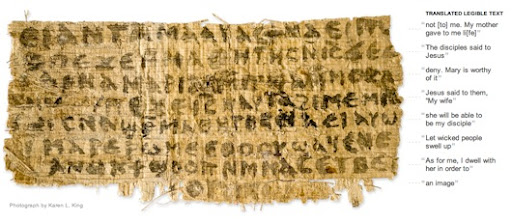
Let’s start with the facts of the matter: a fragment of Coptic script on papyrus that may date from the 4th century AD and that consists of 49.5 words in its English translation (see the top of this post) was presented at the International Congress of Coptic Studies on 18th September. The fragment contains no complete sentences and the sole reason for its overnight fame are the following words it contains:

Jesus said to them, “My wife

Looking at reports in the media, the following picture emerges:

“Even with many questions unsettled, the discovery could reignite the debate over whether Jesus was married, whether Mary Magdalene was his wife and whether he had a female disciple.” (New York Times)
“The discovery that some ancient Christians thought Jesus had a wife could shake up centuries-old Christian traditions” (Washington Post)
“A discovery by a Harvard researcher may shed light on a controversial aspect of the life of Jesus Christ.” (Huffington Post)
“A Harvard Divinity School professor’s interpretation of a scrap of fourth-century Egyptian papyrus that quotes Jesus Christ making reference to a wife could stoke new debates to the role of women in Christianity, theologians say.” (Boston Herald)
“An 4th century papyrus fragment could call centuries of celibacy into question.” (Time)

The message is clear: this is a major discovery that could alter that very foundations of Christianity in one fell swoop. As much fun as it would be to debunk statements like the above, it would be falling for a textbook straw man argument (as some have, while others, like Fr. James Martin, haven’t). Instead, let me defer any comment on the matter, until we see Dr. Karen L. King, the scholar who presented the fragment at the Congress, speak for herself. And what better way to do that than to refer to a draft of her peer-reviewed journal paper, to be published in the Harvard Theological Review (link courtesy of Harvard Magazine):

“This is the only extant ancient text which explicitly portrays Jesus as referring to a wife. It does not, however, provide evidence that the historical Jesus was married, given the late date of the fragment and the probable date of original composition only in the second half of the second century. Nevertheless, if the second century date of composition is correct, the fragment does provide direct evidence that claims about Jesus’s marital status first arose over a century after the death of Jesus in the context of intra-Christian controversies over sexuality, marriage, and discipleship.
[…]
The use of the term “gospel” here regards the probable genre of the work to which this fragment belonged (see below, “Genre”) and makes absolutely no claim to canonical status nor to the historical accuracy of the content as such. This invented reference in no way means to imply that this was the title in antiquity, or that “Jesus’s wife” is the “author” of this work, is a major character in it, or is even a significant topic of discussion—none of that can be known from such a tiny fragment. Rather the title references the fragment’s most distinctive claim (that Jesus was married), and serves therefore as a kind of short-hand reference to the fragment.”

Wait, what?! Unlike the cat-among-pigeons reaction of the media, Dr. King’s words (maybe with a little help from the journal’s reviewers 🙂 sound rational, factual and well representative of what this fragment may be: a text recorded probably in the 4th century AD that may be a copy of a 2nd century one, situated among the ’intra-Christian controversies’ of the day. No “Christianity 2.0”, no “we have had it all wrong for 2000 years” and no “shake up.”

In this (hopefully) more complete picture, Dr. King (who, after all was speaking at the Institutum Patristicum Augustinianum, which is part of the Pontifical Lateran University – i.e., popularly known as the “Pope’s University”!) comes up smelling of roses, while the various media reports happen to fit the topic that I actually wanted to talk about today like a glove! Namely, yesterday’s Gospel reading, in which Jesus vents his frustration with childish attitudes. In Luke 7:31-35 he is reported as saying the following:

“To what shall I compare the people of this generation?
What are they like?
They are like children who sit in the marketplace and call to one another,

‘We played the flute for you, but you did not dance.
We sang a dirge, but you did not weep.’

For John the Baptist came neither eating food nor drinking wine,
and you said, ‘He is possessed by a demon.’
The Son of Man came eating and drinking and you said,
‘Look, he is a glutton and a drunkard,
a friend of tax collectors and sinners.’
But wisdom is vindicated by all her children.”

When I read this, I could picture Jesus’ disbelief in the face of his contemporaries’ conduct (“What are they like?!”), who thought of John the Baptist as a nutter and of Jesus himself as a pig [my own words :] and who jumped at anything to push their own agendas. How little has changed in 2000 years!

Let me not finish on a negative note though as I do see this episode as positive overall. That a new fragment from the early days of Christianity has come to light is great (the more we know the better, since knowledge is power and the truth will set us free [apologies for this fragment–peddling – it just seemed fitting :]) and so is the scholarly integrity of Dr. King and her fellow coptologists, who can shed light on the history of this find and its place within the overall corpus of early Christian writings.


I know the media reports are a straw man, but a very juicy and tempting one, so let me just take one slash at it: Assuming the fragment’s authenticity (which I am in no position to question or believe in) places it into the 4th century. Taking it as a record of events from the first century is like someone discovering the following fragment from this post in the 38th century: “Newton wrote: ‘This quantity I designate by the name of aura” and considering it as a record of Newton’s words from 1687 …

On an entirely separate and unrelated note, let me just share what I found out about the following words that Jesus speaks in Luke’s Gospel: ‘We played the flute for you, but you did not dance. We sang a dirge, but you did not weep.’ This intrigued me straightaway and I first though that it may come from one of the Psalms or another part of the Bible. It seems instead that they were just part of a game that kids played at the time. Two groups would be formed – one playing jolly music and another a wailing funereal tune and they’d compete in who’d gather more followers as they moved through the streets. What a bizarre (but great 🙂 game! Thanks to St. Cyril of Alexandria for the tip!

Without words

Juan macias

The saint, whose feast is celebrated today, stands out from among his sainted brothers and sisters in that he never preached or wrote about his faith. Instead, St. Juan Macías, who was a Dominican lay brother and spent his life performing domestic and administrative tasks as his monastery’s porter, gave witness to his faith by welcoming and feeding the needy who came to his door for help. He lived his life in simplicity and frugality, serving his neighbors more eloquently than if he had been a great orator. Reading about his life made me think of last Sunday’s second reading, which ends as follows:

“So also faith of itself, if it does not have works, is dead. Indeed someone might say, “You have faith and I have works.” Demonstrate your faith to me without works, and I will demonstrate my faith to you from my works.” (James, 2:17-18)