Orthodoxy and/or orthopraxy

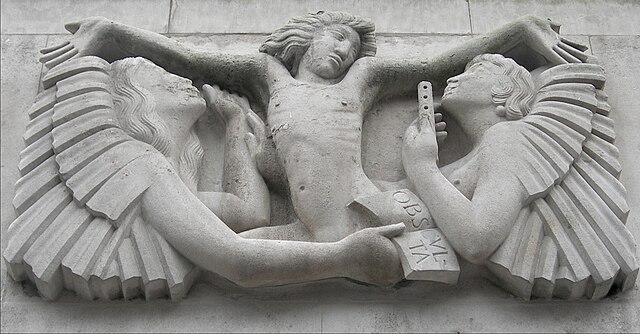
640px Ariel between Wisdom and Gaiety

What is the relationship between correct belief (orthodoxy) and correct action (orthopraxy) and how much does one matter versus the other? Is it more important what you think or what you do? While this is not a new question, I believe it is still a key one today.

Starting with Jesus, we can see him emphasizing both orthopraxy (also as a means of inferring orthodoxy when heterodoxy may be suspected):

“By their fruits you will know them. Do people pick grapes from thornbushes, or figs from thistles?” (Matthew 7:16) and

“Not everyone who says to me, ‘Lord, Lord,’ will enter the kingdom of heaven, but only the one who does the will of my Father in heaven.” (Matthew 7:21)

and validating orthodoxy in spite of it’s proponents’ heteropraxy:

“The scribes and the Pharisees have taken their seat on the chair of Moses. Therefore, do and observe all things whatsoever they tell you, but do not follow their example. For they preach but they do not practice. They tie up heavy burdens [hard to carry] and lay them on people’s shoulders, but they will not lift a finger to move them. All their works are performed to be seen.” (Matthew 23:2-5)

Looking at Jesus’s teaching, there is a clear preference for orthopraxy (whose absence is an obstacle and which will also be the basis for the questions asked at the last judgement about feeding the hungry, quenching their thirst, welcoming strangers, clothing the naked, caring for the sick, visiting prisoners, … (Matthew 25:31-46)) but orthodoxy is valued in its own right as a (non-exclusive) means for engendering orthopraxy (and, by Christians, as a gift from God). In a way it can be seen as being assumed to be present at least implicitly, partially, unconsciously in those behaving orthopractically.

Let me just pick out two examples of where this principle of orthopraxy being taken to assume (implicit) orthodoxy has been employed by Jesus’ followers – a very recent one and a rather ancient one:

  1. Saint Pope Gregory the Great (6-7 century AD) was so taken by the justice that the emperor Trajan (1-2 century AD) has shown towards a widow, who violently lost her only son, and by his virtue that he prayed for the salvation of his soul and it’s promotion from purgatory to heaven. In other words, Gregory was motivated by Trajan’s orthopraxy to petition for his receiving the rewards he thought were only due to the orthodox.
  2. Archbishop Müller, when questioned about his friendship with Gustavo Gutiérrez, the father of Liberation Theology, responded: “The theology of Gustavo Gutiérrez, independently of how you look at it, is orthodox because it is orthopractic. It teaches us the correct way of acting in a Christian fashion since it comes from true faith.” This is not to say that all of Liberation Theology is exonerated by virtue of the virtue of its followers (the Vatican’s criticisms of Marxist influences in some of its strands are upheld by Müller), but that the virtue of its followers is a fruit of their orthodoxy.

All of this links rather nicely with Martini’s idea of (non)believers and is another argument for appreciating the orthopraxy of all while also valuing beliefs that can lead to it. I also believe it is a key to reading some Protestant–Catholic differences, to relating the lives of saints and Church doctrine and to appreciating great works of art created by artists who have committed heinous crimes (a.k.a., my roadmap for a couple of future posts :).
What do you mean, John 3:16?

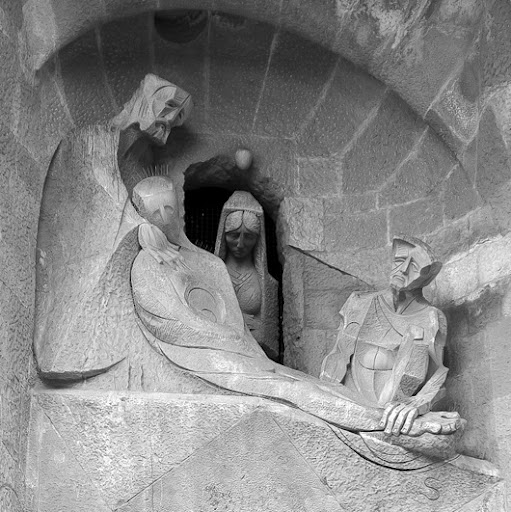
Joseph nicodemus

Today is the feast of two great saints: Nicodemus and Joseph of Arimathea. Neither was involved in the great battles against heresy that mark the lives of so many saints nor were they believed to have been martyred, to have lead ascetic lives or to have had visions or ecstasies. Also, in all likelihood, both were married men – pillars of the Jewish community at the time. Nicodemus was a politician, judge and prominent public figure, while Joseph (believed by some to be none other than Josephus Flavius) was an aristocrat and scholar. If they had LinkedIn profiles, they would come across as regular 1%ers.

Nonetheless, these guys are great examples of following Jesus – and they had the privilege of doing so in person. Nicodemus visiting Jesus in secret at first (John 3:1-21) but then coming out in the open to help Joseph to bury him (John 19:39–42) and Joseph being the one who stepped out of the shadows to petition Pilate for Jesus’s corpse. To my mind, both have shown great courage to place themselves at Jesus’s side under risky circumstances, putting their good standing and reputation at risk by associating themselves with a convicted and executed criminal. While that may not be asked of me, I see them as examples for taking Jesus’s side also when it is uncomfortable in the eyes of society.


Nicodemus can’t be mentioned without a nod to Wyclef Jean‘s “John 3 16,” where “pig couldn’t fly straight so you die in your sleep; I stay awake only to see Nicodemus.” Here you can find the lyrics and the song itself.

The wedding garment


Yesterday’s gospel reading was a bit of a puzzler and as I don’t think I ever heard it convincingly explained in a homily or made satisfactory sense of it myself, I started digging a bit into it. The text is from Matthew’s gospel (22:1-14) and presents the parable of the king’s son’s wedding feast where those who are invited refuse and the king’s servants bring in whomever they can find. The parable then ends in one of the guests being expelled for wearing the wrong gear plus there is a bit of killing too. Here is the full text:
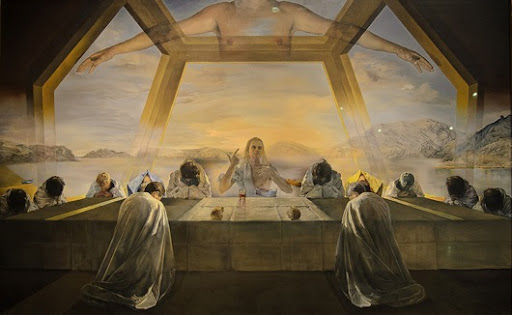
Jesus said to the chief priests and the elders of the people, ‘The kingdom of heaven may be compared to a king who gave a feast for his son’s wedding. He sent his servants to call those who had been invited, but they would not come. Next he sent some more servants. “Tell those who have been invited” he said “that I have my banquet all prepared, my oxen and fattened cattle have been slaughtered, everything is ready. Come to the wedding.” But they were not interested: one went off to his farm, another to his business, and the rest seized his servants, maltreated them and killed them. The king was furious. He despatched his troops, destroyed those murderers and burnt their town. Then he said to his servants, “The wedding is ready; but as those who were invited proved to be unworthy, go to the crossroads in the town and invite everyone you can find to the wedding.” So these servants went out on to the roads and collected together everyone they could find, bad and good alike; and the wedding hall was filled with guests. When the king came in to look at the guests he noticed one man who was not wearing a wedding garment, and said to him, “How did you get in here, my friend, without a wedding garment?” And the man was silent. Then the king said to the attendants, “Bind him hand and foot and throw him out into the dark, where there will be weeping and grinding of teeth.” For many are called, but few are chosen.’

So, what does all this mean? I had a quick look at homilies over the last 2000 years and found the following:

  1. St. Cyril of Jerusalem (4th century AD) basically considers this parable self-explanatory 😐
  2. St. John Chrysostom (4th century AD) gives the parable a historical reading whereby those invited are the people of Israel while the random crowd picked from the cross-roads are the Gentiles. He also focuses on the invitation to the latter being due to no merit of their own but wholly down to grace. The most interesting part if the parable to me is the poor guy who gets kicked out after he was invited at random. Here St. John focuses on the fact that he condemns himself – only after the king personally questions him about his improper attire (representing the corrupted state of his life) and he is unable to bring anything to his own defense, is he condemned. St. John also makes a point about this guest having had a clean garment given to him to begin with: “And yet the calling was of grace; wherefore then doth He take a strict account? Because although to be called and to be cleansed was of grace, yet, when called and clothed in clean garments, to continue keeping them so, this is of the diligence of them that are called.” This addresses the prima facie peculiarity of the parable: why punish someone who was invited in at random. The answer seems to be that the second cohort of guests were given appropriate attire (grace) but failed to maintain it.
  3. St. Augustine (4th-5th century AD) offers a rather convoluted explanation of this parable, spending an inordinate amount of time on evidencing that the one expelled guest actually represents a whole category (he is to be commended for his rigor though). As regards the expelled guest, St. Augustine equates the wedding garment with charity and quotes St. Paul to warn against its imperfect variants :““though I distribute all my goods for the use of the poor, and though I give my body to be burned, and have not charity, it profiteth me nothing.” This then is “the wedding garment.””
  4. Martin Luther (14th-15th century AD) reiterates the historical reading of St. John and St. Augustine and, as regards the expelled guest he characterizes them as follows: “These are pious people, much better than the foregoing; for you must consider them the ones who have heard and understood the Gospel, yet they cleaved to certain works and did not creep entirely into Christ; like the foolish virgins, who had no oil, that is, no faith.” That is, Christians, who were given everything, but have squandered it. What is it that God wants instead? Here Martin Luther has the following to say: “Now, what do we bring to him? Nothing but all our heart-aches, all our misfortunes, sins, misery and lamentations.” God wants us to be open with him and give him our all – weaknesses and strengths included.
  5. Finally, Pope Benedict XVI also offers his reading of this parable in a recent sermon: “God is generous to us, He offers us His friendship, His gifts, His joy, but often we do not accept His words, we show more interest in other things, we put our material concerns, our interests first.” As far as the expelled guest, Pope Benedict says: “on entering the hall, the king sees someone who has not wanted to wear the wedding garment, and for this reason he is excluded from the feast.” again echoing St. John’s position that the wedding garment was available to the guest but that it was his choice not to wear/maintain it. Pope Benedict then quotes St. Gregory the Great, who says that “this garment is symbolically interwoven on two pieces of wood, one above and one below: love of God and love of our neighbour.”

This parable has certainly been given a lot of thought since Jesus shared it with his followers and it seems clear that it is squarely directed at those who have heard the call of God to follow him. It is a warning both to those who hear it and ignore it and to those who follow it on the surface, but don’t back it up with faith and charity. In no way is this any criticism of sincere atheists/agnostics. Instead it is a rather harsh warning to those of us who claim to be Jesus’ followers, and, as St. John says “indicates […] the strictness of the life required, and how great the punishment appointed for the careless.” So, instead of a “oh, isn’t this a bit unfair to the poor, random fella” the message is clearly: take your relationship with God seriously – it is no game.

Many or all?

Dali

How do you preserve the message Jesus proclaimed two thousand years ago, when businesses and institutions struggle to get their members to know even just about the strategy and vision of the moment? I think this is quite a thorny challenge, as it can take you down at least two undesirable paths: On the one hand, you can become caught up in splitting hairs and lose sight of what Jesus wanted to communicate, while holding on to his specific words with zeal (the example of those who can recite Scripture but wouldn’t think twice when walking past a homeless person comes to mind). On the other hand, there is the ‘chillax, man!’ kind of approach, which would argue that it doesn’t matter what Jesus said exactly as we know that he just wanted us to be ‘nice’ to each other. While the latter is far less objectionable to me, it does run the risk of missing out on the richness of Jesus’ words, which we have been unpacking for two millennia (e.g., think of St. Francis’ re-discovery of poverty, St. Therese of Lisieux’s realization of the depth of everyday life, etc.).

It is in this context that the question of a single of Jesus’ word’s translations has been plaguing linguists and theologians during the last half century, leading to votes in various national Bishops’ conferences and now even to an intervention by the Pope himself. The word in question is the Latin ‘multis’ and the controversy revolves around whether it ought to be rendered as ‘many’ or ‘all.’

Coming to this question cold, you could be forgiven for saying: “Well, I googled it, and it clearly says ‘many.’ End of story.” As it happens, the Pope has arrived at the same conclusion, but what is noteworthy to me is how he did it (and, no, he didn’t just google it!) and how he then proceeded. To get the full story, see Benedict XVI’s letter to the German Bishops’ Conference, and if you’d just like my summary, read on. The text in question are Jesus’ words at the last supper, where he blesses and offers the wine to his disciples, saying:

hic est enim calix Sanguinis mei novi et aeterni testamenti, qui pro vobis et pro multis effundetur in remissionem peccatorum

which, up until very recently was translated as:

this is the cup of my blood, the blood of the new and everlasting covenant. It will be shed for you and for all so that sins may be forgiven

and, which is now translated as follows (after a very recent revision of the English translation, that was also influenced by Pope Benedict’s choice):

this is the chalice of my blood, the blood of the new and eternal covenant, which will be poured out for you and for many for the forgiveness of sins

As you can see, this is a pretty important word, since it, at first sight, sets the scope for the effects of Jesus’ sacrifice. Did Jesus offer his life for all (as the Church has been, and still is, teaching: “For as in Adam all die, so also in Christ shall all be made alive” – Catechism of the Catholic Church, §655) or only for some? Suggesting the latter would be outrageous, would fly in the face of everything that Christianity can be most certain of and would be entirely incongruent with the rest of Jesus’ teaching. The potential doubt that this change of translation could introduce in the minds of church goers is precisely what made both the German and Italian bishops rebel and vote massively in favor of not changing the respective translations.

This brings us to Pope Benedict’s letter, where he first proceeds to sum up the history of the argument, then to underline the validity of concerns like the above and to re-affirm the universal scope of Jesus’ sacrifice and salvation. Only after having prepared the ground does he proceed first to deliver a master class on the distinction between translation and interpretation (while acknowledging the difficult balance between the two and agreeing that the ‘for all‘ was “a well-founded interpretation then as now”) and on how the two need to go hand in hand:

“The word must be presented as it is, with its own shape, however strange it may appear to us; the interpretation must be measured by the criterion of faithfulness to the word itself, while at the same time rendering it accessible to today’s listeners.”

Benedict does not leave things at this though and at stating that “the words ‘pro multis’ should be translated as they stand”. Instead he proceeds to outline how local bishops need to prepare their congregations for the change in wording and flips the situation from a source of disagreement to an opportunity to spread the Gospel. He does this by underlining the three reasons that Jesus may have had for using the word ‘many’ instead of ‘all’:

  1. “Firstly, for us who are invited to sit at his table [i.e., participate in the Eucharist], it means surprise, joy and thankfulness that he has called me, that I can be with him and come to know him.”
  2. “Secondly, this brings with it a certain responsibility. How the Lord in his own way reaches the others – “all” – ultimately remains his mystery. But without doubt it is a responsibility to be directly called to his table, so that I hear the words “for you” – he suffered for me. The many bear responsibility for all. The community of the many must be the lamp on the lamp-stand, a city on the hilltop, yeast for all.”
  3. “Finally, [i]n today’s society we often feel that we are not “many”, but rather few – a small remnant becoming smaller all the time. But no – we are “many”: “After this I looked, and behold, a great multitude which no man could number, from every nation, from all tribes and peoples and tongues,”, as we read in the Revelation of Saint John (7:9). We are many and we stand for all. So the words “many” and “all” go together and are intertwined with responsibility and promise.”

Having read Pope Benedict’s letter leaves me with admiration for his method, with gratitude for the nuances of the ‘many’/‘all’ difference that he laid bare and also with an appreciation of the subtlety of his approach. After all this is ‘just’ a letter to the German bishops – not one of the formal ‘weapons’ that he has in his arsenal, such as apostolic letters, apostolic exhortations, apostolic constitutions or ‘ex cathedra,’ infallible proclamations. What we get instead is a point made with such power of reason that it does not require legal support.

5L2F

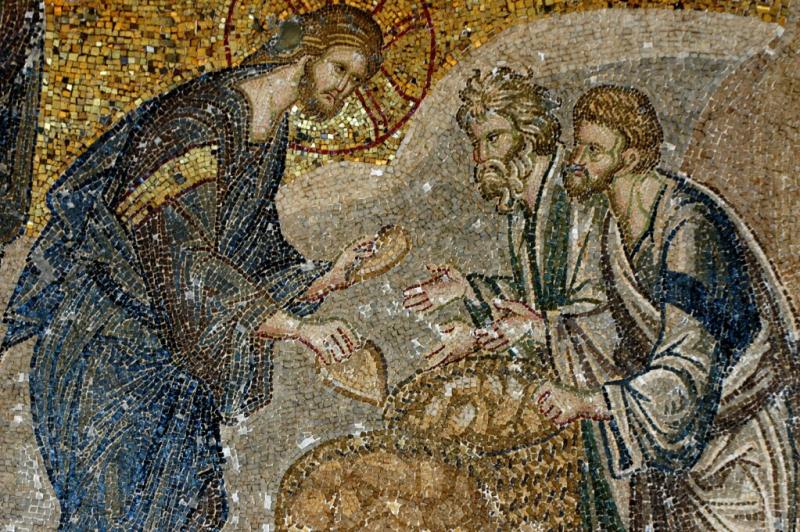
Multiplication of loaves and fishes c osseman

After Sunday’s Gospel reading at mass, I was struck by a seemingly throw-away point made during the homily, where the priest said that Jesus asked his disciples to go and buy some food for the people who assembled to listen to him and were in danger of running hungry:

When Jesus raised his eyes and saw that a large crowd was coming to him, he said to Philip, “Where can we buy enough food for them to eat?” He said this to test him, because he himself knew what he was going to do. Philip answered him, “Two hundred days?’ wages worth of food would not be enough for each of them to have a little.'” One of his disciples, Andrew, the brother of Simon Peter, said to him, “There is a boy here who has five barley loaves and two fish; but what good are these for so many?” Jesus said, “Have the people recline.” Now there was a great deal of grass in that place. So the men reclined, about five thousand in number. Then Jesus took the loaves, gave thanks, and distributed them to those who were reclining, and also as much of the fish as they wanted. When they had had their fill, he said to his disciples, “Gather the fragments left over, so that nothing will be wasted.” So they collected them, and filled twelve wicker baskets with fragments from the five barley loaves that had been more than they could eat.

John 6:5-13

The suggestion that Jesus wanted them to use regular means for feeding the masses made me listen up and reflect on the nature of miracles. The conclusion I am coming to is that the miracles Jesus performed were mostly accidental – not premeditated, planned (maybe with the exception of Lazarus’ raising from the dead where Jesus’ actions took place sometime after he was informed of his friend’s death). In this case, Jesus is spreading the good news of his Father’s love for all and it becomes apparent that the crowd following his words is going to get hungry and disperse to seek food in the nearest towns. Instead of following his disciples’ suggestion to call it a day and send his listeners on their separate ways, Jesus instead challenges their faith and asks them to provide for the crowd. Essentially he’s saying to them: nip down to the shops and fetch some dinner.

In spite of the effect that Jesus has already had on his disciples, Philip comes out with a bit of accountancy, ballparking the order at 200 days’ wages (a touch over £9700 in the UK today, which would give a budget per person/family of just under £2 – not exactly a lavish affair) and attempting to bring Jesus’ desire not to interrupt his mission stumbling down on logistical grounds. What comes next is a really great, but super-hesitant, move by Andrew, who says “There is a boy here who has five barley loaves and two fish; but what good are these for so many?” In other words, I hear Andrew as sticking his neck out and positioning himself next to Jesus by taking a leap of faith and bringing up the slightest of possibilities that could address the present challenge. To my mind the miracle is as much a reward for Andrew as it is a lesson for Philip and for the crowd assembled at Jesus’ feet.

Personally I read it as a call to trust in God and not to self–impose constraints where God’s providence is ready to provide against the odds. I have often experienced generosity by others or the discovery of solutions that only came to light because I placed my trust in God’s providence. Shortly before my older son was to be born, the house we were renting was put on the market and we were given a month’s notice to move. When we were informed about it, I was filled with panic and started rushing around, looking at vacancies but failing to find anything whatsoever as it was two weeks before Christmas and most places were shutting down for the holidays. One evening, and I remember this distinctly, I realized that I was leaving God out of this process (and doing so during Advent of all times!) and decided to skip the frantic search and instead spend the evening in prayer. This certainly calmed me down and when I woke in the morning. the thought came to me to look in the neighboring city instead of the one were we were living at the time. That same day I found us a new house to rent and the following months have shown how good the change of location was for us in ways we could not have anticipated.

Now, was that a miracle? No, in the sense that I don’t believe God intervened in the regular running of the universe. But, it did bring about a conversion in me that lead to greater closeness to God and a more attentive listening to his whispers.

This brings me to the final thought I have about Sunday’s Gospel: how much of what John describes (and incidentally the other three Evangelists too) was a miracle in the sense that the laws of nature were locally and temporarily altered? My impression is that not all. Let me explain … I believe that many people in the crowd that day had some food with them and that, when the gathering was dispersed, they may well have moved to a nice spot, laid it out and had a picnic. Others, who had no food would have had to trek to the nearest village and buy some, yet others would have had to go hungry as they may not have had the means to buy more food for themselves. Instead, what Jesus did by arranging the crowd into smaller groups (making the people assembled to hear him less of an anonymous mass), taking the five loaves of bread and two fish, blessing them and beginning to hand them out, was to create better conditions for sharing. I can imagine that someone who saw what Jesus did and had some food on them would add it to the food passed on to the next person, which in turn would lead to a positive, pyramidal-scheme-like avalanche and result in the many basketfuls collected at the end. Am I saying that I don’t believe a miracle (in the laws-of-nature-bending sense) took place? Certainly not – I do not see why Jesus should not have performed miracles, being God who created the universe out of nothing, but I do believe that his miraculous actions also triggered responses in their witnesses that lead to an amplification. Could Jesus have made food appear for 5000 families – sure! But, isn’t the humble (five loaf of bread + two fish) gesture much more loving, as it allows for human participation, rather than a sudden, imposing appearance of rows of fully-laden tables would have been?