A(rt)ppreciation

Artppreciate

Imagine waking up one morning, walking into your kitchen and finding the table set with your favorite breakfast, beautifully laid out and ready for you to enjoy. What would be your first reaction? Delight? Surprise? Curiosity? Gratitude? And what about when you started eating the food? Would you be savoring its flavors? Would you enjoy the taste?

Or, would the sight of this unforeseen setup stop you dead in your tracks, even preventing you from crossing the kitchen’s threshold? Would you be wondering who prepared the breakfast? What their motivation was? What recipe they followed? How they learned to cook? Where they sourced the ingredients? What other breakfasts they prepared? Who else prepared breakfasts? What they were trying to tell you by making breakfast for you? And would your inability to answer all of these questions put you off so much that you wouldn’t even sit down and eat?

The above scenario might sound very far-fetched and contrived – and it is! – but I’d like to argue that it is an analogy1 of how a growing number of my friends approach art. And I don’t mean to ridicule them here at all – their approach is eminently reasonable, but just to share my own experience2 of relating to art and appreciating it,3 that side-steps (but in some cases defers) what I see as my friends’ inhibitors to sharing in the same enjoyment that I receive.

Over the last couple of years I have, on separate occasions, visited galleries with close friends and have spent some time discussing questions like: “What did the artist want to say with this piece?,” “Is this really art?,” “What do you see in this?” and “What do you know about this artist / the period / the technique / etc.?” As far as I can, I try to dismiss such questions, since I believe them all to be of secondary importance at best.

In the first instance, I find that it pays to try and allow for an encounter between me and a piece of art, which is actually an encounter with a person – its creator – by proxy. And just like when being in the presence of another person, this is all about emptying myself of expectations, prejudices, stereotypes and allowing for the other to express themselves and speak to me. In some cases a connection is established – and it is worth letting it breathe before proceeding to anything else – while in others not – the same applies for art as for people. As Grayson Perry put it – “you don’t have to like it all.”

Second, in case a connection is in place – in case a piece of art has elicited a reaction from me, I can reflect on it and make its effects on me explicit to myself. I can think about how this piece of art fits into my world – what it makes me feel, think, remember, wish for, …

Third, I can share my experience of this encounter with someone else, who is there with me, whom I speak or write to later, … And this sharing can also be in the form of creating new art, that others can engage with without my immediate presence.

And, fourth, I may be compelled to learn more about the piece, it’s author, the technique, it’s context, it’s symbolism, it’s history, which in turn can allow for the sequence to restart and to take a different course, compared to this first, “uninformed” encounter.

A key idea here, at least one that helps me engage with a piece of art, is also to realize that not everything has a verbal equivalent – not everything is just an alternative to verbalized thought and the resolution of every encounter is not a verbalized thought. When looking at a painting by Paul Klee (to give a recent example), my great friend NP asked me: “What was he thinking when he painted this?” To which I hesitatingly and apologetically replied “This!,” while pointing at the painting. I didn’t believe that it was a visual translation of preexisting verbalized thought any more than a piece of music is. And while the answer was awkward, I believed it to be correct. Certainly, words can be said in response to visual art, but – at least in the case of great art, I don’t believe any amount of words can fully capture it, just like they couldn’t a person, whose expression art is.

Finally, I would also like to anticipate a likely objection: “Alright, what you say may be OK, but it doesn’t lead to an understanding of what the artist wanted to say – only to a subjective and potentially unrelated experience by a viewer. Aren’t you missing the point?” Here I’d like to argue that two scenarios are possible: first, that the artist wasn’t trying to communicate – they were “only” expressing themselves (if they wanted to communicate verbal content, they could have used more unambiguous means), in which case a quest to identify a message is futile and, second, that the artist was well aware of the the inherent disjointedness of the process, where the content they intended to embody in a piece of art may not be accessible to some (or even any) viewer, in which case an effort to cross the chasm, that is the piece of art itself, is likely to have arbitrary success.

A third scenario is possible though, I hear you say: that the artist has also written or spoken about what their intentions were when creating a piece. Then, if I am unaware of this proclamation, my viewing of their work will be incomplete and my lack of knowledge an obstacle to getting what they intended by their work. That may well be true, but even if it is, this only impacts the fourth stage of engaging with a piece of art as outlined above – a risk I am happy to take, especially since most artists I know of detested or flatly refused supplying such crutches for the viewing of their work.


1 Please note a key feature of analogy, which is its incompleteness – I don’t mean to suggest that art is the same as food (although it can have a nourishing effect) and I am intentionally staying away from the trap of trying to define what art is – only to argue that there may be a particular way to engage with it.
2 I am making no claims of universality or excellence of method here – this is only my attempt at introspection and sharing of what goes on when I come across a piece of art, in case it may be of some interest or help to someone else.
3 Just a word of warning – if you google “appreciating art,” you are far more likely to find junk – including statements like: “Visiting an art gallery or museum is a low-cost way to spend time with friends or a date.” or “Appreciating art is very easy once you understand art history.” from sources I won’t even link to …
Duchamp: art beyond the retinal

Fountain

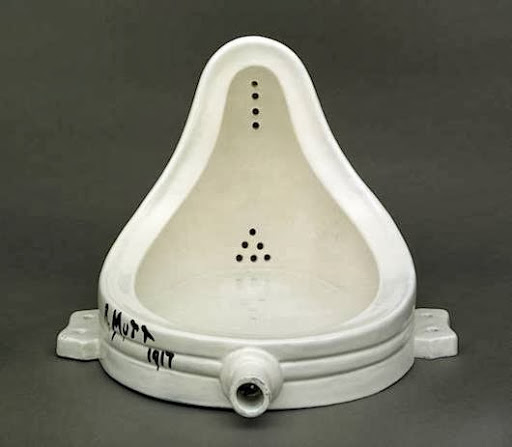
While Marcel Duchamp can certainly be credited for broadening the palette of what can constitute art – making absolutely anything a candidate, it would be a mistake to think of this move as in any way arbitrary or frivolous. Nor was this about novelty, since Duchamp’s view was that “[a]rt is produced by a succession of individuals expressing themselves; it is not a question of progress. Progress is merely an enormous pretension on our part.”1 Taking an urinal and sticking it in a gallery – in the form of his piece “Fountain” shown above – is not what Duchamp was about at all, even though – on the surface of it – that is precisely what it looked like from the outside.

To get a sense of how he arrived at picking up a urinal from a plumbers’ merchant and submitting it to an exhibition, let’s start with the root of Duchamp’s rebellion:

Painting shouldn’t be exclusively retinal or visual; it should have to do with the gray matter, with our urge for understanding. […] I am interested in the intellectual side, although I don’t like the word intellect. For me intellect is too dry a word, too inexpressive. I like the word belief. I think in general when people say “I know”, the don’t know, they believe. I believe that art is the only form of activity in which man as man shows himself to be a true individual. Only in art is he capable of going beyond the animal state, because art is an outlet towards regions not ruled by time and space. To live is to believe; that’s my belief, at any rate.

Duchamp’s concern was that art had become only visual over the preceding two centuries – that its appreciation did not involve faculties beyond the retina. The problem here is not retinal/aesthetic quality but the absence of intellectual, verbal, existential hooks, which art has had during previous times but lost during the 19th century:

I wanted to get away from the physical aspect of painting. I was much more interested in recreating ideas in painting. For me the title was very important. I was interested in making painting serve my purpose, and in getting away from the physicality of painting. […] I was interested in ideas – not merely in visual products. I wanted to put painting once again at the service of the mind. […] In fact until the last hundred years all painting had been literary or religious: it had all been at the service of the mind. […] This is the direction in which art should turn: to an intellectual expression, rather than an animal expression.

I find a great deal of appeal here – to use a piece’s title not merely for nominal, labeling purposes, but to make it be an integral part – in conjunction with the object it is attached to – of being the source of a viewer’s relationship with, reaction to and reflection on.

How does one get beyond the inherent physicality of painting though? Duchamp’s reasoning starts from the reductivism of cubist and futurist forms – especially from the treatment of movement of the latter, although he uses it for other purposes than those originally intended by the Italians:

The reduction of a head in movement to a bare line seemed to me defensible. A form passing through space would traverse a line; and as the form moved the line it traversed would be replaced by another line – and another and another. Therefore I felt justified in reducing a figure in movement to a line rather than to a skeleton. Reduce, reduce, reduce was my thought […] and later, following this view – I came to feel an artist might use anything – a dot, a line, the most conventional or unconventional symbol – to say what he wanted to say.

It is the extreme reductions employed by the futurists that lead Duchamp to the insight that any thing that the artist chooses can be the signifier for any signified. The signifier and signified do not need to share appearance, features or structure. This basic liberation of the requirements of semiotics also attacks another undesirable feature of art, which is the role of habit and convention in its judgement:

The danger is to “lead yourself” into a form of taste. [… Taste] is a habit. Repeat the same thing long enough and it becomes a habit. If you interrupt your work, I mean after you have done it, then it becomes, it stays a thing in itself; but if it is repeated a number of times it becomes taste. […] A mechanical drawing has no taste in it [because it is divorced from conventional expressions in painting. … In] trying to draw a conclusion or consequence from the dehumanization of a work of art, I came to the idea of the ready-mades […] works in effect that are already completely made. [e.g., “Why not sneeze Rose Selavy?” 1921 – a bird cage filled with cubes of sugar, or “Fountain”]

The “readymades” that Duchamp arrives at here are the result of a reductio ad absurdum of the insight that increasingly further and further removed signifiers can stand for any given signified. If a line or a point can be placed in correspondence with figure, then a pre-existing object can be a work of art and the means for an artist’s self-expression. But Duchamp doesn’t stop here and also attacks that most sacred of art’s social requirements – uniqueness:

The choice of readymades was never dictated by esthetic delectation. This choice was based on a reaction of visual indifference with at the same time a total absence of good or bad taste … In fact a complete anesthesia. One important characteristic was the short sentence which I occasionally inscribed on the “readymade”. That sentence instead of describing the object like a title was meant to carry the mind of the spectator towards other regions more verbal. […] Another aspect of the “readymade” is its lack of uniqueness … the replica of a readymade delivering the same message; in fact nearly every one of the readymades existing today is not an original in the conventional sense.

As Grayson Perry, who to my mind established a new orthoepy for Duchamp – Dű•shomP, put it: “anything could be art that [Duchamp] decided was art [… However,] though we live in an era when anything can be art, not everything is art.” The challenges of what is/isn’t art become harder, but the question remains far from arbitrary – even with the broader palette available to the artist, it is their sincerity of expression that fuels their work’s artistic merit and Duchamp can, in my opinion, rightly be counted among the greats of this deeply transcendent of human activities.


1 All the quotes from Marcel Duchamp here are from his Essential Writings.

Grayson Perry: the stealth spirituality of art

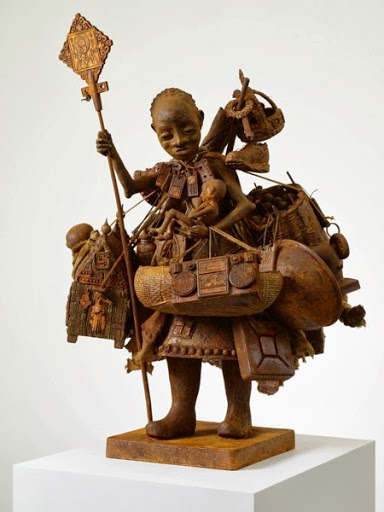
4 our mother by grayson perry1

Before I say anything else, I have to come clean and declare that I am a huge fan of Grayson Perry both as an artist and as a thinker (and I don’t mean to suggest that those are separate facets of Perry, but only to emphasize the prominence of reflection in his work). I have first encountered his pottery when he won the Turner Prize in 2003, then I immensely enjoyed his three-part Channel 4 series “All In The Best Possible Taste” – where I was not only impressed by the tapestries he created as the product of his analysis of the tastes of different classes in British society, but very much also by his ability to relate with such immediacy to all he met in the process – and finally I have delighted in his Reith lectures both due to their tremendously entertaining form (the whip-cracking sounds of the second lecture, his pronunciation of Duchamp [DushomP] and his jovial laughter being highlights) and their partly ironic/satirical and partly sincere, profound, spiritual content.

If you have any interest in art whatsoever, I highly recommend the lectures, which can be found at the BBC 4 website both in audio an transcribed textual form. There, Perry will take you through his thoughts on what art is versus is not, what makes good art, what the position of art and artist is in contemporary society and what it is like to become and be an artist. If you are looking for formulaic answers or even definitions, you’ll be disappointed, but if you are willing to be lead through the warren of insights into and critiques of the “art world” that Perry masterfully moulds together, you will come away greatly enriched.

Instead of attempting a synthesis or even just a walk-through of my favorite bits, let me only focus on a single aspect of Perry’s Reith lectures: the tension between the irony of the art world and the sincerity that is the source of art. Both are effected by artists, yet they stand in opposition to each other.

In Lecture 3, Perry first presents the pitfalls of irony (whose application copiously peppers all four of his lectures):

“[D]etached irony has become the kind of default mode of our time in the art world. And you know I think it can be problematic. [… Tracey Thorn describes the problem of irony as follows:] “It is difficult for people in the arts to be entirely sincere about things without looking like they have not thought about it properly.” The problem with irony is that it assumes the position of being the end result, from having looked at it from both sides and have a very sophisticated take on everything. So the danger of eschewing irony is that you look as though you’ve not thought hard enough about it and that you’re being a bit simplistic. […] Me, I have to sort of protect myself against this because when I’m out in the evening and I’m with my mates and I’m being terribly cynical and ironic; but when I want to look at art, I want to have a sincere one to one experience with it because I am a serious artist. I’ve dedicated my life to it. So I go to exhibitions in the morning on my own when I can go, hmn, and you know maybe have a little bit of a moment. (LAUGHTER) I have to protect my tender parts from that wicked irony. And perhaps the most shocking tactic that’s left to artists these days is sincerity.”

By considering irony to be a sign of reflection and careful though, it becomes an expected feature of an artist’s response to art. Yet, at the same time, irony is an inhibitor of sincerity and to the forming of genuine connections with art or with others. The artist is expected to be externally ironic while internally sincere and the danger of the former taking over and stifling the latter is a concern for Perry.

Towards the end of Lecture 4 and then in response to a question from the audience, Perry elaborates further:

I have a list of banned words: passionate, spiritual, profound. I mean these are all words I could describe – this tender part of me, the tender part that many artists have, you know what keeps them going – but I have an acute allergy to cliches […] and I have to protect that part of me from becoming a cliché. [… Jennifer Yane expressed it by saying:] “Art is spirituality in drag.” [… It’s] the idea that it’s a kind of performance of spirituality, it’s a dressing up, and it’s kind of like a way to accessing spirituality perhaps by stealth almost – you know being tricked into all the colour and loveliness of the art. You know we look at it and suddenly we’re having a spiritual moment, you know. But, like I say, I’m not allowed to talk … […] But the metaphor that […] best describes what it’s like for me being an artist is a refuge, a place inside my head where I can go on my own and process the world and its complexities. It’s a kind of inner shed in which I can lose myself.

There are a couple of points that I really like about what Perry says here. First, that it is the “tender,” inner part of his self that drives his art, which very much reminds me (no, not of Martin Parr) of Kandinsky, who characterizes art as the consequence of an inner necessity. Second, that Perry is protective of this innermost tenderness and sincerity, since he considers their expression to be of importance – to be serious. Third, the at first jarring expression of art being “spirituality in drag”1 actually makes great sense, as explained by Perry: aesthetics and the superficial, at-first-sight are the means by which the profound, innermost, spiritual are smuggled past irony, much like Odysseus’ strapping sheep furs on his back let him escape the cyclops Polyphemus’ abattoir. In many ways, Perry himself comes across as a personification of this definition of art, with a form that has an element of wink-wink, nudge-nudge and hyperbole, but with a substance that is tender, spiritual and profound.


1 Grayson Perry being a transvestite (in a tradition whose roots reach back at least to Ancient Greek theatre, where all characters of the period’s seminal tragedies and comedies were played by male actors, via the pepperpots of Monty Python fame) adds to the poignancy of this definition.