Being body in spirit

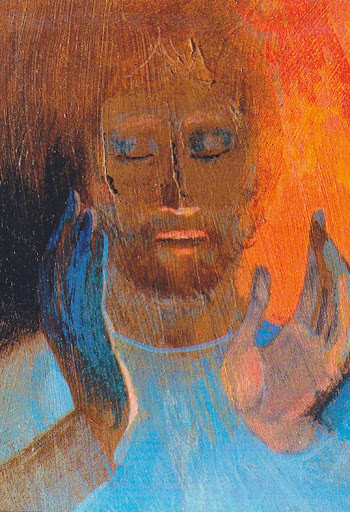
Le christ arcabas

Last Saturday at mass, I heard something along the following lines during the sermon: “We need to look after our souls more than after our bodies, since our souls are eternal and our bodies will be discarded at the end of our lives.” While the intention behind this statement may have been good, and was set in the context of the priest noting that only around 1% of those who attend mass come to confession in his parish, the suggestion of the body being secondary and only temporarily attached to the soul certainly wasn’t in keeping with the Church’s teaching. Since such dualist views are not uncommon and since I have heard them attributed to Catholicism by some friends of mine, I would here like to take a closer look at what the Catholic Church actually teaches about this topic.

Originally I was going to look at the question of how the body and soul are understood in a broader way, with a look at Scripture, a mention of St. Francis of Assisi, a glimpse at the counter-reformation and then examples from Pope Francis’ teaching (e.g., his insistence on the importance of touching the flesh of the poor and suffering), I will instead stay monographic and focus on what St. John Paul II wrote on the subject in his “Man and Woman He Created Them.” As soon as I went back to that book and started re-reading the relevant passages I realized that all of what I wanted to bring into play is there and is expressed crisply and sharply.

To being with, John Paul II’s point of departure is that of humans1 being made in the image of God and therefore being a “primordial sacrament”:

“Man appears in the visible world as the highest expression of the divine gift, because he bears within himself the inner dimension of the gift. And with it he carries into the world his particular likeness to God, with which he transcends and also rules his “visibility” in the world, his bodiliness, his masculinity or femininity, his nakedness. […] Thus, in this dimension, a primordial sacrament is constituted, understood as a sign that efficaciously transmits in the visible world the invisible mystery hidden in God from eternity. And this is the mystery of Truth and Love, the mystery of divine life, in which man really participates. In the history of man, it is original innocence that begins this participation and is also the source of original happiness. The sacrament, as a visible sign, is constituted with man, inasmuch as he is a “body,” through his “visible” masculinity and femininity. The body, in fact, and only the body, is capable of making visible what is invisible: the spiritual and the divine. It has been created to transfer into the visible reality of the world the mystery hidden from eternity in God, and thus to be a sign of it.”

Note how John Paul II does not say “he has a body” but “he is a body” and that the sacramentality of humans consists in their being a “visible sign” of God’s presence in the world. Unlike other sacraments, humans are conscious of their being so and therefore become subjects rather than objects:

“Consciousness of the gift conditions in this case “the sacrament of the body”: in his body as man or woman, man senses himself as a subject of holiness. With this consciousness of the meaning of his own body, man, as male and female, enters into the world as a subject of truth and love.”

The body’s origins (as gift from God and God’s visible sign in the world) and function (as “subject of holiness”) already point to it’s being a lasting and intrinsic part of what it is to be human:

“[W]e draw a first hope already from the mystery of creation: namely, that the fruit of the divine economy of truth and love, which revealed itself “at the beginning,” is not Death, but Life, and not so much the “destruction of the body of man made in the image of God,” but rather the “call to glory” (Romans 8:30).”

And it is Jesus’ resurrection that seals the deal:

“The resurrection, according to Christ’s words reported by the Synoptics, means not only the recovery of bodiliness and the reestablishment of human life in its integrity, through the union of body and soul, but also a wholly new state of human life itself.”

It is often said that all philosophy is a conversation between Plato and Aristotle, and the body-soul question seems to be no different. John Paul II here clearly aligns Christianity and Catholic teaching with Aristotle and later with Thomas Aquinas:

“Reflection about the resurrection led Thomas Aquinas in his metaphysical (and simultaneously theological) anthropology to abandon Plato’s philosophical conception on the relation between the soul and the body and to draw near to Aristotle’s view. In fact, the resurrection attests, at least indirectly, that in the whole of the human composite, the body is not, contrary to Plato, only temporarily linked with the soul (as its earthly “prison,” as Plato maintained), but that together with the soul it constitutes the unity and integrity of the human being. This is precisely what Aristotle taught, in contrast to Plato. When St. Thomas in his anthropology accepted Aristotle’s conception, he did so because he considered the truth about the resurrection. In fact, the truth about the resurrection clearly affirms that man’s “eschatological perfection and happiness cannot be understood as a state of the soul alone, separated (according to Plato, liberated) from the body, but must be understood as the definitively and perfectly “integrated” state of man brought about by such a union of the soul with the body that it definitively qualifies and assures this perfect integrity.”

Siding with Aristotle here is firmly on the basis of the resurrection, which brings about the original harmony that was created by God “in the beginning”:

“In the resurrection, the body will return to perfect unity and harmony with the spirit: man will no longer experience the opposition between what is spiritual and what is bodily in him. [… It is] not only that the spirit will master the body, but, I would say, that it will also fully permeate the body and the powers of the spirit will permeate the “energies of the body.””

John Paul II is quick to insist on the resurrection not having resulted in victory of spirit over body, a subjugation, but in participation and personal fulfillment:

“In fact, in the composite, psychosomatic being that is man, perfection cannot consist in a reciprocal opposition of the spirit and the body, but in a deep harmony between them, in safeguarding the primacy of the spirit. In the “other world,” this primacy will be realized, and it will be manifested in a perfect spontaneity without any opposition on the part of the body. Nevertheless, this should not be understood as a definitive “victory” of the spirit over the body. The resurrection will consist in the perfect participation of all that is bodily in man in all that is spiritual in him. At the same time, it will consist in the perfect realization of what is personal in man.”

This also very much echoes Giuseppe Maria Zanghí’s thought on how our being in God does not annihilate us, is not a victory over us, but instead:

“I can be myself in Him (being an intimate participant of Trinitarian life in the Word), while being really distinct from Him (by virtue of being a creature different from Him). It is His love that wants me, and the love of God does not withdraw into itself, canceling diversity with the other by totally reverting it to Himself, but “makes” the other and guards them in diversity from Himself, not wanting to possess (like He doesn’t possess Himself) in total reabsorption. […] Because the relationship between the two “opposing” extremes (I and the other, I and God) is still thought of as ending in one of the two (and, therefore, in the strongest!); while, if Christian faith is true, the relationship does not end in either of the mediated extremes, but in a third that saves them precisely in their diversity.”

And – as far as the body-soul relationship is concerned, I believe Zanghí’s “third” is precisely John Paul II’s “resurrection.”


1 In my own words I will use the somewhat awkward “humans” to refer to both men and women, while in the quotes from John Paul II’s writings there will be reference to “man.” Note, however, that John Paul II means “human” when his words are rendered as “man” in English, which is explicit from the full text of “Man and Woman He Created Them” and also reflects the fact that in Polish he uses the word “człowiek” which also refers to both men and women and is used in everyday language without the technical connotations that “human” has in English.
Harmony in diversity

Turkey popejpeg 01dca c0 327 5242 3382 s561x327

10380974 837984076265611 4582951503244712748 n

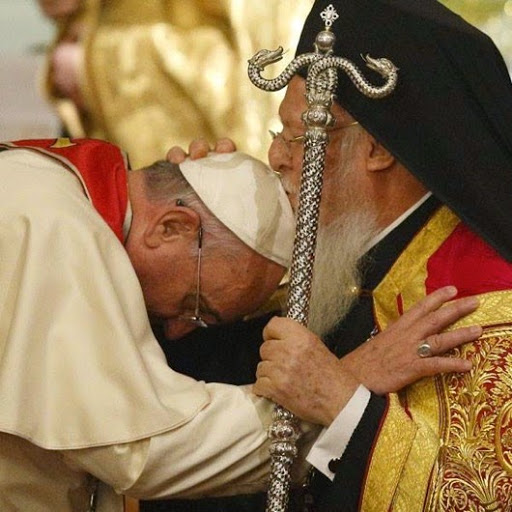
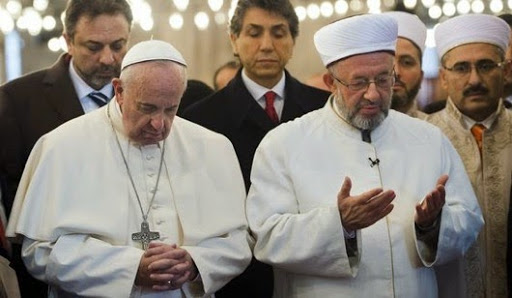
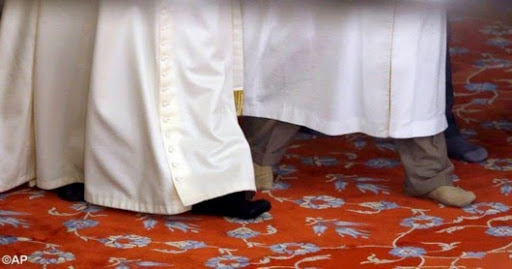
Last weekend Pope Francis visited Turkey, a country where 99.8% of the population is Muslim and where there are only about 35,000 Roman Catholics – truly a peripheral choice, fitting perfectly into Francis’ focus throughout his pontificate. What I would like to do in this post is just to pick out a couple of my favorites from among the things the pope said and share with you three photos – the two at the top, of Francis praying with Istanbul’s Grand Mufti Rahmi Yaran in the Blue Mosque and the one in the middle of Francis – and with him the entire Roman Church – being blessed (and kissed on the head) by Ecumenical Patriarch Bartholomew I.

In his first address in Turkey, to civil authorities, Francis emphasized the centrality of human dignity and brotherhood:

“Today what is needed is a dialogue which can deepen the understanding and appreciation of the many things which we hold in common. Such a dialogue will allow us to reflect sensibly and serenely on our differences, and to learn from them.

There is a need to move forward patiently in the task of building a lasting peace, one founded on respect for the fundamental rights and duties rooted in the dignity of each person. In this way, we can overcome prejudices and unwarranted fears, leaving room for respect, encounter, and the release of more positive energies for the good of all.

To this end, it is essential that all citizens – Muslim, Jewish and Christian – both in the provision and practice of the law, enjoy the same rights and respect the same duties. They will then find it easier to see each other as brothers and sisters who are travelling the same path, seeking always to reject misunderstandings while promoting cooperation and concord. Freedom of religion and freedom of expression, when truly guaranteed to each person, will help friendship to flourish and thus become an eloquent sign of peace.”

Later during the first day, Francis addressed the president of the Diyanet, the Department For Religious Affairs, denouncing religious extremism and fundamentalism:

“Particular concern arises from the fact that, owing mainly to an extremist and fundamentalist group, entire communities, especially – though not exclusively – Christians and Yazidis, have suffered and continue to suffer barbaric violence simply because of their ethnic and religious identity. They have been forcibly evicted from their homes, having to leave behind everything to save their lives and preserve their faith. This violence has also brought damage to sacred buildings, monuments, religious symbols and cultural patrimony, as if trying to erase every trace, every memory of the other.

As religious leaders, we are obliged to denounce all violations against human dignity and human rights. Human life, a gift of God the Creator, possesses a sacred character. As such, any violence which seeks religious justification warrants the strongest condemnation because the Omnipotent is the God of life and peace. The world expects those who claim to adore God to be men and women of peace who are capable of living as brothers and sisters, regardless of ethnic, religious, cultural or ideological differences.”

The next day, during his homily at the Catholic Cathedral of the Holy Spirit in Istanbul, Francis focused first on the fundamental role of the Holy Spirit in our lives and then on the nature of diversity in unity:

“When we pray, it is because the Holy Spirit inspires prayer in our heart. When we break the cycle of our self-centredness, and move beyond ourselves and go out to encounter others, to listen to them and help them, it is the Spirit of God who impels us to do so. When we find within a hitherto unknown ability to forgive, to love someone who doesn’t love us in return, it is the Spirit who has taken hold of us. When we move beyond mere self-serving words and turn to our brothers and sisters with that tenderness which warms the heart, we have indeed been touched by the Holy Spirit.

It is true that the Holy Spirit brings forth different charisms in the Church, which at first glance, may seem to create disorder. Under his guidance, however, they constitute an immense richness, because the Holy Spirit is the Spirit of unity, which is not the same thing as uniformity. Only the Holy Spirit is able to kindle diversity, multiplicity and, at the same time, bring about unity. When we try to create diversity, but are closed within our own particular and exclusive ways of seeing things, we create division. When we try to create unity through our own human designs, we end up with uniformity and homogenization. If we let ourselves be led by the Spirit, however, richness, variety and diversity will never create conflict, because the Spirit spurs us to experience variety in the communion of the Church. […] Saint Basil the Great’s lovely expression comes to mind: “Ipse harmonia est”, He himself is harmony.

The temptation is always within us to resist the Holy Spirit, because he takes us out of our comfort zone and unsettles us; he makes us get up and drives the Church forward. It is always easier and more comfortable to settle in our sedentary and unchanging ways. In truth, the Church shows her fidelity to the Holy Spirit in as much as she does not try to control or tame him. And the Church shows herself also when she rejects the temptation to look only inwards. We Christians become true missionary disciples, able to challenge consciences, when we throw off our defensiveness and allow ourselves to be led by the Spirit. He is freshness, imagination and newness.”

On the Saturday evening then came a particularly moving moment of “mystical tenderness” (as Fr. Antonio Spadaro, SJ put it), shown in the following photo and following these words by Pope Francis, addressed to the Patriarch Bartholomew:

“Andrew and Peter heard [the promise of joy]; they received this gift. They were blood brothers, yet their encounter with Christ transformed them into brothers in faith and charity. In this joyful evening, at this prayer vigil, I want to emphasize this; they became brothers in hope – and hope does not disappoint us! What a grace, Your Holiness, to be brothers in the hope of the Risen Lord! What a grace, and what a responsibility, to walk together in this hope, sustained by the intercession of the holy Apostles and brothers, Andrew and Peter! And to know that this shared hope does non deceive us because it is founded, not upon us or our poor efforts, but rather upon God’s faithfulness.

With this joyful hope, filled with gratitude and eager expectation, I extend to Your Holiness and to all present, and to the Church of Constantinople, my warm and fraternal best wishes on the Feast of your holy Patron. And I ask a favour of you: to bless me and the Church of Rome.”

IMG 4226

The final day of Francis’ trip – Sunday 30th November, the feast day of St. Andrew, patron saint of the Orthodox Church – started with an address during the Orthodox Divine Liturgy at the Patriarchal Church of St. George in Istanbul, where his focus was on the relationship between the Catholic and Orthodox Churches and where he first underlined deeply personal nature of the Christian life:

“Meeting each other, seeing each other face to face, exchanging the embrace of peace, and praying for each other, are all essential aspects of our journey towards the restoration of full communion. All of this precedes and always accompanies that other essential aspect of this journey, namely, theological dialogue. An authentic dialogue is, in every case, an encounter between persons with a name, a face, a past, and not merely a meeting of ideas.

This is especially true for us Christians, because for us the truth is the person of Jesus Christ. The example of Saint Andrew, who with another disciple accepted the invitation of the Divine Master, “Come and see”, and “stayed with him that day” (Jn 1:39), shows us plainly that the Christian life is a personal experience, a transforming encounter with the One who loves us and who wants to save us. In addition, the Christian message is spread thanks to men and women who are in love with Christ, and cannot help but pass on the joy of being loved and saved. Here again, the example of the apostle Andrew is instructive. After following Jesus to his home and spending time with him, Andrew “first found his brother Simon, and said to him, ‘We have found the Messiah’ (which means Christ). He brought him to Jesus” (Jn 1:40-42). It is clear, therefore, that not even dialogue among Christians can prescind from this logic of personal encounter.”

Next, Francis reiterated the Vatican II Unitatis Redintegratio position that the Catholic Church recognizes that the Orthodox Churches “possess true sacraments, above all – by apostolic succession – the priesthood and the Eucharist, whereby they are still joined to us in closest intimacy” and that “it is of the greatest importance to preserve and support the rich patrimony of the Eastern Churches.” He then set out his vision for the road towards full communion:

“I believe that it is important to reaffirm respect for this principle as an essential condition, accepted by both, for the restoration of full communion, which does not signify the submission of one to the other, or assimilation. Rather, it means welcoming all the gifts that God has given to each, thus demonstrating to the entire world the great mystery of salvation accomplished by Christ the Lord through the Holy Spirit. I want to assure each one of you here that, to reach the desired goal of full unity, the Catholic Church does not intend to impose any conditions except that of the shared profession of faith.”

And finally, he called for joint action already, as a consequence of being Jesus’ disciples, in three areas: the poor, the victims of conflicts and young people.

Next followed a common declaration by Pope Francis and Patriarch Bartholomew, of their desire “to intensify our efforts to promote the full unity of all Christians, and above all between Catholics and Orthodox. […] asking our faithful to join us in praying “that all may be one, that the world may believe” (Jn 17:21).” And finally, Pope Francis went to meet with young refugees from Turkey, Syria and Iraq who were being looked after by Salesians in Istanbul, where he said:

“Dear young people, do not be discouraged. It is easy to say this, but please make an effort not to be discouraged. With the help of God, continue to hope in a better future, despite the difficulties and obstacles which you are currently facing. […] Remember always that God does not forget any of his children, and that those who are the smallest and who suffer the most are closest to the Father’s heart.”

As has been customary on Pope Francis’ trips, there was a press conference this time too during the return flight, where journalists could ask him questions directly. Here I’d just pick out his answer to a question about what praying in the Blue Mosque meant for him:

“I went there, to Turkey, as a pilgrim, not as a tourist. And I went there primarily for the feast [of St. Andrew] that we celebrated today: I came precisely to share it with Patriarch Bartholomew, with a religious motive. But then, when I went to the mosque, I could not say, “No, now I’m a tourist.” No, it was all religious. And I saw that wonderful place! The mufti explained things well to me, with such gentleness, and also using the Qur’an, which speaks of Mary and John the Baptist, he explained everything to me … That’s when I felt the need to pray. And I said: “Shall we pray a bit?” – “Yes, yes,” he said. And I prayed for Turkey, for peace, for the mufti … for all … for myself, since I need it … I prayed, really … And I prayed for peace, above all. I said, “Lord, let’s put an end to these wars …” So, it was a moment of sincere prayer.”