In the beginning

In the beginning

This is my third attempt at starting a post1 that I have been thinking about intensively all weekend (and that follows a train of thought that I have nursed on and off for years). Why write about it now? Because I believe I have finally understood something that has been staring me in the face for years: the opening line of St. John’s Gospel is a joke!

“Whoa!” I hear you say “Hold it right there!” Before you start crying “Blasphemy!” or “Stone him!,” please, do hear me out.2 I don’t mean to say that it is ridiculous, frivolous, trivial or inconsequential. On the contrary! I believe that I can now see a twist of humor in it that furthermore alludes to complexity that would otherwise have taken tomes upon tomes to try and spell out and that would have been well beyond St. John or the Christians of the first many centuries.

Picture this (imaginary, non-canonical!) scene:

God the Father, Jesus and the Holy Spirit are sitting around a table, chatting (you can imagine that this is what they spoke about in the scene Rublev painted, if you like):

Father: OK, guys, let’s get John started with his Gospel.

Jesus: Dad, can we have him spell out how it all started, and not just open with my birth?

HS: Sure(!), but the maths might be a tad beyond him, don’t you think?

Jesus: I didn’t mean to give him the full recipe, HS! This is not about repeatability and independent verification …

HS: So, were you thinking along the lines of the atemporal – yet dynamic, hyper-dimensional, infinite, partaking in the finite, linear, half-axis of time and being delimited in space? Even if we dumb it down to the level of philosophy, it’s still a tall order (although if anyone can do it, I can!).

Father: Look, HS, Jesus does have a point – we could give them a sense of what is going on, without having to bring Ambrose, Thomas or Albert forward. Surely you can think of some little quip to point them in the right direction.

[A “moment”’s silence later.]

HS: It’s a bit cheeky, but how about this – and I’m just riffing here (plus they’ll have to wait for Ludwig and Martin to start unpacking it) …

Jesus: Get on with it! We may have all eternity, but I’d rather get back to giving Sidd some more hints.

HS: All right, all right! How about John opens with this: “In the beginning was the Word!”

The Father and Jesus look at each other, wide-eyed, exclaim: “Genius!” and the triune bursts out laughing.

The insight I had, while walking to mass on Sunday morning and thinking about Dei Verbum, the Johannine prologue and Descartes’ “cogito,” was the following: Saying “In the beginning was the Word” is like starting a recipe with “knead the dough.” A word cannot possibly be the start: it requires a language, other words, syntax, grammar and speakers and listeners who know how to play the games it facilitates. Saying “In the beginning was the Word” is saying “Look, this is as far back as we can take you, but know that there was lots that came before.” It places at the beginning an innocent-looking entity: a word, yet one that vehemently points beyond itself. To meaning, to reference, to relation, to function, to communication, to a meeting of minds. With a simple sentence, John (with some help), gives a masterclass on the inevitability of the preexisting and the core of Trinitarian relationships, where, like a word, each person points beyond themselves.

“Alright,” you say, “but why call it a joke?” I believe the structure of this sentence is precisely that of all one-liners: the first part (“In the beginning”) prepares you for a certain set of expectations and the second surprises you with something that just does not fit (“the Word,” which cannot possibly be in the beginning :). This is exactly what Kant meant with “Laughter is an effect that arises if a tense expectation is transformed into nothing.” Not wanting to kill humor with explanation, let me leave you with another example of the same comedic form: “Every winter when the first snow fell, I’d run to the front door with excitement, start banging on it and shout: “Mum! Dad! Let me in!”” (Milton Jones).

Realizing the above, I started seeing the Johannine pattern elsewhere too. Descartes, starts with “cogito ergo sum,” in an attempt to draw a line and derive a philosophy from that stake in the ground. Yet, it is a line that carries a lot of baggage beyond itself. My own earlier attempt too, which tries to take the “cogito” a step further by starting with “Language” is nothing but an explicit acknowledgement of such a necessary preexistence and in no way escapes or circumvents it. Unsurprisingly, the account of creation in Genesis uses the word/language mechanism for indicating the process of creation, where matter is spoken into being (“Then God said: Let there be light, and there was light” (Genesis 1:3)). More surprisingly, one of the Hindu creation accounts (the Nasadiya Sukta in the Rigveda) also employs a similar, though not identical, mechanism: “The One breathed windlessly and self-sustaining […] that was the primal seed, born of the mind.” Even the creation account of the Sumerians (The debate between Sheep and Grain, written in the 3rd millennium BC), highlights the role of language in the process: “the great gods, did not even know the names Grain or Sheep.”

What is clear to me from the above is the fundamental role of language in the process of something coming from nothing, which in a sense undermines the idea of a true nothing having preceded the something. With this in mind, the Christian identification of Jesus with “the Word,” which I have been wondering about for years, makes perfect sense. The Father makes himself known to us by speaking his Son, who in turn points back to Him: “Whoever has seen me has seen the Father.” (John 14:9) and then: “The words that I speak to you I do not speak on my own. The Father who dwells in me is doing his works. Believe me that I am in the Father and the Father is in me, or else, believe because of the works themselves.” (John 14:10-11, with a nice hat-tip to orthopraxy).

So, let me finish with a one-liner: “In the beginning was the Word.” 🙂


1 In a previous version I would have taken you through Lemaître, the Planck epoch and the opening lines of the Tanakh, before getting to the Johannine prologue.
2 Thanks to my über–bestie, PM, for his Nihil Obstat and Transferitur (the Imprimatur of the digital age) – much appreciated!
I say polygon, you say polyhedron


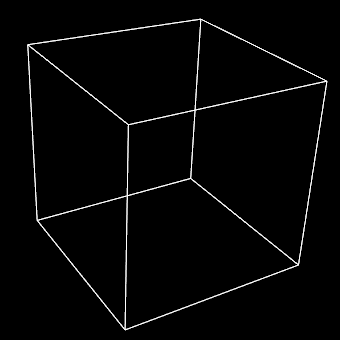
When you look at the above image, what do you see? Two triangles and five quadrangles, a cube or something else? Now, let’s turn to the following thought experiment:
You are strapped into a chair, your head held firmly in place, and you see a bright, diffuse screen in front of you, showing a series of black lines. You notice that the screen can go from an only-just visible black point at its periphery, via lines cutting across it or forming triangles with its edges, to closed squares or even constellations of polygons moving and morphing across it. You also notice that there are several knobs and levers at your disposal and that you can influence the shapes seen on the screen. Your task is to work out how the patterns you see are formed.

All you have access to in this case is a sequence of experiences of a two-dimensional, bounded world, yet through painstaking experiments you come to the realization that what you are seeing is consistent with there being a wireframe cube behind the screen. All the patters, the changes from one pattern to another and the lengths of edges could be the result of a wireframe cube casting a shadow. Once you arrive at your conclusion you are released from your restraints and are free to exit the room. As you do so, another person exits the room next to you. A quick chat reveals you had the same experience, but it turns out that they are convinced that it was just a computer screen rather that the silhouette of a mesh cube. You enter each other’s rooms and realize that they look identical! You believe their room shows a 3D cube’s shadow; they believe your room contains a 2D computer-driven display. You both look for a way to access what is behind the respective screens and after a while you find the rooms backing onto your two ones. Your screen and theirs were indeed driven differently: one was a display driven by a computer and the other a piece of translucent plexiglass having a backlit cube cast shadows on it. Which was which remains a secret guarded by the two of you.

Now, my question to you: who was the more rational participant in this experiment? The person postulating a 3D entity on the basis of strictly 2D evidence or the person whose theories remained firmly 2D, in line with the nature of their evidence?

I would like to argue that they were both equally rational and that the distinction between them was not along rational-irrational lines and to underline the fact that they were both deriving their world views from the same evidence.

What was the point of this whole exercise though? It was to propose that empirical evidence alone is not sufficient to constrain explanation to a solely empirical domain (even just the use of mathematics in science, with its universal quantifier is beyond the empirical) and that the exact same experiences can be held up as a basis for alternative theories.

The last exegetical point I’d like to make though is that the two protagonists of the thought experiment can learn a lot from each other. The person hypothesizing the 3D cube can lend the other means for simplification while the strictly 2D person can share a more refined understanding of 2D relationships, which also enrich the cube’s understanding.

Why is it that I am concerned by the evidence-theory relationship and try to dig into its nature? It is because this is a key stumbling block in the rapprochement between atheist scientists and the rational religious. The former don’t get how the latter can transcend evidence while the latter are threatened by the former’s insights into empirical evidence. The many-to-many nature of the evidence-theory relationship also underlies inter-religious dialogue. Since the transcendent is infinite, hyper-dimensional and vastly exceeding the fragmentary insights we can have of it, also in terms of aspects we don’t even know about!, it is understandable that different interpretations of its actions have been formed in different cultures and by different people. It would be short-sighted to stop at an incompatibility between the monotheism of some religions, the personal Trinitarian insight of Christianity, the polytheism of Hinduism and the apparent atheism of Buddhism (in the strict sense of atheism as opposed to its current use as anti-theism) and arrive at the erroneous conclusion that these religions talk about different things rather than differently about aspects of the same (please, don’t mis-read this as me saying that everything that all religions claim is true, that all religions are equally true or that religions can be freely intertwined and recombined. End of caveat :).

If there is a God, who is infinite, transcendent and vastly more complex than us, wouldn’t his actions as experienced in our limited realm lead precisely to the variety of religions as well as agnosticism and atheism that we see today?


Just a quick hat-tip to Flatland, to the Chinese Room thought experiment and to the story of the blind men and an elephant (and surely to many others :).

The Principle of Charity

Cholmondeley I first came across the “principle of charity” thanks to one of the lecturers on the MA in Philosophy that I attended (but sadly not completed) at Sheffield. In the first lecture of the Aristotle module, where we were going to cover Book 9 of the Metaphysics, Dr. Stephen Makin* put something like the following idea to his students:

Aristotle wrote the Metaphysics in the 4th century BC, using the language of the day and firmly set in the cultural, scientific and political context of the time. If we approach this text without an attempt at looking for something positive, valuable or meaningful, we will very quickly come to dismiss it, as it is very easy to find it dated, set it superseded modes of thinking or irrelevant. This would be a great shame though, as it would keep Aristotle’s insights hidden from us. Instead, let’s adopt the principle of charity and look for the most favorable interpretation of Aristotle’s words – the interpretation that would give his statements the greatest value, the most sense.

As you can imagine, I was super enthusiastic about this attitude, since it struck me both as very sensible and like exactly the kind of angle that the Gospels would take, had they addressed the topic of hermeneutics. While looking into the background of this principle, I came across the following example of its application in the context of religion that I found particularly positive:

“The next [human representation of the ideal of divine love] is what is known as Vatsalya, loving God not as our Father but as our Child. This may look peculiar, but it is a discipline to enable us to detach all ideas of power from the concept of God. … [T]he Christian and the Hindu can realize [this idea of God as Child] easily, because they have the baby Jesus and the baby Krishna.”

Swami Vivekanda (1863–1902)

Not only does Vivekanda shed light on an aspect of Christian revelation from a new angle, but he uses it to draw parallels with Hinduism, thereby making both religions’ insights accessible to each other’s followers. In this context it is particularly rewarding to see how this same point is emphasized in a recent homily of Pope Benedict XVI:

“God’s sign is simplicity. God’s sign is the baby. God’s sign is that he makes himself small for us. This is how he reigns. He does not come with power and outward splendor. He comes as a baby – defenseless and in need of our help. He does not want to overwhelm us with his strength. He takes away our fear of his greatness.”

Just to avoid the ever-lurking accusation of syncretism when considering inter-religious questions, I don’t read Vivekanda as equating Jesus with Krishna or proposing their co–existence or merging, but instead as pointing to principles expressed with similarity in both traditions.

If only the principle of charity were more broadly applied both in secular and religious discourse …


I can’t mention Dr. Makin without sharing the following anecdote: One morning Dr. Makin arrives late to give his lecture and with indignation exclaims: “I have been asked to do some administrative work! Can you imagine a professional administrator being asked to write a book about Aristotle?!” I often feel the same (but still have to do it :).