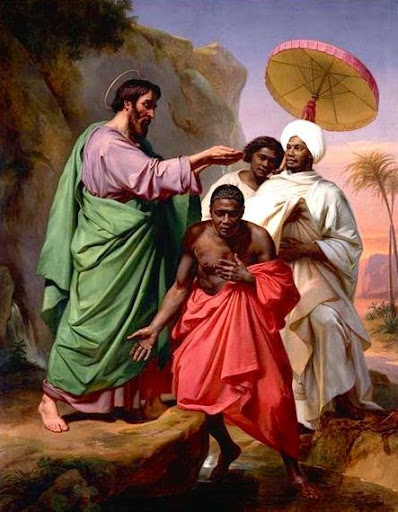
The Ethiopian eunuch: a case study in mercy

Ethiopian eunuch

Today’s first reading, from the Acts of the Apostles (8:26-40), tells the story of St. Philip’s journey from Jerusalem to Gaza, during which he meets the chief treasurer of the Queen of Ethiopia, who is a eunuch (i.e., man castrated to become a more trustworthy and disinterested servant). The eunuch is reading from the book of Isaiah and, upon being asked by Philip whether he understands what he reads, Philip is invited to join the eunuch in his chariot to explain it to him. The passage in question was:

“Like a sheep he was led to the slaughter,
and as a lamb before its shearer is silent,
so he opened not his mouth.

In (his) humiliation justice was denied him.
Who will tell of his posterity?
For his life is taken from the earth.”
(cf Isaiah 53:7-8)

Philip told the eunuch that the passage was about Jesus and proceeded to tell him more. When they came to some water, the eunuch said: “Look, there is water. What is to prevent my being baptized?” (Acts 8:36). And Philip baptized him.

You might think: “so what?,” but the above is actually quite an important passage given what is going on in the Church today, since, I believe, it gives an example of what being welcoming of everyone and focused on mercy mean. The eunuch in question here wasn’t just some guy who wanted to be baptized and whom Philip baptized as a matter of fact, to boost statistics.

The Hebrew Bible is very clear that “the law forbids the community of the Lord to accept anyone who has undergone destruction or removal of their sexual organs” (cf. Deuteronomy 23:2), as is certainly the case with eunuchs. Since St. Philip – like Jesus – was a Jew, and Jesus’ followers at that time were part of the Jewish community, these restrictions would have been know to him and there would have been an obligation to honor and adhere to them. Nonetheless, it must have been Jesus’ imperative to “Go, therefore, and make disciples of all nations, baptizing them in the name of the Father, and of the Son, and of the holy Spirit” (Matthew 28:19) that lead Philip to baptize – and thereby welcome into the community of Jesus’ followers – not only a non-Jew, but a member of a different race and of a sexual minority, explicitly outlawed by the Old Testament. None of these obstacles mattered to him, since “[t]he Spirit said to Philip, “Go and join up with that chariot.”” (Acts 8:29).

Pope Francis’ homily from this morning also deals with this first reading, instead of the Gospel as is more customary, and focuses on Philip’s attitude towards the eunuch:

“It’s impossible to evangelize without dialogue. It’s impossible. Because you must begin from where the person is, who is to be evangelized. And how important this is. ‘But, father, so much time is wasted because every person has their own story, comes with this or that, their own ideas …’ And, time is wasted. God wasted more time when he created the world, and He did well to do so! Dialogue. Waste time with that person because that person is whom God wants you to evangelize, what’s most important is that you give them the news about Jesus. But the way they are, not the way they ought to be: the way they are now.

Let’s think about these three moments of evangelization: the docility to evangelize; to do what God is asking, secondly, dialogue with people – but in dialogue, one begins from where they are – and thirdly, trusting in grace: grace is more important than all of bureaucracy. ‘What prevents this?’ Remember this. Often we in the Church are a factory of obstacles, because of which people can’t arrive at grace. May the Lord help us to understand this.”

Here, I believe, it is important to bear in mind what Francis means by “evangelizing,” which is “[t]o give witness with joy and simplicity to what we are and what we believe in.” There is no compulsion here, no obligation, no proselytizing. And that St. Philip had the same attitude is clear also from it being the eunuch’s initiative to become baptized. What struck me here is also the great simplicity and obviousness of his request: “Look, there is water. What is to prevent my being baptized?” Having received Jesus’ Good News from Philip, the eunuch has a new optics, through which the obstacles of old become invisible and it is only God’s welcome that can be seen. For the Church to then turn to this guy and say: “Sorry, mate, but you don’t qualify,” would have been absurd and is not at all what St. Philip did.

This brings me to a superb interview with Cardinal Walter Kasper, given to Commonweal magazine during his visit to the USA this week, where he speaks about mercy as follows:

“[The] ontological understanding of God was so strong that justice became the main attribute of God, not mercy. Thomas Aquinas clearly said that mercy is much more fundamental because God does not answer to the demands of our rules. Mercy is the faithfulness of God to his own being as love. Because God is love. And mercy is the love revealed to us in concrete deeds and words. So mercy becomes not only the central attribute of God, but also the key of Christian existence. Be merciful as God is merciful. We have to imitate God’s mercy. […]

Mercy concerns not only individuals. It also an imperative for the church itself. The church defined itself at the Second Vatican Council as a sacrament of God’s grace. How can the church be sacramental, a sign and instrument of mercy, when she herself doesn’t live out mercy? So many people do not perceive the church as merciful. It’s hard. […]

There are those who believe the church is for the pure. They forget that the church is also a church of sinners. We all are sinners. And I am happy that’s true because if it were not then I would not belong to the church. It’s a matter of humility.”

The key idea to me here is Kasper’s beautifully synthetic: “God does not answer to the demands of our rules. Mercy is the faithfulness of God to his own being as love.” Our own openness to others must be informed by a desire to share with them the joy that we have received from being brothers and sisters of Jesus and we must be weary of placing obstacles between them and God – no matter what they might be.

Francis’ “grammar of simplicity”

Dsm01

Yesterday the 28th World Youth Day has come to a close in Rio de Janeiro and there would undoubtedly be a lot to say about it. Instead, I would like to look at a different, yet related, topic today, which is that of Pope Francis’ daily morning sermons, delivered at the Domus Sanctæ Marthæ (DSM). Since his election in March, Francis has been inviting different groups of Vatican staff and other visitors to join him for morning mass at his residence of choice, during which he’d deliver a short, off-the-cuff-style reflection, inspired by the day’s readings. Since these morning masses, and the homilies they contained, have now been suspended for the summer months, one can consider their first season, so to speak, as complete, and reflect on them as a whole. These, by my count 123, homilies form a corpus that is not only important in terms of the themes that it addresses, but also as a body of linguistic content, and it is both of these aspects that I would like to reflect on here.

Before proceeding to the DSM homilies, it is worth hearing the following point made by Francis on Saturday, during a lunch with Brazilian bishops, since it is the key to unlocking their language:

“Another lesson which the Church must constantly recall is that she cannot leave simplicity behind; otherwise she forgets how to speak the language of Mystery. Not only does she herself remain outside the door of the mystery, but she proves incapable of approaching those who look to the Church for something which they themselves cannot provide, namely, God himself. At times we lose people because they don’t understand what we are saying, because we have forgotten the language of simplicity and import an intellectualism foreign to our people. Without the grammar of simplicity, the Church loses the very conditions which make it possible “to fish” for God in the deep waters of his Mystery.”

With the above in mind, let’s turn to the DSM homilies. According to the Vatican’s spokesman, Fr. Federico Lombardi, the morning homilies are spontaneous instead of delivered from a prepared written text and a “‘complete’ publication, therefore, would necessarily entail a transcription and a reworking of the text at various points, given that the written form is different from the spoken one, which in this case is the original form chosen intentionally by the Holy Father.” The result would be “‘something else’, which isn’t what the Holy Father intends to do [with his daily homily] each morning.” As a result of this primarily spoken and spontaneous form of the morning homilies, only summaries and quotes from them are available, instead of full transcripts. These summaries, furthermore, include notes on who was present at the individual masses, on what the readings of the day were and addenda like “the Holy Father said,” “pope Francis noted,” etc.

As a direct linguistic analysis of the summaries would be skewed by the above additions, I first parsed the 123 summaries and removed from them any text that went beyond a transcript or paraphrasing of Pope Francis. The end result are 27K words, resulting in an average of 220 words per sermon, which corresponds to about half a page of written text. The end result are only snippets of what Francis said and a degree of separation between his full, albeit short, sermons and the record available publicly is inevitable, and indeed in accord with Francis’ own wishes.

Running a textual analysis on the above corpus yields very interesting results, which make plain the simplicity of the language Francis employs:

  1. The total of 27,132 words result from using only 4,118 different ones, which is less than the typical vocabulary of a 6-year-old.
  2. The Gunning fog readability score of the text, which derives from the number of words per sentence and the percentage of complex words used, is 6.6. This is at the very bottom end of the scale and matches that of the Bible (with popular novels coming in at 8-10 and academic texts at 15-20).
  3. The average sentence length here is 13 words, where 17 is typical and 11-13 is considered easy.
  4. Word length too is at the low end of the scale, with an average of 1.49 syllables per word (as compared with typical language having 1.66).

That Francis speaks simply can easily be seen when listening to him and the above just underlines how consistently and persistently he does so during his morning sermons.

Turning to the content of his homilies, the word cloud at the top of this post shows the 50 most frequently used words, where font size is proportional to frequency. As can be seen immediately, “Jesus” is the word that Francis uses by far most often (2.3% of the time), followed by “Lord” (1.5%), where the two top words are in fact synonyms in this context. Comparing this to an analysis of his first sermons after being elected pope, it can be seen that his focus on the person of Jesus is a constant feature of his preaching. If we combine these two words, the second most frequent word becomes “our,” which, to my mind, underlines the sense one gets of Francis being one of us, referring to issues and ideas applicable to an “us” that includes him, rather than a “you” that he is removed from. Worth noting is also that the highest-ranked verb among the 4K words used in these homilies is “love” (7th among all words). A final point to pick up on in terms of word frequency is that of the top 50 words, only two imply obstacles or prohibition by themselves: “cannot” (48th) and “without” (49th). Looking at four word phrases, the most frequent one is “the word of God” (used 41 times in these 123 homilies) and in third place comes “the name of Jesus.” Francis continuously stays close to the person of Jesus, even just from the perspective of the vocabulary he employs, stays close to the congregation he addresses and is overwhelmingly positive.

Since I have already written at length about some of Francis’ DSM homilies in earlier posts, I would here just like to highlight some of the aspects that stood out to me while editing the text of these 123 sermons:

  1. Francis uses the term “pope” quite generously: he refers to the apostle Paul by saying that he “is a Pope, a builder of bridges.” and he also refers to Tawadros II in the same way, and has the following to say about him to the morning mass congregation: “Today there’s a good reason for joy in this house, where we are hosting the Pope of Alexandria, the Patriarch of the See of St Mark. He is a brother who has come to visit the Church of Rome to talk and to make a journey together.”
  2. Similes are a great favorite of Francis’, and he uses them liberally: “The confessional is not a laundromat,” “To solve the problems of life it is necessary to look reality in the face, ready like the goalkeeper of a football team to grab the ball whatever side it comes from,” that God is “not an indefinite God dispersed in the air like a spray”, that Jesus is “like an engineer, like an architect; He tells them what He will do: ‘I am going to prepare a place, in my Father’s house is my dwelling’,” that the Church is like a mother (“How would you feel if someone said: she’s a domestic administrator? ‘No, I am the mother!’ And the Church is Mother.”) and that some Christians are like pickled peppers (“Sometimes these melancholy Christians faces have more in common with pickled peppers than the joy of having a beautiful life”) are just a couple of examples.
  3. Francis draws inspiration from a very broad range of sources, including his grandmother (who’d tell him and other children in the family: ‘Look he is dead, but tomorrow he will be Risen!,’ when visiting the tomb on Good Friday), a man who worked for the diocese of Buenos Aires (“before going to do any of the things he had to do, he would always whisper to himself: ‘Jesus!’”), Pope Paul VI (who “said that you cannot advance the Gospel with sad, hopeless, discouraged Christians”), the martyrs of Nagasaki (“each one helped the other, they struggled mightily and spoke of Jesus as they awaited the moment of their death”), the garment factory collapse in Dhaka (which “killed hundreds of workers who were being exploited and who worked without the proper safety preoccupations. It is a title, which struck me the day of the tragedy in Bangladesh: ‘How to die for 38 euros a month’”), an electrician who prayed for his daughter’s recovery (“Miracles do happen. But we need to pray with our hearts: A courageous prayer, that struggles to achieve a miracle, not prayers of courtesy”) and a priest, who, when he was appointed bishop worried about his unworthiness (to which his confessor told him: “But do not worry. If after the mess Peter made of things, they made him Pope, then you go ahead!”).

Hatred and liberty cannot coexist

Chief Rabbi Lord Sacks pic 3 Copy

I have been following Lord Sacks, the chief rabbi of the Commonwealth, for a while on Twitter and have greatly enjoyed his writings ever since. Today’s post on his website is no exception and is well worth reading in full. Kicking off with a great quote by Martin Luther King:

Darkness cannot drive out darkness: only light can do that. Hate cannot drive out hate: only love can do that. Hate multiplies hate, violence multiplies violence, and toughness multiplies toughness …

he then goes on to discuss one of the instructions Moses gives to his people: “Do not hate an Egyptian, because you were a stranger in his land.” (Deuteronomy 23: 8). Lord Sacks emphasizes how counter-intuitive a law this is, given the exploitation and slavery the Israelites suffered at the hands of the Egyptians, instead of a spell of hospitality that the quote may suggest. His key point though is that hatred makes us slaves of the past and allows for past wrongs to persist in us even after they occurred. This does not mean that injustice ought to be forgotten, but only that its remembrance is to serve the purpose of prevention rather than retaliation. The key paragraph from Lord Sacks’s exegesis to me is the following though:

Hatred and liberty cannot coexist. A free people does not hate its former enemies; if it does, it is not yet ready for freedom. To create a non-persecuting society out of people who have been persecuted, you have to break the chains of the past; rob memory of its sting; sublimate pain into constructive energy and the determination to build a different future.

In many ways this is similar also to what St. Augustine, whose feast it is today, said:

“[He] he shall neither hate the man because of his vice, nor love the vice because of the man, but hate the vice and love the man. For the vice being cursed, all that ought to be loved, and nothing that ought to be hated, will remain.” (The City of God, 14:6)

Here Lord Sacks’ words can be read as saying that a fault’s or wrongdoing’s ‘cure’ needs to be accelerated and that those who have been wronged can take the first step. Maybe hatred is not a feeling I have myself, but there are certainly past events that have hurt or saddened me and I will strive to apply Lord Sacks’s advice to my attitude to them.

The wedding garment


Yesterday’s gospel reading was a bit of a puzzler and as I don’t think I ever heard it convincingly explained in a homily or made satisfactory sense of it myself, I started digging a bit into it. The text is from Matthew’s gospel (22:1-14) and presents the parable of the king’s son’s wedding feast where those who are invited refuse and the king’s servants bring in whomever they can find. The parable then ends in one of the guests being expelled for wearing the wrong gear plus there is a bit of killing too. Here is the full text:
Jesus said to the chief priests and the elders of the people, ‘The kingdom of heaven may be compared to a king who gave a feast for his son’s wedding. He sent his servants to call those who had been invited, but they would not come. Next he sent some more servants. “Tell those who have been invited” he said “that I have my banquet all prepared, my oxen and fattened cattle have been slaughtered, everything is ready. Come to the wedding.” But they were not interested: one went off to his farm, another to his business, and the rest seized his servants, maltreated them and killed them. The king was furious. He despatched his troops, destroyed those murderers and burnt their town. Then he said to his servants, “The wedding is ready; but as those who were invited proved to be unworthy, go to the crossroads in the town and invite everyone you can find to the wedding.” So these servants went out on to the roads and collected together everyone they could find, bad and good alike; and the wedding hall was filled with guests. When the king came in to look at the guests he noticed one man who was not wearing a wedding garment, and said to him, “How did you get in here, my friend, without a wedding garment?” And the man was silent. Then the king said to the attendants, “Bind him hand and foot and throw him out into the dark, where there will be weeping and grinding of teeth.” For many are called, but few are chosen.’

So, what does all this mean? I had a quick look at homilies over the last 2000 years and found the following:

  1. St. Cyril of Jerusalem (4th century AD) basically considers this parable self-explanatory 😐
  2. St. John Chrysostom (4th century AD) gives the parable a historical reading whereby those invited are the people of Israel while the random crowd picked from the cross-roads are the Gentiles. He also focuses on the invitation to the latter being due to no merit of their own but wholly down to grace. The most interesting part if the parable to me is the poor guy who gets kicked out after he was invited at random. Here St. John focuses on the fact that he condemns himself – only after the king personally questions him about his improper attire (representing the corrupted state of his life) and he is unable to bring anything to his own defense, is he condemned. St. John also makes a point about this guest having had a clean garment given to him to begin with: “And yet the calling was of grace; wherefore then doth He take a strict account? Because although to be called and to be cleansed was of grace, yet, when called and clothed in clean garments, to continue keeping them so, this is of the diligence of them that are called.” This addresses the prima facie peculiarity of the parable: why punish someone who was invited in at random. The answer seems to be that the second cohort of guests were given appropriate attire (grace) but failed to maintain it.
  3. St. Augustine (4th-5th century AD) offers a rather convoluted explanation of this parable, spending an inordinate amount of time on evidencing that the one expelled guest actually represents a whole category (he is to be commended for his rigor though). As regards the expelled guest, St. Augustine equates the wedding garment with charity and quotes St. Paul to warn against its imperfect variants :““though I distribute all my goods for the use of the poor, and though I give my body to be burned, and have not charity, it profiteth me nothing.” This then is “the wedding garment.””
  4. Martin Luther (14th-15th century AD) reiterates the historical reading of St. John and St. Augustine and, as regards the expelled guest he characterizes them as follows: “These are pious people, much better than the foregoing; for you must consider them the ones who have heard and understood the Gospel, yet they cleaved to certain works and did not creep entirely into Christ; like the foolish virgins, who had no oil, that is, no faith.” That is, Christians, who were given everything, but have squandered it. What is it that God wants instead? Here Martin Luther has the following to say: “Now, what do we bring to him? Nothing but all our heart-aches, all our misfortunes, sins, misery and lamentations.” God wants us to be open with him and give him our all – weaknesses and strengths included.
  5. Finally, Pope Benedict XVI also offers his reading of this parable in a recent sermon: “God is generous to us, He offers us His friendship, His gifts, His joy, but often we do not accept His words, we show more interest in other things, we put our material concerns, our interests first.” As far as the expelled guest, Pope Benedict says: “on entering the hall, the king sees someone who has not wanted to wear the wedding garment, and for this reason he is excluded from the feast.” again echoing St. John’s position that the wedding garment was available to the guest but that it was his choice not to wear/maintain it. Pope Benedict then quotes St. Gregory the Great, who says that “this garment is symbolically interwoven on two pieces of wood, one above and one below: love of God and love of our neighbour.”

This parable has certainly been given a lot of thought since Jesus shared it with his followers and it seems clear that it is squarely directed at those who have heard the call of God to follow him. It is a warning both to those who hear it and ignore it and to those who follow it on the surface, but don’t back it up with faith and charity. In no way is this any criticism of sincere atheists/agnostics. Instead it is a rather harsh warning to those of us who claim to be Jesus’ followers, and, as St. John says “indicates […] the strictness of the life required, and how great the punishment appointed for the careless.” So, instead of a “oh, isn’t this a bit unfair to the poor, random fella” the message is clearly: take your relationship with God seriously – it is no game.

5L2F

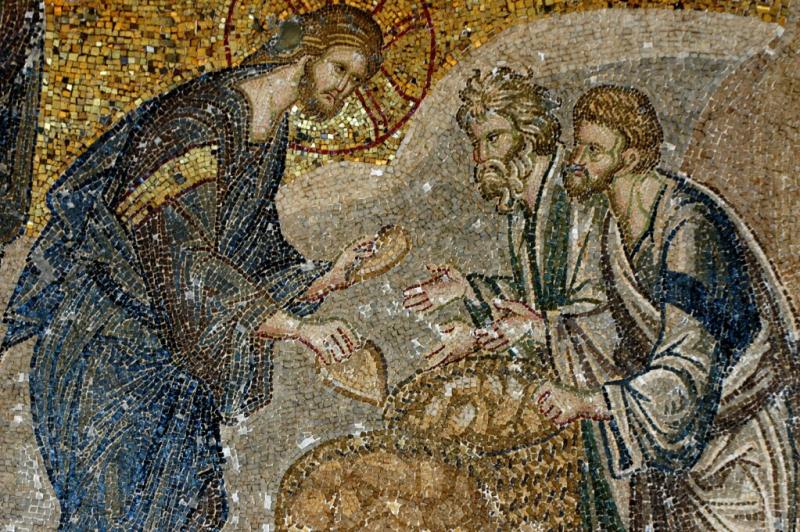
Multiplication of loaves and fishes c osseman

After Sunday’s Gospel reading at mass, I was struck by a seemingly throw-away point made during the homily, where the priest said that Jesus asked his disciples to go and buy some food for the people who assembled to listen to him and were in danger of running hungry:

When Jesus raised his eyes and saw that a large crowd was coming to him, he said to Philip, “Where can we buy enough food for them to eat?” He said this to test him, because he himself knew what he was going to do. Philip answered him, “Two hundred days?’ wages worth of food would not be enough for each of them to have a little.'” One of his disciples, Andrew, the brother of Simon Peter, said to him, “There is a boy here who has five barley loaves and two fish; but what good are these for so many?” Jesus said, “Have the people recline.” Now there was a great deal of grass in that place. So the men reclined, about five thousand in number. Then Jesus took the loaves, gave thanks, and distributed them to those who were reclining, and also as much of the fish as they wanted. When they had had their fill, he said to his disciples, “Gather the fragments left over, so that nothing will be wasted.” So they collected them, and filled twelve wicker baskets with fragments from the five barley loaves that had been more than they could eat.

John 6:5-13

The suggestion that Jesus wanted them to use regular means for feeding the masses made me listen up and reflect on the nature of miracles. The conclusion I am coming to is that the miracles Jesus performed were mostly accidental – not premeditated, planned (maybe with the exception of Lazarus’ raising from the dead where Jesus’ actions took place sometime after he was informed of his friend’s death). In this case, Jesus is spreading the good news of his Father’s love for all and it becomes apparent that the crowd following his words is going to get hungry and disperse to seek food in the nearest towns. Instead of following his disciples’ suggestion to call it a day and send his listeners on their separate ways, Jesus instead challenges their faith and asks them to provide for the crowd. Essentially he’s saying to them: nip down to the shops and fetch some dinner.

In spite of the effect that Jesus has already had on his disciples, Philip comes out with a bit of accountancy, ballparking the order at 200 days’ wages (a touch over £9700 in the UK today, which would give a budget per person/family of just under £2 – not exactly a lavish affair) and attempting to bring Jesus’ desire not to interrupt his mission stumbling down on logistical grounds. What comes next is a really great, but super-hesitant, move by Andrew, who says “There is a boy here who has five barley loaves and two fish; but what good are these for so many?” In other words, I hear Andrew as sticking his neck out and positioning himself next to Jesus by taking a leap of faith and bringing up the slightest of possibilities that could address the present challenge. To my mind the miracle is as much a reward for Andrew as it is a lesson for Philip and for the crowd assembled at Jesus’ feet.

Personally I read it as a call to trust in God and not to self–impose constraints where God’s providence is ready to provide against the odds. I have often experienced generosity by others or the discovery of solutions that only came to light because I placed my trust in God’s providence. Shortly before my older son was to be born, the house we were renting was put on the market and we were given a month’s notice to move. When we were informed about it, I was filled with panic and started rushing around, looking at vacancies but failing to find anything whatsoever as it was two weeks before Christmas and most places were shutting down for the holidays. One evening, and I remember this distinctly, I realized that I was leaving God out of this process (and doing so during Advent of all times!) and decided to skip the frantic search and instead spend the evening in prayer. This certainly calmed me down and when I woke in the morning. the thought came to me to look in the neighboring city instead of the one were we were living at the time. That same day I found us a new house to rent and the following months have shown how good the change of location was for us in ways we could not have anticipated.

Now, was that a miracle? No, in the sense that I don’t believe God intervened in the regular running of the universe. But, it did bring about a conversion in me that lead to greater closeness to God and a more attentive listening to his whispers.

This brings me to the final thought I have about Sunday’s Gospel: how much of what John describes (and incidentally the other three Evangelists too) was a miracle in the sense that the laws of nature were locally and temporarily altered? My impression is that not all. Let me explain … I believe that many people in the crowd that day had some food with them and that, when the gathering was dispersed, they may well have moved to a nice spot, laid it out and had a picnic. Others, who had no food would have had to trek to the nearest village and buy some, yet others would have had to go hungry as they may not have had the means to buy more food for themselves. Instead, what Jesus did by arranging the crowd into smaller groups (making the people assembled to hear him less of an anonymous mass), taking the five loaves of bread and two fish, blessing them and beginning to hand them out, was to create better conditions for sharing. I can imagine that someone who saw what Jesus did and had some food on them would add it to the food passed on to the next person, which in turn would lead to a positive, pyramidal-scheme-like avalanche and result in the many basketfuls collected at the end. Am I saying that I don’t believe a miracle (in the laws-of-nature-bending sense) took place? Certainly not – I do not see why Jesus should not have performed miracles, being God who created the universe out of nothing, but I do believe that his miraculous actions also triggered responses in their witnesses that lead to an amplification. Could Jesus have made food appear for 5000 families – sure! But, isn’t the humble (five loaf of bread + two fish) gesture much more loving, as it allows for human participation, rather than a sudden, imposing appearance of rows of fully-laden tables would have been?