2105 words, 11 min read
The theory of humor is about as much use to humor as ornithology is to birds, to paraphrase Richard Feynman. Instead of setting out a preamble that contrasts Bergson’s attributing the comic to inflexibility with Kant’s focus on strained expectations being transformed into nothing, or with Freud’s view that it is a mechanism for psychological release, or reflecting on the importance of the non sequitur and the absurd, I will just say that what is labelled as humorous in the following is simply what made me laugh, chuckle or smile.
I am certainly not the first (and hopefully not the last either) to find comedy in Scripture, so there is no claim to novelty here. Instead, the following follows from a desire to share what I found when reading St. Matthew’s Gospel, back to back, with the aim of looking for humor in it.1 As a final preambulatory point, and one that ought to be redundant for recidivist readers of this blog, I believe humor to be a profoundly positive and deeply relationship-building trait, as a result of which its roots and its pinnacle are in God and their absence from Scripture would be a joke.
Even though it might not be obvious at first, St. Matthew’s Gospel opens with what to my mind is a very funny bit – the genealogy of Jesus (1:1-16). On the face of it, this is a formal piece, designed to legitimize Jesus’ lineage and rootedness in the people of Israel, since it presents a sequence of forty pillars of the community from Abraham, father of God’s chosen people, to St. Joseph, Jesus’ own earthly father. So far so serious, but what gives this résumé a nice, humorous twist is the mention of four women – St. Joseph’s great-great-… grandmothers:
- Tamar, who was mistaken for a prostitute by Jesus’ ancestor, Judah, who subsequently solicits her services and whose immorality is then publicly unmasked by her.
- Rahab, who was actually a prostitute.
- Ruth, who was a foreigner, a Moabite, member of a tribe with a tempestuous relationship with the Israelites, eventually destroyed by them.
- Bathsheba, who was a real looker and whose first husband, Uriah, was sent to his death by king David after he saw her naked, so that he could take her for himself.
St. Matthew could just have presented us with a dry list of the great and the good of Israel’s glorious history. Instead, he very much spices things up and I wonder whether his contemporaries laughed, or at least sniggered at the ladies he chose to parade alongside the gents who otherwise might have projected too much propriety.
Matthew also seems to have a nice, dry sense of humor, when, in Chapter 4 he tells us that Jesus “fasted for forty days and forty nights, and afterwards he was hungry.” (4:2) A bit like the Black Knight telling King Arthur “It’s just a flesh wound,” after having both arms cut off in Monty Python and the Holy Grail.
And it is not only Matthew, who has fun here. Jesus too played games when talking to the disciples and it seems like Matthew was only too happy to record them. In the same, fourth chapter we get this gem:
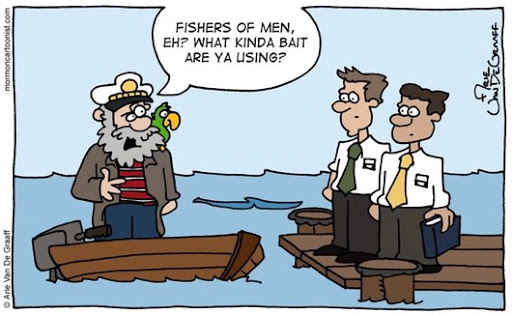
He said to them, “Come after me, and I will make you fishers of men.” At once they left their nets and followed him. (4:19-20)
Really? This guy shows up out of nowhere, tells a bunch of fishermen that he’ll make them “fishers of men” and they all jump up and ask where to sign up. What seems much more likely to me is that these guys would have followed Jesus no matter what he said, so he had some fun with them and delivered a line of beautiful absurd humor. “My hovercraft is full of eels.” might have been too much (although it is appropriately fishing-themed), so he went with “I will make you fishers of men.” I can imagine Jesus reminiscing with Peter about it after the resurrection and the two having a great laugh …
The absurd is also well represented in the various exaggerations that Jesus uses, such as his invitation to schizophrenia when almsgiving:
“But when you give alms, do not let your left hand know what your right is doing, so that your almsgiving may be secret.” (6:3-4)
To typographical hair-splitting:
“Amen, I say to you, until heaven and earth pass away, not the smallest letter or the smallest part of a letter will pass from the law, until all things have taken place.” (5:18)
Or to wanton exaggeration in response to reasonable requests (“No, I won’t just count to infinity once, I’ll do it twice!” as Chuck Norris would add):
“If anyone wants to go to law with you over your tunic, hand him your cloak as well. Should anyone press you into service for one mile, go with him for two miles.” (5:40-41)
Jesus’s parables, as recounted by Matthew, are also a good source of humor, like the following one about light:
“You are the light of the world. A city set on a mountain cannot be hidden. Nor do they light a lamp and then put it under a bushel basket; it is set on a lampstand, where it gives light to all in the house.” (5:14-15)
I can’t help but be reminded of the Sufi story of Mulla Nasreddin looking for his ring:
“Mulla had lost his ring in the living room. He searched for it for a while, but since he could not find it, he went out into the yard and began to look there. His wife, who saw what he was doing, asked: “Mulla, you lost your ring in the room, why are you looking for it in the yard?”
Mulla stroked his beard and said: “The room is too dark and I can’t see very well. I came out to the courtyard to look for my ring because there is much more light out here.””
The parable about the pearls too must have elicited some laughter, simply by virtue of the sharp simile it used:
“Do not give what is holy to dogs, or throw your pearls before swine, lest they trample them underfoot, and turn and tear you to pieces.” (7:6)
Neither dogs, who in some cultures today are treated like children, nor pigs, who were the very embodiment of uncleanliness, were epithets that one would have been happy about and their free application to those Jesus was critical of must have made his listeners chuckle.
And, the parable about the camel must also have made them laugh at the ridiculousness of what Jesus was delivering to them, presumably with a straight face:
“Again I say to you, it is easier for a camel to pass through the eye of a needle than for one who is rich to enter the kingdom of God.” When the disciples heard this, they were greatly astonished and said, “Who then can be saved?” Jesus looked at them and said, “For human beings this is impossible, but for God all things are possible.”” (19:24-26)
Eddie Izzard’s “If you’ve never seen an elephant ski, you’ve never been on acid,” comes to mind.
Jesus also happily used flowery language on another occasion:
“But I say to you, whoever is angry with his brother will be liable to judgment,o and whoever says to his brother, ‘Raqa,’ will be answerable to the Sanhedrin, and whoever says, ‘You fool,’ will be liable to fiery Gehenna.” (5:22)
And, purely in the interest of clarity, remember that “Raqa” means div, dope, eejit, gobshite, plonker, tool, berk, wally, schmuck, pillock, thicko, numpty, … – now, don’t tell me that didn’t at least make you smile!
Also, let’s not forget that Jesus quite happily self-applied humor and didn’t shy away from formulating what he perceived was a crowd’s attitude towards him using some choice words:
““To what shall I compare this generation? It is like children who sit in marketplaces and call to one another, ‘We played the flute for you, but you did not dance, we sang a dirge but you did not mourn.’ For John came neither eating nor drinking, and they said, ‘He is possessed by a demon.’ The Son of Man came eating and drinking and they said, ‘Look, he is a glutton and a drunkard, a friend of tax collectors and sinners.’ But wisdom is vindicated by her works.”” (11:16-19)
Now, Jesus’ pulling his listener’s legs didn’t just end with the use of some juicy words. No, our Lord took it to the next level and wove entire stories to illustrate just how absurdly misguided some of his contemporaries were.
He accused them of being impotent:
“I say to you, do not swear at all; not by heaven, for it is God’s throne; nor by the earth, for it is his footstool; nor by Jerusalem, for it is the city of the great King. Do not swear by your head, for you cannot make a single hair white or black.” (5:34-36)
So self-obsessed as to be dangerous:
“Why do you notice the splinter in your brother’s eye, but do not perceive the wooden beam in your own eye? How can you say to your brother, ‘Let me remove that splinter from your eye,’ while the wooden beam is in your eye?” (7:3-4)
So entirely missing the magnitude of what he was presenting to them as to be stupid:
“Another of [his] disciples said to him, “Lord, let me go first and bury my father.” But Jesus answered him, “Follow me, and let the dead bury their dead.”” (8:21-22)
And, so completely back-to-front that their behavior, when transposed to a familiar scenario, would be criminal:
“Which one of you would hand his son a stone when he asks for a loaf of bread,or a snake when he asks for a fish?” (7:9-10)
Situational comedy wasn’t off the menu either, where the best example is a contribution to the universally-rich category pertaining to mothers-in-law:
“Jesus entered the house of Peter, and saw his mother-in-law lying in bed with a fever. He touched her hand, the fever left her, and she rose and waited on him.” (8:14-15)
No, no, he didn’t “just” cure her so she’d rustle up a nice dinner, it was for her own good …
Jesus didn’t shy away from shock tactics either, going more for a nervous than a hearty laugh and intermingled with a sense of fear rather than Freud’s release:
“When he was going back to the city in the morning, he was hungry. Seeing a fig tree by the road, he went over to it, but found nothing on it except leaves. And he said to it, “May no fruit ever come from you again.” And immediately the fig tree withered. When the disciples saw this, they were amazed and said, “How was it that the fig tree withered immediately?” Jesus said to them in reply, “Amen, I say to you, if you have faith and do not waver, not only will you do what has been done to the fig tree, but even if you say to this mountain, ‘Be lifted up and thrown into the sea,’ it will be done. Whatever you ask for in prayer with faith, you will receive.”” (21:18-22)
If the disciples didn’t think “This guy’s loco,” when Jesus made the fig tree wither for not bearing fruit as Jesus passed by, then I’d eat my hat (if I wore one). I wonder whether nervous “ahaha”s filled the air as the tree – an inanimate object without will or the potential for culpability – was “punished” for not doing it’s job and whether some of the disciples took a couple of cautious steps back, away from their Master.
In what can only be seen as a case of Žižek’s post-hoc predestination proof points, applied to the Dead Parrot sketch, Jesus also delivers the following, perfect line:
“When Jesus arrived at the official’s house and saw the flute players and the crowd who were making a commotion, he said, “Go away! The girl is not dead but sleeping.” And they ridiculed him. When the crowd was put out, he came and took her by the hand, and the little girl arose.” (9:23-25)
1 Please, note that nothing could be further from my mind than to suggest that my reading of the following passages from the perspective of humor is a claim to their only meaning or interpretation being from that point of view.

 eyebeleave