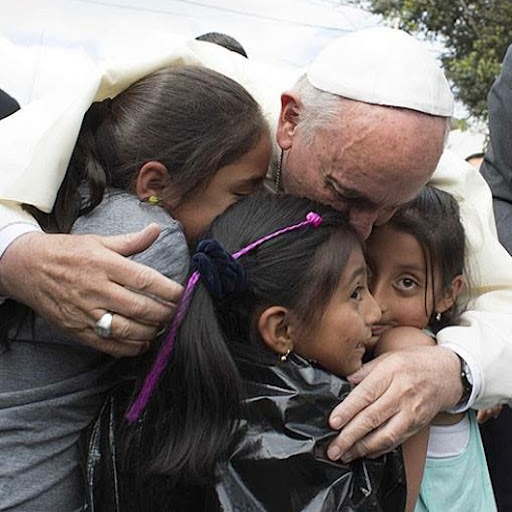
On Monday, pope Francis returned from a week-long visit to Ecuador, Bolivia and Paraguay, and I would again like to share my favorite parts of that trip with you next.
As soon as Francis landed in Ecuador, he pointed to the source of light that the Church is called to reflect:
“We Christians identify Christ with the sun, and the moon with the Church; the moon does not have its own light, indeed if it hides from the sun it will be enveloped by darkness. The sun is Jesus Christ and if the Church moves away or hides from him, she will be in darkness and no longer able to offer witness. May the coming days make all of us ever more clearly aware of how close the sun is that “dawns upon us from on high”. May each of us be a true reflection of his light and his love.”
The next day, on Monday 6th July, Pope Francis went on to present Mary as the role model for every Christian in a homily about the wedding at Cana given during a mass for families:
“Let us make room for Mary, “the Mother” as the evangelist calls her. Let us journey with her now to Cana. Mary is attentive, she is attentive in the course of this wedding feast, she is concerned for the needs of the newlyweds. She is not closed in on herself, worried only about her little world. Her love makes her “outgoing” towards others. She does not seek her friends to say what is happening, to criticize the poor organization of the wedding feast. And since she is attentive, she discretely notices that the wine has run out. Wine is a sign of happiness, love and plenty. How many of our adolescents and young people sense that these is no longer any of that wine to be found in their homes? How many women, sad and lonely, wonder when love left, when it slipped away from their lives? How many elderly people feel left out of family celebrations, cast aside and longing each day for a little love, from their sons and daughters, their grandchildren, their great grandchildren? This lack of this “wine” can also be due to unemployment, illness and difficult situations which our families around the world may experience. Mary is not a “demanding” mother, nor a mother-in-law who revels in our lack of experience, our mistakes and the things we forget to do. Mary, quite simply, is a Mother! She is there, attentive and concerned.”
Francis then proceeds with elaborating on what Mary does next, after having been attentive to those around her:
“But Mary, at the very moment she perceives that there is no wine, approaches Jesus with confidence: this means that Mary prays. She goes to Jesus, she prays. She does not go to the steward, she immediately tells her Son of the newlyweds’ problem. The response she receives seems disheartening: “What does it have to do with you and me? My hour has not yet come” (v. 4). But she nonetheless places the problem in God’s hands. Her deep concern to meet the needs of others hastens Jesus’ hour. And Mary was a part of that hour, from the cradle to the cross. She was able “to turn a stable into a home for Jesus, with poor swaddling clothes and an abundance of love” (Evangelii Gaudium, 286). She accepted us as her sons and daughters when the sword pierced her heart. She teaches us to put our families in God’s hands; she teaches us to pray, to kindle the hope which shows us that our concerns are also God’s concerns. […]
And finally, Mary acts. Her words, “Do whatever he tells you” (v. 5), addressed to the attendants, are also an invitation to us to open our hearts to Jesus, who came to serve and not to be served. Service is the sign of true love. Those who love know how to serve others. We learn this especially in the family, where we become servants out of love for one another. In the heart of the family, no one is rejected; all have the same value. I remember once how my mother was asked which of her five children – we are five brothers – did she love the most. And she said: it is like the fingers on my hand, if I prick one of them, then it is as if the others are pricked also. A mother loves her children as they are. And in the family, children are loved as they are. None are rejected. “In the family we learn how to ask without demanding, to say ‘thank you’ as an expression of genuine gratitude for what we have been given, to control our aggressivity and greed, and to ask forgiveness when we have caused harm, when we quarrel, because in all families there are quarrels. The challenge is to then ask for forgiveness. These simple gestures of heartfelt courtesy help to create a culture of shared life and respect for our surroundings” (Laudato Si’, 213). The family is the nearest hospital; when a family member is ill, it is in the home that they are cared for as long as possible. The family is the first school for the young, the best home for the elderly. The family constitutes the best “social capital”. It cannot be replaced by other institutions. It needs to be helped and strengthened, lest we lose our proper sense of the services which society as a whole provides. Those services which society offers to its citizens are not a type of alms, but rather a genuine “social debt” with respect to the institution of the family, which is foundational and which contributes to the common good.”
The next day, in Quito’s Bicentennial Park, Francis reflects on Jesus’ testament:
““Father, may they be one… so that the world may believe”. This was Jesus’ prayer as he raised his eyes to heaven. This petition arose in a context of mission: “As you sent me into the world, so I have sent them into the world”. At that moment, the Lord experiences in his own flesh the worst of this world, a world he nonetheless loves dearly. Knowing full well its intrigues, its falsity and its betrayals, he does not turn away, he does not complain. We too encounter daily a world torn apart by wars and violence. It would be facile to think that division and hatred only concern struggles between countries or groups in society. Rather, they are a manifestation of that “widespread individualism” which divides us and sets us against one another (cf. Evangelii Gaudium, 99), they are a manifestation of that legacy of sin lurking in the heart of human beings, which causes so much suffering in society and all of creation. But is it precisely this troubled world, with its forms of egoism, into which Jesus sends us. We must not respond with nonchalance, or complain we do not have the resources to do the job, or that the problems are too big. Instead, we must respond by taking up the cry of Jesus and accepting the grace and challenge of being builders of unity.”
Next, he presents an approach to evangelization that is built on humility and respect:
“Evangelization does not consist in proselytizing, for proselytizing is a caricature of evangelization, but rather evangelizing entails attracting by our witness those who are far off, it means humbly drawing near to those who feel distant from God in the Church, drawing near to those who feel judged and condemned outright by those who consider themselves to be perfect and pure. We are to draw near to those who are fearful or indifferent, and say to them: “The Lord, with great respect and love, is also calling you to be a part of your people” (cf. Evangelii Gaudium, 113). Because our God respects us even in our lowliness and in our sinfulness. This calling of the Lord is expressed with such humility and respect in the text from the Book of Revelations: “Look, I am at the door and I am calling; do you want to open the door?” He does not use force, he does not break the lock, but instead, quite simply, he presses the doorbell, knocks gently on the door and then waits. This is our God!”
And, finally, he speaks about what the unity that Jesus asks the Father for looks like:
“Intimacy with God, in itself incomprehensible, is revealed by images which speak to us of communion, communication, self-giving and love. For that reason, the unity to which Jesus calls us is not uniformity, but rather a “multifaceted and inviting harmony” (Evangelii Gaudium, 117). The wealth of our differences, our diversity which becomes unity whenever we commemorate Holy Thursday, makes us wary of all temptations that suggest extremist proposals akin to totalitarian, ideological or sectarian schemes. The proposal offered by Jesus is a concrete one and not a notion. It is concrete: “Go and do the same” he tells that man who asked “who is my neighbor?” After having told the parable of the Good Samaritan, Jesus says, “Go and do the same”. Nor is this proposal of Jesus something we can fashion as we will, setting conditions, choosing who can belong and who cannot; the religiosity of the ‘elite’. Jesus prays that we will all become part of a great family in which God is our Father, in which all of us are brothers and sisters. No one is excluded; and this is not about having the same tastes, the same concerns, the same gifts. We are brothers and sisters because God created us out of love and destined us, purely of his own initiative, to be his sons and daughters (cf. Eph 1:5). We are brothers and sisters because “God has sent the Spirit of his Son into our hearts, crying “Abba! Father!” (Gal 4:6). We are brothers and sisters because, justified by the blood of Christ Jesus (cf. Rom 5:9), we have passed from death to life and been made “coheirs” of the promise (cf. Gal 3:26-29; Rom 8:17). That is the salvation which God makes possible for us, and which the Church proclaims with joy: to be part of that “we” which leads to the divine “we”.”
During the afternoon, Pope Francis then addressed educators at the Pontifical Catholic University of Ecuador, picking up the theme of that shared “we” with God that he spoke about to families:
“Our world is a gift given to us by God so that, with him, we can make it our own. God did not will creation for himself, so he could see himself reflected in it. On the contrary: creation is a gift to be shared. It is the space that God gives us to build up with one another, to build a “we”. The world, history, all of time – this is the setting in which we build this “we” with God, with others, with the earth. This invitation is always present, more or less consciously in our life; it is always there.”
Francis then presents his model for an education that leads to open, critically-thinking and dialogue-ready people:
“My question to you, as educators, is this: Do you watch over your students, helping them to develop a critical sense, an open mind capable of caring for today’s world? A spirit capable of seeking new answers to the varied challenges that society sets before humanity today? Are you able to encourage them not to disregard the world around them, what is happening all over? Can you encourage them to do that? To make that possible, you need to take them outside the university lecture hall; their minds need to leave the classroom, their hearts must go out of the classroom. Does our life, with its uncertainties, its mysteries and its questions, find a place in the university curriculum or different academic activities? Do we enable and support a constructive debate which fosters dialogue in the pursuit of a more humane world? Dialogue, that bridge word, that word which builds bridges.”
Later that same day, Francis addressed politicians and representatives of civic authority, speaking to them about “gratuitousness”:
“Gratuitousness is a necessary requisite of justice. Who we are, and what we have, has been given to us so that we can place it at the service of others; freely we have received, freely we must give. Our task is to make it bear fruit in good works. The goods of the earth are meant for everyone, and however much someone may parade his property, which is legitimate, it has a social mortgage – always. In this way we move beyond purely economic justice, based on commerce, towards social justice, which upholds the fundamental human right to a dignified life. […] As stewards of these riches which we have received, we have an obligation towards society as a whole and towards future generations. We cannot bequeath this heritage to them without proper care for the environment, without a sense of gratuitousness born of our contemplation of the created world. […] We received this world as an inheritance from past generations, but we must also remember that we received it as a loan from our children and from future generations, to whom we will have to return it! And we will have to return it in a better off state – that is gratuitousness!”
Finally, Francis returned to the importance of dialogue, when referring to the importance of subsidiarity:
“To recognize that our choices are not necessarily the only legitimate ones is a healthy exercise in humility. In acknowledging the goodness inherent in others, even with their limitations, we see the richness present in diversity and the value of complementarity. Individuals and groups have the right to go their own way, even though they may sometimes make mistakes. In full respect for that freedom, civil society is called to help each person and social organization to take up its specific role and thus contribute to the common good. Dialogue is needed and is fundamental for arriving at the truth, which cannot be imposed, but sought with a sincere and critical spirit. In a participatory democracy, each social group, indigenous peoples, Afro-Ecuadorians, women, civic associations and those engaged in public service are all indispensable participants in that dialogue, not spectators. The walls, patios and cloisters of this city eloquently make this point: rooted in elements of Incan and Caranqui culture, beautiful in their proportions and shapes, boldly and strikingly combining different styles, the works of art produced by the “Quito school” sum up that great dialogue, with its successes and failures, which is Ecuador’s history. Today we see how beautiful it is. If the past was marked by errors and abuses – how can we deny it, even in our own lives? – we can say that the amalgamation which resulted radiates such exuberance that we can look to the future with great hope.”
Wednesday morning then saw the last event of Francis’ stay in Ecuador – a meeting with clergy, religious and seminarians, where he again returned to the importance of gratuitousness.
“Women and men religious, priests and seminarians, I ask you to retrace your steps back to the time God gratuitously chose you. You did not buy a ticket to enter the seminary, to enter consecrated life. You were not worthy. If some religious brother, priest, seminarian or nun here today thinks that they merited this, raise your hands. It is all gratuitousness. And the entire life of a religious brother and sister, priest and seminarian must walk that path, and here why not add bishops as well. It is the path that leads to gratuitousness, the path we must follow each day: “Lord, today I did this, I did this thing well, I had this difficulty, all this but … all is from you, all is free gift”. That is gratuitousness. We are those who receive God’s gratuitousness. If we forget this, then slowly we begin to see ourselves as more important: “Look at these works you are doing”, or “Look at how they made this man a bishop of such and such a place… how important”, or “this man they made a Monsignor”, and so on. With this way of thinking we gradually move away from what is fundamental, what Mary never moved away from: God’s gratuitousness. Permit me as a brother to offer you some advice: every day, perhaps night time is better, before going to sleep, look at Jesus and say to him: “All you have given me is a free gift”, and then go back to what you were doing. As a result, then, when I am asked to move or when there is some difficulty, I do not complain, because everything is free gift, I merit nothing. This is what Mary did.”
During a mass on Thursday, the second day in Bolivia, Pope Francis speaks with great clarity about how Jesus’ example of feeding a crowd with just a handful of bread and fish leads from a culture of waste and discarding to one of communion, and he does so by zooming in on three actions – taking, blessing and giving:
“What [Jesus] does can be summed up in three words. He takes a little bread and some fish, he blesses them and then gives them to his disciples to share with the crowd. And this is how the miracle takes place. It is not magic or sorcery. With these three gestures, Jesus is able to turn a mentality which discards others into a mindset of communion, a mindset of community. I would like briefly to look at each of these actions.
Taking. This is the starting-point: Jesus takes his own and their lives very seriously. He looks at them in the eye, and he knows what they are experiencing, what they are feeling. He sees in those eyes all that is present in the memory and the hearts of his people. He looks at it, he ponders it. He thinks of all the good which they can do, all the good upon which they can build. But he is not so much concerned about material objects, cultural treasures or lofty ideas. He is concerned with people. The greatest wealth of a society is measured by the lives of its people, it is gauged by its elderly, who pass on their knowledge and the memory of their people to the young. Jesus never detracts from the dignity of anyone, no matter how little they possess or seem capable of contributing. He takes everything as it comes.
Blessing. Jesus takes what is given him and blesses his heavenly Father. He knows that everything is God’s gift. So he does not treat things as “objects”, but as part of a life which is the fruit of God’s merciful love. He values them. He goes beyond mere appearances, and in this gesture of blessing and praise he asks the Father for the gift of the Holy Spirit. Blessing has this double aspect: thanksgiving and transformative power. It is a recognition that life is always a gift which, when placed in the hands of God, starts to multiply. Our Father never abandons us; he makes everything multiply.
Giving. With Jesus, there can be no “taking” which is not a “blessing”, and no blessing which is not also a “giving”. Blessing is always mission, its purpose is to share what we ourselves have received. For it is only in giving, in sharing, that we find the source of our joy and come to experience salvation. Giving makes it possible to refresh the memory of God’s holy people, who are invited to be and to bring the joy of salvation to others. The hands which Jesus lifts to bless God in heaven are the same hands which gave bread to the hungry crowd. We can imagine now how those people passed the loaves of bread and the fish from hand to hand, until they came to those farthest away. Jesus generated a kind of electrical current among his followers, as they shared what they had, made it a gift for others, and so ate their fill. Unbelievably, there were even leftovers: enough to fill seven baskets. A memory which is taken, a memory which is blessed and a memory which is given, always satisfies people’s hunger.”
Later that day, Francis met with clergy, religious and seminarians and spoke to them about the Gospel passage where the blind beggar, Bartimaeus sat on the roadside as Jesus and his disciples passed him by and cried out to them. Francis then proceeds with reflecting on the three reactions that Bartimaeus received – two from the disciples – whom Francis identifies with bishops, priests, sisters, seminarians, the committed lay faithful – and one from Jesus:
“1. “They passed by”. Some of those who passed by did not even hear his shouting. They were with Jesus, they looked at Jesus, they wanted to hear him. But they were not listening. Passing by is the response of indifference, of avoiding other people’s problems because they do not affect us. It is not my problem. We do not hear them, we do not recognize them. Deafness. Here we have the temptation to see suffering as something natural, to take injustice for granted. And yes, there are people like that: I am here with God, with my consecrated life, chosen by God for ministry and yes, it is normal that there are those who are sick, poor, suffering, and it is so normal that I no longer notice the cry for help. To become accustomed. We say to ourselves, “This is nothing unusual; this were always like this, as long as it does not affect me”. It is the response born of a blind, closed heart, a heart which has lost the ability to be touched and hence the possibility to change. How many of us followers of Christ run the risk of losing our ability to be astonished, even with the Lord? That wonder we had on the first encounter seems to diminish, and it can happen to anyone. Indeed it happened to the first Pope: “Whom shall we go to Lord? You have the words of eternal life”. And then they betray him, they deny him, the wonder fades away. It happens when we get accustomed to things. The heart is blinded. A heart used to passing by without letting itself be touched; a life which passes from one thing to the next, without ever sinking roots in the lives of the people around us, simply because it is part of the elite who follow the Lord.
We could call this “the spirituality of zapping”. It is always on the move, but it has nothing to show for it. There are people who keep up with the latest news, the most recent best sellers, but they never manage to connect with others, to strike up a relationship, to get involved, even with the Lord whom they follow, because their deafness gets worse.
You may say to me, “But those people in the Gospel were following the Master, they were busy listening to his words. They were intent on him.” I think that this is one of the most challenging things about Christian spirituality. The Evangelist John tells us, “How can you love God, whom you do not see, if you do not love your brother whom you do see?” (1 Jn 4:20). They believed that they were listening to the Master, but they also made their own interpretation, and the words of the Master are distilled by their blinded hearts. One of the great temptations we encounter on the path as we follow Jesus is to separate these two things, listening to God and listening to our brothers and sisters, both of which belong together. We need to be aware of this. The way we listen to God the Father is how we should listen to his faithful people. If we do not listen in the same way, with the same heart, then something has gone wrong.
To pass by, without hearing the pain of our people, without sinking roots in their lives and in their world, is like listening to the word of God without letting it take root and bear fruit in our hearts. Like a tree, a life without roots is a one which withers and dies.
2. The second phrase: “Be quiet”. This is the second response to Bartimaeus’ cry: “Keep quiet, don’t bother us, leave us alone, for we are praying as a community, we are in heightened state of spirituality. Don’t bother us. Unlike the first response, this one hears, acknowledges, and makes contact with the cry of another person. It recognizes that he or she is there, but reacts simply by scolding. It is the bishops, priests, sisters, popes, who point their finger threateningly. In Argentina we say of teachers who point their fingers in this way: “This is like the teacher from the time of Yrigoyen who used particularly strict methods”. And the poor faithful people of God, how often are they tested, either by the bad temper or the personal situation of a follower of Christ. It is the attitude of some leaders of God’s people; they continually scold others, hurl reproaches at them, tell them to be quiet. Please give them something to do, listen to them, tell them that Jesus loves them. “No, you can’t do that”. “Madam, take your crying child out of the church as I am preaching”. As if the cries of a child were not a sublime homily.
This is the drama of the isolated consciousness, of those disciples who think that the life of Jesus is only for those deserve it. There is an underlying contempt for the faithful people of God: “This blind man who has to interfere with everything, let him stay where he is”. They seem to believe there is only room for the “worthy”, for the “better people”, and little by little they separate themselves, become distinct, from the others. They have made their identity a badge of superiority. That identity which makes itself superior, is no longer proper to the pastor but rather to a foreman: “I made it here, now you wait in line”. Such persons no longer listen; they look, but they cannot see. Let me tell you an anecdote, something I experienced around 1975 in your Archdiocese. I had made a promise to Nuestro Señor de los Milagros to go to Salta on pilgrimage if he blessed us with 40 novices. He sent forty-one. After a concelebrated Mass – as at all important sanctuaries, there were many Masses, confessions, and you don’t stop – I was walking up with a another priest who was with me and had come with me, and a lady came up to us, almost at the top, with an image of a saint. She was a simple woman, maybe from Salta itself, or perhaps she had come from another place, as so often happens when people take a few days to reach the capital for the Feast of the Lord of Miracles. She said to the priest who was accompanying me, “Father, please bless this image”. He replied, “Lady, you were at Mass”. “Yes, Father”. “Well then, the blessing of God, the presence of God there blesses everything”. “Yes Father, Yes Father” came the reply. At that moment another priest came up, a friend of the priest that had just spoken, but they hadn’t seen each other so he says, “Oh, you’re here!”. He turned away and the woman – I do not know her name, we’ll call her the “Yes Father Lady” – looked at me and said: “Father, please bless it”. Those who always put up barriers between themselves and the people of God, push them away. They hear, but they don’t listen. They deliver a sermon, but look without seeing. The need to show that they are different has closed their heart. Their need to tell themselves, consciously or subconsciously, “I am not like that person, like those people”, not only cuts them off from the cry of their people, from their tears, but most of all from their reasons for rejoicing. Laughing with those who laugh, weeping with those who weep; all this is part of the mystery of a priestly heart and the heart of a consecrated person. Sometimes there are elite groups that are created by not listening and seeing, and we distance ourselves. […]
3. The third word: “Take heart and get up”. This is the third response. It is not so much a direct response to the cry of Bartimaeus as a reaction of people who saw how Jesus responded to the pleading of the blind beggar. In other words, those who gave no importance to the beggar, those who did not let him pass, or those who told him to be quiet… when they see Jesus’ reaction they change their attitude: “Get up, he is calling you”. In those who told him to take heart and get up, the beggar’s cry issued in a word, an invitation, a new and changed way of responding to God’s holy and faithful People.
Unlike those who simply passed by, the Gospel says that Jesus stopped and asked what was happening. “What is happening here?” “Who is making noise?” He stopped when someone cried out to him. Jesus singled him out from the nameless crowd and got involved in his life. And far from ordering him to keep quiet, he asked him, “Tell me, what do you want me to do for you?” Jesus didn’t have to show that he was different, somehow apart, and he didn’t give the beggar a sermon; he didn’t decide whether Bartimaeus was worthy or not before speaking to him. He simply asked him a question, looked at him and sought to come into his life, to share his lot. And by doing this he gradually restored the man’s lost dignity, the man who was on the side of the path and blind; Jesus included him. Far from looking down on him, Jesus was moved to identify with the man’s problems and thus to show the transforming power of mercy. There can be no compassion – and I mean compassion and not pity – without stopping. If you do not stop, you do not suffer with him, you do not have divine compassion. There is no “com-passion” that does not listen and show solidarity with the other. Compassion is not about zapping, it is not about silencing pain, it is about the logic of love, of suffering with. A logic, a way of thinking and feeling, which is not grounded in fear but in the freedom born of love and of desire to put the good of others before all else. A logic born of not being afraid to draw near to the pain of our people. Even if often this means no more than standing at their side and praying with them.
This is the logic of discipleship, it is what the Holy Spirit does with us and in us. We are witnesses of this. One day Jesus saw us on the side of the road, wallowing in our own pain and misery, our indifference. Each one knows his or her past. He did not close his ear to our cries. He stopped, drew near and asked what he could do for us. And thanks to many witnesses, who told us, “Take heart; get up”, gradually we experienced this merciful love, this transforming love, which enabled us to see the light. We are witnesses not of an ideology, of a recipe, of a particular theology. We are not witnesses of that. We are witnesses to the healing and merciful love of Jesus. We are witnesses of his working in the lives of our communities.
And this is the pedagogy of the Master, this is the pedagogy which God uses with his people. It leads us to passing from distracted zapping to the point where we can say to others: “Take heart; get up. The Master is calling you” (Mk 10:49). Not so that we can be special, not so that we can be better than others, not so that we can be God’s functionaries, but only because we are grateful witnesses to the mercy which changed us. When we live like this, there is joy and delight, and we can identify ourselves with the testimony given by the religious sister who made her own Saint Augustine’s counsel, “Sing and walk”. This is the joy that comes from witnessing to the mercy that transforms.”
In the evening of that same day, Pope Francis spoke to members of popular movements and, after emphasizing the need for structural change, presented a critique of the current profit-driven system and asked what those who suffer from it can do about it:
“Time, my brothers and sisters, seems to be running out; we are not yet tearing one another apart, but we are tearing apart our common home. Today, the scientific community realizes what the poor have long told us: harm, perhaps irreversible harm, is being done to the ecosystem. The earth, entire peoples and individual persons are being brutally punished. And behind all this pain, death and destruction there is the stench of what Basil of Caesarea – one of the first theologians of the Church – called “the dung of the devil”. An unfettered pursuit of money rules. This is the “dung of the devil”. The service of the common good is left behind. Once capital becomes an idol and guides people’s decisions, once greed for money presides over the entire socioeconomic system, it ruins society, it condemns and enslaves men and women, it destroys human fraternity, it sets people against one another and, as we clearly see, it even puts at risk our common home, sister and mother earth.
I do not need to go on describing the evil effects of this subtle dictatorship: you are well aware of them. Nor is it enough to point to the structural causes of today’s social and environmental crisis. We are suffering from an excess of diagnosis, which at times leads us to multiply words and to revel in pessimism and negativity. Looking at the daily news we think that there is nothing to be done, except to take care of ourselves and the little circle of our family and friends.
What can I do, as collector of paper, old clothes or used metal, a recycler, about all these problems if I barely make enough money to put food on the table? What can I do as a craftsman, a street vendor, a trucker, a downtrodden worker, if I don’t even enjoy workers’ rights? What can I do, a farmwife, a native woman, a fisher who can hardly fight the domination of the big corporations? What can I do from my little home, my shanty, my hamlet, my settlement, when I daily meet with discrimination and marginalization? What can be done by those students, those young people, those activists, those missionaries who come to a neighborhood with their hearts full of hopes and dreams, but without any real solution for their problems? They can do a lot. They really can. You, the lowly, the exploited, the poor and underprivileged, can do, and are doing, a lot. I would even say that the future of humanity is in great measure in your own hands, through your ability to organize and carry out creative alternatives, through your daily efforts to ensure the three “L’s” – do you agree? – (labor, lodging, land) and through your proactive participation in the great processes of change on the national, regional and global levels. Don’t lose heart!”
Next, Francis spells out his vision of an economy that is oriented towards the common good:
“The economy should not be a mechanism for accumulating goods, but rather the proper administration of our common home. This entails a commitment to care for that home and to the fitting distribution of its goods among all. It is not only about ensuring a supply of food or “decent sustenance”. Nor, although this is already a great step forward, is it to guarantee the three “L’s” of land, lodging and labor for which you are working. A truly communitarian economy, one might say an economy of Christian inspiration, must ensure peoples’ dignity and their “general, temporal welfare and prosperity”.[1] (Pope John XXIII spoke this last phrase fifty years ago, and Jesus says in the Gospel that whoever freely offers a glass of water to one who is thirsty will be remembered in the Kingdom of Heaven.) All of this includes the three “L’s”, but also access to education, health care, new technologies, artistic and cultural manifestations, communications, sports and recreation. A just economy must create the conditions for everyone to be able to enjoy a childhood without want, to develop their talents when young, to work with full rights during their active years and to enjoy a dignified retirement as they grow older. It is an economy where human beings, in harmony with nature, structure the entire system of production and distribution in such a way that the abilities and needs of each individual find suitable expression in social life. You, and other peoples as well, sum up this desire in a simple and beautiful expression: “to live well”, which is not the same as “to have a good time”.
Such an economy is not only desirable and necessary, but also possible. It is no utopia or chimera. It is an extremely realistic prospect. We can achieve it. The available resources in our world, the fruit of the intergenerational labors of peoples and the gifts of creation, more than suffice for the integral development of “each man and the whole man”. The problem is of another kind. There exists a system with different aims. A system which, in addition to irresponsibly accelerating the pace of production, and using industrial and agricultural methods which damage Mother Earth in the name of “productivity”, continues to deny many millions of our brothers and sisters their most elementary economic, social and cultural rights. This system runs counter to the plan of Jesus, against the Good News that Jesus brought.
Working for a just distribution of the fruits of the earth and human labor is not mere philanthropy. It is a moral obligation. For Christians, the responsibility is even greater: it is a commandment. It is about giving to the poor and to peoples what is theirs by right. The universal destination of goods is not a figure of speech found in the Church’s social teaching. It is a reality prior to private property. Property, especially when it affects natural resources, must always serve the needs of peoples. And those needs are not restricted to consumption. It is not enough to let a few drops fall whenever the poor shake a cup which never runs over by itself. Welfare programs geared to certain emergencies can only be considered temporary and incidental responses. They could never replace true inclusion, an inclusion which provides worthy, free, creative, participatory and solidary work.”
Finally, Pope Francis also took advantage of speaking about the injustice of exploitative systems to apologize for mistakes made by the Church:
“Let us say NO, then, to forms of colonialism old and new. Let us say YES to the encounter between peoples and cultures. Blessed are the peacemakers. Here I wish to bring up an important issue. Some may rightly say, “When the Pope speaks of colonialism, he overlooks certain actions of the Church”. I say this to you with regret: many grave sins were committed against the native peoples of America in the name of God. My predecessors acknowledged this, CELAM, the Council of Latin American Bishops, has said it, and I too wish to say it. Like Saint John Paul II, I ask that the Church – I repeat what he said – “kneel before God and implore forgiveness for the past and present sins of her sons and daughters”.[6] I would also say, and here I wish to be quite clear, as was Saint John Paul II: I humbly ask forgiveness, not only for the offenses of the Church herself, but also for crimes committed against the native peoples during the so-called conquest of America. Together with this request for forgiveness and in order to be just, I also would like us to remember the thousands of priests and bishops who strongly opposed the logic of the sword with the power of the Cross. There was sin, a great deal of it, for which we did not ask pardon. So for this, we ask forgiveness, I ask forgiveness. But here also, where there was sin, great sin, grace abounded through the men and women who defended the rights of indigenous peoples.”
The next morning, on Friday 10th July, Pope Francis visited the Santa Cruz-Palmasola Rehabilitation Center, where he presented himself to the prisoners there as a sinner:
“You may be asking yourselves: “Who is this man standing before us?”. I would like to reply to that question with something absolutely certain about my own life. The man standing before you is a man who has experienced forgiveness. A man who was, and is, saved from his many sins. That is who I am. I don’t have much more to give you or to offer you, but I want to share with you what I do have and what I love. It is Jesus Christ, the mercy of the Father.”
Next, he shared with them the good news of Jesus’ closeness to us all on the cross:
“When Jesus becomes part of our lives, we can no longer remain imprisoned by our past. Instead, we begin look to the present, and we see it differently, with a different kind of hope. We begin to see ourselves and our lives in a different light. We are no longer stuck in the past, but capable of shedding tears and finding in them the strength to make a new start. If there are times when we experience sadness, when we’re in a bad way, when we’re depressed or have negative feelings, I ask you to look at Christ crucified. Look at his face. He sees us; in his eyes there is a place for us. We can all bring to Christ our wounds, our pain, our mistakes, our sins, and all those things which perhaps we got wrong. In the wounds of Jesus, there is a place for our own wounds. Because we are all wounded, in one way or another. And so we bring our wounds to the wounds of Jesus. Why? So that there they can be soothed, washed clean, changed and healed. He died for us, for me, so that he could stretch out us his hand and lift us up. Speak to the priests who come here, talk to them! Speak to the brothers and sisters who come, speak to them. Speak to everyone who comes here to talk to you about Jesus. Jesus wants to help you get up, always.”
The morning after arriving in Paraguay, on Saturday 11th July, Pope Francis went to visit a pediatric hospital, where he spoke to the children receiving treatment there:
“Dear children, I want to ask you a question; maybe you can help me. They tell me that you are all very intelligent, and so I want to ask you: Did Jesus ever get annoyed? … Do you remember when?
If this seems like a difficult question, let me help you. It was when they wouldn’t let the children come to him. That is the only time in the entire Gospel of Mark when we hear that he was “annoyed” (cf. Mk 10:13-15). We would say that he was really “ticked off”.
Do you get annoyed every now and then? Jesus felt that way when they wouldn’t let the children come to him. He was really mad. He loved children. Not that he didn’t like adults, but he was really happy to be with children. He enjoyed their company, he enjoyed being friends with them. But not only. He didn’t just want to have them around, he wanted something else: he wanted them to be an example. He told his disciples that “unless you become like children, you will never enter the Kingdom of Heaven” (Mt 18:3).”
Still that morning, Francis then celebrated mass at the Marian Shrine of Caacupé and during the homily he again spoke at length about Mary – this time focusing on the difficult moments of her life and on her being mother of the Church:
“1. The first moment: the birth of Jesus. There was no room for them. They had no house, no dwelling to receive her Son. There was no place where she could give birth. They had no family close by; they were alone. The only place available was a stall of animals. Surely she remembered the words of the angel: “Rejoice, Mary, the Lord is with you”. She might well have asked herself: “Where is he now?”.
2. The second moment: the flight to Egypt. They had to leave, to go into exile. Not only was there no room for them, no family nearby, but their lives were also in danger. They had to depart to a foreign land. They were persecuted migrants, on account of the envy and greed of the King. There too she might well have asked: “What happened to all those things promised by the angel?”.
3. The third moment: Jesus’ death on the cross. There can be no more difficult experience for a mother than to witness the death of her child. It is heartrending. We see Mary there, at the foot of the cross, like every mother, strong, faithful, staying with her child even to his death, death on the cross. There too she might well have asked: “What happened to all those things promised to me by the angel?”. Then we see her encouraging and supporting the disciples.
We contemplate her life, and we feel understood, we feel heard. We can sit down to pray with her and use a common language in the face of the countless situations we encounter each day. We can identify with many situations in her own life. We can tell her what is happening in our lives, because she understands.
Mary is the woman of faith; she is the Mother of the Church; she believed. Her life testifies that God does not deceive us, that God does not abandon his people, even in moments or situations when it might seem that he is not there. Mary was the first of her Son’s disciples and in moments of difficulty she kept alive the hope of the apostles. With probably more than one key, they were locked in the upper room, due to fear. A woman attentive to the needs of others, she could say – when it seemed like the feast and joy were at an end – “see, they have no wine” (Jn 2:3). She was the woman who went to stay with her cousin “about three months” (Lk 1:56), so that Elizabeth would not be alone as she prepared to give birth. That is our mother, so good and so kind, she who accompanies us in our lives.”
In the afternoon, Francis met with representatives of Paraguayan civil society, where he again spoke at length about dialogue, with identity and openness being its prerequisites:
“Dialogue is not easy. There exists also a “theatrical dialogue” by which I mean that we rehearse dialogue, play out the conversation, but it is subsequently all forgotten. If you do not say what you really feel when you dialogue with another person, what you think, and if you are not truly interested in what the other person is saying and adapting to their way of expressing themselves, then it is not a real dialogue but simply a painting, a work of art. Now it is true that dialogue is not easy and that there are many difficulties to be overcome, and sometimes it seems as if we are intent on only make things even harder. Dialogue must be built on something, an identity.
For example, I think about that dialogue we have in the Church, interreligious dialogue, where different representatives of religions speak to each other. We sometimes meet to speak and share our points of view, and everyone speaks on the basis of their own identity: “I’m Buddhist, I’m Evangelical. I’m Orthodox, I’m Catholic.” Each one explains their identity. They do not negotiate their identity. This means that, for there to be dialogue, that fundamental basis of identity must exist. And what is the identity of a country? – and here we are speaking about a social identity – to love the nation. The nation first, and then my business! The nation comes first! That is identity. That is the basis upon which I will dialogue. If I am to speak without that basis, without that identity, then dialogue is pointless. Moreover, dialogue presupposes and demands that we seek a culture of encounter; an encounter which acknowledges that diversity is not only good, it is necessary. Uniformity nullifies us, it makes us robots. The richness of life is in diversity. For this reason, the point of departure cannot be, “I’m going to dialogue but he’s wrong”. No, no, we must not presume that the other person is wrong. I dialogue with my identity but I’m going to listen to what the other person has to say, how I can be enriched by the other, who makes me realize my mistakes and see the contribution I can offer. It is a going out and a coming back, always with an open heart. If I presume that the other person is wrong, it’s better to go home and not dialogue, would you not agree?
Dialogue is for the common good and the common good is sought by starting from our differences, constantly leaving room for new alternatives. In other words, look for something new. When dialogue is authentic, it ends up with – allow me to use the word and to use it in a noble way – a new agreement, in which we all agree on something. Are there differences? They remain to one side, to be looked at again later. But on those things that we are agreed, we are committed and we defend them. This is one step forward. This is the culture of encounter. Dialogue is not about negotiating. Negotiating is trying to get your own slice of the cake. To see if I can get my own way. If you go with this intention, don’t dialogue, don’t waste your time. Dialogue is about seeking the common good. Discuss, think, and discover together a better solution for everybody. Many times this culture of encounter can involve conflict. To put it another way, we saw a beautiful ballet recently. Everything was coordinated and the orchestra was a veritable symphony of concordance. Everything was perfect. Everything went well. But during dialogue, it’s not always the case, for it is not a perfect ballet or a coordinated orchestra. During dialogue there is conflict. This is logical and even desirable. Because if I think in one way and you in another and we walk together, there will be conflict. But we mustn’t fear it, we mustn’t ignore it. On the contrary, we are invited to embrace conflict. If we don’t embrace conflict, saying to ourselves “this is a headache, let him go home with his ideas, and I’ll go back to mine with my ideas”, then we will never be able to dialogue. This means that we have to “face conflict head on, to resolve it and to make it a link in the chain of a new process” (Evangelii Gaudium 227).
Let us dialogue. Where there is conflict, I embrace it, I transform it, and it is a necessary element of a new process. It is a beginning that will help us greatly. “Unity is greater than conflict” (ibid., 228). Conflict exists: we have to embrace it, we have to try and resolve it as far as possible, but with the intention of achieving that unity which is not uniformity, but rather a unity in diversity. A unity which does not cancel differences, but experiences them in communion through solidarity and understanding. By trying to understand the thinking of others, their experiences, their hopes, we can see more clearly our shared aspirations. This is the basis of encounter: all of us are brothers and sisters, children of the same heavenly Father, and each of us, with our respective cultures, languages and traditions, has much to contribute to the community. Am I ready to receive this? If I am ready to receive and to dialogue with this, then I am up to the task of dialogue; but if I am not ready then it is better not to waste time. True cultures are never closed in on themselves – cultures would die if they closed in on themselves – but are called to meet other cultures and to create new realities. When we study history we find ancient cultures that no longer exist. They have died, and for many reasons. But one of them is having closed themselves in. Without this essential presupposition, without this basis of fraternity, it will be very difficult to arrive at dialogue. If someone thinks that there are persons, cultures, or situations which are second, third or fourth class… surely things will go badly, because the bare minimum, a recognition of the dignity of the other, is lacking. There are no first, second, third, fourth categories of persons: they are all of the same lineage.”
The last morning of Francis’ trip started with a visit to Bañado Norte, a poor, frequently-flooded neighborhood of the city of Asunción, where he spoke about solidarity and neighborliness:
“Faith awakens our commitment to others, faith awakens our solidarity: it is a virtue, human and Christian, which you possess and which many possess, a virtue that we must learn. The birth of Jesus changes our lives. A faith which does not draw us into solidarity is a faith which is dead, it is deceitful. “No, I am a very Catholic man; I am a very Catholic woman, and I go to Mass every Sunday”. But I ask you this, “what is going on in Bañados?”. You reply, “Oh I don’t know, I know that there are people there, but I don’t know…”. No matter how many Sunday Masses, if your heart does not reach out to others, if you do not know what is happening to your people, your faith is weak, unhealthy, or dead. It is a faith without Christ; faith without solidarity is faith without Christ, it is faith without God, faith without brothers and sisters. There is a saying, and I hope I remember it accurately. It describes the problem of faith without solidarity: “A God without people, a people without brothers and sisters, a people without Jesus”. That is faith without solidarity. And God entered into the heart of the people he chose to accompany, and he sent his Son to that same people to bring them salvation and help. He sent his Son to that people, and Jesus did not hesitate to come down, to humble himself, to abase himself, to the point of dying for each one of us, to express brotherly solidarity, a solidarity which comes from his love for the Father and from his love for us. Remember, when faith shows no solidarity, or when it is weak, sick, or dead, it is not the faith of Jesus. As I was saying to you, the first to show this solidarity was our Lord, who chose to live in our midst.”
Later that Sunday morning, Francis celebrated mass at Campo Grande, still in the city of Asunción, where he gave a homily about the Gospel passage where Jesus send out his disciples in pairs to spread the good news:
“Jesus does not send them out as men of influence, landlords, officials armed with rules and regulations. Instead, he makes them see that the Christian journey is simply about changing hearts. One’s own heart first all, and then helping to transform the hearts of others. It is about learning to live differently, under a different law, with different rules. It is about turning from the path of selfishness, conflict, division and superiority, and taking instead the path of life, generosity and love. It is about passing from a mentality which domineers, stifles and manipulates to a mentality which welcomes, accepts and cares.
These are two contrasting mentalities, two ways of approaching our life and our mission.
How many times do we see mission in terms of plans and programs. How many times do we see evangelization as involving any number of strategies, tactics, maneuvers, techniques, as if we could convert people on the basis of our own arguments. Today the Lord says to us quite clearly: in the mentality of the Gospel, you do not convince people with arguments, strategies or tactics. You convince them by simply learning how to welcome them.
The Church is a mother with an open heart. She knows how to welcome and accept, especially those in need of greater care, those in greater difficulty. The Church, as desired by Jesus, is the home of hospitality. And how much good we can do, if only we try to speak this language of hospitality, this language of receiving and welcoming. How much pain can be soothed, how much despair can be allayed in a place where we feel at home! This requires open doors, especially the doors of our heart. Welcoming the hungry, the thirsty, the stranger, the naked, the sick, the prisoner (Mt 25:34-37), the leper and the paralytic. Welcoming those who do not think as we do, who do not have faith or who have lost it. And sometimes, we are to blame. Welcoming the persecuted, the unemployed. Welcoming the different cultures, of which our earth is so richly blessed. Welcoming sinners, because each one of us is also a sinner.”
Before returning to Rome, Francis met with young people and spoke to them first about freedom:
“Freedom is a gift that God gives us, but we have to know how to accept it. We have to be able to have a free heart, because we all know that in the world there are so many things that bind our hearts and prevent them from being free. Exploitation, lack of means to survive, drug addiction, sadness, all those things take away our freedom. And so we can all thank Orlando for having asked for this blessing of having a free heart, a heart that can say what it thinks, that can express what it feels, and can act according to how it thinks and feels. That is a free heart!”
Then he shared a prayer for freedom with them:
“Lord Jesus,
give me a heart that is free,
that I may not be a slave to all the snares in the world.
That I may not be a slave to comfort and deception.
That I may not be a slave to the good life.
That I may not be a slave to vice.
That I may not be a slave to a false freedom,
which means doing what I want at every moment”
Finally, Pope Francis again gave an in-flight interview to the journalists who accompanied him on the trip and were returning with him to Rome. Of the 14 questions he answered, I would just like to pick out three. First, in a response to a question about criticisms of his own criticism of the global economic system, Francis shows what dialogue means for him personally:
“I heard that there were some criticisms from the United States. I heard about it, but I haven’t read [them], I haven’t had the time to study [them] well, because every criticism must be received, studied, and then dialogue must ensue. You ask me what I think. If I have not had a dialogue with those who criticize, I don’t have the right to state an opinion, isolated from dialogue, no?”
Second, when asked why he speaks so little about the middle class, Francis’ reply starts with a direct admission of having made a mistake and humbly accepts the journalist’s question as a correction:
“Thank you so much. It’s a good correction, thanks. You are right. It’s an error of mine not to think about this. I will make a comment, but not to justify myself. You’re right. I have to think a bit.
The world is polarized. The middle class becomes smaller. The polarization between the rich and the poor is big. This is true. And, perhaps this has brought me not to take account of this, no? Some nations are doing very well, but in the world in general the polarization is seen. And the number of poor is large. And why do I speak of the poor? Because they’re at the heart of the Gospel. And I always speak from the Gospel on poverty, no? It’s not that it’s sociological. Then on the middle class, there are some words that I’ve said, but a little in passing. But the common people, the simple people, the worker, that is a great value, no? But, I think you’re telling me about something I need to do. I need to do delve further into this magisterium.”
Third, his response to a question about the statue of Christ on a hammer and sickle that the Bolivian president Evo Morales gave him, and that he obviously disliked (see the photo below) is also an example of how to engage with cultural expressions that are contrary to his own tastes and preferences – note the lengths he goes to to understand what was behind this piece:
“It’s curious, I didn’t know [it], nor did I know that Fr. Espinal was a sculptor and also a poet. I learned this in these days. I saw it and for me it was a surprise. Secondly, you can qualify it in the genre of “protest art” – for example in Buenos Aires, some years ago, there was an exhibit of a good sculptor, creative, Argentine, who is now dead. It was protest art, and I recall one, it was a crucified Christ on a bomber that was falling down, no? It’s Christianity, but a criticism that, let’s say, Christianity allied with imperialism, which is the bomber. The genre that first I didn’t know, and secondly, I would qualify it as protest art, which in some cases can be offensive, in some cases. Thirdly, in this concrete case, Fr Espinal was killed in 1980. It was a time when liberation theology had many different branches. One of the branches was with Marxist analysis of reality. Fr Espinal belonged to this, this. Yes, I knew because I was in those years rector of the theology faculty and we talked a lot about it, about the different branches and who were the representatives, no? In the same year, the general of the Society (of Jesus), Fr. Arrupe, wrote a letter to the whole Society on the Marxist analysis of reality in theology. Stopping on this point saying, “it’s no good, these are different things, it’s not right, it’s not correct.” And, four years later in 1984, the Congregation for the Doctrine of the Faith published the first small volume, the first declaration on liberation theology that criticizes this. Then comes the second, which opens to a more Christian perspective. I’m simplifying, no? Let’s do the hermeneutic of that time: Espinal was an enthusiast of this Marxist analysis of the reality, but also of theology using Marxism. From this, he came up with this work. Also the poetry of Espinal was of this kind of protest. But, it was his life, it was his thought. He was a special man, with so much human geniality, who fought in good faith, no? Making a hermeneutic like this, I understand this work. For me it wasn’t an offense, but I had to do this hermeneutic, and I say it to you so that there aren’t any wrong opinions.”


 eyebeleave