Jesus, with feeling

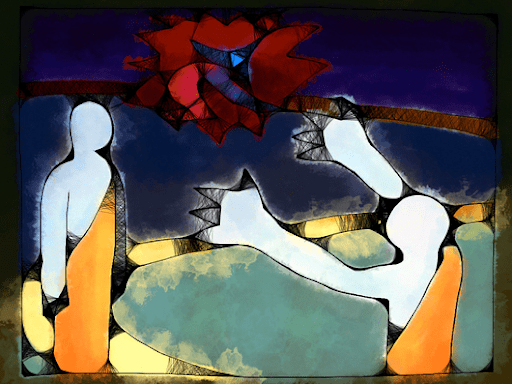
Paulklee144 v vierspaltig

1424 words, 7 min read

While the focus in the Gospels is mostly on what Jesus said and did, the Evangelists in some cases also report how they thought he felt, which is what I would like to look at in this post.1 Reading the Gospels with this aspect of Jesus in mind underlines the sense that it is his words and actions that were of greatest concerns to their authors, with little thought given most of the time to what Jesus’ emotional life might have been at any given moment. This makes the few explicit reference to his feelings the more interesting since they seem to point to instances where Jesus’ feelings were either not obvious (he may have done or said a certain thing in different states), a key to understanding his subsequent actions or of particularly high importance.

For a start, and unsurprisingly, Jesus felt love towards others, alongside loving them by what he said and did. Mark tells us about this being Jesus response to a man who observed the commandments since his youth:

“Jesus, looking at him, loved him and said to him, “You are lacking in one thing. Go, sell what you have, and give to [the] poor and you will have treasure in heaven; then come, follow me.”” (Mark 10:21)

And he also felt love towards his friends:

“Now Jesus loved Martha and her sister and Lazarus.” (John 11:5)

Jesus also felt hunger, as all three synoptic Gospels report. Matthew and Luke speak about Jesus’ understandable hunger after 40 days of fasting in the desert:

“He fasted for forty days and forty nights, after which he was hungry.” (Matthew 4:2)

“Filled with the holy Spirit, Jesus returned from the Jordan and was led by the Spirit into the desert for forty days, to be tempted by the devil. He ate nothing during those days, and when they were over he was hungry.” (Luke 4:1-2)

Mark instead tells us about Jesus’ hunger as a way to set the scene for the episode where he curses a fig tree for bearing no fruit out of season:

“The next day as they were leaving Bethany he was hungry.” (Mark 11:12)

Beyond the strongly biological, the Evangelists also report Jesus feeling amazed and astonished, in all cases in the face of faith or the lack thereof. Matthew and Luke tell us about Jesus’ response to the unexpected faith of the Roman Centurion, whose daughter is ill and who takes it as a given that Jesus has the power to heal here even at a distance:

“When Jesus heard this he was astonished and said to those following him, ‘In truth I tell you, in no one in Israel have I found faith as great as this.” (Matthew 8:10)

“When Jesus heard this he was amazed at him and, turning, said to the crowd following him, “I tell you, not even in Israel have I found such faith.”” (Luke 7:9)

Mark, instead reports the complement – Jesus’ amazement at the lack of faith in his own home town of Nazareth:

“He was amazed at their lack of faith.” (Mark 6:6)

Jesus also takes such surprise and responds to it with greater displeasure by being stern and strict when he wants to emphasise that his instructions are to be adhered to without fail. Mark reports this attitude when Jesus admonishes unclean spirits not to reveal his true nature:

“He warned them sternly not to make him known.” (Mark 3:12)

Matthew first mentions this when describing how Jesus spoke to two blind men whom he cured:

“And their sight returned. Then Jesus sternly warned them, ‘Take care that no one learns about this.’” (Matthew 9:30)

and then when describing Jesus’ reaction to Peter declaring who he thought Jesus was:

“Then he strictly ordered his disciples to tell no one that he was the Messiah.” (Matthew 16:20)

Sternness becomes indignation, as far as Mark is concerned, when he describes Jesus discovering that his disciples wouldn’t let kids come to him:

“When Jesus saw this he became indignant and said to them, “Let the children come to me; do not prevent them, for the kingdom of God belongs to such as these.”” (Mark 10:14)

And Jesus even feels anger and grief when the good he does – of curing a man’s hand – is disapproved of:

“Looking around at them with anger and grieved at their hardness of heart, he said to the man, “Stretch out your hand.” He stretched it out and his hand was restored.” (Mark 3:5)

Jesus then feels perturbed and troubled upon receiving news of his friend Lazarus’ death:

“When Jesus saw her weeping and the Jews who had come with her weeping, he became perturbed and deeply troubled, and said, “Where have you laid him?” They said to him, “Sir, come and see.” And Jesus wept. […] So Jesus, perturbed again, came to the tomb. It was a cave, and a stone lay across it.” (John 11:33-35,38)

The same feelings return to Jesus on the night before his crucifixion. First, already during the last supper, after washing the disciples’ feet and telling them that one of them will betray him:

“When he had said this, Jesus was deeply troubled and testified, “Amen, amen, I say to you, one of you will betray me.”” (John 13:21)

Then, on the way to the Garden of Gethsemane, when feelings of sorrow accompany his distress and being troubled:

“He took along Peter and the two sons of Zebedee, and began to feel sorrow and distress.” (Matthew 26:37)

“He took with him Peter, James, and John, and began to be troubled and distressed. Then he said to them, “My soul is sorrowful even to death. Remain here and keep watch.”” (Mark 14:33-34)

Finally, the time in the Garden culminates in feeling agony:

“He was in such agony and he prayed so fervently that his sweat became like drops of blood falling on the ground.” (Luke 22:44)

However, the feeling most often reported by the Evangelists is one of compassion – of feeling pity and feeling sorry for the condition others are in. Jesus felt this for the public at large as he was teaching in towns and villages:

“And when he saw the crowds he felt sorry for them because they were harassed and dejected, like sheep without a shepherd.” (Matthew 9:36)

And he felt this in particular who followed him even to deserted places with a disregard for their own needs:

“When he disembarked and saw the vast crowd, his heart was moved with pity for them, and he cured their sick.” (Matthew 14:14)

“When he disembarked and saw the vast crowd, his heart was moved with pity for them, for they were like sheep without a shepherd; and he began to teach them many things.” (Mark 6:34)

“My heart is moved with pity for the crowd, because they have been with me now for three days and have nothing to eat.” (Mark 8:2)

Feelings of pity were also elicited in Jesus by individuals at the periphery of society, like a leper and two blind men, whose healing was triggered by his feelings:

“Moved with pity, Jesus touched their eyes. Immediately they received their sight, and followed him.” (Matthew 20:34)

“Moved with pity, he stretched out his hand, touched him, and said to him, “I do will it. Be made clean.”” (Mark 1:41)

Finally, pity was a also how Jesus felt when seeing a widow from Nain mourn her dead son:

“When the Lord saw her, he was moved with pity for her and said to her, “Do not weep.”” (Luke 7:13)

What strikes me most about having read the Gospels through the lens of Jesus’ emotions is that they point to his having engaged with the world fully and richly, responding to it with great closeness at certain times and with forceful rejection and condemnation at others. His feelings in some cases grew out of his own self (bodily and psychologically) while in others they came about as reactions to events unfolding around him. Instead of an aloof, otherworldly apparition come to deliver a message, Jesus clearly had preferences, needs and dislikes, making himself one with us and therefore showing the way to a life of fulfilment through compassion and self-giving.


1 Two principles guided my choices: first, to look for instances where it is the Evangelists who directly describe Jesus’ feelings (i.e., I left out verses where his actions are described and where these could be used to infer his feelings), and second to try and be exhaustive.
I’m with Fr. Martin: respect, compassion, and sensitivity for LGBTs

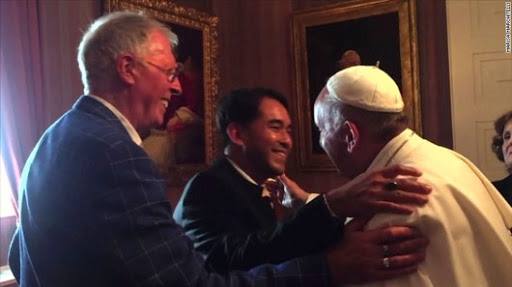
151003075258 pope francis meets hugs same sex couple 00000803 exlarge 169

2413 words, 12 min read

Jesus’ last will and testament, which he passed on to the apostles at the Last Supper, contains the following exhortation: “that they may all be one” (John 17:21). Here, Jesus explains in the same verse that “one” means to relate to each other “as you, Father, are in me and I in you.” And since “all” means “all,” it falls to every Christian to strive towards building relationships with everyone like those among the persons of the Trinity – i.e., relationships of loving self-noughting and self-othering. This means that there is no more us versus them, only an all-encompassing us.

Now, this “us” undoubtedly also includes those who are gay, lesbian, bisexual and transgender, and indeed anyone else too, regardless of their sexual orientation. It is therefore essential that we, Christians make everyone, regardless of their sexuality, feel not only welcome but loved and since this has often not been the case, there is a need for a deliberate effort to reach out, which has also been apparent in many things Pope Francis, and many other representatives of the Catholic Church, have said and done recently.

In this context, an important contribution has recently been made by Fr. James Martin SJ, who has for many years ministered to the LGBT community and who has now written an excellent book on how to bring it and the institutional Church closer together. The book is entitled “Building a Bridge: How the Catholic Church and the LGBT Community Can Enter into a Relationship of Respect, Compassion, and Sensitivity” and contains four parts. The first two are built on the metaphor of a bridge between the institutional Church and the LGBT community, where Fr. Martin’s advice for traversing it in both directions is based on what the Catechism of the Catholic Church teaches with regard to LGBT people, which is to treat them with “respect, compassion, and sensitivity” (§2358). The third part comprises a series of scriptural passages that Fr. Martin found helpful in his ministry, each with an introduction and followed by questions suitable for reflection. Finally, the book concludes with a beautiful prayer – “A prayer for when I feel rejected”.

When I first read this book, I found it to be a pure expression of the Gospel desire to share the Good News that Jesus brought to humanity – an invitation to mutual love, to dialogue and to closeness. I also thought that it was highly non-controversial and entirely consistent with the Catholic Church’s teaching and I thought no more about it. During the course of recent days, things have changed though and I have seen a savage and persistent campaign of hate directed at Fr. Martin, who is now being accused of heresy and whose name is being dragged through the mud of social media echo chambers. I am no censor or even theologian, but as a member of the Church’s laity, I have a right and duty to support and defend those who uphold the Gospel, and Fr. Martin certainly does that in spades.

Instead of engaging in a futile rebuttal of his critics, I would just like to share with you some of my favorite passages mostly from the first part of “Building a Bridge,” since it is there that I have most felt spoken to myself.

In the opening pages of the book Fr. Martin sets out the rationale for writing it, which is about breaking down us v. them barriers:

“[T]he work of the Gospel cannot be accomplished if one part of the church is essentially separated from any other part. […] In these times, the church should be a sign of unity. Frankly, in all times. Yet many people see the church as contributing to division, as some Christian leaders and their congregations mark off boundaries of “us” and “them.” But the church works best when it embodies the virtues of respect, compassion, and sensitivity.”

Next, he looks at each of respect, compasion and sensitivity in turn, as they apply to the institutional Church’s relationship with LGBT Catholics and the LGBT community in general. Thinking about respect first, Fr. Martin highlights three consequences of it, the first of which is recognition:

“[R]ecognizing that the LGBT community exists, and extending to it the same recognition that any community desires and deserves because of its presence. […] Jesus recognizes all people, even those who seem invisible in the greater community.”

Throughout the book, Fr. Martin also presents and engages with potential reservations about his proposals. For example, in the case of recognition being misconstrued as blanket approval, he writes:

“Some Catholics have objected to this approach, saying that any outreach implies a tacit agreement with everything that anyone in the LGBT community says or does. This seems an unfair objection, because it is raised with virtually no other group. If a diocese sponsors, for example, an outreach group for Catholic business leaders, it does not mean that the diocese agrees with every value of corporate America.”

The second aspect of respect then is “calling a group what it asks to be called.”:

“[P]eople have a right to name themselves. Using those names is part of respect. And if Pope Francis and several of his cardinals and bishops can use the word gay, as they have done several times during his papacy, so can the rest of the church.”

The third side of respect is to recognise that LGBT Catholics bring many gifts to the Church:

“Respect also means acknowledging that LGBT Catholics bring unique gifts to the church—both as individuals and as a community. […] Many, if not most, LGBT people have endured, from an early age, misunderstanding, prejudice, hatred, persecution, and even violence, and therefore often feel a natural compassion toward the marginalized. Compassion is a gift. They have often been made to feel unwelcome in their parishes and in their church, but they persevere because of their vigorous faith. Perseverance is a gift. They are often forgiving of clergy and other church employees who treat them like damaged goods. Forgiveness is a gift. Compassion, perseverance, and forgiveness are all gifts.”

In summary, Fr. Martin argues that respect translates to participation in God’s love:

“Seeing, naming, and honoring all these gifts are components of respecting our LGBT brothers and sisters and siblings. So also is accepting them as beloved children of God and letting them know that they are beloved children of God. The church has a special call to proclaim God’s love for a people who are often made to feel, whether by their families, neighbors, or religious leaders, as though they were damaged goods, unworthy of ministry, and even subhuman. The church is invited to both proclaim and demonstrate that LGBT people are beloved children of God.”

Turning to compassion, the model is Jesus’ incarnation itself and the need for listening to and living alongside others:

“The word compassion (from the Greek paschō, “to suffer”) means “to experience with, to suffer with.” So what would it mean for the institutional church not only to respect LGBT Catholics, but to be with them, to experience life with them, and even to suffer with them? […]

The first and most essential requirement is listening. It is impossible to experience a person’s life, or to be compassionate, if you do not listen to the person or if you do not ask questions. […]

We need not look far for a model for this. God did this for all of us—in Jesus. The opening lines of the Gospel of John tell us, “The Word became flesh and lived among us” (1: 14). The original Greek is more vivid: “The Word became flesh and pitched its tent among us” (eskēnōsen en hēmin). Isn’t that a beautiful phrase? God entered our world to live among us. This is what Jesus did. He lived alongside us, took our side, even died like us.

We can celebrate and treasure more than simply their gifts. We can celebrate and treasure them. This is a kind of compassion too—to share in the experience of Christian joy that LGBT men and women, young and old, bring to the church.”

Next, sensitivity is presented as a call to closeness, along Pope Francis’ lines of encountering and accompanying and in imitation of Jesus’ reaching out also to those considered on the margins of the People of Israel, in an outside-in motion:

“Merriam-Webster’s Dictionary defines sensitivity as “an awareness or understanding of the feelings of other people.” That’s related to Pope Francis’s call for the church to be a church of “encounter” and “accompaniment.” To begin with, it is nearly impossible to know another person’s feelings at a distance. You cannot understand the feelings of a community if you don’t know the community. You can’t be sensitive to the LGBT community if you only issue documents about them, preach about them, or tweet about them, without knowing them.[…]

In this, as in all things, Jesus is our model. When Jesus encountered people on the margins, he saw not categories but individuals. To be clear, I am not saying that the LGBT community should be, or should feel, marginalized. Rather, I am saying that within the church many of them do find themselves marginalized. They are seen as “other.” But for Jesus there was no “other.” Jesus saw beyond categories; he met people where they were and accompanied them. The Gospel of Matthew, for example, tells the story of Jesus meeting a Roman centurion who asked for healing for his servant (8: 5–13). Although the man was not Jewish, Jesus saw a man in need and responded to his need. […]

The movement for Jesus was always from the outside in. His message was always one of inclusion, communicated through speaking to people, healing them, and offering them what biblical scholars call “table fellowship,” that is, dining with them, a sign of welcome and acceptance in first-century Palestine. In fact, Jesus was often criticized for this practice. But Jesus’s movement was about inclusion. He was creating a sense of “us.” For with Jesus, there is no us and them. There is only us.

In this context, Fr. Martin also addresses the potential objection that Jesus also admonished sinners not to sin, arguing that his approach was one of inclusion first and conversion second (a conversion we are all called to and in need of):

“One common objection here is to say, “No, Jesus always told them, first of all, not to sin!” We cannot meet LGBT people because they are sinning, goes the argument, and when we do meet them, the first thing we must say is, “Stop sinning!” But more often than not, this is not Jesus’s way. In the story of the Roman centurion, Jesus doesn’t shout “Pagan!” or scold him for not being Jewish. Instead, he professes amazement at the man’s faith and then heals his servant. Likewise, in the story of Zacchaeus, after spying the tax collector perched in the tree, he doesn’t point to him and shout, “Sinner!” Instead, Jesus says that he will dine at Zacchaeus’s house, a public sign of openness and welcome, before Zacchaeus has said or done anything. Only after Jesus offers him welcome is Zacchaeus moved to conversion, promising to pay back anyone he might have defrauded. For Jesus it is most often community first—meeting, encountering, including—and conversion second. Here I’m talking about the conversion that all of us need, not simply LGBT people (and, incidently, not “conversion therapy”). Pope Francis echoed this approach in an inflight press conference in 2016, on his return to Rome from the countries of Georgia and Azerbaijan. “People must be accompanied, as Jesus accompanied,” he said. “When a person who has this situation comes before Jesus, Jesus will surely not say: ‘Go away because you’re homosexual.’””

At the conclusion of the first half of the book, Fr. Martin spells out a point that forms the bedrock of his approach, which is that:

“[w]e are all on the bridge together. For that bridge is the church. And, ultimately, on the other side of the bridge for each group is welcome, community, and love.”

And, finally, he draws our attention to the sustaining power of the Holy Sprit, to the need of our, universal brotherhood and sisterhood, and to God’s constant accompanying of humanity:

In difficult times you might ask: “What keeps the bridge standing? What keeps it from collapsing onto the sharp rocks? What keeps us from plunging into the dangerous waters below?” The answer is: the Holy Spirit. The Holy Spirit, which is supporting the church, is supporting you, for you are beloved children of God who, by virtue of your baptism, have as much right to be in the church as the pope, your local bishop, and me. Of course, that bridge has some loose stones, big bumps, and deep potholes, because the people in our church are not perfect. We never have been—just ask St. Peter. And we never will be. We are all imperfect people, struggling to do our best in the light of our individual vocations. We are all pilgrims on the way, loved sinners following the call we first heard at our baptism and that we continue to hear every day of our lives. In short, you are not alone. Millions of your Catholic brothers and sisters accompany you, as do your bishops, as we journey imperfectly together on this bridge. More important, we are accompanied by God, the reconciler of all men and women as well as the architect, the builder, and the foundation of that bridge.

To my mind, Fr. Martin has written a beautiful treatise on dialogue, openness and love that could just as well be applied to any other group of people who are and/or feel marginalised by the Church. The text could easily be transposed to refugees or atheists or to other groups and communities, whom parts of the Church may not be as welcoming towards as they should1 and I highly recommend the book in its entirety.


1 E.g., see Pope Francis’ words from the press conference during his return from Armenia in June 2016: “I think that the Church not only should apologise … to a gay person whom it offended but it must also apologise to the poor as well, to the women who have been exploited, to children who have been exploited by (being forced to) work. It must apologise for having blessed so many weapons.”

Enfleshment

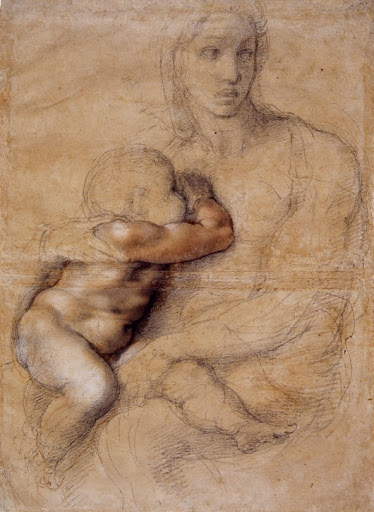
Michelangelo drawing

1221 words, 6 min read

Are there some places or objects that are more sacred than others? Is there anything special about the spot where Jesus was entombed after Joseph of Arimathea obtained his dead body from Pontius Pilate? How about the relics of saints, do they deserve special reverence? Or the cell where St. Theresa of Ávila spent her life, the patch of soil where St. Francis is buried or the spots where Dietrich Bonhoeffer was hanged or St. Thomas More beheaded? Are they any different from your local supermarket?

Before a hasty “yes” to the above, let’s approach the question from the other end too. Isn’t all of creation, the entire Universe made holy because it has been created and is being sustained by God, because it has being only insofar as God makes it participate in His own? Isn’t God present everywhere and always? Isn’t it the case that wherever I may go, God is already there, awaiting me and waiting for me to discover him and relate to him there? Isn’t each person equally loved by God and therefore given equal dignity and worth? Shouldn’t we see His presence everywhere, always, in everything and everyone? Doesn’t that result in universal equality and equivalence?

As with very many questions of this kind, I believe the answer is a resounding “both” and the template in this case could be Patriarch Athenagoras’ saying: “God loves everyone equally, but secretly each one of us is his favorite.” It is both a confirmation of universal equality and of individual exceptionality and I believe that both are needed in equal measure. Focusing only on the former, universal aspect brings with it a danger of declaring a love of humanity while not particularly liking any one person, a danger of emphasizing the general principle while loosing sight of the instances in ought to be applied to. The risk here is an idealism that lacks flesh. A focus on the latter, instead risks an idolization of some while looking down upon others, a schizophrenia of reverence for people and objects that ostensibly possess special qualities while walking past the poor, the “ordinary”, the “everyday” whose dignity is equipollent. The risk here is a materialism – even when it may appear as sacred – that lacks soul.

What does a “both” attitude look like though, in the face of these seemingly polar opposites. Here, I believe the answer is the incarnation – and if you are not a Christian, please, bear with me, because I believe that the pattern of thought that it represents (and embodies!) is more broadly relevant.

Let’s see first how Pope Benedict XVI explains what “incarnation” means:

“Incarnation derives from the Latin incarnatio. St Ignatius of Antioch — at the end of the first century — and, especially, St Irenaeus used this term in reflecting on the Prologue to the Gospel according to St John, in particular in the sentence “the Word became flesh” (Jn 1:14). Here the word “flesh”, according to the Hebrew usage, indicates man in his whole self, the whole man, but in particular in the dimension of his transience and his temporality, his poverty and his contingency. This was in order to tell us that the salvation brought by God, who became man in Jesus of Nazareth, affects man in his material reality and in whatever situation he may be. God assumed the human condition to heal it from all that separates it from him, to enable us to call him, in his Only-Begotten Son, by the name of “Abba, Father”, and truly to be children of God. […]

The Logos, who is with God, is the Logos who is God, the Creator of the world (cf. Jn 1:1) through whom all things were created (cf. 1:3) and who has accompanied men and women through history with his light (cf. 1:4-5; 1:9), became one among many and made his dwelling among us, becoming one of us (cf. 2:14).

The Second Vatican Ecumenical Council said: “The Son of God… worked with human hands, he thought with a human mind. He acted with a human will, and with a human heart he loved. Born of the Virgin Mary, he has truly been made one of us, like to us in all things except sin” (Constitution Gaudium et Spes, n. 22). Thus it is important to recover our wonder at the mystery, to let ourselves be enveloped by the grandeur of this event: God, the true God, Creator of all, walked our roads as a man, entering human time to communicate his own life to us (cf. 1 Jn 1:1- 4). And he did not do so with the splendour of a sovereign who dominates the world with his power, but with the humility of a child.”

At the heart of Christianity there is a co-existence, a simultaneity between the eternal and the transient, the splendid and the humble, the self-sufficient and the contingent, which invests the latter with the former. It elevates material reality to a status that is inseparable from the uncreated, the eternal, since the uncreated made Himself created, while retaining His uncreatedness.

Elevating the material through the incarnation also elevates the specific to the status of the general. Material being brings with it Leibniz’s principle of identity, whereby no two entities can be the same since they will always differ at least in temporal and or spatial location. Since no two material entities can be the same, their distinction and specificity is intrinsic to material being, whose elevation through God’s incarnation also raises the specific, delimited to the level of the general and infinite.

Because God became flesh, flesh becomes not only a signifier of His presence, a token, but His actual presence. The value that materialist atheism attributes to matter is therefore in no way undermined or diminished by the Christian’s belief in its being in relationship with God, its being a manifestation of His presence. Both can, and the Christian ought, lest they deny the reality of the incarnation, value the physical, without caveats.

Pope Francis, in fact, makes Christian love conditional on being connected to Jesus’ flesh, which the flesh of the poor, the suffering and the needy makes present today, and he has harsh words for those who de-flesh the Church:

“A love which does not acknowledge that Jesus came in the flesh is not the love with which God commands us: it is a worldly love, it is a philosophical love, it is an abstract love, it is a somewhat failed love, it is soft love. No! The criterion for Christian love is the Incarnation of the Word. […]

[W]hoever wishes to love not as Christ loves his spouse, the Church, with his own flesh and giving life, loves ideologically: they do not love with the all their body and with all their soul. And this way of theorizing, of being ideological, as well as the proposals of religiosity which removes the flesh of Christ, which removes the flesh of the Church, going beyond and ruining the community, ruining the Church.”

Instead of distancing Christians from atheist materialists, the incarnation makes every Christian be as much of a materialist as their atheist brothers and sisters. It makes them be both materialists and theists, fully materialist so as to be fully theist.

The demon of distance

Demon of distance

A couple of weeks ago, Cardinal Gianfranco Ravasi lead another of the “courtyard of the gentiles” events, aimed at providing a space for dialogue between non-believers and Catholics. This time it took place in Budapest and Cardinal Ravasi’s address focused on the fundamental Christian principles, from which its understanding of morality, economy and society derives.

These principles include those of the person (created in the image of God and intrinsically being in relationship with others), of autonomy (of the civil and religious spheres, following Jesus’ words: “Then repay to Caesar what belongs to Caesar and to God what belongs to God.” (Matthew 22:21)), of solidarity and of truth (that precedes and exceeds us and that we inhabit rather than possess1). Each of these four principles is insightfully presented and analyzed by Ravasi and I would recommend anyone to read his talk in full (at the time of writing this post, only available in Italian). Here, however, I would like to focus only on the principle of solidarity, which Ravasi further differentiates into its aspects of justice and love.

The starting point of the principle of solidarity in Christianity, like that of the other three principles too, is the incarnation: “And the Word became flesh” (John 1:14), as a result of which there is a link between faith and history, between religion and political and social life. Cardinal Ravasi also emphasized this point during his brief opening remarks of the entire event, where he pointed out that, while in Eastern religions saints tend to be depicted with closed eyes (indicating an interiority of focus), in Christian art saints are typically shown with their eyes wide open – projecting out into the world around them. What is needed, Ravasi concludes, is both an interiority and a having one’s eyes open to see the great political, economic, social and cultural problems of the world.

In this context, the principle of solidarity in Christianity has its roots already in the Genesis account of creation, where

“the fact of all of us being human is expressed by the noun “Adam,” which in Hebrew is ha-’adam,2 with the article (ha-) that simply means “the human.” is used to refer to humanity. Therefore there is in all of us a shared “adamness.” Solidarity is, therefore, structural to our fundamental anthropological reality. Religion expresses this anthropological unity using two terms that are two moral categories: justice and love. Faith takes solidarity, which is also at the basis of lay philanthropy, but goes beyond it. In fact, staying with John’s Gospel, during the last evening of his earthly life Jesus says a wonderful phrase: “No one has greater love than this, to lay down one’s life for one’s friends.” (John 15:13).”

To illustrate the two aspects of solidarity – justice and love, Ravasi takes advantage not only of Christian tradition, but also makes reference to Eastern thought, in the spirit of inter-religious dialogue.

To present the essence of justice, Ravasi quotes the 4th century saint, Ambrose of Milan:

“The earth was created as a common good for all, for the rich and for the poor. Why, then, O rich, do you usurp an exclusive right to the soil? When you help the poor, you, rich, don’t give them from your own, but you return to them their own. In fact, you alone use the common property, given for the use of all. The earth belongs to all, not only to the rich, therefore when you help the poor you give them back their due, instead of providing them with a gift of your own.” (On Naboth)

Turning to the second aspect of solidarity – love, Ravasi takes advantage of the following Tibetan parable, showing that religious cultures, that are undoubtedly diverse, do at their bases have touch-points and contacts:

“A man, walking through the desert, spots something strange in the distance. Fear starts welling up in him, since, in the absolute solitude of the steppe, such an obscure and mysterious reality – maybe an animal, a dangerous wild beast – can’t but unsettle. Moving ahead, the traveller discovers that he is not approaching a beast, but a person instead. But his fear does not pass. If anything, it grows, thinking that the person could be a robber. Nonetheless, he has no choice but to proceed, until arriving in the presence of the other. At this moment, the traveller lifts his gaze and, to his surprise, exclaims: “It is my brother, whom I haven’t seen for many years!””

Ravasi concludes his reflection on solidarity by noting that “distance generates fears and demons; one has to get close to the other to overcome fears, no matter how understandable they may be. Refusing to get to know the other and to encounter the other is the same as saying no to the love that springs from solidarity and that dissolves terror and generates a true society.”

Personally, I have found Cardinal Ravasi’s reflection highly compelling and enlightening, both due to its deep roots in Scripture and its open and broad perspective that is equally at ease with drawing on the rich sources of Christianity as it is to benefit from the insights of other religions, even in matters as fundamental and core to Christianity as its understanding of love. Specifically, I have also found the Tibetan parable to be a great reminder to attempt closeness with all, instead of remaining at a distance and being put off by distorted, prejudice-filled, blurry perception.


1 Ravasi addressed this concept of the truth several times already, e.g. see also its coverage in a previous post here.
2 For more on the Genesis account and ha-’adam, see John Paul II’s “Man and Woman He Created Them,” discussed here.