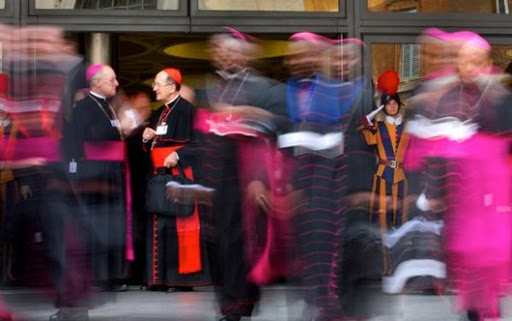
Synod15: martyrdom of a document (Part 1)

Synod15

The first output of this year’s Synod came today in the form of the small groups’ reports on the first part of the Instrumentum Laboris, which offers an analysis of the current challenges of the family. In a press conference today, Cardinal Luis Antonio Tagle characterized instrumentum laboris documents in general as being “martyr” documents in the sense that they have to die so that new life may be born. Looking at the reports of the circuli minores that’s certainly the case for this Synod too.

What I would like to do next is to pull together the contents of the English, Italian, Spanish and German reports, grouping it by topic and using acronyms of the source group names from their official list (i.e., AA will refer to Circulus Anglicus “A”):

  1. Announce the Good News for families clearly and attractively.
    AA: “we recommend the words of Pope Francis who vividly engaged families at the Saturday Vigil for the World Meeting of Families in Philadelphia with the invitation: “So great was (God’s) love, that He began to walk with humanity, with His people, until the right moment came, and He made the highest expression of love – His own Son. And where did He send his son – to a palace? To a city? No.He sent him to a family. God sent him amid a family. And He could do this, because it was a family that had a truly open heart!””
    AB: “The group felt that the language of the final document should be a more simple language, accessible to families, showing also that the Synod Fathers had listened to and heard their contribution and comments to the synodal process.”
    AC: “We also considered certain phrases which have become commonplace in Church documents, among them “the Gospel of the family” and “the domestic Church”. These were vivid and illuminating formulations when they first appeared, but in the meantime they have become clichés, which are less clear in their meaning than they are usually assumed to be. We felt that it may be a good thing if they were given a rest and if we chose instead to use a language which was more accessible to those unfamiliar with our particular speak.”
    AD: “Still others thought that the text lacked anything that would attract people. If the document is destined to the general public, they felt that stories from family life, or the lives of the saints along with illustrations, should be included to make the material more compelling. They stressed the need to review the language of the document and ensure that it appeals to both men and women, leaving no one out.”
    IC: “The recommendation has emerged that in the review of the document, we proceed very carefully to facilitate the text, to clean it of overly technical language and to enrich it with different points of view.”
    HB: “point to positive experiences: movements, domestic catechumenate, formed and forming families, family support programs and bioethics at universities and colleges.”
    G: “So we suggest and ask, at the beginning of the first chapter to add a section that describes the beauty of marriage, the mission of marriages and families, and draw on the concerns and observations of Pope Francis. Gratefully and with awe we perceive that marriage is called to participate in the creative power of God and in His work of redemption. […] In the constitution of the texts it should be ensured that religious and theological positions are understandable not only internally, but are also accessible in a secular environment. This calls for a “cultural translation”, as it were an inculturation. For the editing of the final document this means, whether a negatively delimiting and normative judgmental language prevails (forensic style) or a positive language that unfolds the Christian position is used, where the two are incompatible from a Christian perspective.”
  2. Avoid overly bleak analysis of status quo.
    AA: “speak less of “crisis” and more of “lights and shadows.””
    AB: “the analysis of the difficulties which the family faces was too negative.”
    AC: there “needs to be a less negative reading of history, culture and the situation of the family at this time. True, there are negative forces at work at this time in history and in the various cultures of the world; but that is far from the full story. If it were the full story, all the Church could do would be to condemn. There are also forces which are positive, even luminous, and these need to be identified, since there may well be the signs of God in history.”
    AD: “Most of our group felt the IL should begin with hope rather than failures because a great many people already do successfully live the Gospel’s good news about marriage. Our group expressed concern that readers will simply ignore the document if it begins with a litany of negatives and social problems rather than a biblical vision of joy and confidence in the Word of God regarding the family. The huge cloud of challenges pervading the first section of the text unintentionally creates a sense of pastoral despair. [… Some] thought that the language of the text was too careful and politically correct, and because of that, the content was unclear and sometimes incoherent.”
    IC: “It has also been pointed out that the diagnosis offered in the document emphasizes the shadows and struggle to highlight the strong positive points emerging from the traversed landscape. […] Many amendments that our group has proposed are aimed at a positive reading of challenges not only for the family, so that it may become a place of inclusion, overcoming a life set apart (living in an “apartment”), but also for the evangelizing mission of the Church.”
    G: “What is necessary here is a differentiated analysis and assessment, in order to contribute to proper and nuanced world exchange between the Church and culture. I would like to clarify this point with an example: Often, in the first chapter there is talk of individualism. As a selfish trait it is undoubtedly a great danger to people’s lives. However, it mustn’t be confused with the individuality of a person. Every single human being is created by God in a very unique and great way and deserves to be respected and have the dignity of their person protected. Our text speaks repeatedly about individualism but little good is said about the positive signs of the times, arising out of respect for the individuality of a person.”
  3. Present positive vision of sexuality and educate to a culture of self-giving.
    AB: “Young people live in an oversexualized culture. They need to be educated to a culture of self-giving, which is the basis of the self-donation of conjugal love. Young people need to develop the ability to live in harmony with emotions and feelings, and to seek mature affective, mature relations with others. This can be an antidote to selfishness and isolation, which often lead young people to a lack of meaning in their lives and even to despair, self-harm, and suicide.”
    IA: “In terms of the formation to affectivity, there is a need to mention explicitly the ideal of chastity and the value of self-giving.”
    IB: “There is a need to reiterate that the Church has a positive outlook on sexuality, expression of a symphonic tension between eros and agape.”
    HA: “There has been a rupture of unity between love, sexuality and procreation. Not only that, but it has also been separated from the educational dimension: the relationship between love, sexuality, marriage, family and the bringing up of children has broken.”
    G: “Everyone longs to be loved and to give love. Love is the full and unconditional ‘yes’ to another person – for their own sake, with no ulterior motives and reservations. It is a human trait that love always wants to give. Thus unfolds the marriage in the love for children and other family members. Thus grows the family out of marriage, which radiates in society and the Church. Christian marriage is thus a piece of lived Church.”
  4. Link more closely and explicitly with Scripture and deposit of faith.
    AA: “We discussed a proper methodology, which needs to make reference to Sacred Scripture and Tradition throughout this document as we read the signs of our times in light of the Gospel.”
    AB: “The language of Scripture can be closer to the realities of the daily experience of families and can become a bridge between faith and life.”
    IB: “The Fathers stressed the importance of the text bringing with it more biblical citations (to find the first one, you have to get to no. 39, p. 32) and some patristic quotes.”
  5. Express appreciation to families giving Gospel witness and offering support to others.
    AB: “[T]he extended family is so often the ordinary means by which men and women are accompanied through every stage of life. The love and support given by and received in so many families on the pilgrimage of life is an expression of the love that God has for his pilgrim people. [… F]amilies who are far from perfect, living in an imperfect world do actually realize their vocation, even though they may fail along their journey.”
    AD: “[M]embers felt strongly that even in difficult situations, we need to underline the fact that many Christian families serve as a counter-witness to negative trends in the world by the way they faithfully live the Catholic vision of marriage and the family. These families need to be recognized, honored and encouraged by the document.”
  6. Avoid overly Euro-centric or Western mindset in wording.
    AA: use “a cultural tone that is global and that is open to the richness and real experiences of families today, in various nations and continents.”
    AD: “Members said that some of the sections seemed narrow in scope and excessively inspired by West European and North American concerns, rather than a true presentation of the global situation. Some of the members thought that terms like “developing nations” and “advanced countries” were condescending and inappropriate for a Church document.”
    IC: “The timbre of the text seemed to many strongly characterized by a Western perspective (European and North American), especially in the description of the aspects and challenges posed by secularization and individualism that characterizes the consumer society.”
  7. Recognize inadequacy of current support.
    AB.
    AD: “We need to acknowledge and ask forgiveness for our own mistakes as pastors, especially those that have undermined family life.”
    HA: “We have failed in “Christian education” and in the “education of faith” and one comes to marriage with many gaps.”
    G: “We also propose, in these introductory thoughts, to thank spouses and families for their great service to each other, to our society and to our church. We also want to thank those especially who have stayed together in difficulties, and thereby have become a visible sign of God’s faithfulness.”
  8. Avoid stereotype of “ideal family.”
    AB: “What emerged was far from a stereotype of an “ideal family,” but rather a collage of families different in their social, ethnic, and religious background. Amid many difficulties our families gave us the gift of love and the gift of faith; in our families we discovered a sense of self-worth and dedication.”
    AC: “In speaking of “the family”, we were conscious of the danger of lapsing into an idealized, removed and disembodied sense of family, which may have its own beauty and internal coherence but which can end up inhabiting a somewhat bloodless world rather that the real world of families in all their variety and complexity.”
  9. [There is a great sense of frankness in the reports.]
    AC: “The going was very slow indeed at times, and we are left wondering how on earth we will manage to make our way paragraph by paragraph through the entire document before the end of the Synod. […] At times our work has seemed more muddled than methodical; but our hope is that focus, if not perfect clarity, will emerge as the Synod unfolds and we become more assured about both task and method.”
    AD: “we found much of the [instrumentum laboris] text to be flawed or inadequate, especially in its theology, clarity, trust in the power of grace, its use of Scripture and its tendency to see the world through overwhelmingly Western eyes. Second, we felt limited in our ability to respond by not knowing clearly who the audience of the document is. In other words, are we writing to the Holy Father, to families of the Church, or to the world? […] Members criticized many of the paragraphs in the first section. Some thought the presentation was chaotic, without inherent logic. Sentences seemed to be tossed together without any organic connection to one another. […] The current material is obviously the work of a committee. Because of that, it lacks beauty, clarity and force.”
    G: “The German translation followed the Italian text relatively closely, which, however, sometimes this makes the German text often difficult to understand. The reason for this are often the overlong sentences, requiring shorter sentences in German. Even the nested style is hard work. Here it would be better to look for shorter sentences in general and a better structuring of content. In the translation of the final texts there ought to be close attention paid to good style, pleasant readability and clear formulation. The translation should not be interlinear, but one that transmits meaning.”


Synod15: the joy of feeling loved

Emmaus arcabas

Today saw the publication of the “instrumentum laboris” (working document) that will be used in preparation for this October’s Synod on the Family and that incorporates answers from around the world to the questionnaire put forward at the end of last year’s Synod. The document is 21K words long, only available in Italian so far and reproduces the “lineamenta” (directives for the work to be done between the two synods on the family) of last year’s Synod in their entirety. As a result, the following will focus on those of the 147 paragraphs of the “instrumentum laboris” that differ from the 61 paragraphs of the “lineamenta” and the English wording here will be my own, crude translation.

The first part of the text is entitled “Listening to the challenges of the family,” which presents a rather pessimistic view of the current state of the family, starting with the following statement:

“Only a minority live, support and put forward the Catholic Church’s teaching on marriage and the family, recognizing in it the goodness of God’s creative plan. Marriages, religious or not, are on the decrease and the number of separations and divorces is growing.” (§7)

The following sections the speak about the a variety of challenges, from cultural (where differences between men and women are not understood and instead denied), to social, economic and political ones (where insufficient support for the life of the family is bemoaned). The particular difficulties following from solitude, old age, the last stages of life and bereavement, disability and migration are also profiled.

The many difficulties related to the unequal treatment of women are then spelled out in §30:

“Many have observed that the processes of the emancipation of women have brought their role in the growth of the family and society to the fore. It remains true, however, that the status of women in the world is subject to large differences resulting primarily from cultural factors. It ought not be thought that problematic situations could be resolved simply by an end to difficult economic conditions and the arrival of modern culture, as evidenced by the difficult conditions of women in various countries that have recently become developed.

In western countries, the emancipation of women requires a rethinking of the duties of spouses in their reciprocity and common responsibility for family life. In developing countries, the exploitation and violence perpetrated against women’s bodies is supplemented by onerous tasks imposed on them even during pregnancy, as well as forced abortions and sterilizations, not to mention the extremely negative practices connected with procreation (for example, the renting of a uterus or the market in embryonic gametes). In advanced countries, the desire for a child “at all costs” has not resulted in happier or stronger family, but has in many cases actually exacerbated the inequality between women and men. The sterility of a woman is, according to the prejudices present in various cultures, a socially discriminating condition.

What could contribute to a more decisive role of women would also be a greater recognition of their responsibilities in the Church: their involvement in decision-making; their participation, not only formal, in the government of some institutions; their involvement in the formation of ordained ministers.”

The first part of the “instrumentum laboris” concludes with remarks on bioethics, the need for formation about affectivity and the importance of bearing in mind that even those “far” from the life of the Church are “persons loved by God” and that all ought to be looked upon with understanding (§36).

The second part of the text is entitled “Discernment of the call to family life”, where a lack of knowledge of Scripture and its reading in the family is first noted with concern. The value of indissolubility is then emphasizes:

“The witness of couples who live Christian marriage in its fullness highlights the value of this indissoluble union and awakens the desire to embark on ever new paths of marital fidelity. Indissolubility is a person’s response to a deep desire for mutual and enduring love: a love that is “forever” and that becomes choice and self-giving of each spouse to the other, of the couple towards God and towards all those whom God entrusts to them.” (§42)

The unitive and procreative character of marriage, of the family being in the image of the Trinity, the missionary character of the family, prayer in the family and the importance of catechesis are addressed next, followed by a call to emphasizing the joy that springs from the life of a family:

“The joy of a person is an expression of their full realization. To present the unique joy that comes from the union of spouses and the establishment of a new family, it is beneficial to show the family as a place of personal, gratuitous relationships, unlike those in other social groupings. Mutual and gratuitous giving, being the origin of life and a place where all members are cared for, from the youngest to the elderly, are just some of aspects that make the family unique in its beauty. It is important let the idea grow that marriage is a choice for life that does not limit our existence, but makes it richer and fuller, even in difficulties.” (§55)

A call is next made for a greater appreciation of the value of marriage and of a recognition of the good in the life of unmarried couples who may be on the road towards sacramental marriage:

“The Church is aware of the high profile of the mystery of marriage between man and woman. […] The seriousness of adhering to it and the courage that it requires ought to be appreciated in a particular way today, when the value of this inspiration, which covers all the relationships built by a family, is called into question, or even censored and removed.

Therefore, even in the case where the decision to proceed to sacramental marriage by cohabiting or civilly married couples is still in an immature, virtual or early state, or only a gradual approximation, it is asked that the Church does not shirk from the task of encouraging and supporting such development. At the same time, it would be good if the Church showed appreciation and friendship with regard to the commitments already made, where she ought to recognize elements that are consistent with the plan of God for his creation.” (§57)

This need for welcoming those who are potentially on a journey towards an understanding and practice of marriage shared with the Church is again emphasized in §61:

“The attitude of the faithful towards people who have not yet come to the understanding of the importance of the sacrament of marriage ought to be expressed in particular through a relationship of personal friendship, accepting the other as they are, without judging, meeting their basic needs and at the same time witnessing to the love and mercy of God. It is important to be clear about the fact that we are all weak, sinners like the others, without giving up on affirming the goodness and values of Christian marriage. Also, we ought to become aware of the fact that the family in God’s plan is not a duty, but a gift, and that today the decision to approach the sacrament is not something already given, but a step to be arrived at and goal to be achieved.”

The “instrumentum” then speaks about the fear of young people to get married, also because they see so many failed marriages, and the second part of the document concludes with the following paragraph on the relationship between mercy and truth (§68):

“For the Church this is about departing from the concrete situations of today’s families, all in need of mercy, starting with those who suffer most. In mercy, in fact, the sovereignty of God shines, with which he is faithful, time and again, to his own being, which is love (cf. 1 Jn 4: 8), and to his covenant. Mercy is the revelation of God’s loyalty and identity with himself, and therefor, at the same time, a demonstration of Christian identity. Therefore mercy does not take away anything from the truth. She herself is revealed truth and is closely linked with the fundamental truths of the faith – the incarnation, death and resurrection of the Lord – without which she would fall into nothingness. Mercy is “the core of the revelation of Jesus Christ” (MV, 25).”

The third part of the text is entitled “The mission of the family today” and it starts by identifying tenderness in the family with the tenderness of God:

“Tenderness means to give with joy and stir in the other the joy of feeling loved. It is expressed particularly in turning with exquisite attention to the limits of the other, especially when they emerge clearly. Delicacy and respect mean healing wounds and giving back hope, reviving confidence in the other. Tenderness in family relationships is the everyday virtue that helps to overcome the inner and relational conflicts. In this regard, Pope Francis invites us to reflect: “We have the courage to welcome with tenderness the difficulties and problems of those who are near to us, or do we prefer impersonal solutions, perhaps effective but devoid of the warmth of the Gospel? How much the world needs tenderness today! The patience of God, the closeness of God, the tenderness of God.”(Homily for the Midnight Mass on the Solemnity of Christmas, December 24, 2014).” (§70)

Next, the point is made that the family is a subject of pastoral work and ought to think about the Church as “we,” and attention is paid to a point that was also very prominent during last year’s Synod, which is the need for a new language:

“The Christian message must be announced with preference for a language that will inspire hope. It is necessary to adopt communication that is clear and inviting, open, that does not moralize, judge and control, that bears witness to the Church’s moral teaching, while remaining sensitive to the conditions of each individual.

Because the Magisterium of the Church is no longer understood by many on certain topics, there is an urgent need for a language that can reach everyone, especially young people, to convey the beauty of family love and an understanding of the meaning of terms such as donation, conjugal love, fertility and procreation.” (§78)

That such hope and joy filled communication is set in a cultural context is underlined next, followed by an exposition of the concept of a “symphony of differences”:

“Starting from an observation of religious and cultural pluralism, it is hoped that the Synod will protect and enhance the image of a “symphony of differences.” It is shown that as a whole the pastoral care of marriage and family needs to value positive elements that are found in different cultural and religious experiences, which are a “praeparatio evangelica” [“preparation for the Gospel”]. Through an encounter with those who have followed a path of awareness and responsibility with regard to the authentic goods of marriage, one can establish an effective collaboration for the promotion and defense of the family.” (§83)

The following paragraphs speak about formation in the family, recognizing its currently meager state and underlining the importance of thorough and extensive preparation for marriage. Mention is also made of the importance of the role of the family in the formation of future priests and in the continuous formation of the clergy and pastoral workers. The need for accompanying newlyweds and for participating in socio-political processes that favor the family is also stressed.

Next, the “instrumentum laboris” turns to pastoral care for those who may be on a journey towards sacramental marriage and those who live in “wounded” families (“separated, divorced and not remarried, divorced and remarried, single parent families”), paying particular attention to the “art of accompaniment”:

“Many have appreciated the references of the Synod Fathers to the image of Jesus who accompanies the disciples of Emmaus. Staying close to a family as a journeying companion means, for the Church, to adopt a wise and nuanced attitude. Sometimes, we need to stay close and listen in silence; at other times, to stand in front and point to the way ahead; at yet other times, to stand behind to support and encourage. In an affectionate sharing, the Church makes her own the joys and hopes, the sorrows and anxieties of every family.” (§110)

The importance of being close to the divorced who do not remarry and of reinforcing in them the knowledge that God never abandons us is followed by an insistence on the need for speeding up procedures for recognizing marital nullity. That this also requires formation and greater numbers of tribunal staff and clear guidelines on top of which individual cases may then be approached is discussed next. After emhasizing the need for finding ways to integrate the divorced and remarried into the life of the Church, the “instrumentum laboris” speaks about the possibility of a “penitential way:”

“[T]here is broad agreement about the idea of a journey of reconciliation or penance, under the authority of the Bishop, for the divorced and civilly remarried faithful who are in irreversible cohabitation. With reference to Familiaris Consortio §84, a process is suggested of becoming aware of failure and of the wounds produced by it, and, with repentance, a verification of the possible nullity of marriage, to make a commitment to spiritual communion and a decision to live in continence.

What others mean by a penitential way instead is a process of clarification and reorientation, following the experience of failure, accompanied by a priest appointed for this purpose. This process should lead the concerned party to developing a fair assessment of their condition. This process that same priest too would develop his own assessment so as to make use of the power of binding and loosing in a manner adequate to the situation.” (§123)

The need for more coherent practice with regard to mixed marriages (i.e., among Christians) and marriages with a disparity of cult (between a Catholic and a non-baptized person) is then stated, followed by a section on pastoral attention towards “persons with a homosexual tendency” [note the return of the word “welcomed” – for background see here :)]:

“It is reaffirmed that each person, regardless of their sexual orientation, must be respected in their dignity and welcomed with sensitivity and delicacy, both in the Church and in society. It would be desirable that diocesan pastoral plans paid specific attention to the accompaniment of families in which homosexual person live and of these same persons.” (§131)

The following paragraphs then speak about procreation, where the following passage is particularly significant:

“Bearing in mind the wealth of wisdom contained in Humanae Vitae, two poles emerge in relation to the issues it deals with there that need to be constantly balanced. On the one hand, the role of conscience, understood as God’s voice, which resounds in the human heart that has been taught to listen to it; on the other, the directions of objective morality, which prevent thinking about procreation as a reality to be decided arbitrarily, irrespective of the divine plan for human procreation. When reference to the subjective pole dominates, there is a risk of making easy, selfish choices; in the other case, moral norms are perceived as an unbearable burden, not corresponding to the needs and possibilities of the person. The combination of the two aspects, lived under the accompaniment of a competent spiritual guide, will help the spouses to make choices that are fully human and that conform to the will of the Lord.” (§137)

Next, the goodness of adoption is emphasized, followed by a reaffirmation of the insistence of the value and dignity of life from conception to natural death, and the “instrumentum laboris” concludes by underlining the challenges and importance of education in the family.

Finally the prayer to the Holy Family that Pope Francis first shared during the General Audience on 25th March 2015 is presented in preparation for this October’s Synod:

“Jesus, Mary and Joseph,
in you we contemplate
the splendour of true love,
to you we turn with trust.

Holy Family of Nazareth,
grant that our families too
may be places of communion and prayer,
authentic schools of the Gospel
and small domestic Churches.

Holy Family of Nazareth,
may families never again experience
violence, rejection and division:
May all who have been hurt or scandalized
find ready comfort and healing.

Holy Family of Nazareth,
may the approaching Synod of Bishops
make us more mindful
of the sacredness and inviolability of the family,
and its beauty in God’s plan.

Jesus, Mary and Joseph,
graciously hear our prayer.

Amen.”

From a first reading, I believe that the “instrumentum laboris,” elaborated in close collaboration with Pope Francis represents only minor adjustments to the final “relatio” of last year’s Synod. Including the full text of last year’s Synod is a strong signal of continuity and the new paragraphs predominantly focus on elaborating on what was there last year. Only in few cases can the new material be seen as a nudge towards one of alternative lines of thought present during last year’s Synod. The reiteration of the “penitential way” for the remarried and divorced and the re-introduction of the word “accogliere” (“to welcome”) with regard to homosexual persons (which was there in the intermediate working document of last year’s Synod but then got removed from the final one) are – to my mind – the most prominent examples. What also permeates the document are echoes of Pope Francis’ closing speech from last year where he insisted on the Church “flinging open” her doors to all and of the need for tenderness, accompanying and personal relationships rather than the blind following of rules that have also been key themes of his pontificate.

[UPDATE (1st July 2015): The official English translation of the “instrumentum” is now available.]

The Gospel for families “as they are”

Modern family

The Catholic Church is in the process of preparing for two synods of its bishops – one this autumn and the other the following year – during which questions to do with the family will be reviewed. As a basis for the discussions, the Vatican has issued an initial preparatory document last November, whose most novel feature was an extensive questionnaire addressed to the bishops conferences of the world, but open to completion by anyone. The questionnaire spanned topics like whether Church teaching about the family was known, whether marriage preparation and care for families were effective, how difficult marital situations were dealt with, how same-sex unions were approached, how procreation was understood, plus an open question about any other family-related challenges.A questionnaire of this scale and openness is unprecedented, and three days ago, a summary of its results was published in the form of the “instrumentum laboris” (i.e., working instrument) that will be used during this year’s synod. The document, which weighs in at 25K words is very much worth reading in its entirety, since it – in my opinion – presents a very interesting, world-wide and above all utterly frank look at the life of the family at the beginning of the 21st century and the Church’s relationship with it. Rather than an analysis or commentary, I would first just like to share with you the passages that found most important and that effectively are my favorite 10% of the text (each passage is prefixed with the number of the paragraph it was taken from; note that – with one exception for the sake of the extracts’ logic – the following is in the same order as in the original text):

Part I: Communicating the Gospel of the Family in Today’s World

(2) [T]he divine measure of conjugal love, to which spouses are called by grace, has its source in “the beauty of the saving love of God made manifest in Jesus Christ who died and rose from the dead” (EG, 36), the very heart of the Gospel.

(4) The “true love between husband and wife” (GS, 49) implies a mutual gift of self and includes and integrates the sexual and affective aspects, according to the divine plan (cf. GS, 48-49). […] Christ the Lord “comes into the lives of married Christians through the Sacrament of Matrimony,” and remains with them. In the Incarnation, he assumes human love, purifies it and brings it to fulfillment. Through his Spirit, he enables the bride and groom to live their love and makes that love permeate every part of their lives of faith, hope and charity. In this way, the bride and groom are, so to speak, consecrated and, through his grace, they build up the Body of Christ and are a domestic Church (cf. LG, 11), so that the Church, in order to fully understand her mystery, looks to the Christian family, which manifests her in a real way.

(6) “marriage based on an exclusive and definitive love becomes the icon of the relationship between God and his people and vice versa. God’s way of loving becomes the measure of human love” (DCE, 11).

(35) “Marriage is the icon of God’s love for us. Indeed, God is communion too: the three Persons of the Father, the Son and the Holy Spirit live eternally in perfect unity. And this is precisely the mystery of Matrimony: God makes of the two spouses one single life” (General Audience, 2 April 2014).

(36) A recurring subject in almost all the responses is the importance of the Holy Family of Nazareth as the model and example for the Christian family. The mystery of the Word of God’s becoming incarnate within a family reveals how it is the privileged place for God’s revelation to humanity. In fact, the family is acknowledged to be the ordinary and everyday place to encounter Christ. The Christian people look to the Holy Family of Nazareth as a model in relationships and love, as a point of reference for every family and as a comfort in time of trial.

(39) The role of parents as primary educators in the faith is considered vital and essential. Emphasis is often placed on their witness of fidelity, particularly on the beauty of their individuality and at times, simply on the importance of their distinctive roles as father and mother. At other times, the responses stress the positive character of the spouses’ freedom, equality and reciprocity. Still other responses, especially from Europe, stress the equal importance of both parents in the upbringing of their children and domestic responsibilities.

(43) The family is essential in the maturation of those cognitive and affective processes which are crucial to personal development. In addition to being a vital environment in personal formation, the family is also the place to experience the awareness of being not only a Child of God but also called to a vocation of love.

(7) Faith is no refuge for the fainthearted, but something which enhances our lives. It makes us aware of a magnificent calling, the vocation of love. (LF, 53)

(11) The People of God’s knowledge of conciliar and post-conciliar documents on the Magisterium of the family seems to be rather wanting.

(13) Church teaching is more widely accepted, when the faithful are engaged in a real journey of faith and are not just casually curious in what might be the Church’s thinking in the matter of sexual morality.

(14) Ultimately, the responses and observations call for the need of establishing real, practical formation programmes through which the truths of the faith on the family might be presented, primarily to appreciate their profound human and existential value.

(15) the reason for much resistance to the Church’s teaching on moral issues related to the family is a want of an authentic Christian experience, namely, an encounter with Christ on a personal and communal level, for which no doctrinal presentation, no matter how accurate, can substitute. In this regard, some responses point to the insufficiency of pastoral activity which is concerned only with dispensing the sacraments without a truly engaging Christian experience.

(18) [V]arious episcopal conferences recall the importance of developing the insights of Pope St. John Paul II in his “theology of the body” series, in which he proposes a fruitful approach to the topics of family through existential and anthropological concerns and an openness to the new demands emerging in our time.

(24) Furthermore, much attention is given in the responses to the fact that what becomes established in civil law — based on an increasingly dominant legal positivism — might mistakenly become in people’s mind accepted as morally right. What is “natural” tends to be determined by the individual and society only, who have become the sole judges in ethical choices. The relativization of the concept of “nature” is also reflected in the concept of stability and the “duration” of the relationship of marriage unions. Today, love is considered “forever” only to the point that a relationship lasts.

(29) [T]his tendency accentuates the absolute right to personal freedom without any compromise: people are “formed” on the basis of their individual desires only. What is increasingly judged to be “natural” is more of a reference-to-self only, when it comes to their desires and aspirations.

(30) [M]ore emphasis [is to] be placed on the role of the Word of God as a privileged instrument in the conception of married life and the family, and […] greater reference to the Bible, its language and narratives [is recommended …] Moreover, this proposal insists on using language which is accessible to all, such as the language of symbols utilized during the liturgy. The recommendation was also made to engage young people directly in these matters.

(31) [T]he family is experiencing very difficult times, requiring the Church’s compassion and understanding in offering guidance to families “as they are” and, from this point of departure, proclaim the Gospel of the Family in response to their specific needs.

Part II: The Pastoral Program for the Family in Light of New Challenges

62. [I]n cases where the faith of family members is either weak or non-existent, both the parish and the Church in general are not seen as supportive. […] Often, when the lay faithful sense the great distance between the ideal of family living and the impossibility of achieving that goal, the couple’s crisis in marriage and the family gradually becomes a crisis in faith. Therefore, the question arises on how to act pastorally in these situations, namely, how to make sure that the Church, in her variety of pastoral activities, can demonstrate that she has the ability of caring for couples in difficulty and families.

64. [O]ne of the many critical issues facing the family is a difficulty in relationships and communication. Whether it be tensions and conflicts in a marriage due to a lack of mutual trust and intimacy or the domination of one marriage partner over the other or the inter-generational conflict between parents and children, all hinder the building of family relationships and can even make them entirely impossible. The dramatic aspect of these situations is that they lead to the gradual disappearance of the possibility of dialogue as well as the time and opportunity to work on relationships. For want of sharing and communication, each one is forced to face difficulties in isolation without an experience of being loved and, in turn, loving others. […] People who do not witness, live and accept love on a daily basis find it particularly difficult to discover the person of Christ as the Son of God and the love of God the Father.

66. The responses unanimously make reference to psychological, physical and sexual violence and abuse in families which has a particularly damaging effect on women and children, a phenomenon which, unfortunately, is neither occasional nor isolated, particularly in certain parts of the world. [… T]he responses also mention the appalling phenomenon of the killing of women, often caused by deep emotional trouble in relationships. Arising from a false culture based on possessions, this is particularly disturbing and calls for action by everyone in society and by the Church in her ministry to the family. Sexual promiscuity and incest in the family are explicitly cited in certain parts of the world (Africa, Asia and Oceania), as well as pedophilia and child abuse. The responses also refer to authoritarianism by parents, expressed in the lack of care and attention given to their children, a situation often leading to their children’s abandonment, and, on the parents’s part, a want of a sense of responsible parenthood which causes them to refuse to not only care for their children but also educate them, thereby leaving them totally to their own devices.

70. Increasing job insecurity, together with the growth of unemployment and the consequent need to travel greater distances to work, have taken their toll on family life, resulting in, among other things, a weakening of family relationships and the gradual isolation of persons, causing even greater anxiety.

71. In dialoguing with the State and the related public entities, the Church is called to offer real support for decent jobs, just wages and a fiscal policy favouring the family as well as programmes of assistance to families and children. In this regard, laws protecting the family in relation to work are frequently wanting, particularly those affecting working mothers.

75. Responses from almost every part of the world frequently refer to the sexual scandals within the Church (pedophilia, in particular) and, in general, to a negative experience with the clergy and other persons. Sex scandals significantly weaken the Church’s moral credibility, above all in North America and northern Europe. In addition, a conspicuously lavish lifestyle by some of the clergy shows an inconsistency between their teaching and their conduct. Some lay faithful live and practice their faith in a “showy manner,” failing to display the truth and humility required by the Gospel spirit. The responses lament that persons who are separated, divorced or single parents sometimes feel unwelcome in some parish communities, that some clergy are uncompromising and insensitive in their behavior; and, generally speaking, that the Church, in many ways, is perceived as exclusive, and not sufficiently present and supportive. In this sense, an open and positive pastoral approach is needed, one which can restore confidence in the institution through a credible witness by all her members.

80. “The Church is called to be the house of the Father, with doors always wide open, […] where there is a place for everyone, with all their problems” (GE, 47). […] The mercy of God does not provide a temporary cover-up of personal misdeeds, but rather radically opens lives to reconciliation which brings new trust and serenity through true inward renewal. The pastoral care of families, far from limiting itself to a legal point of view, has a mission to recall the great vocation of love to which each person is called and to help a person live up to the dignity of that calling.

89. Generally speaking, the responses from various places in the world devote attention to divorced and remarried persons or those, at least, who have formed a different union. Those living in such canonically irregular situations display various attitudes ranging from their being entirely unaware of their irregular situation to their consciously enduring the difficulties created by their irregular situation.

90. A rather great number of people give no thought to their irregular situation.

91. Before treating the suffering associated with those who are unable to receive the sacraments due to their irregular union, the responses refer to a more basic suffering which the Church must take in hand, namely, the suffering of a breakdown in marriage and the difficulty of regularizing the situation.

92. Some Church members who are cognizant that they are in an irregular situation clearly suffer from the fact that they are unable to receive the sacraments. Many feel frustrated and marginalized. Some wonder why other sins can be forgiven and not theirs. Others cannot see how religious and priests can receive a dispensation from their vows and priestly obligations so they can marry, while divorced and remarried persons are unable to receive Holy Communion.

103. Pastoral charity impels the Church to assist people who have suffered the breakdown of their marriage and are living with their situation relying on the grace of Christ. A more painful wound results when these people remarry and enter a state of life which does not allow them to receive Holy Communion. Clearly, in these cases, the Church must not assume an attitude of a judge who condemns (cf. Pope Francis, Homily, 28 February 2014), but that of a mother who always receives her children and nurses their wounds so they may heal (cf. GE, 139-141). With great mercy, the Church is called to find forms of “accompaniment” which can support her children on the path of reconciliation. With patience and understanding, she must explain to these people that their not being able to celebrate the sacraments does not mean that they are excluded from the Christian life and a relationship with God.

109. Generally speaking, pastoral care, preparation and planning of formation sessions prior to marriage are having a limited and uneven success everywhere. In almost every case, everything depends, for good or for ill, on the initiatives of each priest.

110. On unions of persons of the same sex, the responses of the bishops’ conferences refer to Church teaching. “There are absolutely no grounds for considering homosexual unions to be in any way similar or even remotely analogous to God’s plan for marriage and family. […] Nonetheless, according to the teaching of the Church, men and women with homosexual tendencies ‘must be accepted with respect, compassion and sensitivity. Every sign of unjust discrimination in their regard should be avoided’” (CDF, Considerations regarding Proposals to Give Legal Recognition to Unions between Homosexual Persons, 4).

113. Every bishops’ conference voiced opposition to “redefining” marriage between a man and a woman through the introduction of legislation permitting a union between two people of the same sex. The episcopal conferences amply demonstrate that they are trying to find a balance between the Church’s teaching on the family and a respectful, non-judgmental attitude towards people living in such unions. On the whole, the extreme reactions to these unions, whether compromising or uncompromising, do not seem to have facilitated the development of an effective pastoral programme which is consistent with the Magisterium and compassionate towards the persons concerned.

115. Episcopal conferences supply a variety of information on unions between persons of the same sex. In countries where legislation exists on civil unions, many of the faithful express themselves in favour of a respectful and non-judgmental attitude towards these people and a ministry which seeks to accept them. This does not mean, however, that the faithful give equal status to heterosexual marriage and civil unions between persons of the same sex.

Part III: An Openness to Life and Parental Responsibility in Upbringing

122. The Church is called to proclaim the fruitfulness of love in light of that faith which “helps us grasp in all its depth and richness the begetting of children, as a sign of the love of the Creator who entrusts us with the mystery of a new person” (LF, 52).

131. The responses recommend that the synod can be of assistance in rediscovering the deep anthropological meaning of the moral character of conjugal life, which beyond every type of moralism, appears as a true desire to live the beauty demanded by the Christian love between a man and a woman and given value by considering the greatest act of love which comes from laying down one’s life for a friend (cf. Jn 15:13).

132. “Parents are called, as Saint Augustine once said, not only to bring children into the world but also to bring them to God, so that through baptism they can be reborn as children of God and receive the gift of faith” (LF, 43).

137. In general, families participating in ecclesial movements are the most active in seeking to transmit the faith to newer generations.

138. [F]amilies with children who may be particularly affected by the so-called “irregular” situation of their parents deserve greater pastoral attention in Christian education. In this regard, words and expressions need to be used which create a sense of belonging and not exclusion, ones that can better convey the warmth, love and the support of the Church, so as not to generate, especially in the children and young people involved, the idea of rejection or discrimination against their parents, fully aware that “irregular” is a word applied to situations, not persons.

146. When parents, usually after an absence from the Church for some time, request from the ecclesial community the sacramental preparation of their children, the most recommended approach in all the responses is to readily accept them without making any distinctions. Receiving them with a basic attitude of respect, a friendly disposition and a willingness to listen to their human and spiritual needs creates a proper and beneficial atmosphere for communicating the Gospel message.

159. After examining the responses and observations and gathering from them not only the hopes and joys but also the griefs and anxieties, this work concludes by returning to the sources of faith, hope and charity, namely, the Blessed Trinity which is the mystery of absolute love, revealed in Christ and made accessible by the Holy Spirit. The love of God shines in a particular way in the Holy Family of Nazareth, the sure point of reference and comfort for every family. The Holy Family, the beacon of true love, is to be contemplated in every family situation so as to draw light, strength and consolation.

I have to say that this document makes me very optimistic and it does so for three reasons: first, the complete frankness of the assessment of today’s reality that doesn’t shirk either from pointing out failings of the Church or from recognizing a disconnect with regard to some aspect of her teaching (the entire document being evidence for this), second, the insistence on the importance of mercy and accompanying: “With great mercy, the Church is called to find forms of “accompaniment” which can support her children on the path of reconciliation.” (§103), and, third, that what is at stake here is not some rejigging of rules, but the very heart of men and women being called to love: “The pastoral care of families, far from limiting itself to a legal point of view, has a mission to recall the great vocation of love to which each person is called and to help a person live up to the dignity of that calling.” (§80). A consequence of these three features is, in my opinion, a chance for the upcoming Synod to bring the joy of the Gospel to families “as they are.”