Dei Verbum: a first look

Word made flesh 2

As set out in a previous post, I have embarked on a journey through the 16 Vatican II documents, starting with the dogmatic constitution Dei Verbum here.

Before getting into it, let me start with a few words to those of you – my friends! – who hold no or other beliefs about God than me. Without meaning to tell you what to do, I’d say that probably the best attitude to have when reading this post (and the rest of the series that will follow on Vatican II) is that of Thomas Nagel in his well-known paper entitled: “What is it like to be a bat?1 I don’t mean to get sidetracked here into his superb challenge to how consciousness is to be approached, but would just like to take some pointers from him on how one can consider the words of another, who holds different beliefs (and I am talking purely about understanding, without meaning to reduce relationships to knowledge alone). Nagel has the key insight that the question of what it is to be a bat is not about what it would be like for me to be a bat, but what it is for a bat to be a bat. “Yet if I try to imagine this, I am restricted to the resources of my own mind, and those resources are inadequate to the task. I cannot perform it either by imagining additions to my present experience, or by imagining segments gradually subtracted from it, or by imagining some combination of additions, subtractions, and modifications.” Just to avoid any misunderstanding, I believe these limitations apply in both directions. I too lack the direct experience of not believing in God or of holding other beliefs to my own, and therefore can only get so far with understanding what it is like to be an atheist or agnostic using my own “inadequate resources.” Sticking to Nagel’s example, trying to understand another person with whom I don’t share a key characteristic is like trying to understand from a bat what it is like to have sonar. Even if the bat could speak English, we wouldn’t have a shared vocabulary for it to quite get that across to me. In spite of such limitations, I hope that you will find interest in how Catholics look at the way they believe God has revealed himself to the world, which is precisely the subject of Dei Verbum.

Where else would the discourse start but with a quote from the New Testament, where John says the following:

“We announce to you the eternal life which dwelt with the Father and was made visible to us. What we have seen and heard we announce to you, so that you may have fellowship with us and our common fellowship be with the Father and His Son Jesus Christ” (1 John 1:2-3)

This puts us in a very clear context from the word go: that of continuity with Jesus’s disciples desiring to share what they have “seen and heard,” for the sake of building relationships with others and with God. The purpose of Dei Verbum then is to clarify how the above revelation of God to the world is to be understood. This revelation, where “the invisible God out of the abundance of His love speaks to men as friends and lives among them, so that He may invite and take them into fellowship with Himself.”

Dei Verbum proceeds to present different ways in which God has revealed and continues to reveal himself:

  1. Nature. “God, who through the Word creates all things and keeps them in existence, gives men an enduring witness to Himself in created realities” and “he ceaselessly kept the human race in His care, to give eternal life to those who perseveringly do good in search of salvation.” The message here is clear: God can be found in his creation,2 “known […] by the light of human reason” and all who live for others rather than themselves will find him.
  2. The people of Israel. “Then, at the time He had appointed He called Abraham in order to make of him a great nation. Through the patriarchs, and after them through Moses and the prophets, He taught this people to acknowledge Himself the one living and true God, provident father and just judge.” The books of the Old Testament “give expression to a lively sense of God, contain a store of sublime teachings about God, sound wisdom about human life, and a wonderful treasury of prayers, and in them the mystery of our salvation is present in a hidden way.” Even though these books “also contain some things which are incomplete and temporary, [we] should receive them with reverence.” “God, the inspirer and author of both Testaments, wisely arranged that the New Testament be hidden in the Old and the Old be made manifest in the New.”
  3. Jesus. “He sent His Son, the eternal Word, who enlightens all men, so that He might dwell among men and tell them of the innermost being of God.” God sends his Son, Jesus – the “eternal Word” – and through his life, teaching, death and resurrection, God shows himself directly to us and reveals himself in full intimacy.
  4. The Holy Spirit. For someone to “freely assent to the truth revealed by Him […], the grace of God and the interior help of the Holy Spirit must precede and assist” and “[t]o bring about an ever deeper understanding of revelation the same Holy Spirit constantly brings faith to completion.” While revelation is complete in the person of Jesus, the Holy Spirit (“the Spirit of truth”), whom Jesus sent to his followers after his resurrection, continues to deepen our understanding of it.

How is it then, that God’s revelation is preserved, maintained and spread? Jesus commissioned the Apostles to share with others “what they had received from [His lips], from living with Him, and from what He did, or what they had learned through the prompting of the Holy Spirit.” They were also prompted to “commit the message of salvation to writing” and, “to keep the Gospel forever whole and alive.” “[T]he Apostles left bishops as their successors, “handing over” to them “the authority to teach in their own place.” (St. Irenaeus, Against Heretics III, 3)” Since the words of the Gospel are put into practice by Jesus’ followers, and since the Holy Spirit inspires them, “there is a growth in the understanding of the realities and the words which have been handed down.” This to me is quite a key passage – the account of Jesus’s life and teaching is not a static piece of text, frozen in time, but instead a source of growing understanding and new insights brought about with the help of the Holy Spirit in those who follow Jesus: “[T]hus God, who spoke of old, uninterruptedly converses with the bride of His beloved Son; [through the] Holy Spirit, through whom the living voice of the Gospel resounds in the Church, and through her, in the world.” The upshot of this is a very tight link between Scripture (a record of Jesus’ life and teaching) and Tradition (Jesus’ followers’ growing insight into Scripture from putting it into practice and with the help of the Holy Spirit), interpreted over time by the successors of the Apostles.

How is one to understand the nature of Scripture though? Dei Verbum first reaffirms the Church’s belief in “the books of both the Old and New Testaments in their entirety, with all their parts, [being] sacred and canonical because written under the inspiration of the Holy Spirit, they have God as their author and have been handed on as such to the Church herself.” However, since they were written by men, we “should carefully investigate what meaning the sacred writers really intended, and what God wanted to manifest by means of their words.” Here, a distinction needs to be made between passages that are “historical, prophetic, poetic, or of other forms of discourse.” “[We] must investigate what meaning the sacred writer intended to express and actually expressed in particular circumstances by using contemporary literary forms in accordance with the situation of his own time and culture. [… D]ue attention must be paid to the customary and characteristic styles of feeling, speaking and narrating which prevailed at the time of the sacred writer, and to the patterns men normally employed at that period in their everyday dealings with one another.” This is as far from literalism as you can get – instead it is a teasing out of intention from a text anchored in a specific period of history and in a specific geographical location. No wonder its understanding has the potential to grow and for “new insights [to be] brought about”!

An important warning follows next in Dei Verbum: “serious attention must be given to the content and unity of the whole of Scripture if the meaning of the sacred texts is to be correctly worked out [and t]he living tradition of the whole Church must be taken into account along with the harmony which exists between elements of the faith.” Understanding what was meant by a passage from Scripture mustn’t be done on the basis of picking a couple of phrases out of the whole and trying to make sense of them from scratch. They are part of a textual corpus and there is a rich body of existing insight into them and interpretation of them, to which any new understanding can add. Preserving the message God sent us through his Son and the Holy Spirit – and understanding it in the context I am in – requires a careful and critical interaction with all of Scripture, in which the Church’s judgment plays a key guiding and interpretative role too. Ultimately, the aim is “that we may learn the gentle kindness of God, which words cannot express, and how far He has gone in adapting His language with thoughtful concern for our weak human nature” (St. John Chrysostom, On Genesis).

Within the New Testament, the Gospels have a special “preeminence,” “for they are the principal witness for the life and teaching of the incarnate Word.” Their authors wrote the four Gospels, “selecting some things from the many which had been handed on by word of mouth or in writing, reducing some of them to a synthesis, explaining some things in view of the situation of their churches and preserving the form of proclamation but always in such fashion that they told us the honest truth about Jesus. For their intention in writing was that […] we might know “the truth” concerning those matters about which we have been instructed.” To make these “words of God” “accessible at all times, the Church […] sees to it that suitable and correct translations are made into different languages, especially from the original texts of the sacred books.” Preference is given also to producing translations “with the separated brethren[…, so that] all Christians will be able to use them.”

Finally, all Christians are called to a frequent reading of Scripture and to accompany it with prayer, “so that God and man may talk together; for “we speak to Him when we pray; we hear Him when we read the divine saying.” (St. Ambrose, On the Duties of Ministers I)” In this way “the treasure of revelation, entrusted to the Church, may more and more fill the hearts of men.”

So, these are my 1500 word notes on the 6000 word Vatican II text 🙂 – if you are interested, do read it in full. I certainly got a lot out of it and feel very comfortable with what the Church teaches about Scripture: they are believed to be the true Words of God, but since they were recorded by humans and within the “literary forms” and cultural conventions of a specific place and time, the task of understanding what the authors’ intentions were and what God meant to communicate, is a delicate process. That it is a process is also key, to my mind – it is not like these 2000 year old texts can just be internalized immediately (no text can!). Instead, they require knowledge, discernment, an open mind and the willingness to hear what God has to say to me – here and now.

Lumen Gentium is up next, and since it has 27000 words, I reckon it will occupy me for a while :).


1 Thanks to my bestie, Margaret, for introducing me to this paper a good 10 years ago! If you are interested in consciousness at all, I highly recommend it in full.
2 Note, that this does not imply the lunacy of Creationism – instead, I read this as, with our best knowledge today, God sustaining a universe that he made to follow the (his!) Standard Model.
Jesus’ wife: clicks, facts and ‘children in a marketplace’

King jesus wife

I wasn’t going to write about this, but then I received a direct (and very welcome) requests by my bestie PM, and with his help realized that there was a much more interesting angle to this story than the obvious (and not all that exciting) one.

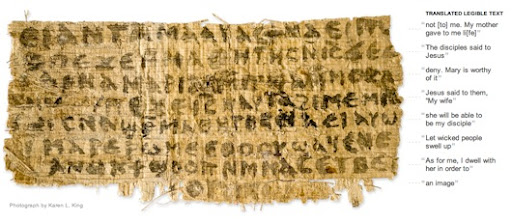
Let’s start with the facts of the matter: a fragment of Coptic script on papyrus that may date from the 4th century AD and that consists of 49.5 words in its English translation (see the top of this post) was presented at the International Congress of Coptic Studies on 18th September. The fragment contains no complete sentences and the sole reason for its overnight fame are the following words it contains:

Jesus said to them, “My wife

Looking at reports in the media, the following picture emerges:

“Even with many questions unsettled, the discovery could reignite the debate over whether Jesus was married, whether Mary Magdalene was his wife and whether he had a female disciple.” (New York Times)
“The discovery that some ancient Christians thought Jesus had a wife could shake up centuries-old Christian traditions” (Washington Post)
“A discovery by a Harvard researcher may shed light on a controversial aspect of the life of Jesus Christ.” (Huffington Post)
“A Harvard Divinity School professor’s interpretation of a scrap of fourth-century Egyptian papyrus that quotes Jesus Christ making reference to a wife could stoke new debates to the role of women in Christianity, theologians say.” (Boston Herald)
“An 4th century papyrus fragment could call centuries of celibacy into question.” (Time)

The message is clear: this is a major discovery that could alter that very foundations of Christianity in one fell swoop. As much fun as it would be to debunk statements like the above, it would be falling for a textbook straw man argument (as some have, while others, like Fr. James Martin, haven’t). Instead, let me defer any comment on the matter, until we see Dr. Karen L. King, the scholar who presented the fragment at the Congress, speak for herself. And what better way to do that than to refer to a draft of her peer-reviewed journal paper, to be published in the Harvard Theological Review (link courtesy of Harvard Magazine):

“This is the only extant ancient text which explicitly portrays Jesus as referring to a wife. It does not, however, provide evidence that the historical Jesus was married, given the late date of the fragment and the probable date of original composition only in the second half of the second century. Nevertheless, if the second century date of composition is correct, the fragment does provide direct evidence that claims about Jesus’s marital status first arose over a century after the death of Jesus in the context of intra-Christian controversies over sexuality, marriage, and discipleship.
[…]
The use of the term “gospel” here regards the probable genre of the work to which this fragment belonged (see below, “Genre”) and makes absolutely no claim to canonical status nor to the historical accuracy of the content as such. This invented reference in no way means to imply that this was the title in antiquity, or that “Jesus’s wife” is the “author” of this work, is a major character in it, or is even a significant topic of discussion—none of that can be known from such a tiny fragment. Rather the title references the fragment’s most distinctive claim (that Jesus was married), and serves therefore as a kind of short-hand reference to the fragment.”

Wait, what?! Unlike the cat-among-pigeons reaction of the media, Dr. King’s words (maybe with a little help from the journal’s reviewers 🙂 sound rational, factual and well representative of what this fragment may be: a text recorded probably in the 4th century AD that may be a copy of a 2nd century one, situated among the ’intra-Christian controversies’ of the day. No “Christianity 2.0”, no “we have had it all wrong for 2000 years” and no “shake up.”

In this (hopefully) more complete picture, Dr. King (who, after all was speaking at the Institutum Patristicum Augustinianum, which is part of the Pontifical Lateran University – i.e., popularly known as the “Pope’s University”!) comes up smelling of roses, while the various media reports happen to fit the topic that I actually wanted to talk about today like a glove! Namely, yesterday’s Gospel reading, in which Jesus vents his frustration with childish attitudes. In Luke 7:31-35 he is reported as saying the following:

“To what shall I compare the people of this generation?
What are they like?
They are like children who sit in the marketplace and call to one another,

‘We played the flute for you, but you did not dance.
We sang a dirge, but you did not weep.’

For John the Baptist came neither eating food nor drinking wine,
and you said, ‘He is possessed by a demon.’
The Son of Man came eating and drinking and you said,
‘Look, he is a glutton and a drunkard,
a friend of tax collectors and sinners.’
But wisdom is vindicated by all her children.”

When I read this, I could picture Jesus’ disbelief in the face of his contemporaries’ conduct (“What are they like?!”), who thought of John the Baptist as a nutter and of Jesus himself as a pig [my own words :] and who jumped at anything to push their own agendas. How little has changed in 2000 years!

Let me not finish on a negative note though as I do see this episode as positive overall. That a new fragment from the early days of Christianity has come to light is great (the more we know the better, since knowledge is power and the truth will set us free [apologies for this fragment–peddling – it just seemed fitting :]) and so is the scholarly integrity of Dr. King and her fellow coptologists, who can shed light on the history of this find and its place within the overall corpus of early Christian writings.


I know the media reports are a straw man, but a very juicy and tempting one, so let me just take one slash at it: Assuming the fragment’s authenticity (which I am in no position to question or believe in) places it into the 4th century. Taking it as a record of events from the first century is like someone discovering the following fragment from this post in the 38th century: “Newton wrote: ‘This quantity I designate by the name of aura” and considering it as a record of Newton’s words from 1687 …

On an entirely separate and unrelated note, let me just share what I found out about the following words that Jesus speaks in Luke’s Gospel: ‘We played the flute for you, but you did not dance. We sang a dirge, but you did not weep.’ This intrigued me straightaway and I first though that it may come from one of the Psalms or another part of the Bible. It seems instead that they were just part of a game that kids played at the time. Two groups would be formed – one playing jolly music and another a wailing funereal tune and they’d compete in who’d gather more followers as they moved through the streets. What a bizarre (but great 🙂 game! Thanks to St. Cyril of Alexandria for the tip!

Many or all?

Dali

How do you preserve the message Jesus proclaimed two thousand years ago, when businesses and institutions struggle to get their members to know even just about the strategy and vision of the moment? I think this is quite a thorny challenge, as it can take you down at least two undesirable paths: On the one hand, you can become caught up in splitting hairs and lose sight of what Jesus wanted to communicate, while holding on to his specific words with zeal (the example of those who can recite Scripture but wouldn’t think twice when walking past a homeless person comes to mind). On the other hand, there is the ‘chillax, man!’ kind of approach, which would argue that it doesn’t matter what Jesus said exactly as we know that he just wanted us to be ‘nice’ to each other. While the latter is far less objectionable to me, it does run the risk of missing out on the richness of Jesus’ words, which we have been unpacking for two millennia (e.g., think of St. Francis’ re-discovery of poverty, St. Therese of Lisieux’s realization of the depth of everyday life, etc.).

It is in this context that the question of a single of Jesus’ word’s translations has been plaguing linguists and theologians during the last half century, leading to votes in various national Bishops’ conferences and now even to an intervention by the Pope himself. The word in question is the Latin ‘multis’ and the controversy revolves around whether it ought to be rendered as ‘many’ or ‘all.’

Coming to this question cold, you could be forgiven for saying: “Well, I googled it, and it clearly says ‘many.’ End of story.” As it happens, the Pope has arrived at the same conclusion, but what is noteworthy to me is how he did it (and, no, he didn’t just google it!) and how he then proceeded. To get the full story, see Benedict XVI’s letter to the German Bishops’ Conference, and if you’d just like my summary, read on. The text in question are Jesus’ words at the last supper, where he blesses and offers the wine to his disciples, saying:

hic est enim calix Sanguinis mei novi et aeterni testamenti, qui pro vobis et pro multis effundetur in remissionem peccatorum

which, up until very recently was translated as:

this is the cup of my blood, the blood of the new and everlasting covenant. It will be shed for you and for all so that sins may be forgiven

and, which is now translated as follows (after a very recent revision of the English translation, that was also influenced by Pope Benedict’s choice):

this is the chalice of my blood, the blood of the new and eternal covenant, which will be poured out for you and for many for the forgiveness of sins

As you can see, this is a pretty important word, since it, at first sight, sets the scope for the effects of Jesus’ sacrifice. Did Jesus offer his life for all (as the Church has been, and still is, teaching: “For as in Adam all die, so also in Christ shall all be made alive” – Catechism of the Catholic Church, §655) or only for some? Suggesting the latter would be outrageous, would fly in the face of everything that Christianity can be most certain of and would be entirely incongruent with the rest of Jesus’ teaching. The potential doubt that this change of translation could introduce in the minds of church goers is precisely what made both the German and Italian bishops rebel and vote massively in favor of not changing the respective translations.

This brings us to Pope Benedict’s letter, where he first proceeds to sum up the history of the argument, then to underline the validity of concerns like the above and to re-affirm the universal scope of Jesus’ sacrifice and salvation. Only after having prepared the ground does he proceed first to deliver a master class on the distinction between translation and interpretation (while acknowledging the difficult balance between the two and agreeing that the ‘for all‘ was “a well-founded interpretation then as now”) and on how the two need to go hand in hand:

“The word must be presented as it is, with its own shape, however strange it may appear to us; the interpretation must be measured by the criterion of faithfulness to the word itself, while at the same time rendering it accessible to today’s listeners.”

Benedict does not leave things at this though and at stating that “the words ‘pro multis’ should be translated as they stand”. Instead he proceeds to outline how local bishops need to prepare their congregations for the change in wording and flips the situation from a source of disagreement to an opportunity to spread the Gospel. He does this by underlining the three reasons that Jesus may have had for using the word ‘many’ instead of ‘all’:

  1. “Firstly, for us who are invited to sit at his table [i.e., participate in the Eucharist], it means surprise, joy and thankfulness that he has called me, that I can be with him and come to know him.”
  2. “Secondly, this brings with it a certain responsibility. How the Lord in his own way reaches the others – “all” – ultimately remains his mystery. But without doubt it is a responsibility to be directly called to his table, so that I hear the words “for you” – he suffered for me. The many bear responsibility for all. The community of the many must be the lamp on the lamp-stand, a city on the hilltop, yeast for all.”
  3. “Finally, [i]n today’s society we often feel that we are not “many”, but rather few – a small remnant becoming smaller all the time. But no – we are “many”: “After this I looked, and behold, a great multitude which no man could number, from every nation, from all tribes and peoples and tongues,”, as we read in the Revelation of Saint John (7:9). We are many and we stand for all. So the words “many” and “all” go together and are intertwined with responsibility and promise.”

Having read Pope Benedict’s letter leaves me with admiration for his method, with gratitude for the nuances of the ‘many’/‘all’ difference that he laid bare and also with an appreciation of the subtlety of his approach. After all this is ‘just’ a letter to the German bishops – not one of the formal ‘weapons’ that he has in his arsenal, such as apostolic letters, apostolic exhortations, apostolic constitutions or ‘ex cathedra,’ infallible proclamations. What we get instead is a point made with such power of reason that it does not require legal support.