The face of mercy

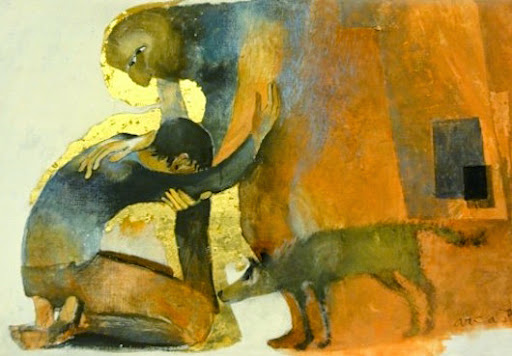
Arcabas prodigal son

On Saturday evening, on the eve of Mercy Sunday, Pope Francis proclaimed the opening of the Extraordinary Jubilee of Mercy that will run from 8th December 2015 until 20th November 2016 by presenting the bull of indiction, Misericordiae Vultus – “The face of mercy.” At 9.5K words some have called it “Evangelii Gaudium II” already, and in terms of significance of content, it is not hard to see why. If you have the time and inclination, I would very much like to encourage you to read it in full, but, if you prefer, the following is my selection of key passages from this important statement.

To begin with, Francis identifies mercy with Jesus and its recipients with all of humanity:

“Jesus Christ is the face of the Father’s mercy. These words might well sum up the mystery of the Christian faith. Mercy has become living and visible in Jesus of Nazareth, reaching its culmination in him.” (§1)

“How much I desire that the year to come will be steeped in mercy, so that we can go out to every man and woman, bringing the goodness and tenderness of God! May the balm of mercy reach everyone, both believers and those far away, as a sign that the Kingdom of God is already present in our midst!” (§6)

A love that to God is “visceral,” fatherly and motherly is then presented as the motivation for mercy:

“[T]he mercy of God is not an abstract idea, but a concrete reality through which he reveals his love as that of a father or a mother, moved to the very depths out of love for their child. It is hardly an exaggeration to say that this is a “visceral” love. It gushes forth from the depths naturally, full of tenderness and compassion, indulgence and mercy.” (§6)

Several parables are then pointed to as examples of Jesus explaining what mercy means, with a particularly poignant one being the parable of the ruthless servant in which mercy becomes “a criterion for ascertaining who his true children are”:

“In the parables devoted to mercy, Jesus reveals the nature of God as that of a Father who never gives up until he has forgiven the wrong and overcome rejection with compassion and mercy. We know these parables well, three in particular: the lost sheep, the lost coin, and the father with two sons (cf. Lk 15:1-32). In these parables, God is always presented as full of joy, especially when he pardons. In them we find the core of the Gospel and of our faith, because mercy is presented as a force that overcomes everything, filling the heart with love and bringing consolation through pardon. […]

“[In the parable of the “ruthless servant,” (Matthew 18:21-35)] Jesus affirms that mercy is not only an action of the Father, it becomes a criterion for ascertaining who his true children are. In short, we are called to show mercy because mercy has first been shown to us. Pardoning offences becomes the clearest expression of merciful love, and for us Christians it is an imperative from which we cannot excuse ourselves. At times how hard it seems to forgive! And yet pardon is the instrument placed into our fragile hands to attain serenity of heart. To let go of anger, wrath, violence, and revenge are necessary conditions to living joyfully. Let us therefore heed the Apostle’s exhortation: “Do not let the sun go down on your anger” (Eph 4:26). Above all, let us listen to the words of Jesus who made mercy as an ideal of life and a criterion for the credibility of our faith: “Blessed are the merciful, for they shall obtain mercy” (Mt 5:7): the beatitude to which we should particularly aspire in this Holy Year.” (§9)

Having set out the centrality of mercy in Jesus’ teaching and identified it with Him, Pope Francis places it at the basis of the Church and insists that “nothing in her preaching and in her witness to the world can be lacking in mercy”:

“Mercy is the very foundation of the Church’s life. All of her pastoral activity should be caught up in the tenderness she makes present to believers; nothing in her preaching and in her witness to the world can be lacking in mercy. The Church’s very credibility is seen in how she shows merciful and compassionate love. The Church “has an endless desire to show mercy.” Perhaps we have long since forgotten how to show and live the way of mercy. The temptation, on the one hand, to focus exclusively on justice made us forget that this is only the first, albeit necessary and indispensable step. But the Church needs to go beyond and strive for a higher and more important goal. On the other hand, sad to say, we must admit that the practice of mercy is waning in the wider culture. It some cases the word seems to have dropped out of use. However, without a witness to mercy, life becomes fruitless and sterile, as if sequestered in a barren desert. The time has come for the Church to take up the joyful call to mercy once more. It is time to return to the basics and to bear the weaknesses and struggles of our brothers and sisters. Mercy is the force that reawakens us to new life and instils in us the courage to look to the future with hope.” (§10)

Next, two complementary points are made about language and silence: the need for merciful expression and for silence so as to hear God’s Word:

“It is absolutely essential for the Church and for the credibility of her message that she herself live and testify to mercy. Her language and her gestures must transmit mercy, so as to touch the hearts of all people and inspire them once more to find the road that leads to the Father.” (§12)

“The Evangelist reminds us of the teaching of Jesus who says, “Be merciful just as your Father is merciful” (Lk 6:36). It is a programme of life as demanding as it is rich with joy and peace. Jesus’s command is directed to anyone willing to listen to his voice (cf. Lk 6:27). In order to be capable of mercy, therefore, we must first of all dispose ourselves to listen to the Word of God. This means rediscovering the value of silence in order to meditate on the Word that comes to us. In this way, it will be possible to contemplate God’s mercy and adopt it as our lifestyle.” (§13)

To complement the positive expressions of mercy, Pope Francis also sets out a negative one (negative in the sense that it proscribes rather than prescribes) that echoes his “Who am I to judge?” that so many have downplayed since it was pronounced in an interview rather than an official, magisterial document:

“The Lord asks us above all not to judge and not to condemn [cf. (Luke 6:37-38)]. If anyone wishes to avoid God’s judgement, he should not make himself the judge of his brother or sister. Human beings, whenever they judge, look no farther than the surface, whereas the Father looks into the very depths of the soul. How much harm words do when they are motivated by feelings of jealousy and envy! To speak ill of others puts them in a bad light, undermines their reputation and leaves them prey to the whims of gossip. To refrain from judgement and condemnation means, in a positive sense, to know how to accept the good in every person and to spare him any suffering that might be caused by our partial judgment and our presumption to know everything about him. But this is still not sufficient to express mercy. Jesus asks us also to forgive and to give. To be instruments of mercy because it was we who first received mercy from God. To be generous with others, knowing that God showers his goodness upon us with immense generosity.” (§14)

Pope Francis then links mercy to the Father’s self-giving that he characterizes using the hallmarks of the life of the Trinity:

“Merciful like the Father, therefore, is the “motto” of this Holy Year. In mercy, we find proof of how God loves us. He gives his entire self, always, freely, asking nothing in return. He comes to our aid whenever we call upon him.” (§14)

Leading his exposition of mercy to practical measures, Francis points to the corporal and spiritual acts of mercy that the Church has advocated since its beginning:

“Jesus introduces us to these works of mercy in his preaching so that we can know whether or not we are living as his disciples. Let us rediscover these corporal works of mercy: to feed the hungry, give drink to the thirsty, clothe the naked, welcome the stranger, heal the sick, visit the imprisoned, and bury the dead. And let us not forget the spiritual works of mercy: to counsel the doubtful, instruct the ignorant, admonish sinners, comfort the afflicted, forgive offences, bear patiently those who do us ill, and pray for the living and the dead.

We cannot escape the Lord’s words to us, and they will serve as the criteria upon which we will be judged: whether we have fed the hungry and given drink to the thirsty, welcomed the stranger and clothed the naked, or spent time with the sick and those in prison (cf. Mt 25:31-45). Moreover, we will be asked if we have helped others to escape the doubt that causes them to fall into despair and which is often a source of loneliness; if we have helped to overcome the ignorance in which millions of people live, especially children deprived of the necessary means to free them from the bonds of poverty; if we have been close to the lonely and afflicted; if we have forgiven those who have offended us and have rejected all forms of anger and hate that lead to violence; if we have had the kind of patience God shows, who is so patient with us; and if we have commended our brothers and sisters to the Lord in prayer. In each of these “little ones,” Christ himself is present. His flesh becomes visible in the flesh of the tortured, the crushed, the scourged, the malnourished, and the exiled … to be acknowledged, touched, and cared for by us. Let us not forget the words of Saint John of the Cross: “as we prepare to leave this life, we will be judged on the basis of love.”” (§15)

That mercy is not about following rules, but about a going out towards those who are in need of it and a respect for their dignity, is put clearly next:

“For his part, Jesus speaks several times of the importance of faith over and above the observance of the law. It is in this sense that we must understand his words when, reclining at table with Matthew and other tax collectors and sinners, he says to the Pharisees raising objections to him, “Go and learn the meaning of ‘I desire mercy not sacrifice.’ I have come not to call the righteous, but sinners.” (Mt 9:13). Faced with a vision of justice as the mere observance of the law that judges people simply by dividing them into two groups – the just and sinners – Jesus is bent on revealing the great gift of mercy that searches out sinners and offers them pardon and salvation. One can see why, on the basis of such a liberating vision of mercy as a source of new life, Jesus was rejected by the Pharisees and the other teachers of the law. In an attempt to remain faithful to the law, they merely placed burdens on the shoulders of others and undermined the Father’s mercy. The appeal to a faithful observance of the law must not prevent attention from being given to matters that touch upon the dignity of the person.” (§20)

Pope Francis then goes on to situating mercy in an inter-religious context, with a particular focus on Judaism and Islam, and with a call to open-mindedness, respect and peacefulness:

“There is an aspect of mercy that goes beyond the confines of the Church. It relates us to Judaism and Islam, both of which consider mercy to be one of God’s most important attributes. Israel was the first to receive this revelation which continues in history as the source of an inexhaustible richness meant to be shared with all mankind. As we have seen, the pages of the Old Testament are steeped in mercy, because they narrate the works that the Lord performed in favour of his people at the most trying moments of their history. Among the privileged names that Islam attributes to the Creator are “Merciful and Kind.” This invocation is often on the lips of faithful Muslims who feel themselves accompanied and sustained by mercy in their daily weakness. They too believe that no one can place a limit on divine mercy because its doors are always open.

I trust that this Jubilee year celebrating the mercy of God will foster an encounter with these religions and with other noble religious traditions; may it open us to even more fervent dialogue so that we might know and understand one another better; may it eliminate every form of closed-mindedness and disrespect, and drive out every form of violence and discrimination.” (§23)

The next day – on Mercy Sunday, Pope Francis returned to the starting point of Misericordiae Vultus, where he identifies mercy with Jesus and went on to spell out the basis of that identity:


“[T]he Lord shows us, through the Gospel, his wounds.  They are wounds of mercy.  It is true: the wounds of Jesus are wounds of mercy. […]

Jesus invites us to behold these wounds, to touch them as Thomas did, to heal our lack of belief.  Above all, he invites us to enter into the mystery of these wounds, which is the mystery of his merciful love. Through these wounds, as in a light-filled opening, we can see the entire mystery of Christ and of God: his Passion, his earthly life – filled with compassion for the weak and the sick – his incarnation in the womb of Mary.

Faced with the tragic events of human history we can feel crushed at times, asking ourselves, “Why?”.  Humanity’s evil can appear in the world like an abyss, a great void: empty of love, empty of goodness, empty of life.  And so we ask: how can we fill this abyss?  For us it is impossible; only God can fill this emptiness that evil brings to our hearts and to human history.  It is Jesus, God made man, who died on the Cross and who fills the abyss of sin with the depth of his mercy.”
Harmony in diversity

Turkey popejpeg 01dca c0 327 5242 3382 s561x327

10380974 837984076265611 4582951503244712748 n

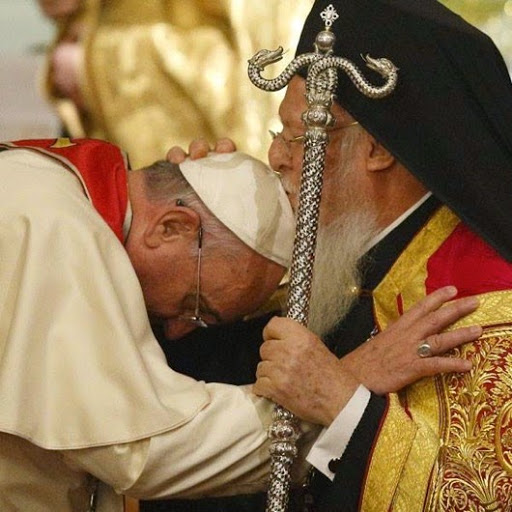
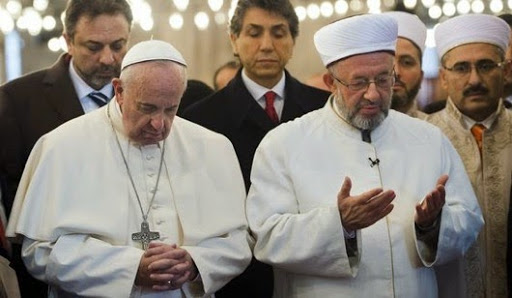
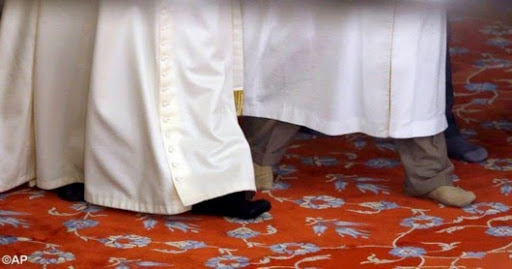
Last weekend Pope Francis visited Turkey, a country where 99.8% of the population is Muslim and where there are only about 35,000 Roman Catholics – truly a peripheral choice, fitting perfectly into Francis’ focus throughout his pontificate. What I would like to do in this post is just to pick out a couple of my favorites from among the things the pope said and share with you three photos – the two at the top, of Francis praying with Istanbul’s Grand Mufti Rahmi Yaran in the Blue Mosque and the one in the middle of Francis – and with him the entire Roman Church – being blessed (and kissed on the head) by Ecumenical Patriarch Bartholomew I.

In his first address in Turkey, to civil authorities, Francis emphasized the centrality of human dignity and brotherhood:

“Today what is needed is a dialogue which can deepen the understanding and appreciation of the many things which we hold in common. Such a dialogue will allow us to reflect sensibly and serenely on our differences, and to learn from them.

There is a need to move forward patiently in the task of building a lasting peace, one founded on respect for the fundamental rights and duties rooted in the dignity of each person. In this way, we can overcome prejudices and unwarranted fears, leaving room for respect, encounter, and the release of more positive energies for the good of all.

To this end, it is essential that all citizens – Muslim, Jewish and Christian – both in the provision and practice of the law, enjoy the same rights and respect the same duties. They will then find it easier to see each other as brothers and sisters who are travelling the same path, seeking always to reject misunderstandings while promoting cooperation and concord. Freedom of religion and freedom of expression, when truly guaranteed to each person, will help friendship to flourish and thus become an eloquent sign of peace.”

Later during the first day, Francis addressed the president of the Diyanet, the Department For Religious Affairs, denouncing religious extremism and fundamentalism:

“Particular concern arises from the fact that, owing mainly to an extremist and fundamentalist group, entire communities, especially – though not exclusively – Christians and Yazidis, have suffered and continue to suffer barbaric violence simply because of their ethnic and religious identity. They have been forcibly evicted from their homes, having to leave behind everything to save their lives and preserve their faith. This violence has also brought damage to sacred buildings, monuments, religious symbols and cultural patrimony, as if trying to erase every trace, every memory of the other.

As religious leaders, we are obliged to denounce all violations against human dignity and human rights. Human life, a gift of God the Creator, possesses a sacred character. As such, any violence which seeks religious justification warrants the strongest condemnation because the Omnipotent is the God of life and peace. The world expects those who claim to adore God to be men and women of peace who are capable of living as brothers and sisters, regardless of ethnic, religious, cultural or ideological differences.”

The next day, during his homily at the Catholic Cathedral of the Holy Spirit in Istanbul, Francis focused first on the fundamental role of the Holy Spirit in our lives and then on the nature of diversity in unity:

“When we pray, it is because the Holy Spirit inspires prayer in our heart. When we break the cycle of our self-centredness, and move beyond ourselves and go out to encounter others, to listen to them and help them, it is the Spirit of God who impels us to do so. When we find within a hitherto unknown ability to forgive, to love someone who doesn’t love us in return, it is the Spirit who has taken hold of us. When we move beyond mere self-serving words and turn to our brothers and sisters with that tenderness which warms the heart, we have indeed been touched by the Holy Spirit.

It is true that the Holy Spirit brings forth different charisms in the Church, which at first glance, may seem to create disorder. Under his guidance, however, they constitute an immense richness, because the Holy Spirit is the Spirit of unity, which is not the same thing as uniformity. Only the Holy Spirit is able to kindle diversity, multiplicity and, at the same time, bring about unity. When we try to create diversity, but are closed within our own particular and exclusive ways of seeing things, we create division. When we try to create unity through our own human designs, we end up with uniformity and homogenization. If we let ourselves be led by the Spirit, however, richness, variety and diversity will never create conflict, because the Spirit spurs us to experience variety in the communion of the Church. […] Saint Basil the Great’s lovely expression comes to mind: “Ipse harmonia est”, He himself is harmony.

The temptation is always within us to resist the Holy Spirit, because he takes us out of our comfort zone and unsettles us; he makes us get up and drives the Church forward. It is always easier and more comfortable to settle in our sedentary and unchanging ways. In truth, the Church shows her fidelity to the Holy Spirit in as much as she does not try to control or tame him. And the Church shows herself also when she rejects the temptation to look only inwards. We Christians become true missionary disciples, able to challenge consciences, when we throw off our defensiveness and allow ourselves to be led by the Spirit. He is freshness, imagination and newness.”

On the Saturday evening then came a particularly moving moment of “mystical tenderness” (as Fr. Antonio Spadaro, SJ put it), shown in the following photo and following these words by Pope Francis, addressed to the Patriarch Bartholomew:

“Andrew and Peter heard [the promise of joy]; they received this gift. They were blood brothers, yet their encounter with Christ transformed them into brothers in faith and charity. In this joyful evening, at this prayer vigil, I want to emphasize this; they became brothers in hope – and hope does not disappoint us! What a grace, Your Holiness, to be brothers in the hope of the Risen Lord! What a grace, and what a responsibility, to walk together in this hope, sustained by the intercession of the holy Apostles and brothers, Andrew and Peter! And to know that this shared hope does non deceive us because it is founded, not upon us or our poor efforts, but rather upon God’s faithfulness.

With this joyful hope, filled with gratitude and eager expectation, I extend to Your Holiness and to all present, and to the Church of Constantinople, my warm and fraternal best wishes on the Feast of your holy Patron. And I ask a favour of you: to bless me and the Church of Rome.”

IMG 4226

The final day of Francis’ trip – Sunday 30th November, the feast day of St. Andrew, patron saint of the Orthodox Church – started with an address during the Orthodox Divine Liturgy at the Patriarchal Church of St. George in Istanbul, where his focus was on the relationship between the Catholic and Orthodox Churches and where he first underlined deeply personal nature of the Christian life:

“Meeting each other, seeing each other face to face, exchanging the embrace of peace, and praying for each other, are all essential aspects of our journey towards the restoration of full communion. All of this precedes and always accompanies that other essential aspect of this journey, namely, theological dialogue. An authentic dialogue is, in every case, an encounter between persons with a name, a face, a past, and not merely a meeting of ideas.

This is especially true for us Christians, because for us the truth is the person of Jesus Christ. The example of Saint Andrew, who with another disciple accepted the invitation of the Divine Master, “Come and see”, and “stayed with him that day” (Jn 1:39), shows us plainly that the Christian life is a personal experience, a transforming encounter with the One who loves us and who wants to save us. In addition, the Christian message is spread thanks to men and women who are in love with Christ, and cannot help but pass on the joy of being loved and saved. Here again, the example of the apostle Andrew is instructive. After following Jesus to his home and spending time with him, Andrew “first found his brother Simon, and said to him, ‘We have found the Messiah’ (which means Christ). He brought him to Jesus” (Jn 1:40-42). It is clear, therefore, that not even dialogue among Christians can prescind from this logic of personal encounter.”

Next, Francis reiterated the Vatican II Unitatis Redintegratio position that the Catholic Church recognizes that the Orthodox Churches “possess true sacraments, above all – by apostolic succession – the priesthood and the Eucharist, whereby they are still joined to us in closest intimacy” and that “it is of the greatest importance to preserve and support the rich patrimony of the Eastern Churches.” He then set out his vision for the road towards full communion:

“I believe that it is important to reaffirm respect for this principle as an essential condition, accepted by both, for the restoration of full communion, which does not signify the submission of one to the other, or assimilation. Rather, it means welcoming all the gifts that God has given to each, thus demonstrating to the entire world the great mystery of salvation accomplished by Christ the Lord through the Holy Spirit. I want to assure each one of you here that, to reach the desired goal of full unity, the Catholic Church does not intend to impose any conditions except that of the shared profession of faith.”

And finally, he called for joint action already, as a consequence of being Jesus’ disciples, in three areas: the poor, the victims of conflicts and young people.

Next followed a common declaration by Pope Francis and Patriarch Bartholomew, of their desire “to intensify our efforts to promote the full unity of all Christians, and above all between Catholics and Orthodox. […] asking our faithful to join us in praying “that all may be one, that the world may believe” (Jn 17:21).” And finally, Pope Francis went to meet with young refugees from Turkey, Syria and Iraq who were being looked after by Salesians in Istanbul, where he said:

“Dear young people, do not be discouraged. It is easy to say this, but please make an effort not to be discouraged. With the help of God, continue to hope in a better future, despite the difficulties and obstacles which you are currently facing. […] Remember always that God does not forget any of his children, and that those who are the smallest and who suffer the most are closest to the Father’s heart.”

As has been customary on Pope Francis’ trips, there was a press conference this time too during the return flight, where journalists could ask him questions directly. Here I’d just pick out his answer to a question about what praying in the Blue Mosque meant for him:

“I went there, to Turkey, as a pilgrim, not as a tourist. And I went there primarily for the feast [of St. Andrew] that we celebrated today: I came precisely to share it with Patriarch Bartholomew, with a religious motive. But then, when I went to the mosque, I could not say, “No, now I’m a tourist.” No, it was all religious. And I saw that wonderful place! The mufti explained things well to me, with such gentleness, and also using the Qur’an, which speaks of Mary and John the Baptist, he explained everything to me … That’s when I felt the need to pray. And I said: “Shall we pray a bit?” – “Yes, yes,” he said. And I prayed for Turkey, for peace, for the mufti … for all … for myself, since I need it … I prayed, really … And I prayed for peace, above all. I said, “Lord, let’s put an end to these wars …” So, it was a moment of sincere prayer.”

Francis in Jerusalem: brothers in mercy

Francis rabi imam

[Long read.]

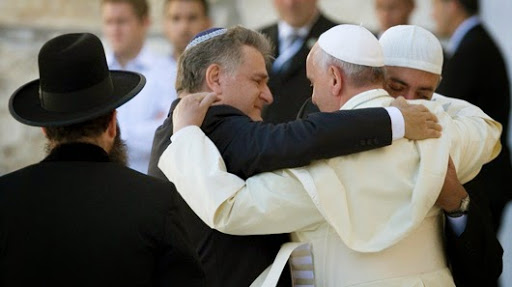
Last weekend saw Pope Francis’ visit to the Holy Land, during which he delivered 15 scheduled speeches and made several spontaneous stops that have been in the headlines all over the world. Here I don’t mean to re-tell his whirlwind visit, since that has already been done very well elsewhere, but just to pick out some of my favorite moments from the homilies and addresses he delivered during that 3-day period (in chronological order).

First, there was his homily during a mass in Amman on 24th May (note the focus on diversity in unity, which is one of the key themes of the whole trip):

“The mission of the Holy Spirit, in fact, is to beget harmony – he is himself harmony – and to create peace in different situations and between different people. Diversity of ideas and persons should not trigger rejection or prove an obstacle, for variety always enriches. So today, with fervent hearts, we invoke the Holy Spirit and ask him to prepare the path to peace and unity.”

Second, he addressed refugees and disabled young people in Bethany (note the use of humility as a means of closeness to Jesus and his damning words addressed to the arms trade):

“Coming here to the Jordan to be baptized by John, Jesus showed his humility and his participation in our human condition. He stooped down to us and by his love he restored our dignity and brought us salvation. Jesus’ humility never fails to move us, the fact that he bends down to wounded humanity in order to heal us: he bends down to heal all our wounds! […]

[A]s we observe this tragic conflict, seeing these wounds, seeing so many people who have left their homeland, forced to do so, I ask myself: who is selling arms to these people to make war? Behold the root of evil! Hatred and financial greed in the manufacturing and sale of arms. This should make us think about who is responsible for this situation, for providing arms to those in conflict and thereby sustaining such conflict. Let us think about this and with sincere hearts let us call upon these poor criminals to change their ways.”

The next day (25th May), Pope Francis then addressed President Mahmoud Abbas and the Palestinian authorities, where he concluded his speech as follows (note the reference to God’s almightiness, which is very prominent in Islam, the reference to brotherhood, and the Arabic greeting at the end):

“Mr President, dear brothers and sisters gathered here in Bethlehem: may Almighty God bless you, protect you and grant you the wisdom and strength needed to continue courageously along the path to peace, so that swords will be turned into ploughshares and this land will once more flourish in prosperity and concord. Salaam!”

Later the same day, Francis then delivered a homily in Manger Square, Bethlehem, from which I’d like to quote more extensively, since it provides a great insight about the importance he gives children:

“The Child Jesus, born in Bethlehem, is the sign given by God to those who awaited salvation, and he remains forever the sign of God’s tenderness and presence in our world. The angel announces to the shepherds: “This will be a sign for you: you will find a child…”. […]

The Child of Bethlehem is frail, like all newborn children. He cannot speak and yet he is the Word made flesh who came to transform the hearts and lives of all men and women. This Child, like every other child, is vulnerable; he needs to be accepted and protected. Today too, children need to be welcomed and defended, from the moment of their conception.

Sadly, in this world, with all its highly developed technology, great numbers of children continue to live in inhuman situations, on the fringes of society, in the peripheries of great cities and in the countryside. All too many children continue to be exploited, maltreated, enslaved, prey to violence and illicit trafficking. Still too many children live in exile, as refugees, at times lost at sea, particularly in the waters of the Mediterranean. Today, in acknowledging this, we feel shame before God, before God who became a child.

And we have to ask ourselves: Who are we, as we stand before the Child Jesus? Who are we, standing as we stand before today’s children? Are we like Mary and Joseph, who welcomed Jesus and care for him with the love of a father and a mother? Or are we like Herod, who wanted to elim- inate him? Are we like the shepherds, who went in haste to kneel before him in worship and offer him their humble gifts? Or are we indifferent? Are we perhaps people who use fine and pious words, yet exploit pictures of poor children in order to make money? Are we ready to be there for children, to “waste time” with them? Are we ready to listen to them, to care for them, to pray for them and with them? Or do we ignore them because we are too caught up in our own affairs?”

In the same location, Francis then issued an invitation to prayer for peace (which was very quickly accepted by both parties – within a matter of hours):

“In this, the birthplace of the Prince of Peace, I wish to invite you, President Mahmoud Abbas, together with President Shimon Peres, to join me in heartfelt prayer to God for the gift of peace. I offer my home in the Vatican as a place for this encounter of prayer.

All of us want peace. Many people build it day by day through small gestures and acts; many of them are suffering, yet patiently persevere in their efforts to be peacemakers. All of us – especial- ly those placed at the service of their respective peoples – have the duty to become instruments and artisans of peace, especially by our prayers.”

Francis bartholomew slab

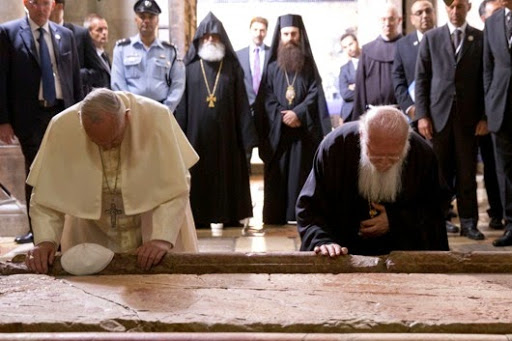
From the perspective of ecumenism, the most important speech was then the one Pope Francis delivered at the Holy Sepulchre in Jerusalem, in the presence of Patriarch Bartholomew (note its supporting pillars being mercy, forgiveness, joy and unity, and the fractal nature of ecumenism – from the visible union among Christian churches to the ecumenism of everyday acts of closeness):

“Let us receive the special grace of this moment. We pause in reverent silence before this empty tomb in order to rediscover the grandeur of our Christian vocation: we are men and women of resurrection, and not of death. From this place we learn how to live our lives, the trials of our Churches and of the whole world, in the light of Easter morning. Every injury, every one of our pains and sorrows, has been borne on the shoulders of the Good Shepherd who offered himself in sacrifice and thereby opened the way to eternal life. His open wounds are like the cleft through which the torrent of his mercy is poured out upon the world. Let us not allow ourselves to be robbed of the basis of our hope, which is this: Christòs anesti! Let us not deprive the world of the joyful message of the resurrection! And let us not be deaf to the powerful summons to unity which rings out from this very place, in the words of the One who, risen from the dead, calls all of us “my brothers” (cf. Mt 28:10; Jn 20:17). […]

We know that much distance still needs to be travelled before we attain that fullness of communion which can also be expressed by sharing the same Eucharistic table, something we ardently desire; yet our disagreements must not frighten us and paralyze our progress. We need to believe that, just as the stone before the tomb was cast aside, so too every obstacle to our full communion will also be removed. This will be a grace of resurrection, of which we can have a foretaste even today. Every time we ask forgiveness of one another for our sins against other Christians and every time we find the courage to grant and receive such forgiveness, we experience the resurrection! Every time we put behind us our longstanding prejudices and find the courage to build new fraternal relationships, we confess that Christ is truly risen! Every time we reflect on the future of the Church in the light of her vocation to unity, the dawn of Easter breaks forth!”

On the final day (26th May), Pope Francis addressed the Gran Mufti of Jerusalem, where he concluded with a call to brotherhood:

“Dear brothers, dear friends, from this holy place I make a heartfelt plea to all people and to all communities who look to Abraham: may we respect and love one another as brothers and sisters! May we learn to understand the sufferings of others! May no one abuse the name of God through violence! May we work together for justice and peace! Salaam!”

Then, Francis changed his plans and instead of having lunch at the Notre Dame of Jerusalem Center, he turned up at a Franciscan friary instead, insisting that nothing be changed in either the refectory customs or the day’s menu.

Francis holocaust survivor hand

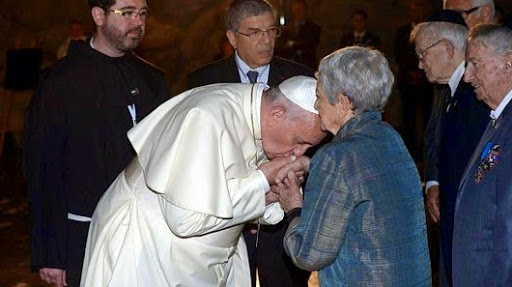
For me the most important moment of the trip was Francis’ visit to the Yad Vashem Memorial, from where I’d like to quote almost his entire address, without commentary:

““Adam, where are you?” (cf. Gen 3:9). Where are you, o man? What have you come to? In this place, this memorial of the Shoah, we hear God’s question echo once more: “Adam, where are you?” This question is charged with all the sorrow of a Father who has lost his child. The Father knew the risk of freedom; he knew that his children could be lost… yet perhaps not even the Father could imagine so great a fall, so profound an abyss! Here, before the boundless tragedy of the Holocaust, That cry – “Where are you?” – echoes like a faint voice in an unfathomable abyss…

Adam, who are you? I no longer recognize you. Who are you, o man? What have you become? Of what horror have you been capable? What made you fall to such depths?

Certainly it is not the dust of the earth from which you were made. The dust of the earth is some- thing good, the work of my hands. Certainly it is not the breath of life which I breathed into you. That breath comes from me, and it is something good (cf. Gen 2:7).

No, this abyss is not merely the work of your own hands, your own heart… Who corrupted you? Who disfigured you? Who led you to presume that you are the master of good and evil? Who convinced you that you were god? Not only did you torture and kill your brothers and sisters, but you sacrificed them to yourself, because you made yourself a god.

Today, in this place, we hear once more the voice of God: “Adam, where are you?”

From the ground there rises up a soft cry: “Have mercy on us, O Lord!” To you, O Lord our God, be- longs righteousness; but to us confusion of face and shame (cf. Bar 1:15).

A great evil has befallen us, such as never happened under the heavens (cf. Bar 2:2). Now, Lord, hear our prayer, hear our plea, save us in your mercy. Save us from this horror.”

Finally, Francis also celebrated mass at the Upper Room, where he spoke about what its meaning is for us (note the emphasis on friendship, service and family – both the importance of families in the Church, and the Church being a family):

“The Upper Room speaks to us of service, of Jesus giving the disciples an example by washing their feet. Washing one another’s feet signifies welcoming, accepting, loving and serving one another. It means serving the poor, the sick and the outcast, those whom I find difficult, those who annoy me. […]

The Upper Room also reminds us of friendship. “No longer do I call you servants – Jesus said to the Twelve – but I have called you friends” (Jn 15:15). The Lord makes us his friends, he reveals God’s will to us and he gives us his very self. This is the most beautiful part of being a Christian and, especially, of being a priest: becoming a friend of the Lord Jesus, and discovering in our hearts that he is our friend. […]

[T]he Upper Room reminds us of the birth of the new family, the Church, our holy Mother the hierarchical Church established by the risen Jesus; a family that has a Mother, the Virgin Mary. Christian families belong to this great family, and in it they find the light and strength to press on and be renewed, amid the challenges and difficulties of life. All God’s children, of every people and language, are invited and called to be part of this great family, as brothers and sisters and sons and daughters of the one Father in heaven.”

Francis: let’s share the joys of Muslims

Francis sultan

A while ago now, Pope Francis wrote a, to my mind, very important message to Muslims at the end of Ramadan (on the feast of Eid al-Fitr), and, I believe, I, as a Christian, need to read it too, as if it were addressed to me personally. Aside from the gesture of Francis himself1 sending the message “as an expression of esteem and friendship for all Muslims,” his choice of theme itself is of great importance, as is the way in which he introduces himself.

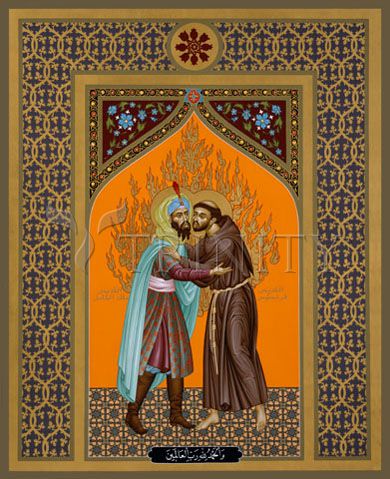
First, he ties himself closely to St. Francis, who had very close links with the Muslim world of his day and who – with Jesus and Mary – is revered also among Muslims and who, after speaking with Sheikh al-Malik al-Kamel (the Sultan of Egypt) told his followers: “[You] are not to engage in arguments or disputes, but to be subject to every human creature for God’s sake.” Then, Francis underlines a number of themes close to the hearts of Muslims: alms giving, a reverence for creation and the family:

“[W]hen the Cardinals elected me as Bishop of Rome and Universal Pastor of the Catholic Church, I chose the name of “Francis”, a very famous saint who loved God and every human being deeply, to the point of being called “universal brother”. He loved, helped and served the needy, the sick and the poor; he also cared greatly for creation. I am aware that family and social dimensions enjoy a particular prominence for Muslims during this period, and it is worth noting that there are certain parallels in each of these areas with Christian faith and practice.”

Next we arrive at the theme chosen for this year’s Ramadan message: “Promoting Mutual Respect through Education,” which Francis lays out as follows:

““Respect” means an attitude of kindness towards people for whom we have consideration and esteem. “Mutual” means that this is not a one-way process, but something shared by both sides. What we are called to respect in each person is first of all his life, his physical integrity, his dignity and the rights deriving from that dignity, his reputation, his property, his ethnic and cultural identity, his ideas and his political choices. We are therefore called to think, speak and write respectfully of the other, not only in his presence, but always and everywhere, avoiding unfair criticism or defamation.”

So far Francis’ message is universal and, I believe, applies to all human relationships and not only those between Christians and Muslims. Kindness, esteem, reciprocity, respect and refraining from gossip are all basics that prepare the ground for the “sincere and lasting friendship” that Francis speaks about later.

Then, Francis’ focus shifts to the aspect of religious belief in this context of human relationships:

“Turning to mutual respect in interreligious relations, especially between Christians and Muslims, we are called to respect the religion of the other, its teachings, its symbols, its values. Particular respect is due to religious leaders and to places of worship. How painful are attacks on one or other of these! It is clear that, when we show respect for the religion of our neighbours or when we offer them our good wishes on the occasion of a religious celebration, we simply seek to share their joy, without making reference to the content of their religious convictions.”

I believe the above is a key move by Francis, in that it explicitly calls for mutual respect of the religious expressions of others while placing the emphasis on the joy and wishing for the good of others that accompany them and that are universally human. No buy-in with regard to the content of religious expression is inferred from being kind and participating in the other’s joy. There is neither proselytizing or attempting to convert the other here nor the suggestion of syncretism.

All of the above is very consistent with what I have heard from Francis so far – we have to realize that we are all brothers and sisters before anything else can happen. In the context of speaking about the poor, his emphasis is always on “touch[ing] the flesh of Christ,” on looking into the eyes of those in need when they are being helped. Just like helping the poor is about building human relationships with them and not only about material assistance, so interreligious dialogue too – and the very essence of the Christian life – is about the exact same thing.

How is this to be achieved though? While the answer here is pretty obvious (education), it is nonetheless worth seeing how Francis puts it:

“Regarding the education of Muslim and Christian youth, we have to bring up our young people to think and speak respectfully of other religions and their followers, and to avoid ridiculing or denigrating their convictions and practices.”

It is impossible to respect and esteem caricatures – if that is how we get used to referring to others (whether they be of a different religion, or none, or of other convictions to our own) we are putting up barriers that prevent us from ever discovering what lives in the hearts and minds of our neighbors.

To conclude, Francis puts his own teaching into practice and concludes his message a follows: “Finally, I send you my prayerful good wishes, that your lives may glorify the Almighty and give joy to those around you. Happy Feast to you all!”

No pomp and circumstance, just sincere simplicity.


1 Instead of having the message sent by the Pontifical Council for Interreligious Dialogue, who normally do so.

Queen of Paradise مريم

Mariam

A couple of days ago I came across the following tweets, written by a Muslim:

“Mary = Maryam/Miryam. “None among women have reached perfection except Mary the Virgin” – P. Muhammad”

“Since the Quran venerates her & the Prophet Muhammad called her […] the Queen of Paradise, I do recourse to her intercession.”

As you can imagine, it stopped me in my tracks and I have been trying to find out more about where these statements fitted within Islamic teaching. While I was vaguely aware of the Qur’an considering Jesus a prophet and also mentioning Mary (and doing so more extensively even than the New Testament), what I learned over the last couple of days goes so far beyond that and I would like to share it with you.

Muslims believe that God sent the angel Gabriel to the prophet Muhammad, who transmitted to him God’s words, verbatim – the Qur’an. There Mary is mentioned from the start and the Annunciation, is recounted as follows in the third chapter (Surat ‘Āli `Imrān):

“[T]he angels said, “O Mary, indeed Allah has chosen you and purified you and chosen you above the women of the worlds. O Mary, be devoutly obedient to your Lord and prostrate and bow with those who bow [in prayer].”” (Qur’an, 3:42-43)

“[T]he angels said, “O Mary, indeed Allah gives you good tidings of a word from Him, whose name will be the Messiah, Jesus, the son of Mary – distinguished in this world and the Hereafter and among those brought near [to Allah].
He will speak to the people in the cradle and in maturity and will be of the righteous.”
She said, “My Lord, how will I have a child when no man has touched me?” [The angel] said, “Such is Allah; He creates what He wills. When He decrees a matter, He only says to it, ‘Be,’ and it is.
And He will teach him writing and wisdom and the Torah and the Gospel.
And [make him] a messenger to the Children of Israel, [who will say], ‘Indeed I have come to you with a sign from your Lord in that I design for you from clay [that which is] like the form of a bird, then I breathe into it and it becomes a bird by permission of Allah. And I cure the blind and the leper, and I give life to the dead – by permission of Allah.”” (Qur’an, 3:45-49)

The Qur’an also talks about Mary’s birth, the years leading up to the Annunciation and her life of prayer under the supervision of the prophet Zechariah in earlier verses:

“[W]hen the wife of ‘Imran [Joachim] said, “My Lord, indeed I have pledged to You what is in my womb, consecrated [for Your service], so accept this from me. Indeed, You are the Hearing, the Knowing.”
But when she delivered her, she said, “My Lord, I have delivered a female.” And Allah was most knowing of what she delivered, “And the male is not like the female. And I have named her Mary, and I seek refuge for her in You and [for] her descendants from Satan, the expelled [from the mercy of Allah].”
So her Lord accepted her with good acceptance and caused her to grow in a good manner and put her in the care of Zechariah. Every time Zechariah entered upon her in the prayer chamber, he found with her provision. He said, “O Mary, from where is this [coming] to you?” She said, “It is from Allah. Indeed, Allah provides for whom He wills without account.””(Qur’an, 3:35-37)

Later on, chapter 19 (Surat Maryam) is dedicated to Mary, which after an account of John the Baptist’s birth proceeds to re-tell the Annunciation (having the angel say to Mary: “I am only the messenger of your Lord to give you [news of] a pure boy.”) and then proceeding to the birth of Jesus:

“So she conceived him, and she withdrew with him to a remote place.
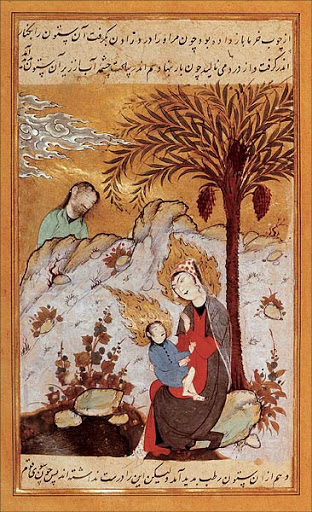
And the pains of childbirth drove her to the trunk of a palm tree. She said, “Oh, I wish I had died before this and was in oblivion, forgotten.”
But he called her from below her, “Do not grieve; your Lord has provided beneath you a stream.
And shake toward you the trunk of the palm tree; it will drop upon you ripe, fresh dates.” (Qur’an, 19:22-25)

“[S]he pointed to him. They said, “How can we speak to one who is in the cradle a child?”
[Jesus] said, “Indeed, I am the servant of Allah. He has given me the Scripture and made me a prophet.
And He has made me blessed wherever I am and has enjoined upon me prayer and zakah as long as I remain alive
And [made me] dutiful to my mother, and He has not made me a wretched tyrant.
And peace is on me the day I was born and the day I will die and the day I am raised alive.”” (Qur’an, 19:29-33)

Mary is mentioned 34 times in the Qur’an (the only woman to be referred to by name) and there is a wealth of ways in which she is revered and taken as an example in Islam. What am I, a Catholic, to make of this though? Primarily, my reaction is one of joy at having discovered a previously unknown community of my Mother’s sons and daughters. There is no doubt in my mind that Muslims who look to Mary as a role model (which I didn’t know existed before) have a lot in common with me and that is unquestionably a delight. Even from the few quotes above (that barely scratch the surface and don’t even touch on exegesis), it is clear though that there are dramatic differences here both in direct contrast (e.g., the account of Jesus’ birth being at odds with its Christian understanding) and in terms of lacking parallel accounts (Mary’s youth not being recounted in the New Testament), not to mention the very different conception of Jesus as compared to the Christian one. While it would be a mistake to look for syncretism (it always is), I believe it would also be a missed opportunity to only focus on differences. The Catechism of the Catholic Church is very clear about there being goodness and truth to be found in all religions (§843) and that they all “reflect a ray of that truth which enlightens all men” (Nostra Aetate 2). I certainly feel enriched from having read the above passages of the Qur’an and will seek to further deepen my understanding.

Allāhu Akbar.

I say polygon, you say polyhedron


When you look at the above image, what do you see? Two triangles and five quadrangles, a cube or something else? Now, let’s turn to the following thought experiment:

You are strapped into a chair, your head held firmly in place, and you see a bright, diffuse screen in front of you, showing a series of black lines. You notice that the screen can go from an only-just visible black point at its periphery, via lines cutting across it or forming triangles with its edges, to closed squares or even constellations of polygons moving and morphing across it. You also notice that there are several knobs and levers at your disposal and that you can influence the shapes seen on the screen. Your task is to work out how the patterns you see are formed.

All you have access to in this case is a sequence of experiences of a two-dimensional, bounded world, yet through painstaking experiments you come to the realization that what you are seeing is consistent with there being a wireframe cube behind the screen. All the patters, the changes from one pattern to another and the lengths of edges could be the result of a wireframe cube casting a shadow. Once you arrive at your conclusion you are released from your restraints and are free to exit the room. As you do so, another person exits the room next to you. A quick chat reveals you had the same experience, but it turns out that they are convinced that it was just a computer screen rather that the silhouette of a mesh cube. You enter each other’s rooms and realize that they look identical! You believe their room shows a 3D cube’s shadow; they believe your room contains a 2D computer-driven display. You both look for a way to access what is behind the respective screens and after a while you find the rooms backing onto your two ones. Your screen and theirs were indeed driven differently: one was a display driven by a computer and the other a piece of translucent plexiglass having a backlit cube cast shadows on it. Which was which remains a secret guarded by the two of you.

Now, my question to you: who was the more rational participant in this experiment? The person postulating a 3D entity on the basis of strictly 2D evidence or the person whose theories remained firmly 2D, in line with the nature of their evidence?

I would like to argue that they were both equally rational and that the distinction between them was not along rational-irrational lines and to underline the fact that they were both deriving their world views from the same evidence.

What was the point of this whole exercise though? It was to propose that empirical evidence alone is not sufficient to constrain explanation to a solely empirical domain (even just the use of mathematics in science, with its universal quantifier is beyond the empirical) and that the exact same experiences can be held up as a basis for alternative theories.

The last exegetical point I’d like to make though is that the two protagonists of the thought experiment can learn a lot from each other. The person hypothesizing the 3D cube can lend the other means for simplification while the strictly 2D person can share a more refined understanding of 2D relationships, which also enrich the cube’s understanding.

Why is it that I am concerned by the evidence-theory relationship and try to dig into its nature? It is because this is a key stumbling block in the rapprochement between atheist scientists and the rational religious. The former don’t get how the latter can transcend evidence while the latter are threatened by the former’s insights into empirical evidence. The many-to-many nature of the evidence-theory relationship also underlies inter-religious dialogue. Since the transcendent is infinite, hyper-dimensional and vastly exceeding the fragmentary insights we can have of it, also in terms of aspects we don’t even know about!, it is understandable that different interpretations of its actions have been formed in different cultures and by different people. It would be short-sighted to stop at an incompatibility between the monotheism of some religions, the personal Trinitarian insight of Christianity, the polytheism of Hinduism and the apparent atheism of Buddhism (in the strict sense of atheism as opposed to its current use as anti-theism) and arrive at the erroneous conclusion that these religions talk about different things rather than differently about aspects of the same (please, don’t mis-read this as me saying that everything that all religions claim is true, that all religions are equally true or that religions can be freely intertwined and recombined. End of caveat :).

If there is a God, who is infinite, transcendent and vastly more complex than us, wouldn’t his actions as experienced in our limited realm lead precisely to the variety of religions as well as agnosticism and atheism that we see today?


Just a quick hat-tip to Flatland, to the Chinese Room thought experiment and to the story of the blind men and an elephant (and surely to many others :).