I’m with Fr. Martin: respect, compassion, and sensitivity for LGBTs

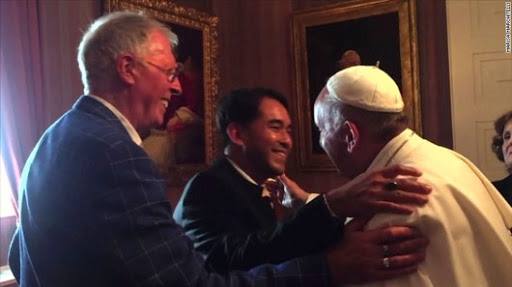
151003075258 pope francis meets hugs same sex couple 00000803 exlarge 169

2413 words, 12 min read

Jesus’ last will and testament, which he passed on to the apostles at the Last Supper, contains the following exhortation: “that they may all be one” (John 17:21). Here, Jesus explains in the same verse that “one” means to relate to each other “as you, Father, are in me and I in you.” And since “all” means “all,” it falls to every Christian to strive towards building relationships with everyone like those among the persons of the Trinity – i.e., relationships of loving self-noughting and self-othering. This means that there is no more us versus them, only an all-encompassing us.

Now, this “us” undoubtedly also includes those who are gay, lesbian, bisexual and transgender, and indeed anyone else too, regardless of their sexual orientation. It is therefore essential that we, Christians make everyone, regardless of their sexuality, feel not only welcome but loved and since this has often not been the case, there is a need for a deliberate effort to reach out, which has also been apparent in many things Pope Francis, and many other representatives of the Catholic Church, have said and done recently.

In this context, an important contribution has recently been made by Fr. James Martin SJ, who has for many years ministered to the LGBT community and who has now written an excellent book on how to bring it and the institutional Church closer together. The book is entitled “Building a Bridge: How the Catholic Church and the LGBT Community Can Enter into a Relationship of Respect, Compassion, and Sensitivity” and contains four parts. The first two are built on the metaphor of a bridge between the institutional Church and the LGBT community, where Fr. Martin’s advice for traversing it in both directions is based on what the Catechism of the Catholic Church teaches with regard to LGBT people, which is to treat them with “respect, compassion, and sensitivity” (§2358). The third part comprises a series of scriptural passages that Fr. Martin found helpful in his ministry, each with an introduction and followed by questions suitable for reflection. Finally, the book concludes with a beautiful prayer – “A prayer for when I feel rejected”.

When I first read this book, I found it to be a pure expression of the Gospel desire to share the Good News that Jesus brought to humanity – an invitation to mutual love, to dialogue and to closeness. I also thought that it was highly non-controversial and entirely consistent with the Catholic Church’s teaching and I thought no more about it. During the course of recent days, things have changed though and I have seen a savage and persistent campaign of hate directed at Fr. Martin, who is now being accused of heresy and whose name is being dragged through the mud of social media echo chambers. I am no censor or even theologian, but as a member of the Church’s laity, I have a right and duty to support and defend those who uphold the Gospel, and Fr. Martin certainly does that in spades.

Instead of engaging in a futile rebuttal of his critics, I would just like to share with you some of my favorite passages mostly from the first part of “Building a Bridge,” since it is there that I have most felt spoken to myself.

In the opening pages of the book Fr. Martin sets out the rationale for writing it, which is about breaking down us v. them barriers:

“[T]he work of the Gospel cannot be accomplished if one part of the church is essentially separated from any other part. […] In these times, the church should be a sign of unity. Frankly, in all times. Yet many people see the church as contributing to division, as some Christian leaders and their congregations mark off boundaries of “us” and “them.” But the church works best when it embodies the virtues of respect, compassion, and sensitivity.”

Next, he looks at each of respect, compasion and sensitivity in turn, as they apply to the institutional Church’s relationship with LGBT Catholics and the LGBT community in general. Thinking about respect first, Fr. Martin highlights three consequences of it, the first of which is recognition:

“[R]ecognizing that the LGBT community exists, and extending to it the same recognition that any community desires and deserves because of its presence. […] Jesus recognizes all people, even those who seem invisible in the greater community.”

Throughout the book, Fr. Martin also presents and engages with potential reservations about his proposals. For example, in the case of recognition being misconstrued as blanket approval, he writes:

“Some Catholics have objected to this approach, saying that any outreach implies a tacit agreement with everything that anyone in the LGBT community says or does. This seems an unfair objection, because it is raised with virtually no other group. If a diocese sponsors, for example, an outreach group for Catholic business leaders, it does not mean that the diocese agrees with every value of corporate America.”

The second aspect of respect then is “calling a group what it asks to be called.”:

“[P]eople have a right to name themselves. Using those names is part of respect. And if Pope Francis and several of his cardinals and bishops can use the word gay, as they have done several times during his papacy, so can the rest of the church.”

The third side of respect is to recognise that LGBT Catholics bring many gifts to the Church:

“Respect also means acknowledging that LGBT Catholics bring unique gifts to the church—both as individuals and as a community. […] Many, if not most, LGBT people have endured, from an early age, misunderstanding, prejudice, hatred, persecution, and even violence, and therefore often feel a natural compassion toward the marginalized. Compassion is a gift. They have often been made to feel unwelcome in their parishes and in their church, but they persevere because of their vigorous faith. Perseverance is a gift. They are often forgiving of clergy and other church employees who treat them like damaged goods. Forgiveness is a gift. Compassion, perseverance, and forgiveness are all gifts.”

In summary, Fr. Martin argues that respect translates to participation in God’s love:

“Seeing, naming, and honoring all these gifts are components of respecting our LGBT brothers and sisters and siblings. So also is accepting them as beloved children of God and letting them know that they are beloved children of God. The church has a special call to proclaim God’s love for a people who are often made to feel, whether by their families, neighbors, or religious leaders, as though they were damaged goods, unworthy of ministry, and even subhuman. The church is invited to both proclaim and demonstrate that LGBT people are beloved children of God.”

Turning to compassion, the model is Jesus’ incarnation itself and the need for listening to and living alongside others:

“The word compassion (from the Greek paschō, “to suffer”) means “to experience with, to suffer with.” So what would it mean for the institutional church not only to respect LGBT Catholics, but to be with them, to experience life with them, and even to suffer with them? […]

The first and most essential requirement is listening. It is impossible to experience a person’s life, or to be compassionate, if you do not listen to the person or if you do not ask questions. […]

We need not look far for a model for this. God did this for all of us—in Jesus. The opening lines of the Gospel of John tell us, “The Word became flesh and lived among us” (1: 14). The original Greek is more vivid: “The Word became flesh and pitched its tent among us” (eskēnōsen en hēmin). Isn’t that a beautiful phrase? God entered our world to live among us. This is what Jesus did. He lived alongside us, took our side, even died like us.

We can celebrate and treasure more than simply their gifts. We can celebrate and treasure them. This is a kind of compassion too—to share in the experience of Christian joy that LGBT men and women, young and old, bring to the church.”

Next, sensitivity is presented as a call to closeness, along Pope Francis’ lines of encountering and accompanying and in imitation of Jesus’ reaching out also to those considered on the margins of the People of Israel, in an outside-in motion:

“Merriam-Webster’s Dictionary defines sensitivity as “an awareness or understanding of the feelings of other people.” That’s related to Pope Francis’s call for the church to be a church of “encounter” and “accompaniment.” To begin with, it is nearly impossible to know another person’s feelings at a distance. You cannot understand the feelings of a community if you don’t know the community. You can’t be sensitive to the LGBT community if you only issue documents about them, preach about them, or tweet about them, without knowing them.[…]

In this, as in all things, Jesus is our model. When Jesus encountered people on the margins, he saw not categories but individuals. To be clear, I am not saying that the LGBT community should be, or should feel, marginalized. Rather, I am saying that within the church many of them do find themselves marginalized. They are seen as “other.” But for Jesus there was no “other.” Jesus saw beyond categories; he met people where they were and accompanied them. The Gospel of Matthew, for example, tells the story of Jesus meeting a Roman centurion who asked for healing for his servant (8: 5–13). Although the man was not Jewish, Jesus saw a man in need and responded to his need. […]

The movement for Jesus was always from the outside in. His message was always one of inclusion, communicated through speaking to people, healing them, and offering them what biblical scholars call “table fellowship,” that is, dining with them, a sign of welcome and acceptance in first-century Palestine. In fact, Jesus was often criticized for this practice. But Jesus’s movement was about inclusion. He was creating a sense of “us.” For with Jesus, there is no us and them. There is only us.

In this context, Fr. Martin also addresses the potential objection that Jesus also admonished sinners not to sin, arguing that his approach was one of inclusion first and conversion second (a conversion we are all called to and in need of):

“One common objection here is to say, “No, Jesus always told them, first of all, not to sin!” We cannot meet LGBT people because they are sinning, goes the argument, and when we do meet them, the first thing we must say is, “Stop sinning!” But more often than not, this is not Jesus’s way. In the story of the Roman centurion, Jesus doesn’t shout “Pagan!” or scold him for not being Jewish. Instead, he professes amazement at the man’s faith and then heals his servant. Likewise, in the story of Zacchaeus, after spying the tax collector perched in the tree, he doesn’t point to him and shout, “Sinner!” Instead, Jesus says that he will dine at Zacchaeus’s house, a public sign of openness and welcome, before Zacchaeus has said or done anything. Only after Jesus offers him welcome is Zacchaeus moved to conversion, promising to pay back anyone he might have defrauded. For Jesus it is most often community first—meeting, encountering, including—and conversion second. Here I’m talking about the conversion that all of us need, not simply LGBT people (and, incidently, not “conversion therapy”). Pope Francis echoed this approach in an inflight press conference in 2016, on his return to Rome from the countries of Georgia and Azerbaijan. “People must be accompanied, as Jesus accompanied,” he said. “When a person who has this situation comes before Jesus, Jesus will surely not say: ‘Go away because you’re homosexual.’””

At the conclusion of the first half of the book, Fr. Martin spells out a point that forms the bedrock of his approach, which is that:

“[w]e are all on the bridge together. For that bridge is the church. And, ultimately, on the other side of the bridge for each group is welcome, community, and love.”

And, finally, he draws our attention to the sustaining power of the Holy Sprit, to the need of our, universal brotherhood and sisterhood, and to God’s constant accompanying of humanity:

In difficult times you might ask: “What keeps the bridge standing? What keeps it from collapsing onto the sharp rocks? What keeps us from plunging into the dangerous waters below?” The answer is: the Holy Spirit. The Holy Spirit, which is supporting the church, is supporting you, for you are beloved children of God who, by virtue of your baptism, have as much right to be in the church as the pope, your local bishop, and me. Of course, that bridge has some loose stones, big bumps, and deep potholes, because the people in our church are not perfect. We never have been—just ask St. Peter. And we never will be. We are all imperfect people, struggling to do our best in the light of our individual vocations. We are all pilgrims on the way, loved sinners following the call we first heard at our baptism and that we continue to hear every day of our lives. In short, you are not alone. Millions of your Catholic brothers and sisters accompany you, as do your bishops, as we journey imperfectly together on this bridge. More important, we are accompanied by God, the reconciler of all men and women as well as the architect, the builder, and the foundation of that bridge.

To my mind, Fr. Martin has written a beautiful treatise on dialogue, openness and love that could just as well be applied to any other group of people who are and/or feel marginalised by the Church. The text could easily be transposed to refugees or atheists or to other groups and communities, whom parts of the Church may not be as welcoming towards as they should1 and I highly recommend the book in its entirety.


1 E.g., see Pope Francis’ words from the press conference during his return from Armenia in June 2016: “I think that the Church not only should apologise … to a gay person whom it offended but it must also apologise to the poor as well, to the women who have been exploited, to children who have been exploited by (being forced to) work. It must apologise for having blessed so many weapons.”

Adversus Scruton

Tracey emin

2191 words, 11 min read

Is the body subject to the mind, or the mind something that the body does? Is it my body that holds me – my true, immaterial self – back, or is it my parasitic mind that inhibits the freedom of my body, my true, physical self? Ought I to favor the purity of ideas over messy matter, or the concreteness of being over the ephemeral nature of the mind?

Such questions are the polar opposites of a concept of the human person as a single being that is at home both in the material world and in a world that – at least apparently – is beyond matter: a world of thought, memory, relationships and values.

In the context of Christianity, the above is an opposition between the dualist heresy that denigrates matter and the body and attributes goodness only to the soul, and the concept of differentiated unity pervading the New Testament and made explicit in St. Paul speaking of the “spiritual body” [soma pneumatikón] (1 Corinthians 15:44). In Karl Barth’s words, “man is an embodied soul, a besouled body” and the Catechism of the Catholic Church presents an ultimately Trinitarian anthropology: “[t]he unity of soul and body is so profound that one has to consider the soul to be the “form” of the body. [… S]pirit and matter, in man, are not two natures united, but rather their union forms a single nature.” (§365).

With that brief preamble in mind, let us turn to a program by the philosopher Roger Scruton where he speaks about beauty, a subject very close to my heart (in the Homerian sense). Instead of being enlightening or thought provoking, Scruton’s position lead me to disappointment and frustration and, eventually (after some hesitation, given the strength of my initial aversion) to the writing of this piece.

There is a lot to be “against” in this hour-long program, but I will focus on only three of its, liberally intermingled, aspects here: superficiality, internal inconsistency and dualism.

Before arguing in favor of his positions’ flaws, I would first like to underline the good that I have seen in Scruton’s thought. For a start, I wholeheartedly share his insistence on the importance of beauty:

“I want to persuade you that beauty matters; that it is not just a subjective thing, but a universal need of human beings. If we ignore this need we find ourselves in a spiritual desert. I want to show you the path out of that desert. It is a path that leads to home.”

Scruton also presents beauty in art as impelling its recipient towards the good – “The beautiful work of art brings consolation in sorrow and affirmation in joy.” – and as a gateway to profound truths: “The most ordinary event can be made into something beautiful by a painter who can see into the heart of things.” And Scruton also aligns himself with Immanuel Kant’s emphasis of selflessness in art:

“Kant argued that the experience of beauty comes when we put our interests to one side; when we look on things not to use them for our own purposes or to explain how they work or to satisfy some need or appetite, but simply to absorb them and to endorse what they are.”

Sadly that is all I can echo from Scruton’s 6300 word defense of beauty, since the rest strikes me as little more than an attempt to justify what is to his taste and belittle what isn’t, instead of being an attempted enquiry into beauty.

The first issue I find with Scruton’s thought is that there is a tremendous superficiality and lack of charity in his approach to post-nineteenth-century art. This is coupled with a blanket attribution of goodness to all that came before it, paired with a universal belittling of all that came since. Virtually at the start of the program, Scruton declares:

“[I]n the 20th century beauty stopped being important. Art increasingly aimed to disturb and to break moral taboos. It was not beauty but originality however achieved and at whatever moral cost that won the prizes. Not only has art made a cult of ugliness. Architecture too has become soul-less and sterile. […] One word is written large on all these ugly things and that word is “Me.” My profits, my desires, my pleasures. […] Our world has turned its back on beauty and because of that we find ourselves surrounded by ugliness and alienation.”

To my mind this is little more than an expression of Scruton’s esthetic response to contemporary art rather than the result of an analysis either of its motives (in which he assumes beauty not to feature) or of its beauty (which, incidentally, Scruton never defines or analyses beyond declaring its presence or absence). If Scruton had taken the trouble to listen to even just the responses of those who were interviewed in his own program (!), he could have seen that beauty is very much still a driving force in contemporary art. Admittedly not a beauty that he might recognize or appreciate, but beauty nonetheless and not the universally base consumerist pursuit of selfish pleasures that he attributes it.

The clearest example in the program is the following passage from Tracey Emin being interviewed by David Frost about her 1998 piece “My Bed”:

Frost: “[T]he Tate says that it is [beautiful]. But what do you want the viewer, the visitor to the gallery to say? Do you want…. You don’t want them to say, ‘I think that’s beautiful.’”
Emin: “No, no one’s actually said that, only me.”
Frost: “You think it’s beautiful?”
Emin: “Yeah…. I do, otherwise I wouldn’t have showed it.”

Far from beauty being absent from artistic expression, Emin here not only points to it as the motive of her work (“otherwise I wouldn’t have showed [sic] it”) but, to my mind, also expresses a sadness about its absence from the minds of those who view her work.

Another piece that Scruton presents as an example for the absence of beauty is Marcel Duchamp’s 1917 “Fountain” which, he argues “was [a] satirical [gesture], designed to mock the world of art and the snobberies that go with it.” In other words, Duchamp’s work is about mockery and is entirely disconnected from beauty. Interestingly, the Tate describes this work in different terms – as “testing the commitment of the new American Society to freedom of expression and its tolerance of new conceptions of art.” And, importantly, the photographer Alfred Stieglitz, writing in a letter from 1917 describes his photograph of Duchamp’s work as “really quite a wonder – Everyone who has seen it thinks it beautiful – And it’s true – it is. It has an oriental look about it – a cross between a Buddha and a Veiled Woman.” Again, news of the death of beauty is greatly exaggerated …

Finally, let’s look at the words of a third of the enemies of beauty as presented by Scruton – the conceptual artist and painter Michael Craig-Martin. During his interview with Scruton, he responds to a question about what the point was of the changes that Duchamp wanted to usher in, by saying:

“I also think it is important to say that the notion of beauty has been extended to include things that would not have been thought of – that’s part of the artist’s function, to make one see something as beautiful that no one thought was beautiful until now.”

The difficulty here is not that Scruton does not like what Emin, Duchamp and Craig-Martin have done – he is free to experience reality as he pleases – but that he equates the lack of his perception of beauty in their work with their own disinterest in beauty and that he attributes motives to them that are base and among which beauty does not figure.

A second flawed strand in Scruton’s arguments is a total lack of self-consistency. E.g., he is quite content to launch into a tirade against today’s “people”:

“Maybe people have lost their faith in beauty because they have lost their belief in ideals. All there is, they are tempted to think, is the world of appetite. There are no values other than utilitarian ones. Something has a value if it has a use and what’s the use of beauty? […] Our consumer society puts usefulness first and beauty is no better than a side-effect.”

And, almost in the same breath put the following question to Craig-Martin, as a challenge to contemporary art: “What is the use of this art? What does it help people to do?” In other words: “Consumer society puts utility before beauty, and what’s the use of contemporary art anyway?!”

Scruton also simultaneously does two things: he bemoans a “cult of ugliness” at the beginning of the program and, half an hour later, states that art has always done that:

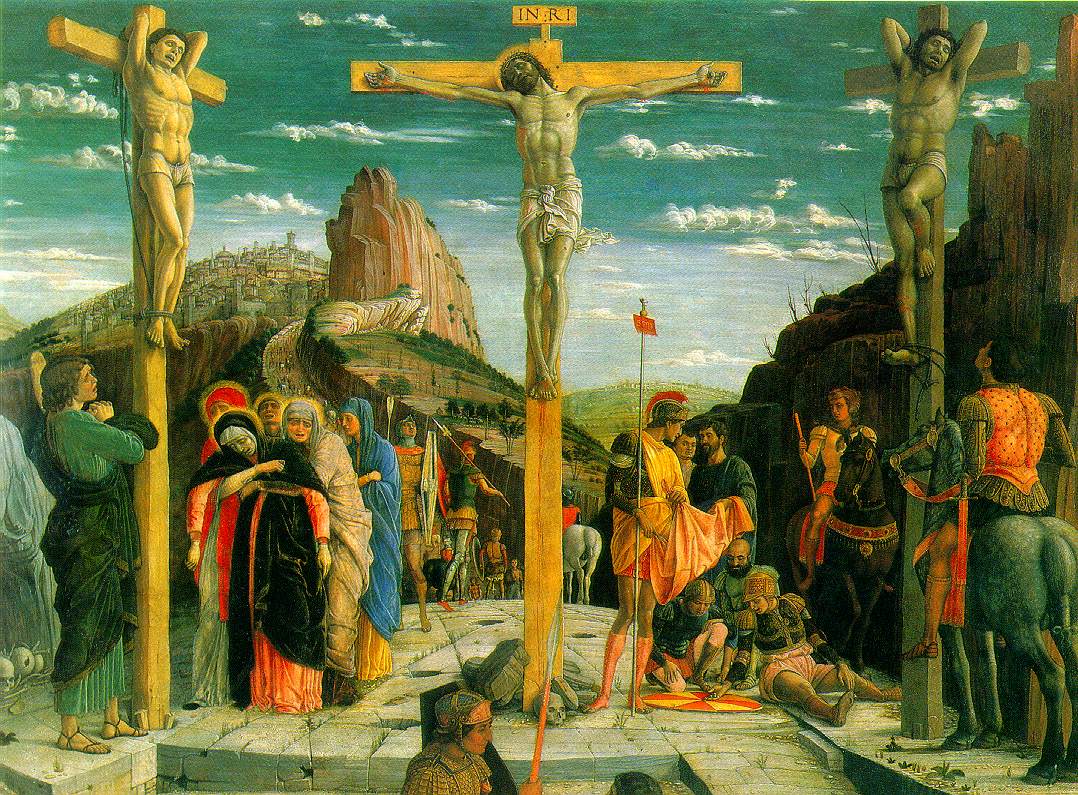
“Of course, this habit of dwelling on the distressing side of human life isn’t new. From the beginning of our civilisation it has been one of the tasks of art to take what is most painful in the human condition and to redeem it in a work of beauty. Art has the ability to redeem life, by finding beauty even in the worst aspect of things. Mantegna’s crucifixion displaying the cruellest and most ugly of deaths achieves a kind of majesty and serenity”

The third flaw I see though is the one that presents the greatest gulf between the beauty that Scruton speaks about and the one that I know: his putting in dualist opposition of the ideal and the particular, of desire and adoration:

“But if human beauty arouses desire how can it have anything to do with the divine? Desire is for the individual, living in this world. It is an urgent passion. Sexual desire presents us with a choice: adoration or appetite? Love or lust? Lust is about taking, but love is about giving.

Lust brings ugliness – the ugliness of human relations in which one person treats another as a disposable instrument. To reach the source of beauty we must overcome lust.

This longing without lust is what we mean today by Platonic love. When we find beauty in a youthful person it is because we glimpse the light of eternity shining in those features from a heavenly source beyond this world. The beautiful human form is an invitation to unite with it spiritually not physically. Our feeling for beauty therefore is a religious and not a sensual emotion.”

Beyond the questionable leaps from desire to sexual desire to lust, Scruton’s thought here too is self-inconsistent: lust leads to ugliness which makes one treat another as an instrument; beauty in youth points to “light of eternity”. To my mind Scruton’s proposal for how to engage with beauty is as objectifying as the sexually-lustful one he decries. In both the case of a source of beauty being turned into an object of one’s pleasure and the case of it being treated as a means for seeking an eternal ideal, that source of beauty is not engaged with for its own sake but is used as a device for satisfying its “consumer”’s ends. And while one can argue about the relative merits of those two ends, their seeking degrades beauty into a mere means.

Scruton’s thought here seems like a polar opposite of the caricature of contemporary art that he battles against, which, however, makes it a caricature too, pitting the beauty of the material and sensory against the beauty of the spiritual and ideal, instead of being open to the union and mutual enrichment of both.

Just to give an example of what an approach of differentiated unity – instead of dualism – looks like when applied to desire, let us consider the way Fr. James Martin, SJ speaks about it:

“[S]adly, desire has a disreputable reputation in many religious circles. When many hear the term, they think of two things: sexual desire or material wants, both of which are often condemned by some religious leaders. The first is one of the greatest gifts from God to humanity; without it the human race would cease to exist! The second is part of our natural desire for a healthy life — desire for food, shelter and clothing. […]

The deep longings of our hearts are our holy desires. Not only desires for physical healing, as Bartimaeus asked for (and as many ask for today) but also the desires for change, for growth, for a fuller life. And our deepest desires, those desires that lead us to become who we are, are God’s desires for us. They are ways that God speaks to you directly, one way that the Creator deals with the creation. They are also the way that God fulfills God’s own dreams for the world, by calling people to certain tasks.”

Such a recognition of good in desire leads to greater appreciation of the entirety of the universe we inhabit rather than to an a priori discarding of either the totality of the material/sensual or spiritual/ideal. In fact it leads to a vision of art like that of Pope Francis who said that “art must discard nothing and no one.”

Synod15: every family is light in darkness

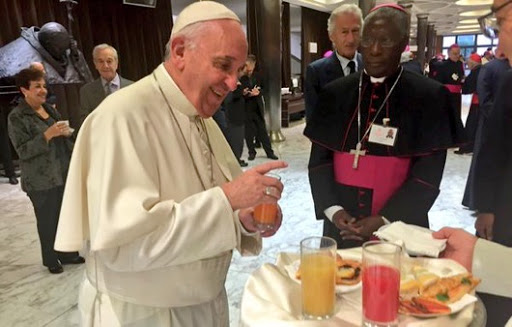
Synod juice

Yesterday, Cardinal Vincent Nichols’ intervention at the Synod has been published, in which he spoke out against the temptation to fall into traditionalist and liberal camps and where he called for a focus on the family being a joy, rather than predominantly a problem:

“[Let us give] our attention first and consistently to the family not as a focus of problems but the first place in which the drama of the working of grace and nature is to be found. And in this work, we know that “God is not bound by his sacraments” (CCC 1257). […]

Despite all the difficulties they face, most people want to speak, again and again, of the love they have for their family, which gives meaning to everything they do.

We must do the same. If our focus becomes fixed on problems we miss the most important message: that every family is a light in the darkness. At the heart of the work of this Synod must be this: the joy of the family.

Many families give a powerful witness to the Church. We must both learn from this witness and bring it to the great stage of the Church and the world. We must be taught by the family especially about how to face difficult problems.

Most families never withdraw a loving welcome home, even when dismayed by certain behaviour. We, the entire Church, must learn this pathway of “tough love”, a love that is compassionate, honest, and always seeking to find and nurture all that is good, as illuminated by the Gospel.”

One of the aspects of the working of the Synod that has come across very strongly from various Synod Fathers (e.g., see the Synod blogs of Abbot Jeremias Schröder OSB and Archbishop Mark Coleridge for frank, daily impressions) is a sense of confusion. Confusion about method, expectations, purpose, process … In the press conference yesterday, Cardinal Luis Antonio Tagle also made reference to this sense of confusion, but he pointed to it being a good thing:

“definitely it has caused … a bit of confusion. But it’s good to be confused once in a while. If things are always clear, then we might not be in real life anymore.”

In an excellent article yesterday, Fr. James Martin, SJ argued that the sense of confusion that the Synod Fathers are experiencing may have its roots in Ignatian “group discernment”, which

“begins with the belief that God wants a person, or a group, to make good, healthy and life-giving decisions; and through the “discernment of spirits,” that is, sorting out what is coming from God and what is not, one gains clarity into the best path. God therefore both wants and enables individuals and groups to arrive at good decisions.”

Fr. Martin then proceeds to elaborate five aspects of this process (very much worth reading in full), which “is by its very nature is messy, confusing and even chaotic”: freedom, complete openness, patience, significant time for prayer, and confirmation. In a brief Salt and Light interview, Archbishop Matthew Ma-oso Ndagoso of Kaduna, Nigeria emphasized the need for formation so that parents may exercise their sharing in Christ’s priestly office:

“Looking at the ministerial priesthood, it takes at least six years, a minimum of six years to train a priest to look after the church, you know. And how many months do we take preparing parents, couples who want to become parents in the future? If you look at it, its very short term. In some places it is nonexistent. Therefore it is my belief that if we want parents to be able to minister, to pastoral their flock within the family very well, then we need to arm them, we need to train them, we need to support them so that they know what their ministry is all about, so that eventually, when they have children, when they form a family, they will be able to look after them very well.”

Returning to Abbot Jeremias Schröder’s latest blog post, which contains a good summary of the 13 working group reports, also leads to a particularly insightful reflection about gender ideology, which has often been brought up as an evil that is to be condemned during these last days, typically without more than a declaration of it being harmful. Here Abbot Schröder’s thoughts to me are an example of looking for what is good everywhere and of having a more nuanced approach:

“[At the Synod there is] proper outrage when the gender ideology is mentioned, i.e., the belief that gender roles are social constructs that can be changed at will. The unanimity of indignation awakens in me and some others now, however, already a concern. In gender studies there are, in addition to the well-known ideological exaggerations, also meaningful core insights: how we live our being men and women is not only biology but is also influenced by our social traditions, our personal values ​​and so on. When I look at the three generations of mothers in my family, I see that the in which their being mothers is lived very differently. Here, the Synod ought to use not only outraged but also wise words; otherwise we will just make ourselves look ridiculous if we issue undifferentiated blanket statements.”

Today then, during the press conference, we have had the first news about the 75 interventions on the second part of the Instrumentum Laboris – entitled “The Discernment of the Family Vocation” – that took place yesterday and this morning.

Topics covered during these interventions included marriage as a vocation of equal dignity with priesthood and religious life, the spirituality of the family, the importance of prayer and the Eucharist, a focus on sanctification and the importance of closeness and tenderness in the context of mercy. Not putting mercy and truth in opposition and the importance of welcome that the Church needs to show towards all, towards all families, including those that are in difficulties were also emphasized. The prophetic nature of the indissolubility of marriage was also underlined as was its being positive instead of a yoke.

Fr. Rosica, in his update about the English language interventions reported the following contribution from the Synod Fathers:

“Unless we acknowledge openly people’s situations, we will not be able to address those situations clearly. Mercy towards sinners is not a form of weakness, nor an abandonment of church teaching. We have to learn how to speak the truth in love in many situations, because in many situations people are completely powerless over what has befallen them. And our communities of faith have to be communities that welcome people.”

Jesus laughed

Jesus laughed

In many ways I find the subject of today’s post among the most difficult to talk about as, to me, it is akin to asking whether Jesus looked people in the eye when he spoke to them (or whether he looked down at his feet instead). Neither is mentioned in the Bible, yet both seem equally self-evident to me. I have yet to meet a loving, kind, compassionate person whom I haven’t also seen and heard laughing. So why is it that I am even writing about this topic?

The most immediate reason is a message I received from my bestie ML a couple of days ago, in which he shares a frustration that I too have had for years: the tendency of some to make a science out of distinguishing between joy and “mere fun,” branding one as a deplorable, shallow waste of time while extolling the other as a good, clean, Christian virtue. The point here isn’t that no distinctions ought to be made between varieties of enjoyment (the joy of mutual love, of a joke shared among friends, of delighting in success not being consubstantial with sadism or schadenfreude), but that such an enterprise bears the great risk of draining the joy out of Christian life through a process of abstract analysis and categorization that leaves one dour and cold.

In fact, the above thoughts were triggered by one of Pope Francis’ homilies from last week, where he says:

“A Christian is a man and a woman of joy. Jesus teaches us this, the Church teaches us this, in a special way in this liturgical time. What is this joy? Is it having fun? No: it is not the same. Fun is good, eh? Having fun is good. But joy is more, it is something else. […] Fun, if we want to have fun all the time, in the end becomes shallow, superficial, and also leads us to that state where we lack Christian wisdom. […] Joy is another thing. Joy is a gift from God. It fills us from within. It is like an anointing of the Spirit. [… On the other hand, s]ometimes melancholy Christian faces have more in common with pickled peppers than the joy of having a beautiful life.”

Clearly Francis distinguishes between fun that becomes shallow and joy that “fills us from within,” but he also warns against the lifelessness that follows from an absence of joy and that this is not Christian.

Having read and re-read Francis’ sermon many times over the last days, I am coming to the conclusion that the distinction ought not to be between fun and joy but between fun that leads to or subsists in joy and fun that does not and that leads to resentment, frustration and disappointment. In fact, Francis himself says that “Having fun is good[, b]ut joy is more” and I believe that this leads to a reading not of dichotomy but of set relationships, where fun and joy overlap. I’d like to go a step further though and argue that if joy is sought on the back of avoiding fun then only the latter is likely to be be achieved. Fun is a context in which relationships are built and avoiding it or looking down on it will eventually cut a person off from their neighbors – precisely the neighbors Jesus asks me to love like myself.

If I just look at my best friends, I can say with confidence that the moments that have lead to the birth of friendship have been ones of fun and joy – of delighting in each other, of recognizing oneself in the other, of having fun being together. This is not all that friendship is and moments of difficulty and suffering certainly test and strengthen it, but ultimately, as John Paul II said: “We are an Easter people.” Being an “Easter people” means both understanding the fundamental value that suffering has and realizing that its embracing is not for its own sake but as a means that leads to the joy of the resurrection.

But where does the question about whether Jesus laughed fit into this picture? It comes precisely from concerns about fun: should it be discredited or seen as a potential contributor to love and joy. At least up until the middle ages, many viewed laughter with deep-seated suspicion, but there were also those, like Erasmus of Rotterdam, who wrote the “Morias Enkomion” (“In Praise of Folly”) to his friend, St. Thomas More, who were its proponents. I don’t mean to mount an extensive defense of Jesus’ having laughed here – it is not something I believe is necessary and if you are convinced he never laughed, then Billy Graham would tell you: “I feel sorry for [you], because a balanced sense of humor can save us from taking ourselves too seriously, and help us see through the pride and pretense of our sinful world.” If, however, you’d like to see such a defense of laughter, others have done so very well already and I’d just pick out two: first, there are the very interesting scriptural pointers by the Protestant Rev. Kuiper and second, the great defense of humour by the Jesuit Fr. Martin, both of which I very much recommend.

To conclude on a fun note, let me leave you with a couple of examples of humor and laughter from the bible and the sayings of the saints (who are always a great weather vane for orthopraxy):

  1. St. Sarah (yes, “Old Testament” figures are held up as saints in the Catholic Church), who is the patron saint of laughter, laughed when God told her she’d get pregnant in her nineties: “God has given me cause to laugh, and all who hear of it will laugh with me.” (Genesis 21:6). Not only did Sarah laugh, but her son was named Isaac, which means “He laughed.”
  2. Jesus, during the “Sermon on the Plain” says: “Blessed are you who are now weeping, for you will laugh.” (Luke 6:21).
  3. Jesus often employs humor (which does not preclude him making important points at the same time) – e.g., as in the “eye of the needle” image: “[I]t is easier for a camel to pass through the eye of a needle than for one who is rich to enter the kingdom of God.” (Matthew 19:24).
  4. I have previously argued that the opening line of the Johannine prologue has the structure of a joke.
  5. When St. Thomas More is about to be executed for disobeying Henry VIII, he pulls his beard off the chopping block and tells the executioner: “This hath not offended the king.”
  6. In instructions to fellow nuns, St. Teresa of Ávila said: “What would happen if we hid what little sense of humor we had? Let each of us humbly use this to cheer others.”
  7. When asked by a journalist “How many people work in the Vatican?,” Blessed Pope John XXIII replied: “About half.”

🙂