Marriage after death

Adam

1621 words, 8 min read

Last Saturday I attended a wedding during which the priest conducting the ceremony started his sermon by addressing the bride and groom with: “Today is the greatest day of your lives.” While this was undoubtedly well intentioned and said in the spirit of underlining the goodness of marriage and the joy of the occasion, my mind – and I am not proud of this – immediately transformed itself into a hatchet and shredded that statement to smithereens. “Do you mean that it is downhill from here?” “They haven’t even gotten married yet and you are telling them that any attempt at growth and development is doomed?”

Thankfully I then turned to one of my favorite kōans that I reached for with the intention of weaponizing it (not a nice thing to do to a kōan), but whose memory derailed my rage as I remembered it’s beautiful twist.

The kōan in question is about a famous general, who went to see a zen master to ask him for a nice piece of calligraphy to use as interior decoration. The zen master happily agreed and, when the general returned a week later, presented him with a beautifully executed inscription that read: “Father dies, son dies, grandson dies.” The general exploded with rage, drew his sword and, before cleaving the zen master in half, gave him an opportunity to explain himself. The zen master, all surprised, looked at the general and said: “What don’t you like about the inscription? Would you prefer to see your son die and for your father to see both his and your death? What I have written for you is the natural progression of life, which is true happiness and prosperity.” The general, ashamed about his hasty rage, left with his sword unused and grateful for the master’s good wishes.

Suitably calmed, and recognizing a fellowship with the kōanic general, I asked myself what I would have wished the couple to be their greatest day – if I had to, although that is not something that would have come to me naturally. And I arrived at: “May the greatest day of your marriage be the day one of you dies.” Thankfully I wasn’t asked for my opinion and, even if I had been and if I had said what I thought, the bride and groom are, to the best of my knowledge, not versed in martial arts or marksmanship. Nonetheless, if I had been asked and if there had been the inevitable, outraged call for an explanation, I would have pointed to my wish being one for maximum greatness. Wishing for the last day of a marriage to be its greatest is both a wish for continuous growth in greatness and, at the same time, a suggestion that every day of a marriage contains the greatness of all the days that preceded it and that the last day is therefore going to be the greatest by definition.

This lead me to thinking about the end of marriage, which the Catholic Church teaches comes with the death of one of the spouses,1 and to wondering about what that meant. How do I, a married person, relate to my spouse once they or I die? Is that it? In the next life, will we, who are one flesh now, be strangers? If I survive my spouse, will they, who have already passed into life everlasting, be there without being one with me? Somehow that did not seem right at all, since it violates the central Christian understanding of who God is. The God who is Love and who is Three and One. How could the God of Love dissolve the bond of love that marriage effects? How could the God of unity wish for the oneness of husband and wife to be annulled at the point of unity with Him? No, that didn’t seem right at all.

The obvious thing to do was to go back to where Jesus spoke about marriage to the Sadducees, who tried to set him a trap by running a hypothetical scenario past him and asking him a question designed to undermine the idea of the resurrection:

“Teacher, Moses said, ‘If a man dies without children, his brother shall marry his wife and raise up descendants for his brother.’ Now there were seven brothers among us. The first married and died and, having no descendants, left his wife to his brother. The same happened with the second and the third, through all seven. Finally the woman died. Now at the resurrection, of the seven, whose wife will she be? For they all had been married to her.” (Matthew 22:24-28)

What a nice, little trap! If Jesus says that she is the wife of all of the brothers, he says that in the next life there is polyandry, which, like polygamy, was against the Law, and he therefore undermines the credibility of the resurrection that the Sadducees denied. Alternatively, if he says that she isn’t anyone’s wife (or only the wife of one of the brothers) then he puts the solidity of marriage into question, which is also enshrined in the Law, and the Sadducees win again.

So, let’s see what Jesus said to them in reply:

“You are misled because you do not know the scriptures or the power of God. At the resurrection they neither marry nor are given in marriage but are like the angels in heaven.” (Matthew 22:29-30)

Now, the way this is typically read is to say that there is no marriage in Paradise, however, I would like to argue, that such an interpretation is not a particularly close reading of Jesus’ words. Jesus didn’t say “At the resurrection she won’t be anyone’s wife.” Instead, he said: “At the resurrection they neither marry nor are given in marriage.” In other words, no marriage is contracted in the next life. And, let’s not forget his admonition: “You are misled because you do not know the scriptures or the power of God.” I.e., the way you are looking at marriage is not from God’s point of view.

I believe that there is another reading of what Jesus’ words about marriage mean, which we can get to by the light of St. Paul saying:

“For no one hates his own flesh but rather nourishes and cherishes it, even as Christ does the church, because we are members of his body. “For this reason a man shall leave [his] father and [his] mother and be joined to his wife, and the two shall become one flesh.” This is a great mystery, but I speak in reference to Christ and the church.” (Ephesians 5:29-32)

Notice how St. Paul parallels first, a person’s love for their own flesh, second, Christ’s love for the Church, who is His flesh (body), made up by us, and, third, husband and wife becoming one flesh in marriage. This, indeed is the sacrament of marriage, that the “one flesh” of married spouses is sacrament (“efficacious sign of grace”2) of the “one body” of Christ and us, His Church.

Therefore, I believe that what happens at the death of one of the spouses is that the unity of flesh that previously resided in the created, passes, with the now ever-alive spouse, into the uncreated, where the unity of Christ’s Body dwells. Instead of suggesting that the bond, which ontologically makes the spouses one, breaks at the point of one of their deaths, I believe that Jesus’ and St. Paul’s words point to another reading: that this bond persists; no longer only as a bond between the spouses, but now also as an eternal constituent of the Body of Christ. The bond of marriage, contracted on Earth, remains both the force that made the spouses one here and, at the same time, becomes like the bonds of unity that in Paradise will bind us to Christ and to all other members of his body.

Finally, I also believe that the above reading is consistent with what the Church teaches, since it does not argue for a multiplicity of marriage bonds on Earth, but only for a recognition of their persistence in and subsummation into the bonds that make up the Body of Christ in Paradise. What ends with death is the exclusivity of the bond of one man and one woman, but not the bond itself, which now becomes one with the oneness of Christ and His Church.

So, maybe a better wish for newlyweds would be: “May every day be the greatest day of your lives.” The sequential days of chronos now, and the eternal day of kairos then.


1 “A marriage that is ratum et consummatum can be dissolved by no human power and by no cause, except death.” (Can. 1141) This is also related to St. Paul saying the following about death ending the bond of marriage: “Thus a married woman is bound by law to her living husband; but if her husband dies, she is released from the law in respect to her husband. Consequently, while her husband is alive she will be called an adulteress if she consorts with another man. But if her husband dies she is free from that law, and she is not an adulteress if she consorts with another man.” (Romans 7:2-3).
2 “The sacraments are efficacious signs of grace, instituted by Christ and entrusted to the Church, by which divine life is dispensed to us. The visible rites by which the sacraments are celebrated signify and make present the graces proper to each sacrament. They bear fruit in those who receive them with the required dispositions.” (Catechism of the Catholic Church, §1131)

The least in the kingdom of heaven

Infinitesimal1 1200

1262 words, 6 min read

The Hebrew Bible presents a copious offering of laws, rules and regulations for virtually every aspect of life, as does the Church today. There is the Code of Canon Law, the Catechism and a rich body of magisterial texts that prescribe and proscribe in equal measure. All of this poses the perennial challenge of how a person is to understand and relate to such a body of laws and rules. Is full and permanent compliance with all of them the way to God and happiness? And are those who don’t comply to be reprimanded and shunned? Are laws a necessary and sufficient guarantee of holiness? Will adherence to them ensure a life that imitates that of Jesus, God who became man?

Probably the best way to arrive at an answer, or at least the beginnings of one, is to see what Jesus said and did himself. Here a good starting point may be the words with which he addressed the crowds to whom he had just presented the Beatitudes:

“Do not think that I have come to abolish the law or the prophets. I have come not to abolish but to fulfill. Amen, I say to you, until heaven and earth pass away, not the smallest letter or the smallest part of a letter will pass from the law, until all things have taken place. Therefore, whoever breaks one of the least of these commandments and teaches others to do so will be called least in the kingdom of heaven. But whoever obeys and teaches these commandments will be called greatest in the kingdom of heaven.” (Mark 5:17-19)

So, it sounds like compliance with the law is pretty fundamental and not even the slightest deviation from it is to be tolerated. This seems pretty clear and one would expect that the rest of the Gospel accounts would be a catalogue of Jesus being exemplary at complying with the rules and regulations of Scripture.

However, the polar opposite is actually the case!

Jesus broke the laws calling for abstaining from work on the Sabbath, by healing the withered hand of a man (Matthew 12:9-19), which incensed the Pharisees to the point of plotting his death. He cured a “blind, lame and crippled” man, again on a Sabbath (John 5:1-18). He cured another man’s blindness (John 9:1-16), yet again on a Sabbath, making the Pharisees exclaim that “This man is not from God, because he does not keep the sabbath.” And Jesus also cured a woman “crippled by a spirit; [who] was bent over, completely incapable of standing erect.” (Luke 13:11) – again on a Sabbath and much to the consternation of the authorities, with the leader of the Synagogue exclaiming in exasperation: “There are six days when work should be done. Come on those days to be cured, not on the sabbath day.”

On another occasion, Jesus condoned his disciples’ breaking the Sabbath, when they picked grain from a field to feed themselves (cf. Matthew 12:1-8). In fact, the disciples’ behavior was a source of complaint by the Pharisees on another occasion too, when they asked Jesus: “Why do your disciples break the tradition of the elders? They do not wash [their] hands when they eat a meal.” (Matthew 15:2).

Jesus broke the law again when touching a leper who approached him (Matthew 8:1-4), which goes directly against the rules laid out in Leviticus 13. He also touched a dead girl (cf. Matthew 9:25) which is against Numbers 19:11. Jesus allowed a prostitute to touch him (Luke 7:36-50) and he also ate with tax collectors on the same occasion, who broke the laws set out in Leviticus 25:36-38 that prohibit charging interest on loans. And he even invited himself for a meal at a tax collector’s house (cf. Luke 19:1-10)!

Jesus also broke the law when he stopped the stoning of an adulteress, even though the Pharisees told him directly that “in the law, Moses commanded us to stone such women.” (cf. John 8:1-11).

Finally, Jesus broke the law again when blasphemously identifying himself with God (cf. John 5:18), a crime he was accused of also during his trial before the Sanhedrin that lead to his – legal – condemnation to death (cf. Matthew 26:65-66).

So, what is going on here?

I believe there are two keys in the passage where Jesus declares that he has not “come to abolish the law.”

First, Jesus states that his purpose is to “fulfill” rather than abolish the law. To my mind, fulfillment is consistent both with change, since something that becomes fulfilled changes (since it was, presumably, not fulfilled before, otherwise it would have had no capacity for fulfillment) and with remaining the same (it is the one thing that grows in fulfillment). What kind of fulfillment does Jesus have in mind though? The obvious place to look to for an answer is the law that Jesus himself imposes on his followers: “I give you a new commandment: love one another. As I have loved you, so you also should love one another.” (John 13:34). The purity laws, the laws governing the Sabbath, the laws pertaining to blasphemy get, prima facie, broken for the sake of underlining the one law that they were designed to safeguard, but whose attainment they have become at times obstacles to: love of neighbor. When Jesus transgresses against laws, his motivation is love of neighbor: of the sick, of sinners, of his disciples. He is moved by mercy (misericordia, meaning compassion felt by the heart) and it is indeed this participation of the heart in bringing laws to fulfillment that Jesus saw lacking in the reactions of the Pharisees. This in turn lead him to throwing Isaiah’s prophesy in their faces when they complained about Jesus allowing his disciples to eat with unwashed hands:

“Hypocrites, well did Isaiah prophesy about you when he said:
‘This people honors me with their lips,
but their hearts are far from me;
in vain do they worship me,
teaching as doctrines human precepts.’” (Matthew 15:7-9)

Second, there is another, perhaps less immediately recognizable key in Jesus’ words, which calls for a closer reading of the text. Note what it is that Jesus is actually saying in the following sentence: “Therefore, whoever breaks one of the least of these commandments and teaches others to do so will be called least in the kingdom of heaven.” If you break these commandments, you’ll be in heaven. You’ll be the least in heaven, but you’ll be in heaven! To my mind this is a brilliant piece of humor. It’s like saying: if you break the rules you’ll be the poorest among billionaires, the weakest among superheroes, the unluckiest among Leprechauns, the shortest among giants. And, let’s remember that Jesus isn’t saying that it is a free-for-all. He is quite happy to threaten exclusion and a “wailing and grinding of teeth” (cf. Luke 13:22-30) or to recommend that it would be better to “have a great millstone hung around [their] neck and to be drowned in the depths of the sea” for those who lead the young astray (cf. Matthew 18:6-9). This is not about laxity, but about priorities: love of neighbor precedes adherence to rules and regulations, whose breaking may actually be the act of love that someone needs to have done to them to turn their life around.

Conscientious objection

Brangwyn1

1611 words, 8 min read

The supremacy of conscience in determining the actions of an individual is a key principle of the current Catechism of the Catholic Church, which, in no uncertain terms, presents it as the ultimate criterion: “A human being must always obey the certain judgment of his conscience. If he were deliberately to act against it, he would condemn himself.” (CCC, §1790). Regardless of whether it is “right” or not – and it can certainly also be wrong! – “[i]n all his activity a man is bound to follow his conscience in order that he may come to God, the end and purpose of life. It follows that he is not to be forced to act in a manner contrary to his conscience. Nor, on the other hand, is he to be restrained from acting in accordance with his conscience.” (Dignitatis Humanae, §3).

This is, indeed, not only the teaching of the Catholic Church, but also enshrined in the Universal Declaration of Human Rights’ articles 1 and 18:

“Article 1. All human beings are born free and equal in dignity and rights. They are endowed with reason and conscience and should act towards one another in a spirit of brotherhood.

Article 18. Everyone has the right to freedom of thought, conscience and religion; this right includes freedom to change his religion or belief, and freedom, either alone or in community with others and in public or private, to manifest his religion or belief in teaching, practice, worship and observance.”

In practice, the picture is far from clear though, in that external forces – but internal ones too – often push in directions opposed to a person’s conscience and going against them can come with significant risks, to the point of putting one’s own life on the line. The United Nations themselves recognize this clearly and in their guidance about conscientious objection with regard to military service, give the following example of probably the earliest recorded conscientious objector:

“In the year 295, on reaching the age of 21, Maximilianus, as the son of a Roman army veteran, was called up to the legions. However, he reportedly told the Proconsul in Numidia that because of his religious convictions he could not serve as a soldier. He persisted in his refusal and was executed. He was subsequently canonized as Saint Maximilian.”

It may not always be a matter of life and death though, at least for the person whose conscience can come in conflict with external forces, such as a state’s laws, and the qualifier “certain” used in the Catechism as well as the knowledge that one’s own conscience may be erroneous can both put a question mark over one’s conscience. The principle of following it can therefore be less than unambiguous in practice and arguments for its bending and dulling can easily creep in. This may, in part be what has resulted in the, to my mind, disgraceful positions taken by some politicians and representatives of the Catholic Church in Central Europe with regard to the refugee crisis (and the opposite of what has thankfully lead many citizens as well as clergy and lay persons to do the right thing).

Against the above background, I would here like to translate parts of an interview that Cardinal Walter Kasper gave yesterday, in which he addressed the question of conscience in the context of the refugee crisis and with reference to the laws of individual states. Here Kasper starts his argument from the position of mercy:

“To welcome someone is a work of mercy and justice that goes beyond state laws. The Holy Year of Mercy reminds us about what the Old and New Testament teach: we must welcome as brothers and sisters those who arrive to us from oppressions and persecutions. And even before we understand whether or not they are to be considered refugees, we must remember that they are human beings and as such have the right to live in a healthy and free environment. It is clear that immigrants must respect the rules of the society that welcomes them, but we must be open because that is what Christian mercy asks of us.”

Next, he goes on to directly address how mercy and the laws of states relate:

“State laws are to be observed, but they are not the ultimate criterion of being a Christian. Mercy goes further. The state cannot give orders to mercy. In this sense, the laws stipulate a minimum level for the rules of coexistence, while mercy goes beyond. And it is only mercy that gives a certain warmth to our society, without it and without compassion we would live in a very cold society. […] There is a question of conscience. One has to wonder if a man who has no documents can be returned to a country where he was persecuted. It is clear that a state has the right to ask for the documents of immigrants, but there is always room for individual conscience.”

In fact, Pope Francis took this same argument even beyond the confines of the Church, by emphasizing the inviolability of a person’s conscience also in the case of non-believers (in one of his first acts as Pope – the letter to the atheist Eugenio Scalfari):

“[T]he mercy of God is limitless for those who turn to him with a sincere and contrite heart, the issue for the unbeliever lies in obeying his or her conscience. There is sin, even for those who have no faith, when conscience is not followed. Listening to and obeying conscience means deciding in the face of what is understood to be good or evil. It is on the basis of this choice that the goodness or evil of our actions is determined.”

And, some months earlier, in his remarks before the Angelus prayer, he explained what he means by conscience, in clearly Christian terms:

“[T]he importance, even for Jesus, of conscience [was this]: listening in his heart to the Father’s voice, and following it. Jesus, in his earthly life, was not, so to speak, “remote-controlled”: He was the Word made flesh, the Son of God made man, and at one point he made a firm decision to go up to Jerusalem for the last time – a decision taken in His conscience, but not on His own: ​​with the Father, in full union with Him! He decided in obedience to the Father, in profound intimate attunement to the Father’s will. For this reason, then, the decision was steadfast: because it was taken together with the Father. In the Father, then, Jesus found the strength and the light for His journey. Jesus was free. His decision was a free one. Jesus wants us Christians to be free as he is: with that liberty, which comes from this dialogue with the Father, this dialogue with God. Jesus wants neither selfish Christians, who follow their egos and do not speak with God, nor weak Christians, without will: “remote-controlled” Christians, incapable of creativity, who seek ever to connect with the will of another, and are not free. Jesus wants us free, and this freedom – where is it found? It is to be found in the inner dialogue with God in conscience. If a Christian does not know how to talk with God, does not know how to listen to God, in his own conscience, then he is not free – he is not free.

So we also must learn to listen more to our conscience. Be careful, however: this does not mean we ought to follow our ego, do whatever interests us, whatever suits us, whatever pleases us. That is not conscience. Conscience is the interior space in which we can listen to and hear the truth, the good, the voice of God. It is the inner place of our relationship with Him, who speaks to our heart and helps us to discern, to understand the path we ought to take, and once the decision is made, to move forward, to remain faithful.”

During the press conference after his visit to the USA, Francis also explicitly applied this same principle to the scenario of a conflict between individual conscience and state law:

“[C]onscientious objection is a right, and enters into every human right. It is a right, and if a person does now allow for conscientious objection, he or she is denying a right. Every legal system should provide for conscientious objection because it is a right, a human right. Otherwise, we would end up selecting between rights: “this right is good, this one less so”. It is a human right. I am always moved when I read, and I have read it many times, when I read the “Chanson de Roland”, when there were all these Moors lined up before the baptismal font, and they had to choose between baptism and the sword. They had to choose. They weren’t permitted conscientious objection. It’s a right and if we want to have peace, we have to respect all rights.”

While its prominence has recently been heightened, conscience has been given great respect throughout the history of Christianity, which can also be seen in the following guidance given by St. Francis of Assisi to the leaders of his own order:

“If a superior give any order to one who is under him which is against that man’s conscience, although he do not obey it yet he shall not be dismissed.”

At a time when obedience to hierarchy was unquestionable, Francis underlined the importance of placing conscience above obedience even in a context where authority may be exercised with the best of motives and by the best and most holy of people.

Enter darkness, make your closeness felt

Widow nain

1532 words, 8 min read

A book-length interview with Pope Francis, by the Italian journalist Andrea Tornielli and entitled “The Name of God is Mercy”, has been published today and I would here like to share some of my favorite passages with you (and encourage you to read it in full!).

First, there is Francis’ rooting of mercy in Ezekiel’s account of the foundation of Jerusalem:

“[M]ercy is God’s identity card. God of Mercy, merciful God. For me, this really is the Lord’s identity. I was always impressed by the story of Jerusalem as it is told in chapter 16 of the Book of Ezekiel. The story compares Jerusalem to a little girl whose umbilical cord wasn’t cut, who was left in blood and cast out. God saw her wallowing in blood, he washed the blood from her, he anointed her, he dressed her, and when she grew up he adorned her with silk and jewels. But she, infatuated with her own beauty, became a harlot, taking lovers not for money but paying them herself. God, however, will never forget his covenant and he will place her above her sisters so that Jerusalem will remember and be ashamed (Ezekiel 16:63), when she is forgiven for what she has done.

For me this is one of the most important revelations: you will continue to be the chosen people and all your sins will be forgiven. So mercy is deeply connected to God’s faithfulness. The Lord is faithful because he cannot deny himself. This is explained well by Saint Paul in the Second Letter to Timothy: “If we are faithless, he remains faithful, for he cannot deny himself.” You can deny God, you can sin against him, but God cannot deny himself. He remains faithful.”

Second, Francis exalts the goodness of starting again over that of an (impossible) never failing:

“The most important thing in the life of every man and every woman is not that they should never fall along the way. The important thing is always to get back up, not to stay on the ground licking your wounds. The Lord of mercy always forgives me; he always offers me the possibility of starting over. He loves me for what I am, he wants to raise me up, and he extends his hand to me.”

In fact, earlier in the book, Francis is explicit about the impossibility of not sinning and follows it up with a great quote by St. Francis de Sales:

“We must take this sad reality of ours into account: no one can avoid sin, small or great, for very long. ‘But,’ as Saint Francis de Sales said, ‘if you have a little donkey and along the road it falls onto the cobblestones, what should you do?’ You certainly don’t go there with a stick to beat it, poor little thing; it’s already unfortunate enough. You must take it by the halter and say: ‘Up, let’s take to the road again . . . Now we will get back on the road, and we will pay more attention next time.’”

Third, there is a good number of personal experiences that Pope Francis shares in the book, to give his answers to Tornielli’s questions a fresh sense of concreteness and specificity. Of these one of my favorites is the following:

“Back when I was rector of the Collegio Massimo of Jesuits and a parish priest in Argentina, I remember a mother with young children, whose husband had left her. She did not have a steady job and only managed to find temporary work a couple of months out of the year. When there was no work, she had to prostitute herself to provide her children with food. She was humble, she came to the parish church, and we tried to help her with our charity, Caritas. I remember one day—it was during the Christmas holidays—she came with her children to the College and asked for me. They called me and I went to greet her. She had come to thank me. I thought it was for the package of food from Caritas that we had sent to her. “Did you receive it?” I asked. “Yes, yes, thank you for that, too. But I came here today to thank you because you never stopped calling me Señora.” Experiences like this teach you how important it is to welcome people delicately and not wound their dignity. For her, the fact that the parish priest continued to call her Señora, even though he probably knew how she led her life during the months when she could not work, was as—or perhaps even more—important than the concrete help that we gave her.”

Fourth, in response to being asked to clarify what he meant when he said that famous “who am I to judge” soon after being elected pope, Francis said:

“I am glad that we are talking about “homosexual people” because before all else comes the individual person, in his wholeness and dignity. And people should not be defined only by their sexual tendencies: let us not forget that God loves all his creatures and we are destined to receive his infinite love. I prefer that homosexuals come to confession, that they stay close to the Lord, and that we pray all together.”

Fifth, in the context of being asked about the “scholars of the law” whom Francis frequently lambasts in his homilies, he recalled a great quote from St. Ambrose’s De Abraham:

“When it comes to bestowing grace, Christ is present; when it comes to exercising rigor, only the ministers of the Church are present, but Christ is absent.”

Sixth, Francis addresses the important question put to him by Tornielli of whether there is a risk of “infection” when dealing with those who live in sin:

“We need to enter the darkness, the night in which so many of our brethren live. We need to be able to make contact with them and let them feel our closeness, without letting ourselves be wrapped up in that darkness and influenced by it. Caring for outcasts and sinners does not mean letting the wolves attack the flock. It means trying to reach everyone by sharing the experience of mercy, which we ourselves have experienced, without ever caving in to the temptation of feeling that we are just or perfect. The more conscious we are of our wretchedness and our sins, the more we experience the love and infinite mercy of God among us, and the more capable we are of looking upon the many “wounded” we meet along the way with acceptance and mercy. So we must avoid the attitude of someone who judges and condemns from the lofty heights of his own certainty, looking for the splinter in his brother’s eye while remaining unaware of the beam in his own. Let us always remember that God rejoices more when one sinner returns to the fold than when ninety-nine righteous people have no need of repentance.”

Seventh, there is also a great deal that made me smile in this book, like the following passage that, while clearly communicating a profound truth, does so with humor:

“At times I have surprised myself by thinking that a few very rigid people would do well to slip a little, so that they could remember that they are sinners and thus meet Jesus. I think back to the words of God’s servant John Paul I, who during a Wednesday audience said, “The Lord loves humility so much that sometimes he permits serious sins. Why? In order that those who committed these sins may, after repenting, remain humble. One does not feel inclined to think oneself half a saint, half an angel, when one knows that one has committed serious faults.””

Eighth, Pope Francis speaks beautifully about how compassion relates to mercy, using Jesus himself as the example:

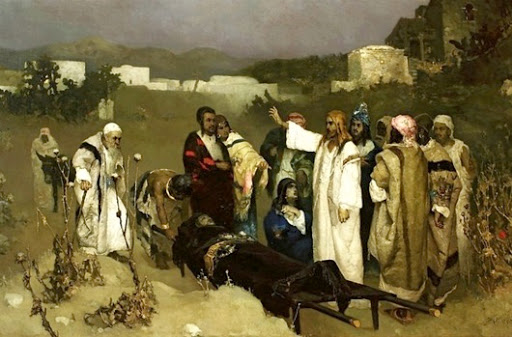
“Let us reflect on the beautiful pages that describe the raising from the dead of the widow’s son. When Jesus arrived in the village of Nain in Galilee, he was moved by the tears of the widow, who was devastated by the loss of her only son. He says to her, “Woman, do not weep.” As Luke writes in the Gospel: “When the Lord saw her, he felt compassion for her” (7:13). God Incarnate let himself be moved by human wretchedness, by our need, by our suffering. The Greek verb that indicates this compassion is σπλαγχνίζομαι [splanchnízomai, ed.], which derives from the word that indicates internal organs or the mother’s womb. It is similar to the love of a father and mother who are profoundly moved by their own son; it is a visceral love. God loves us in this way, with compassion and mercy. Jesus does not look at reality from the outside, without letting himself be moved, as if he were taking a picture. He lets himself get involved. This kind of compassion is needed today to conquer the globalization of indifference. This kind of gaze is needed when we find ourselves in front of a poor person, an outcast, or a sinner. This is the compassion that nourishes the awareness that we, too, are sinners.”

Ravasi: Borges’ agnostic Christology

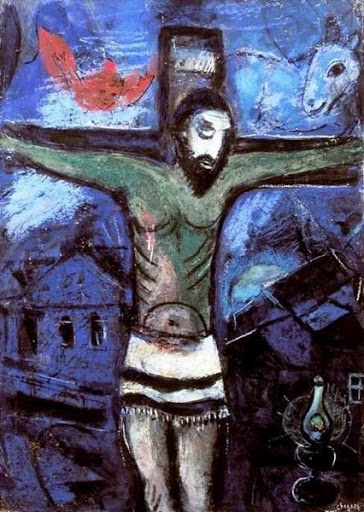
CHRIST EN CROIX  CHAGALL

1691 words, 8 min read

I have just come across a great talk by Cardinal Gianfranco Ravasi on Jorge Luis Borges, given in Cordoba, Argentina last October in the context of the Courtyard of the Gentiles and his receiving an honorary doctorate from the Universidad Católica de Córdoba there. Ravasi gives some beautiful examples from Borges’ poetry that illustrate his approach to Scripture and Christ and where Ravasi underlines the richness of his understanding and the depth of his sincerity, which come from what Pope Francis speaks about as “periphery”. Note that the following is my translated transcript of the talk and that a more extensive version of it can be found here in Spanish.

To Borges, boundaries are always moveable and subtle. There is never an iron curtain between truth and fiction, between waking and dreaming, between reality and imagination, between rationality and feelings, between the essential and consequences, between concrete and abstract, between theology and fantasy literature, between Anglo-Saxon conjecture and Baroque emphasis.

Among his readings, an undisputed primacy was given to the Bible, as he had confessed: “I must remember my grandmother who knew the Bible off by heart, so I could enter literature along the way the Holy Spirit.” His paternal grandmother was in effect English and practicing Anglican and it was her who introduced the little Jorge Luis to the Scriptures and to the exalted English language. During a talk given at Harvard, dedicated to the art of storytelling, Borges, extolling the epic poem as the oldest form of poetry, lead to a triptych of masterpieces for humanity: “The Iliad, The Odyssey and a third ‘poem’ that stands out above the others: the four Gospels … The three stories of Troy, Odysseus and Jesus have been sufficient for humanity … Even though, in the case of the Gospels, there is a difference: I think that the story of Christ can not be told better.”

Let us now leave behind this specific topic of the literary and existential panorama of Borges to focus on a narrower scope that is particularly rich, so much so that here has exercised a small legion of scholars. Here we will deal with the aforementioned passion of the author for the Bible and we will do so through two examples.

The first is the story of Cain and Abel (Genesis 4:1-16) that had a poetic evocation in a short composition “The Unending Rose” entitled, as Borges often liked to do by revisiting Bible passages, “Genesis IV, 8”:

“In the first desert it was.
Two arms cast a great stone.
No cry. Blood.
For the first time death.
Was I Abel or Cain?”

Next to it we must, however, place the broadest reading of this Biblical scene in “In praise of Darkness” where the two brothers meet again after the death of Abel in an atmosphere of the eschatological court, even though the scene is set in the desert and the origins of the world. They sit, light a fire, while the day comes to an end and the stars, as yet unnamed, light up in the sky.

“By the light of the flame, Cain noticed the mark of a stone indented in Abel’s forehead and the bread he had raised to his lips fell before he could eat it and he asked whether his crime had been forgiven.

Abel answered:

“Did you kill me or did I kill you? I already cannot remember, and here we are, together like before.”

“Now, you must have forgiven me,” Cain said, “because to forget is to forgive. I will, too, try to forget.”

Abel replied softly:

“That’s right. While the remorse lasts, so does the guilt.””

Some have seen in this text a relativist moral conception by which an imperceptible transition is performed between good and evil, true and false, virtue and vice. Actually here we instead witness a process of transformation or alteration that we have indicated above and that Borges performs to show the infinite potentialities of an archetypal text. The same text allows continual re-transcriptions and in this case the aim is a paradigmatic celebration of forgiveness that makes the crime vanish completely: revenge is erased by forgetting and through it, the blame of the other becomes dissolved. What certainly remains always active is the fluidity of historical human reality and, therefore, of ethics that, in vain – in the eyes of Borges – also the “inspired” word tries to compress into defined and definitive certainties.

The second example is linked to the figure of Christ as Borges proposes in some of his many texts dedicated to this fundamental figure of Christianity.

“The black beard hangs down heavy over his chest.
His face is not the face from the engravings.
It’s harsh and Jewish. I do not see him
And will keep questing for him till the final
Day of my steps falling upon this earth.”

It was already in the twilight of his existence when Borges writes these verses of “Christ on the Cross”, dating them Kyoto 1984. They are verses of high spiritual tension, that all quote when they want to define Borges’ relationship with Christ, a hoped for encounter, but one that hasn’t occurred fully, bearing in mind that we don’t know his “last steps on earth”. Maria Lucrecia Romera wrote that “Borges confronts the tragic Christ of the Cross … and not the [theological] doctrine of the Resurrection .. His is not the optics of the believer’s faith, but that of the restlessness of the agnostic poet”. However, one needs to add immediately that the general observation made by the French writer Pierre Reverdy in his “En vrac” applies to certain of Borges’ verses: “There are fiercely harsh atheists who are much more interested in God than some frivolous and light believers”. Borges absolutely didn’t have “the fierce harshness” of an atheist, but his was certainly a more intense search than that of many pale and colorless believers. His restlessness was profound, hidden under the bark of a rhythmic dictation and streaked with disinterest, and even irony.

This is the intuition of Borges: the face of Christ is to be sought in the mirrors that reflect human faces. On the other hand, it was Jesus himself who said that everything done “to one of his least brothers”: hungry, thirsty, strangers, naked, sick and imprisoned, is done to him (Matthew 25:31-46). Behind the, often deformed, contours of human faces hides therefore the image of Christ and in this regard, the writer refers to St. Paul for whom “God is all in all” (1 Corinthians 15:28) . It is here, then, that we find Borges’s invitation to follow him in this human quest for Christ in the faces of men:

“We have lost those features,
just as a magic number made up of ordinary figures can be lost;
just as an image in a kaleidoscope is lost for ever. We may come across the features
and not know them. The profile of a Jew on an underground train
may be that of Christ; the hands that give us our
change over a counter may echo those that some soldiers
once nailed to the cross.
Perhaps some feature
of the crucified face lurks in every mirror; perhaps the face
died and was erased so that God could be everyone.”
[Paradise, XXXI: 108]

Now, on the basis of Borgesian Christology, we undoubtedly find the humanity of Jesus of Nazareth who is born, dies, even proclaims himself Son of God, and, therefore, assigns himself a transcendent quality. The writer does not ignore this interweaving of divine and human, of absolute and contingent, of eternal and time, of infinity and the limit and, even while witnessing the side of humanity, does not hesitate to interpret Christ’s consciousness in a poem of extraordinary power, as is that of the original Gospel matrix that generates it.

Here the title is, certainly, more explicit still: “John I, 14” (in “In praise of Darkness”). The verse is cut from the that literary and theological masterpiece that is the anthem-prologue of the Fourth Gospel: “The Lógos (Word) became sarx (flesh) and made his dwelling among us.” A verse that is a counterpoint to the solemn opening words of the hymn: “In the beginning was the Lógos, and the Lógos was with God, and the Lógos was God.” (1:1). Let us consider how John’s Lógos intrigued Goethe so much that in Faust he proposes a range of meanings to express its profound semantics: the Word is, certainly, Wort, word, but also Sinn, meaning, Kraft, power, and Tat, act, in line with the value of the parallel Hebrew word dabar, which means word and act/event. Let us read a few sentences from this surprising “autobiography” of the Word that is eternal (“Is, ​​Was, Is to Come”), but is also “time in succession.”

“I who am the Was, the Is, and the Is to Come
again condescend to the written word
which is time in succession and no more than an emblem. …
I lived under a spell, imprisoned in a body,
in the humbleness of a soul. …
I knew wakefulness, sleep, and dreams,
ignorance, the flesh,
reason’s roundabout labyrinths,
the friendship of men,
the blind devotion of dogs.
I was loved, understood, praised, and hung from a cross.”

***

During the round-table discussion after his talk, Cardinal Ravasi then made a very significant gesture of appreciation towards Borges:

“Borges could be the best patron of the Courtyard of the Gentiles. Because he is not only in the courtyard of the gentiles, and he is not only in the courtyard of the believers. He was, instead, on top of that wall that divided the two spaces. That wall allowed for a good view both from one side and from the other. And Borges is a bit of a believer, in his own way as he said, and also a gentile. And it is because of this that the Courtyard of the Gentiles that takes place here in Córdoba or in Buenos Aires, in his hame, is the best Courtyard of the Gentiles.”

The patron [saint] of the Catholic Church’s dialogue with non-believers is an agnostic!

Schönborn: The door is never closed

Yesterday, the Jesuit journal, La Civiltà Cattolica, published an extensive interview of its director Fr. Antonio Spadaro, SJ with Cardinal Christoph Schönborn of Vienna in Italian. Even though some partial translations in English are already available, the following is my, rough translation of the passages that spoke to me most strongly (it is around 90% of the full text and the passages I left out were only left out for practical reasons …).

In response to a question about whether the scope of the upcoming Synod on the family ought to be doctrinal, Cardinal Schönborn replied:

“The challenge that Pope Francis puts in front of us is to believe that, with the courage that comes from simple closeness, from the everyday reality of people, we will not distance ourselves from doctrine. We don’t risk diluting its clarity by walking with people, because we ourselves are called to walk in faith. Doctrine isn’t, in the first place, a series of abstract statements, but the light of the word of God demonstrated by the apostolic witness at the heart of a Church and in the hearts of believers who walk in the world today. The clarity of the light of faith and its doctrinal development in each person is not in contradiction with the journey that God undertakes with us, who are often far from living the Gospel fully.”

When asked about how we ought to view and what attitude we ought to have towards those who live in irregular arrangements, he then replied:

“At the last Synod, I proposed an interpretative key that has lead to much discussion and was referred to in the Relatio post disceptationem, but that was no longer present in the final document, the Relatio Synodi. It was an analogy with the ecclesiological interpretative key given by Lumen Gentium, the constitution on the Church, in its article 8. There the question is: “Where is the Church of Christ? Where it is incarnated concretely? Does the Church of Jesus Christ, which he desired and founded, really exist?” To this, the Council responded with the famous statement: “The only Church of Christ subsists in the Catholic Church”, subsistit in Ecclesia catholica. It is not a pure and simple identification, like saying that the Church of Jesus Christ is the Catholic Church. The Council affirmed: it “subsists in the Catholic Church”, united with the Pope and legitimate bishops. The Council adds this phrase, which has become key: “Although many elements of sanctification and of truth are found outside of its visible structure. These elements, as gifts belonging to the Church of Christ, are forces impelling toward catholic unity.” Other denominations, other churches, other religions are not simply nothing. Vatican II excludes and ecclesiology of the all or nothing. The all is fulfilled in the Catholic Church, but there are elements of truth and holiness in other churches, and even in other religions. These elements are elements of the Church of Christ, and by their nature they tend to catholic unity and the unity of mankind, towards which the Church herself tends, in anticipation of, so to speak, the great plan of God that is the one Family of God, humanity. The approach of the Council is justified in this key, because of which one does not consider first what is missing in the other Churches, Christian communities or religions, but what is positive there. One gathers the semina Verbi, as has been said, the seeds of the Word, elements of truth and sanctification.”

And how does this translate to the family?

“I simply proposed to apply this interpretation to the ecclesiological reality of the sacrament of marriage. Because marriage is a Church in miniature, an ecclesiola, the family as a small Church, it seems legitimate to me to establish an analogy and say that the sacrament of marriage is fully realized where there is a properly established sacrament between a man and a woman living in faith etc. But this does not prevent that, outside of this full realization of the sacrament of marriage, there be elements of marriage that are anticipatory signs, positive elements.”

Let’s take, for example, civil marriage:

“Yes, we consider it as something more than simple cohabitation. Why? It is a simple civil contract that from a strictly ecclesial point of view has no meaning. But we recognize that in civil marriage there is more commitment, therefore a greater alliance, than in simple cohabitation. The two make a commitment before society, humanity and themselves, in a more explicit alliance, anchored legally with sanctions, obligations, duties, rights … The Church believes that this is a further step than simply living together. There is in this case a greater proximity to sacramental marriage. As a promise, an anticipatory sign. Instead of speaking about all that is missing, one can approach these realities, noting the positive that exist in this love that is becoming more stable.”

How do we therefore consider situations that have objective shortcomings?

“We should look at the numerous situations of coexistence not only from the point of view of what is missing, but also from the point of view of what is already promised, what is already present. Moreover, the Council adds that, although there is always real holiness in the Church, it is made up of sinners and advances along the path of conversion (LG 8). It is always in need of purification. A Catholic mustn’t put themselves on a step above others. There are saints in all the Christian churches, and even in other religions. Jesus said twice to the pagans, a woman [cf. Luke 8:48] and a Roman officer [Luke 7:9]: “I tell you, not even in Israel have I found such faith.” A true faith, that Jesus found outside the chosen people.”

So, the dividing line is not between those who live sacramental marriage and who don’t?

“Those who have the grace and the joy of living sacramental marriage in faith, humility and mutual forgiveness, in a trust in God who acts in our daily lives, know how to look and discern in a couple, in a cohabitation, the elements of true heroism, true charity, true mutual giving. Even though we must say: “It is not yet the full reality of the sacrament.” But who are we to judge and say that there are no elements of truth and sanctification in them? The Church is a people that God draws to himself and to which all are called. The Church’s role is to accompany everyone in growth, along a path. As a pastor I experience this joy of being on a journey, among believers, but also among many non-believers.”

Cardinal Schönborn then gives examples of how a person who has been through several marriages may find faith in later life and how accompanying them and caring for them may require considering their specific, individual circumstances rather than a simple application of rules. He concludes that answer with saying “I can’t hide […] that I have been shocked by how a purely formalist way of thinking wields the axe of the “intrinsece malum.” Fr. Spadaro then explains it in a footnote thus: “What is meant by an “intrinsically evil” (intrinsece malum) act is an action whose moral connotation is such that it can in no case change from negative to positive. Therefore it is an act that is always considered morally evil, irrespective of the ulterior intentions of the one acting and of the circumstances.”

Could you elaborate on the problem of that which is defined as “intrinsece malum”?

“In practice, it excludes any reference to the question of fitness [convenientia] that, for St. Thomas, is always a way of expressing prudence. It is neither utilitarianism nor an easy pragmatism, but a way to express a sense of appropriateness, of conformity, of harmony. Regarding the question of divorce, this type of argument has been systematically excluded by our intransigent moralists. If misunderstood, the intrinsece malum suppresses discussion of – by definition complex – circumstances of and situations in life. A human act is never simple, and the risk is to “paste” in a false relationship between the true object, purpose and circumstances, which instead should be read in the light of freedom and of an attraction to the good. The free act is reduced to a physical one so that the clarity of logic suppresses any moral discussion and all circumstances. The paradox is that by focusing in the intrinsece malum one loses all the wealth, I would say almost the beauty of a moral articulation, resulting in its annihilation. Not only does the moral analysis of situations become univocal, but but one is left cut off from a comprehensive perspective on the dramatic consequences of divorce: economic, educational, psychological, etc. This is true for everything that regards the themes of marriage and the family. The obsession with intrinsece malum has so impoverished the debate that we are deprived of a wide range of arguments in favor of the uniqueness, indissolubility, openness to life, of the human foundation of the doctrine of the Church. We have lost the flavor of discourse on these human realities. One of the key elements of the Synod is the reality of the Christian family, not from an exclusive point of view, but from an inclusive one. The Christian family is a grace, a gift of God. It is a mission, and by its nature – if it is lived in a Christian way – is something to be welcomed. I remember a proposal for a pilgrimage for families in which the organizers wanted to invite only those who practice natural birth control. During a meeting of the Bishops Conference we asked them how they would: “Select only those who practice 100%, n%? How do you do that?”. From these somewhat caricature expressions you realize that if the Christian family is lived in this way, it inevitably becomes sectarian. A world apart. When you seek safety, you are not a Christian, you are focused only on yourself!”

On the challenges of pastoral accompaniment of persons living in irregular unions:

“If a valid sacramental marriage existed, a second marriage is an irregular union. However, there is the whole dimension of spiritual and pastoral care for people living in irregular situations, where it will be necessary to discern between everything and nothing. You can not transform an irregular situation into a regular, but there are ways of healing, of deepening, ways in which the law is experienced step by step. There are also situations where the priest, the accompanying person, who knows the people well, may arrive at saying: “Your situation is such that, in conscience, in your and in my consciousness as a pastor, I see your place in the sacramental life of the Church.””

Could you tell me about a pastoral experience that was particularly significant for you?

“I have an unforgettable memory of the time when I was a student at Saulchoir, with the Dominicans in Paris. I was not yet a priest. Under the bridge over the Seine that leads to the Évry convent lived a homeless couple. She had been a prostitute and I don’t know what he has done in life. Certainly they were not married, nor did they frequent the Church, but every time I passed by there, I said to myself: “My God, they help each other along the path through such a hard life.” And when I saw gestures of tenderness between them, I said to myself: “My God, it is beautiful that these two poor people should help each other, what a great thing!” God is present in this poverty, this tenderness. We must break free from this narrow perspective on the access to the sacraments in irregular situations. The question is: “Where is God in their lives? And how can I, as a pastor, discern the presence of God in their lives? And how can they can me to better discern the work of God in a life?” We need to learn how to read the Word of God in actu [in reality] between the lines on which life is written and not only between the lines of incunabula!”

Are there any situations that are irreparable for the mercy of God?

“There may certainly be situations of self-exclusion. When Jesus says: “But you were unwilling” [Matthew 23:37]. Faced with this, in some way, God is disarmed, because He gave us the freedom … And the Church must recognize and accept the freedom to say no. It’s hard to want to reconcile at all costs complex situations in life with full participation in the life of the Church. This will never prevent either hoping or praying, and will always be an invitation to entrust such a situation to the providence of God, which can continuously offer instruments of salvation. The door is never closed.”

How can we find realist and Gospel-based words to accompany homosexuals along their journey of faith?

“We can and we must respect the decision to form a union with a person of the same sex, to seek means under civil law to protect their living together with laws to ensure such protection. But if we are asked, if it is demanded of the Church to say that this is a marriage, well, we have to say: non possumus [we cannot]. It is not a discrimination of persons: to distinguish does not mean to discriminate. This absolutely does not prevent having great respect, friendship, or collaboration with couples living in this kind of union, and above all we mustn’t look down on them. No one is obliged to accept this doctrine, but one can’t pretend that the Church does not teach it.”

Have you come across circumstances in the lives of homosexuals that have spoken to you in a particular way?

“Yes, for example, I know a homosexual person who has lived a series of experiences for years, not with a particular person or cohabiting, but frequent experiences with different people. Now he has found a stable relationship. It is an improvement, if nothing else then on a human level, this not jumping from one relationship to another, but being in a stable relationship that is not based only on sexuality. One shares one’s life, one shares the joys and sufferings, one helps one another. We must recognize that this person has made an important step for his own good and for the good of others, even though, of course, this is not a situation that the Church can consider regular. The judgment on homosexual acts as such is necessary, but the Church mustn’t look first in the bedroom, but in the dining room instead! We must accompany.”

What then is the correct, Gospel-based attitude in the face of all these challenges?

“Pope Benedict has magnificently shown in his teaching that the Christian life is not at first a morality, but a friendship, a meeting, a person. In this friendship we learn how to behave. If we say that Jesus is our teacher, it means that we learn directly from him the path of Christian life. It is not a catalog of abstract doctrine or a backpack full of heavy stones that we must carry, it is a living relationship instead. In the life and Christian practice of following Christ, the Christian path shows its soundness and its fruits of joy. Jesus promised us that on this path “the Holy Spirit will teach you everything and remind you of all that I told you.” (Jn 14:26). The entire doctrine of the Church acquires sense only in a living relationship with Jesus, of a friendship with him and a docility towards the guidance of the Holy Spirit. Herein lies the power of Pope Francis’ gestures. I think that he really lives the charism of the Jesuits and of St. Ignatius, that of being available to the movement of the Holy Spirit. It is also the classical doctrine of St. Thomas on the new law, the law of Christ, which is not an external law, but the work of the Holy Spirit in the human heart. Of course, we also need external teaching, but for it to be a living reality, it must pass through the heart. When we observe a lived Christian marriage, we perceive the meaning of marriage; and seeing Mother Teresa in action, in her gestures, we understand what it means to love the poor. Life teaches us doctrine, more than doctrine not teaching us life.”

How do we unite the two dimensions of doctrine and mercy?

“The doctrine of the Church is the doctrine of the Good Shepherd. In an attitude of faith, there is no opposition between “doctrine” and “pastoral”. Doctrine is not an abstract utterance without a link to “what the Spirit says to the churches” (Rev 2.7). Pastoral ministry is not a degraded putting into practice, or even a pragmatic version of doctrine. The doctrine is the teaching of the “Good Shepherd”, which manifests itself in his person, the true way of life, a teaching of a Church who, as she walks, goes towards all those who are awaiting Good News, a waiting that is sometimes kept secret in the heart . The pastoral is a doctrine of salvation in actu [in reality], the “Good Teacher”‘s Word of life for the world. There is an involution between these two dimensions of the Word of God, of which the Church is bearer. The pastoral without doctrine is nothing but a “clashing cymbal” (1 Cor 13.1). The pastoral without doctrine is only “human thought” (Mt 16:[23]). Doctrine is first of all the Good News: “For God so loved the world that he gave his only Son, so that everyone who believes in him might not perish but might have eternal life.” (Jn 3:16). It is the announcement of the fundamental truth of faith: God has used mercy. And all that the Church teaches is this message, that is then translated into complementary doctrines, into a true hierarchy of truth, both dogmatic and moral. We must constantly return to the kerygma, to what is essential and gives meaning to our whole body of doctrine, especially to moral teaching.”

We need to be pastors [shepherds] …

“Pope Francis calls each of us, pastors to a real pastoral conversion. In the final speech of the Synod, he summed up what he meant when he said that the experience of the Synod is an experience of the Church: one, holy, catholic, and apostolic and composed of sinners, in need of His mercy. It is the Church who is not afraid of eating and drinking with prostitutes and tax collectors. The Pope expresses perfectly the balance that must characterize this pastoral conversion. At the end of this, his speech, all spontaneously stood up, and there was a unanimous and intense applause. Everyone felt that it was the Pope, Peter, who spoke.”

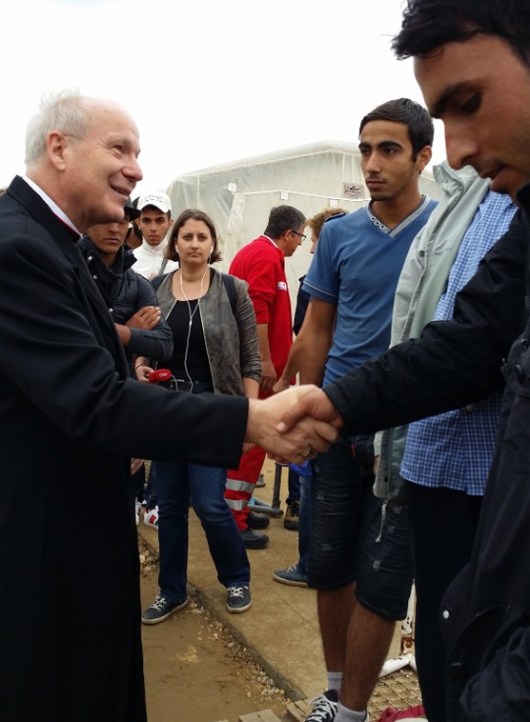
I feel a great sense of gratitude towards Cardinal Schönborn for his deep wisdom and obvious love for humanity, that has also shone during this last days in his welcoming of Syrian refugees – a welcoming that was not only conceptual by highly practical when he went to meet and welcome them as they crossed the border from Hungary to Austria. I wish the bishops of other Central European countries would follow his example. I am also grateful to Fr. Spadaro for not only having conducted such an outstanding interview, but for having made it freely available. Thank you!


The face of mercy

Arcabas prodigal son

On Saturday evening, on the eve of Mercy Sunday, Pope Francis proclaimed the opening of the Extraordinary Jubilee of Mercy that will run from 8th December 2015 until 20th November 2016 by presenting the bull of indiction, Misericordiae Vultus – “The face of mercy.” At 9.5K words some have called it “Evangelii Gaudium II” already, and in terms of significance of content, it is not hard to see why. If you have the time and inclination, I would very much like to encourage you to read it in full, but, if you prefer, the following is my selection of key passages from this important statement.

To begin with, Francis identifies mercy with Jesus and its recipients with all of humanity:

“Jesus Christ is the face of the Father’s mercy. These words might well sum up the mystery of the Christian faith. Mercy has become living and visible in Jesus of Nazareth, reaching its culmination in him.” (§1)

“How much I desire that the year to come will be steeped in mercy, so that we can go out to every man and woman, bringing the goodness and tenderness of God! May the balm of mercy reach everyone, both believers and those far away, as a sign that the Kingdom of God is already present in our midst!” (§6)

A love that to God is “visceral,” fatherly and motherly is then presented as the motivation for mercy:

“[T]he mercy of God is not an abstract idea, but a concrete reality through which he reveals his love as that of a father or a mother, moved to the very depths out of love for their child. It is hardly an exaggeration to say that this is a “visceral” love. It gushes forth from the depths naturally, full of tenderness and compassion, indulgence and mercy.” (§6)

Several parables are then pointed to as examples of Jesus explaining what mercy means, with a particularly poignant one being the parable of the ruthless servant in which mercy becomes “a criterion for ascertaining who his true children are”:

“In the parables devoted to mercy, Jesus reveals the nature of God as that of a Father who never gives up until he has forgiven the wrong and overcome rejection with compassion and mercy. We know these parables well, three in particular: the lost sheep, the lost coin, and the father with two sons (cf. Lk 15:1-32). In these parables, God is always presented as full of joy, especially when he pardons. In them we find the core of the Gospel and of our faith, because mercy is presented as a force that overcomes everything, filling the heart with love and bringing consolation through pardon. […]

“[In the parable of the “ruthless servant,” (Matthew 18:21-35)] Jesus affirms that mercy is not only an action of the Father, it becomes a criterion for ascertaining who his true children are. In short, we are called to show mercy because mercy has first been shown to us. Pardoning offences becomes the clearest expression of merciful love, and for us Christians it is an imperative from which we cannot excuse ourselves. At times how hard it seems to forgive! And yet pardon is the instrument placed into our fragile hands to attain serenity of heart. To let go of anger, wrath, violence, and revenge are necessary conditions to living joyfully. Let us therefore heed the Apostle’s exhortation: “Do not let the sun go down on your anger” (Eph 4:26). Above all, let us listen to the words of Jesus who made mercy as an ideal of life and a criterion for the credibility of our faith: “Blessed are the merciful, for they shall obtain mercy” (Mt 5:7): the beatitude to which we should particularly aspire in this Holy Year.” (§9)

Having set out the centrality of mercy in Jesus’ teaching and identified it with Him, Pope Francis places it at the basis of the Church and insists that “nothing in her preaching and in her witness to the world can be lacking in mercy”:

“Mercy is the very foundation of the Church’s life. All of her pastoral activity should be caught up in the tenderness she makes present to believers; nothing in her preaching and in her witness to the world can be lacking in mercy. The Church’s very credibility is seen in how she shows merciful and compassionate love. The Church “has an endless desire to show mercy.” Perhaps we have long since forgotten how to show and live the way of mercy. The temptation, on the one hand, to focus exclusively on justice made us forget that this is only the first, albeit necessary and indispensable step. But the Church needs to go beyond and strive for a higher and more important goal. On the other hand, sad to say, we must admit that the practice of mercy is waning in the wider culture. It some cases the word seems to have dropped out of use. However, without a witness to mercy, life becomes fruitless and sterile, as if sequestered in a barren desert. The time has come for the Church to take up the joyful call to mercy once more. It is time to return to the basics and to bear the weaknesses and struggles of our brothers and sisters. Mercy is the force that reawakens us to new life and instils in us the courage to look to the future with hope.” (§10)

Next, two complementary points are made about language and silence: the need for merciful expression and for silence so as to hear God’s Word:

“It is absolutely essential for the Church and for the credibility of her message that she herself live and testify to mercy. Her language and her gestures must transmit mercy, so as to touch the hearts of all people and inspire them once more to find the road that leads to the Father.” (§12)

“The Evangelist reminds us of the teaching of Jesus who says, “Be merciful just as your Father is merciful” (Lk 6:36). It is a programme of life as demanding as it is rich with joy and peace. Jesus’s command is directed to anyone willing to listen to his voice (cf. Lk 6:27). In order to be capable of mercy, therefore, we must first of all dispose ourselves to listen to the Word of God. This means rediscovering the value of silence in order to meditate on the Word that comes to us. In this way, it will be possible to contemplate God’s mercy and adopt it as our lifestyle.” (§13)

To complement the positive expressions of mercy, Pope Francis also sets out a negative one (negative in the sense that it proscribes rather than prescribes) that echoes his “Who am I to judge?” that so many have downplayed since it was pronounced in an interview rather than an official, magisterial document:

“The Lord asks us above all not to judge and not to condemn [cf. (Luke 6:37-38)]. If anyone wishes to avoid God’s judgement, he should not make himself the judge of his brother or sister. Human beings, whenever they judge, look no farther than the surface, whereas the Father looks into the very depths of the soul. How much harm words do when they are motivated by feelings of jealousy and envy! To speak ill of others puts them in a bad light, undermines their reputation and leaves them prey to the whims of gossip. To refrain from judgement and condemnation means, in a positive sense, to know how to accept the good in every person and to spare him any suffering that might be caused by our partial judgment and our presumption to know everything about him. But this is still not sufficient to express mercy. Jesus asks us also to forgive and to give. To be instruments of mercy because it was we who first received mercy from God. To be generous with others, knowing that God showers his goodness upon us with immense generosity.” (§14)

Pope Francis then links mercy to the Father’s self-giving that he characterizes using the hallmarks of the life of the Trinity:

“Merciful like the Father, therefore, is the “motto” of this Holy Year. In mercy, we find proof of how God loves us. He gives his entire self, always, freely, asking nothing in return. He comes to our aid whenever we call upon him.” (§14)

Leading his exposition of mercy to practical measures, Francis points to the corporal and spiritual acts of mercy that the Church has advocated since its beginning:

“Jesus introduces us to these works of mercy in his preaching so that we can know whether or not we are living as his disciples. Let us rediscover these corporal works of mercy: to feed the hungry, give drink to the thirsty, clothe the naked, welcome the stranger, heal the sick, visit the imprisoned, and bury the dead. And let us not forget the spiritual works of mercy: to counsel the doubtful, instruct the ignorant, admonish sinners, comfort the afflicted, forgive offences, bear patiently those who do us ill, and pray for the living and the dead.

We cannot escape the Lord’s words to us, and they will serve as the criteria upon which we will be judged: whether we have fed the hungry and given drink to the thirsty, welcomed the stranger and clothed the naked, or spent time with the sick and those in prison (cf. Mt 25:31-45). Moreover, we will be asked if we have helped others to escape the doubt that causes them to fall into despair and which is often a source of loneliness; if we have helped to overcome the ignorance in which millions of people live, especially children deprived of the necessary means to free them from the bonds of poverty; if we have been close to the lonely and afflicted; if we have forgiven those who have offended us and have rejected all forms of anger and hate that lead to violence; if we have had the kind of patience God shows, who is so patient with us; and if we have commended our brothers and sisters to the Lord in prayer. In each of these “little ones,” Christ himself is present. His flesh becomes visible in the flesh of the tortured, the crushed, the scourged, the malnourished, and the exiled … to be acknowledged, touched, and cared for by us. Let us not forget the words of Saint John of the Cross: “as we prepare to leave this life, we will be judged on the basis of love.”” (§15)

That mercy is not about following rules, but about a going out towards those who are in need of it and a respect for their dignity, is put clearly next:

“For his part, Jesus speaks several times of the importance of faith over and above the observance of the law. It is in this sense that we must understand his words when, reclining at table with Matthew and other tax collectors and sinners, he says to the Pharisees raising objections to him, “Go and learn the meaning of ‘I desire mercy not sacrifice.’ I have come not to call the righteous, but sinners.” (Mt 9:13). Faced with a vision of justice as the mere observance of the law that judges people simply by dividing them into two groups – the just and sinners – Jesus is bent on revealing the great gift of mercy that searches out sinners and offers them pardon and salvation. One can see why, on the basis of such a liberating vision of mercy as a source of new life, Jesus was rejected by the Pharisees and the other teachers of the law. In an attempt to remain faithful to the law, they merely placed burdens on the shoulders of others and undermined the Father’s mercy. The appeal to a faithful observance of the law must not prevent attention from being given to matters that touch upon the dignity of the person.” (§20)

Pope Francis then goes on to situating mercy in an inter-religious context, with a particular focus on Judaism and Islam, and with a call to open-mindedness, respect and peacefulness:

“There is an aspect of mercy that goes beyond the confines of the Church. It relates us to Judaism and Islam, both of which consider mercy to be one of God’s most important attributes. Israel was the first to receive this revelation which continues in history as the source of an inexhaustible richness meant to be shared with all mankind. As we have seen, the pages of the Old Testament are steeped in mercy, because they narrate the works that the Lord performed in favour of his people at the most trying moments of their history. Among the privileged names that Islam attributes to the Creator are “Merciful and Kind.” This invocation is often on the lips of faithful Muslims who feel themselves accompanied and sustained by mercy in their daily weakness. They too believe that no one can place a limit on divine mercy because its doors are always open.

I trust that this Jubilee year celebrating the mercy of God will foster an encounter with these religions and with other noble religious traditions; may it open us to even more fervent dialogue so that we might know and understand one another better; may it eliminate every form of closed-mindedness and disrespect, and drive out every form of violence and discrimination.” (§23)

The next day – on Mercy Sunday, Pope Francis returned to the starting point of Misericordiae Vultus, where he identifies mercy with Jesus and went on to spell out the basis of that identity:


“[T]he Lord shows us, through the Gospel, his wounds.  They are wounds of mercy.  It is true: the wounds of Jesus are wounds of mercy. […]

Jesus invites us to behold these wounds, to touch them as Thomas did, to heal our lack of belief.  Above all, he invites us to enter into the mystery of these wounds, which is the mystery of his merciful love. Through these wounds, as in a light-filled opening, we can see the entire mystery of Christ and of God: his Passion, his earthly life – filled with compassion for the weak and the sick – his incarnation in the womb of Mary.

Faced with the tragic events of human history we can feel crushed at times, asking ourselves, “Why?”.  Humanity’s evil can appear in the world like an abyss, a great void: empty of love, empty of goodness, empty of life.  And so we ask: how can we fill this abyss?  For us it is impossible; only God can fill this emptiness that evil brings to our hearts and to human history.  It is Jesus, God made man, who died on the Cross and who fills the abyss of sin with the depth of his mercy.”

Asymmetry

Polyhedron2

In Manila, Pope Francis returned to a concept that he first introduced in Evangelii Gaudium – that of the polyhedron being the ideal of social interaction instead of the, seemingly more perfect, sphere. There, speaking about “ideological colonization,” he said:

“[W]hen conditions are imposed by […] colonizing empires they seek to make peoples forget their own identity and make them (all) equal. This is the globalization of the sphere – all the points are equidistant from the center. But the true globalization […] is not the sphere. It is important to globalize […] not like the sphere, but like the polyhedron. Namely that every people, every part, conserves its own identity without being ideologically colonized.”

To make more sense of the sphere-polyhedron distinction, let’s go back to Evangelii Gaudium, where it is presented in the context of strategies for contributing to the common good and peace in society. There, Francis gives preference to time over space (§222-225), unity over conflict (§226-230), realities over ideas (§231-233) and finally the whole over the part. However, he is quick to argue that the part is not negated or subsumed in the whole, but that they mutually enrich each other (§235):

“The whole is greater than the part, but it is also greater than the sum of its parts. There is no need, then, to be overly obsessed with limited and particular questions. We constantly have to broaden our horizons and see the greater good which will benefit us all. But this has to be done without evasion or uprooting. We need to sink our roots deeper into the fertile soil and history of our native place, which is a gift of God. We can work on a small scale, in our own neighborhood, but with a larger perspective. Nor do people who wholeheartedly enter into the life of a community need to lose their individualism or hide their identity; instead, they receive new impulses to personal growth. The global need not stifle, nor the particular prove barren.”

And it is in the context of how the whole and its parts can be thought of without the former stifling the latter that the concept of the polyhedron comes into play (§236):

“Here our model is not the sphere, which is no greater than its parts, where every point is equidistant from the centre, and there are no differences between them. Instead, it is the polyhedron, which reflects the convergence of all its parts, each of which preserves its distinctiveness. Pastoral and political activity alike seek to gather in this polyhedron the best of each. There is a place for the poor and their culture, their aspirations and their potential. Even people who can be considered dubious on account of their errors have something to offer which must not be overlooked. It is the convergence of peoples who, within the universal order, maintain their own individuality; it is the sum total of persons within a society which pursues the common good, which truly has a place for everyone.”

Reading the above, I believe, that the image of a polyhedron also points to another fundamental feature, implicit in the distinction between sphere and polyhedron, which is that of asymmetry.

Purely on geometric grounds, an obvious distinction between a sphere and any polyhedron is that the former abounds in symmetry: an infinity of rotation symmetries around the sphere’s center, an infinity of reflection symmetries with respect to any plane containing the sphere’s center and a central point symmetry, also with respect to its center, not to mention a host of other symmetry groups. On the other hand, a polyhedron, in general, has no guaranteed symmetry whatsoever, where each of its vertices may relate to all the others in a unique way and where even subsets of the polyhedron’s vertices may form geometries distinct from those of other vertex subsets. As a result, the polyhedron formed by a set of vertices, edges and faces is both a unique whole and one whose nature depends on where each one of its components is located, potentially without any symmetry at all. In fact, the absence of symmetry can also be though of as an expression of the non-redundancy of the polyhedron’s parts, since any, even partial symmetries or repetitions would allow for a representation of the polyhedron that no longer requires a reliance on all of its parts. The sphere here represents an extreme, where the infinite continuum of points that form its surface can be reduced just to the coordinates of its center and its radius. Incidentally this line of thinking also resonates with Pope Francis’ early insistence on the importance of peripheries, expressed by him saying that “We understand reality better not from the center, but from the peripheries.” To understand a polyhedron requires traversing its vertices, edges and faces that form its perimeter, while a sphere can be “understood” from its center and radius, since its surface can be inferred from them, without ever being traversed.

Asymmetry not only means that each member is necessary for the identity of the resulting whole, but it is also a principle that is deeply embedded in Jesus’ life and teaching. His incarnation itself is vastly asymmetrical, since it is the infinite, unbounded God making Himself spatiotemporally finite, as is His death on the cross, where his one life is given “so that everyone who believes in him might not perish but might have eternal life.” (John 3:16). The all becomes one to save the many.

Jesus’ teaching too is full of asymmetry, starting with the following, emphatic passage:

“But to you who hear I say, love your enemies, do good to those who hate you, bless those who curse you, pray for those who mistreat you. To the person who strikes you on one cheek, offer the other one as well, and from the person who takes your cloak, do not withhold even your tunic. Give to everyone who asks of you, and from the one who takes what is yours do not demand it back.” (Luke 6:27-30)

In St. Matthew’s account of the same speech, we then hear Jesus adding: “If anyone wants to go to law with you over your tunic, hand him your cloak as well. Should anyone press you into service for one mile, go with him for two miles.” (Matthew 5:40-41).

Love-hate, bless-curse, pray-mistreat, strike-offer, take-give, tunic-tunic+cloak.

And the madness doesn’t stop there! The asymmetrical rewards offered in the parable of the workers in the vineyard have those who have worked a full day complain to the owner: “These last ones worked only one hour, and you have made them equal to us, who bore the day’s burden and the heat.” (Matthew 20:12). The pittance offered by a poor widow is valued above the large sums contributed by the rich (cf. Mark 12:41-44) and asymmetry is also at the heart of Jesus’ exhortation to “be shrewd as serpents and simple as doves” (Matthew 10:16).

Not only are action and reaction, action and reward asymmetrical, but asymmetry is at the very heart of God’s own inner life and at the core of love as such. The gratuity of love and the very concept of a gift hinge on asymmetry. I give without expecting anything in return, for if I did, my gift would not be a gift at all, but – at least implicitly – an exchange, a transaction, a symmetrical process. In the Trinity the Father gives all of Himself to the Son, without holding back or without requiring prior guarantees of equal recompense. The Son too gives Himself to the Father unreservedly and totally, making Himself nothing to Himself and all as gift to the Father. The Holy Spirit makes Himself empty unconditionally to allow for the love of the Father and the Son to find space in Him. Each Person of the Trinity is ultimately asymmetrical: a gift of self outside oneself, for the other; nothing and everything. It is only on this asymmetry that Father, Son and Holy Spirit are one – a one that is dynamic (instead of being static), varied (instead of being monotonous) and communion (instead of being regimented).

A consequence of the asymmetry of love is also a difference in what to expect of oneself versus others. For my actions to be gratuitous and an expression of love, their end must remain their being love, gift and a benefit for the other. If they get reciprocated, my neighbor and I share in the life of the Trinity and we become one without either of us being annihilated.

I believe it is for these same reasons that St. John Paul II used to say: “Be strict to yourself and lenient with everyone else.” and that I choose to constrain what I say and do, out of love for my neighbors, without wanting to impose those same constraints on them. For by imposing them, I would preclude them from freely choosing to self-apply them out of love for me.

Jesus the blasphemer

After the Charlie Hebdo attack, I was struck by a tweet from the Protestant theologian and Yale professor, Miroslav Volf:

“Jesus was crucified for “blasphemy.” Blasphemers should not be crucified, or killed, or punished in any way.”

This assertion of Jesus having been a blasphemer stopped me in my tracks, as I have never thought of him in that way. Good Shepherd, Son of God, Paschal Lamb, and Word Made Flesh would ring a bell, but not Blasphemer. Then, I started thinking about all the offense Jesus has caused during his lifetime: fraternizing with tax collectors and prostitutes (cf. Luke 5:27-32), healing the sick on the Sabbath (cf. Mark 3:1-6), having his disciples eat corn without washing their hands (cf. Mark 7:2), making ludicrous claims about rebuilding the temple in Jerusalem in three days (cf. John 2:19), and even his death on a cross was perceived as a scandal (cf. 1 Corinthians 1:23) … And how did his listeners react? Exactly as Pope Francis suggested recently – with threats and violence, to the point of dragging Jesus to the edge of a cliff and wanting to throw him to his death (cf. Luke 4:29), or to making him fear for his life to the point of deciding to hide from the people he scandalized and who were about to stone him (cf. John 8:59).

Suddenly adding blasphemy to the list doesn’t seem like such a stretch, and in fact the Gospel accounts of Jesus’ trial clearly state that this was the charge brought against him.

When questioned by the Sanhedrin during the night at the start of Good Friday, the high priest commanded Jesus: “I order you to tell us under oath before the living God whether you are the Messiah, the Son of God.” (Matthew 26:63), to which Jesus responded: “You have said so. But I tell you: From now on you will see ‘the Son of Man seated at the right hand of the Power’ and ‘coming on the clouds of heaven.’” (Matthew 26:64). Jesus’ words then triggered the following scene:

““Then the high priest tore his robes and said, “He has blasphemed! What further need have we of witnesses? You have now heard the blasphemy; what is your opinion?” They said in reply, “He deserves to die!” (Matthew 26:65-66)

The determination of Jesus’ blasphemer status is then presented to Pilate by his accusers as the grounds for having the secular powers of the Roman Empire put him to death: “We have a law, and according to that law he ought to die, because he made himself the Son of God.” (John 19:7)

The above may seem pretty cut-and-dried, but, like all legal arguments, it too is just that – arguable. Here the New American Bible has the following, interesting note on Jesus’ blasphemy, as a commentary on the passage about his hearing before the Sanhedrin:

Blasphemed: the punishment for blasphemy was death by stoning (see Leviticus 24:10–16). According to the Mishnah, to be guilty of blasphemy one had to pronounce “the Name itself,” i.e., Yahweh […]. Those who judge the gospel accounts of Jesus’ trial by the later Mishnah standards point out that Jesus uses the surrogate “the Power,” and hence no Jewish court would have regarded him as guilty of blasphemy; others hold that the Mishnah’s narrow understanding of blasphemy was a later development.”

The spirit of what Jesus said certainly qualified as blasphemy, while the letter may have been arguable. Nonetheless, this guy, who was going around Galilee and Judea, telling everyone he was the Son of God, was guilty – a blasphemer! – and had to be killed. It’s the law. The Bible say so …

Now, you may ask yourself, where am I going wit all of this? And that brings us to Charlie Hebdo and other brutal murders of those who speak out against oppressors of free speech, whether they be religious or atheist regimes (and, sadly, there are plenty of examples of both, both in the present and the past). In the case of Charlie Hebdo too we have a bunch of blasphemers, depicting what the law decries as insulting and blasphemous, and law-abiding believers doing their bit for the law’s just punishment being meted out.

Is what the Charlie Hebdo murderers have done consistent with how the vast majority of Muslims understand Islam? Is what Charlie Hebdo have been publishing detestable, crude and inciting of hatred?

Regardless of how those questions are answered (and I’d say “no” and “in some cases, yes”), the first order of business has to be a defense of the freedom of speech – and not just the freedom of “good” speech. Is this an argument for all speech being equal? Absolutely not! And neither is it an expression of support for what publications like Charlie Hebdo have been doing. Instead it is an insistence on the absolute value of free speech. And once that is given, arguments against expressions like Charlie Hebdo can be made (and must be made). Arguments to convince their listeners and readers of such offensive expressions being contrary to the common good, risking an angry (albeit wrong!) response, and not being the most efficacious ways of fighting against oppression, corruption or bigotry. But these must be arguments made on the foundation of free speech where its limiting to “good” free speech becomes a choice of the individual and not the imposed dictate of a legislative regime that is enforced at all cost, including the administration of death.

Making freedom of speech about “good” speech turns it into its opposite, as is clear both from fictional (although chillingly prophetic) accounts like George Orwell’s 1984 and the enforced superficial innocuousness of public speech in 20th century communist regimes, where everything was wonderful, according to plan, fraternal and equal. Unless you made fun of it that is … in which case you’d qualify for a “Golden Bars” award (bars that were not golden, but embedded in prison walls instead). And the distortions of political correctness that grip many countries today are a scarily similar phenomenon. Only two days ago did I hear the following here in the US, in response to showing a historical photo of a Native American during a presentation to illustrate that a certain process was native to its context: “Um … You should be careful about saying “native.” It is a very sensitive term here. Saying Red Indian or chief or similar can be offensive. Some sports teams here have already changed their names not to offend.” My colleague then proceeded to tiptoe around such a sensitive topic and ended up using the term “native” as a non-offensive way of referring to this whole faux pas of mine – the exact term that initially triggered the friendly advice.

Freedom of speech is clearly a complex question and it is easy to come up with examples of things that shouldn’t be said (e.g., racist slurs), that shouldn’t be made fun of (e.g., genocide), that should not be promoted (e.g., violence or exploitation). And I would unquestionably agree with that and support very specific, narrow constraints on freedom of speech. However, the easy solution of criminalizing whole categories of verbal expression brings with it great dangers in that those same legal instruments may be abused for very different ends. The extremes here are totalitarian regimes that criminalize any criticism of themselves and that consider any such criticism an offense against the common good that their leaders embody. In our democratic societies too there are dangers, where governments have been prone to overstep their remits and where legislation to prevent terrorism has enabled infringements of privacy and the gagging or undermining of critical voices. A society that cannot handle hearing ideas it disagrees with will eventually descend into fear and caution, rendering speech lukewarm. Speech that becomes barely worthy of being spat out.

I am therefore wholeheartedly with Volf: “Blasphemers should not be crucified, or killed, or punished in any way.” Instead, they should be challenged and engaged with in the same free speech context they employ and, who knows, maybe such engagement (instead of a silencing by law or bullets) could let all discover each other’s brothers and sisters on the other side of the argument.

The Parable of the Good Lesbian

Good samaritan

A very good friend of mine, MK, wrote the following on Facebook a couple of days ago: “I think that if Jesus was telling the parable of the good Samaritan today, maybe it would be the parable of the good gay.” And, as soon as I saw it, I “liked” it, since it seemed to fit Jesus’ choice of profile for that particular parable character like a glove – i.e., as someone who is frowned upon, mistrusted and seen as repulsive by “good” God-fearing folk, and with whom there is an us-versus-them that needs to be undermined.

A short while later I noticed that MK’s Facebook status had received 43 comments, dominated by outrage, exhortations to read St. Paul (undoubtedly a good idea, and one, which that comment’s author should also self-apply) and a bandying-about of phrases like “the truth of Christ” (as if there were different flavors of truth). There were also reasonable comments, but these formed a small minority among the sea of tirades that followed the outrageous suggestion that homosexuals could be thought of as today’s equivalent of first-century Judea’s Samaritans.

My immediate reaction to seeing this was to look more closely at the Good Samaritan parable and get a sense of how well founded MK’s suggestion for its contemporary adaptation is – not so much for the sake of assessing its reasonableness (which had intuitive appeal to me from the start), but to get a more specific sense of its context and exegesis.

To get an idea of how Jews and Samaritans got on with each other, Blessed John Henry Newman provides the following summary, after giving an account of mutual killings between the two peoples:

“[… T]he strongest expression of hatred the Jews could invent against Christ was ‘Thou art a Samaritan and hast a devil’ (John 8:48). [… I]f a Jew and a Samaritan met in a narrow way, they were particularly careful to avoid touching each fearing to receive pollution from the other.”

Saying “Samaritan” in the first century AD to an audience of Jewish lawyers (as Jesus – and, lets not forget, himself a Jew, did), seems to have been the same kind of trigger as saying “gay” is today to my friend’s “Christian” contacts. 1:0 to MK – the glove does indeed seem to fit.

Let me next take a look at how the last three popes have read this parable and see whether that sheds light on the transposition proposed by my friend.

St. John Paul II spoke at length about the Parable of the Good Samaritan in his apostolic letter on suffering, Salvifici Doloris (§28):

“The parable of the Good Samaritan belongs to the Gospel of suffering. For it indicates what the relationship of each of us must be towards our suffering neighbour. We are not allowed to “pass by on the other side” indifferently; we must “stop” beside him. Everyone who stops beside the suffering of another person, whatever form it may take, is a Good Samaritan. This stopping does not mean curiosity but availability. It is like the opening of a certain interior disposition of the heart, which also has an emotional expression of its own. The name “Good Samaritan” fits every individual who is sensitive to the sufferings of others, who “is moved” by the misfortune of another. If Christ, who knows the interior of man, emphasizes this compassion, this means that it is important for our whole attitude to others’ suffering. Therefore one must cultivate this sensitivity of heart, which bears witness to compassion towards a suffering person. Some times this compassion remains the only or principal expression of our love for and solidarity with the sufferer.

Nevertheless, the Good Samaritan of Christ’s parable does not stop at sympathy and compassion alone. They become for him an incentive to actions aimed at bringing help to the injured man. In a word, then, a Good Samaritan is one who brings help in suffering, whatever its nature may be. Help which is, as far as possible, effective. He puts his whole heart into it, nor does he spare material means. We can say that he gives himself, his very “I”, opening this “I” to the other person. Here we touch upon one of the key-points of all Christian anthropology. Man cannot “fully find himself except through a sincere gift of himself” (Gaudium et Spes, 24). A Good Samaritan is the person capable of exactly such a gift of self.”

What strikes me here immediately are two things: first, the deep-seated universality of St. John Paul II’s words, addressed to “each of us,” “everyone,” “every individual,” where “Good Samaritan” status is predicated only on one’s capacity for “a gift of self.” Second, the imperative nature of his words which insist both on what we must do (being sensitive to, moved by and helping our suffering neighbors; being compassionate and self-giving) and what we are not allowed to do: be indifferent. This exegesis too easily extends to homosexuals, who are undoubtedly in a position of showing compassion to those around them and of selflessly coming to their aid.

Pope Benedict XVI adds further clarity to this universally-predicated imperative to love, in his exceptional piece of thinking: the encyclical Deus Caritas Est:

“14. […] Union with Christ is also union with all those to whom he gives himself. I cannot possess Christ just for myself; I can belong to him only in union with all those who have become, or who will become, his own. […] We become “one body”, completely joined in a single existence. Love of God and love of neighbour are now truly united: God incarnate draws us all to himself. […] the “commandment” of love is only possible because it is more than a requirement. Love can be “commanded” because it has first been given.

15. This principle is the starting-point for understanding the great parables of Jesus. […] The parable of the Good Samaritan (cf. Lk 10:25-37) offers two particularly important clarifications. Until that time, the concept of “neighbour” was understood as referring essentially to one’s countrymen and to foreigners who had settled in the land of Israel; in other words, to the closely-knit community of a single country or people. This limit is now abolished. Anyone who needs me, and whom I can help, is my neighbour. The concept of “neighbour” is now universalized, yet it remains concrete. Despite being extended to all mankind, it is not reduced to a generic, abstract and undemanding expression of love, but calls for my own practical commitment here and now. The Church has the duty to interpret ever anew this relationship between near and far with regard to the actual daily life of her members.”

For me, the most significant aspect of this passage is Benedict’s insistence on love being a commandment and on the justification of its imperative status being the precedent of God’s love. Since the source of this “obligation” to love is inexhaustible, its scope too is universal (as St. John Paul II already made clear). Furthermore, Benedict also calls for a keeping current of what such universality means in the present. This is very much in line with the current process of discernment underway in the Catholic Church, which is on the road to the second Synod on the Family this October. Specifically, the challenges of how to provide opportunities for homosexuals to feel part of the Church are on the table there too, which is easily read as an instance of Benedict’s “interpret[ing] ever anew this relationship between near and far.”

Finally, let’s hear what Pope Francis has to say about this parable:

“The Gospel passage from St Luke (10:25-37) tells of a certain man, half dead, who had been thrown into the street. Now by chance a priest was going down that road. A good priest, in his cassock: good, very good. He saw him and looked: I’ll be late for Mass, and he went on his way. He didn’t hear the voice of God there”. […] It is curious to note that only a man who habitually fled from God, a sinner, the Samaritan, was the very one who perceived the voice of God. He drew near to the man. He bound up his wounds, pouring on oil and wine; then he set him on his own beast. Oh how much time he lost: he brought him to an inn, and took care of him. He lost the whole evening! In the meantime, the priest arrived in time for the Holy Mass and all the faithful were content.

Why did the priest flee from God? Because his heart was closed. When your heart is closed you cannot hear the voice of God. Instead, it was a Samaritan on a journey who saw the wounded man and had compassion. His heart was opened, he had a human heart. His humanity enabled him to draw near.

The priest had a plan for his life: he wanted to write his own history well, according to God’s ways. But he was the one writing it. However, this other sinner allowed God to write the history of his life. He changed all his plans that evening because the Lord placed before him this poor, wounded man who had been thrown out onto the street.

I ask myself and I also ask you: do we allow God to write the history of our lives or do we want to write it? This speaks to us of docility: are we docile to the Word of God? Yes, I want to be docile, but are you able to listen to his Word, to hear it? Are you able to find the Word of God in the history of each day, or do your ideas so govern you that you do not allow the Lord to surprise you and speak to you?”

What strikes me here is the supremacy of openness over righteousness. Making oneself the ultimate judge (+ jury & executioner), instead of opening oneself up to discerning the will of God and listening to the promptings of the Holy Spirit through one’s conscience, leads to a spoiling even of things that are good in themselves and to an assumption of ultimate power by an imperfect subject. Instead, the admission of sinfulness, that Pope Francis (and before him the saints universally) has made for himself and that each one of us can recognize in our own lives, if we are sincere enough, helps us both to recognize brothers and sisters in all, without exception, and to open ourselves up to God’s surprises.