Like a tax collector

Publicanus

Tom and Jack are standing at the back of the crowd that had gathered to listen to their beloved master. At these events you just never know when some old lady would faint and need of a drop of water, or even the healing hands of Luke. Having a medic with them was a real blessing – and such good planning! In any case, keeping to the peripheries afforded an easy view of anything that needed attention and cut out the jostling that would otherwise be inevitable even for the simplest of things. To be honest, however, having Tom wasn’t always an asset, with his quick temper and occasional outbursts of proselytism. He was a solid guy though and his total commitment beyond question.

“Can you hear him?” an old man whisper-shouted at Tom. “Barely. Try to squeeze closer to the center, if you can. Let the man through, people – at his age you’d appreciate the kindness too!”

“If your brother does something wrong, have it out with him alone, between your two selves. If he listens to you, you have won back your brother.”1

“Classic Jesus!” whispers Jack to Tom. “I love this guy …”

“If he does not listen, take one or two others along with you: the evidence of two or three witnesses is required to sustain any charge. But if he refuses to listen to these, report it to the community.”2

“And, see how he advocates due process and checks and balances. This is exactly what we need!” Jack continues to Tom.

“And if he refuses to listen to the community, treat him like a pagan or a tax collector.”3

“That’s it!” exclaims Tom. “See, justice will catch up with transgressors.” he adds, turning to Jack.

“Sure.” admits Jack flatly, with a mischievous smile only just detectable on his lips, and thinks to himself: “Teaching moment coming up.”

“Listen, Tom, can you remind me, how are we to treat ‘pagans and tax collectors’ again?” “Like scum! Why? Because they are scum! Just look at them. Pagans give offense to God and all who worship Him, and tax collectors … Don’t get me started on tax collectors! They are what’s wrong with this country! Sowing misery wherever they go, adding to the Empire’s extortion and getting fat and lazy, heads deep in the trough. They give pigs a bad name!”

“Interesting …” Jack pretends to ponder Tom’s words and, with the most innocent expression he can muster, turns to him with the killer question: “Remind me, Tom, how is it that our Master treats these “offenders” and “pigs,” as you put it?” “What do you mean?!” Tom snaps back, blood visibly rushing to his head.

“Let me tell you a story,” Jack says calmly, while enjoying himself just a tad too much. “Remember that fella, Zac?4 A tax collector par excellence! Fat little chap. Cheating and thieving left, right and center. And what does Jesus do? Homes in on the wretch, looking past all the good people lining his path, calls him down from a tree he climbed up – the grotesque fool, and – to freak the respectable citizenry out even more – invites himself to his place for dinner! Jesus may as well have hugged him … That’s what “treating someone like a tax collector” looks like!” finishes Jack with a flourish.

“Well said kiddo,” adds Jesus who suddenly appears next to our lads, so deep in conversation they were oblivious to everyone else having left, “but there’s no need to be smug about it. Tom is a hothead, yet he is just as much my favorite as you are!”


1Matthew 18:15.
2Matthew 18:16-17a.
3Matthew 18:17b.
4 Cf. Luke 19:1-10.

Probably the best movie about Jesus

Il vangelo

Franco Zefirelli’s “Jesus of Nazareth”? No. (Phew!)

Mel Gibson’s “The Passion of the Christ”? No, not that one either. (Phew, again!)

No, “probably the best movie about Jesus” is Pier Paolo Pasolini’s “The Gospel According to St. Matthew.”

“Says who?,” you ask.

Well, none other than the Vatican’s own newspaper, l’Osservatore Romano, which in a review on the 50th anniversary of the movie’s premiere had the following to say (in the words of Emilio Ranzato):

“Whether it be a movie about a crisis in progress or about its overcoming, The Gospel according to Matthew remains a masterpiece, and probably the best movie about Jesus ever made. It is certainly the one in which his words ring out most fluidly, in the most elevated and the most powerful way. Hewn out of bare rock, like the best moments of Pasolinian cinema.”

But, what makes this movie the pinnacle of depicting Jesus’ life? The l’Osservatore Romano review elaborates:

“The director follows the Gospel pages to the letter and doesn’t shy away even from talking about miracles, which he presents with an inspiration worthy of a believer. In this way, on the one hand confirming the validity and power of the Christian word, but, on the other hand, giving it a more down-to-earth context in which to spread, the director clearly intends to give a thrust both towards the marxist and ecclesial worlds. At the same time, however, and maybe unexpectedly, he finds peace in a place that is equidistant from these two poles. Surely there have been few other times in the history of cinema where a representation that plays on sacred strings, or even only mythical and epic ones, has been built on such a sincere realism.”

So, what drove this marxist (and atheist and gay) director to making a movie about Jesus? He explains this himself – during the year before the movie’s release – in a letter to Lucio Caruso of the Pro Civitate Christiana of Assisi (a Christian volunteer organization):

“The first time I visited all of you in Assisi, I found the Gospels at my bedside: your diabolical calculation!

That day, in your place, I read them from beginning to end, like a novel.

And in the exaltation of reading – as you know, it’s the most exalting thing one can read! – there came to me among other things, the idea of making a film… as the days and later the weeks went by, the idea kept getting more overwhelming and exclusive. It threw in the shade all the other ideas for work I had in my head, it weakened and devitalised them.

And it alone remained, alive and thriving within me… my idea is this: to follow the Gospel according to Saint Matthew, point by point, without making a script or adaptation of it. To translate it faithfully into images, following its story exactly without any omissions or additions.

The dialogue too should be strictly that of Saint Matthew, without even a single explanatory or connecting sentence, because no image or inserted word could ever attain the poetic heights of the text… to put it very simply and frankly, I don’t believe that Christ is the son of God, because I am not a believer – at least not consciously. But I believe that Christ is divine. I believe that is, that in him humanity is so kind and ideal as to exceed the common terms of humanity. For this reason I say “poetry” – an irrational instrument to express this irrational feeling of mine for Christ.”

His answer to the question of why he, a non-believer, had made a film which dealt with religious themes, at a press conference in 1966, is also illuminating:

“If you know that I am an unbeliever, then you know me better than I do myself. I may be an unbeliever, but I am an unbeliever who has a nostalgia for a belief.”

But, how does one who is not a Christian create a piece of art that is recognized by Christians as their own, and not only that, but a masterpiece? Here Pasolini’s answer is very telling:

“[T]he rule that dominated the making of the film was the rule of analogy. That is, I found settings that were not reconstructions but that were analogous to ancient Palestine. The characters, too—I didn’t reconstruct characters but tried to find individuals who were analogous. I was obliged to scour southern Italy, because I realized that the pre-industrial agricultural world, the still feudal area of southern Italy, was the historical setting analogous to ancient Palestine. One by one I found the settings that I needed for The Gospel. I took these Italian settings and used them to represent the originals. I took the city of Matera, and without changing it in any way, I used it to represent the ancient city of Jerusalem. Or the little caverns of the village between Lucania and Puglia are used exactly as they were, without any modifications, to represent Bethlehem. And I did the same thing for the characters. The chorus of background characters I chose from the faces of the peasants of Lucania and Puglia and Calabria. […]

In reality, my method consists simply of being sincere, honest, penetrating, precise in choosing men who psychological essence is real and genuine. Once I’ve chosen them, then my work is immensely simplified. I don’t have to do with them what I have to do with professional actors: tell them what they have to do and what they haven’t to do and the sort of people they are supposed to represent and so forth. I simply tell them to say these words in a certain frame of mind and that’s all. And they say them.”

Whether intentionally or not, this way of analogy is precisely Jesus’ own method. The employment of parables, and his teaching in its entirety rely fundamentally on analogy. Here is God – the infinite, omnipotent, omniscient, wholly transcendent and other – speaking to his creatures, who are addled with limitations, and the only possible way is that of analogy, since the listeners have no direct access to the ultimate realities that the speaker is trying to convey. At the heart of this method is in fact the very life of the Trinity, where each Person empties itself so as to receive the other and fully gives itself to the other that is ready to receive them. This self-othering1 nature of God is the basis of analogy, which Pasolini applied masterfully and I would like to argue that his work resonates with Christians not only because of the subject matter, but because of the method that begot it. And I have to say that I am a great fan of it too!

To conclude, I’d just like to share a fragment of the dialogue between the Franciscan Fr. Ugolino Vagnuzzi and Pier Paolo Pasolini that took place in June ’68 and that Fr. Vagnuzzi published a couple of days ago. It starts with Pasolini’s words:

““I saw Christ with two “eyes,” one being mine – of a rational man, modern and a lay person; the other being the look of a simple person with great faith. These two visions complement each other, I’ll explain: I saw him as the Son of God, mystically, religiously, but at the same time I saw him as a revolutionary.”

I asked him [writes Fr. Ugolino] whether before or after that Christ was so successful in the cinema, he had said something to him.

“Religious convictions or non-belief are like blocks of quartz. The reasons that make these blocks dissolve is always mysterious, so I can say neither yes nor no to you.”

I was deeply moved when he then turned to me with these words:

“You see, dear Brother, you and I are one on one and the other on the other bank of a river. A bridge unites us where we can meet. Both of us must travel some distance. I am certain that you will not say no to taking these steps, which are precious to me.””


1 A term coined by my überbestie CS.

Who are children of God?

45460002 aboud mustafa jamie areen avery2

Catholics? Christians? “Good” people?

No.

In total disagreement with the author of yesterday’s “Thoughts on today’s Mass,” distributed in my parish, who said that “we are not naturally children of God: we become so by baptism, when God adopts us as his own. Otherwise to call God our Father would be a bold presumption,” I would like to show that the Catholic Church teaches that every single human being is a child of God. Using the idea of being God’s child as the basis of separation, the basis of an “us,” as opposed to a ”them,” is perverse and absolutely not what the Catholic Church teaches, in spite of the official-looking material handed out in some of its parishes.

To begin with, Jesus – the Son of God – himself recognizes familial status universally, when he says that “whoever does the will of my heavenly Father is my brother, and sister, and mother” (Matthew 12:50) and St. Paul too picks up on the key being adherence to God’s will: “For those who are led by the Spirit of God are children of God” (Romans 8:14).

That such adherence to the will of God is open to everyone – whether they believe in God or not – and that it is at the heart of what the Catholic Church believes, is very clear from Nostra Aetate, the declaration issued during the Second Vatican Council by Pope Paul VI, which says in its closing paragraph:

“We cannot truly call on God, the Father of all, if we refuse to treat in a brotherly way any man, created as he is in the image of God. Man’s relation to God the Father and his relation to men his brothers are so linked together that Scripture says: “He who does not love does not know God” (1 John 4:8).

No foundation therefore remains for any theory or practice that leads to discrimination between man and man or people and people, so far as their human dignity and the rights flowing from it are concerned.

The Church reproves, as foreign to the mind of Christ, any discrimination against men or harassment of them because of their race, color, condition of life, or religion. On the contrary, following in the footsteps of the holy Apostles Peter and Paul, this sacred synod ardently implores the Christian faithful to “maintain good fellowship among the nations” (1 Peter 2:12), and, if possible, to live for their part in peace with all men, so that they may truly be sons of the Father who is in heaven.”

And this is also reflected in what the Catechism teaches about the opening words of the Our Father, the prayer Jesus taught:

“God’s love has no bounds, neither should our prayer. Praying “our” Father opens to us the dimensions of his love revealed in Christ: praying with and for all who do not yet know him, so that Christ may “gather into one the children of God.” God’s care for all men and for the whole of creation has inspired all the great practitioners of prayer; it should extend our prayer to the full breadth of love whenever we dare to say “our” (§2793)

Note in particular the thought-provoking idea in the above of Catholics praying with those who don’t know Jesus. Even in a fundamentally religious act the desire of Catholics is to be united with those who don’t share their beliefs!

And if the above weren’t enough to categorically declare that Catholics consider every human being to be a child of God and therefore also their brother or sister, let’s see what the last three popes had to say on the subject:

  1. “We must never forget that every person, from the moment of conception to the last breath, is a unique child of God and has a right to life.” Pope Saint John Paul II (Address at the Ceremony of the Anointing Of The Sick, Southwark’s Cathedral, London, 28 May 1982)
  2. “God is the origin of the existence of every creature, and the Father in a unique way of every human being: he has a unique, personal relationship with him or her.” Pope Benedict XVI (Sunday Angelus address, 8 January 2012)
  3. “Since many of you are not members of the Catholic Church, and others are not believers, I cordially give this blessing silently, to each of you, respecting the conscience of each, but in the knowledge that each of you is a child of God. May God bless you!” Pope Francis (Audience to Representatives of the Communications Media, 16th March 2013 – the day after his election!)
  4. “Every human being is a child of God! He or she bears the image of Christ! We ourselves need to see, and then to enable others to see, that migrants and refugees do not only represent a problem to be solved, but are brothers and sisters to be welcomed, respected and loved.” Pope Francis (Message for the World Day of Migrants and Refugees, 5 August 2013)

I rest my case.

Gifts of the Holy Spirit

Mnemosyne

Pope Francis uses virtually every opportunity he gets to speak about the Holy Spirit, with whom he calls Christians to have a personal relationship:

“We believe in God who is Father, who is Son, who is Holy Spirit. We believe in Persons, and when we talk to God we talk to Persons: or I speak with the Father, or I speak with the Son, or I speak with the Holy Spirit. And this is the faith. [… Not, a]n ‘all over the place – god,’ a ‘god-spray’ so to speak, who is a little bit everywhere but who no-one really knows anything about.”

But, who is this third person of the Trinity? The most concise characterization that Francis provides here is that the Holy Spirit is “God active in us,” the one who, as Jesus said, “will guide [us] to all truth” (John 16:13), and he expands on this by saying that the Holy Spirit is:

“the soul, the life blood of the Church and of every individual Christian: He is the Love of God who makes of our hearts his dwelling place and enters into communion with us. The Holy Spirit abides with us always, he is always within us, in our hearts.”

Because of his being active in the present, the Holy Spirit “is always somewhat ‘the unknown’ of the faith,” and consequently the reactions to his promptings can at times be less than positive, to the point of annoyance:

“Even among us, we see manifestations of this resistance to the Holy Spirit. Actually, to say it clearly, the Holy Spirit annoys us. Because he moves us, he makes us journey, he pushes the Church to go forward. And we are like Peter at the Transfiguration: ‘Oh, how wonderful it is for us to be here, all together!’ But let it not inconvenience us. We would like the Holy Spirit to doze off. We want to subdue the Holy Spirit. And that just will not work. For he is God and he is that wind that comes and goes, and you do not know from where. He is the strength of God; it is he who gives us consolation and strengthen to continue forward. But to go forward! And this is bothersome. Convenience is nicer. You all could say: ‘But Father, that happened in those times. Now we are all content with the Holy Spirit’. No, that is not true! This is still today’s temptation.”

If the Church is guided by the promptings of the Holy Spirit, she too will exude courage, candor and freedom, as Francis said during the Regina Caeli address this Pentecost, adding:

“Take note: if the Church is alive, she must always surprise. It is incumbent upon the living Church to astound. A Church which is unable to astound is a Church that is weak, sick, dying, and that needs admission to the intensive care unit as soon as possible!”

But how can I tell whether I am listening to the Holy Spirit and allowing myself to be guided by him? Here a great check-list are his gifts, which Pope Francis spoke about in a series of Wednesday general audiences that concluded only last week.

The seven gifts of the Holy Spirit, as laid out in the Catechism (§1831) and as discussed by Francis, are: wisdom, understanding, counsel, fortitude, knowledge, piety and fear of the Lord, which “complete and perfect the virtues of those who receive them.” However, when Pope Francis met with a stadium-full of members of the Charismatic Renewal movement, and when he asked them which was the first gift of the Holy Spirit (an obvious trick question, that was met with embarrassed awkwardness :), he said: “It is the gift of himself, the one who is love and who makes us fall in love with Jesus.”

Instead of attempting a synthesis of the seven already synthetic general audience talks, I would just like to pick out my favorite passages from each one next:

  1. Wisdom “is the grace of being able to see everything with the eyes of God. It is simply this: it is to see the world, to see situations, circumstances, problems, everything through God’s eyes. [… T]his comes from intimacy with God, from the intimate relationship we have with God, from the relationship children have with their Father. [… T]he Holy Spirit thus makes the Christian “wise”. Not in the sense that he has an answer for everything, that he knows everything, but in the sense that he “knows” about God, he knows how God acts, he knows when something is of God and when it is not of God.”
  2. Understanding “is a grace which [… gives] the ability to go beyond the outward appearance of reality and to probe the depths of the thoughts of God and his plan of salvation. […] This of course does not mean that a Christian can comprehend all things and have full knowledge of the designs of God: all of this waits to be revealed in all its clarity once we stand in the sight of God and are truly one with Him. However, as the very word [“l’intelletto” in Italian] suggests, understanding allows us to “intus legere”, or “to read inwardly”: this gift enables us to understand things as God understands them, with the mind of God. […] Jesus himself told his disciples: I will send you the Holy Spirit and he will enable you to understand all that I have taught you [cf. John 16:13]. To understand the teachings of Jesus, to understand his Word, to understand the Gospel, to understand the Word of God.”
  3. Counsel “is the gift through which the Holy Spirit enables our conscience to make a concrete choice in communion with God, according to the logic of Jesus and his Gospel. […] In intimacy with God and in listening to his Word, little by little we put aside our own way of thinking, which is most often dictated by our closures, by our prejudice and by our ambitions, and we learn instead to ask the Lord: what is your desire? What is your will? What pleases you? In this way a deep, almost connatural harmony in the Spirit grows and develops within us and we experience how true the words of Jesus are that are reported in the Gospel of Matthew: “do not be anxious how you are to speak or what you are to say; for what you are to say will be given to you in that hour; for it is not you who speak but the spirit of your Father speaking through you” (10:19-20). It is the Spirit who counsels us, but we have to make room for the Spirit, so that he may counsel us. And to give space is to pray, to pray that he come and help us always.”
  4. Fortitude. “[T]hrough the gift of fortitude, the Holy Spirit liberates the soil of our heart, he frees it from sluggishness, from uncertainty and from all the fears that can hinder it, so that Lord’s Word may be put into practice authentically and with joy. The gift of fortitude is a true help, it gives us strength, and it also frees us from so many obstacles. […] The Apostle Paul said something that will benefit us to hear: “I can do all things in him who strengthens me” (Philippians 4:13). When we face daily life, when difficulties arise, let us remember this: “I can do all things in him who strengthens me”. The Lord always strengthens us, he never lets strength lack. The Lord does not try us beyond our possibilities. He is always with us.”
  5. Knowledge “is a special gift, which leads us to grasp, through creation, the greatness and love of God and his profound relationship with every creature. When our eyes are illumined by the Spirit, they open to contemplate God, in the beauty of nature and in the grandeur of the cosmos, and they lead us to discover how everything speaks to us about Him and His love. All of this arouses in us great wonder and a profound sense of gratitude! [… I]f God sees creation as good, as a beautiful thing, then we too must take this attitude and see that creation is a good and beautiful thing. […] Creation is ours so that we can receive good things from it; not exploit it, to protect it. God forgives always, we men forgive sometimes, but creation never forgives and if you don’t care for it, it will destroy you.”
  6. Piety “indicates our belonging to God and our profound relationship with Him, a bond that gives meaning to our life and keeps us sound, in communion with Him, even during the most difficult and tormenting moments. […] It is a relationship lived with the heart: it is our friendship with God, granted to us by Jesus, a friendship that changes our life and fills us with passion, with joy. Thus, the gift of piety stirs in us above all gratitude and praise. [… S]ome think that to be pious is to close one’s eyes, to pose like a picture and pretend to be a saint. In Piedmont we say: to play the “mugna quacia” [literally: the pious or serene nun]. This is not the gift of piety. The gift of piety means to be truly capable of rejoicing with those who rejoice, of weeping with those who weep, of being close to those who are lonely or in anguish, of correcting those in error, of consoling the afflicted, of welcoming and helping those in need. The gift of piety is closely tied to gentleness. The gift of piety which the Holy Spirit gives us makes us gentle, makes us calm, patient, at peace with God, at the service of others with gentleness.”
  7. Fear of the Lord reminds us “of how small we are before God and of his love and that our good lies in humble, respectful and trusting self-abandonment into his hands. This is fear of the Lord: abandonment in the goodness of our Father who loves us so much. […] It does not mean being afraid of God: we know well that God is Father, that he loves us and wants our salvation, and he always forgives, always; thus, there is no reason to be scared of him! […] It is precisely in experiencing our own limitations and our poverty, however, that the Holy Spirit comforts us and lets us perceive that the only important thing is to allow ourselves to be led by Jesus into the Father’s arms. […] When we are pervaded by fear of the Lord, then we are led to follow the Lord with humility, docility and obedience. This, however, is not an attitude of resignation, passivity or regret, but one of the wonder and joy of being a child who knows he is served and loved by the Father. Fear of the Lord, therefore, does not make of us Christians who are shy and submissive, but stirs in us courage and strength! It is a gift that makes of us Christians who are convinced, enthusiastic, who aren’t submissive to the Lord out of fear but because we are moved and conquered by his love! To be conquered by the love of God! This is a beautiful thing. To allow ourselves to be conquered by this love of a father, who loves us so, loves us with all his heart.”

What struck me first as I read Francis’ words is how the gifts of the Holy Spirit are extraordinary (knowledge of whether something is of God, an understanding with the mind of God, communion with God, freedom from uncertainty, contemplation of God, friendship with God, being led by Jesus) and how no sane person could claim to have the means of achieving them. Were I to say that I can “think with the mind of God,” I would be a good candidate for being committed to a mental asylum. That is precisely not what Francis is saying though. He is at pains to differentiate the gifts of the Holy Spirit from self-delusional claims of omniscience, “full knowledge of the designs of God,” or self-originating sanctity. The key idea here is that these extraordinary realities are gifts as opposed to achievements – and they are gifts whose effects come about “little by little,” as we make ourselves receptive of them, by putting aside our ways of thinking, our ambitions and prejudices. The relationship with the Holy Spirit is one of contradictions, of extremes: on the one hand it calls for child-like trust and self-effacing humility, on the other hand it brings passion, freedom and joy.

Serra: space in the flesh

Serra threats of hell

[Warning: long read – again]

It might seem strange to start a post about the sculptor Richard Serra by referring to Pope Francis’ homily from last Friday morning, but I hope you’ll bear with me while I do it anyway and that you won’t interpret it as an attempt to imbue Serra’s work with religious motives, which I believe it does not have. Instead, my reason for starting out with the following quote is that I believe both Richard Serra and Pope Francis give great importance to physicality, as is apparent from the examination of conscience proposed here by the pope and as I will try to spell out in greater detail with regard to Serra’s work:

“Am I embarrassed by the flesh of my brother or sister? When I give alms, do I let the coins fall without touching his hand? And if by chance I touch him, do I do this? [he asked mimicking a gesture of repulsion with his hand] When I give alms, do I look my brother or sister in the eyes? When I know a person is sick do I visit him or her? Do I greet them with tenderness?”

That the pope emphasizes physicality – using the word “flesh” 13 times last Friday morning – is, I believe, motivated by a desire to counter the ever-recurrent dualist distortion of Christianity that considers only the spirit to be good while equating matter with evil. This is categorically not Jesus’ message and, to my mind, Serra’s work is a great way also for a Christian (and everyone else too) to understand why, in an experiential rather than a moral or intellectual way.

What Richard Serra does, in my opinion, is to heighten the potential for an immediate experience of space, mass, scale, orientation and matter in a way that is difficult to be had directly in nature, where these experiences are admixed with those of other properties or qualities. The result can be awe and an experience of profound beauty (that is not to be sought only in the superficially aesthetic), which – while, as far as I can tell, not intended by their author – make Richard Serra’s work precisely what the composer James MacMillan pinpointed as the key feature of art: “a window on to the mind of God.”

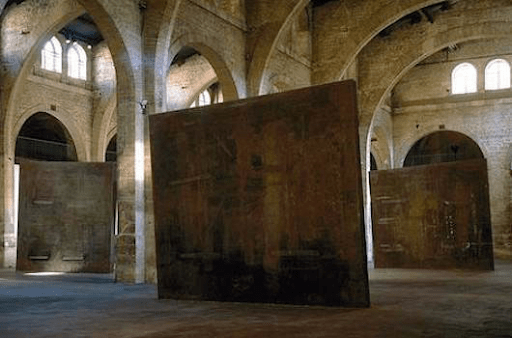
To begin with, speaking about Richard Serra’s work faces the same challenges as appreciating any piece of art, in that no verbal account is going to suffice as a surrogate for direct experience. In fact, Serra himself argues this point very starkly, when asked to describe his “Delineator” (shown next):1

Serra delineator

“What happens with Delineator is that the only way to understand this work is to experience the place physically, and you can’t have an experience of space outside of the place and the space you’re in. Any linguistic mapping or reconstruction by analogy, or any verbalization or interpretation or explanation, even of this kind, is a linguistic debasement, in a sense, because it isn’t even true in a parallel way.”

Nonetheless, Serra does say more about Delineator elsewhere, which highlights some of his concerns and the mental model he uses for thinking about his own work:

“The sculpture defines a definite space inside the room. […] The juxtaposition of steel plates forming this open cross generates a volume of space which has an inside and an outside, openings and directions, aboves, belows, rights, lefts – coordinates to your body that you understand when you walk through it. Noe you might say that that sounds quite esoteric. Well, one of the things that you get into as you become more in tune with articulating space is that space systems are different than linguistic systems in that they are nondescriptive. The conclusion I’ve come to is that philosophy and science are descriptive disciplines, whereas art and religion are not.”

So, if you haven’t seen any of his work and tried to circumnavigate and “inhabit” it, I would very much encourage you to try to do so, if you get a chance. Personally, I have had experiences akin to what Serra speaks about above, when I saw his “Seven plates, six angles” (below) at the Gagosian in New York. The overwhelming sensation I had was of a heightened awareness of scale, volume and proportion, but also – unexpectedly – of space and mass. In some sense, my extensive use of photos in this post is futile – like showing you images of alien foodstuffs that you have not tasted, so, please, consider them tokens or bookmarks – i.e., pointers for your own future experience.

Serra 7 plates 6 angles

When asked about the relation of one of his pieces, shown at the Tate in London, to the building it was exhibited in, Serra made another important observation about what his work intends to be (and one that rang very true to me in retrospect):

“I did not want to enter into an affirmative dialogue with the building. I did not want to mirror face-value language, the physiognomy of the architecture. I wanted to deal with the volume, weight, mass and directionality of the space. [… I] wanted to make a sculpture out of the whole volume […] I wanted to make the volume of the space tangible, so that it is understood immediately, physically, by your body.”

The idea that the sculpture is not solely the object Serra created, but that it is that object in relation to the space it is situated in, is a paradigm shift and the key to understanding his insistence on making site-specific work even in the case of indoor sculptures. And even when a piece is shown in multiple locations over time, its placement in every one of those spaces results in multiple sculptures involving the one Serra-made object (that naïvely might be identified as the sculpture in full).

Beyond the paradigm shift from objects to entire spaces, Serra also broadens the palette of sculptural considerations:

“There’s a difference between walking into a telephone booth and a football stadium. If you take those two extremes and make the idea very subtle, then you can say there’s a difference between walking to the left and walking to the right, between the experience of the concave and convex, between something leaning right and something leaning left. How do you know that to be a different experience in terms of your daily life? And if it is, is it meaningful? The degree of meaningfulness depends on the limitations of the viewer. I think it is very difficult to introduce large-scale works into the public arena inasmuch as I am not interested in complicity or affirmation.

[…]

Compared to that of vertical sculpture, the ideas of sculpture existing horizontally are basically different concepts about construction, are basically different concepts about how we live in the world. On a simple, perceptual level, a modular unit extending above your eye-level becomes foreshortened as it rises, while the horizontal modular unit implies an infinite vanishing point. […] The cultural symbolic iconography of verticality versus horizontality is most apparent in the cross, where the vertical expresses transcendence and the horizontal expresses materiality.”

While Serra is clear about his interests being “nonutilitarian, nonfunctional” and declaring that “any use [of sculpture] is a misuse,” as well as anticipating limited audience appreciation (likening it to “poetry and experimental film” :)), he at the same time has a profound message behind his work:

“We are all restrained and condemned by the weight of gravity. […] The constructive process, the daily concentration and effort appeal to me more than the light fantastic, more than the quest for the ethereal. Everything we choose in life for its lightness soon reveals its unbearable weight. We face the fear of unbearable weight of repression, the weight of constriction, the weight of government, the weight of tolerance, the weight of resolution, the weight of responsibility, the weight of destructions, the weight of suicide, the weight of history which dissolves weight and erodes meaning to a calculated construction of palpable lightness.”

In many ways, the above strikes me as having affinities with Christianity, where Serra’s “Everything we choose in life for its lightness soon reveals its unbearable weight.” can be seen as a complement of Jesus’ “But seek first the kingdom of God and his righteousness, and all these things will be given you besides.” (Matthew 6:33).

A further aspect of Serra’s weight versus lightness statement (made in 1988) is its echoing of Milan Kundera’s novel “The Unbearable Lightness of Being,” published only four years earlier, where its author too makes a play for weight over lightness:2

“The heaviest of burdens is therefore simultaneously an image of life’s most intense fulfillment. The heavier the burden, the closer our lives come to the earth, the more real and truthful they become. Conversely, the absolute absence of burden causes man to be lighter than air, to soar into heights, take leave of the earth and his earthly being, and become only half real, his movements as free as they are insignificant. What then shall we choose? Weight or lightness?”

What, you may ask, is my point though? I hope that the above highlighted a couple of aspects of Serra’s work, which I have found to be deeply engaging and appealing. First, that he has invented a whole new concept of sculpture whose building blocks are not only form, texture, composition and proportion, but also mass, space, directionality and orientation, rendering an entire space a sculpture. Second, that his work is deeply rooted in the entirety of art and philosophy, without these being prerequisites for its appreciation and experience. Third, that experiencing his work, which explicitly shuns religious motives, does shed light on deeply Christian concepts and is therefore also of spiritual value to a Christian viewer at least.

As such, it shouldn’t come as a surprise to you, when I tell you that Richard Serra is probably my favorite sculptor (alongside Michelangelo, Rodin and Giacometti) and I hope that you will appreciate his work too when you next see one of his pieces.


1 All Richard Serra quotes here are from “Writings/Interviews.”
2 Both, probably, derived from Nietzsche’s concept of eternal recurrence, where the permanent (heavy) is contrasted against the fleeting (light).
Gender

South Sudan Rain Clouds UN Photo

An easy way of making a Catholic gasp and recoil in horror these days is to utter the word “gender,”1 which in many cases is heard as being synonymous with “heretic.” Saying: “I work for gender equity,” is tantamount to admitting to drug dealing, human trafficking, or worse. What are “gender equity,” or the more widely used term “gender equality,” though? Here one of the best descriptions of it’s consequences – in my opinion – is the following:

“And what shall we say of the obstacles which in so many parts of the world still keep women from being fully integrated into social, political and economic life? […] As far as personal rights are concerned, there is an urgent need to achieve real equality in every area: equal pay for equal work, protection for working mothers, fairness in career advancements, equality of spouses with regard to family rights and the recognition of everything that is part of the rights and duties of citizens in a democratic State.”

Oh, but this doesn’t sound despicable!? If anything, it seems like exactly what every Catholic ought to be (and very often is) striving for! So, where does the opposition to anything to do with “gender” come from?

Let’s take a couple of steps back and look at the concept in isolation. In terms of etymology, “gender” derives from the Latin “genus,” which in turn means “kind” or “type” and which has since antiquity (at least since as early as Protagoras in the 5th century BC) been employed in the context of grammar, resulting in a categorization of nouns into masculine, feminine and neuter. While the application of such categories to human identity, behavior and social roles has traces in the Middle Ages, it is only since the middle of the 20th century that the term is consistently used to refer to a person’s identity or social role, distinguishing between male and female (and more recently a growing list of other types too).

In other words, “gender” refers to whether one considers oneself male or female and/or whether one is considered male or female by society, with all the implications that such (self)categorization entails. It “refers to the economic, social and cultural attributes and opportunities associated with being male or female,” as the United Nations put it.

So far, “gender” sounds like a fairly uncontroversial concept: men and women see themselves as male or female, where their being male or female also has consequences socially, economically and culturally. The term allows for distinguishing between biological sex and it psychological and social consequences and allows for highlighting inequality for which society rather than physiology is accountable for.

To a Christian, who professes that every human being is made in the “Image of God,” inequality needs to be fundamentally abhorrent and equal dignity, opportunity, recognition, rights and respect be seen as an inherent good. If you are a Catholic and feel a bit squeamish about any use of the term “gender,” get over it. And next time someone tells you they work for “gender equality,” congratulate them and support them. Period. Women today are at a disadvantage around the world – in many cases shockingly and criminally so, purely by virtue of being women. Gender equity – the striving for fair treatment of men and women – is an intrinsic moral good that is every Christian’s duty and a direct consequence of Jesus’ commandment to “love your neighbor as yourself” (Matthew 22:39).

So, is the kerfuffle around the term “gender” all just some big mixup or exaggeration?

No.

There is another use of the concept of “gender,” where it becomes an ideology and where, I believe, it is distorted in ways that can lead to at least psychological harm. This ideology – “gender theory” – proceeds along the following lines: “Since gender is a social construct, and since I have self-determination, gender is not an intrinsic attribute of my self. Instead, it is something I “do” and I am free to choose arbitrarily. As a woman I am neither intrinsically female nor male. I become female or am made to behave according to female constraints that society imposes on me.” It is in this vein that Simone de Beauvoir says “one is not born a woman, one becomes so” (The Second Sex) or that Judith Butler declares that “[r]ather than ‘woman’ being something one is, it is something one does” (Gender Trouble). And it is this ideology that Benedict XVI decries and sums up by saying:

“People dispute the idea that they have a nature, given by their bodily identity, that serves as a defining element of the human being. […] Man calls his nature into question. From now on he is merely spirit and will. […] From now on there is only the abstract human being, who chooses for himself what his nature is to be.”

I believe that, in both of the above examples of gender theory statements, the motives for opposition to gender roles, as imposed by society and resulting in injustice, were positive. They were a revolt both against the misogynistic contortions of Freudian psychoanalysis, that posits female inferiority, and against social injustice perpetrated on women. The difficulty, to my mind, arrises neither from the well-justified analysis of social inequality, nor from the reactions against dubious models of female psychology. Instead, it lies with the conclusions drawn from them.2 The observation of unjust gender roles and models leads to their dissociation from sex, instead of to an attack on their injustice and a subsequent project for their rectification.

Instead of denying the link between the biological and the social, as tends to be the case with “gender theory” ideologies, I believe the answer lies in reforming unjust and inequality-fueling gender roles. Here, there are good examples of campaigns that foster awareness and work towards the changing of negative stereotypes, today imposing pressure both in peer groups and from the media. E.g., the UK-based “GREAT Initiative” has a “Great Men Value Women,” campaign where they work with teenage boys to challenge male stereotypes that foster gender inequality (e.g., being tough, even aggressive and not showing their feelings). Then there are: the “Men in Childcare” initiative, which promotes the involvement of men in childcare and related professions, one of the UN’s “Millennium Goals” focusing on gender equality, or the World Food Programme’s providing training sessions for fathers about maternal and child health and nutrition, just to name a few. These, to my mind, are pushing in the right direction. In contrast, the consequences of the sex-gender decoupling of “gender theory” range from the innocuous, albeit arguably exaggerated, protests against the ““pinkification” of girls’ toys” to the dramatically more worrying example of the raising of a boy as “gender neutral.”

Oh, and by the way, the opening quote of this post is from Blessed Pope John Paul II’s “Letter to women” (§4)…


1 Many thanks to my überbesties YYM and PM for their nihil obstats.
2 In many ways this reminds me of Marxism3 (and apologies in advance for the great simplification of critiquing it in a single sentence here), which correctly diagnosed the serious problem of social inequality, but which applied to it a non-remedy: class war. The problem still persists to this day, but it requires an actual solution, mindful of human dignity, instead.
3 No, not of Martin Parr this time either.

Cognition by mutual reflection

Escher mobius

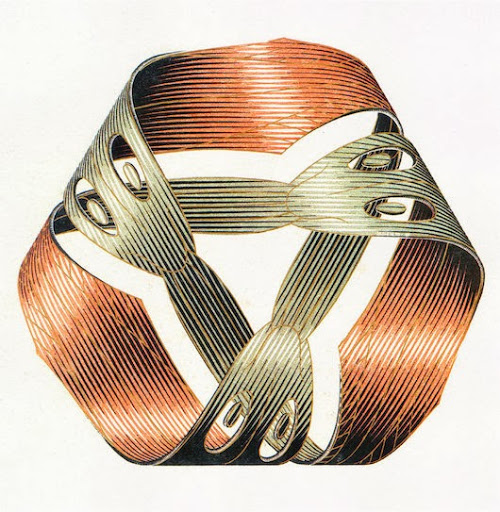
A paper I have been meaning to read since it was published in October is Dr. Callan Slipper’s “Towards a New Kind of Cognition,” in which he reviews a number of cognitive modes, characterizing not only an individual’s development, but also the evolution of the human species and of cultures and then introducing a new, social mode that has roots in the mystical experiences of Chiara Lubich.

As far as setting the scene and providing context, Slipper’s approach bears resemblance to Dr. Yuval Harari’s “A Brief History of Humanity,” both in that it goes back to the cognitive modes of hominids and that it considers both biological and cultural factors. Even Harari’s favorite device of “fiction” (quotes mine) is mirrored in Slipper’s references to myth as a cultural contributor to cognition.

Instead of attempting a summary of the already concentrated review of classical modes of cognition, where Slipper discusses Jean Piaget’s somatic, symbolic and theoretic modes of knowledge that can be observed in a child’s development and then proceeds to show how these are mirrored also in the evolution of the Hominidae family and the basis of rational enquiry into the present day, I’d instead recommend reading the excellent, full paper itself. Instead, what I’d like to do is focus on the new cognitive mode that Slipper’s paper culminates in.

To understand the novelty and otherness of the new cognitive mode, it is worth considering the following observations Slipper makes about the state at which the evolution of cognition has arrived in the present day, as an evolution of “mythic culture”:

Mythic culture employs symbolic representations in the context of narratives (mythos is Greek for story), and these give human subjects powerful instruments to interpret and interact with the environment. Mythic cognition is not static and it did progress, using its narrative and symbolic methodology, to be self-critical. […] The culture that emerged, which we are heir to today, can be called […] the culture of the logos. The logos is a form of knowing that attempts to achieve objectivity, that is, to see things without projections from the hopes, fears, fantasies, or preconditioning of the subject. It develops conceptual reasoning that produces theories, and so it corresponds to the acquisition of theoretical knowledge. But the logos-word can also be a word of command and so have ethical and existential implications. Furthermore, as the light of understanding it can also mean conscience or a profound spiritual intuition, which attempts to see things as they truly are. […] In Greece, for example, this was undertaken by theoretical discourse in the development of philosophy; the ethical-existential dimension was developed in the light of Transcendence by the Hebrew prophets; a transcendent spiritual intuition (bodhi) was at the root of the new conceptual thinking that arose with Buddhism.

The scene therefore is a cognitive culture that aims at objectivity and an abstraction of the individual’s bias from the cognitive process. It is against this cognitive background that Chiara Lubich’s experience and thought are set. It has as its central themes a focus on two of Jesus’ utterances: “where two or three are gathered together in my name, there am I in the midst of them.” (Matthew 18:20) and “My God, my God, why have you forsaken me?” (Matthew 27:46). The first here makes the subject of cognition a community and the second is the key for that community to transcend itself, by imitating Jesus’ self-emptying (kenosis) at the moment of his greatest suffering. It is this mutual loosing oneself out of love for another that is Lubich’s central insight – the fruit first of years of putting the Gospel into practice and then of a mystical, intellectual vision that started in 1949.1With the above, 10K mile view, let’s look at the consequences that Slipper spells out for cognition:

“The individual remains but it is now in a relationship of profound mutual involvement with other individuals, a form of recollection both within self and within the other person insofar as empathy, sensitivity, and attentive listening and communication (the apotheosis of the logos-word) will allow. […] In relation to the other person, everything can be reframed or rethought; even hard-won theories cannot be defended by the ego that generated them. Gesture, symbol, theory are all offered, not imposed, within the context of a deep meeting. In this way it is the very social nature of this process that offers the participants an intensified reflexivity, an extra possibility of using critical reasoning to challenge their presuppositions. Ideas are seen as instruments of a mutual reflection, engaged in together, so that out of the meeting of persons emerges a new act of cognition, one based on but not bound by any of the previous mental models. It thus has creative potential and is capable of thinking thoughts not had before in an act of cognition that is not closed and which, at least in principle, can be developed in further encounters.”

I have to say that I recognize the features of what Slipper speaks about here from personal experience. The attitude that “everything can be reframed or rethought,” that “gesture, symbol, theory are all offered, not imposed” and that “ideas are seen as instruments of a mutual reflection” is precisely what, I believe, allows for the “deep meeting” and “recollection both within self and within the other,” which has the potential for a “new act of cognition” to emerge. When all, who are engaged in jointly trying to understand something, bring this attitude of detachment (that mirrors Jesus’ self-emptying) to the table, the result is a transcendence of each individual (that mirrors Jesus’ promise of being present among his followers).

Slipper puts this very clearly and succinctly as follows:

Meeting together in a shared transcendent experience, the human subjects both feel themselves united with Jesus and find that they are seeing things (nature, humanity, indeed all creation), as it were, from Jesus.

To conclude, I would like to emphasize one aspect of the above, that to me personally is of great importance: this social, transcendent mode of cognition is open to all and is not contingent on Christian beliefs, even though I (like Dr. Slipper) experience, pose and believe it to be their consequence. And this is not some hypothetical speculation, but again an observation from my personal experience. I have experienced the above “deep meeting” with Christians, agnostics and atheists alike, since self-emptying, being open to the other and a going out of oneself to meet the other are all open to everyone. Whether the person I am thinking with believes this to be a participation in Jesus’ vision or not, is not a prerequisite to it. Wherever there is mutual love and detachment from one’s own ideas, it is possible for thought to become a social, self-transcendent experience and lead to insights, already interiorized by virtue of the process itself, that would otherwise be unlikely or impossible. In some sense it is a turning on its head of Jean-Paul Sartre’s being-for-others where the other objectifies me and, by taking something away from me, becomes my “hell.”


For the text of her notes on how that mystical experience started, see here and for a commentary here.

Slovak bishops celebrate Opposite Day

Ryanoppositeday 15

1The most plausible explanation that I can think of for the letter that the bishops of Slovakia have addressed to their flock yesterday is that they must think of the last nine months – since the election of Pope Francis – as one, long Opposite Day. In fact, they must be under the impression that it has been Opposite Day for much longer than that, since their message just reads like the polar opposite of where the Church has been heading at the very least since Vatican II.

Be that as it may, let me set out how the Slovak bishops’ letter points away from both Pope Francis’ words and deeds:

  1. There is not a single use of the words “Jesus” or “Christ” in the entire document. The closest, and single reference to Him is their saying that Advent “reminds us of the arrival of God’s Son on Earth.” And that’s Jesus taken care of. In contrast, “Jesus” is the single most frequently used word in Pope Francis’ morning sermons and at the very top of the frequency tables in all his other speeches and writings. For Pope Francis, Jesus is the be all and end all of his mission – the Slovak bishops don’t even mention him by name.
  2. There is a single reference to Scripture in the Slovak bishops’ letter – a “cf. John 10:10” in reference to the “Son of God’s” coming being for the sake of our lives’ fullness. Pope Francis – and all of his predecessors and their collaborators – instead takes ample advantage of maintaining a close link to Scripture, which he therefore also copiously refers to. And, please, don’t take these first two points as being about form – they are deeply about substance. A close adherence and frequent reference to Jesus and his words are an integral part of what it means to be His followers and their absence then leads to failures like the letter under scrutiny here.
  3. How about the poor and marginalized? The divorced and remarried, single mothers, the sick, those who suffer from discrimination? How do they, who are so central to Pope Francis’ message, fare in the letter? Not very well, actually … There is no mention whatsoever of the poor, in a letter about the season during which we remember Jesus’ coming into the world under circumstances of clear poverty. And how about the divorced or those who suffer from the breakdown of the family? Do they get a look in? Yes, but not in the way you’d expect: “God wants for every person to come into the world in loving, well-ordered family communities. If that is not the case, it is either a misfortune or human failure.” Let’s see what Pope Francis has to say instead:

    “Think about a single mother who goes to church, in the parish and to the secretary she says: ‘I want my child baptized’. And then this Christian, this Christian says: ‘No, you cannot because you’re not married!’. But look, this girl who had the courage to carry her pregnancy and not to return her son to the sender, what is it? A closed door! This is not zeal! It is far from the Lord! It does not open doors! […] Jesus is indignant when he sees these things because those who suffer are his faithful people, the people that he loves so much.”

    I know whose side I am on! And I don’t mean to deny any of the beauty and value of the family – the same family that the Slovak bishops, presumably, have in mind. What I do distance myself from is the tone and content of their letter where all who are not in “well-ordered,” “responsible” families are opponents of God’s laws and the order of the universe.

  4. And what about homosexuals? They are branded as being proponents of a “culture of death” and enactors of a “sodomite caricature that is opposed to God’s will and awaits God’s punishment.” How well is this aligned with Pope Francis’ words? Judge for yourself:

    “A person once asked me, in a provocative manner, if I approved of homosexuality. I replied with another question: ‘Tell me: when God looks at a gay person, does he endorse the existence of this person with love, or reject and condemn this person?’ We must always consider the person. Here we enter into the mystery of the human being. In life, God accompanies persons, and we must accompany them, starting from their situation. It is necessary to accompany them with mercy. When that happens, the Holy Spirit inspires the priest to say the right thing.”

    Hm … not quite on the same page … Mercy and accompanying instead of caricature and punishment. Hey, that sounds familiar – how about: “Go and learn the meaning of the words, ‘I desire mercy, not sacrifice.’ I did not come to call the righteous but sinners.” (Jesus, in Matthew 9:13).

  5. Finally, just to round out the entertainment value of this post, the letter also contains an interesting set of nouns with regard to men: “man, husband, father, knight, gentleman” (did anyone say “museum-piece Christians” – actually, yes, it was Pope Francis again …) and women: “woman, wife, mother” (did anyone say “Bazinga!”?). No comment.

There’d be plenty more to say, but I believe the above gives a sense of how categorically misaligned the Slovak bishops’ Advent pastoral letter is with Pope Francis. There is no sense of joy, mercy, love or a care for the poor or those at the peripheries, who are Pope Francis’ central concern and who, unsurprisingly, were Jesus’ own preferred company.

Just so that I don’t leave a sense of complete disagreement and pure criticism in the air, let me say though that I share the Slovak bishops’ concerns with regard to “gender theory.” Instead of reproducing their own words, let me make recourse to Pope Benedict XVI’s, who can put the central problem far more lucidly and rationally than I or the Slovak bishops could:

“[T]he very notion of being – of what being human really means – is being called into question. […] Simone de Beauvoir [saying] “one is not born a woman, one becomes so” (on ne naît pas femme, on le devient) [lays] the foundation for what is put forward today under the term “gender” as a new philosophy of sexuality. According to this philosophy, sex is no longer a given element of nature, that man has to accept and personally make sense of: it is a social role that we choose for ourselves, while in the past it was chosen for us by society. The profound falsehood of this theory and of the anthropological revolution contained within it is obvious. People dispute the idea that they have a nature, given by their bodily identity, that serves as a defining element of the human being. They deny their nature and decide that it is not something previously given to them, but that they make it for themselves. […] Man calls his nature into question. From now on he is merely spirit and will. The manipulation of nature, which we deplore today where our environment is concerned, now becomes man’s fundamental choice where he himself is concerned. From now on there is only the abstract human being, who chooses for himself what his nature is to be.”

There are certainly contentious and very serious issues on the table, but they need to be considered in an atmosphere of respect, dialogue and mercy and in a way that shows their balance against other issues, such as poverty, injustice, oppression, exploitation and violence.


1 Many thanks to my überbestie PM, whose reactions to the letter are incorporated here too.

Faith in science

Hanson3

A couple of days ago I saw Prof. Steven Pinker tweet about an article (“No Faith in Science”) by Prof. Jerry Coyne, who argues that science does not involve faith. I was curious to see whether Coyne would come up with a convincing argument or whether the piece was going to be a rather ill-informed rant against religion (as has been the case previously).

My summary of Coyne’s argument – and do read it in full if you are that way inclined – is the following:

  1. Religious faith is “intense, usually confident, belief that is not based on evidence sufficient to command assent from every reasonable person” (Walter Kaufmann), “involves pretending to know things you don’t” and is “wish-thinking.” The term “faith” used in the context of science is “confidence derived from scientific tests and repeated, documented experience.” In other words faith when applied to religion is delusional pretense while when applied to science it is rational confidence. “The conflation of faith as “unevidenced belief” with faith as “justified confidence” is simply a word trick used to buttress religion. In fact, you’ll never hear a scientist saying, “I have faith in evolution” or “I have faith in electrons.””
  2. Confidence in a scientist’s statements “is based on the doubt and criticism inherent in science (but not religion): the understanding that their expertise has been continuously vetted by other [scientists]. In contrast, a priest’s claims about God are no more demonstrable than anyone else’s. We know no more now about the divine than we did 1,000 years ago.” Science is advancing while religion is arbitrary and static.
  3. Science is built on evidence while religion can’t be: “There is strong evidence for the Higgs boson, whose existence was confirmed last year by two independent teams using a giant accelerator and rigorous statistical analysis. But there isn’t, and never will be, any evidence for [religious claims].”
  4. “The orderliness of nature—the set of so-called natural laws—is not an assumption but an observation.”
  5. In summary – and in Richard Dawkinswords – Coyne argues that “There’s all the difference in the world between a belief that one is prepared to defend by quoting evidence and logic and a belief that is supported by nothing more than tradition, authority, or revelation.”

Since I completely disagree with the above, let me try to be explicit about my reasons, which will be made from my perspective as a Catholic (and scientist), but many features of which also apply to believers of other religions (and practitioners of other rational pursuits):

  1. Let’s first look at the Kaufmann definition: religious faith as “usually confident” and insufficient to “command assent from every reasonable person.” Here I’d first like to point to the pervasive presence of doubt in Christianity – starting right with the apostles themselves (Thomas being the obvious choice, but the rest of them were an equally incredulous lot too, much to Jesus’ frustration 🙂 and explicit in the Catechism of the Catholic Church, which in its opening paragraphs says: “Since our knowledge of God is limited, our language about him is equally so. […] We must therefore continually purify our language of everything in it that is limited, image-bound or imperfect, if we are not to confuse our image of God — “the inexpressible, the incomprehensible, the invisible, the ungraspable” — with our human representations” (§40-42). Far from being over-confident, this opening caveat sounds eminently transparent and humble to me. Turning to the second feature of the Kaufmann definition, I struggle to think of many things that “command assent from every reasonable person” – least of all new scientific theories or even observations of phenomena that appear contradictory of the accepted science of the day. One could argue that such an attitude – of cautious assent – is good and is a feature of being critical. That is all well, but then it becomes problematic to use it as a test of reasonableness of faith. Finally, let’s look at the claim that scientists don’t make statements like “I have faith in evolution.” That may well be, but slight variants like “I believe evolution to be true,” or “I consider evolution to be a likely mechanism accounting for the variety of changing life-forms on Earth” are much easier to come by. Is Coyne arguing that the specific grammar and vocabulary of “I have faith in …” has some special features that its alternative formulations don’t?
  2. Next, there is the juxtaposition of “unevidenced belief” with “justified confidence.” Here I’d like to argue that beliefs, assumptions, working hypotheses, views, etc. of both scientific and religious nature can easily fall into these two categories. As a scientist, my adherence to theories whose consistency with observation I have not tested can be as much based on authority and tradition (I read them in text books and other scientists also hold them to be true), as those of a religious person with regard to the teachings of their faith. Conversely, many of my beliefs are very much backed up by evidence: that the merciful will be shown mercy (Matthew 5:7), that walking an extra mile (Matthew 5:41) or welcoming strangers (Matthew 25:35) are sources of joy, or that the pinnacle of love is self-sacrifice (John 15:13). I believe these not because someone has tricked me or made me believe them, but because I have experienced their truth. This is not to say that religious faith and the beliefs that form part of science are the same – they are not – but just to argue that the line is not between the two but among different beliefs in both.
  3. The claim that “we know no more now about the divine than we did 1,000 years ago” may well be true for a “we” that includes Coyne, but certainly not for a “we” that includes me or a vast number of Christians. Christianity is in constant flux and if a Catholic from 500 years ago time-travelled to the present day, they would be stunned by many of the features of present-day Christianity. The Church’s teachings change constantly based on the experiences of her members trying to put Jesus’ words into practice. For a simple, but very specific, example, see a previous post, and for a greater variety, just take a look at a number of statements made by Pope Francis over the last months – causing a stir with regard to atheists, homosexuals, the poor, etc. – even the cross he uses is a source of controversy, which couldn’t exist if Catholics were just a bunch of nodding sheep. To look at all that and say that there is no change in religion is plain irrational.
  4. Arguing from “giant accelerator[s] and rigorous statistical analysis” is just scarily naïve. Statistics is all about compliance with assumptions (about populations, sampling, distributions, …) and the scale of a device has no bearing on its capacity to access the truth. The scary thing to me here is the underlying naïveté by virtue of which observation is considered to be about the “given” (data) instead of realizing that it is all about the “taken.” There is no observation without theory (language itself being theory laden) – what you are looking for, how you measure, are a consequence of what your expectations are and the result can either be consistency or inconsistency (where in the latter case the theory can be revised or the content of observation questioned). This is not meant as a criticism – the process leads to progress and great understanding, but just as an emphasizing of observation and measurement not starting from scratch or being an independent entity with respect to theory.
  5. Finally, let’s look at the claim that the “orderliness of nature is not an assumption but an observation.” Beyond the implicit challenges of observation, I’d ask about what observation or observations result in the belief in orderliness, repeatability, the uniformity of the laws of nature? For this universally-quantified claim to be attributable to a finite set of observation, requires an assumption or even a belief in finite observations lending credence to the nature of other observations of greater cardinality and holding under conditions for which no observations were made (e.g., in the past) or for which no observations can be made (e.g. the future). Again, this is not a criticism of science – making the assumption of orderliness and repeatability is a useful and rational thing to do (it is inherent to rationality itself), but it is not a consequence of observation. Instead, it is a precursor. Without such a belief or assumption, observation would be pointless.

Ultimately it is up to you to decide for yourself whether my arguments above – the arguments of a Catholic – are “intense, usually confident, belief[s] that [are] not based on evidence,” “supported by nothing more than tradition, authority, or revelation,” or whether they make recourse to “evidence and logic” and can therefore co-exist happily with scientific convictions.

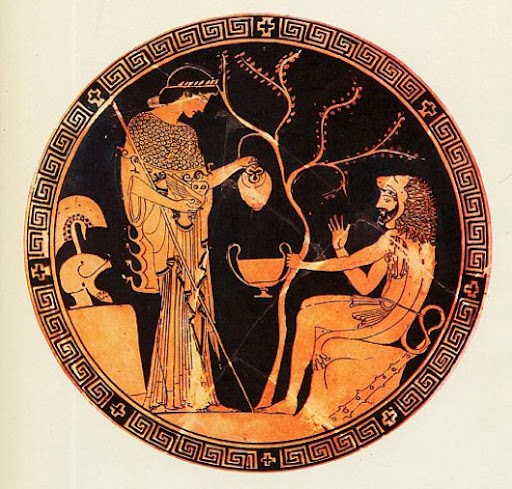
Athena and/or Jesus?

Athena

The other day I watched a greatly edifying and enjoyable video of Eugenio Scalfari and Cardinal Gianfranco Ravasi having a chat about a variety of topics in the context of the Courtyard of the Gentiles initiative launched by Pope Benedict XVI – a forum for dialogue between catholics and non-believers. What struck me in particular was a train of thought triggered by Scalfari commenting on Ravasi quoting him as having said that he was “in love” with Jesus. To this Scalfari responds:1

“Maybe it is an exaggerated phrase, but it is true. I have been following the life and preaching of Jesus ever since I was a kid, since I abandoned the faith. I grew up in a Catholic family […] but then I met Athena, together with Italo Calvino, with whom I shared a desk for three years at school …”

This follows the pattern I have seen so many times among my friends: I grew up a Catholic (or member of another church), but then I realized that belief in God was not reasonable and I became an atheist or agnostic. Scalfari tells the same story: upon encountering Athena (the Greek goddess of wisdom) his religious beliefs crumbled. Faced with a choice between faith and reason, he opted for the latter and while he still admires Jesus, he does so without any accompanying – irrational or at least arational – religious beliefs.

I particularly liked the posing of the above process with rationality personified by Athena, as it gave it a symmetry that less poetic accounts lack, and I was looking forward to Ravasi’s response, as this was a statement that he was sure to react to:

“[You tell the story of how you] made the choice of Athena, in a certain sense abandoning the choice of Christ in that moment at least. I think though that this choice, these two choices are not necessary and divisive, that they would split a person. Because I am firmly convinced, I personally, that, even though I have made the choice of Christ, I have not renounced my choice of Athena. Athena, reason, has always interested me.”

Ravasi then – very compellingly – proceeds to expand on Pope Francis’s speaking about the Truth in relational terms in his letter to Scalfari, and then shares the following, personal reflection:

“I, for myself, can’t say that I have the Truth, that I have God. I, every day, have to return – and in some moments it is likely that I drift into a territory where the heavens seem devoid of divinity … [pause] Precisely because there is this dimension of the subject [pointing at himself], that is limited and that walks in a reality that exceeds me. This is why I believe that the element of seeking, searching is fundamental.”

I believe Ravasi is absolutely spot-on here – faith is not an alternative to reason, but a position that requires reason for the sake of remaining authentic. Ravasi presents his relationship with God as a dynamic, persistent search for the infinite, transcendent-immanent by a limited and finite self contained by it. This is no rejection of reason, blind adherence to tradition or irrational ignorance of evidence that are often the objections leveled at faith, but a sincere, dynamic relationship with God, as experienced through the limited, fallible, imperfect consciousness of a human person.

Having focused on Ravasi – whose fan I admit I am, I would also like to express my admiration for Scalfari, who comes across as a highly intelligent, sincere and compassionate person and whose atheism I don’t in any way find issue with. If anything, the fact that shines through their conversation is that both are open and honest about their own understanding of reality and that both value the other’s thoughts and find inspiration in them.

To conclude, I’d like to share my motivation for this post, which was my überbestie, PM’s saying that he didn’t get why I keep talking about faith and reason as being opposed, when in fact they are not. This certainly made me stop, since I completely agree with him, and I in fact proceeded to read up on more formal treatments of rationality, reason and faith, with the desire to get to some low-level mixup that would explain the mistaken perception of this fictitious opposition. I very quickly realized though (how could I not have seen that straight-away?!) that such efforts lead me down the well-trodden, lengthy and criss-crossing paths of epistemology and ontology, for whose considerations the terms “reason” and “rational” were a lax shorthand. Not wanting to attempt a synthesis of a vast field of investigation here, I’d just like to argue again that faith and reason are not opposed – they are both means for making sense of our conscious experiences in ways which I (and the Catholic Church) believe to be complementary and fundamentally incapable of contradicting each other in their perfect instantiations.

Seeing the sincere experiences of Scalfari and many of my friends, who arrive at a different conclusion – i.e., of faith being opposed to reason – instead leads me to an examination of conscience. Why is it that the Church and I fail to present the inherent compatibility of faith and reason compellingly enough? Has too much baggage accumulated over the centuries? Have ulterior motives obscured the profound purity and rationality of Christian faith, motivated by insecurity and lack of trust in God’s love? Maybe the answer lies in personal dialogue though, instead of an attempt to address the question via some new systematic exposition. And Pope Francis’ clear, blunt and razor-sharp directness will help too, of that I am sure …


1 This is around 21:50 in the video (in Italian) and Ravasi’s reaction around 43:00.