Benedict XVI – Odifreddi: searching for Truth, with gloves off

Boxing gloves

[Warning: long read :)]1

If you are even remotely interested in the dialogue between faith and reason, between religion and science, the last fortnight has to be among the most electrifying periods in the history of mankind. Not only did it kick-off with the beautifully sincere and profound move by Pope Francis in his letter to the atheist journalist Eugenio Scalfari, but it saw the publication of “the” interview that Pope Francis gave to Jesuit media and in which he spoke about science in terms that, to my mind, take the Church’s appreciation of science further than ever before. And if that wasn’t enough, today saw the publication of extracts from an 11-page letter that Pope Emeritus Benedict XVI wrote to the Italian atheist mathematician Prof. Piergiorgio Odifreddi, in response to his book “Caro Papa ti scrivo: Un matematico ateo a confronto con il papa teologo” (“Dear Pope, I write to you: An atheist mathematician confronting the theologian pope”).

Looking at the two letters (or, more precisely, the extracts from Benedict’s versus the full text of Francis’), Francis’ and Scalfari’s style is like a polite, yet illuminating, exchange between two gentlemen over a cup of tea, while Benedict’s and Odifreddi’s exchange is like a bare-knuckle fist-fight between a pair of prize-winning boxers who in the end sincerely shake hands and respect each other, but without giving an inch during the fight itself.

To begin with, let’s take a quick look at Odifreddi’s opening move – his 204-page book, addressed to Benedict as “between colleagues” – from a maths to a theology professor. Early on, Odifreddi identifies a point in common with Benedict’s thought, by pointing to the following passage from Benedict’s Regensburg address:

“the experience […] of the fact that despite our specializations which at times make it difficult to communicate with each other, we made up a whole, working in everything on the basis of a single rationality with its various aspects and sharing responsibility for the right use of reason”

While Odifreddi identifies this – the adherence to reason – as a common point of departure, he quickly objects to Benedict’s excessive use of it (“your almost obsessive use of the word “reason,” repeated around forty times, akin to a musical motif or continuous base”) and to the “scandalous” words from Benedict’s sermon before the conclave that elected him:

“[H]aving a clear faith based on the Creed of the Church is often labeled as fundamentalism. Whereas relativism, that is, letting oneself be “tossed here and there, carried about by every wind of doctrine”, seems the only attitude that can cope with modern times. We are building a dictatorship of relativism that does not recognize anything as definitive and whose ultimate goal consists solely of one’s own ego and desires.”

While being critical of Benedict’s words, Odifreddi argues that “both religion and science are perceived as antidemocratic and absolutist” as a result of their focus on “ultimate truths” and then proceeds to arguing against a series of passages from Benedict’s “Introduction To Christianity” and his Jesus of Nazareth trilogy.

Since it is the full, fine detail that is key to understanding the nature of what is going on between Odifreddi and Benedict, let me just pick out a single point of contention (from among many important and interesting ones that I hope to return to soon!),2 which Benedict objected to most forcefully and which the following passage from Odifreddi’s book sums up nicely:

“There is little to say about the historical Jesus, literally, because there are virtually no traces of him in the official history of the period. In total, there are only few tens of lines about him in the works of Pliny, Tacitus, Suetonius and Flavius Josephus. Some are of uncertain interpretation, like the “Chrestus” of Suetonius. Others are of dubious authenticity, like the interpolation of Flavius Josephus. […] If, therefore, Jesus truly existed, he must have been irrelevant to his contemporaries, beyond the narrow circle of his relatives, friends and followers.”

Odifreddi further accuses Benedict of side-stepping questions of fact by saying to him: “you seem uninterested in (or seem interested in not) discussing the historicity of the Gospels and the facts that they report” and attributes to him an opposition to historical-critical methods of Biblical interpretation, by quoting Benedict as saying that they “can effectively become an instrument of the Antichrist.”

Benedict’s response here is as sharp as the jab he received:

“What you say about the figure of Jesus is not worthy of your scientific status. If you put the question as if nothing were, ultimately, known about Jesus, as a historical figure, as if nothing were ascertainable, then I can only firmly invite you to become more competent from a point of view of history. To this end I particularly recommend to you the four volumes that Martin Hengel (exegete at the Protestant Faculty of Theology of Tübingen) has published with Maria Maria Schwemer: it is an excellent example of historical precision and of vast breadth of historical information. […] Further I have to forcefully reject your affirmation (pp. 126) according to which I have presented historical-critical exegesis as an instrument of the Antichrist. Discussing the account of Jesus’ temptations, I have only recalled Soloviev’s thesis, according to whom historical-critical exegesis may also be used by the Antichrist – which is an unquestionable fact. At the same time, however, I have always – and in particular in the foreword to the first volume of my book on Jesus of Nazareth – made it evidently clear that historical-critical exegesis is necessary for a faith that does not propose myths using historical images, but demands true historicity and therefore has to present historical reality in its affirmations also in a scientific way. Because of this, it is not correct either that you say that I have been interested only in meta-history: on the contrary, all my efforts have had as their objective to show that the Jesus described in the Gospels is also the real, historical Jesus; that it is a matter of history that really took place.”

Uff … I have to be honest and admit that I was at first a bit uneasy about the tone of both Odifreddi and Benedict, neither of whom are pulling punches and both of whom are blunt to say the least. Looking more closely though, and reflecting on my professional experience as a scientist, I recognize that this is the tone and strength of academic argument and doing anything less would be dishonest on the part of both the professor and the ex-professor. This is a very different context from the Francis-Scalfari one and it demands the unforgiving rigor, precision and detail of the quotes shown above. Treating Benedict like any other academic shows Odifreddi’s respect for him (which he is explicit about when saying “Having read his Introduction to Christianity, […] I realized that the faith and doctrine of Benedict XVI, unlike that of others, were sufficiently solid and fierce that they could very well face and sustain frontal attack.”) Benedict is equally complimentary about Odifreddi, when he tells him that he “considers very positively the fact that you […] have sought such an open dialogue with the faith of the Catholic Church and that, in spite of all the differences, in the central themes, there is no lack of convergence at all.”

What this, academic, dialogue is truly about is put best – and to my mind beautifully lucidly – by Odifreddi, who says that:

“[The aim], obviously, was not to try and “convert the Pope,” but instead to honestly present to him the perplexity, and at times incredulity, of a mathematician with regard to faith. Analogously, the letter from Benedict XVI does not try to “convert the atheist,” but to direct at him his own, honest, symmetrical perplexity, and at time incredulity, of a very special believer with regard to atheism. The result is a dialogue between faith and reason, which, as Benedict XVI notes, has allowed both of us to confront each other frankly, and at times also bluntly, in the spirit of the Courtyard of the Gentiles that he himself has initiated in 2009. […] Divided in almost everything, but joined by at least one objective: the search for Truth, with a capital “T”.”

Wow! I have to say I am very impressed with Odifreddi (having come to this clearly as Benedict XVI fan) and I look forward to seeing his next steps in this full-contact dialogue. In many ways, I believe, that the most important thing to take away from this first encounter is the seriousness and complete transparency, with which both parties approached the challenge of dialogue – a dialogue that is not a watering-down or a “playing nice” but a striving for Truth, regardless of how vast the abyss may appear between its opposing cliffs. It would be a mistake to get stuck on whether I happen to agree with one side or the other, as it would miss the masterclass in serious dialogue that we have just witnessed. In many ways, I read Odifreddi’s closing thoughts as a transposition – from an intra-Christian to a Christian-atheist setting – of Francis’ call to an ecumenism that starts now, while there are clear differences between the parties, when he says in “the” interview: “We must walk united with our differences: there is no other way to become one. This is the way of Jesus.”


1 Apologies, again, for the rough translation from Italian – once “official” translations are available, I’ll point you to them.
2 I can’t not mention the following zinger from Benedict, which points to the widespread use of “science fiction” in science, in response to Odifreddi’s claiming that it was religion that practiced the genre. Benedict here says, referring to Heisenberg and Schrödinger’s theories, and adding Dawkins’ “selfish gene” to the list, that “I’d call them “science fiction” too, in the good sense: they are visions and anticipations, to arrive at true knowledge, but they are, indeed, only imagination with which we try to get closer to reality.” 🙂 I agree and I’ll definitely pick this line up in a future post.

Liberation Theology rehabilitated

Santa cena teologia liberacion

Pope Francis is about to meet with the founder of Liberation Theology, Fr. Gustavo Gutiérrez, thanks to the current head of the Congregation for the Doctrine of the Faith (CDF) – Archbishop Gerhard Ludwig Müller, which – on the face of it – is a 180° turn versus its past condemnations by the Vatican. Taken superficially, it is a meeting between Francis and a proponent of a theology that has been categorically denounced both by Blessed Pope John Paul II and his successor, Pope Benedict XVI.

A closer look reveals quite a different picture though:

  1. Fr. Gutiérrez, unlike other teachers of Liberation Theology (e.g., Leonardo Boff), has never been censured by the Vatican.
  2. John Paul II and Benedict XVI never condemned Liberation Theology as such, but only those variants of it that placed Marxist analysis at their cores and thereby de-Christified it. In fact, Benedict XVI (then then-Cardinal Ratzinger) is quite clear about the distinction in the “instruction” he published in 1984 as the head of the CDF:

    “The aspiration for ‘liberation’, as the term itself suggests, repeats a theme which is fundamental to the Old and New Testaments. In itself, the expression “theology of liberation” is a thoroughly valid term: it designates a theological reflection centered on the biblical theme of liberation and freedom, and on the urgency of its practical realization. […] The warning against the serious deviations of some “theologies of liberation” must not be taken as some kind of approval, even indirect, of those who keep the poor in misery, who profit from that misery, who notice it while doing nothing about it, or who remain indifferent to it. The Church, guided by the Gospel of mercy and by the love for mankind, hears the cry for justice and intends to respond to it with all her might.”

  3. Instead of this being a change brought in by Francis, the re-visiting of the position taken with respect to Liberation Theology escalated when Benedict XVI appointed Müller as the head of the CDF in 2011 – Müller, who was known to be a personal friend of Gutiérrez, whom he considered as his mentor and whose summer lectures he has been attending annually since 1998 in Peru.
  4. While the new attitude is a change version previous positions, it is not a change as far as Marxist-based flavors of Liberation Theology go. Instead, it is a sign of support for those strands of Liberation Theology that have presented social justice and a focus on the poor on a wholly Christian basis. Fr. Juan Carlos Scannone, one of Pope Francis’ former professors puts it as follows: “In the Argentinean Liberation Theology, social Marxist analysis is not used, but rather a historical-cultural analysis, not based on class warfare as a determining principle for the interpretation of society and history.”

To get a sense of why Müller, who is clearly the catalyst behind the rehabilitation of some strands of Liberation Theology, took an interest in it, it is worth taking a look at the speech1 he gave at the Pontifical Catholic University of Peru in 2008, when it awarded him an honorary doctorate.

There, Müller starts by admitting that he had read expositions of Liberation Theology as well as their criticisms by the CDF, before meeting Gutiérrez, but that his engagement with them was purely theoretical. His initial attitude was one of skepticism and concern about both a danger of leading to violence and a naïveté with regard to the application of Marxist principles. Attending a seminar lead by Gutiérrez then turned him “from academic reflection on a new theological concept to experience with the men and women for whom this theology had been developed.” From the start, Gutiérrez emphasized that Liberation Theology was about theology and not politics, with the aim “to understand the world, history and society and transform them in light of the God’s own supernatural revelation as savior and liberator of man.” The “point of departure” is very clearly put by Müller as follows:

“How one can speak of God in the face of human suffering, of the poor who don’t have sustenance for their children, or the right to medical assistance, or access to education, who are excluded from social and cultural life, marginalized and considered a burden and a threat to the lifestyle of the wealthy few.

These poor are not an anonymous mass. Each one of them has a face. How can I as a Christian, priest or layman, whether through evangelization or scientific theological work, talk about God and His Son who became man and died for us on the cross and bear witness to Him, if I don’t want to build another theological system in addition to the existing one, except by saying to the specific poor person face to face: God loves you and your inalienable dignity is rooted in God. How does one make Biblical considerations real in individual and collective life, when human rights originate in the creation of man in the image and likeness of God.”

Müller then moves on to what I believe is the core of his message, when he speaks about not only attending courses about Liberation Theology in various Latin American countries, but also their being accompanied by:

“long weeks of pastoral work in the Andean region, especially in Lares in the Archdiocese of Cuzco. There the faces acquired names and became personal friends, this experience of universal Communion in the love of God and neighbor, which must be the essence of the Catholic Church. Finally it was a deep joy for me when in 2003, in Lares, in the Archdiocese of Cuzco, being already a bishop, I could administer the sacrament of Confirmation to young people whose parents I had already known for a long time and whom I myself had baptized.

Hence I have not been speaking of liberation theology in an abstract and theoretical way, much less ideologically to flatter progressive church groups. Similarly I have no fear that this may be interpreted as a lack of orthodoxy. Gustavo Gutiérrez’s theology, regardless of which angle you look at it from, is orthodox because it is orthopractic and teaches us proper Christian action because it comes from true faith.”

Müller’s assessment of Liberation Theology comes not only from a reading of and reflection on its teachings, but from him personally having put it into practice and experienced its fruits. It is these fruits that reinforce the truth of its principles, whose flowing from “true faith” can be inferred from them. It is a “see, judge, act” process, which Müller says “has been decisive in my own theological development” and which follows Jesus’ own words as regards orthopraxy:

“Beware of false prophets, who come to you in sheep’s clothing, but underneath are ravenous wolves. By their fruits you will know them. Do people pick grapes from thornbushes, or figs from thistles? Just so, every good tree bears good fruit, and a rotten tree bears bad fruit. A good tree cannot bear bad fruit, nor can a rotten tree bear good fruit. Every tree that does not bear good fruit will be cut down and thrown into the fire. So by their fruits you will know them.” (Matthew 7:15-20).

UPDATE (13 September 2013): The Catholic New Service has just tweeted that the Vatican has confirmed that a meeting between Pope Francis and Fr. Gutiérrez took place two days ago.


1 The original, Spanish version can be found here. Note that the English text used above includes my adjustments based on this original (e.g., at one point “imperdible” is translated as “amazing” in the English referred to above, while I render it as “inalienable”).

The sickness of the Pharisees

Abstract joy

Pope Francis’ homilies yesterday and today are a pair of true gems and since they have filled me with joy, I’d like to share their highlights here with you.

This morning Francis starts out by warning against various flavors of Christianity that don’t have the person of Jesus at their center – in other words, that are not honest! – and that get bogged down in paraphernalia. Their first type is what I’d call headless Christians:

“The Pharisees of today’s Gospel (Luke 6:1-5) make so many commandments the centre of their religiosity. [… T]hose who have the sickness of the Pharisees and are Christians that put their faith, their religiosity in so many commandments, so many. ‘Ah, I have to do this, I have to do this, I have to do this. Christians of this attitude … ‘But why do you do this?’ – ‘No, it must be done!’ – ‘But why?’ – ‘Ah, I don’t know, but it must be done.’ And Jesus – where is He? A commandment is valid if it comes from Jesus: I do this because the Lord wants me to do this. But if I am a Christian without Christ, I do this and I don’t know why I have to do it.”

Then Francis warns against what I’d say are procedural Christians:

“There are other Christians without Christ: those who only seek devotions … But Jesus is not there. If your devotions bring you to Christ, that works. But if you remain there [in those devotions], something’s wrong.”

Finally, there are the Christians 2.0 who seek novelty for its own sake:

“[Then there are t]hose who seek things that are a little uncommon, a little special, that go back to private revelations, while Revelation concluded with the New Testament. Such a spectacle of revelation, to hear new things [is misguided. Instead,] take the Gospel!”

With the wrong approaches ridiculed, Francis turns to how to tell whether one is on the right track:

“‘But Father, what is the rule for being a Christian with Christ, and not becoming a Christian without Christ. What is the sign of a person that is a Christian with Christ?’ The rule is simple: only that which brings you to Jesus is valid, and only that is valid that comes from Jesus. Jesus is the centre.”

A consequence then of such a centeredness on Jesus is joy:

“The Christian is fundamentally joyful. [… To be sure], there are truly moments of crucifixion, moments of pain – but there is ever that profound peace of joy, because Christian life is lived as a celebration, like the nuptial union of Christ with the Church.”

Getting rid of the clutter that has accumulated around following Jesus and seeking to imitate Him honestly and consciously will not annihilate difficulties, but will lead to profound peace and joy. I wish this for myself as much as I wish its consequences for everyone – especially those who endure the most difficult circumstances in war-torn parts of the world.

Oscar Wilde: Socialism, Jesus, Art

Roses for stalin

Even before reading his work, I was a fan of Oscar Wilde on the basis of his witticisms, with my favorite being the following (from The Picture of Dorian Gray): “It is only shallow people who do not judge by appearances.” While it could be dismissed as just a throwaway flourish, I have always felt a sense of depth behind it and proceeded to read his writings with great joy.

The other day I then came across a reference to his essay, “The Soul of Man under Socialism,” in the context of theories of art and I was immediately keen to read it. Even though the essay’s focus is socialism – a topic of limited interest to me, since I have experienced a failed attempt of implementing it first hand – I would like to acknowledge Wilde’s prophetic anticipation of the flaws of its authoritarian flavor, as practiced in the Soviet bloc, when he says: “If the Socialism is Authoritarian; if there are Governments armed with economic power as they are now with political power; if, in a word, we are to have Industrial Tyrannies, then the last state of man will be worse than the first.” +1!

What I found more interesting than the call to anarchic socialism, were Wilde’s thoughts on Jesus, whom he introduces thus:

“‘Know thyself’ was written over the portal of the antique world. Over the portal of the new world, ‘Be thyself’ shall be written. And the message of Christ to man was simply ‘Be thyself.’ That is the secret of Christ.”

This is a great synthesis of the Gospel and it seems to me that it derives from what is already there in Genesis, which says that “God created mankind in his image” (1:27). Being created in God’s image and being myself put me on a path towards God, closeness to whom is my fulfillment, and I see why Wilde presents it as Jesus’ “secret” and then proceeds to elaborate on what this “Be thyself” implies:

“What Jesus meant, was this. He said to man, ‘You have a wonderful personality. Develop it. Be yourself. Don’t imagine that your perfection lies in accumulating or possessing external things. Your affection is inside of you. If only you could realise that, you would not want to be rich. Ordinary riches can be stolen from a man. Real riches cannot. In the treasury-house of your soul, there are infinitely precious things, that may not be taken from you.’”

This very closely tracks Jesus’ saying: “Do not store up for yourselves treasures on earth, where moth and decay destroy, and thieves break in and steal. But store up treasures in heaven, where neither moth nor decay destroys, nor thieves break in and steal. For where your treasure is, there also will your heart be.” (Matthew 6:19-21). Such an attitude has direct consequences, which Wild puts in a particularly clear and again Gospel-mirroring way:

“If a man takes their cloak, they are to give him their coat, just to show that material things are of no importance. If people abuse them, they are not to answer back. What does it signify? The things people say of a man do not alter a man. He is what he is. Public opinion is of no value whatsoever. Even if people employ actual violence, they are not to be violent in turn. That would be to fall to the same low level. After all, even in prison, a man can be quite free. His soul can be free. His personality can be untroubled. He can be at peace. And, above all things, they are not to interfere with other people or judge them in any way.”

Reading the above, in particular the point about freedom in prison (which Wilde too knew about from first hand experience), made me think of all those who have been and to this day are imprisoned not for criminal reasons but as a form of persecution for their beliefs and convictions, whether political, personal or religious. The Vietnamese Cardinal François-Xavier Nguyễn Văn Thuận then sprung to mind, who insisted that the focus needs to be maintained on living in every present moment even as he was in solitary confinement while imprisoned by the Communist regime:

“While in prison, everyone waits for freedom, every day, every minute. We must live each day, each minute of our life as though it is the last.”

His was not only a tolerance of the desolate conditions he had to endure but a being himself as a follower of Jesus:

“I am happy here, in this cell, where white mushrooms are growing on my sleeping mat, because You are here with me, because You want me to live here with You. I have spoken much in my lifetime: now I speak no more. It’s Your turn to speak to me, Jesus; I am listening to You.”

Returning to Wilde’s essay, there is a clear sense of him having understood something profound about Jesus’ message, while at the same time I have to say that I am far from agreeing with his views on the family (where he claims that Jesus advocated its abolition) or on the poor (although he certainly makes important observations there also, especially as far as dignity is concerned). Only after these topics does Wilde turn to art, which was the initial motive for my reading his essay, and kicks off by warning against the exercise of control over art:

“[W]henever a community or a powerful section of a community, or a government of any kind, attempts to dictate to the artist what he is to do, Art either entirely vanishes, or becomes stereotyped, or degenerates into a low and ignoble form of craft. A work of art is the unique result of a unique temperament. Its beauty comes from the fact that the author is what he is. It has nothing to do with the fact that other people want what they want. Indeed, the moment that an artist takes notice of what other people want, and tries to supply the demand, he ceases to be an artist, and becomes a dull or an amusing craftsman, an honest or a dishonest tradesman. He has no further claim to be considered as an artist.”

The key idea here is very much consonant with Kandinsky’s concept of the inner necessity and the dire consequences that Wild foretells in the case of dictatorship bearing on art are very much what I believe can be seen in that repugnant “art” called Socialist Realism or the soulless classicism of the Third Reich.

Wilde then makes a great point about the absurdity of public expectation and tastes attempting to influence art, by drawing parallels with science and philosophy:

“Art should never try to be popular. The public should try to make itself artistic. There is a very wide difference. If a man of science were told that the results of his experiments, and the conclusions that he arrived at, should be of such a character that they would not upset the received popular notions on the subject, or disturb popular prejudice, or hurt the sensibilities of people who knew nothing about science; if a philosopher were told that he had a perfect right to speculate in the highest spheres of thought, provided that he arrived at the same conclusions as were held by those who had never thought in any sphere at all–well, nowadays the man of science and the philosopher would be considerably amused.”

Finally, Wilde underlines again the absurdity of measuring art against past criteria and precedents:

“[A]n educated person’s ideas of Art are drawn naturally from what Art has been, whereas the new work of art is beautiful by being what Art has never been; and to measure it by the standard of the past is to measure it by a standard on the rejection of which its real perfection depends.”

The above very much reminds me of Le Corbusier exclaiming: “Every day, every hour, the Earth sees splendors surging up which are truths and present-day beauty,” and I have to say that I feel great affinity with what the last three artists – Le Corbusier, Kandinsky and Wilde – whose thoughts on art I have read recently are saying. True art springs from the innermost being of an artist – necessarily in the now – and cares only about its own honesty and purity. Yet, it is not detached from the world, since – in Wilde’s words – it rises up from “the perfection of the soul that is within him,” a perfection rooted in God and thereby connected to the souls of all.

Look at Mary, see Jesus

8717839098 b716ba634d

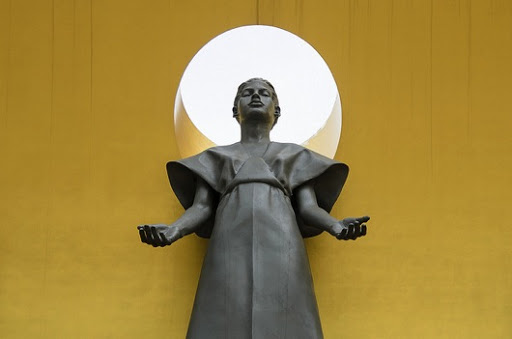
Last week I visited the Cathedral of Our Lady of the Angels in Los Angeles1 and it struck me that the statue above its entrance showed something akin to an optical illusion. Already when seen from afar, the statue above the main doors of the cathedral presented a somewhat ambiguous figure – the short hair, bare arms and forward facing palms were more consonant with an adolescent Jesus, prefiguring his later crucifixion wounds, while the context (i.e., it being the Cathedral of Our Lady and “the medium [being] the message” as McLuhan put it), the moon at the figure’s feet and the placement of the belt on the robe pointed to Mary, albeit posed in a highly unusual way.

In fact, if you look at the typical silhouettes of a statue of Mary (left – where her cloak dominates the outline), the LA statue (center) and a statue of Jesus (right – where head and hands are clearly distinct from the torso) you’ll see where my ambiguity came from:

Silhouette

Even up close this ambiguity does not resolve itself:

8716719089 f0a29367d0 z

The muscular arms as well as the scale of the hands are consistent with a young man, while the dress becomes more clearly female and the face is sufficiently androgynous to allow both for a male and a female reading. In the end I am left with a feeling akin to viewing the rabbit-duck in that I can both resolve the ambiguity in Mary’s and in Jesus’ favor.

What the sculptor Robert Graham has achieved here – at least through my eyes, is to put in bronze the key to Mary being the model Christian. Saint Louis Marie de Montfort put it as follows: “We never give more honor to Jesus than when we honor his Mother, and we honor her simply and solely to honor him all the more perfectly. We go to her only as a way leading to the goal we seek – Jesus, her Son.” And Pope Benedict XVI simply expressed it by saying that we look to Christ by “going towards Mary who shows us Jesus.” Instead of seeking fame and glory for herself, her whole life was one of self-effacing humility, a constant pointing beyond herself – to Jesus – to the point of becoming transparent.


1 For more about the cathedral’s architecture see here.

The devil

Liardet2

Beyond his great humility, simplicity, personal poverty, warmth and approachability, what struck me about Pope Francis have also been his frequent references to the devil. He mentioned him as early as his first full day in office and keeps bringing him up at least on a weekly, if not a more frequent, basis in his sermons.

Since the devil is not part of what consciously constitutes my spiritual life, I have at first just glossed over his mentions, but I am now growing curious about why it is that Francis so frequently refers to him. It is not that I have an issue with the devil being referred to – it is more that I just haven’t given him much thought. The Christianity I try to practice is about love rather than the avoidance of sin, about following Jesus rather than combatting the devil and about seeking to encounter goodness, truth and beauty rather than learning how to recognize evil. It is not that I don’t care about avoiding evil, but I believe that to be a necessary side-effect of seeking good.

The problem of evil is unquestionably challenging though and its manifestations in the world are a source of horror and sorrow for me, which does make me want to understand why it is that Francis speaks so often about the devil. In fact, I have been reading Steven Pinker’s excellent The Better Angels of Our Nature precisely for the sake of gaining a better understanding of how it is that we, humans, are capable of the shocking atrocities that we keep perpetrating on each other. While Pinker is certainly critical of religion and opposed to the idea of the devil, he makes two points that I think are relevant here: first, that “[we] need to make the case that [our inner demons] exist, because there is a resistance in modern intellectual life to the idea that human nature embraces any motives that incline us toward violence at all,”1 and second that “[violence] is not a single motive, let alone a mounting urge. It is the output of several psychological systems that differ in their environmental triggers, their internal logic, their neurobiological basis, and their social distribution.” In other words, Pinker argues both that there is a tendency to deny the ubiquity of the capacity for violence and that its origins and manifestations are complex.

These two points are in fact a great bridge from contemporary psychology and anthropology to the Church’s teaching about evil and the devil. In its most recent (1975) review of the subject of the devil, the Congregation of the Doctrine of the Faith starts with the same kind of realization as Pinker makes in the context of violence – that “the very existence of the devil is frankly called into question.” On the point of complexity too, it calls for caution and reason: “The many forms of superstition [and] obsessional preoccupation with Satan […] have always been condemned by the Church. […] Reserve and prudence are in fact demanded. [… O]ne must exercise discernment. And one must leave room for research and its findings.” Finally, it also dispells a potential misunderstanding, where the devil could be used as an excuse and a barrier to seeking scientific understanding: “It is clear that [the Church] has never allowed man to rid himself of his responsibility by attributing his faults to the devil. The Church did not hesitate to oppose such escapism when the latter manifested itself, saying with St. John Chrysostom: “It is not the devil but men’s own carelessness which causes all their falls and all the ills of which they complain.””

So, why is it that the Church speaks about the devil? By far the most obvious and compelling answer is that Jesus himself did so – calling him “tempter” (Matthew 4:3), “accuser” (Revelation 12:10), “father of lies” and “murderer” (John 8:44). Who is this devil though, whom Jesus speaks about? Jesus himself describes him as follows: “He was a murderer from the beginning and does not stand in truth, because there is no truth in him.” (John 8:44). Two things are important here: first, that the devil has been present “from the beginning,” which the Catechism explains by saying that ““[t]he devil and the other demons were indeed created naturally good by God, but they became evil by their own doing.” Scripture speaks of a sin of these angels. This “fall” consists in the free choice of these created spirits, who radically and irrevocably rejected God.” (§391-392). This means that the devil is God’s creature, rather than an equivalent but opposed being, which in turn leaves God as having created only what is good and the devil opposing him out of pride and his free choice. The second part of Jesus’ profile of the devil is equally key: the devil has “no truth in him” – his temptations are lies and the sufferings they lead to are a consequence of an opposition to the truth.

Coming back to Pope Francis, let me just pick out a couple of his references to the devil:

  1. In his very first sermon after being elected pope, Francis quotes the French poet Léon Bloy: “Whoever does not pray to God, prays to the devil.” I read this as him pointing to there being no middle ground between truth and falsehood.
  2. During one of his morning masses in the Domus Sanctae Marthae, he points to the seriousness of falsehood: “We are all sinners; all of us. We all commit sins. But calumny is something else. It is of course a sin, too, but it is something more. Calumny aims to destroy the work of God, and calumny comes from a very evil thing: it is born of hatred. And hate is the work of Satan. Calumny destroys the work of God in people, in their souls. Calumny uses lies to get ahead. And let us be in no doubt, eh?: Where there is calumny, there is Satan himself.”
  3. On another occasion he places the impulse to gossip at the feet of the devil: “When we prefer to gossip, gossip about others, criticize others- these are everyday things that happen to everyone, including me – these are the temptations of the evil one who does not want the Spirit to come to us and bring about peace and meekness in the Christian community.”
  4. Finally, he also warns that “the devil, lead[s] us to believe that ghosts, fantasies, are reality,” again underlining how it is the absence of truth that is the root from which evil springs.

As you can see, the above is just my attempt to structure some first notes rather than an exposition of some clear insight. I am at the point of trying to begin to make sense of why it is that Francis keeps bringing up the devil and trying to understand why it is that Jesus, and subsequently the Church, speaks about him. The picture I am getting is one that certainly makes sense in the bigger context of creation and has the following as its core idea: The truth presented to a free recipient can be rejected out of pride, where subsequent lies result in evil and suffering. To have this rejection of the truth be the act of a creature, albeit spiritual, rather than “just” an abstract concept or principle is again consistent with the personal nature of the Trinity and the ultimate superiority of good to evil.


1 This reminded me of the following line from The Usual Suspects (delivered by the character Keyser Söze), which comes from Charles Baudelaire’s Le spleen de Paris: “The finest trick of the devil is to persuade you that he does not exist.”

(A)synchronicity

French painter Georges Br 001

I hope you won’t cry “Apophenia!” or “Pareidolia!” once you read what I have written and that you will instead take it as my sharing a personal reflection.

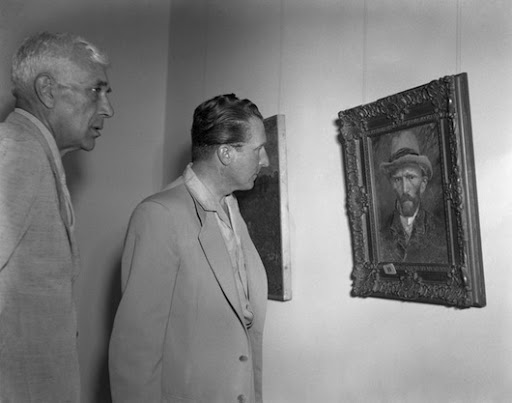
It all started when I saw the photo at the top of this post, where Georges Braque, one of the fathers of Cubism, is seen looking at Vincent van Gogh’s self–portrait. The thought that came to me straight-away was that I too have seen that painting and that this, in some sense, places me beside Braque, albeit at a different time. You could think of it as asynchronous colocation and as a variant of Jung’s synchronicity, where it is not meaning (or causation) that provides the link but an object … I swiped to the next story in my Flipboard stream, but this thought of having more in common with Braque than I previously thought, and of us having – in some sense – shared an appreciation of van Gogh’s work stayed with me.

A couple of days later, during the Easter vigil’s Litany of the Saints I then felt a particular connection with some of the names as they were being called out. They were saints whose lives and thoughts I am familiar with and with whom I felt a particular connection – Peter, John, Gregory, Augustine, Martin, Francis and Teresa of Jesus being just some of the most prominent ones. I felt like their names alone were keys that enabled a connection – in some sense …

When the litany concluded, I thought back to the Exsultet, sung at the beginning of the Easter vigil, which spoke to me already when I first heard it, and I realized that a good few of the saints, whose names were so significant to me just then, must also have listened to it. In some sense I felt like I was standing beside them as we jointly listened to this profound hymn of praise. Not only did I feel a connection to these specific saints, but to all who since at least the 4th century AD have celebrated the resurrection to the tune of this hymn. When I returned home, and after my family has gone to sleep, I looked more closely both at the Exsultet’s content, which contains so many gems of synthesis (cf. “O happy fault”), and at its history, where St. Augustine is one of the earliest sources mentioning it and where St. John Damascene (another favorite of mine) is credited with being the author of the text used today.

Returning to the Easter vigil, it’s high-point came with the Eucharist, which tied this strand of reflection together for me. The Eucharist is Jesus, who is the head and heart of His mystical body. By receiving Him and thereby being received into Him, I am connected not only to Him but to all who ever have and ever will be connected to Him. Through Jesus-Eucharist I am in a real sense connected to all of humanity – past, present and future, since he is the finite-infinite, the atemporal now.1

The intuition of connections across time and space, via a proxy like the painting that Braque and I viewed, or via a hymn that the saints, my friends, and I listened to, helped me more fully appreciate their reality in the Eucharist on Saturday night.


1 To my delight, this topic came up again while talking to my überbestie MR last night.

Why did God make bad stuff?

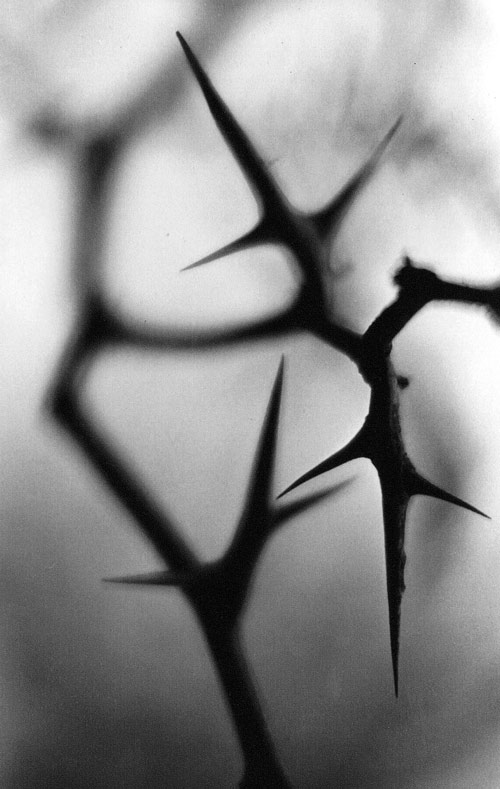
Thorns

Since my sons, who are 5 and 10 years old, attend a non-Catholic school, I have been giving them Catechism lessons. The format is that I try to get them to propose topics, encourage them to share what they think themselves and then attempt to round out the picture we arrive at together. When we kicked-off these weekly catechism sessions, the first one was me pretending to be an alien and asking them to explain to me what this whole God, Jesus, Church business is all about – as you can imagine it was hilarious both for me and for them and I believe it gave catechism a place in the entertainment category :).

At the end of the most recent session, I again asked my boys for suggestions for the next topic, to which my older son replied: “Why did God make bad stuff?” I have to say I was really pleased with this question, since it shows that he is thinking carefully about his faith and also that he applies and contrasts it with his life.

What I would like to do next, therefore, is to sketch out the answer that I’ll try to get across in our Q&A-style format and thereby to attempt a response to the question of evil in language accessible to a 10-year-old, with a 5-year-old listening in. The following then are some of the questions/ideas I will try to share with them. As you’ll see, they expect certain responses from the boys that you’ll just have to intuit from my half of the conversation :):1

“What do you like best about your friends?

Great! Can you think of some examples when someone was kind/friendly/nice to you?
And you do the same to others as well, don’t you?

But do you think you can make someone be nice/friendly/kind?

That’s right, you can’t! They have to choose to be nice to you, don’t they? And sometimes even your friends aren’t nice – right? Can you think of some examples?

That’s not good, is it? But, do they stop being your friends?

Exactly, of course they don’t … What do you think you can do when they are not nice? Can you make them be nice?

Is there something else you can do though?

That’s right, you can keep being kind and loving towards them, regardless of what they do. But it’s best when they are kind and loving back to you, isn’t it?

What do you think God would like us to do?

And do you think he can make us be nice?

Sure, he could – but then it wouldn’t really be us who are loving him, would it? We would no longer choose to be kind and we’d be like robots instead. Do you think God wants us to be like robots?

So, it looks like God needs to give us the choice to be either good or bad, so that we can really choose to love him and the people around us … But, let’s think a bit more about the question we started with: “Why did God make bad stuff?” Do you think he really made bad stuff?

That’s right – he didn’t, because he is good and he always loves everyone! Good things are like light and bad things are like darkness – in the end there will be light everywhere. No matter how much darkness there is, it cannot stop the light shining from even just one candle.

So, you can see that when we are unkind to others it is not God who makes them suffer. He only lets it happen because he wants us to choose to be kind instead of forcing us. But, instead of choosing to be kind, we are sometimes mean – that’s pretty sad, isn’t it?

How do you think God feels when we are mean to each other?

Yes, he is sad too, because he loves every one of us very much and when we are mean to others we are also mean to him.

How about another, even more difficult question: Why is it that bad things happen that are not the result of someone being mean? Why do people get sick, why are there earthquakes or tsunamis, or why is it that God doesn’t stop people from being mean when what they do is very bad? What do you think?

It is tricky … And, to be honest I don’t know either! I don’t think anyone really knows. What we do know though is that when Jesus came to show us how God loves us, in the end he suffered a lot for us. As you know, he was killed in a very painful way on the cross. What do you think this tells us?

Yes, it must mean that there is a reason for suffering. We don’t know what it is, but we can trust that God is loving us even when things are difficult and painful. Just imagine that God, who can do anything he wants, chose to show us that he loves us so much that he is prepared even to suffer for us.

And do you remember what happened after Jesus was killed on the cross?

Yes, he came back to life and then went up to heaven. It is the same for us – when bad things happen we can say to Jesus: “I know you are with me now and I am with you on the cross.” You will see that you will feel Jesus close to you and he will then take you with him to heaven.”

I know the above is incomplete and far from a satisfactory treatment of the problem of evil for an adult audience (and probably even for kids). What I tried to do though is to give my sons a sense of how freedom plays a role here, how it is that we don’t have anything like a full answer and also how Jesus’ death and resurrection can help us at least intuit the value of suffering. Any thoughts on the above would be much appreciated – as always!


1 Not that I can hope for anything remotely as masterful as Camus’ The Fall, but at least the half-dialogue format of the following is inspired by it :).

Tenderness

Father holding his newborn baby pavlo kolotenko

Pope Francis’ words and actions during yesterday’s inaugural mass are rich in inspiration, where one could reflect on his adherence to the readings of the day’s feast of St. Joseph instead of those intended for a Pope’s installation, his choice to depart from custom and have the Gospel sung in Greek as opposed to Latin (surely in honor of Patriarch Bartholomew I – the first Orthodox Patriarch to be at a pope’s inaugural mass since 1054!), his nods both to Benedict XVI and John Paul II, and his insistence on “authentic power [being] service.” Of all the aspects of the day, it is the following passage from his sermon that spoke to me most:

“[L]et us be “protectors” of creation, protectors of God’s plan inscribed in nature, protectors of one another and of the environment. […] Being protectors […] also means keeping watch over our emotions, over our hearts, because they are the seat of good and evil intentions: intentions that build up and tear down! We must not be afraid of goodness or even tenderness!

[… C]aring, protecting, demands goodness, it calls for a certain tenderness. In the Gospels, Saint Joseph appears as a strong and courageous man, a working man, yet in his heart we see great tenderness, which is not the virtue of the weak but rather a sign of strength of spirit and a capacity for concern, for compassion, for genuine openness to others, for love. We must not be afraid of goodness, of tenderness!”

Taken together with the other things Pope Francis said since his election (and before it!), I see a very clear call both to making a serious commitment – a commitment that has its eyes on the cross, that understands suffering as participation in Jesus’ passion, that is concerned about the truth and that exercises control over oneself, one’s emotions and impulses – and to transmitting the warmth, compassion and tenderness that God has for us to our brothers and sisters. While it was his emphasis on tenderness that caught my eye here, I have also been thinking about his positioning it in the context of protection, which seems to have these two sides: one of strength and effort on the side of the protector and the other of gentleness shown to the protected. In many ways this mirrors John Paul II’s dictum: “Be strict to yourself and generous to others.”

In my personal experience I have had several friends who have come to the – to my mind erroneous – conclusion that a spiritual life ought to suppress what they saw as a purely human need for warmth, for tenderness, for personal connection. This has always been an attitude that has made me concerned for their wellbeing and sadly in many cases has lead them to deep crises and disillusionment, which for some resulted even in an abandonment of their erstwhile ideals. At the heart of such an assumed spiritual-affective opposition is, in my opinion, a fundamental misunderstanding of what it is to be human – a person made in God’s image.

God being three persons who love each other to the point of being one means that we too are made for communion, for closeness, for togetherness – a point also highlighted by John Paul II saying: “God is One, but not alone”. The tenderness that Pope Francis talks about is therefore not something outside what it means to be a Christian, a follower of Jesus, and a human being made in God’s image, but very much at its heart. Even just a cursory glance at the Bible reveals that it is brimming over with God’s tenderness, where the following are just a couple of my favorite examples:

  1. “For God will hide me in his shelter
    in time of trouble,
    He will conceal me in the cover of his tent;
    and set me high upon a rock.” (Psalm 27:5)
  2. “Like a shepherd he feeds his flock; in his arms he gathers the lambs, Carrying them in his bosom, leading the ewes with care.” (Isaiah 40:11)
  3. ““Amen, I say to you, whoever does not accept the kingdom of God like a child will not enter it.” Then he embraced them and blessed them, placing his hands on them.” (Mark 10:15-16)
  4. “When Mary came to where Jesus was and saw him, she fell at his feet and said to him, “Lord, if you had been here, my brother would not have died.” When Jesus saw her weeping and the Jews who had come with her weeping, he became perturbed and deeply troubled, and said, “Where have you laid him?” They said to him, “Sir, come and see.” And Jesus wept. So the Jews said, “See how he loved him.”” (John 11:32-36)
  5. “Come to me, all you who labor and are burdened, and I will give you rest. Take my yoke upon you and learn from me, for I am meek and humble of heart; and you will find rest for your selves. For my yoke is easy, and my burden light.” (Matthew 11:28-30)
  6. “Jerusalem, Jerusalem, you who kill the prophets and stone those sent to you, how many times I yearned to gather your children together, as a hen gathers her young under her wings, but you were unwilling!” (Matthew 23:37)
  7. “Standing by the cross of Jesus were his mother and his mother’s sister, Mary the wife of Clopas, and Mary of Magdala. When Jesus saw his mother and the disciple there whom he loved, he said to his mother, “Woman, behold, your son.” Then he said to the disciple, “Behold, your mother.”” (John 19:25-17)

At the same time as placing tenderness at the heart of his message, Pope Francis also emphasizes that it – as well as the self-sacrifice implied by being protectors of the universe and of our brothers and sisters – is open to all: “The vocation of being a “protector”, however, is not just something involving us Christians alone; it also has a prior dimension which is simply human, involving everyone.” Where the Pope, and with him the whole Church, believes that every human “is a child of God.”

Pope Francis’ first week: Jesus

Francis pectoral cross s

In spite of the very short period of time that Pope Francis has been in office, one thing is clear – all he cares about is to put Jesus first and to introduce him to all in a gentle and warm way. This is a thread I see running through everything he does and I would like to share with you the highlights of the talks he has given in addition to his greeting immediately after being elected and his address to the cardinals the next day that I already wrote about (and that also form part of this Christocentric theme).

  1. “We can walk as much as we want, we can build many things, but if we do not profess Jesus Christ, things go wrong. We may become a charitable NGO, but not the Church, the Bride of the Lord.” (Missa pro Ecclesia with the Cardinal-Electors, 14th March)
    Instead of this being a dig at NGOs, as some media outlets interpreted it, it is instead an underlining of who the Church is and that her actions are a consequence of her fundamental nature. Even if we perform charitable actions, whose goodness is not questioned here, but fall silent about Jesus, we cease to be his Church.
  2. “When we journey without the Cross, when we build without the Cross, when we profess Christ without the Cross, we are not disciples of the Lord, we are worldly: we may be bishops, priests, cardinals, popes, but not disciples of the Lord.” (Missa pro Ecclesia)
    Pope Francis here makes it clear what the “professing Jesus” that he insisted on earlier means – it means following Jesus also in suffering and sacrifice and not only in what is “nice,” easy and comfortable. This is a temptation that St. Peter himself succumbed to, when, after Jesus told the disciples that he will “suffer greatly […] and be killed and on the third day be raised,” he then took him to one side and said: “God forbid, Lord! No such thing shall ever happen to you.” (Matthew 16:21-22) What I found particularly meaningful here were not only the above words but also the emphasis with which Francis said them and the time he took to address these words very personally to the cardinals.
  3. “Christ is the Church’s Pastor, but his presence in history passes through the freedom of human beings; from their midst one is chosen to serve as his Vicar, the Successor of the Apostle Peter. Yet Christ remains the centre, not the Sucessor of Peter: Christ, Christ is the centre. Christ is the fundamental point of reference, the heart of the Church. Without him, Peter and the Church would not exist or have reason to exist.” (Audience to representatives of the media, 16th March)
    Here I particularly like how Francis brings two aspects of being Jesus’ followers together: first that it is through us that Jesus’ presence persists in the world and second that this presence is not an imposition or an over-ride, but that it respects our freedom. Also, he again uses his election as an opportunity to put Jesus in the foreground.
  4. “[T]he Church exists to communicate precisely this: Truth, Goodness and Beauty in person.” (Audience to representatives of the media)
    Again Francis emphasizes that it is all about Jesus, who is Truth, Goodness and Beauty personified. Here the official transcript of his address has “in person” in quotation marks, while I believe – also from having listened carefully to him saying this sentence – that the meaning was not meant to be different from what “in person” ordinarily means. Jesus is Truth, Goodness and Beauty incarnate – i.e., in person.
  5. “Since many of you are not members of the Catholic Church, and others are not believers, I cordially give this blessing silently, to each of you, respecting the conscience of each, but in the knowledge that each of you is a child of God. May God bless you!” (Audience to representatives of the media)
    Seemingly an afterthought, Pope Francis adds these words in Spanish at the end of the audience, which he already concluded by saying “I cordially impart to all of you my blessing.” in Italian. Yet again he puts himself in second place, is concerned about the freedom and dignity of his audience and at the same time is clear about his beliefs. To my mind all of this radiates his concern and love for those to whom he speaks.
  6. “[God] has the ability to forget, [which is] special: He forgets [our sins], He kisses you, He embraces you, and He says to you, ‘Neither do I condemn you. Go, and from now, on, sin no more.’ [John 8:11] Only that counsel does He give you.” (Mass at St. Anne’s – the parish church of Vatican City, March 17th)
  7. “[W]e do not hear words of contempt, we do not hear words of condemnation [from Jesus], but only words of love, of mercy, that invite us to conversion.” (Angelus, 17th March)
    Here Francis continues with the theme of forgiveness and openness of Jesus towards all that he already sketched out during the morning mass and he again emphasizes Jesus’ love and invitation to a free conversion as opposed to condemnation or coercion.
  8. “In these days, I have been able to read a book by […] Cardinal Kasper, a talented theologian, a good theologian—on mercy. And it did me such good, […] so much good…”
    “I wanted to ask her[, the woman in her eighties who came to me to hear her confession and who told me “If the Lord didn’t forgive everyone, the world would not exist.”]: “Tell me, have you studied at the Gregorian [Pontifical University]?”, because that is the wisdom that the Holy Spirit gives: the inner wisdom of God’s mercy.”
    Finally, I also wanted to pick out the above moments from the Angelus address: first, Pope Francis choosing to highlight the thoughts of one of his cardinals instead of putting his own thoughts first and second, recognizing God’s wisdom in the words of a simple parishioner and sharing it with the world.