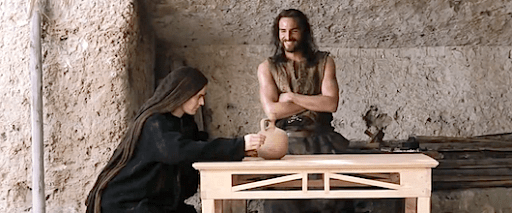
Jesus laughed

Jesus laughed

In many ways I find the subject of today’s post among the most difficult to talk about as, to me, it is akin to asking whether Jesus looked people in the eye when he spoke to them (or whether he looked down at his feet instead). Neither is mentioned in the Bible, yet both seem equally self-evident to me. I have yet to meet a loving, kind, compassionate person whom I haven’t also seen and heard laughing. So why is it that I am even writing about this topic?

The most immediate reason is a message I received from my bestie ML a couple of days ago, in which he shares a frustration that I too have had for years: the tendency of some to make a science out of distinguishing between joy and “mere fun,” branding one as a deplorable, shallow waste of time while extolling the other as a good, clean, Christian virtue. The point here isn’t that no distinctions ought to be made between varieties of enjoyment (the joy of mutual love, of a joke shared among friends, of delighting in success not being consubstantial with sadism or schadenfreude), but that such an enterprise bears the great risk of draining the joy out of Christian life through a process of abstract analysis and categorization that leaves one dour and cold.

In fact, the above thoughts were triggered by one of Pope Francis’ homilies from last week, where he says:

“A Christian is a man and a woman of joy. Jesus teaches us this, the Church teaches us this, in a special way in this liturgical time. What is this joy? Is it having fun? No: it is not the same. Fun is good, eh? Having fun is good. But joy is more, it is something else. […] Fun, if we want to have fun all the time, in the end becomes shallow, superficial, and also leads us to that state where we lack Christian wisdom. […] Joy is another thing. Joy is a gift from God. It fills us from within. It is like an anointing of the Spirit. [… On the other hand, s]ometimes melancholy Christian faces have more in common with pickled peppers than the joy of having a beautiful life.”

Clearly Francis distinguishes between fun that becomes shallow and joy that “fills us from within,” but he also warns against the lifelessness that follows from an absence of joy and that this is not Christian.

Having read and re-read Francis’ sermon many times over the last days, I am coming to the conclusion that the distinction ought not to be between fun and joy but between fun that leads to or subsists in joy and fun that does not and that leads to resentment, frustration and disappointment. In fact, Francis himself says that “Having fun is good[, b]ut joy is more” and I believe that this leads to a reading not of dichotomy but of set relationships, where fun and joy overlap. I’d like to go a step further though and argue that if joy is sought on the back of avoiding fun then only the latter is likely to be be achieved. Fun is a context in which relationships are built and avoiding it or looking down on it will eventually cut a person off from their neighbors – precisely the neighbors Jesus asks me to love like myself.

If I just look at my best friends, I can say with confidence that the moments that have lead to the birth of friendship have been ones of fun and joy – of delighting in each other, of recognizing oneself in the other, of having fun being together. This is not all that friendship is and moments of difficulty and suffering certainly test and strengthen it, but ultimately, as John Paul II said: “We are an Easter people.” Being an “Easter people” means both understanding the fundamental value that suffering has and realizing that its embracing is not for its own sake but as a means that leads to the joy of the resurrection.

But where does the question about whether Jesus laughed fit into this picture? It comes precisely from concerns about fun: should it be discredited or seen as a potential contributor to love and joy. At least up until the middle ages, many viewed laughter with deep-seated suspicion, but there were also those, like Erasmus of Rotterdam, who wrote the “Morias Enkomion” (“In Praise of Folly”) to his friend, St. Thomas More, who were its proponents. I don’t mean to mount an extensive defense of Jesus’ having laughed here – it is not something I believe is necessary and if you are convinced he never laughed, then Billy Graham would tell you: “I feel sorry for [you], because a balanced sense of humor can save us from taking ourselves too seriously, and help us see through the pride and pretense of our sinful world.” If, however, you’d like to see such a defense of laughter, others have done so very well already and I’d just pick out two: first, there are the very interesting scriptural pointers by the Protestant Rev. Kuiper and second, the great defense of humour by the Jesuit Fr. Martin, both of which I very much recommend.

To conclude on a fun note, let me leave you with a couple of examples of humor and laughter from the bible and the sayings of the saints (who are always a great weather vane for orthopraxy):

  1. St. Sarah (yes, “Old Testament” figures are held up as saints in the Catholic Church), who is the patron saint of laughter, laughed when God told her she’d get pregnant in her nineties: “God has given me cause to laugh, and all who hear of it will laugh with me.” (Genesis 21:6). Not only did Sarah laugh, but her son was named Isaac, which means “He laughed.”
  2. Jesus, during the “Sermon on the Plain” says: “Blessed are you who are now weeping, for you will laugh.” (Luke 6:21).
  3. Jesus often employs humor (which does not preclude him making important points at the same time) – e.g., as in the “eye of the needle” image: “[I]t is easier for a camel to pass through the eye of a needle than for one who is rich to enter the kingdom of God.” (Matthew 19:24).
  4. I have previously argued that the opening line of the Johannine prologue has the structure of a joke.
  5. When St. Thomas More is about to be executed for disobeying Henry VIII, he pulls his beard off the chopping block and tells the executioner: “This hath not offended the king.”
  6. In instructions to fellow nuns, St. Teresa of Ávila said: “What would happen if we hid what little sense of humor we had? Let each of us humbly use this to cheer others.”
  7. When asked by a journalist “How many people work in the Vatican?,” Blessed Pope John XXIII replied: “About half.”

🙂
Neither faith nor reason: ex nihilo butchered

Nequaquam

Another Sunday, another “Faith and Reason” column in the “Our Faith on Sunday” newsletter, another spectacularly confused piece on an otherwise interesting topic, and this time – to add insult to injury – a complete disregard for the fact that it was Easter Sunday!

Instead of reflecting on something to do with the Easter triduum (e.g., the resurrection, Jesus’ descent into hell or his abandonment on the cross, or a myriad other aspects that could have been looked at from the faith-reason perspective), yesterday’s column was the following (with its first, superfluous sentence removed):

“[…] Creation ex nihilo (out of nothing) does not mean that, before matter was brought into existence, that there was absolute nothingness. If there had been absolutely nothing before creation, absolutely nothing could have come into existence. The nihil of ex nihilo refers to the nothing of material existence. Creation ex nihilo means that, before matter was called into being, there was no matter. God and the angels existed ‘before’ the creation of matter.”

Oh, man! Where to start? Before debunking the above hot mess, let me just put a couple of quotes from the Catechism on the table, so that the squirming irrationality of this week’s “Faith and Reason” column is counterbalanced by how the Church actually talks about God and creation:

“In [Jesus] “all things were created, in heaven and on earth… all things were created through him and for him. He is before all things, and in him all things hold together.” (Colossians 1:16-17)” (§291)

“We believe that God needs no pre-existent thing or any help in order to create, nor is creation any sort of necessary emanation from the divine substance. God creates freely “out of nothing”.” (§296)

“The world began when God’s word drew it out of nothingness; all existent beings, all of nature, and all human history are rooted in this primordial event, the very genesis by which the world was constituted and time begun. (cf. St. Augustine, De Genesi contra Manichaeos 1, 2, 4)” (§338)

Note how there is no arguing against the nothingness that preceded creation in the Catechism (neither in the passages quoted above nor anywhere else in its 2865 paragraphs) for it would be futile to do so. Even in the context of poetic (as distinct from philosophical, theological or scientific) language, both Genesis 1 (“In the beginning, when God created the heavens and the earth”) and John 1 (“In the beginning was the Word, and the Word was with God, and the Word was God. He was in the beginning with God. All things came to be through him, and without him nothing came to be.”) steer well clear of attempting to talk about what happened before “the beginning” in which God created the universe (i.e., space-time).

Why is that? Again we find the Church’s position in the Catechism as follows:

“Since our knowledge of God is limited, our language about him is equally so. We can name God only by taking creatures as our starting point, and in accordance with our limited human ways of knowing and thinking.”(§40)

“God transcends all creatures. We must therefore continually purify our language of everything in it that is limited, image-bound or imperfect, if we are not to confuse our image of God — “the inexpressible, the incomprehensible, the invisible, the ungraspable” — with our human representations. Our human words always fall short of the mystery of God. Admittedly, in speaking about God like this, our language is using human modes of expression; nevertheless it really does attain to God himself, though unable to express him in his infinite simplicity. Likewise, we must recall that “between Creator and creature no similitude can be expressed without implying an even greater dissimilitude”; and that “concerning God, we cannot grasp what he is, but only what he is not, and how other beings stand in relation to him.””(§42-43)

To me the key here is: “we can name God only by taking creatures as our starting point,” which you could transpose into Wittgensteinese as “we can only use the rules of games we have played.” In other words – the meanings of our language (using which we can “name” God) derive from our own, direct experiences, which take place firmly within the context of the universe and which therefore have a scope constrained to it. Instead of strictly following Wittgenstein’s “whereof one cannot speak, thereof one must be silent,” Christianity still talks about God and about what has been revealed to it about realities beyond the universe, but does so with great caution and with lots of “in some sense.”

To take the “ex nihilo” of God’s creative act and start qualifying it in the belief that it would otherwise preclude a pre-existence of God is jut confused, since before the “beginning” in which space-time were created, there is no before (which requires time) and to consider creation to be only of matter (and not of time as well – as the column’s author does) not only flies in the face of contemporary physics but also of St. Augustine’s insights, arrived at around 389 AD.

The crowning glory of yesterday’s column though is its assertion that “If there had been absolutely nothing before creation, absolutely nothing could have come into existence,” which is a direct denial of God’s ex nihilo bringing about of the universe (and of contemporary physics pointing to the same) and stands proudly alongside the same column barefacedly denying the incarnation the previous Sunday.

The most charitable interpretation of yesterday’s mental contortions is that they were a misguided attempt at trying to resolve a fictitious contradiction or a mistimed April Fools prank …


1 Previous ones having protested against the denial of the incarnation, the allegedly separate “orders of knowledge” of science and religion, the abuse of “cf.,” the perversion of philosophy and a plagiaristic ignorance of infinity.

In the beginning

In the beginning

This is my third attempt at starting a post1 that I have been thinking about intensively all weekend (and that follows a train of thought that I have nursed on and off for years). Why write about it now? Because I believe I have finally understood something that has been staring me in the face for years: the opening line of St. John’s Gospel is a joke!

“Whoa!” I hear you say “Hold it right there!” Before you start crying “Blasphemy!” or “Stone him!,” please, do hear me out.2 I don’t mean to say that it is ridiculous, frivolous, trivial or inconsequential. On the contrary! I believe that I can now see a twist of humor in it that furthermore alludes to complexity that would otherwise have taken tomes upon tomes to try and spell out and that would have been well beyond St. John or the Christians of the first many centuries.

Picture this (imaginary, non-canonical!) scene:

God the Father, Jesus and the Holy Spirit are sitting around a table, chatting (you can imagine that this is what they spoke about in the scene Rublev painted, if you like):

Father: OK, guys, let’s get John started with his Gospel.

Jesus: Dad, can we have him spell out how it all started, and not just open with my birth?

HS: Sure(!), but the maths might be a tad beyond him, don’t you think?

Jesus: I didn’t mean to give him the full recipe, HS! This is not about repeatability and independent verification …

HS: So, were you thinking along the lines of the atemporal – yet dynamic, hyper-dimensional, infinite, partaking in the finite, linear, half-axis of time and being delimited in space? Even if we dumb it down to the level of philosophy, it’s still a tall order (although if anyone can do it, I can!).

Father: Look, HS, Jesus does have a point – we could give them a sense of what is going on, without having to bring Ambrose, Thomas or Albert forward. Surely you can think of some little quip to point them in the right direction.

[A “moment”’s silence later.]

HS: It’s a bit cheeky, but how about this – and I’m just riffing here (plus they’ll have to wait for Ludwig and Martin to start unpacking it) …

Jesus: Get on with it! We may have all eternity, but I’d rather get back to giving Sidd some more hints.

HS: All right, all right! How about John opens with this: “In the beginning was the Word!”

The Father and Jesus look at each other, wide-eyed, exclaim: “Genius!” and the triune bursts out laughing.

The insight I had, while walking to mass on Sunday morning and thinking about Dei Verbum, the Johannine prologue and Descartes’ “cogito,” was the following: Saying “In the beginning was the Word” is like starting a recipe with “knead the dough.” A word cannot possibly be the start: it requires a language, other words, syntax, grammar and speakers and listeners who know how to play the games it facilitates. Saying “In the beginning was the Word” is saying “Look, this is as far back as we can take you, but know that there was lots that came before.” It places at the beginning an innocent-looking entity: a word, yet one that vehemently points beyond itself. To meaning, to reference, to relation, to function, to communication, to a meeting of minds. With a simple sentence, John (with some help), gives a masterclass on the inevitability of the preexisting and the core of Trinitarian relationships, where, like a word, each person points beyond themselves.

“Alright,” you say, “but why call it a joke?” I believe the structure of this sentence is precisely that of all one-liners: the first part (“In the beginning”) prepares you for a certain set of expectations and the second surprises you with something that just does not fit (“the Word,” which cannot possibly be in the beginning :). This is exactly what Kant meant with “Laughter is an effect that arises if a tense expectation is transformed into nothing.” Not wanting to kill humor with explanation, let me leave you with another example of the same comedic form: “Every winter when the first snow fell, I’d run to the front door with excitement, start banging on it and shout: “Mum! Dad! Let me in!”” (Milton Jones).

Realizing the above, I started seeing the Johannine pattern elsewhere too. Descartes, starts with “cogito ergo sum,” in an attempt to draw a line and derive a philosophy from that stake in the ground. Yet, it is a line that carries a lot of baggage beyond itself. My own earlier attempt too, which tries to take the “cogito” a step further by starting with “Language” is nothing but an explicit acknowledgement of such a necessary preexistence and in no way escapes or circumvents it. Unsurprisingly, the account of creation in Genesis uses the word/language mechanism for indicating the process of creation, where matter is spoken into being (“Then God said: Let there be light, and there was light” (Genesis 1:3)). More surprisingly, one of the Hindu creation accounts (the Nasadiya Sukta in the Rigveda) also employs a similar, though not identical, mechanism: “The One breathed windlessly and self-sustaining […] that was the primal seed, born of the mind.” Even the creation account of the Sumerians (The debate between Sheep and Grain, written in the 3rd millennium BC), highlights the role of language in the process: “the great gods, did not even know the names Grain or Sheep.”

What is clear to me from the above is the fundamental role of language in the process of something coming from nothing, which in a sense undermines the idea of a true nothing having preceded the something. With this in mind, the Christian identification of Jesus with “the Word,” which I have been wondering about for years, makes perfect sense. The Father makes himself known to us by speaking his Son, who in turn points back to Him: “Whoever has seen me has seen the Father.” (John 14:9) and then: “The words that I speak to you I do not speak on my own. The Father who dwells in me is doing his works. Believe me that I am in the Father and the Father is in me, or else, believe because of the works themselves.” (John 14:10-11, with a nice hat-tip to orthopraxy).

So, let me finish with a one-liner: “In the beginning was the Word.” 🙂


1 In a previous version I would have taken you through Lemaître, the Planck epoch and the opening lines of the Tanakh, before getting to the Johannine prologue.
2 Thanks to my über–bestie, PM, for his Nihil Obstat and Transferitur (the Imprimatur of the digital age) – much appreciated!