Cardinal Müller’s confusion

2017 09 20 Cdl

685 words, 4 min read

It is interesting to see the approach that Cardinal Gerhard Ludwig Müller has taken to responding to an ostensible call from “many bishops, priests, religious and lay people of the Catholic Church” to “make a public testimony about the truth of revelation”, which he constructs by referencing 33 of the Catechism’s 2865 paragraphs.

Sadly, those 33 paragraphs do not include the one that would have sufficed: §85, which goes like this and two thirds of which come from one of Vatican II’s four dogmatic constitutions – Dei Verbum:

““The task of giving an authentic interpretation of the Word of God, whether in its written form or in the form of Tradition, has been entrusted to the living teaching office of the Church alone. Its authority in this matter is exercised in the name of Jesus Christ.” (Dei Verbum, §10) This means that the task of interpretation has been entrusted to the bishops in communion with the successor of Peter, the Bishop of Rome.”

Also curious is the total lack of mention of the pope, the “successor of Peter, the Bishop of Rome” in Cardinal Müller’s attempt to dispel confusion and shed light on the “many bishops, priests, religious and lay people of the Catholic Church” who are currently at a loss with regard to the “truth of revelation”, especially since he is rather central (to put it mildly) to the “shepherds’ very own task” that Cardinal Müller self-attributes in his statement. Yet again the answer is in the Catechism that Cardinal Müller presents – quoting St. John Paul II’s Fidei Depositum – as the “safe standard for the doctrine of the faith” in the opening paragraph of his declaration. There, at §883, and quoting from another of Vatican II’s dogmatic constitutions, we read:

““The college or body of bishops has no authority unless united with the Roman Pontiff, Peter’s successor, as its head.” As such, this college has “supreme and full authority over the universal Church; but this power cannot be exercised without the agreement of the Roman Pontiff.” (Lumen Gentium, §22)”

Besides such paradigmatic confusion, Cardinal Müller also seems to be exercising some, shall we say, poetic license. Just to give an example, he presents “[f]or he who dies in mortal sin without repentance will be forever separated from God” as the summary of §1033, which reads:

“We cannot be united with God unless we freely choose to love him. But we cannot love God if we sin gravely against him, against our neighbor or against ourselves: “He who does not love remains in death. Anyone who hates his brother is a murderer, and you know that no murderer has eternal life abiding in him.” (1 Jn 3:14-15) Our Lord warns us that we shall be separated from him if we fail to meet the serious needs of the poor and the little ones who are his brethren. (Cf. Mt 25:31-46.) To die in mortal sin without repenting and accepting God’s merciful love means remaining separated from him for ever by our own free choice. This state of definitive self-exclusion from communion with God and the blessed is called “hell.””

I’m afraid the Catechism (and the magisterium of at least the last three popes) is a shade more nuanced. Instead of Cardinal Müller’s “[f]or he who dies in mortal sin without repentance will be forever separated from God” we have “[t]o die in mortal sin without repenting and accepting God’s merciful love means remaining separated from him for ever by our own free choice” (emphasis mine). Not the same and a bit confusing, if you ask me … or even better, if you ask the Pope, or read and put into practice the Gospel, or read the whole Catechism, instead of Reader’s Digest versions of 33 of its 2865 paragraphs.

Finally, the entire missive ends on another confusion, which is its author’s title, given as “Prefect of the Congregation for the Doctrine of the Faith 2012-2017” and which instead ought to be “Prefect emeritus of the Congregation for the Doctrine of the Faith”, with all the implications of authority that this difference entails.

God is a family

Border father son

588 words, 3 min read

Last Sunday our new parish priest started his homily with reflecting on Jesus’ startling rebuke of St. Peter: “Get behind me, Satan! You are thinking not as God thinks, but as human beings do.” (Mark 8:33). This, our parish priest argued, was akin to him going up to the parents of a disabled child, taking them to one side and saying: “Look, why don’t you put your kid into a home so you can live a calmer, more relaxed life?” The parents would look at him like at an alien and would be as horrified as Jesus was when Peter suggested to him to get out of his impending suffering and death. Peter’s saying “Heaven preserve you, Lord, this must not happen to you.” (Matthew 16:22) was like parents hearing someone telling them to get rid of their child for a quiet life. Our parish priest then went on to develop an edifying line of thought about “thinking as God does” but I saw a different path leading on from such an insightful opening.

What struck me was the wisdom of the simile. Jesus related to the will of his Father in as inalienable and unquestionable a way as a parent relates to their child. Suggesting alternatives to it or a turning away from it then elicits as visceral a reaction as would result from being faced with separation from one’s own kids. Jesus therefore reaches for the most savage label he has at his disposal – Satan. He, who enjoyed direct access to the Father’s will and chose to turn away from it with full knowledge of the consequences. He, about whom Jesus said: “I watched Satan fall like lightning from heaven.” (Luke 10:18). St. Peter must have been well freaked out, as must have Jesus. “How can he say that to me when I just wanted the best for him”; “How can he still not get it?! Hasn’t anything I said to him sunk in?” they may have thought …

Then it seemed to me that this simile points to another angle: that the preference parents have for their children mirrors an essential aspect of the nature of God, whose inner life is that of a family. As St. John Paul II said, “our God in his deepest mystery is not a solitude, but a family, since he has in himself fatherhood, sonship and the essence of the family, which is love.” The Father favors the Son, the Son favors the Father and their preference for each other is the Holy Spirit, who thereby doesn’t remain “unfavored” since he is integral to the preferential relationship of the other two Persons. Thinking about my relationship with my family, I at times wonder about how my manifest preference for them sits with my relationship with everyone else, whom I am called to love equally. What struck me on Sunday is that the solution here is not to diminish my preference for my own family but to realize that every single person I meet is loved by God as his own child. Being a child of God myself, this places everyone else into my immediate family. Having a spouse and children (and parents and siblings) also serves the purpose of making me experience more deeply how it is that the Persons of the Trinity favor and love one another and each one of us. Yet again I return to Patriarch Athenagoras’ dictum: “God loves us all equally, but secretly each one of us is his favorite.”

Gaudete et Exsultate: God’s face reflected in so many other faces

Faces

6590 words, 33 min read

At Roman noon today, Pope Francis published his latest apostolic exhortation, entitled Gaudete et Exsultate (“Rejoice and be glad”) in which he sets out “to repropose the call to holiness in a practical way for our own time, with all its risks, challenges and opportunities. For the Lord has chosen each one of us “to be holy and blameless before him in love” (Eph 1:4).” (§2). This 126K word document will take some time to receive and internalize well and I would, for now, just like to share with you my favorite passages from it. The holiness Pope Francis presents here is one that has its eyes wide open to the world and to God present in it. It is a holiness that asks for everything and that gives more in return. A holiness that requires sacrifice to the smallest details and that offers fulfilment and endless joy in a community where God dwells among his people.


I like to contemplate the holiness present in the patience of God’s people: in those parents who raise their children with immense love, in those men and women who work hard to support their families, in the sick, in elderly religious who never lose their smile. In their daily perseverance I see the holiness of the Church militant. Very often it is a holiness found in our next-door neighbours, those who, living in our midst, reflect God’s presence. We might call them “the middle class of holiness”. (§7)

Holiness is the most attractive face of the Church. But even outside the Catholic Church and in very different contexts, the Holy Spirit raises up “signs of his presence which help Christ’s followers” (Novo Millennio Ineunte). Saint John Paul II reminded us that “the witness to Christ borne even to the shedding of blood has become a common inheritance of Catholics, Orthodox, Anglicans and Protestants”. In the moving ecumenical commemoration held in the Colosseum during the Great Jubilee of the Year 2000, he stated that the martyrs are “a heritage which speaks more powerfully than all the causes of division”. (§9)

We should not grow discouraged before examples of holiness that appear unattainable. There are some testimonies that may prove helpful and inspiring, but that we are not meant to copy, for that could even lead us astray from the one specific path that the Lord has in mind for us. The important thing is that each believer discern his or her own path, that they bring out the very best of themselves, the most personal gifts that God has placed in their hearts (cf. 1 Cor 12:7), rather than hopelessly trying to imitate something not meant for them. We are all called to be witnesses, but there are many actual ways of bearing witness. (§11)

To be holy does not require being a bishop, a priest or a religious. We are frequently tempted to think that holiness is only for those who can withdraw from ordinary affairs to spend much time in prayer. That is not the case. We are all called to be holy by living our lives with love and by bearing witness in everything we do, wherever we find ourselves. Are you called to the consecrated life? Be holy by living out your commitment with joy. Are you married? Be holy by loving and caring for your husband or wife, as Christ does for the Church. Do you work for a living? Be holy by labouring with integrity and skill in the service of your brothers and sisters. Are you a parent or grandparent? Be holy by patiently teaching the little ones how to follow Jesus. Are you in a position of authority? Be holy by working for the common good and renouncing personal gain. (§14)

When you feel the temptation to dwell on your own weakness, raise your eyes to Christ crucified and say: “Lord, I am a poor sinner, but you can work the miracle of making me a little bit better”. In the Church, holy yet made up of sinners, you will find everything you need to grow towards holiness. The Lord has bestowed on the Church the gifts of scripture, the sacraments, holy places, living communities, the witness of the saints and a multifaceted beauty that proceeds from God’s love, “like a bride bedecked with jewels” (Is 61:10). (§15)

This holiness to which the Lord calls you will grow through small gestures. Here is an example: a woman goes shopping, she meets a neighbour and they begin to speak, and the gossip starts. But she says in her heart: “No, I will not speak badly of anyone”. This is a step forward in holiness. Later, at home, one of her children wants to talk to her about his hopes and dreams, and even though she is tired, she sits down and listens with patience and love. That is another sacrifice that brings holiness. Later she experiences some anxiety, but recalling the love of the Virgin Mary, she takes her rosary and prays with faith. Yet another path of holiness. Later still, she goes out onto the street, encounters a poor person and stops to say a kind word to him. One more step. (§16)

At times, life presents great challenges. Through them, the Lord calls us anew to a conversion that can make his grace more evident in our lives, “in order that we may share his holiness” (Heb 12:10). At other times, we need only find a more perfect way of doing what we are already doing: “There are inspirations that tend solely to perfect in an extraordinary way the ordinary things we do in life”. When Cardinal François-Xavier Nguyên van Thuân was imprisoned, he refused to waste time waiting for the day he would be set free. Instead, he chose “to live the present moment, filling it to the brim with love”. He decided: “I will seize the occasions that present themselves every day; I will accomplish ordinary actions in an extraordinary way”. (§17)

At its core, holiness is experiencing, in union with Christ, the mysteries of his life. It consists in uniting ourselves to the Lord’s death and resurrection in a unique and personal way, constantly dying and rising anew with him. But it can also entail reproducing in our own lives various aspects of Jesus’ earthly life: his hidden life, his life in community, his closeness to the outcast, his poverty and other ways in which he showed his self-sacrificing love. The contemplation of these mysteries, as Saint Ignatius of Loyola pointed out, leads us to incarnate them in our choices and attitudes. (§20)

The Father’s plan is Christ, and ourselves in him. In the end, it is Christ who loves in us, for “holiness is nothing other than charity lived to the full”. As a result, “the measure of our holiness stems from the stature that Christ achieves in us, to the extent that, by the power of the Holy Spirit, we model our whole life on his”. Every saint is a message which the Holy Spirit takes from the riches of Jesus Christ and gives to his people. (§21)

It is not healthy to love silence while fleeing interaction with others, to want peace and quiet while avoiding activity, to seek prayer while disdaining service. Everything can be accepted and integrated into our life in this world, and become a part of our path to holiness. We are called to be contemplatives even in the midst of action, and to grow in holiness by responsibly and generously carrying out our proper mission. (§26)

Needless to say, anything done out of anxiety, pride or the need to impress others will not lead to holiness. We are challenged to show our commitment in such a way that everything we do has evangelical meaning and identifies us all the more with Jesus Christ. We often speak, for example, of the spirituality of the catechist, the spirituality of the diocesan priesthood, the spirituality of work. For the same reason, in Evangelii Gaudium I concluded by speaking of a spirituality of mission, in Laudato Si’ of an ecological spirituality, and in Amoris Laetitia of a spirituality of family life. (§28)

This does not mean ignoring the need for moments of quiet, solitude and silence before God. Quite the contrary. The presence of constantly new gadgets, the excitement of travel and an endless array of consumer goods at times leave no room for God’s voice to be heard. We are overwhelmed by words, by superficial pleasures and by an increasing din, filled not by joy but rather by the discontent of those whose lives have lost meaning. How can we fail to realize the need to stop this rat race and to recover the personal space needed to carry on a heartfelt dialogue with God? Finding that space may prove painful but it is always fruitful. (§29)

We need a spirit of holiness capable of filling both our solitude and our service, our personal life and our evangelizing efforts, so that every moment can be an expression of self-sacrificing love in the Lord’s eyes. In this way, every minute of our lives can be a step along the path to growth in holiness. (§31)

Do not be afraid of holiness. It will take away none of your energy, vitality or joy. On the contrary, you will become what the Father had in mind when he created you, and you will be faithful to your deepest self. To depend on God sets us free from every form of enslavement and leads us to recognize our great dignity. We see this in Saint Josephine Bakhita: “Abducted and sold into slavery at the tender age of seven, she suffered much at the hands of cruel masters. But she came to understand the profound truth that God, and not man, is the true Master of every human being, of every human life. This experience became a source of great wisdom for this humble daughter of Africa”. (§32)

When somebody has an answer for every question, it is a sign that they are not on the right road. They may well be false prophets, who use religion for their own purposes, to promote their own psychological or intellectual theories. God infinitely transcends us; he is full of surprises. We are not the ones to determine when and how we will encounter him; the exact times and places of that encounter are not up to us. Someone who wants everything to be clear and sure presumes to control God’s transcendence. (§42)

It is not easy to grasp the truth that we have received from the Lord. And it is even more difficult to express it. So we cannot claim that our way of understanding this truth authorizes us to exercise a strict supervision over others’ lives. Here I would note that in the Church there legitimately coexist different ways of interpreting many aspects of doctrine and Christian life; in their variety, they “help to express more clearly the immense riches of God’s word”. It is true that “for those who long for a monolithic body of doctrine guarded by all and leaving no room for nuance, this might appear as undesirable and leading to confusion”. (§43)

Only on the basis of God’s gift, freely accepted and humbly received, can we cooperate by our own efforts in our progressive transformation. We must first belong to God, offering ourselves to him who was there first, and entrusting to him our abilities, our efforts, our struggle against evil and our creativity, so that his free gift may grow and develop within us: “I appeal to you, therefore, brethren, by the mercies of God, to present your bodies as a living sacrifice, holy and acceptable to God” (Rom 12:1). For that matter, the Church has always taught that charity alone makes growth in the life of grace possible, for “if I do not have love, I am nothing” (1 Cor 13:2). (§56)

Still, some Christians insist on taking another path, that of justification by their own efforts, the worship of the human will and their own abilities. The result is a self-centred and elitist complacency, bereft of true love. This finds expression in a variety of apparently unconnected ways of thinking and acting: an obsession with the law, an absorption with social and political advantages, a punctilious concern for the Church’s liturgy, doctrine and prestige, a vanity about the ability to manage practical matters, and an excessive concern with programmes of self-help and personal fulfilment. Some Christians spend their time and energy on these things, rather than letting themselves be led by the Spirit in the way of love, rather than being passionate about communicating the beauty and the joy of the Gospel and seeking out the lost among the immense crowds that thirst for Christ. (§57)

[A]mid the thicket of precepts and prescriptions, Jesus clears a way to seeing two faces, that of the Father and that of our brother. He does not give us two more formulas or two more commands. He gives us two faces, or better yet, one alone: the face of God reflected in so many other faces. For in every one of our brothers and sisters, especially the least, the most vulnerable, the defenceless and those in need, God’s very image is found. Indeed, with the scraps of this frail humanity, the Lord will shape his final work of art. For “what endures, what has value in life, what riches do not disappear? Surely these two: the Lord and our neighbour. These two riches do not disappear!” (§61)

The Beatitudes are like a Christian’s identity card. So if anyone asks: “What must one do to be a good Christian?”, the answer is clear. We have to do, each in our own way, what Jesus told us in the Sermon on the Mount. In the Beatitudes, we find a portrait of the Master, which we are called to reflect in our daily lives. (§63)

The word “happy” or “blessed” thus becomes a synonym for “holy”. It expresses the fact that those faithful to God and his word, by their self-giving, gain true happiness. (§64)

“Blessed are the poor in spirit, for theirs is the kingdom of heaven”

Wealth ensures nothing. Indeed, once we think we are rich, we can become so self-satisfied that we leave no room for God’s word, for the love of our brothers and sisters, or for the enjoyment of the most important things in life. In this way, we miss out on the greatest treasure of all. That is why Jesus calls blessed those who are poor in spirit, those who have a poor heart, for there the Lord can enter with his perennial newness. (§68)

This spiritual poverty is closely linked to what Saint Ignatius of Loyola calls “holy indifference”, which brings us to a radiant interior freedom: “We need to train ourselves to be indifferent in our attitude to all created things, in all that is permitted to our free will and not forbidden; so that on our part, we do not set our hearts on good health rather than bad, riches rather than poverty, honour rather than dishonour, a long life rather than a short one, and so in all the rest”. (§69)

“Blessed are the meek, for they will inherit the earth”

These are strong words in a world that from the beginning has been a place of conflict, disputes and enmity on all sides, where we constantly pigeonhole others on the basis of their ideas, their customs and even their way of speaking or dressing. Ultimately, it is the reign of pride and vanity, where each person thinks he or she has the right to dominate others. Nonetheless, impossible as it may seem, Jesus proposes a different way of doing things: the way of meekness. This is what we see him doing with his disciples. It is what we contemplate on his entrance to Jerusalem: “Behold, your king is coming to you, humble, and mounted on a donkey” (Mt 21:5; Zech 9:9). (§71)

Someone might object: “If I am that meek, they will think that I am an idiot, a fool or a weakling”. At times they may, but so be it. It is always better to be meek, for then our deepest desires will be fulfilled. The meek “shall inherit the earth”, for they will see God’s promises accomplished in their lives. In every situation, the meek put their hope in the Lord, and those who hope for him shall possess the land… and enjoy the fullness of peace (cf. Ps 37:9.11). For his part, the Lord trusts in them: “This is the one to whom I will look, to the humble and contrite in spirit, who trembles at my word” (Is 66:2). (§74)

“Blessed are those who mourn, for they will be comforted”

The world tells us exactly the opposite: entertainment, pleasure, diversion and escape make for the good life. The worldly person ignores problems of sickness or sorrow in the family or all around him; he averts his gaze. The world has no desire to mourn; it would rather disregard painful situations, cover them up or hide them. Much energy is expended on fleeing from situations of suffering in the belief that reality can be concealed. But the cross can never be absent. (§75)

A person who sees things as they truly are and sympathizes with pain and sorrow is capable of touching life’s depths and finding authentic happiness. He or she is consoled, not by the world but by Jesus. Such persons are unafraid to share in the suffering of others; they do not flee from painful situations. They discover the meaning of life by coming to the aid of those who suffer, understanding their anguish and bringing relief. They sense that the other is flesh of our flesh, and are not afraid to draw near, even to touch their wounds. They feel compassion for others in such a way that all distance vanishes. In this way they can embrace Saint Paul’s exhortation: “Weep with those who weep” (Rom 12:15). (§76)

“Blessed are those who hunger and thirst for righteousness, for they will be filled”

Hunger and thirst are intense experiences, since they involve basic needs and our instinct for survival. There are those who desire justice and yearn for righteousness with similar intensity. Jesus says that they will be satisfied, for sooner or later justice will come. We can cooperate to make that possible, even if we may not always see the fruit of our efforts. (§77)

True justice comes about in people’s lives when they themselves are just in their decisions; it is expressed in their pursuit of justice for the poor and the weak. While it is true that the word “justice” can be a synonym for faithfulness to God’s will in every aspect of our life, if we give the word too general a meaning, we forget that it is shown especially in justice towards those who are most vulnerable: “Seek justice, correct oppression; defend the fatherless, plead for the widow” (Is 1:17). (§79)

“Blessed are the merciful, for they will receive mercy”

Jesus does not say, “Blessed are those who plot revenge”. He calls “blessed” those who forgive and do so “seventy times seven” (Mt 18:22). We need to think of ourselves as an army of the forgiven. All of us have been looked upon with divine compassion. If we approach the Lord with sincerity and listen carefully, there may well be times when we hear his reproach: “Should not you have had mercy on your fellow servant, as I had mercy on you?” (Mt 18:33). (§82)

“Blessed are the pure in heart, for they will see God”

A heart that loves God and neighbour (cf. Mt 22:36-40), genuinely and not merely in words, is a pure heart; it can see God. In his hymn to charity, Saint Paul says that “now we see in a mirror, dimly” (1 Cor 13:12), but to the extent that truth and love prevail, we will then be able to see “face to face”. Jesus promises that those who are pure in heart “will see God”. (§86)

“Blessed are the peacemakers, for they will be called children of God”

It is not easy to “make” this evangelical peace, which excludes no one but embraces even those who are a bit odd, troublesome or difficult, demanding, different, beaten down by life or simply uninterested. It is hard work; it calls for great openness of mind and heart, since it is not about creating “a consensus on paper or a transient peace for a contented minority”, or a project “by a few for the few”. Nor can it attempt to ignore or disregard conflict; instead, it must “face conflict head on, resolve it and make it a link in the chain of a new process”. We need to be artisans of peace, for building peace is a craft that demands serenity, creativity, sensitivity and skill. (§89)

“Blessed are those who are persecuted for righteousness’ sake, for theirs is the kingdom of heaven”

Jesus himself warns us that the path he proposes goes against the flow, even making us challenge society by the way we live and, as a result, becoming a nuisance. He reminds us how many people have been, and still are, persecuted simply because they struggle for justice, because they take seriously their commitment to God and to others. Unless we wish to sink into an obscure mediocrity, let us not long for an easy life, for “whoever would save his life will lose it” (Mt 16:25). (§90)

Here we are speaking about inevitable persecution, not the kind of persecution we might bring upon ourselves by our mistreatment of others. The saints are not odd and aloof, unbearable because of their vanity, negativity and bitterness. The Apostles of Christ were not like that. The Book of Acts states repeatedly that they enjoyed favour “with all the people” (2:47; cf. 4:21.33; 5:13), even as some authorities harassed and persecuted them (cf. 4:1-3, 5:17-18). (§93)

In the twenty-fifth chapter of Matthew’s Gospel (vv. 31-46), Jesus expands on the Beatitude that calls the merciful blessed. If we seek the holiness pleasing to God’s eyes, this text offers us one clear criterion on which we will be judged. “I was hungry and you gave me food, I was thirsty and you gave me drink, I was a stranger and you welcomed me, I was naked and you clothed me, I was sick and you took care of me, I was in prison and you visited me” (vv. 35-36). (§95)

Given these uncompromising demands of Jesus, it is my duty to ask Christians to acknowledge and accept them in a spirit of genuine openness, sine glossa. In other words, without any “ifs or buts” that could lessen their force. Our Lord made it very clear that holiness cannot be understood or lived apart from these demands, for mercy is “the beating heart of the Gospel”. (§97)

If I encounter a person sleeping outdoors on a cold night, I can view him or her as an annoyance, an idler, an obstacle in my path, a troubling sight, a problem for politicians to sort out, or even a piece of refuse cluttering a public space. Or I can respond with faith and charity, and see in this person a human being with a dignity identical to my own, a creature infinitely loved by the Father, an image of God, a brother or sister redeemed by Jesus Christ. That is what it is to be a Christian! Can holiness somehow be understood apart from this lively recognition of the dignity of each human being? (§98)

[An] ideological error is found in those who find suspect the social engagement of others, seeing it as superficial, worldly, secular, materialist, communist or populist. Or they relativize it, as if there are other more important matters, or the only thing that counts is one particular ethical issue or cause that they themselves defend. Our defence of the innocent unborn, for example, needs to be clear, firm and passionate, for at stake is the dignity of a human life, which is always sacred and demands love for each person, regardless of his or her stage of development. Equally sacred, however, are the lives of the poor, those already born, the destitute, the abandoned and the underprivileged, the vulnerable infirm and elderly exposed to covert euthanasia, the victims of human trafficking, new forms of slavery, and every form of rejection. We cannot uphold an ideal of holiness that would ignore injustice in a world where some revel, spend with abandon and live only for the latest consumer goods, even as others look on from afar, living their entire lives in abject poverty. (§101)

We often hear it said that, with respect to relativism and the flaws of our present world, the situation of migrants, for example, is a lesser issue. Some Catholics consider it a secondary issue compared to the “grave” bioethical questions. That a politician looking for votes might say such a thing is understandable, but not a Christian, for whom the only proper attitude is to stand in the shoes of those brothers and sisters of ours who risk their lives to offer a future to their children. Can we not realize that this is exactly what Jesus demands of us, when he tells us that in welcoming the stranger we welcome him (cf. Mt 25:35)? (§102)

The saints do not waste energy complaining about the failings of others; they can hold their tongue before the faults of their brothers and sisters, and avoid the verbal violence that demeans and mistreats others. Saints hesitate to treat others harshly; they consider others better than themselves (cf. Phil 2:3). (§116)

It is not good when we look down on others like heartless judges, lording it over them and always trying to teach them lessons. That is itself a subtle form of violence. Saint John of the Cross proposed a different path: “Always prefer to be taught by all, rather than to desire teaching even the least of all”. And he added advice on how to keep the devil at bay: “Rejoice in the good of others as if it were your own, and desire that they be given precedence over you in all things; this you should do wholeheartedly. You will thereby overcome evil with good, banish the devil, and possess a happy heart. Try to practise this all the more with those who least attract you. Realize that if you do not train yourself in this way, you will not attain real charity or make any progress in it”. (§117)

If you are unable to suffer and offer up a few humiliations, you are not humble and you are not on the path to holiness. The holiness that God bestows on his Church comes through the humiliation of his Son. He is the way. Humiliation makes you resemble Jesus; it is an unavoidable aspect of the imitation of Christ. For “Christ suffered for you, leaving you an example, so that you might follow in his steps” (1 Pet 2:21). In turn, he reveals the humility of the Father, who condescends to journey with his people, enduring their infidelities and complaints (cf. Ex 34:6-9; Wis 11:23-12:2; Lk 6:36). (§118)

Here I am not speaking only about stark situations of martyrdom, but about the daily humiliations of those who keep silent to save their families, who prefer to praise others rather than boast about themselves, or who choose the less welcome tasks, at times even choosing to bear an injustice so as to offer it to the Lord. “If when you do right and suffer for it, you have God’s approval” (1 Pet 2:20). This does not mean walking around with eyes lowered, not saying a word and fleeing the company of others. At times, precisely because someone is free of selfishness, he or she can dare to disagree gently, to demand justice or to defend the weak before the powerful, even if it may harm his or her reputation. (§119)

Far from being timid, morose, acerbic or melancholy, or putting on a dreary face, the saints are joyful and full of good humour. Though completely realistic, they radiate a positive and hopeful spirit. The Christian life is “joy in the Holy Spirit” (Rom 14:17), for “the necessary result of the love of charity is joy; since every lover rejoices at being united to the beloved… the effect of charity is joy”. Having received the beautiful gift of God’s word, we embrace it “in much affliction, with joy inspired by the Holy Spirit” (1 Thess 1:6). If we allow the Lord to draw us out of our shell and change our lives, then we can do as Saint Paul tells us: “Rejoice in the Lord always; I say it again, rejoice!” (Phil 4:4). (§122)

Holiness is also parrhesía: it is boldness, an impulse to evangelize and to leave a mark in this world. To allow us to do this, Jesus himself comes and tells us once more, serenely yet firmly: “Do not be afraid” (Mk 6:50). “I am with you always, to the end of the world” (Mt 28:20). These words enable us to go forth and serve with the same courage that the Holy Spirit stirred up in the Apostles, impelling them to proclaim Jesus Christ. Boldness, enthusiasm, the freedom to speak out, apostolic fervour, all these are included in the word parrhesía. The Bible also uses this word to describe the freedom of a life open to God and to others (cf. Acts 4:29, 9:28, 28:31; 2 Cor 3:12; Eph 3:12; Heb 3:6, 10:19). (§129)

Look at Jesus. His deep compassion reached out to others. It did not make him hesitant, timid or self-conscious, as often happens with us. Quite the opposite. His compassion made him go out actively to preach and to send others on a mission of healing and liberation. Let us acknowledge our weakness, but allow Jesus to lay hold of it and send us too on mission. We are weak, yet we hold a treasure that can enlarge us and make those who receive it better and happier. Boldness and apostolic courage are an essential part of mission. (§131)

God is eternal newness. He impels us constantly to set out anew, to pass beyond what is familiar, to the fringes and beyond. He takes us to where humanity is most wounded, where men and women, beneath the appearance of a shallow conformity, continue to seek an answer to the question of life’s meaning. God is not afraid! He is fearless! He is always greater than our plans and schemes. Unafraid of the fringes, he himself became a fringe (cf. Phil 2:6-8; Jn 1:14). So if we dare to go to the fringes, we will find him there; indeed, he is already there. Jesus is already there, in the hearts of our brothers and sisters, in their wounded flesh, in their troubles and in their profound desolation. He is already there. (§135)

Let us not forget that Jesus asked his disciples to pay attention to details. The little detail that wine was running out at a party. The little detail that one sheep was missing. The little detail of noticing the widow who offered her two small coins. The little detail of having spare oil for the lamps, should the bridegroom delay. The little detail of asking the disciples how many loaves of bread they had. The little detail of having a fire burning and a fish cooking as he waited for the disciples at daybreak. (§144)

A community that cherishes the little details of love, whose members care for one another and create an open and evangelizing environment, is a place where the risen Lord is present, sanctifying it in accordance with the Father’s plan. There are times when, by a gift of the Lord’s love, we are granted, amid these little details, consoling experiences of God. (§145)

Finally, though it may seem obvious, we should remember that holiness consists in a habitual openness to the transcendent, expressed in prayer and adoration. The saints are distinguished by a spirit of prayer and a need for communion with God. They find an exclusive concern with this world to be narrow and stifling, and, amid their own concerns and commitments, they long for God, losing themselves in praise and contemplation of the Lord. I do not believe in holiness without prayer, even though that prayer need not be lengthy or involve intense emotions. (§147)

So let me ask you: Are there moments when you place yourself quietly in the Lord’s presence, when you calmly spend time with him, when you bask in his gaze? Do you let his fire inflame your heart? Unless you let him warm you more and more with his love and tenderness, you will not catch fire. How will you then be able to set the hearts of others on fire by your words and witness? If, gazing on the face of Christ, you feel unable to let yourself be healed and transformed, then enter into the Lord’s heart, into his wounds, for that is the abode of divine mercy. (§151)

I ask that we never regard prayerful silence as a form of escape and rejection of the world around us. (§152)

Meeting Jesus in the Scriptures leads us to the Eucharist, where the written word attains its greatest efficacy, for there the living Word is truly present. In the Eucharist, the one true God receives the greatest worship the world can give him, for it is Christ himself who is offered. When we receive him in Holy Communion, we renew our covenant with him and allow him to carry out ever more fully his work of transforming our lives. (§157)

We are not dealing merely with a battle against the world and a worldly mentality that would deceive us and leave us dull and mediocre, lacking in enthusiasm and joy. Nor can this battle be reduced to the struggle against our human weaknesses and proclivities (be they laziness, lust, envy, jealousy or any others). It is also a constant struggle against the devil, the prince of evil. Jesus himself celebrates our victories. He rejoiced when his disciples made progress in preaching the Gospel and overcoming the opposition of the evil one: “I saw Satan fall like lightning from heaven” (Lk 10:18). (§159)

[W]e should not think of the devil as a myth, a representation, a symbol, a figure of speech or an idea. This mistake would lead us to let down our guard, to grow careless and end up more vulnerable. The devil does not need to possess us. He poisons us with the venom of hatred, desolation, envy and vice. When we let down our guard, he takes advantage of it to destroy our lives, our families and our communities. “Like a roaring lion, he prowls around, looking for someone to devour” (1 Pet 5:8). (§161)

God’s word invites us clearly to “stand against the wiles of the devil” (Eph 6:11) and to “quench all the flaming darts of the evil one” (Eph 6:16). These expressions are not melodramatic, precisely because our path towards holiness is a constant battle. Those who do not realize this will be prey to failure or mediocrity. For this spiritual combat, we can count on the powerful weapons that the Lord has given us: faith-filled prayer, meditation on the word of God, the celebration of Mass, Eucharistic adoration, sacramental Reconciliation, works of charity, community life, missionary outreach. If we become careless, the false promises of evil will easily seduce us. (§162)

Discernment is necessary not only at extraordinary times, when we need to resolve grave problems and make crucial decisions. It is a means of spiritual combat for helping us to follow the Lord more faithfully. We need it at all times, to help us recognize God’s timetable, lest we fail to heed the promptings of his grace and disregard his invitation to grow. Often discernment is exercised in small and apparently irrelevant things, since greatness of spirit is manifested in simple everyday realities. It involves striving untrammelled for all that is great, better and more beautiful, while at the same time being concerned for the little things, for each day’s responsibilities and commitments. For this reason, I ask all Christians not to omit, in dialogue with the Lord, a sincere daily “examination of conscience”. Discernment also enables us to recognize the concrete means that the Lord provides in his mysterious and loving plan, to make us move beyond mere good intentions. (§169)

Only if we are prepared to listen, do we have the freedom to set aside our own partial or insufficient ideas, our usual habits and ways of seeing things. In this way, we become truly open to accepting a call that can shatter our security, but lead us to a better life. It is not enough that everything be calm and peaceful. God may be offering us something more, but in our comfortable inadvertence, we do not recognize it. (§172)

Naturally, this attitude of listening entails obedience to the Gospel as the ultimate standard, but also to the Magisterium that guards it, as we seek to find in the treasury of the Church whatever is most fruitful for the “today” of salvation. It is not a matter of applying rules or repeating what was done in the past, since the same solutions are not valid in all circumstances and what was useful in one context may not prove so in another. The discernment of spirits liberates us from rigidity, which has no place before the perennial “today” of the risen Lord. The Spirit alone can penetrate what is obscure and hidden in every situation, and grasp its every nuance, so that the newness of the Gospel can emerge in another light. (§173)

An essential condition for progress in discernment is a growing understanding of God’s patience and his timetable, which are never our own. God does not pour down fire upon those who are unfaithful (cf. Lk 9:54), or allow the zealous to uproot the tares growing among the wheat (cf. Mt 13:29). Generosity too is demanded, for “it is more blessed to give than to receive” (Acts 20:35). Discernment is not about discovering what more we can get out of this life, but about recognizing how we can better accomplish the mission entrusted to us at our baptism. This entails a readiness to make sacrifices, even to sacrificing everything. For happiness is a paradox. We experience it most when we accept the mysterious logic that is not of this world: “This is our logic”, says Saint Bonaventure, pointing to the cross. Once we enter into this dynamic, we will not let our consciences be numbed and we will open ourselves generously to discernment. (§174)

God asks everything of us, yet he also gives everything to us. He does not want to enter our lives to cripple or diminish them, but to bring them to fulfilment. Discernment, then, is not a solipsistic self-analysis or a form of egotistical introspection, but an authentic process of leaving ourselves behind in order to approach the mystery of God, who helps us to carry out the mission to which he has called us, for the good of our brothers and sisters. (§175)

Schönborn: towards a person’s possible good

R schoenborn fluechtlingsfa jpg r schoenborn fluechtlingsfa

5141 words, 26 min read

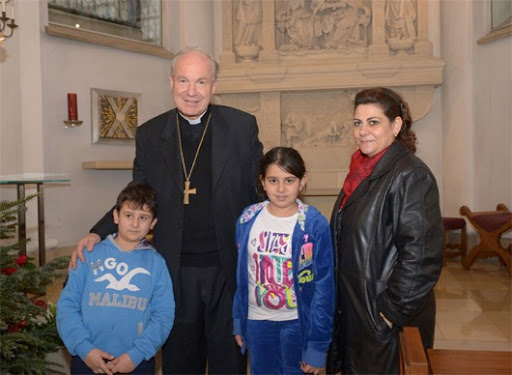
In July, at Mary Immaculate College’s Irish Institute for Pastoral Studies, Cardinal Christoph Schönborn of Vienna gave a beautiful, commented reading of some passages of Amoris Laetitia, Pope Francis’ encyclical on the family. A video of the whole event has been published recently and, as a sign of gratitude to Cardinal Schönborn, I would here like to share a lightly edited transcript of the majority of his talk. It radiates love and profound care for the family and, by extension, for all of humanity, and benefits from Cardinal Schönborn’s rich gifts and experiences – his having been editor of the current Catechism of the Catholic Church, his being archbishop of Vienna, his having been a student of Benedict XVI, his participation in both Synods that lead to Amoris Laetitia and his having been chosen to present Amoris Laetitia by Pope Francis when it was published.


Moral Theology stands on two feet: the principles and then the prudential steps to application of the principles to reality. And this is the normal challenge that every parent faces when they have to educate their children. […] This is the classical field of the virtue of prudence. And in moral theology the treatise on prudence has been gravely neglected. There was a great insistence on principles, and that was right, and it’s necessary. Principles must be clear. But then the question is how to come to practical judgment and then practical action. That’s the task of the virtue of prudence. […] For Pope Francis the key question is discernment […] for the right handling of the relation between principles and concrete action.

AL: “325. The teaching of the Master (cf. Mt 22:30) and Saint Paul (cf. 1 Cor 7:29-31) on marriage is set – and not by chance – in the context of the ultimate and definitive dimension of our human existence. We urgently need to rediscover the richness of this teaching. By heeding it, married couples will come to see the deeper meaning of their journey through life.”

One of the key words of Pope Francis in the whole document is: marriage is a journey. It’s [a] classical Thomistic approach. It’s the existence “in via” – we are on the way, on the road. There is no family in a static way. Every family is “in via” as each of us is “in via” his whole life.

AL: “325. As this Exhortation has often noted, no family drops down from heaven perfectly formed; families need constantly to grow and mature in the ability to love. This is a never-ending vocation born of the full communion of the Trinity, the profound unity between Christ and his Church, the loving community which is the Holy Family of Nazareth, and the pure fraternity existing among the saints of heaven. Our contemplation of the fulfillment which we have yet to attain also allows us to see in proper perspective the historical journey which we make as families, and in this way to stop demanding of our interpersonal relationships a perfection, a purity of intentions and a consistency which we will only encounter in the Kingdom to come.”

Very often Pope Francis remembers that one of the main causes of [difficulties in] marriage is not that we ask too little from marriage, but too much. […]

AL: “325. It also keeps us from judging harshly those who live in situations of frailty. All of us are called to keep striving towards something greater than ourselves and our families, and every family must feel this constant impulse. Let us make this journey as families, let us keep walking together. What we have been promised is greater than we can imagine. May we never lose heart because of our limitations, or ever stop seeking that fullness of love and communion which God holds out before us.”

[This] helps us to see that we are all on a journey and imperfection is [an] essential part of our life. […]

AL: “320. There comes a point where a couple’s love attains the height of its freedom and becomes the basis of a healthy autonomy. This happens when each spouse realizes that the other is not his or her own, but has a much more important master, the one Lord. No one but God can presume to take over the deepest and most personal core of the loved one; he alone can be the ultimate centre of their life. At the same time, the principle of spiritual realism requires that one spouse not presume that the other can completely satisfy his or her needs. The spiritual journey of each – as Dietrich Bonhoeffer nicely put it – needs to help them to a certain “disillusionment” with regard to the other,382 to stop expecting from that person something which is proper to the love of God alone. This demands an interior divestment. The space which each of the spouses makes exclusively for their personal relationship with God not only helps heal the hurts of life in common, but also enables the spouses to find in the love of God the deepest source of meaning in their own lives. Each day we have to invoke the help of the Holy Spirit to make this interior freedom possible.”

It shows that great freedom that is the Christian vocation, which is not an impediment for the donation of each other but the condition of not demanding of each other what only God can give. And, nevertheless, he can affirm in the next point a word I love very much in this document:

AL: “321. “Christian couples are, for each other, for their children and for their relatives, cooperators of grace and witnesses of the faith”. God calls them to bestow life and to care for life. For this reason the family “has always been the nearest ‘hospital’”.”

It’s a beautiful metaphor! […] When my mother had to leave our home in ’45 as a refugee, with me on her arm as a baby, and my elder brother two years old, from Bohemia, from what’s today the Czech Republic, she had to leave the house in half an hour. Where did she go? She looked for the closest point at the Austrian border where she had relatives, family. The family is the nearest hospital. Where do you go? Where do these thousands and thousands of refugees who came through Austria and went all over Europe, where do they go? I have heard so many of them say, “I have family, relatives in Sweden, I want to go to Sweden. I have family in the Netherlands, I want to go there.” Family is the strongest hub, the most protected hub. It’s also the most vulnerable hub. […]

Pope Francis with Amoris Laetitia wants to tell us one key message. […] “Amoris Laetitia: marriage and family are possible.” […]

Before we enter this document, we must look at the Biblical foundations in the first chapter. […] There are some words that show how realistic Pope Francis’ approach is to the question of marriage and family. […]

AL: “19. The idyllic picture presented in Psalm 128 is not at odds with a bitter truth found throughout sacred Scripture, that is, the presence of pain, evil and violence that break up families and their communion of life and love. For good reason Christ’s teaching on marriage (cf. Mt 19:3-9) is inserted within a dispute about divorce. The word of God constantly testifies to that sombre dimension already present at the beginning, when, through sin, the relationship of love and purity between man and woman turns into domination: “Your desire shall be for your husband, and he shall rule over you” (Gen 3:16).”

The approach is always realistic. Let’s speak of the families […] as they really are. […] This realism invites us to not idealize the family but to look mercifully on that reality. And I want to show you three methodological texts, numbers 35, 36 and 37, where Pope Francis indicates the main line of his approach.

AL: “35. As Christians, we can hardly stop advocating marriage simply to avoid countering contemporary sensibilities, or out of a desire to be fashionable or a sense of helplessness in the face of human and moral failings.”

Sometimes we really feel helpless. I had to speak to the German government and officials. Angela Merkel was sitting there at the front. She is a very impressive lady, and I said, listen, dear politicians, we in the Catholic Church we feel often like against a wall. Whatever difficult question arrises, we are accused of being retrograde, of being conservative, of being out of touch, and it is so hard for us to say that the ideal we present is viable, that it is not impossible. So, Pope Francis encourages us to stand up for the values we [stand] for, not to be ashamed.

AL: “35. We would be depriving the world of values that we can and must offer. It is true that there is no sense in simply decrying present-day evils, as if this could change things.”

During the Synod, a Synod Father, he was a cardinal, gave a talk – 3 minutes we were allowed to speak – it was a good decision – he began to describe all the evils of our time: consumerism, materialism, hedonism, “pansexualism” he said, and some other isms I have forgotten, and then I said: but, brethren, with a long list of isms, that we criticize, nobody will be motivated to choose Christian values. And that’s exactly what Pope Francis says:

AL: “35. Nor it is helpful to try to impose rules by sheer authority. What we need is a more responsible and generous effort to present the reasons and motivations for choosing marriage and the family, and in this way to help men and women better to respond to the grace that God offers them.”

[…] The word grace appears so often in this document. Trust in grace. Don’t only repeat the norms, but trust in grace. And the two words: reasons and motivations. We have reasons for our hope. We have reasons for our faith.

AL: “36. Nor have we always provided solid guidance to young married couples, understanding their timetables, their way of thinking and their concrete concerns. At times we have also proposed a far too abstract and almost artificial theological ideal of marriage, far removed from the concrete situations and practical possibilities of real families. This excessive idealization, especially when we have failed to inspire trust in God’s grace, has not helped to make marriage more desirable and attractive, but quite the opposite.”

AL: “37. We also find it hard to make room for the consciences of the faithful, who very often respond as best they can to the Gospel amid their limitations, and are capable of carrying out their own discernment in complex situations. We have been called to form consciences, not to replace them.”

I must say, I was deeply moved when I read this text: “We have been called to form consciences, not to replace them.” And do we really trust in the conscience of people who very often respond “as best they can.” The “bonum possibile” in moral theology that has been so neglected. What is the possible good a person can achieve, or a couple can achieve, in difficult circumstances? Often Pope Francis comes back to what he has said in Evangelii Gaudium: “A little step towards the good, done under difficult circumstances, can be more valuable than a moral, solid life under comfortable circumstances.” […] Do we really trust conscience? Of course, dialogue is necessary, deepening the awareness of conscience, but first of all we can trust.

And I want to read with you number 49, which is, as the theologians would say, the hermeneutic key, the key to understanding where Pope Francis comes from. What moves him in speaking as he does.

AL: “49. Here I would also like to mention the situation of families living in dire poverty and great limitations. The problems faced by poor households are often all the more trying.36 For example, if a single mother has to raise a child by herself and needs to leave the child alone at home while she goes to work, the child can grow up exposed to all kind of risks and obstacles to personal growth. In such difficult situations of need, the Church must be particularly concerned to offer understanding, comfort and acceptance, rather than imposing straightaway a set of rules that only lead people to feel judged and abandoned by the very Mother called to show them God’s mercy. Rather than offering the healing power of grace and the light of the Gospel message, some would “indoctrinate” that message, turning it into “dead stones to be hurled at others”.”

I have met Pope Francis for the first time when he was an auxiliary at Buenos Aires in ’97. […] I will never forget the barrio, the quarter where the sisters [I was visiting] were living. It was “un oceano de miseria” – an ocean of misery. Huts and huts and huts as far as you could see. And in the neighboring hut of the Little Sisters, there was a couple, who had a little daughter and a boy – the boy has become a criminal – and the daughter, Roxanne, now has two little children, two boys, and she showed me when I was there three years ago, the little hut she had built herself, with a little garden, all very very poor, but when I read this text I thought, Roxanne – the heroism of these women in such difficult situations. That is the existential place, where Pope Francis comes from and what matters to him. […]

AL: “123. After the love that unites us to God, conjugal love is the “greatest form of friendship”. It is a union possessing all the traits of a good friendship: concern for the good of the other, reciprocity, intimacy, warmth, stability and the resemblance born of a shared life. Marriage joins to all this an indissoluble exclusivity expressed in the stable commitment to share and shape together the whole of life. Let us be honest and acknowledge the signs that this is the case. Lovers do not see their relationship as merely temporary. Those who marry do not expect their excitement to fade. Those who witness the celebration of a loving union, however fragile, trust that it will pass the test of time. Children not only want their parents to love one another, but also to be faithful and remain together.”

I was asked one day in a school [… by a girl]: “Bishop, what was the most difficult day in your life?” I was surprised by this question and without reflecting, I said: “The moment when I heard that my parents divorced.” There was a great silence. That’s the experience of many young people, and I tried to repair what I had done and said: “But, listen, I can tell you, by experience, there is always a way.” But, this is such a deep truth, and we will see how important this experience is for Pope Francis, in Chapter 8. Before asking the question: are they allowed – yes or no – to receive communion, look at the situation of the family, the children, and so on.

AL: “123. These and similar signs show that it is in the very nature of conjugal love to be definitive. The lasting union expressed by the marriage vows is more than a formality or a traditional formula; it is rooted in the natural inclinations of the human person.”

We must not be desperate […]. Marriage will last because it is rooted in the deepest inclinations of human nature. The “inclinatio naturalis” was in Thomas Aquinas – this is typically Thomistic – so to say the guideline, the orientation that human nature, that the Creator, has given us. Therefore the best ally of our understanding of marriage and family is human nature. That will last and we shouldn’t be too afraid of the discussions of other forms of relations because fundamentally this natural inclination will always be stronger.

AL: “123. For believers, it is also a covenant before God that calls for fidelity.”

That’s what faith adds to this natural inclination. But all these arguments show that love in itself is inclined to be permanent and faithful and lasting. […]

[Now] we must read number 220 – it’s so funny – it shows the realism of Pope Francis. I think this should be read by a couple, because it is so true for a couple, it is also somewhat true for us who live in celibacy.

AL: “This process [the process of growth] occurs in various stages that call for generosity and sacrifice. The first powerful feelings of attraction give way to the realization that the other is now a part of my life. The pleasure of belonging to one another leads to seeing life as a common project, putting the other’s happiness ahead of my own, and realizing with joy that this marriage enriches society. As love matures, it also learns to “negotiate”. Far from anything selfish or calculating, such negotiation is an exercise of mutual love, an interplay of give and take, for the good of the family. At each new stage of married life, there is a need to sit down and renegotiate agreements, so that there will be no winners and losers, but rather two winners. In the home, decisions cannot be made unilaterally, since each spouse shares responsibility for the family; yet each home is unique and each marriage will find an arrangement that works best.”

There is no general rule. Every marriage synthesis is unique. […] Our former president of Austria, I am good friends with him and his wife, he is an agnostic and she is not baptized, of Jewish origin, but they are a very good couple. An exemplary couple. And one day they spoke about how they work, their strategies in conflicts and they said: we have an agreement that the one of us who more easily gives in does it. “So,” I asked, “but how do you know who of you can give in more easily than the other?” And they smiled and said: “That’s by experience.” No winner, no loser; negotiate.

AL: “221. Each marriage is a kind of “salvation history”, which from fragile beginnings – thanks to God’s gift and a creative and generous response on our part – grows over time into something precious and enduring. […] Love is thus a kind of craftsmanship.”

[… On homosexuals and homosexuality]

AL: “250. The Church makes her own the attitude of the Lord Jesus, who offers his boundless love to each person without exception.During the Synod, we discussed the situation of families whose members include persons who experience same-sex attraction, a situation not easy either for parents or for children. We would like before all else to reaffirm that every person, regardless of sexual orientation, ought to be respected in his or her dignity and treated with consideration, while ‘every sign of unjust discrimination’ is to be carefully avoided, particularly any form of aggression and violence. Such families should be given respectful pastoral guidance, so that those who manifest a homosexual orientation can receive the assistance they need to understand and fully carry out God’s will in their lives.”

In all these discussions, it is known through the media that I have had the case of an elected parish councillor who lives in a same-sex union. He is a very fine young man, he works with handicapped children, he is fully engaged in the parish, he leads the parish choir, and he is highly respected by the parish and his friend, his partner, is a good and a fine young man and they are faithful to each other. I had the choice, when he was elected to the parish council – he had the most votes for the parish council – I was confronted with the question: have I to cancel this vote? In the same week we had the media full with a monk, a Benedictine monk, who had abused in the college of his abbey, probably about 100 boys. He ended in prison, but the abbot had covered … The media were full of this and I said, no, I can’t cancel this parish vote. It was not a protest vote against the Church’s teaching. It was for this young man, who is an honest and good Christian, a real believer, and I decided not to cancel that vote. It was discussed all over the globe, in the “blogosphere”, and I think these few words of Amoris Laetitia are sufficient. As we do for marriage crises, as we do for priests in crisis, we have to look at the person first, not the orientation. I have always said in these discussions: I have never met a homosexual, I have always met a person that has also had a homosexual orientation, but that is not all of the person and there are so many good things to look at. So, I think it is good that Pope Francis refused to have a long discussion about the question.

AL: “251. In discussing the dignity and mission of the family, the Synod Fathers observed that, “as for proposals to place unions between homosexual persons on the same level as marriage, there are absolutely no grounds for considering homosexual unions to be in any way similar or even remotely analogous to God’s plan for marriage and family”. It is unacceptable “that local Churches should be subjected to pressure in this matter and that international bodies should make financial aid to poor countries dependent on the introduction of laws to establish ‘marriage’ between persons of the same sex”.“

[…] In Austria we have a law for same-sex partnership and this is a law with reasonable civil law dispositions for same-sex people living together, sharing their life. It’s questions of inheritance, of rights of visit, of sharing an apartment, and so on – all these legal questions. And from the Church’s side we have not at all objected to this law, because it’s helpful for civil situations which we have not to judge on the personal level. But then, we clearly said we are grateful to the government that they clearly distinguish the legislation on marriage and family from this kind of civil legislation. Of course, some groups were not satisfied, but I think it is a possible way and I think it is also an honest way. […]

Chapter 8. Let’s have a look at number 300. […]

AL: “300. If we consider the immense variety of concrete situations such as those I have mentioned, it is understandable that neither the Synod nor this Exhortation could be expected to provide a new set of general rules, canonical in nature and applicable to all cases.”

When I received the draft for preparing my presentation in Rome, of course, I admit, I read first Chapter 8, which you shouldn’t do. And, when I read this sentence, I was relieved. I must say, I had a serious fear that the attempt of certain bishops, certain theologians, certain pressure groups, would lead Pope Francis to the attempt of formulating a new canonical disposition applicable for all cases of irregular situations. That’s what the Eastern Orthodox churches do with the canons of 692 where it is generally, canonically established that a second and a third union are possible. Not under certain conditions, but they are possible. And this is a canonical, general rule. Some people wanted such a kind of disposition in canon law for the Catholic Church and I was so relieved, so glad, that Pope Francis stood clear about this. The canonical disposition and the dogmatic grounds for this canonical disposition, are valid and need no supplement, no addition. Does it mean, as some people conclude, from this sentence, that nothing has changed? That nothing is possible? Therefore, lets’ read the second sentence:

AL: “300. What is possible is simply a renewed encouragement to undertake a responsible personal and pastoral discernment of particular cases.”

Now, you may say, that’s much too difficult. We need clear rules. How can a couple, a priest, a pastoral personnel, come to such a discernment? Pope John Paul II has said in Familiaris Consortio no 84. – a famous text on divorced remarried – he said “the pastors, the shepherds, by love for truth, are obliged to distinguish the cases, to distinguish the situations” – that’s John Paul! And if you turn back to number 298 you will find a series of quotes of St. John Paul about the distinction of cases, distinction of situations. Pope Francis has enlarged this chapter of 84 of Familiaris Consortio by adding some other cases. I give you just the first case:

AL: “298. The divorced who have entered a new union, for example, can find themselves in a variety of situations, which should not be pigeonholed or t into overly rigid classifications leaving no room for a suitable personal and pastoral discernment. One thing is a second union consolidated over time, with new children, proven fidelity, generous self giving, Christian commitment, a consciousness of its irregularity and of the great difficulty of going back without feeling in conscience that one would fall into new sins. The Church acknowledges situations “where, for serious reasons, such as the children’s upbringing, a man and woman cannot satisfy the obligation to separate”.”

That’s a reality. We do not speak about communion here! We speak about the moral qualification of different situations. Pope Francis said once during the Synod: this question of the communion is a trap because you put away the consideration of the situation. You only want to have a casuistic approach: are they allowed, aren’t they allowed. But, first of all, discern the situations.

AL: “298. There are also the cases of those who made every effort to save their first marriage and were unjustly abandoned, or of “those who have entered into a second union for the sake of the children’s upbringing, and are sometimes subjectively certain in conscience that their previous and irreparably broken marriage had never been valid”.“

When my parents divorced, they knew each other for three days before they got married. It was wartime, my father was at the front, came back to Prague, met my mother at a party, and asked her to marry him the first evening. And then he had to return to the front, they wrote letters, and during the second holiday from the front, they got married. My father then deserted the German army, he was very hostile to the Nazis, escaped and joined the British army. He came back with the British army when I was already born. And they began to live together practically four years after their wedding, and had to discover that they didn’t know each other. So, it’s great that my parents stood together 17 years and they really tried to bring us up but they knew that this marriage … So, as a child already, I had the feeling that if my mother said: “I cannot bring up four children alone,” working hard – she was in business – she brought us up alone, she is still alive – 97! Amazing! But, I would have understood if she had said, “I just can’t do it, bringing up four children alone.” And she had had the possibility for a second marriage, but she didn’t do it, and she always says until today, “He was my husband, yes, he is my husband.” Of course, this marriage could have been dissolved easily, because, they knew each other three days, but nevertheless, the situation addressed here is morally different from destroying an existing marriage through adultery. And we have finally a fifth [and sixth] case:

AL: “298. Another thing is a new union arising from a recent divorce, with all the suffering and confusion which this entails for children and entire families, or the case of someone who has consistently failed in his obligations to the family. It must remain clear that this is not the ideal which the Gospel proposes for marriage and the family. The Synod Fathers stated that the discernment of pastors must always take place “by adequately distinguishing”, with an approach which “carefully discerns situations”. We know that no “easy recipes” exist.””

We could say a lot about this discernment. I just want to add one point, which is made in number 300:

AL: “300. Priests have the duty to “accompany [the divorced and remarried] in helping them to understand their situation according to the teaching of the Church and the guidelines of the bishop.”

That’s what Pope Francis recommends in this situation, before asking the question of communion. Ask five questions:

AL: “300. Useful in this process is an examination of conscience through moments of reflection and repentance. The divorced and remarried should ask themselves: how did they act towards their children when the conjugal union entered into crisis; whether or not they made attempts at reconciliation; what has become of the abandoned party; what consequences the new relationship has on the rest of the family and the community of the faithful; and what example is being set for young people who are preparing for marriage. A sincere reflection can strengthen trust in the mercy of God which is not denied anyone”.”

This is for me the real program for how to accompany divorced remarried in their great variety of situations. These 5 points. And I end with number 245:

AL: “245. The Synod Fathers also pointed to “the consequences of separation or divorce on children, in every case the innocent victims of the situation”. Apart from every other consideration, the good of children should be the primary concern, and not overshadowed by any ulterior interest or objective. I make this appeal to parents who are separated: “Never ever, take your child hostage! You separated for many problems and reasons. Life gave you this trial,”

I find it very impressive. Pope Francis does not judge: “Life gave you this trial” of separation. But:

AL: “245. but your children should not have to bear the burden of this separation or be used as hostages against the other spouse. They should grow up hearing their mother speak well of their father, even though they are not together, and their father speak well of their mother”. It is irresponsible to disparage the other parent as a means of winning a child’s affection, or out of revenge or self-justification. Doing so will affect the child’s interior tranquillity and cause wounds hard to heal.”

This is the attitude of discernment Pope Francis is inviting us to exercise and practice and the question of communion can come after that, when he says: “There may be cases in which the help of the sacraments can be given.” But that needs discernment. And he gave us, and I tried to present in brief, some guidelines for this discernment.

Ethics in the Time of Human Fragility

Jurek 2

1310 words, 7 min read

The other day I came across an article entitled: “Ethicist says ghostwriter’s role in ‘Amoris’ is troubling”, in which an ethicist is troubled by Pope Francis having had the help of others when drafting his encyclicals and where one of these others, Archbishop Víctor Manuel Fernández, has used passages from his previous writings. Not only is this “material plagiarism” but it also undermines whether the encyclical is “magisterial” in the opinion of the aforementioned ethicist. While this line of inquiry does not hold much appeal (or water, in my opinion), it has lead to a response by Archbishop Fernández, who takes issue with how his views are presented in the article and who points to one of his papers for clarification.

Having read – and enjoyed – that paper, entitled “Trinitarian life, ethical norms and human fragility,” I would like to offer a partial translation and summary of its content next.

The paper starts with an enumeration of various flavors of relativism, from the theological, via the humanist, the mystical, the cultural, to the fragmentary, all of which are dismissed with reference to St. John Paul II’s Veritatis Splendor, which defends objectivity and which affirms the existence of “intrinsically evil” acts.

Fernández then goes on to recognizing that even these erroneous approaches to morality may contain “fragments of truth” and “legitimate aspirations”, but he points to a need for persisting with an integral Gospel world-view where, as the Compendium of the Social Doctrine of the Church affirms that ethical questions: “must be considered as a whole, since they are characterized by an ever greater interconnectedness, influencing one another mutually” (CSDC, 9).

At the same time, the Church has, for some time now, recognized that there exist circumstances that may reduce, “or under exceptional circumstances even annul” the moral responsibility of subjects and Fernández quotes from St. John Paul II’s 1995 Evangelium Vitae to back up his claim:

“Decisions that go against life sometimes arise from difficult or even tragic situations of profound suffering, loneliness, a total lack of economic prospects, depression and anxiety about the future. Such circumstances can mitigate even to a notable degree subjective responsibility and the consequent culpability of those who make these choices which in themselves are evil.” (§18b)

Fernández then points to three examples of the Church’s response to moral questions, where responsibility and culpability have recently been addressed: euthanasia, divorce and remarriage and same-sex sexual relations.

First, the 1980 declaration on euthanasia by the Congregation for the Doctrine of the Faith, entitled Iura et Bona, recognizes that under some circumstances people may no longer be truly responsible for what they do:

“by reason of prolonged and barely tolerable pain, for deeply personal or other reasons, people may be led to believe that they can legitimately ask for death or obtain it for others. Although in these cases the guilt of the individual may be reduced or completely absent, nevertheless the error of judgment into which the conscience falls, perhaps in good faith, does not change the nature of this act of killing, which will always be in itself something to be rejected.” (Part II.)

Second, a declaration by the Pontifical Council for Legislative Texts from 24th June 2000 stated that, even though the situation of the divorced and remarried is a matter of “grave sin, understood objectively, [a] minister of Communion would not be able to judge [its] subjective imputability” (2a.).

Third, as regards same-sex sexual relations, the Congregation of the Doctrine of the Faith stated in 2001 that “there is a precise and well-founded evaluation of the objective morality of sexual relations between persons of the same sex. The degree of subjective moral culpability in individual cases is not the issue here.” (§2b) Again, drawing a clear distinction between the objectivity of an act’s moral goodness and the responsibility that a person bears for it.

Against this background, Fernández then proceeds to introduce grace into the picture, by arguing that:

“If an action of a subject who is strongly conditioned can be objectively evil but not imputable – and therefore not culpable – then, consequently, it does not deprive this person of the life of sanctifying grace. When this action does not stem from responsible freedom, but is enormously conditioned instead, it cannot be imputed to the subject as a sin that deprives them of supernatural life with its trinitarian dynamics.”

Next, Fernández is careful to point out that the result here is not a change to the objective evil of such actions – they do not become virtuous or of merit to the subjects who perform them. Instead, it is in the good intentions of the subject in which “the love of God and trinitarian life can shine forth” and not in what remain objectively evil actions. “No matter how much a person acts in good faith, and no matter how good their intentions may be, this does not alter the moral qualification of an objectively evil act and neither does it convert it into an expression of love.” What Fernández therefore means by “in” when he says that “trinitarian dynamics can also come about in an objective situation of sin” is an “in the context of” or an “in the midst of” and not a “through.”

In fact, Fernández later proceeds to underlining the effects of the presence of grace in good intentions that may lead to objectively evil actions, which is that:

“Grace itself provokes an interior desire to please God more with one’s own life or to follow more perfectly one’s own internal impulses. In grace itself – even when its dynamics may be conditioned by inculpable deficiencies – there is a tendency to wake up the desire for overcoming such conditioning. Because of this, the person who has been conditioned continues to experience a certain “this cannot be” in their own way of living.”

Following a reflection on St. Thomas Aquinas’ distinguishing between external and internal acts when it comes to morality, Fernández argues that while love cannot coexist with mortal sin, it can “coexist with inculpable evil acts, where some of the conditions required for grave sin are not met.” Turning to the Gospel, Fernández then points to its call to the correction of persons based on the evil of their actions (cf. Matthew 18:15) but without judging their responsibility and culpability (cf. Matthew 7:1; Luke 6:37). In summary, Fernández underlines that fraternal correction, including sanctions that the Church may legitimately impose, do not imply the emission of judgment about the interior situation and the life of grace of the corrected brother: “de internis non iudicat pretor,” as the Roman juridical maxim goes (“the judge does not judge what is on the inside”).

The above context leads Fernández to spelling out his understanding of the key to Gospel morality:

“At the same time as focusing on a subject’s full compliance with moral laws, they always have to be encouraged also to grow in love with their own acts, which will never stop being the most important of the virtues and “the fulfillment of the law” (Romans 13:10). Without it there is no merit whatsoever and neither is there any authentically evangelical growth.”

Fernández concludes the article with putting his cards on the table and spelling out the motivation for his enquiry into the workings of grace. After rejecting the suggestion that it is a result of responding to secular prejudices or to theological progress, Fernández traces his thought to his time as a parish priest in a poor neighborhood in Argentina, because of which he desires to show two things at the same time:

“the immense mercy of God in the face of the limited and conditioned response of human beings, and the inescapable call to a generous surrender that may ever more perfectly respond to the objective proposal of the Gospel that the Church offers to the world.”

Amoris Lætitia: sex sanctified

Close quibe

3406 words, 17 min read

An aspect of marriage that Pope Francis speaks about extensively in Amoris Lætitia is sex and he does so by presenting a very positive view. He speaks about sex in a way that recognizes both its beauty and its importance in the context of a couple’s relationship, also beyond its procreative function. This is a topic that was very prominent during the two Synods that preceded the exhortation, where the Synod Fathers have called for a new way of speaking about sex and of making it clear that it is valued broadly and positively by the Church. Since Pope Francis has, I believe, taken up that challenge masterfully and has written with great clarity and freshness about the subject, I would next like to share with you my favorite passages from Amoris Lætitia in which he speaks about this topic.

Sex comes up very early on in the text, in §9, which is effectively the second paragraph of the exhortation, since the preceding ones present more meta context (about the process, an outline, …). Here, Francis goes back to the origins of the family in Scripture and introduces it as Genesis does:

“At the centre we see the father and mother, a couple with their personal story of love. They embody the primordial divine plan clearly spoken of by Christ himself: “Have you not read that he who made them from the beginning made them male and female?” (Mt 19:4). We hear an echo of the command found in the Book of Genesis: “Therefore a man shall leave his father and mother and cleave to his wife, and they shall become one flesh (Gen 2:24)”.”

Francis then points to it being a couple’s potential to beget life as a result of their love for each other that makes them an icon of God himself, a vehicle for salvation and a reflection of the inner life of the Trinity:

“The couple that loves and begets life is a true, living icon – not an idol like those of stone or gold prohibited by the Decalogue – capable of revealing God the Creator and Saviour. For this reason, fruitful love becomes a symbol of God’s inner life (cf. Gen 1:28; 9:7; 17:2-5, 16; 28:3; 35:11; 48:3-4). […] The ability of human couples to beget life is the path along which the history of salvation progresses. Seen this way, the couple’s fruitful relationship becomes an image for understanding and describing the mystery of God himself, for in the Christian vision of the Trinity, God is contemplated as Father, Son and Spirit of love. The triune God is a communion of love, and the family is its living reflection. Saint John Paul II shed light on this when he said, “Our God in his deepest mystery is not solitude, but a family, for he has within himself fatherhood, sonship and the essence of the family, which is love. That love, in the divine family, is the Holy Spirit”. The family is thus not unrelated to God’s very being. This Trinitarian dimension finds expression in the theology of Saint Paul, who relates the couple to the “mystery” of the union of Christ and the Church (cf. Eph 5:21-33).” (§11)

The “becoming one flesh” that is referred to right at the start of AL is then unpacked and presented as being both physical and spiritual:

“The marital union is thus evoked not only in its sexual and corporal dimension, but also in its voluntary self-giving in love. The result of this union is that the two “become one flesh”, both physically and in the union of their hearts and lives, and, eventually, in a child, who will share not only genetically but also spiritually in the “flesh” of both parents.” (§13)

Further on in the exhortation, Pope Francis underlines that Christian Scripture presents marriage as a gift from God and that this gift also contains sexuality:

“Contrary to those who rejected marriage as evil, the New Testament teaches that “everything created by God is good and nothing is to be rejected” (1 Tim 4:4). Marriage is “a gift” from the Lord (1 Cor 7:7). At the same time, precisely because of this positive understanding, the New Testament strongly emphasizes the need to safeguard God’s gift: “Let marriage be held in honour among all, and let the marriage bed be undefiled” (Heb 13:4). This divine gift includes sexuality: “Do not refuse one another” (1 Cor 7:5).” (§61)

Francis also points to this position already having been put forward by Vatican II’s Gaudium et Spes:

“The Second Vatican Council, in its Pastoral Constitution Gaudium et Spes, was concerned “to promote the dignity of marriage and the family (cf. Nos. 47-52)”. The Constitution “defined marriage as a community of life and love (cf. 48), placing love at the centre of the family… ‘True love between husband and wife’ (49) involves mutual self-giving, includes and integrates the sexual and affective dimensions, in accordance with God’s plan (cf. 48-49)”. (§67)

This then leads to a reflection on the sacrament of marriage, where the link between the love of wife and husband for each other and of Christ for his Church is again made (§72) and where links are also shown to Christ’s incarnation and to the joys of Paradise:

“By becoming one flesh, they embody the espousal of our human nature by the Son of God. That is why “in the joys of their love and family life, he gives them here on earth a foretaste of the wedding feast of the Lamb”. Even though the analogy between the human couple of husband and wife, and that of Christ and his Church, is “imperfect”, it inspires us to beg the Lord to bestow on every married couple an outpouring of his divine love.” (§73)

Next, Pope Francis speaks directly about the role of sex in the context of the sacrament of marriage and emphasizes that it is sanctified, leads to growth in grace and has meaning in the context of complete, mutual self-giving:

“Sexual union, lovingly experienced and sanctified by the sacrament, is in turn a path of growth in the life of grace for the couple. It is the “nuptial mystery”. The meaning and value of their physical union is expressed in the words of consent, in which they accepted and offered themselves each to the other, in order to share their lives completely. Those words give meaning to the sexual relationship and free it from ambiguity.” (§74)

Francis then goes on to spell out its divine, unitive nature:

“[B]y manifesting their consent and expressing it physically, [the man and the woman who marry] receive a great gift. Their consent and their bodily union are the divinely appointed means whereby they become “one flesh”.” (§75)

Next, he speaks with nuance about the relationship between sex and procreation:

“Marriage is firstly an “intimate partnership of life and love” which is a good for the spouses themselves, while sexuality is “ordered to the conjugal love of man and woman”. It follows that “spouses to whom God has not granted children can have a conjugal life full of meaning, in both human and Christian terms”. Nonetheless, the conjugal union is ordered to procreation “by its very nature”.” (§80)

Following a beautiful reflection on St. Paul’s Hymn to Love, Pope Francis underlines through Pope Pius XI’s words the link between conjugal love and Christ’s love for us:

“[Conjugal love] is the love between husband and wife, a love sanctified, enriched and illuminated by the grace of the sacrament of marriage. It is an “affective union”, spiritual and sacrificial, which combines the warmth of friendship and erotic passion, and endures long after emotions and passion subside. Pope Pius XI taught that this love permeates the duties of married life and enjoys pride of place. Infused by the Holy Spirit, this powerful love is a reflection of the unbroken covenant between Christ and humanity that culminated in his self-sacrifice on the cross. “The Spirit which the Lord pours forth gives a new heart and renders man and woman capable of loving one another as Christ loved us. Conjugal love reaches that fullness to which it is interiorly ordained: conjugal charity.”” (§120)

Later on in AL, Francis speaks both about the good effects of sex on a married couple and about the meaning of it being used as a parallel to heavenly love, in which context he also points to the importance of pleasure and passion:

“The Second Vatican Council teaches that this conjugal love “embraces the good of the whole person; it can enrich the sentiments of the spirit and their physical expression with a unique dignity and ennoble them as the special features and manifestation of the friendship proper to marriage”. For this reason, a love lacking either pleasure or passion is insufficient to symbolize the union of the human heart with God: “All the mystics have affirmed that supernatural love and heavenly love find the symbols which they seek in marital love, rather than in friendship, filial devotion or devotion to a cause. And the reason is to be found precisely in its totality”.” (§142)

Pope Francis then revisits the idea of sex as a gift and quotes from St. John Paul’s writings on the theology of the body, in which he denies a negative view and one restricted solely to procreation:

“God himself created sexuality, which is a marvellous gift to his creatures. If this gift needs to be cultivated and directed, it is to prevent the “impoverishment of an authentic value”. Saint John Paul II rejected the claim that the Church’s teaching is “a negation of the value of human sexuality”, or that the Church simply tolerates sexuality “because it is necessary for procreation”. Sexual desire is not something to be looked down upon, and “and there can be no attempt whatsoever to call into question its necessity”.” (§150)

This leads Francis to following John Paul II’s lead further into a view of sexuality that neither deprives it of spontaneity nor denies the need for self-control, leading to a recognition of its nature being love and self-giving:

“To those who fear that the training of the passions and of sexuality detracts from the spontaneity of sexual love, Saint John Paul II replied that human persons are “called to full and mature spontaneity in their relationships”, a maturity that “is the gradual fruit of a discernment of the impulses of one’s own heart”. This calls for discipline and self-mastery, since every human person “must learn, with perseverance and consistency, the meaning of his or her body”. Sexuality is not a means of gratification or entertainment; it is an interpersonal language wherein the other is taken seriously, in his or her sacred and inviolable dignity. As such, “the human heart comes to participate, so to speak, in an other kind of spontaneity”. In this context, the erotic appears as a specifically human manifestation of sexuality. It enables us to discover “the nuptial meaning of the body and the authentic dignity of the gift”. In his catecheses on the theology of the body, Saint John Paul II taught that sexual differentiation not only is “a source of fruitfulness and procreation”, but also possesses “the capacity of expressing love: that love precisely in which the human person becomes a gift”. A healthy sexual desire, albeit closely joined to a pursuit of pleasure, always involves a sense of wonder, and for that very reason can humanize the impulses.” (§151)

The train of thought then concludes with a repeated rejection of a negative view of sex and Francis links it to goodness and happiness:

“In no way, then, can we consider the erotic dimension of love simply as a permissible evil or a burden to be tolerated for the good of the family. Rather, it must be seen as gift from God that enriches the relationship of the spouses. As a passion sublimated by a love respectful of the dignity of the other, it becomes a “pure, unadulterated affirmation” revealing the marvels of which the human heart is capable. In this way, even momentarily, we can feel that “life has turned out good and happy”.” (§152)

While sex is presented as an inherent part of marriage and as a gift from God, Francis also speaks about the dangers of its misuse as a means of egoistic consumerism:

“On the basis of this positive vision of sexuality, we can approach the entire subject with a healthy realism. It is, after all, a fact that sex often becomes depersonalized and unhealthy; as a result, “it becomes the occasion and instrument for self-assertion and the selfish satisfaction of personal desires and instincts”. In our own day, sexuality risks being poisoned by the mentality of “use and discard”. The body of the other is often viewed as an object to be used as long as it offers satisfaction, and rejected once it is no longer appealing. Can we really ignore or overlook the continuing forms of domination, arrogance, abuse, sexual perversion and violence that are the product of a warped understanding of sexuality?” (§153)

This is a point he also made very early on in AL, where he decried all forms of violence directed towards women in the family:

“Unacceptable customs still need to be eliminated. I think particularly of the shameful ill-treatment to which women are sometimes subjected, domestic violence and various forms of enslavement which, rather than a show of masculine power, are craven acts of cowardice. The verbal, physical, and sexual violence that women endure in some marriages contradicts the very nature of the conjugal union.” (§54)

Following from its nature as self-giving, Pope Francis next warns against an abuse of sexuality between husband and wife:

“We also know that, within marriage itself, sex can become a source of suffering and manipulation. Hence it must be clearly reaffirmed that “a conjugal act imposed on one’s spouse without regard to his or her condition, or personal and reasonable wishes in the matter, is no true act of love, and therefore offends the moral order in its particular application to the intimate relationship of husband and wife”. The acts proper to the sexual union of husband and wife correspond to the nature of sexuality as willed by God when they take place in “a manner which is truly human”. Saint Paul insists: “Let no one transgress and wrong his brother or sister in this matter” (1 Th 4:6). Even though Paul was writing in the context of a patriarchal culture in which women were considered completely subordinate to men, he nonetheless taught that sex must involve communication between the spouses.” (§154)

And he again points to St. John Paul who spoke out clearly about the dangers of domination perverting what ought to be a communion build on the recognition of mutual dignity:

“Saint John Paul II very subtly warned that a couple can be “threatened by insatiability”. In other words, while called to an increasingly profound union, they can risk effacing their differences and the rightful distance between the two. For each possesses his or her own proper and inalienable dignity. When reciprocal belonging turns into domination, “the structure of communion in interpersonal relations is essentially changed”. It is part of the mentality of domination that those who dominate end up negating their own dignity. Ultimately, they no longer “identify themselves subjectively with their own body”, because they take away its deepest meaning. They end up using sex as form of escapism and renounce the beauty of conjugal union.” (§155)

Like he did in Laudato Si’ with regard to a misinterpretation of passages from Genesis that have been taken as license to exploit the Earth, Pope Francis next presents an exegesis of a passage from St. Paul that could be misunderstood as giving men power over their wives:

“Every form of sexual submission must be clearly rejected. This includes all improper interpretations of the passage in the Letter to the Ephesians where Paul tells women to “be subject to your husbands” (Eph 5:22). This passage mirrors the cultural categories of the time, but our concern is not with its cultural matrix but with the revealed message that it conveys. As Saint John Paul II wisely observed: “Love excludes every kind of subjection whereby the wife might become a servant or a slave of the husband… The community or unity which they should establish through marriage is constituted by a reciprocal donation of self, which is also a mutual subjection”. Hence Paul goes on to say that “husbands should love their wives as their own bodies” (Eph 5:28). The biblical text is actually concerned with encouraging everyone to overcome a complacent individualism and to be constantly mindful of others: “Be subject to one another” (Eph 5:21). In marriage, this reciprocal “submission” takes on a special meaning, and is seen as a freely chosen mutual belonging marked by fidelity, respect and care. Sexuality is inseparably at the service of this conjugal friendship, for it is meant to aid the fulfillment of the other.” (§156)

Concluding this section of Amoris Lætitia, in which Francis warns about distortions of sexuality, is a passage that reaffirms, with the help of Benedict XVI’s beautiful words from Deus Caritas Est, the intrinsic importance of sex also as a safeguard against a dualism that would result in a loss of the value of both body and spirit:

“All the same, the rejection of distortions of sexuality and eroticism should never lead us to a disparagement or neglect of sexuality and eros in themselves. The ideal of marriage cannot be seen purely as generous donation and self-sacrifice, where each spouse renounces all personal needs and seeks only the other’s good without concern for personal satisfaction. We need to remember that authentic love also needs to be able to receive the other, to accept one’s own vulnerability and needs, and to welcome with sincere and joyful gratitude the physical expressions of love found in a caress, an embrace, a kiss and sexual union. Benedict XVI stated this very clearly: “Should man aspire to be pure spirit and to reject the flesh as pertaining to his animal nature alone, then spirit and body would both lose their dignity”. For this reason, “man cannot live by oblative, descending love alone. He cannot always give, he must also receive. Anyone who wishes to give love must also receive love as a gift”. Still, we must never forget that our human equilibrium is fragile; there is a part of us that resists real human growth, and any moment it can unleash the most primitive and selfish tendencies.” (§157)

Speaking about marriage preparation, Pope Francis introduces a new aspect to his presentation of sexuality, which again builds on St. John Paul II’s thought, who links it to the wedding liturgy and who thinks of sex as its continuation:

“[young people] need to be encouraged to see the sacrament not as a single moment that then becomes a part of the past and its memories, but rather as a reality that permanently influences the whole of married life. The procreative meaning of sexuality, the language of the body, and the signs of love shown throughout married life, all become an “uninterrupted continuity of liturgical language” and “conjugal life becomes in a certain sense liturgical”.” (§215)

Finally, Pope Francis mentions sexuality again in one of the last paragraphs of the exhortation, where he speaks about it in the context of family spirituality and where he links it to the resurrection:

“If a family is centred on Christ, he will unify and illumine its entire life. Moments of pain and difficulty will be experienced in union with the Lord’s cross, and his closeness will make it possible to surmount them. In the darkest hours of a family’s life, union with Jesus in his abandonment can help avoid a breakup. Gradually, “with the grace of the Holy Spirit, [the spouses] grow in holiness through married life, also by sharing in the mystery of Christ’s cross, which transforms difficulties and sufferings into an offering of love”. Moreover, moments of joy, relaxation, celebration, and even sexuality can be experienced as a sharing in the full life of the resurrection. Married couples shape with different daily gestures a “God-enlightened space in which to experience the hidden presence of the risen Lord”.” (§317)

Ceaselessly re-expressing the universal

Trinity

For several years now I have kept coming across articles by George Weigel, the US author and political and social activist, all of which have to my mind been misguided and lacking in insight. This undoubtedly makes me biased, which may be why I have not responded to his writings here before, and his latest piece – “The deeper issue at the Synod” – was destined to join that growing rank of articles to which I turned with silence. It is not like his latest feuilleton is any more objectionable than its predecessors, but, since it addresses a point that I do agree is pivotal for the upcoming Synod on the Family, and now that I have put my cards clearly on the table, I will spell out my disagreement in this case.

Weigel in this piece starts with recalling opposing positions before Paul VI issued Humanae Vitae, where the losers “argued, moral choices should be judged by a “proportional” calculation of intention, act, and consequence” while the winners – who upheld “tradition” – “held that some things were always and everywhere wrong, in and of themselves.” He then cites John Paul II’s Veritatis Splendor as reinforcing this position and moves on to recounting an analysis of the pre-Synod battle-lines by Prof. Thomas Stark, likely from this article – although without referring to it directly, where he argues that the real opposition at the Synod will be between two camps. The first, who, like Cardinal Walter Kasper, effectively believe that there are no “sacred givens”:

“Professor Stark argues that, for Kasper, the notion of what we might call “sacred givens” in theology has been displaced by the idea that our perceptions of truth are always conditioned by the flux of history – thus there really are no “sacred givens” to which the Church is accountable. To take a relevant example from last year’s Synod: on Kasper’s theory, the Lord Jesus’s teaching on the indissolubility of marriage, seemingly “given” in Scripture, should be “read” through the prism of the turbulent historical experience of the present, in which “marriage” is experienced in many different ways and a lot of Catholics get divorced.”

This, in Weigel’s reading of Stark results in Kasper denying human nature or there even being “Things As They Are”, since the attitude they attribute to Kasper is one where “what happens in history does not happen atop, so to speak, a firm foundation of Things As They Are; there are no Things As They Are.”

The second camp, instead believes that “the “truth of the Gospel” is a gift to the Church and the world from Jesus Christ: a “sacred given.”” Weigel then concludes that Kasper “absolutizes history to the point that it relativizes and ultimately demeans revelation – the “sacred givens” that are the permanent structure of Christian life.” The opposition, in Weigel’s view, is between an absolutization of history at the expense of relativizing revelation and tradition, versus a – in Weigel’s view – appropriate absolutization of the latter.

Instead of retracing Weigel’s steps through Stark’s article, which quotes from Kasper’s 1972 (!) book, An Introduction to Christian Faith, let me instead look at how well invoking John Paul II’s Veritatis Splendor as a rod for Kasper’s back holds up, and then proceed to argue for Weigel’s point being built on category mistakes.

Let’s begin by looking at Veritatis Splendor though, and test the strength of Weigel citing it as an argument for “sacred givens” and for “Things [Being] As They Are” as opposed to historical interpretation [I am sure St. John Paul II is slowly shaking his head in disbelief, looking down on this spectacle from the Father’s house.]

In Veritatis Splendor John Paul II kicks off with the following preamble:

“The splendour of truth shines forth in all the works of the Creator and, in a special way, in man, created in the image and likeness of God (cf. Gen 1:26). Truth enlightens man’s intelligence and shapes his freedom, leading him to know and love the Lord. Hence the Psalmist prays: “Let the light of your face shine on us, O Lord” (Ps 4:6).”

From the get go he speaks about a process: Truth leading to knowledge and love of God, rather than “givens” no matter how “sacred” they may be. Not a good start for the “Things As They Are” team.

Already in the second paragraph, John Paul II presents the teaching of the Church to be not words, but the Word – a person:

“Christ is “the way, and the truth, and the life” (Jn 14:6). Consequently the decisive answer to every one of man’s questions, his religious and moral questions in particular, is given by Jesus Christ, or rather is Jesus Christ himself.”

Then comes the killer (and we are still just in paragraph 2 of this 45K word gem of clear thinking by one of the 20th century’s greatest minds):

“The Church remains deeply conscious of her “duty in every age of examining the signs of the times and interpreting them in the light of the Gospel, so that she can offer in a manner appropriate to each generation replies to the continual human questionings on the meaning of this life and the life to come and on how they are related” (Gaudium et Spes, 4).”

Oh … “interpreting … in every age” … “manner appropriate to each generation” …

But, let’s take a closer look at how John Paul II thinks about permanence versus historicity, by reading the opening lines of §25:1

“Jesus’ conversation with the rich young man [Mt 19:16-21] continues, in a sense, in every period of history, including our own. The question: “Teacher, what good must I do to have eternal life?” arises in the heart of every individual, and it is Christ alone who is capable of giving the full and definitive answer. The Teacher who expounds God’s commandments, who invites others to follow him and gives the grace for a new life, is always present and at work in our midst, as he himself promised: “Lo, I am with you always, to the close of the age” (Mt 28:20). Christ’s relevance for people of all times is shown forth in his body, which is the Church. For this reason the Lord promised his disciples the Holy Spirit, who would “bring to their remembrance” and teach them to understand his commandments (cf. Jn 14:26), and who would be the principle and constant source of a new life in the world (cf. Jn 3:5-8; Rom 8:1-13).”

Jesus, who is alive in His Church today, continues to converse with us and continues to supply us both with reminders of what He has already told us and with “new life” too through the Holy Spirit. Jesus’ words today are not mere mindless, mechanical repetitions of what he said 2000 years ago, but instead His continuing and evolving desire to lead us to an understanding and love of Himself, who is Truth, Goodness and Beauty.

To avoid giving a distorted impression about what John Paul II is saying here, it is important not to confuse the above process of renewal, of being up to date, of – as he himself later says – “doctrinal development” and “renewal of moral theology” (§28), with some giving in to the World. No, this being in the presence of the living Christ and under guidance from the Holy Spirit also means not to be “conformed to this world” (Rom 12:2):

“Assisted by the Holy Spirit who leads her into all the truth (cf. Jn 16:13), the Church has not ceased, nor can she ever cease, to contemplate the “mystery of the Word Incarnate”, in whom “light is shed on the mystery of man”. [… The Church needs to undertake] discernment capable of acknowledging what is legitimate, useful and of value in [contemporary tendencies], while at the same time pointing out their ambiguities, dangers and errors.”

John Paul II also speaks directly about how the divine and the human interplay in this context:

“The teaching of the Council emphasizes, on the one hand, the role of human reason in discovering and applying the moral law: the moral life calls for that creativity and originality typical of the person, the source and cause of his own deliberate acts. On the other hand, reason draws its own truth and authority from the eternal law, which is none other than divine wisdom itself. At the heart of the moral life we thus find the principle of a “rightful autonomy” of man, the personal subject of his actions. The moral law has its origin in God and always finds its source in him: at the same time, by virtue of natural reason, which derives from divine wisdom, it is a properly human law.”

Human reason discovers (imperfect historical process) divine wisdom (perfect atemporal). This leads us directly to the question of immutability that Weigel sees threatened by Kasper. Here John Paul II first insists on the reality of “permanent structural elements”:

“To call into question the permanent structural elements of man which are connected with his own bodily dimension would not only conflict with common experience, but would render meaningless Jesus’ reference to the “beginning”, precisely where the social and cultural context of the time had distorted the primordial meaning and the role of certain moral norms (cf. Mt 19:1-9). This is the reason why “the Church affirms that underlying so many changes there are some things which do not change and are ultimately founded upon Christ, who is the same yesterday and today and for ever”. Christ is the “Beginning” who, having taken on human nature, definitively illumines it in its constitutive elements and in its dynamism of charity towards God and neighbour.” (§53)

However, the very next lines distinguish the above, permanent structure from how it is expressed:

“Certainly there is a need to seek out and to discover the most adequate formulation for universal and permanent moral norms in the light of different cultural contexts, a formulation most capable of ceaselessly expressing their historical relevance, of making them understood and of authentically interpreting their truth. This truth of the moral law — like that of the “deposit of faith” — unfolds down the centuries: the norms expressing that truth remain valid in their substance, but must be specified and determined “eodem sensu eademque sententia” [“with the same meaning and the same judgment”] in the light of historical circumstances by the Church’s Magisterium.”

And John Paul II proceeds to refer to John XXIII’s words at the opening of the Second Vatican Council, saying that:

“This certain and unchanging teaching (i.e., Christian doctrine in its completeness), to which the faithful owe obedience, needs to be more deeply understood and set forth in a way adapted to the needs of our time.” (L’Osservatore Romano, October 12, 1962, p. 2.)

Looking back over St. John Paul II’s words and those of George Weigel, the funny aftertaste that the latter left in my mind crystalizes and, I believe, boils down to the following: a confusion of being with knowing and a mistaken assumption that attributes of the latter transfer to beliefs about the former. Weigel, taring with a broad brush, effortlessly transposes Kasper’s talking about a historicity of knowing (“perceptions of truth … conditioned … by history”) to an alleged historicity, or indeed total absence, of being (“there really are no “sacred givens””). This, even with a strained desire to apply the Principle of Charity, is a fundamental category mistake. Epistemological constraints do not ontological ones make.

Accepting an evolving, changing understanding and expression of Truth, as is consistent with John Paul II’s teaching, also has a corollary that may have irked Weigel, which is that past expressions and understanding have use-by dates and expiring validity in the present (without this implying a change of underlying reality). In one of the passages that Stark quotes from Kasper’s 1972 book, and identifies as a serious problem, Kasper expresses this situation as follows:

“Whoever believes that in Jesus Christ hope has been revealed for us and for all mankind, and whoever ventures on that basis to become in real terms a figure of hope for others, is a Christian. He holds in a fundamental sense the whole Christian faith, even though he does not consciously accept all the deductions which in the course of almost two thousand years the Church has made from this message.”

Yes, what was the best the Church could do to understand and express the Truth in the past may no longer be the best it can do today. And, just in case this interpretation of the renewal argument sounds dodgy or misguided, let’s hear it also from Pius XII, who has the following to say about his own teaching in view of his successors’ words, in his Mediator Dei:

“Clearly no sincere Catholic can refuse to accept the formulation of Christian doctrine more recently elaborated and proclaimed as dogmas by the Church, under the inspiration and guidance of the Holy Spirit with abundant fruit for souls, because it pleases him to hark back to the old formulas.”

“Old formulas” are no guarantee of holding on to “sacred givens,” whose expressions today need instead to be sought by living with the Jesus who walks among us today. A less obvious and easily testable answer to what doing the right thing means and one that requires courage, but one that leads to the Truth, however imperfectly we understand Her or adhere to Her.


1 Note that the italics in quotes from Veritatis Splendor are John Paul II’s own, who liked to use them for emphasis in all his writings.

A heart as great as the heart of God

Maria fiore

Today is the feast of Mary’s assumption into heaven, a belief held by Christians since at least the second century and proclaimed as a dogma of the Catholic Church in 1950 by Pope Pius XII:

“we pronounce, declare, and define it to be a divinely revealed dogma: that the Immaculate Mother of God, the ever Virgin Mary, having completed the course of her earthly life, was assumed body and soul into heavenly glory.”

To get a better sense of what this teaching of the Church means and, even more importantly, what its implications are, I would like to share some passages from homilies given by the last three popes on this important marian feast that have given me most joy.

To begin with, St. John Paul II situates the feast of the Assumption not only as a guide for Catholics or Christians, but for all “people of good will” and links it to two themes so central to Pope Francis’ teaching: the poor and mercy:

“Taken up into heaven, Mary shows us the way to God, the way to heaven, the way to life. She shows it to her children baptized in Christ and to all people of good will. She opens this way especially to the little ones and to the poor, those who are dear to divine mercy. The Queen of the world reveals to individuals and to nations the power of the love of God whose plan upsets that of the proud, pulls down the mighty from their thrones and exalts the humble, fills the hungry with good things and sends the rich empty away (cf. Lk 1:51-53).” (St. John Paul II, 15 August 1999)

Pope Benedict XVI then elaborates on what is meant by the destination of Mary’s assumption – Heaven – and how this teaching of the Church is central to two important aspects of its world view: that all of what is on earth is destined for salvation and that there is a profound continuity between the here and now and the eternal:

“All of us today are well aware that by the term “Heaven” we are not referring to somewhere in the universe, to a star or such like; no. We mean something far greater and far more difficult to define with our limited human conceptions. With this term “Heaven” we wish to say that God, the God who made himself close to us, does not abandon us in or after death but keeps a place for us and gives us eternity. We mean that in God there is room for us. To understand this reality a little better let us look at our own lives. We all experience that when people die they continue to exist, in a certain way, in the memory and heart of those who knew and loved them. We might say that a part of the person lives on in them but it resembles a “shadow” because this survival in the heart of their loved ones is destined to end. God, on the contrary, never passes away and we all exist by virtue of his love. We exist because he loves us, because he conceived of us and called us to life. We exist in God’s thoughts and in God’s love. We exist in the whole of our reality, not only in our “shadow”. Our serenity, our hope and our peace are based precisely on this: in God, in his thoughts and in his love, it is not merely a “shadow” of ourselves that survives but rather we are preserved and ushered into eternity with the whole of our being in him, in his creator love. It is his Love that triumphs over death and gives us eternity and it is this love that we call “Heaven”: God is so great that he also makes room for us. And Jesus the man, who at the same time is God, is the guarantee for us that the being-man and the being-God can exist and live, the one within the other, for eternity.

This means that not only a part of each one of us will continue to exist, as it were pulled to safety, while other parts fall into ruin; on the contrary it means that God knows and loves the whole of the human being, what we are. And God welcomes into his eternity what is developing and becoming now, in our life made up of suffering and love, of hope, joy and sorrow. The whole of man, the whole of his life, is taken by God and, purified in him, receives eternity. Dear Friends! I think this is a truth that should fill us with deep joy. Christianity does not proclaim merely some salvation of the soul in a vague afterlife in which all that is precious and dear to us in this world would be eliminated, but promises eternal life, “the life of the world to come”. Nothing that is precious and dear to us will fall into ruin; rather, it will find fullness in God. Every hair of our head is counted, Jesus said one day (cf. Mt 10: 30). The definitive world will also be the fulfilment of this earth, as St Paul says: “Creation itself will be set free from its bondage to decay and obtain the glorious liberty of the children of God” (Rom 8: 21). Then we understand that Christianity imparts a strong hope in a bright future and paves the way to the realization of this future. We are called, precisely as Christians, to build this new world, to work so that, one day, it may become the “world of God”, a world that will surpass all that we ourselves have been able to build. In Mary taken up into Heaven, who fully shares in the Resurrection of the Son, we contemplate the fulfilment of the human creature in accordance with “God’s world”. (Benedict XVI, 15 August 2010)

Benedict also traces the belief in Mary’s Assumption to her closeness with her Son and, like Francis does in Evangelii Gaudium (§269) with regard to the life and passion of Jesus, explains its deep continuity:

“[T]he Mother of God is so deeply integrated into Christ’s Mystery that at the end of her earthly life she already participates with her whole self in her Son’s Resurrection. She lives what we await at the end of time when the “last enemy” death will have been destroyed (cf. 1 Cor 15: 26); she already lives what we proclaim in the Creed: “We look for the Resurrection of the dead, and the life of the world to come”. (Benedict XVI, 15 August 2010)

Two years later, during the last year of his pontificate, Benedict XVI focuses on what the specific implications of the Assumption are for our life as Christians, and he points to two complementary statements: in God there is room for man, and in man there is room for God:

“But now let us ask ourselves: how does the Assumption of Mary help our journey? The first answer is: in the Assumption we see that in God there is room for man, God himself is the house with many rooms of which Jesus speaks (cf. Jn 14:2); God is man’s home, in God there is God’s space. And Mary, by uniting herself, united to God, does not distance herself from us. She does not go to an unknown galaxy, but whoever approaches God comes closer, for God is close to us all; and Mary, united to God, shares in the presence of God, is so close to us, to each one of us.

There is a beautiful passage from St Gregory the Great on St Benedict that we can apply to Mary too. St Gregory the Great says that the heart of St Benedict expanded so much that all creation could enter it. This is even truer of Mary: Mary, totally united to God, has a heart so big that all creation can enter this heart, and the ex-votos in every part of the earth show it. Mary is close, she can hear us, she can help us, she is close to everyone of us. In God there is room for man and God is close, and Mary, united to God, is very close; she has a heart as great as the heart of God.

But there is also another aspect: in God not only is there room for man; in man there is room for God. This too we see in Mary, the Holy Ark who bears the presence of God. In us there is space for God and this presence of God in us, so important for bringing light to the world with all its sadness, with its problems. This presence is realized in the faith: in the faith we open the doors of our existence so that God may enter us, so that God can be the power that gives life and a path to our existence. In us there is room, let us open ourselves like Mary opened herself, saying: “Let your will be done, I am the servant of the Lord”. By opening ourselves to God, we lose nothing. On the contrary, our life becomes rich and great.” (Benedict XVI, 15 August 2012)

Finally, Pope Francis, in his first Assumption homily as pope, outlined the strong parallels between Jesus’ and Mary’s lives, as a result of Mary’s unity with her Son, making her not only our Mother, but also our “eldest sister”:

“The Apostle Paul, writing to the Corinthians, insists that being Christian means believing that Christ is truly risen from the dead. Our whole faith is based upon this fundamental truth which is not an idea but an event. Even the mystery of Mary’s Assumption body and soul is fully inscribed in the resurrection of Christ. The Mother’s humanity is “attracted” by the Son in his own passage from death to life. Once and for all, Jesus entered into eternal life with all the humanity he had drawn from Mary; and she, the Mother, who followed him faithfully throughout her life, followed him with her heart, and entered with him into eternal life which we also call heaven, paradise, the Father’s house.

Mary also experienced the martyrdom of the Cross: the martyrdom of her heart, the martyrdom of her soul. She lived her Son’s Passion to the depths of her soul. She was fully united to him in his death, and so she was given the gift of resurrection. Christ is the first fruits from the dead and Mary is the first of the redeemed, the first of “those who are in Christ”. She is our Mother, but we can also say that she is our representative, our sister, our eldest sister, she is the first of the redeemed, who has arrived in heaven.” (Francis, 15 August 2013)

Thinking about the words of these three popes, what stood out for me is the profound logic of Mary’s assumption into heaven – body and soul – and her closeness to all of humanity, and this – in turn – reminded me of a beautiful passage from the intellectual visions that the Servant of God Chiara Lubich had in 1949. There, she one day saw the following image:1

“Looking at nature, it seems that Jesus has given his new commandment also to it.

I observed two plants and I thought about pollination. Before it happens, the plants grow upward, as if they loved God with their whole being. Then they unite, almost as if they loved one another as the Persons of the Trinity love one another. Out of two they make one single thing. They love to the point of abandonment, to the point of losing – so to speak – their personality like Jesus in His forsakenness.

Then, from the flower that emerges, the fruit is born and, therefore, life continues. It is like the eternal Life of God imprinted in nature.

The Old and New Testaments form a single tree. Its flowering came about in the fullness of time. And the only flower was Mary.

The fruit that followed it was Jesus.

Also the tree of humanity was created in God’s image.

In the fullness of time, at the point of blooming, unity came about between heaven and earth and the Holy Spirit married Mary.”


1 Apologies for the limitations of the following translation from Italian, which is mine.

Mary Magdalene: eyewitness of the resurrection

Noli me tangere fresco by Fra Angelico

On Wednesday is the feast of St. Mary of Magdala, who was one of Jesus’ disciples and the first eyewitness of His resurrection. Because of this, and because it was her who brought the news of the resurrection to the apostles, St. Thomas Aquinas called her “apostolorum apostola”1 – “apostle of the apostles.”

St. John Paul II also highlighted her importance in his 1988 apostolic letter Mulieris Dignitatem, where he argued that Christ “entrust[ed] divine truths to women as well as men” and that His “attitude to women confirms and clarifies, in the Holy Spirit, the truth about the equality of man and woman.” There John Paul II writes:

“The Gospel of John (cf. also Mk 16:9) emphasizes the special role of Mary Magdalene. She is the first to meet the Risen Christ. At first she thinks he is the gardener; she recognizes him only when he calls her by name: “Jesus said to her, ‘Mary.’ She turned and said to him in Hebrew, ‘Rabbuni’ (which means Teacher). Jesus said to her, “Do not hold me, for I have not yet ascended to the Father, but go to my brethren and say to them, I am ascending to my Father and to your Father, to my God and your God.” Mary Magdalene went and said to the disciples, “I have seen the Lord”; and she told them that he had said these things to her” (Jn 20:16-18). Hence she came to be called “the apostle of the Apostles.” Mary Magdalene was the first eyewitness of the Risen Christ, and for this reason she was also the first to bear witness to him before the Apostles.”

But who was Mary Magdalene, and how well does her image of a repentant prostitute actually agree with the Gospels? Here, let’s turn to a great article by Cardinal Gianfranco Ravasi, who – as a professional biblical scholar – provides a clear scriptural analysis of this disciple of Jesus and debunks distortions that have been introduced later and for a variety of ignoble motives. Ravasi starts out by providing some background on her origin, her first mention in the Gospels and the source of an early misidentification with another, anonymous character:2

“Magdala (from the Hebrew “migdol” – “tower”) [was] a village located on the west coast of the Sea of ​​Galilee, at the time a center of the fishing trade, to the point where in Greek it was called Tarichea, that is, “salted fish”. What we know about it has been revealed by archeology, although the village itself today is sunk beneath the waters of the lake.

Well, from this location, Mary suddenly emerges in the Gospel of Luke (8:1-3), in a list of disciples of Christ. Her portrait is sketched out with a single brush stroke, “Mary, called Magdalene, from whom seven demons had gone out.”

The “demon” in the language of the Gospel is not only the root of moral evil but also of physical ailment that can pervade a person. ‘Seven’, then, is the number symbolic of fullness.

We cannot, therefore, know much about the grave evil, moral or psychological or physical, that struck Mary and that Jesus had eliminated. Popular tradition, however, had no hesitation in later centuries to call Mary Magdalene a prostitute. But why? The answer is simple: on the previous page, in chapter 7 of the Gospel of Luke there is the story of an anonymous “sinful woman in the (unnamed) city.” Making the connection was easy but unfounded: this public “sinful woman” had to be Mary Magdalene, presented a few lines later! She was, then, attributed the whole story told by the evangelist that followed. Having learned of the presence of Jesus at a banquet at the house of a prominent Pharisee, she had made a gesture of reverence and love that was especially appreciated by Christ: she anointed with perfumed oil the feet of the rabbi of Nazareth, she bathed them with her tears and dried them with her hair.”

Ravasi also presents a number of other misidentifications of Mary Magdalen with others, including Mary, the sister of Martha and Lazarus, Mary the mother of Jesus, and even with Wisdom, as her personification. Instead of reviewing the details – and refutations – of these as presented by Cardinal Ravasi, let me just focus on the profile he presents that is based on the Gospel accounts:

“All the evangelists are, in fact, agreed on indicating her presence at the crucifixion and burial of Christ. And it is right next to that tomb in the still-pale dawn light of Easter that the Gospel of John (20:11-18) places the famous meeting between Christ and Mary of Magdala.

As is known, Mary confuses the Christ with the guardian of the cemetery. Now, such “blindness” is typical of some appearances of the Risen One: just think of the disciples of Emmaus who are walking together with him for hours without recognizing him (Luke 24:13-35). Naturally, the significance is theological: although still Jesus of Nazareth, the glorious Christ transcends human, historical and physical coordinates. To be able to “recognize” him, one need to get oneself onto a channel of transcendent knowledge, that of faith. That’s why it is only when she feels called by name in personal dialogue, that Mary “recognizes” him and calls him Rabbuní, “my teacher” in Aramaic. […]

Fortunately the only one who called her by name, Mary, and who recognized her and confirmed her as his disciple was Jesus of Nazareth, her Teacher, the Rabbuní. And it is precisely on the basis of that Easter meeting that her presence reappears each year in the Catholic liturgy in the beautiful Gregorian melody of Victimae paschali and in that Latin dialogue that we’ll exempt from translating:

«Dic nobis, Maria, quid vidisti in via?»
«Surrexit Christus spes mea!»3


1Note the grammatical gender of “apostola” being female.
2 Note that the above quotes are from two versions of essentially the one article – one available here, and the other here – and their English translation is mine.
3 While Cardinal Ravasi’s original audience may have been
au fait with Latin, let us exempt ourselves from that translating exemption and look at an English rendition of those two lines:
“Tell us, Mary, what did you see on the road?”
“Christ my hope is arisen.”

The light of the world

Zen photon garden

[Guest post: The following is an extended version of an article prepared for publication in print by Dr. Ján Morovič, which is reproduced here with the author’s permission.]

By pronouncing “Let there be light.” (Genesis 1:3), God spoke it into being and when he became incarnate in the person of Jesus, he identified himself with it by proclaiming: “I am the light of the world. Whoever follows me will not walk in darkness, but will have the light of life.” (John 8:12). Jesus even attributed that same nature to us, when turning to the crowd who had just heard him preach the beatitudes, and saying: “You are the light of the world.” (Matthew 5:14-15). Light was also the sign by which Jesus’ divinity was manifested to Peter, James and John on Mount Tabor, an event about which Matthew wrote: “[H]e was transfigured before them; his face shone like the sun and his clothes became white as light.” (17:2). Finally, completing the arc started in Genesis, the New Testament ends by foretelling – in its last chapter – a definitive victory of light, where those gathered around God at the end of time are described as follows: “Night will be no more, nor will they need light from lamp or sun, for the Lord God shall give them light, and they shall reign forever and ever.” (Revelation 22:5).

Not only is light singled out in Scripture, and existentially identified with God and his sons and daughters, but it is also presented as the means by which understanding comes about. St. Paul exhorts the first Christians in Ephesus to “[l]ive as children of light” (5:8) and emphasizes the tight link between light and vision: “But all things become visible when they are exposed by the light, for everything that becomes visible is light. […] Watch carefully then how you live, not as foolish persons but as wise.” (5:13,15).

Such an understanding of light is, in fact, very close to how contemporary science defines it: as “radiation […] considered from the point of view of its ability to excite the human visual system” (CIE, 2011). Light is fundamentally about the effect of matter on human sensory perception. The only thing that makes the range of electromagnetic radiation with wavelengths between around 400 and 700 nanometers be light is that our eyes are lined with cells in which oxidation takes place when such radiation is incident on them. This, in turn, triggers an electrical signal that passes through an interconnected sequence of neural layers, leading to the back of the brain, where such signals are further processed in dramatically complex and varied ways that lead to our visual experiences.

The evolution of vision, which originated during the lower Cambrian period 508 million years ago (Parker, 2009) in the photoreceptor proteins of single-cell organisms, has reached a remarkable degree of sensitivity to light in humans. For a start, our eyes go to extraordinary lengths to detect light. A single photon incident on a photoreceptive rod cell in a human retina triggers a signal, and even though it takes five to nine photons landing on such a cell for at least 100 milliseconds for the signal to make it past the visual system’s noise suppression, reach the brain and result in conscious perception (Hecht et al., 1942), the staggering degree of the eye’s sensitivity becomes clear when these numbers are put into perspective: a single candle emits 5 million billion (i.e., 5×10¹⁵ – a quadrillion!) photons during such a 100 millisecond period. Put differently, a single candle could be seen in complete darkness from a distance of 30 miles between two mountaintops.

As if this wasn’t enough, our eyes go further still. Instead of simply relaying signals from the array of light-sensitive cells that line their backs, such signals are first combined so that the relationships of a signal from one cell with those from cells around it are amplified. This center-surround mechanism (Wandell, 1995) means that the boundaries between differently-colored regions in our environment are emphasized. Further down the neural pathway from the eyes to the brain, in the lateral geniculate nucleus, the signals from cells sensitive to different ranges of radiation wavelengths are again processed and differences between opponent colors: red-green, yellow-blue and black-white are also enhanced (de Valois et al., 1966). As a result, the signal that originates in the light-sensitive cells of our eyes is enhanced both for spatial and color discrimination, even before it is reaches and is processed and interpreted by the brain and leads to a conscious experience.

What does all of the above mean though, and how can we even begin to reflect on Scripture and the findings of contemporary science side-by-side? Even though Scripture is not and does not claim to be science, and, e.g., the Genesis account of creation is better thought of as symbolical (like the Catechism of the Catholic Church teaches (§337)) or as myth, this does not mean that it “refer[s] to fictitious-fabulous content, but simply to an archaic way of expressing deeper content.” (John Paul II, 2011). The truth revealed in Scripture, the truth sought by empirical and scientific means and even the truth expressed in art are not distinct truths though, and instead present different modes of knowledge of the one reality. John Paul II derives this position from the principle of non-contradiction, whereby truth cannot contradict truth. Hence, the truth, which

“God reveals to us in Jesus Christ, is not opposed to the truths which philosophy perceives. On the contrary, the two modes of knowledge lead to truth in all its fullness. The unity of truth is a fundamental premise of human reasoning, as the principle of non-contradiction makes clear. Revelation renders this unity certain, showing that the God of creation is also the God of salvation history. It is the one and the same God who establishes and guarantees the intelligibility and reasonableness of the natural order of things upon which scientists confidently depend, and who reveals himself as the Father of our Lord Jesus Christ.” (John Paul II, 1998)

During this Year of Light, proclaimed by the United Nations for 2015, we can look at the insights about it both from Scripture and science, and form a picture that is richer than either of them would provide by themselves. Instead of considering these two modes of knowledge as competing with each other, or requiring each other for justification, they stand on their own feet and complement each other. With respect to light, science shows us its fundamentally relational nature – both because of its very definition pointing to the relationship between humans and the world around us, and because of how human vision is tuned to the perception of relationships among the matter that acts upon it. Science also underscores the importance that light has for life, by showing the extraordinary sensitivity that has evolved to it. Scripture, in turn, identifies light with God, with those who follow him, and with the destiny of creation, and it points to light as a means for attaining wisdom and persistence in living as God’s children.


References
CIE (2011) CIE S 017/E:2011 ILV: International Lighting Vocabulary, CIE, Vienna, Austria
De Valois R. L., Abramov I., Jacobs G. H. (1966) Analysis of Response Patterns of LGN Cells, Journal of the Optical Society of America, 56:966–977.
Hecht S., Schlaer S., Pirenne M. H. (1942) Energy, Quanta and vision, Journal of the Optical Society of America, 38:196-208.
John Paul II (2011) Man and Woman He Created Them, Pauline Books and Media
John Paul II (1998) Fides et Ratio, Encyclical Letter, §34
Parker, A. R. (2009) On the origin of optics, Optics & Laser Technology 43(2):323–329.
Wandell B. A. (1995) Foundations of Vision, Sinauer Associates, Sunderland, MA. [UPDATE on 2nd July 2015: An abridged version of this post has now been published in New City Magazine.]