Judaism and Christianity: A common heritage

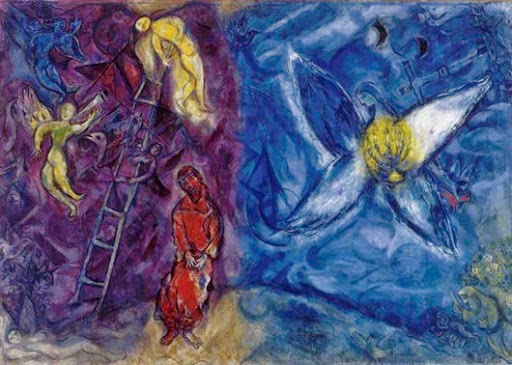
Chagall jacobs dream

A very good friend of mine (CA) lent me a great book about Judaism, entitled “What is a Jew?” and aimed at providing an introduction to a broad variety of aspects of what it means to be Jewish. The book is structured in the form of questions and answers and its tone exudes warmth and a desire to share rather than to impose or indoctrinate. Even before I started reading the book, I was looking forward to learning more about Judaism, both because of a desire to have a better understanding of the religion of several friends of mine, and because of the heightened insistence on a rediscovery of Judaism made by the Catholic Church since Vatican II.

John Paul II was famously the first pope to visit a synagogue, during which visit he spoke with clarity and warmth about the relationship between Christianity and Judaism:

“The Jewish religion is not ‘extrinsic’ to us, but in a certain way is ‘intrinsic’ to our own religion. […] With Judaism, therefore, we have a relationship which we do not have with any other religion. You are our dearly beloved brothers, and, in a certain way, it could be said that you are our elder brothers.”

Benedict XVI went on to maintain very strong relationships with Judaism, both acknowledging the Church’s past wrongs and expressing its gratitude and debt to the Jewish people:

“Abraham, father of the people of Israel, father of faith, has become the source of blessing, for in him ‘all the families of the earth shall call themselves blessed.’ The task of the Chosen People is therefore to make a gift of their God – the one true God – to every other people. In reality, as Christians we are the inheritors of their faith in the one God. Our gratitude therefore must be extended to our Jewish brothers and sisters who, despite the hardships of their own history, have held on to faith in this God right up to the present and who witness to it…”

Finally, Pope Francis has not only continued along the direction indicated by his predecessors, but has also benefitted from close personal friendships with the Jewish community. An example of this is the book – “On Heaven and Earth” that he co-authored with Rabbi Abraham Skorka, who also accompanied him on his recent visit to Israel and who has been a frequent visitor at the Vatican. Pope Francis has also reiterated, in his apostolic exhortation Evangelii Gaudium, the brotherly relationship that his predecessors have stressed:

“We hold the Jewish people in special regard because their covenant with God has never been revoked, for “the gifts and the call of God are irrevocable” (Rom 11:29). The Church, which shares with Jews an important part of the sacred Scriptures, looks upon the people of the covenant and their faith as one of the sacred roots of her own Christian identity (cf. Rom 11:16-18). As Christians, we cannot consider Judaism as a foreign religion; nor do we include the Jews among those called to turn from idols and to serve the true God (cf. 1 Thes 1:9). With them, we believe in the one God who acts in history, and with them we accept his revealed word. Dialogue and friendship with the children of Israel are part of the life of Jesus’ disciples. […] While it is true that certain Christian beliefs are unacceptable to Judaism, and that the Church cannot refrain from proclaiming Jesus as Lord and Messiah, there exists as well a rich complementarity which allows us to read the texts of the Hebrew Scriptures together and to help one another to mine the riches of God’s word. We can also share many ethical convictions and a common concern for justice and the development of peoples.” (§247-9)

Against this background I was particularly pleased to see the relationship between Christianity and Judaism described by Rabbi Morris Kertzer in “What is a Jew?” as follows:

“[The] German dramatist, Gotthold Ephraim Lessing, caught the essence of this common heritage [of Judaism and Christianity] in a play called Nathan, the Wise. One of the most memorable scenes depicts a meeting between a friar and the Jew Nathan. Moved by the beauty of Nathan’s character, the friar exclaims, “Nathan! Nathan! You are a Christian!” His friend replies, “We are of one mind, for that which makes me, in your eyes, a Christian, makes you, in my eyes, a Jew!”” (pp. 279)

I have to say that this paragraph from the last pages of the book very much rang true for me and expressed with accuracy the feeling I had as I made my way through the whole book. To give you a sense of what triggered such a recognition of what I believe to be very much mine in Rabbi Kertzer’s description of Judaism, I will share a number of excerpts from it next.

To begin with, the mystical tradition in Judaism, and its propensity to expressing itself by means of short stories reminded me immediately of the stories told about the Desert Fathers (and also about Zen kōans and the stories of the Sufi Mullah Nasrudin):

““Rabbi,” one of the disciples complained, “some of the congregants are gossiping in the midst of prayer!” “How wonderful are your people, O God,” The rabbi retorted. “Even in the midst of gossip, they devote a few moments to prayer!”

“Can you tell me, Rabbi, why the wicked are always looking for companions while the righteous are not?” “The answer is simple: The wicked walk in darkness, so are anxious for company. Good people walk in the light of God; they don’t mind walking alone.”” (pp. 21-22)

Next, I was struck by a repeated insistence on orthopraxy, which has a strong tradition in Christianity too:

“Jews are urged to put their religion into action. “Talking is not the main thing; action is,” goes a talmudic maxim, and action includes not just activity within the confines of the Jewish world, but working for the welfare of the larger society in which we live. We call this tikkun olam, meaning the “reparation of world.”” (pp. 30)

And Rabbi Kertzer goes on to recounting the same story about the building of the Tower of Babel that Pope Francis reflects on in his above-mentioned book, and then to presenting a synthesis of principles that resonate very strongly with Christianity too:

“The Rabbis used telling parables to illustrate this point. Why did the Tower of Babel crumble? Because the leaders of the project were more interested in the work than in the workers. When a brick fell to earth, they would pause to bewail its loss; when a worker fell they would urge the others to keep on building. The brick was more important than the human being. So God destroyed the imposing edifice. […]

Basic to Judaism are these fundamental principles, which are also basic to democracy: 1) God recognizes no distinction among us  on the basis of creed, color, gender, or class; all of us are equal in God’s sight. 2) We are all our brother’s and sister’s keepers; we bear responsibility for our neighbors’ failings as well as for their needs. 3) All of us, being made in God’s image, have infinite capacity for doing good; therefore the job of society is to evoke the best that is in each of us. 4) Freedom is to be prized above all things; the very first words of the Ten Commandments depict God as the Great Liberator: “I am the Eternal your God who brought you out of the land of Egypt.”” (pp. 31)

A couple of questions later, Kertzer then sets out an understanding of Scripture that could have come from the Vatican II dogmatic constitution Dei Verbum:

“[M]ost Jews look upon the accounts of miracles as inspiring literature, rather than as actual historical events. That is to say, we do not necessarily accept older interpretations of their significance, since an important lesson for the fifth century may be unimportant in the face of today’s spiritual questions; but we do use these tales as sources of inspiration ourselves, trying to draw religious lessons from the text, even the text of an event that may not be literally true. God did not create the world in precisely six days, just as the biblical text insists, but we can learn lessons for our lives from such stories as the Garden of Eden or the Tower of Babel.” (pp. 45)

On the subject of death and the Kaddish prayer, the book presents a profoundly beautiful reflection by Rabbi Steinberg:

“It is easier for me to let go of life with all its treasures, because these things are not and never have been mine. They belong to the Universe and the God who stands behind it. True, I have been privileged to enjoy them for an hour but they were always a loan to be recalled.

And I let go of them the more easily because I know that as parts of the divine economy they will not be lost. The sunset, the bird’s song, the baby’s smile, the thunder of music, the surge of great poetry, the dreams of the heart, and my own being—all these I can well trust to the God who made them. There is a poignancy and regret about giving them up, but no anxiety. When they slip from my hands they will pass to hands better, stronger, and wiser than mine.

Life is dear; let us then hold it tight while yet we may. But we must hold it loosely also! It is at once infinitely precious and yet a thing lightly to be surrendered. Because of God, we clasp the world, but with relaxed hands; we embrace it, but with open arms.” (pp. 67)

The juxtaposition of an enjoyment of the beauty of the universe and a detachment from it leads to an experiencing of everything in relationship with and gratitude to God:

“Because of its innate trust in both God and God’s world, Judaism affirms the value of life and life’s pleasures. It is therefore a religion that urges us to pay attention to the wonderful universe about us. To help us do so, it provides blessings for all of life’s bounties: seeing a rainbow; experiencing a thunderstorm; observing the first blossoms of springtime; putting on new clothes; even eating our first garden produce, as each crop ripens year after year.” (pp. 85)

That the above relationship with God is not simply an individual matter is shown clearly through the concept of minyan, which also reminded me of Jesus’ promise of his presence where “two or three” are gathered together in his name:

“Personal prayer between the individual and God may take place anywhere, any time, and with no one present but God and the individual worshiper. Public services, however, have traditionally required what is known as a minyan, that is, the presence of at least ten adult worshipers. […] Behind the idea of a minimum number is the notion that Jewish spirituality is in some sense communal. We all received the Torah together on Mount Sinai. We are all part of the people Israel.” (pp. 86)

Kertzer then goes on to presenting a simultaneous openness to diversity and faithfulness to God, that has echoes in the Church’s desire for “unity in diversity”:

“Our experience with diverse cultures has enriched our religion in many ways. Above all, perhaps, has been our hospitality to differences. Every question of Jewish law contains both an austere interpretation and a liberal one, and the Rabbis ruled that “both opinions are the word of the living God.” […] One famous rabbinic aphorism pictures God as saying, in effect, “As long as Jews do My will, they need not believe in Me.” That is an exaggeration, of course. Judaism does teach some beliefs, among them the firm conviction that God is real: a real presence in the lives of men and women, children and adults. We can know that reality as surely as we know the beauty of love, the satisfaction of faithfulness, or the buoyancy of hope.” (pp. 108)

In more specific terms, the three pillars of the Jewish faith are presented next, and unity among them is declared:

“We believe, then, in God: a personal God whose ways may be beyond our comprehension, but whose reality makes the difference between a world that has purpose and one that is meaningless.

We believe all human beings are made in God’s image; our role in the universe is thus uniquely important, and despite the failings that spring from our mortality, we are endowed with infinite potential for goodness and greatness.

We believe too that human beings actualize their potential as part of a community. The people Israel is such a community, harking back to Sinai, existing despite all odds from then until now, and still the source of satisfaction for Jews who wish to pursue a life of purpose grounded in the age-old wisdom we call Torah.

And we believe in Torah, therefore, as a continuing source of revelation.

It has been said that you can sum up Jewish belief in these three words, God, Torah, Israel. As the mystics used to say, “God, Torah, and Israel are all one.” If we lose our faith in any one of them, the others quickly perish. […]

In antiquity, it was common for scholars to distill the essence of religion in a simple formula. Thus, Hillel, the great Rabbi and scholar of the first century B.C.E., was asked to sum up Judaism while the questioner stood on one foot! Hillel replied: “Certainly! What is hateful to you, do not do to your neighbor. That is all there is in the Torah. All the rest is mere commentary. I suggest you study the commentary.”” (pp. 109)

The transcendence of God, the universal access to following Him and its being rooted in a putting into practice of His qualities brings the exposition of the Jewish faith to completion:

“Jews believe in the existence of a God who cannot be accurately conceived, described, or pictured. But God is a real presence in the universe at large; and the lives of each of us in particular. We believe also that we most genuinely show God honor when we imitate the qualities that are godly: As God is merciful, so we must be compassionate; as God is just, so we must deal justly with out neighbor; as God is slow to anger, so we must be tolerant in our judgment.” (pp. 110)

“It is the recognition of the reality of God, and the basic moral virtues, such as kindliness, justice, and integrity, that we regard as eternal verities. But we claim no monopoly on these verities, for we recognize that every great religious faith has discovered them. That is what Rabbi Meir meant some eighteen centuries ago, when he said that a non-Jew who follows the Torah is as good as our high priest.” (pp. 113)

Finally, Kertzer also speaks very powerfully about the necessity of remembering the horrors of the Shoah:

“[T]he moral reason [to remember the Shoah] may be the most important one. When the mass murderer Adolf Eichmann was on trial, the Israelis informed the world that the motive behind the judicial proceedings was not vengeance but the moral education of contemporary women and men. The striking thing about Eichmann was precisely that he was so ordinary, a living symbol of what historian Hannah Arendt called “the banality of evil.” Contemplating the events of the Nazi era, we came to see that the sin of omission on the part of the decent peoples of the world was the sin of silence, the refusal to believe that a highly enlightened people like the Germans could permit themselves to be led by a madman into acts of national depravity that culminated in the events of Auschwitz and the other death camps. We had to learn to readjust our vision and take evil seriously once again.” (pp. 161)

Not only is it essential to pursue the doing of good, but so is a taking seriously of evil and a standing up to it, since omission and silence too are grave sins – insights that are of acute relevance today and that were at the time of the Shoah also shared by Christians. The Lutheran theologian Dietrich Bonhoeffer, whose anniversary of being murdered in the Flossenbürg concentration camp in 1945 was yesterday, said:

“Silence in the face of evil is itself evil:
God will not hold us guiltless.
Not to speak is to speak.
Not to act is to act.”
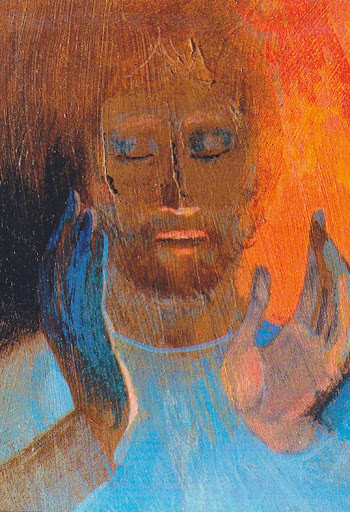
Being body in spirit

Le christ arcabas

Last Saturday at mass, I heard something along the following lines during the sermon: “We need to look after our souls more than after our bodies, since our souls are eternal and our bodies will be discarded at the end of our lives.” While the intention behind this statement may have been good, and was set in the context of the priest noting that only around 1% of those who attend mass come to confession in his parish, the suggestion of the body being secondary and only temporarily attached to the soul certainly wasn’t in keeping with the Church’s teaching. Since such dualist views are not uncommon and since I have heard them attributed to Catholicism by some friends of mine, I would here like to take a closer look at what the Catholic Church actually teaches about this topic.

Originally I was going to look at the question of how the body and soul are understood in a broader way, with a look at Scripture, a mention of St. Francis of Assisi, a glimpse at the counter-reformation and then examples from Pope Francis’ teaching (e.g., his insistence on the importance of touching the flesh of the poor and suffering), I will instead stay monographic and focus on what St. John Paul II wrote on the subject in his “Man and Woman He Created Them.” As soon as I went back to that book and started re-reading the relevant passages I realized that all of what I wanted to bring into play is there and is expressed crisply and sharply.
To being with, John Paul II’s point of departure is that of humans1 being made in the image of God and therefore being a “primordial sacrament”:

“Man appears in the visible world as the highest expression of the divine gift, because he bears within himself the inner dimension of the gift. And with it he carries into the world his particular likeness to God, with which he transcends and also rules his “visibility” in the world, his bodiliness, his masculinity or femininity, his nakedness. […] Thus, in this dimension, a primordial sacrament is constituted, understood as a sign that efficaciously transmits in the visible world the invisible mystery hidden in God from eternity. And this is the mystery of Truth and Love, the mystery of divine life, in which man really participates. In the history of man, it is original innocence that begins this participation and is also the source of original happiness. The sacrament, as a visible sign, is constituted with man, inasmuch as he is a “body,” through his “visible” masculinity and femininity. The body, in fact, and only the body, is capable of making visible what is invisible: the spiritual and the divine. It has been created to transfer into the visible reality of the world the mystery hidden from eternity in God, and thus to be a sign of it.”

Note how John Paul II does not say “he has a body” but “he is a body” and that the sacramentality of humans consists in their being a “visible sign” of God’s presence in the world. Unlike other sacraments, humans are conscious of their being so and therefore become subjects rather than objects:

“Consciousness of the gift conditions in this case “the sacrament of the body”: in his body as man or woman, man senses himself as a subject of holiness. With this consciousness of the meaning of his own body, man, as male and female, enters into the world as a subject of truth and love.”

The body’s origins (as gift from God and God’s visible sign in the world) and function (as “subject of holiness”) already point to it’s being a lasting and intrinsic part of what it is to be human:

“[W]e draw a first hope already from the mystery of creation: namely, that the fruit of the divine economy of truth and love, which revealed itself “at the beginning,” is not Death, but Life, and not so much the “destruction of the body of man made in the image of God,” but rather the “call to glory” (Romans 8:30).”

And it is Jesus’ resurrection that seals the deal:

“The resurrection, according to Christ’s words reported by the Synoptics, means not only the recovery of bodiliness and the reestablishment of human life in its integrity, through the union of body and soul, but also a wholly new state of human life itself.”

It is often said that all philosophy is a conversation between Plato and Aristotle, and the body-soul question seems to be no different. John Paul II here clearly aligns Christianity and Catholic teaching with Aristotle and later with Thomas Aquinas:

“Reflection about the resurrection led Thomas Aquinas in his metaphysical (and simultaneously theological) anthropology to abandon Plato’s philosophical conception on the relation between the soul and the body and to draw near to Aristotle’s view. In fact, the resurrection attests, at least indirectly, that in the whole of the human composite, the body is not, contrary to Plato, only temporarily linked with the soul (as its earthly “prison,” as Plato maintained), but that together with the soul it constitutes the unity and integrity of the human being. This is precisely what Aristotle taught, in contrast to Plato. When St. Thomas in his anthropology accepted Aristotle’s conception, he did so because he considered the truth about the resurrection. In fact, the truth about the resurrection clearly affirms that man’s “eschatological perfection and happiness cannot be understood as a state of the soul alone, separated (according to Plato, liberated) from the body, but must be understood as the definitively and perfectly “integrated” state of man brought about by such a union of the soul with the body that it definitively qualifies and assures this perfect integrity.”

Siding with Aristotle here is firmly on the basis of the resurrection, which brings about the original harmony that was created by God “in the beginning”:

“In the resurrection, the body will return to perfect unity and harmony with the spirit: man will no longer experience the opposition between what is spiritual and what is bodily in him. [… It is] not only that the spirit will master the body, but, I would say, that it will also fully permeate the body and the powers of the spirit will permeate the “energies of the body.””

John Paul II is quick to insist on the resurrection not having resulted in victory of spirit over body, a subjugation, but in participation and personal fulfillment:

“In fact, in the composite, psychosomatic being that is man, perfection cannot consist in a reciprocal opposition of the spirit and the body, but in a deep harmony between them, in safeguarding the primacy of the spirit. In the “other world,” this primacy will be realized, and it will be manifested in a perfect spontaneity without any opposition on the part of the body. Nevertheless, this should not be understood as a definitive “victory” of the spirit over the body. The resurrection will consist in the perfect participation of all that is bodily in man in all that is spiritual in him. At the same time, it will consist in the perfect realization of what is personal in man.”

This also very much echoes Giuseppe Maria Zanghí’s thought on how our being in God does not annihilate us, is not a victory over us, but instead:

“I can be myself in Him (being an intimate participant of Trinitarian life in the Word), while being really distinct from Him (by virtue of being a creature different from Him). It is His love that wants me, and the love of God does not withdraw into itself, canceling diversity with the other by totally reverting it to Himself, but “makes” the other and guards them in diversity from Himself, not wanting to possess (like He doesn’t possess Himself) in total reabsorption. […] Because the relationship between the two “opposing” extremes (I and the other, I and God) is still thought of as ending in one of the two (and, therefore, in the strongest!); while, if Christian faith is true, the relationship does not end in either of the mediated extremes, but in a third that saves them precisely in their diversity.”

And – as far as the body-soul relationship is concerned, I believe Zanghí’s “third” is precisely John Paul II’s “resurrection.”


1 In my own words I will use the somewhat awkward “humans” to refer to both men and women, while in the quotes from John Paul II’s writings there will be reference to “man.” Note, however, that John Paul II means “human” when his words are rendered as “man” in English, which is explicit from the full text of “Man and Woman He Created Them” and also reflects the fact that in Polish he uses the word “człowiek” which also refers to both men and women and is used in everyday language without the technical connotations that “human” has in English.

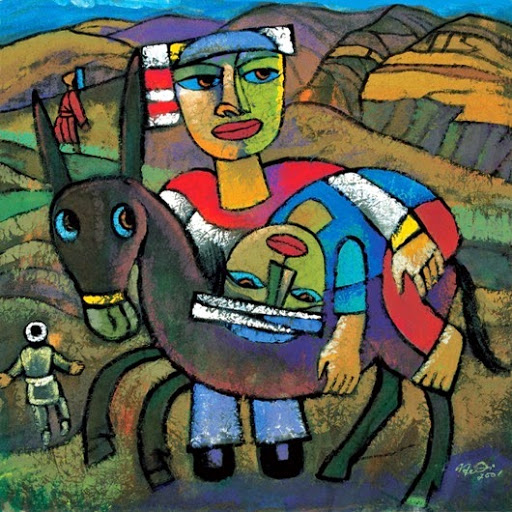
The Parable of the Good Lesbian

Good samaritan

A very good friend of mine, MK, wrote the following on Facebook a couple of days ago: “I think that if Jesus was telling the parable of the good Samaritan today, maybe it would be the parable of the good gay.” And, as soon as I saw it, I “liked” it, since it seemed to fit Jesus’ choice of profile for that particular parable character like a glove – i.e., as someone who is frowned upon, mistrusted and seen as repulsive by “good” God-fearing folk, and with whom there is an us-versus-them that needs to be undermined.

A short while later I noticed that MK’s Facebook status had received 43 comments, dominated by outrage, exhortations to read St. Paul (undoubtedly a good idea, and one, which that comment’s author should also self-apply) and a bandying-about of phrases like “the truth of Christ” (as if there were different flavors of truth). There were also reasonable comments, but these formed a small minority among the sea of tirades that followed the outrageous suggestion that homosexuals could be thought of as today’s equivalent of first-century Judea’s Samaritans.

My immediate reaction to seeing this was to look more closely at the Good Samaritan parable and get a sense of how well founded MK’s suggestion for its contemporary adaptation is – not so much for the sake of assessing its reasonableness (which had intuitive appeal to me from the start), but to get a more specific sense of its context and exegesis.

To get an idea of how Jews and Samaritans got on with each other, Blessed John Henry Newman provides the following summary, after giving an account of mutual killings between the two peoples:

“[… T]he strongest expression of hatred the Jews could invent against Christ was ‘Thou art a Samaritan and hast a devil’ (John 8:48). [… I]f a Jew and a Samaritan met in a narrow way, they were particularly careful to avoid touching each fearing to receive pollution from the other.”

Saying “Samaritan” in the first century AD to an audience of Jewish lawyers (as Jesus – and, lets not forget, himself a Jew, did), seems to have been the same kind of trigger as saying “gay” is today to my friend’s “Christian” contacts. 1:0 to MK – the glove does indeed seem to fit.

Let me next take a look at how the last three popes have read this parable and see whether that sheds light on the transposition proposed by my friend.

St. John Paul II spoke at length about the Parable of the Good Samaritan in his apostolic letter on suffering, Salvifici Doloris (§28):

“The parable of the Good Samaritan belongs to the Gospel of suffering. For it indicates what the relationship of each of us must be towards our suffering neighbour. We are not allowed to “pass by on the other side” indifferently; we must “stop” beside him. Everyone who stops beside the suffering of another person, whatever form it may take, is a Good Samaritan. This stopping does not mean curiosity but availability. It is like the opening of a certain interior disposition of the heart, which also has an emotional expression of its own. The name “Good Samaritan” fits every individual who is sensitive to the sufferings of others, who “is moved” by the misfortune of another. If Christ, who knows the interior of man, emphasizes this compassion, this means that it is important for our whole attitude to others’ suffering. Therefore one must cultivate this sensitivity of heart, which bears witness to compassion towards a suffering person. Some times this compassion remains the only or principal expression of our love for and solidarity with the sufferer.

Nevertheless, the Good Samaritan of Christ’s parable does not stop at sympathy and compassion alone. They become for him an incentive to actions aimed at bringing help to the injured man. In a word, then, a Good Samaritan is one who brings help in suffering, whatever its nature may be. Help which is, as far as possible, effective. He puts his whole heart into it, nor does he spare material means. We can say that he gives himself, his very “I”, opening this “I” to the other person. Here we touch upon one of the key-points of all Christian anthropology. Man cannot “fully find himself except through a sincere gift of himself” (Gaudium et Spes, 24). A Good Samaritan is the person capable of exactly such a gift of self.”

What strikes me here immediately are two things: first, the deep-seated universality of St. John Paul II’s words, addressed to “each of us,” “everyone,” “every individual,” where “Good Samaritan” status is predicated only on one’s capacity for “a gift of self.” Second, the imperative nature of his words which insist both on what we must do (being sensitive to, moved by and helping our suffering neighbors; being compassionate and self-giving) and what we are not allowed to do: be indifferent. This exegesis too easily extends to homosexuals, who are undoubtedly in a position of showing compassion to those around them and of selflessly coming to their aid.

Pope Benedict XVI adds further clarity to this universally-predicated imperative to love, in his exceptional piece of thinking: the encyclical Deus Caritas Est:

“14. […] Union with Christ is also union with all those to whom he gives himself. I cannot possess Christ just for myself; I can belong to him only in union with all those who have become, or who will become, his own. […] We become “one body”, completely joined in a single existence. Love of God and love of neighbour are now truly united: God incarnate draws us all to himself. […] the “commandment” of love is only possible because it is more than a requirement. Love can be “commanded” because it has first been given.

15. This principle is the starting-point for understanding the great parables of Jesus. […] The parable of the Good Samaritan (cf. Lk 10:25-37) offers two particularly important clarifications. Until that time, the concept of “neighbour” was understood as referring essentially to one’s countrymen and to foreigners who had settled in the land of Israel; in other words, to the closely-knit community of a single country or people. This limit is now abolished. Anyone who needs me, and whom I can help, is my neighbour. The concept of “neighbour” is now universalized, yet it remains concrete. Despite being extended to all mankind, it is not reduced to a generic, abstract and undemanding expression of love, but calls for my own practical commitment here and now. The Church has the duty to interpret ever anew this relationship between near and far with regard to the actual daily life of her members.”

For me, the most significant aspect of this passage is Benedict’s insistence on love being a commandment and on the justification of its imperative status being the precedent of God’s love. Since the source of this “obligation” to love is inexhaustible, its scope too is universal (as St. John Paul II already made clear). Furthermore, Benedict also calls for a keeping current of what such universality means in the present. This is very much in line with the current process of discernment underway in the Catholic Church, which is on the road to the second Synod on the Family this October. Specifically, the challenges of how to provide opportunities for homosexuals to feel part of the Church are on the table there too, which is easily read as an instance of Benedict’s “interpret[ing] ever anew this relationship between near and far.”

Finally, let’s hear what Pope Francis has to say about this parable:

“The Gospel passage from St Luke (10:25-37) tells of a certain man, half dead, who had been thrown into the street. Now by chance a priest was going down that road. A good priest, in his cassock: good, very good. He saw him and looked: I’ll be late for Mass, and he went on his way. He didn’t hear the voice of God there”. […] It is curious to note that only a man who habitually fled from God, a sinner, the Samaritan, was the very one who perceived the voice of God. He drew near to the man. He bound up his wounds, pouring on oil and wine; then he set him on his own beast. Oh how much time he lost: he brought him to an inn, and took care of him. He lost the whole evening! In the meantime, the priest arrived in time for the Holy Mass and all the faithful were content.

Why did the priest flee from God? Because his heart was closed. When your heart is closed you cannot hear the voice of God. Instead, it was a Samaritan on a journey who saw the wounded man and had compassion. His heart was opened, he had a human heart. His humanity enabled him to draw near.

The priest had a plan for his life: he wanted to write his own history well, according to God’s ways. But he was the one writing it. However, this other sinner allowed God to write the history of his life. He changed all his plans that evening because the Lord placed before him this poor, wounded man who had been thrown out onto the street.

I ask myself and I also ask you: do we allow God to write the history of our lives or do we want to write it? This speaks to us of docility: are we docile to the Word of God? Yes, I want to be docile, but are you able to listen to his Word, to hear it? Are you able to find the Word of God in the history of each day, or do your ideas so govern you that you do not allow the Lord to surprise you and speak to you?”

What strikes me here is the supremacy of openness over righteousness. Making oneself the ultimate judge (+ jury & executioner), instead of opening oneself up to discerning the will of God and listening to the promptings of the Holy Spirit through one’s conscience, leads to a spoiling even of things that are good in themselves and to an assumption of ultimate power by an imperfect subject. Instead, the admission of sinfulness, that Pope Francis (and before him the saints universally) has made for himself and that each one of us can recognize in our own lives, if we are sincere enough, helps us both to recognize brothers and sisters in all, without exception, and to open ourselves up to God’s surprises.

The family: union with God

8417364534 92a9f089c2 z

On Saturday, Pope Francis met with members of the Schönstatt Apostolic Movement in the Vatican and answered some of their questions. Since I haven’t found the full text in English anywhere, and since the topic of most of the questions was the family, I was keen to hear Francis’ words this soon after the conclusion of the Synod.

Instead of an extensive analysis, I would just like to share the following translated transcript of the introduction to his first answer, which I read as a beautiful “relatio synodi” put in Francis’ own words:

“The Christian family, the family, marriage, have never been attacked as much as now. Attacked directly or attacked as a matter of fact. Maybe I am mistaken, and the historians of the Church could tell us, but the family is being beaten, is being bastardized, as if it were just a loose association, as if you could call anything a family. And then, how many wounded families there are, how many broken down marriages, how much relativism there is, as far as the understanding of the sacrament of marriage. From the sociological point of view, from the point of view of human values, and from the point of the Catholic sacrament, the Christian sacrament, there is a crisis of the family. It gets beaten up from all sides. It ends up being very wounded.

So, we have no choice but to do something. So, what can we do. Yes, we can give nice talks, declare some nice principles, this we do have to do for sure to have clear ideas. Look, these things you are proposing, they are not marriage. It is an association, but it is not marriage. Sometimes it is necessary to say things very clearly. And they must be said. But the pastoral help that is needed is body to body. Accompanying. And this means loosing time. The greatest teacher of how to lose time is Jesus. He lost time by accompanying, to help consciences mature, to heal wounds, to teach. Accompanying means to share a journey.

Evidently the sacrament of marriage has been devalued. And, unconsciously, there has been a move from the sacrament to the ritual. A reduction of sacrament to ritual. This leads to thinking about the sacrament as a social matter. Yes, with religious elements, for sure, but the strong point being the social. […] The social aspect obscures that which is most important about marriage, which is union with God.”

And this, in turn, made me think of St. John Paul II’s profound words on the same subject:

“[T]he primordial model of the family is to be sought in God himself, in the Trinitarian mystery of life. […] The family itself is the great mystery of God.” (Letter to Families, 1994, §6, §19)

Very much is at stake here. Not only the family, but our relationship with God too. The God of mercy and vicinity, who invites us to share in the life of his being family.

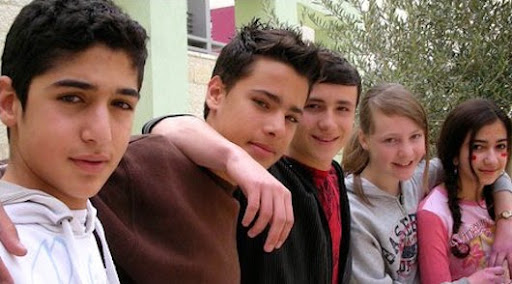
Who are children of God?

45460002 aboud mustafa jamie areen avery2

Catholics? Christians? “Good” people?

No.

In total disagreement with the author of yesterday’s “Thoughts on today’s Mass,” distributed in my parish, who said that “we are not naturally children of God: we become so by baptism, when God adopts us as his own. Otherwise to call God our Father would be a bold presumption,” I would like to show that the Catholic Church teaches that every single human being is a child of God. Using the idea of being God’s child as the basis of separation, the basis of an “us,” as opposed to a ”them,” is perverse and absolutely not what the Catholic Church teaches, in spite of the official-looking material handed out in some of its parishes.

To begin with, Jesus – the Son of God – himself recognizes familial status universally, when he says that “whoever does the will of my heavenly Father is my brother, and sister, and mother” (Matthew 12:50) and St. Paul too picks up on the key being adherence to God’s will: “For those who are led by the Spirit of God are children of God” (Romans 8:14).

That such adherence to the will of God is open to everyone – whether they believe in God or not – and that it is at the heart of what the Catholic Church believes, is very clear from Nostra Aetate, the declaration issued during the Second Vatican Council by Pope Paul VI, which says in its closing paragraph:

“We cannot truly call on God, the Father of all, if we refuse to treat in a brotherly way any man, created as he is in the image of God. Man’s relation to God the Father and his relation to men his brothers are so linked together that Scripture says: “He who does not love does not know God” (1 John 4:8).

No foundation therefore remains for any theory or practice that leads to discrimination between man and man or people and people, so far as their human dignity and the rights flowing from it are concerned.

The Church reproves, as foreign to the mind of Christ, any discrimination against men or harassment of them because of their race, color, condition of life, or religion. On the contrary, following in the footsteps of the holy Apostles Peter and Paul, this sacred synod ardently implores the Christian faithful to “maintain good fellowship among the nations” (1 Peter 2:12), and, if possible, to live for their part in peace with all men, so that they may truly be sons of the Father who is in heaven.”

And this is also reflected in what the Catechism teaches about the opening words of the Our Father, the prayer Jesus taught:

“God’s love has no bounds, neither should our prayer. Praying “our” Father opens to us the dimensions of his love revealed in Christ: praying with and for all who do not yet know him, so that Christ may “gather into one the children of God.” God’s care for all men and for the whole of creation has inspired all the great practitioners of prayer; it should extend our prayer to the full breadth of love whenever we dare to say “our” (§2793)

Note in particular the thought-provoking idea in the above of Catholics praying with those who don’t know Jesus. Even in a fundamentally religious act the desire of Catholics is to be united with those who don’t share their beliefs!

And if the above weren’t enough to categorically declare that Catholics consider every human being to be a child of God and therefore also their brother or sister, let’s see what the last three popes had to say on the subject:

  1. “We must never forget that every person, from the moment of conception to the last breath, is a unique child of God and has a right to life.” Pope Saint John Paul II (Address at the Ceremony of the Anointing Of The Sick, Southwark’s Cathedral, London, 28 May 1982)
  2. “God is the origin of the existence of every creature, and the Father in a unique way of every human being: he has a unique, personal relationship with him or her.” Pope Benedict XVI (Sunday Angelus address, 8 January 2012)
  3. “Since many of you are not members of the Catholic Church, and others are not believers, I cordially give this blessing silently, to each of you, respecting the conscience of each, but in the knowledge that each of you is a child of God. May God bless you!” Pope Francis (Audience to Representatives of the Communications Media, 16th March 2013 – the day after his election!)
  4. “Every human being is a child of God! He or she bears the image of Christ! We ourselves need to see, and then to enable others to see, that migrants and refugees do not only represent a problem to be solved, but are brothers and sisters to be welcomed, respected and loved.” Pope Francis (Message for the World Day of Migrants and Refugees, 5 August 2013)

I rest my case.

Where nothing articulate can be said

Lama sabachthani

The idea of God crying out in forsakenness, nailed to a cross like a criminal, is both deeply disturbing (hence the frequent denial of its “reality”) and a window onto Jesus’ new commandment: “I give you a new commandment: love one another. As I have loved you, so you also should love one another.” (John 13:34). It is an event that has not only occupied theologians and mystics, but has also attracted non-believers and has been written about on this blog several times. Today, I’d like to look at how Hans Urs von Balthasar, St. John Paul II, Gianfranco Ravasi and Chiara Lubich understood it and what consequences they drew from it.

Von Balthasar, like Pope Francis in Evangelii Gaudium (“Jesus’ sacrifice on the cross is nothing else than the culmination of the way he lived his entire life.” §269), argues for a deep continuity between Jesus’ life and teaching and his abandonment on the cross:

“The inarticulate cry of the cross of Jesus is no denial of his articulate proclamation to his disciples and to the people… instead it is the final end of all those articulations… which he utters with the greatest force where nothing articulate can be said any longer.” (The Whole in the Fragment)

To von Balthasar, Jesus’ forsakenness is not failure, but culmination, and this perspective can also be seen in St. John Paul II’s thought where he presents it as necessary for God’s “full solidarity” with humanity:

“[O]n Jesus’ lips the “why” addressed to God was also [… an expression of] pained bewilderment at that suffering which had no merely human explanation, but which was a mystery of which the Father alone possessed the key. Therefore, […] the question contained a theological significance in regard to the sacrifice whereby Christ, in full solidarity with sinful humanity, had to experience in himself abandonment by God.”

During that same General Audience in 1988, John Paul II also presents a synthesis of positions that argue for and against the “reality” of Jesus’ abandonment on the cross:

“If Jesus felt abandoned by the Father, he knew however that that was not really so. He himself said, “I and the Father are one” (Jn 10:30). Speaking of his future passion he said, “I am not alone, for the Father is with me” (Jn 16:32). Jesus had the clear vision of God and the certainty of his union with the Father dominant in his mind. But in the sphere bordering on the senses, and therefore more subject to the impressions, emotions and influences of the internal and external experiences of pain, Jesus’ human soul was reduced to a wasteland. He no longer felt the presence of the Father, but he underwent the tragic experience of the most complete desolation.

Here one can sketch a summary of Jesus’ psychological situation in relationship to God. The external events seemed to manifest the absence of the Father who permitted the crucifixion of his Son, though having at his disposal “legions of angels” (cf. Mt 26:53), without intervening to prevent his condemnation to death and execution. In Gethsemane Simon Peter had drawn a sword in Jesus’ defense, but was immediately blocked by Jesus himself (cf. Jn 18:10 f.). In the praetorium Pilate had repeatedly tried wily maneuvers to save him (cf. Jn 18:31, 38 f.; 19:4-6, 12-15); but the Father was silent. That silence of God weighed on the dying Jesus as the heaviest pain of all […].

In the sphere of feelings and affection this sense of the absence and abandonment by God was the most acute pain for the soul of Jesus who drew his strength and joy from union with the Father. This pain rendered all the other sufferings more intense. That lack of interior consolation was Jesus’ greatest agony.”

While the above may at first look like a variant of the naive arguments for the unreality of Jesus’ abandonment by the Father, which revolve around the claim that Jesus knew he wasn’t “really” abandoned, John Paul II’s position is more nuanced. He both affirms Jesus’ knowledge of the Father’s presence and the fullness of Jesus experiencing the Father’s absence. Unlike the naive positions that present knowledge as a mitigating factor, John Paul II does not hesitate to describe Jesus’ soul as a “wasteland” and his experience as being one of “most complete desolation.” It is essentially a third-person, “objective” view that recognizes the continuing presence of the Father while Jesus fully experiences his absence on the cross. In many ways this is akin to a Christian, who sees their atheist friends’ sincerity, recognizing that their friends live in the absence of an experience of God, while they themselves see both their own and their friends’ lives unfolding in His presence. This is not to deny the “reality” of the atheist experience (qua experience) while at the same time situating it within one’s own understanding of reality. I believe such a parallel also underlines John Paul II’s claim that Jesus’ abandonment on the cross was necessary for the sake of “full solidarity” with all of humanity – both with those who believe in God and who do not.

John Paul II’s analysis does seem to me to be the key also to understanding why many theologians wrestle with with the contradiction of Jesus’ forsakenness on the cross. Even Cardinal Ravasi, who in one context affirms the reality of Jesus’ forsakenness (even calling it “salvific atheism”), in another context speaks both about His being our “brother also in the tragedy of the absence of God” and at the same time about it not being possible to “classify that cry as a sign of despair and almost of disbelief.”

Beyond considerations about the reality of Jesus’ forsakenness and its central role in God’s closeness to humanity, what is its practical impact though? What difference does it mean to me, as a Christian, that Jesus experienced such complete desolation? Here the insights of the Servant of God Chiara Lubich are key, since she recognized in Jesus’ forsakenness the key to uniting herself both to God and to every neighbor she encountered, to the point of declaring Jesus Forsaken to be her spouse.

In a talk from 1971,1 Lubich shares her insight into Jesus’ forsakenness being the pinnacle of his self-giving:

“He had given everything.

First, a life lived beside Mary in hardship and obedience.

Then, three years of mission, revealing the Truth, giving witness to the Father, promising the Holy Spirit, and working all kinds of miracles of love.

Finally, three hours on the cross, from which he gave forgiveness to his executioners, opened paradise to the thief, gave his mother to us, and ultimately gave his body and blood, after having given them mystically in the Eucharist.

He had nothing left but his divinity.

His union with the Father, that sweet and ineffable union with the One who had made him so powerful on earth as the Son of God and so regal on the cross, that feeling of God’s presence had to disappear into the depths of his soul and no longer make itself felt, separating him somehow from the One with whom he had said to be one: “The Father and I are one” (Jn 10:30). In him love was annihilated, the light extinguished, wisdom silenced.”

Left in a state of complete self-noughting, “where nothing articulate can be said,” what choice did he have left?

“To formulate a question was the only way Jesus could then possibly express himself; that loud cry is the Word which is no longer word, which therefore, cannot be understood and explained as word. It is the indescribable reality which is so beyond what words that are uttered in the created world can express. It is the sub-word; that which is chosen by the Powers of Heaven to bear the Eternal ultra- word.”

What was the point of such complete annihilation though? Here Lubich presents a deeply logical argument:

“So he made himself nothing to make us share in the All; a worm2 of the earth, to make us children of God.

We were cut off from the Father. It was necessary that the Son, in whom all of us were represented, should experience separation from the Father. He had to experience being forsaken by God so that we might never be forsaken again.

He had taught that no one has greater love than one who lays down his life for his friends. He who was Life laid down his whole self. This was the culminating point, love’s most beautiful expression. He loved in God’s way! With a love as big as God!”

Most importantly though, Jesus Forsaken was not of academic interest to Lubich, who – with her companions and a growing number of sympathizers and followers – sought to put the Gospel into practice in everything she did, but a person with whom she developed a close relationship:

“He drew us to himself; we discovered him everywhere: in every physical moral or spiritual pain. They were shadows of his great suffering. […] Then we saw him in every neighbor who was suffering. […] Every personal suffering also appeared to us as a countenance of Jesus forsaken to be loved and wanted in order to be with him and like him, so that through the death of ourselves […], he might give life to us and to many others.”

In fact, Lubich understood that such a relationship with Jesus Forsaken, a becoming another Jesus Forsaken, is the way to profound relationships of unity:

“In his testament Jesus had said: “With me in them and you in me, may they be so perfected in unity” (Jn 17:23). If Jesus was in me, if Jesus was in the other, and if Jesus was in all, at that moment we were perfected in unity. […] Jesus forsaken is the model for those who must build unity with others. I cannot enter into another spirit if I am rich of my own. To love others I must constantly make myself so poor in spirit that I possess nothing but love. Love is empty of itself. Jesus forsaken is the perfect model of one who is poor in spirit. He is so poor that he has not even God, so to speak. He does not feel God’s presence.”

And finally, picking up on a theme so close to Pope Francis’ heart, Lubich points to the simultaneous closeness to humanity and God that Jesus’ forsakenness brings about, where He becomes the void that bridges the finite with the infinite:

“In his forsakenness Jesus seems to be nothing but a man, and so never had he been as close to us human beings as in that moment and never, therefore, had he loved so much. At the same time, never had he been so close to the Father; it is out of love for him that he dies in that way.”


1 Which was also my source for the quotes from von Balthasar’s “The Whole in the Fragment” above.
2 “But I am a worm, not a man, scorned by men, despised by the people.” (Psalms 22:7)

Theology: necessary, but only for experts

Experts

Last Sunday was Trinity Sunday – the day when the Church focuses on the one God having revealed himself to be a communion of three persons, whose self-giving love for one another means that they are both three and one – distinct persons, yet of one substance. As St. John Paul II put it in Familiaris Consortio (§11): “God is love and in Himself He lives a mystery of personal loving communion.”

John Paul II then goes on to discussing the relevance of an understanding of the Trinity for humanity, when he says that

“God created man in His own image and likeness: calling him to existence through love, He called him at the same time for love. […] Creating the human race in His own image and continually keeping it in being, God inscribed in the humanity of man and woman the vocation, and thus the capacity and responsibility, of love and communion. Love is therefore the fundamental and innate vocation of every human being.”

Maybe naively, but I therefore expected to read some edifying insight into this trinitarian nature of God when picking up an official leaflet distributed with my parish’s newsletter last Sunday. Instead, I started reading a piece that kicks off as follows:

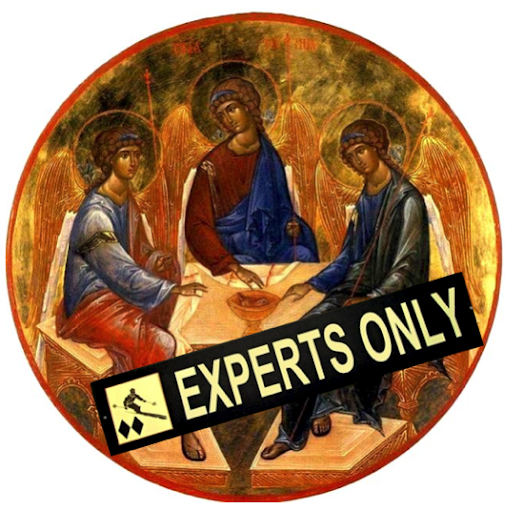
“The liturgy of Trinity Sunday is full of abstract words that many of us find difficult – unity, trinity, person, substance. They can seem to belong more to a mathematical text-book than to a prayer. This is the technical language of theology, necessary but only for experts.”

At this point I stopped reading, since, whatever followed, could be neither edifying nor enriching, and I preferred to spend the rest of the time I had before mass in a positive way instead of by trying to calm myself down in the face of more drivel.

I am not sure what maths books the author of the above patronizing had read, but I can only think of one of those four terms coming up there. More seriously wrong is the idea though that our understanding of the nature of God is in some way an academic exercise, that it is something that just has to be put up with and that it is best left to experts. The rest of us, for whom this must all be terribly confusing, should just get on with our lives and not let ourselves be troubled by abstract concepts. In fact, we should shelve all this hoity-toity talk about persons and substances under the soothing blanket of “mystery,” as the author of the above insult to every rational human being suggests later in the same piece.

Absolutely no way, Bruce! This would be – to use a soccer analogy – like telling players that they didn’t need to know anything about the Laws of the Game, that they should just run around kicking the ball however they liked (since those complicated rules would just give them headaches) and that the referees would tell them what’s going on and, at some point, who won.

Luckily the author in question here is comfortably outranked by another, whose words I will chose to use against him and to adhere to myself. Yes, you guessed it – I am talking again about St. John Paul II, who said:

“[T]he Trinity is beyond the capacities of our understanding and can only be known through revelation. Nevertheless, this mystery which infinitely transcends us is also the reality closest to us, because it is the very source of our being. For in God we “live and move and have our being” (Acts 17:28), and what St Augustine says of God must be applied to all three divine persons: he is “intimior intimo meo” (Confessions, 3, 6, 11). In the depths of our being, where not even our gaze can penetrate, the Father, Son and Holy Spirit, one God in three persons, are present through grace. Far from being a dry intellectual truth, the mystery of the Trinity is the life that dwells in us and sustains us. […]

He is love in his inner life, where the Trinitarian dynamism is the very expression of the eternal love with which the Father begets the Son and both give themselves to each other in the Holy Spirit. He is love in his relationship to the world, since the free decision to make it out of nothing is the fruit of this infinite love which radiates into the sphere of creation.”

Yes, the Trinity is a mystery, but saying so is not a conversation stopper or an excuse, and neither is it code for saying that we cannot think or reason about what it means. Christianity has at its heart the gift of revelation, where God became man and dwelt among us, precisely so that we could also have some understanding of who He is. While being wholly other, and justifiably approached also by apophatic means, He is at the same time “more inward to us than our inmost self and higher than our highest self” (“intimior intimo meo et superior summo meo”), as St. Augustine says. Being made in His image means that by understanding Him we understand ourselves, and vice versa, and this surely is worth struggling for and putting up with (seemingly) abstract and technical language for.

Let’s not let others tell us that thinking about the Trinity is for experts only, that it is too technical and abstract for us to trouble our pretty little heads with. Let’s receive the gift of revelation and the glimpses of His innermost life that God shared with us, since these are treasures beyond the wildest imagination and keys to unlocking joy in our lives. And even if you, my dear reader, are not a Christian, see what it is that we mean by speaking about God as Trinity, since it tells you what we mean by love.

Men and women: towards unity in diversity

Chagall adam and eve

[Warning: Long read.]

My personal experience of having many good friends among both men and women is leading me to believe that differences between the two genders are real, but that their nature is very complex and that any attempt to characterize one versus the other ends up in traits that span some of both genders’ populations. No matter what profile is devised with the intention to characterize what a man’s trademark traits are, there will be women I know who excel at some of them, and, equally, I can think of men who excel at traits that would be attributed to the archetypal woman.

Claims that women are more intuitive while men are more rational have always struck me as simplistic and reductive in terms of their predictive capacity in the face of meeting a new person of either gender, and – more importantly, I have found them to be unhelpful, or even obstructive, when it comes to building relationships. Yet, the view of resolving the question about the differences between men and women by means of two list of ‘typical’ traits is very popular, as can also be seen from best-sellers like “Men are from Mars, Women are from Venus” (the first book I read that compelled me to write a review on Amazon :).

To counter this trend, I would like to sketch out my understanding of how men and women compare, and do so from two perspectives: the first one being science (both neuroscience and psychology) and the second one religion (specifically Christianity, and even more specifically Catholic exegesis, the Theology of the Body of St. John Paul II and the intellectual visions of the Servant of God, Chiara Lubich).

From the perspective of science, there is a growing body of work on quantifying both the neurological/physiological and psychological differences between men and women, where certain physical as well as behavioral differences have been measured repeatedly and for which evidence is mounting.

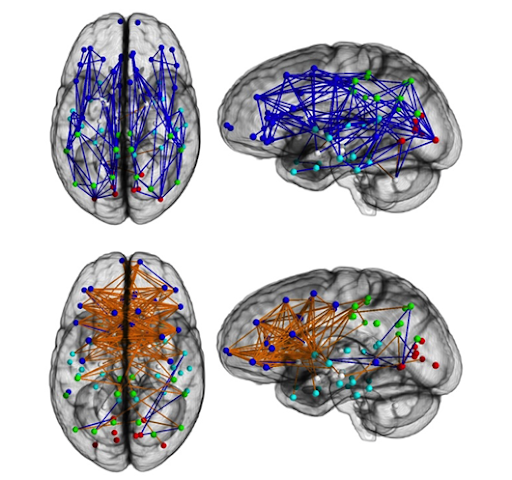
On the neurological and physiological side, there is strong evidence (obtained by a team from Oxford and Cambridge, who pooled together 126 studies, involving 43 000 subjects) to show that the brains of men are between 8% and 13% larger in volume than those of women. There is also evidence for there being significant differences between the relative volumes and densities of different regions in the brain between men and women. A recent example here is the work of Nopoulos et al. from the University of Iowa, who used functional Magnetic Resonance Imaging (fMRI) to study the ventral prefrontal cortex (VPC), a region involved in social cognition and interpersonal judgment. The findings, based on 30 men and 30 women, showed a relatively larger volume of this region in women, by 10%. In other words, relative to the total volume of a brain, the VPC region is 10% larger in women. Finally, there are not only volumetric differences between the brains of men and women, but also morphological ones. Here the most well-known, recent study is by Ingalhalikar et al., where the brains of 949 subjects (428 male and 521 female) were studied in terms of the nature of neural connections (connectome maps) between and within brain hemispheres (using diffusion tensor imaging). The results showed a systematic difference where male brains displayed a greater degree of intra-hemispherical synaptic connections (see top of following figure), while female brains had more prevalent inter-hemispherical links (see bottom of following figure). Interestingly, the authors of this study refer to the differences between the connectome maps of males and females as being a “complementarity” that makes them particularly suitable for collaboration …

Penn medicine

While there is strong evidence for systematic physiological differences between male and female brains, the question of what their consequences are remains far less clearly understood. E.g., taking the question of intelligence, there are studies whose results support all three of the possible outcomes: that there is no statistically significant difference, that men are more intelligent, or that women are more intelligent on average (e.g., see pp. 72 of the following paper). Even in the cases where a difference is shown, it tends to be small: 2-4 points in terms of the well known IQ test, and whether it is men or women who come out ahead depends on the specific test used. E.g., in a study involving 6780 subjects from Brazil, women came out ahead by 2 IQ points using Cambraia’s Attention Test, while men did better in Raven’s Standard Progressive Matrices test – by 1.8 IQ points. Similarly the behavioral consequences, from the perspective of differences between the sexes, of the VPC differences measured by Nopoulos et al., present a complex picture. There, no significant differences were found between men and women in terms of performing the Interpersonal Perception Task, which tests a subject’s ability to understand different types of social interaction. However, when the subjects were asked to complete a Personal Attributes Questionnaire (answering questions that lead to the subject’s self-perception in terms of two scales: “instrumentality” and “expressivity”, which are commonly taken to stand for masculinity and femininity and are used as a measure of gender identity), the resulting scores displayed strong correlation with the Interpersonal Perception Task outcomes.

The point of the above examples taken from recent findings in neuroscience and psychology, from studies that explore the differences between men and women, is to illustrate the complexity of the results obtained to date. On the one hand there is strong evidence for biological differences between male and female subjects, while on the other hand the specific nature of the differences and their impact on psychological traits or inclinations is complex and does not neatly divide along lines of a subject’s sex. While nature differs on average, an individual’s characteristics make them different from their sex’s average, with nurture and society further contributing to there being a continuum of states instead of a binary categorization of abilities, preferences, or traits. In my opinion, the psychology of personality, as opposed to that of gender, is a better means for understanding how one individual may differ from another in terms of their preferences and inclinations, which in turn can facilitate building mutually-fulfilling relationships.1

Turning to how the differences between men and women are understood in the context of Christianity, I would like to highlight three perspectives, as already mentioned at the beginning of this post.

First, there is St. John Paul II’s Theology of the Body, as set out in his “Men and Women He Created Them,” which I have already written about at length here. The only insight I’d like to point to here is John Paul II’s insistence on men and women being created “in the image of God” intrinsically referring to the communion of Persons in the Trinity. He makes this clear by saying that “man2 became the image of God not only through his own humanity, but also through the communion of persons, which man and woman form from the very beginning.” And it is in this context that the differences between men and women have a specific purpose, which is that these “two reciprocally completing ways of “being a body” [… are] complementary dimensions of self-knowledge and self-determination.” This in turn leads John Paul II to saying that a person’s “sex expresses an ever-new surpassing of the limit of man’s solitude [… and] always implies that in a certain way one takes upon oneself the solitude of the body of the second “I” as one’s own.” Men and women are different and complementary, but in profound, existential ways rather than as reducible to a trivial set of typical features or traits.

Second, the New Testament is rich in portraying different roles played by men versus women in the context of Jesus’ mission on Earth. Here Damiano Marzotto’s “Pietro e Maddalena” (mentioned by Pope Francis as being on his reading list), does a superb job of analyzing what these roles are in the Gospels, as a first step towards understanding how women could play the prominent role that they need to have in the Church, which they lack today. Marzotto summarizes his findings by first pointing out a greater propensity in women for welcoming Jesus’ teaching and making themselves available for a deepening and contemplation of his message (with men then acting on what the women understood). Mary’s keeping the events surrounding Jesus’ birth and “reflecting on them in her heart” (Luke 2:19) illustrates this very clearly. This places women in a position of welcoming novelty, of taking risks and of stepping out of line – traits not commonly associated with women in first century Palestine. The women of the Gospel, while having some common features, very much break the mold of societal stereotypes – another argument against characterizing men and women by sets of static, opposed features. The second aspect that Marzotto identifies in the women of the Gospel is an ability to anticipate Jesus’ actions and to provoke him or the apostles to action. Mary’s intervention at the wedding in Cana (John 2:1-12), or Mary Magdalene going to the apostles after meeting the risen Christ (John 20:1-3) are good examples here. Finally, Marzotto also argues that women have been responsible for a broadening of Jesus’ mission, for a greater universality of who it is addressed to. Here the woman suffering from hemorrhage (Mark 5:25-34), the Samaritan woman (John 4:4-42), the Canaanite woman (Matthew 15:21-28), or the widow of Nain (Luke 7:11-17) are great examples.

Third, the Servant of God, Chiara Lubich, in her intellectual visions (like those of Sts. Teresa of Ávila and Ignatius) during the summer of 1949 (referred to as the Paradise ’49), prefigures St. John Paul II’s interpreting the relationship between men and women from the perspective of the Trinity. As Giuseppe Maria Zanghí puts it, “this means that a meeting between the two “differences” requires, in each one of the two, a fullness of being: their synthesis is possible […] because, already before the two meet, each one of them is complete in themselves. Every form of weakness, every temptation of “subjection”, is overcome. […] True unity between man and woman can be achieved if each of the two realities is fulfilled in itself.” During her visions in 1949, Lubich recounts the following insight:

“The perfect man has the woman in him: he contains in his strength all of feminine sweetness, in his directness all of a woman’s suppleness. His character is unitarian, closed and severe like unity. But, if he is perfect (unitarian), he contains in himself the Trinity, who is a woman that is all open, caressing, loving. So the woman too, if she is perfect, encloses her open character in self-restraint that is reminiscent of the Madonna. She is man. Trinity in Unity.” (Paradise ’49, 1319-1320)3

The relationship between men and women, as understood also by Lubich in her mystical vision, is one of unity in distinction and distinction in unity, which is love. To reduce it only to distinction, and to a simplistic binary one at that, is to deny the Trinitarian image in which both men and women were made, and it is also to distort the complex and deeply beautiful picture that science is in the process of understanding as we speak.

[UPDATE on 17 November 2014:] Today Pope Francis opened a symposium on precisely the subject of how men and women relate, entitled “The Complementarity of Man and Woman in Marriage,” during which he had the following to say about the nature of differences between the sexes:

“Christians find [the] deepest meaning [of complementarity] in the first Letter to the Corinthians where Saint Paul tells us that the Spirit has endowed each of us with different gifts so that-just as the human body’s members work together for the good of the whole-everyone’s gifts can work together for the benefit of each. (cf. 1 Cor. 12). To reflect upon “complementarity” is nothing less than to ponder the dynamic harmonies at the heart of all Creation. […]

When we speak of complementarity between man and woman in this context, let us not confuse that term with the simplistic idea that all the roles and relations of the two sexes are fixed in a single, static pattern. Complementarity will take many forms as each man and woman brings his or her distinctive contributions to their marriage and to the formation of their children — his or her personal richness, personal charisma.”


1 But, we’ll have to leave that for another time …
2 “Man” here meaning the human person (as is clear from the context of the original text).
3 Apologies for the crude translation, the Italian original can be found in Zanghí’s “Leggendo un carisma” on pp. 149-150.

St. John Paul II’s encyclical of suffering

Jp2 cross s

Since writing my previous post of thanksgiving to St. John Paul II, ahead of his and St. John XXII’s canonization last Sunday, I kept coming back to thinking about another aspect of his life that has great importance for me. Beyond his words and actions, his perseverance in suffering, especially during the last 15 years of his pontificate (i.e., since the onset of Parkinson’s), has always been an inspiration and an example for me.

Cardinal Bertone put this aspect of St. John Paul II’s life best, when he said that “suffering was another one of his encyclicals.” And by considering it alongside his writings, the most obvious parallel to draw is with the encyclical Salvifici Doloris, which he wrote about suffering some six years after being elected Pope and where one of the key passages for me is the following (§23):

“Those who share in Christ’s sufferings have before their eyes the Paschal Mystery of the Cross and Resurrection, in which Christ descends, in a first phase, to the ultimate limits of human weakness and impotence: indeed, he dies nailed to the Cross. But if at the same time in this weakness there is accomplished his lifting up, confirmed by the power of the Resurrection, then this means that the weaknesses of all human sufferings are capable of being infused with the same power of God manifested in Christ’s Cross. In such a concept, to suffer means to become particularly susceptible, particularly open to the working of the salvific powers of God, offered to humanity in Christ. In him God has confirmed his desire to act especially through suffering, which is man’s weakness and emptying of self, and he wishes to make his power known precisely in this weakness and emptying of self. This also explains the exhortation in the First Letter of Peter: “Yet if one suffers as a Christian, let him not be ashamed, but under that name let him glorify God.””

The absurdity and scandal of a suffering God – and of suffering man – are not explained away or justified, but become invitations to participate in the suffering of Jesus, which demonstrates the extent of God’s love for man.

About fifteen years after writing the above words, and while visiting the sick in a hospital in Mexico City, St. John Paul II returned the the same theme and elaborated it further:

“Seen in this way, pain, disease and the dark moments of human existence acquire a profound and even hopeful dimension. One is never alone in facing the mystery of suffering: we are with Christ who gives meaning to the whole of life: moments of joy and peace, as well as those of affliction and grief. With Christ everything has meaning, even suffering and death; without him, nothing can be fully understood, not even those legitimate pleasures which God has associated to different moments of human life.”

Thinking about St. John Paul II’s health, one can wonder whether his remaining in office was good for the leadership of the Church, whether it wouldn’t have been better if he had resigned, and one can wonder whether such thoughts even entered the Pope’s head, or whether he had continued in his role out of inertia. The answer to the second part of the question is clear from the revision of his own Last Will that he made in the year 2000 and where he added:

“On May 13, 1981, the day of the attack on the Pope during the general audience in St. Peter’s Square, Divine Providence saved me in a miraculous way from death. The One Who is the Only Lord of life and death Himself prolonged my life, in a certain way He gave it to me again. From that moment it belonged to Him even more. I hope He will help me to recognize up to what point I must continue this service to which I was called on Oct. 16, 1978. I ask him to call me back when He Himself wishes. “In life and in death we belong to the Lord … we are the Lord’s.” (cf. Romans 14,8). I also hope that, as long as I am called to fulfill the Petrine service in the Church, the Mercy of God will give me the necessary strength for this service.”

To answer the first doubt, we need look no further than to the homily given by his successor, Benedict XVI, during the beatification of St. John Paul II, where he said:

“[T]he Lord gradually stripped him of everything, yet he remained ever a “rock”, as Christ desired. His profound humility, grounded in close union with Christ, enabled him to continue to lead the Church and to give to the world a message which became all the more eloquent as his physical strength declined. In this way he lived out in an extraordinary way the vocation of every priest and bishop to become completely one with Jesus, whom he daily receives and offers in the Church.”

Leadership of the Church is not about organizational shrewdness, effective policies or vigor (all of which are good, but secondary) – instead it is about an imitation of its head – Jesus. And as such, there is no doubt in my mind that St. John Paul II remained an exemplary leader until his very last moments on Earth. His public and persistent acceptance of frailty, suffering and weakness were as much evidence of his following in Jesus’ footsteps, as his rallying against the mafia, his effort to establish brotherly relationships with other religions, or his forgiving his would-be assassin. Pope Benedict XVI, addressing the Pontifical Council for pastoral healthcare professionals, explained St. John Paul II’s witness as follows:

“The mystery of suffering seems to blur the face of God, making Him almost a stranger, or even identifying him as being responsible for human suffering, but the eyes of faith are able to look deeply into this mystery. God became incarnate, He came to be close to man, even in the most difficult situations, He did not eliminate suffering, but in the Risen Crucified One, the Son of God suffered unto death, even death on a cross, He reveals that His love goes even deeper into the abyss of man to give him hope. The Crucified is risen, death has been illuminated by the morning of Easter: ‘God so loved the world that he gave his only Son, that whoever believes in him shall not perish but have eternal life’ (Jn 3.16). […] The testimony of the last years of John Paul II’s life teach us this: “An unshakable faith pervaded his physical weakness, making his illness, lived for love of God, the Church and the world, a actual participation in the journey of Christ to Calvary. The following of Christ did not spare Blessed John Paul II to take up his cross every day until the end, to be like his only Master and Lord.””

As I was thinking about what it is about St. John Paul II’s example that attracted me so much, I was visiting the Sagrada Familia in Barcelona, and I went to spend some time in front of Jesus in the Eucharist – if you convince a guard that you realize you are in an actual church, you are granted access to a small, walled-off fragment of the basilica where the tabernacle is situated. In the midst of the roar of a throng of tourists, I looked at the inscription on the tabernacle, which read: “Jo sóc la vida” (“I am the life” – cf. John 14:6) and something went “click” in my mind.1 A following of Jesus means an identification of life with Him and it is this that St. John Paul II did. His was an imitation of Jesus in all aspects of life – the joyous and the sorrowful, and a realization that the way to the joy of the resurrection that is mirrored in the joys of life passes through the sorrow of the crucifixion, which we can participate in, in its sufferings.

Just to dispel a potential misunderstanding that might arise from having spent 1500 words talking about suffering and that might suggest a preference for or a seeking out of suffering, let me say that this is not what Christianity is about. Instead it is all about joy, but a joy that embraces and subsumes the difficult and painful moments of life – like a profound beauty that also elevates and incorporates ugliness. In the end though it is about joy and beauty, like St. John Paul too emphasized when he insisted that “We are an Easter people” and when Pope Francis criticized “Christians whose lives seem like Lent without Easter” and who look like “sourpusses.” Let me therefore leave you with a couple of photos of St. John Paul II, from which it can be seen that he was anything but a sourpuss 🙂

Jp2 smiles


1 Not that I think the mind is mechanical :).

Dear Karol, thank you!

Jp2 camping s

That I have remained a Catholic as a teenager is in large part thanks to Pope John Paul II, who was elected when I was 4, whose papacy has lead me into my 30s, and who is now only days away from being declared a saint by the Catholic Church.

At a time when the vast majority of sermons I heard in church were confused, banal and/or plain wrong, and the behavior of certain bishops scandalous (some spouting nationalist idiocy, others visiting casinos and boxing fights),1 John Paul II was an unfailing source of razor-sharp reason, profound compassion, universal openness and a discipleship of Jesus worthy of the apostles. While listening to the drivel that passed as a sermon (or even more offensively as a homily), I had recourse not only to reflecting on the Gospel and the preceding readings, but – and crucially for my Catholicity – also on the brilliant words and actions of my Pope.

Thankfully, there were many others too who gave me great hope in the Church – priests, religious and lay people alike – but it was John Paul II who made any thought of doing a runner unthinkable. That Catholicism made sense even in the 20th century and that it involved the whole person – with an alert and questioning mind and with a body made of flesh and bones – was not only theory, but was lived by it’s head on Earth. The Servant of the Servants of God was a philosophy professor of epic intellect, a brother to the world’s population and an avid skier. The ultimate proof points for my teenage self :). This guy certainly put into practice what he preached and what he preached was as satisfying – both intellectually and emotionally – as anything could be. Being a Catholic wasn’t (and isn’t) some compromise, some ovine brainlessness, some flavorless routine, some wager or safety-net. Instead it was (and is!) an invitation to love, closeness, truth and beauty.

To make the above a bit more specific, let me share some of my favorite thoughts by Pope John Paul II (in the order they come to mind):

  1. “God is one, but not alone.”
    (My favorite explanation of the Trinity and of communion as its – and our – inner life.)
  2. “Faith and reason are like two wings on which the human spirit rises to the contemplation of truth.”
    (The foundation of the need for dialogue between faith and reason and the opening line of one of my favorite encyclicals ever – Fides et Ratio.)
  3. “[W]e all hold conscience and obedience to the voice of conscience to be an essential element in the road towards a better and peaceful world. Could it be otherwise, since all men and women in this world have a common nature, a common origin and a common destiny? If there are many and important differences among us, there is also a common ground, whence to operate together in the solution of this dramatic challenge of our age: true peace or catastrophic war?”
    (His words during the conclusion of the 1986 World Day of Prayer for Peace, where he called together representatives of all Christian denominations and other religions for a first-ever joint prayer.)
  4. “Every genuine artistic intuition goes beyond what the senses perceive and, reaching beneath reality’s surface, strives to interpret its hidden mystery. The intuition itself springs from the depths of the human soul, where the desire to give meaning to one’s own life is joined by the fleeting vision of beauty and of the mysterious unity of things. All artists experience the unbridgeable gap which lies between the work of their hands, however successful it may be, and the dazzling perfection of the beauty glimpsed in the ardour of the creative moment: what they manage to express in their painting, their sculpting, their creating is no more than a glimmer of the splendour which flared for a moment before the eyes of their spirit. […] Even when they explore the darkest depths of the soul or the most unsettling aspects of evil, artists give voice in a way to the universal desire for redemption.”
    (His letter to artists from 1999 has, in my opinion, been the foundation for more recent improvements in the relationship between the Church and contemporary art, as championed by Cardinal Ravasi.)
  5. “[S]ex expresses an ever-new surpassing of the limit of [one’s] solitude [… and] always implies that in a certain way one takes upon oneself the solitude of the body of the second “I” as one’s own.”
    (Just a snippet, but a beautiful example of his analysis of human anthropology, psychology and sexuality in another exceptional piece of thinking – his “Man and Woman He Created Them,” originally delivered as a series of General Audience catecheses(!).)
  6. “[I]n Joseph, the apparent tension between the active and the contemplative life finds an ideal harmony [… W]e can say that Joseph experienced both love of the truth-that pure contemplative love of the divine Truth which radiated from the humanity of Christ-and the demands of love-that equally pure and selfless love required for his vocation to safeguard and develop the humanity of Jesus.”
    (One of my favorite passages from another masterpiece of an encyclical – Redemptoris Custos – where John Paul II emphasizes Jesus’ humanity by reflecting on the instrumental role St. Joseph played in its development.)
  7. “[W]e cannot fail to recognize the infidelities to the Gospel committed by some of our brethren, especially during the second millennium. Let us ask pardon for the divisions which have occurred among Christians, for the violence some have used in the service of the truth and for the distrustful and hostile attitudes sometimes taken towards the followers of other religions. Let us confess, even more, our responsibilities as Christians for the evils of today. […] We humbly ask forgiveness for the part which each of us has had in these evils by our own actions, thus helping to disfigure the face of the Church.”
    (A key passage from his powerful apology for the wrongs committed by the Church over past centuries, made during the Jubilee Year 2000)
  8. “The Jewish religion is not ‘extrinsic’ to us, but in a certain way is ‘intrinsic’ to our own religion. […] With Judaism, therefore, we have a relationship which we do not have with any other religion. You are our dearly beloved brothers, and, in a certain way, it could be said that you are our elder brothers.”
    (A fundamental repositioning of the relationship between Christianity and Judaism, as initiated during Vatican II and then further carried forward by his successors, made during an unprecedented visit to a synagogue in 1986.)

I hope the above at least gives a flavor of why I am such a fan of John Paul II and of how his words have been an inspiration and an encouragement to me. My debt and gratitude to him are immense!


1 I have also met very many holy priests and bishops, both at that time and since, but my teenage years were marked by some of the worst preaching in exegetical, moral, ecclesiological and eschatological terms – to the point where I ended up popping outside during sermons and rejoining the mass once enough time had passed for them to be over. Something I am not proud of, but it had to be done to keep my sanity at the time.