Man and woman: the beginning

Woman

It has been a long time since I last read a text that filled me with excitement and admiration and lead me through a seemingly inexhaustible sequence of insights and profound realizations. The book I am talking about is John Paul II’s “Man and Woman He Created Them,” which presents his “Theology of the Body” – a term that I have heard mentioned on various blogs but that has meant little more to me than a buzz-word so far.

The book presents the content of a series of talks that Blessed John Paul II gave during his Wednesday general audiences between September 1979 and November 1984 (!) that closely track a manuscript he wrote before being elected pope. Instead of the usual pastoral material, typically presented at events like these, the first chapter already makes it crystal clear that the book is going to be technical and intellectually challenging material. To think that he shared it with the crowds who came to see him in Rome is astonishing to me by itself, as it is the polar opposite of the typical dumbing-down that so often informs pubic communication.

The starting point is the origin of the family in marriage, whose indissolubility Jesus categorically reaffirms when challenged by some Pharisees:

“Have you not read that from the beginning the Creator created them male and female and said, ‘For this reason a man will leave his father and his mother and unite with his wife, and the two will be one flesh’? So it is that they are no longer two, but one flesh. Therefore, what God has joined let man not separate.” (Matthew 19:4-6; emphasis by John Paul II)

Here John Paul II picks up on Jesus’ emphasis on “the beginning” and his quoting of verses from two separate chapters of Genesis. Instead of this passage from Matthew being only taken as a confirmation and reinforcement of the Genesis model of marriage, Jesus’ emphasis on “the beginning” triggers an analysis of the creation of humanity. In fact, John Paul II focuses on the specific features and complementary differences of the two Genesis accounts to look not only at the differences between male and female genders, but at key characteristics of what it means to be human.

The first account (which is chronologically more recent and which has more of a theological character) is that “God created man [hā’ādām, collective noun: “humanity”?] in his image, in the image of God he created him, man [zākār, male] and woman [neqēbāh, female] he created them.” (Genesis 1:27, John Paul II’s additions in []). In other words, the creation of man and woman is “a single act.” In contrast, in the second account (which is more ancient and has more of a mythical character), man’s creation (Genesis 2:5-7) precedes that of woman’s (Genesis 2:18-23). However, even here, the first human being is called “man” (’ādām), “while from the moment of the creation of the first woman, [Genesis] begins to call him “male,” îš, in relation to ’iššāh (“woman,” because she has been taken from the male = îš).”

While the above “single-act” creation of the sexes is an aspect of Genesis that I certainly was not aware of, the most impressive move in John Paul II’s analysis comes next and is the insight that the solitude of the pre–male-female differentiated “man,” – expressed in Genesis as “It is not good that the man should be alone” (2:18) – is a reference not only to an individual’s solitude (lacking a mate) but to a fundamental feature of every person’s nature. In Genesis, the first “man” is shown both as being separate from the rest of creation (being alone in spite of a multitude of other living beings already populating the world) and as searching for his identity (being asked by God to name “every living creature” but not “find[ing] a help similar to himself” (Genesis 2:19-20)).

This original solitude of the human person indicates self-consciousness and the commandment about not eating from the “tree of the knowledge of good and evil” introduces self-determination (free will) as a basic feature of humanity. These two together make the human person “created in the image of God” and a “partner of the Absolute.” Next, John Paul II argues that it is man’s (’ādām’s) body that is the source of his awareness of solitude. This body that could have made man place himself as equal among the other created bodies, instead gives him awareness of his otherness and solitude. This in turn makes it evident that “the “invisible” determines man more than the “visible”.”

Next, man’s body is also the means of his “cultivating the earth” (Genesis 2:5) and “subdu[ing] it” (1:28), as the Genesis account further states. As a result, the human body is not only involved in man’s awareness of his separateness from the rest of creation and his potential for self-determination, but also “permits him to be the author of genuinely human activity[, where] the body expresses the person.” The final ingredient that John Paul II identifies in the Genesis account is the introduction of the difference between death an immortality in the form of the mystery of the three of knowledge: “The LORD God gave the man this order: You are free to eat from any of the trees of the garden except the tree of knowledge of good and evil. From that tree you shall not eat; when you eat from it you shall die.” (Genesis 2:16-17).

With man’s features emerging as his self-consciousness, self-determination and, as their consequence, relating to God as a partner, John Paul II turns to taking a closer look at the meaning of the original unity of humanity. The starting point here is an argument for there being a distinction between “bodiliness and sexuality” whereby our being bodies is fundamental to the structure of our being personal subjects, even before differences between the male and female genders are considered. Being a body is fundamental to being human and is intrinsic to the nature of that humanity (as John Paul II argues above), while masculinity and femininity are “two ways in which [a] human being […] is a body.” These two ways of being human bodies – the “double unity as male and female” – are introduced as means of overcoming the solitude of the sexually undifferentiated human. From the Genesis account of how male and female are differentiated, John Paul II notes in particular two aspects: First, that the “second I” – the female – that emerges from the “torpor” of the undifferentiated man during which differentiation is created – is “also personal and equally related to the situation of original solitude.” Second, that man “shows joy and even exultation […] for the other human being, for the second “I”.”

The first 8 chapters, a high-level synthesis of which the above has attempted, take us to the point of the basic features of man and woman having been sketched out, which is then the starting point for looking at the nature of the marital relationship. What I found particularly impressive, beyond the actual content and the psychological and anthropological profile of the human person that John Paul II presents, is the method of analysis he applies to Genesis. Throughout this discourse he is very clear about considering that text to be of mythical character, which “does not refer to fictitious-fabulous content, but simply to an archaic way of expressing a deeper content.” And he goes on to say that “[w]ithout any difficulty, we discover that content under the stratum of the archaic narrative, truly marvelous in the quality and condensation of the truths contained there.” What a guy! While I certainly cannot echo the “without difficulty” qualifier, the marvelousness and “quality and condensation of the truths” that he manages to reveal in this ancient text is amazing. His approach strikes me as being categorically different both from a naive, literal reading of Genesis that leads some to highly irrational and a-scientific conclusions and from a superficial “this is just a story” approach that fails to uncover deeper meaning.

Hellfire and brimstone: not in my name

While the current bishop’s synod in Rome is a joy to follow (with gems like Archbishop Williams’ talk or the pope’s opening sermon and contributions from many of the world’s bishops as well as other invited participants), there are the inevitable oddities swirling around its periphery.

Today, for example, I came across a piece about one of the synod’s observers, Dr. Ralph Martin, Director of Graduate Theology and New Evangelization at Sacred Heart Major Seminary in Detroit, who argues that “Evangelization should include fear of hell” and that “[t]he assumption that almost everyone is basically good and destined for heaven is a “silent apostasy” infecting a culture “drifting toward destruction.”” Martin then proceeds to invoke Lumen Gentium (the Vatican II document I am reading now) and say that while it “does allow the possibility “for certain people to be saved without hearing the Gospel under specific conditions,” […] very often people aren’t inculpably ignorant of the Gospel, they’re not seeking God, they’re not living according to the light of their conscience, they’re not responding to God’s grace, and they actually exchange the truth of God for a lie.” In summary, “we can’t presume that everyone’s on the way that’s leading to Heaven.”

I couldn’t disagree more!

  1. While Martin (rightly) points out that people are often “not living according to the light of their conscience” (and who isn’t at some time or another?!), it is some stretch to go from there to suggest that they (we!) are not on the way to heaven.
  2. Lumen Gentium makes absolutely no mention of hell (or any related concept I could think of) whatsoever, so brandishing it as the justification of one’s views is a bit of a leap of (non)faith.
  3. Martin’s approach seems divorced from both Benedict XVI’s and John Paul II’s teaching about hell:

    “[H]ell is the ultimate consequence of sin itself… Rather than a place, hell indicates the state of those who freely and definitively separate themselves from God, the source of all life and joy.” (Blessed Pope John Paul II, general audience, 28 July 1999)

    “Who will [be in hell]? The Church has never made any pronouncement in this regard. This is a mystery, truly inscrutable, which embraces the holiness of God and the conscience of man. The silence of the Church is, therefore, the only appropriate position for Christian faith. Even when Jesus says of Judas, the traitor, “It would be better for that man if he had never been born” (Matthew 26:24), His words do not allude for certain to eternal damnation.” (Blessed Pope John Paul II, Crossing the Threshold of Hope)

    “Perhaps there are not so many who have destroyed themselves so completely, who are irreparable forever, who no longer have any element upon which the love of God can rest, who no longer have the slightest capacity to love within themselves. This would be hell.” (Pope Benedict XVI, question and answer session with the priests of Rome, 11 February 2008)

    With the above concept of hell (a voluntary separation of oneself from God, in the face of God!), it is hard to see who would be there. Benedict XVI only goes so far as to say that there are perhaps “not so many” there, while John Paul II flatly refuses to speculate! Both of their positions are very much aligned though with the view that Martin opposes (“[t]he assumption that almost everyone is basically good and destined for heaven”) and calls a “silent apostasy” … Not the smartest of criticisms to level at a pope and especially not at the current and previous ones.

  4. Threatening others with hell just seems to be contrary both to the Golden Rule and the Good News that Jesus taught, as can be seen also from what some of the early Church Fathers had to say about the subject, including St. Gregory of Nyssa’s belief that “all free creatures will share the grace of salvation” (i.e., apocatastasis) and another exclaiming: “If anyone has to be in hell, let it be me.” Even just from the perspective of charity, I cannot see how I could wish for anything other than for hell to be empty.
  5. Even from a psychological perspective, reinforcement of good behaviour is more effective than threatening to punish bad behaviour (e. g., see Kahneman’s treatment of the subject).
  6. Jesus’ call is a positive one: love your neighbor as yourself, feed the hungry, clothe the naked, visit prisoners, … Following it leads to heaven, while just trying to avoid transgressions that are punishable is not enough.

I don’t mean to deny the reality of hell – just like heaven (communion with God-Love), a foretaste of hell (separation from God-Love) can readily be had in this life already. What I am saying though is that a focus on hell is counterproductive. By keeping my eyes on God in my neighbors, I am leaving myself less time to be absorbed by myself. Hell is kept at bay by my being busy with the pursuit of heaven.

Other truths

Paul Klee polyphon gefasstes Weiss 1930 Zentrum Paul Klee Bernkl1

Beyond being sheep, Catholics are often also accused of claiming a monopoly on the truth – that it is exclusively them who have it and that everyone else is simply wrong. Sadly there is some basis in this accusation, if you look back over the history of the Church – peaking in shameful crimes like those perpetrated by the Inquisition and for which Blessed Pope John Paul II has unreservedly apologized.

Thankfully the Second Vatican Council has restored a much healthier view of appreciating Truth, wherever it is found, and seeking to learn from and live with those who profess other religions or none. At its root, this newfound openness derives from the event described in last Sunday’s Gospel, where John runs to Jesus to complain: “Teacher, we saw someone driving out demons in your name, and we tried to prevent him because he does not follow us.” It is impressive to see that already at the time of Jesus, his disciples were jealous of Jesus’s actions and teaching and wanted to keep tight control over it. I believe there is a positive motivation for this in that they recognized it as being very valuable and didn’t want it to become distorted by those who did not also have a personal relationship with Jesus.

The response Jesus gives is very clear though: “Do not prevent him. There is no one who performs a mighty deed in my name who can at the same time speak ill of me. For whoever is not against us is for us.” (Mark 9:38-40) Again there is the emphasis on orthopraxy and on the Truth being universal, accessible to all, albeit in different ways and expressed using different language and concepts. The Catechism here states that “the Church considers all goodness and truth found in [other] religions” to come from Him “who enlightens all men.” (CCC, §843).

This challenge is far from dealt with though, and Pope Benedict XVI has spoken about it with great openness and honesty at a meeting with Portuguese artists and scientists during his visit in 2010:

“The Church, in her adherence to the eternal character of truth, is in the process of learning how to live with respect for other “truths” and for the truth of others. Through this respect, open to dialogue, new doors can be opened to the transmission of truth.”

He is very frank about this post–conciliar openness being new, and like with all new things, is the beginning of a process where the Church needs to work out how to behave. In his book, Truth and Tolerance, published in 2003 before he became pope, the then-cardinal Ratzinger lays out the pre-requisites for effective inter-religious dialogue and indeed for a true adherence to one’s own religion:
“Can or must a man simply make the best of the religion that happens to fall to his share, in the form in which it is actually practiced around him? Or must he not, whatever happens, be one who seeks, who strives to purify his conscience and, thus, move toward—at the very least—the purer forms of his own religion? […]

The apostles, and the early Christian congregations as a whole, were only able to see in Jesus their Savior because they were looking for the “hope of Israel”—because they did not simply regard the inherited religious forms of their environment as being sufficient in themselves but were waiting and seeking people with open hearts. […]

[I]t is the dynamic of the conscience and of the silent presence of God in it that is leading religions toward one another and guiding people onto the path to God, not the canonizing of what already exists, so that people are excused from any deeper searching.”

The message here is clear: what is needed is a persistent striving for a conscience that is purified of distractions and impediments (which also requires the practice of charity in its broadest sense) and which will then lead one to God and all people closer to each other.

Serving the Church

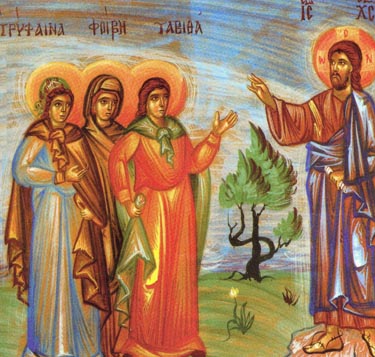
Christ calling Deaconesses to serve the Church

I am starting from scratch after having written a lengthy post on this topic already and realizing – after talking to my besties YYM1 and PM – that I was approaching the topic all wrong. I can still use all the research, but the tone had to change from the playful and partly sarcastic to what I am going to try next.

I feel that my being married, working at a tech company and being a lay person allows me to seek God without limits, to fully participate in the life of the Church and to have the path to sanctity wide open to me. At the same time I realize though that some of my Catholic sisters suffer from feeling the call to the priesthood and being faced with (a now final) barrier to it:

“I declare that the Church has no authority whatsoever to confer priestly ordination on women and that this judgment is to be definitively held by all the Church’s faithful.” (Ordinatio Sacerdotalis, §4)

At first sight (and maybe even after repeated reading) this might sound like an aspect of Church teaching that is simply out of date, that needs to catch up with the times and that can be summed up with the following:

“[T]here is an urgent need to achieve real equality in every area: equal pay for equal work, protection for working mothers, fairness in career advancements, equality of spouses with regard to family rights and the recognition of everything that is part of the rights and duties of citizens in a democratic State.” (Letter to Women, §4)

Now, maybe this will come as a surprise, but the author of both of the above quotes is the same person: Blessed Pope John Paul II, and you may ask yourself how he can at the same time talk about women’s rights and slam the door shut on the question of women priests. I believe the answer lies in the following (and, yes, it too is by John Paul II):

“If Christ […] entrusted only to men the task of being an “icon” of his countenance as “shepherd” and “bridegroom” of the Church through the exercise of the ministerial priesthood, this in no way detracts from the role of women, or for that matter from the role of the other members of the Church who are not ordained to the sacred ministry, since all share equally in the dignity proper to the “common priesthood” based on Baptism.” (Letter to Women, §11)

When I first saw this, a light went on in my mind after I read the words “an “icon” of his countenance.” Priests are Jesus’ proxies and transmit to us his presence in the Church and his being the source of the sacraments. When I attend mass, I experience a man saying the words that bring about the Eucharist, like I would have, had I been at the Last Supper; when I go to confession, I speak to a man, as I would have, had I been among Jesus’ disciples. Jesus having come into the world as a man rather than a woman is not an accident, nor is it a consequence of social conventions. I believe, that God became flesh as a baby boy, to use the male gender in a specific way, just like he sought consent from a girl to become His mother, again because of the specifics of the female gender. To read this as in any way discriminatory against women is incomprehensible to my mind, but I’ll leave that to another post.

Let me now put my last card on the table with regard to the priesthood. God’s call is ultimately the same for all of us: to choose Him as the first priority in our lives and to follow his new commandment of love. Placing something above a love for one’s neighbor and for God is a mistake, even if that something is the priesthood. If love for God and neighbor are missing, the priesthood becomes a millstone (“The road to hell is paved with the skulls of erring priests, with bishops as their signposts.” St. John Chrysostom) and if they are present, then it becomes secondary and one seeks specifics with humility. To come at the argument from a perspective of rights is also a category mistake. No one has the right to be made a priest, whether man or woman, and it is in all cases a gift that is received rather than an entitlement that can be claimed.

For now, let it suffice that my argument is this: the priesthood is only open to men, because Jesus was a man and because he indicated to us from the very beginning that it was through men that he wanted certain aspects of his ministry to be perpetuated. In this way, his ministers’ being male is integral to their being Jesus’ proxies and no matter what social or other developments ensue, the priesthood in the Catholic Church is going to remain restricted to them.

This is not the end of the story though, since we are ultimately all being called to be Jesus’ proxies: to be the means by which He can show His love to all. As a married, lay person I don’t feel in any way limited in the extent to which I can strive to imitate Jesus’ love for humanity, even if I don’t become a priest. But, and there is a but, there is a variety of other ways in which Jesus can be imitated and and in which Catholics can serve the Church (which is fundamentally also what the priesthood is about: service). Two of these, which today are not open to women, are the diaconate and the office of cardinal, and I would like to argue that they may both one day (hopefully soon) be conferred on women.

Bishop Emil Wcela has just published a very interesting article (that I recommend in full), entitled “Why not women?” It starts where the final word on women priests in the Catholic Church ends: by making a case for exploring the possibility of ordaining women as deacons. Wcela presents a compelling case, starting with evidence for deaconesses dating back right to the time of the apostles (giving the example of St. Phoebe, whom St. Paul calls a diakonos in his letter to the Romans (16:1) – although the meaning of the term is disputed) and dotted through the history of the church (including Pope Benedict VIII writing to the bishop of Porto to give him authority to ordain deaconesses). He the proceeds to give the example of deaconesses in other Christian churches, but is also clear about the fact that this is not the case in the Catholic Church at present.

Nonetheless, there has been a desire to explore its possibility since the Second Vatican Council, including a raising of the issue by the US bishops in a pastoral letter from 1992. 2009 then saw an important change to Canon law, which differentiates between the nature of the priestly and episcopal order and that of deacons, stating that bishops and priests “receive the mission and capacity to act in the person of Christ the Head; deacons, however, are empowered to serve the People of God in the ministries of the liturgy, the word and charity.” (Canon 1009 of the Code of Canon Law). This change removes the constraints that previous legislation placed on the diaconate and historical precedent further supports a future change in this area. Bishop Wcela finally notes that women already participate extensively in the Church’s ministry and that ordaining them as deacons would provide greater official recognition, confer the grace of the sacrament on them and give them access to ecclesiastical offices that require ordination. The article ends with a call to raising awareness of this opportunity and I would personally like to add my voice to it.

On a related note, Cardinal Timothy Dolan stated in an interview last March, that the office of cardinal is in principle open to women, since it does not require priestly or episcopal orders. He then proceeded to tell the story of how someone once suggested to Pope John Paul II to make Mother Teresa a cardinal, to which he replied: “I asked her – she doesn’t want to be one.” While the John Paul II – Mother Teresa story may be little more than an anecdote, it nonetheless expresses both the Church’s newfound openness and Mother Teresa’s humility beautifully. What is key here is the acknowledgement by one of the cardinals that his office is in principle not restricted to women.

I hope it is clear what I am getting at: the role of women in the Church is certainly not what it ought to be, but I see clear signs of a desire to change that, including at the highest levels. What it won’t be is an opening of the priesthood to women, but the diaconate and the office of cardinal are both on the horizon (hopefully even in my own lifetime). One point I would like to emphasize though is that the role of women in the Church needs to be all-pervasive and not only constrained to “women’s issues.” When one of the 23 women present at the Second Vatican Council – one of the Council Mothers – was asked what topics were discussed that related to women, she responded “We are now interested in everything.” As Fr. Fabio Ciardi, who was taught by Rosemary Goldie (another Council Mother) during his time at the Lateran University, said: “The temptation is to constrain women in the Church to dealing with topics that are about women, not knowing that all topics are about them and that they have a contribution to make to all of them.”


1 Thanks to YYM also for giving me probably the most acceptable label: “progressive orthodox.” It may sound like an oxymoron, but I shall wear it with pride :).

A golden mouth against corruption

John chrysostom

Q: Which saint had (at least) four skulls?1
A: John Chrysostom – just ask a Russian, a Greek and two Italian churches who all claim to have it. 🙂

St. John Chrysostom, whose feast day it is tomorrow, is actually one of my favorite saints and I’m sure he won’t hold this joke against me. He is one of those saints – like Saint Pope Gregory the Great, whose thought had a wide-reaching influence on the Church during their lifetime and, even more impressively, still continues to have today (just note the 18 sections of the 1992 Catechism that cite him).

St. John’s epithet, Χρυσόστομος (Chrysostom) means “golden mouthed,” and if you start reading his many homilies and treatises you will soon appreciate his obvious rhetorical gift. The Church is fortunate to have had him on her side and to have had Jesus’ teaching so clearly, elegantly and effectively applied to his day. Take a look at the following quote on poverty and Church property (which applies today just as it did in the 4th century AD) and I hope you will agree with me:

“Do you wish to honour the body of Christ? Do not ignore him when he is naked. Do not pay him homage in the temple clad in silk, only then to neglect him outside where he is cold and ill-clad. He who said: “This is my body” is the same who said: “You saw me hungry and you gave me no food”, and “Whatever you did to the least of my brothers you did also to me”… What good is it if the Eucharistic table is overloaded with golden chalices when your brother is dying of hunger? Start by satisfying his hunger and then with what is left you may adorn the altar as well.”

(Evangelium S. Matthaei, hom 50:3-4; Cited by Blessed Pope John Paul II, Ecclesia de Eucharistia, footnote 34.)


1 Multi-skulled saints cannot be mentioned without telling a joke by an Irish relative of mine:

A rogue relic dealer kept selling skulls, claiming to be St. Oliver Plunkett’s, until one day a customer said to them: “This can’t be St. Oliver’s skull. I am a doctor and can tell you that this is the skull of a child and St. Oliver died in his fifties!” The dealer, thinking on their feet, retorted: “Well, of course it is a child’s skull. It is St. Oliver’s skull when he was a child!” 🙂

Martini: backstabber or faithful son?

Primus inter pares

You’ll know from a previous post here, that I am becoming a great fan of Cardinal Martini, whose funeral was celebrated two days ago and whose exchange of letters with Umberto Eco I enjoyed greatly. Upon hearing of his death, I was keen to learn more about him and I also eagerly read the last interview with him, published in the Corriere della Sera (and available in English translation here).

The interview took place on 8th August and asks Martini to comment on the state of the Church – a question he is very well positioned to answer and that he answers with great honesty. Martini says that the church is tired, culturally out of date, being weighted down by bureaucracy and basically showing the traits of a mature business rather than a dynamic start-up (my words :). The Church lacks the dynamism of John the Baptist and St. Paul, the faith of the Roman centurion (whose servant Jesus healed) and of St. Mary Magdalen and the closeness to the people that the Servant of God, Bishop Óscar Romero and the Jesuit martyrs of El Salvador had. Martini’s answer to this predicament is to involve more people from outside formal Church structures, to recognize our own errors and start a process of conversion, to return to the Word (i.e., to a personal closeness to the Gospel), to renew an adherence to the sacraments and to be open to all, regardless of what family and social circumstances they are in. Finally, he exhorts us to renew our faith, confidence and courage and to let ourselves be conquered by God’s love.

My immediate reaction was that of gratitude for such a greatly distilled analysis of where the Church is today, for the degree of honesty and self-criticism, for the concrete steps forward and for a final call to love.

The second hand, to form applause with Martini’s interview, then is the message that Pope Benedict XVI sent to his funeral. The pope picks a line from Psalm 119: “Your word is a lamp for my feet, a light for my path” to sum up the cardinal’s life, calls him a “generous and faithful pastor of the Church” and states that everything Martini did was “for the greater glory of God.” The pope then goes on to say that:

[h]e did so with a great openness of heart, never refusing to encounter and dialogue with anyone, responding concretely to the Apostle’s invitation to “always be ready to give an explanation to anyone who asks you for a reason for your hope ” (1 Peter 3:15).

Finally, he concludes by saying: “May the Lord, who guided Cardinal Carlo Maria Martini his whole life, receive this tireless servant of the Gospel and of the Church in the Heavenly Jerusalem.” Not only an elegant nod to Martini’s fondness for the earthly Jerusalem, but also an endorsement of his faithfulness to and inspiration from God.

If it were just for these two texts – the last interview with Martini and the pope’s message at his funeral – you could think that the two were uncontroversial parts of giving thanks for the life of a great son of the Church and, I believe you’d be right. A quick look at the press presents a very different picture though. The Independent calls Martini’s interview “a damning critique that has rocked the Catholic Church,” the Daily Mail calls it a “scathing attack,” the Belfast Telegraph says that the “Vatican is rocked by Cardinal Martini’s damning words from beyond the grave” and all news outlets latch on to Martini’s saying that “the Church is two hundred years behind.” Reading these and virtually all other reports (with the notable exception of Fr. Lucie-Smith’s blog), you’d think that Martini’s last interview was some kind of vengeful, underhand jab at the Church. Instead, I see Martini’s words as much more in line with Blessed Pope John Paul II’s emphasis on acknowledging past wrongs as a first step towards a renewal of the Church. E.g., in Incarnationis Mysterium he says that the Church “should kneel before God and implore forgiveness for the past and present sins of her sons and daughters” (Section 11), such humble repentance being in fact a common feature of the attitude of saints.


I’d first like to thank my bestie, PM, for suggesting this as a topic for a post 🙂

I also realize that I may come across as someone who unreservedly agrees with everything the Church and its representatives do. Let me assure you that this is far from the case and may in fact be more a consequence of my desire to focus on what is good and worth sharing rather than on presenting a complete, balanced view of how I see the Church. As an example of something that recently irked me, take a look at the third question in this very recent interview with Cardinal Cormac Murphy-O’Connor:

Q: At a lecture after Archbishop Vincent Nichols’ installation you urged Christians to treat atheists and agnostics with deep esteem. However, later you are quoted as saying that a lack of Faith is the ‘greatest of all evils’. You blamed atheism for war and destruction, and implied it was a greater evil than sin itself. Is this a contradiction, or were you misquoted?
[At this point Cardinal Cormac got up and went to his adjacent study. Perhaps this was an abrupt end to our interview? However, after a few minutes he returned with two books.]
A: Yes, I was misquoted – it was out of context. To get the full meaning of what I said, I would encourage [you] to study the books I have assembled ‘Faith in Britain’ and ‘Faith in Europe’.

No, thanks … If the Cardinal cannot address this, very good question in the interview and his only recourse is to bring back TWO books that the reader is to study and from which they are to distill what the Cardinal thinks, then in all likelihood those books are not going to be any help either. Seeing a response like this (and much of the lengthy interview) just makes me recoil in frustration and shake my head in disappointment …