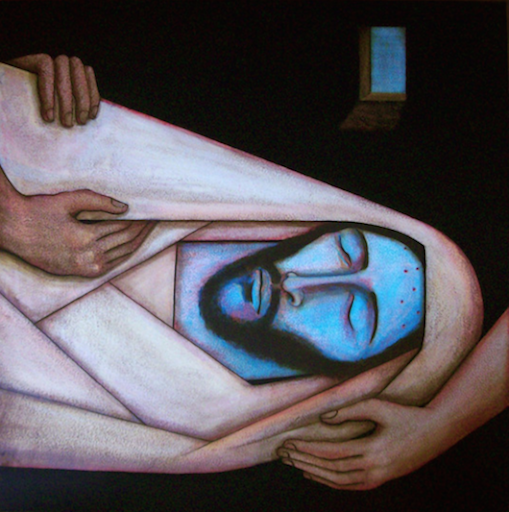
God is dead

Jesus tomb obrien

Today the Church remembers that Jesus – fully man and fully God – was dead for over 24 hours – from Friday afternoon until the early hours of Sunday (Sunday, which in the Jewish week starts at sundown on Saturday). Just like Good Friday is an opportunity to remember his suffering and self-sacrifice, and Easter Sunday is a celebration of his resurrection, so today – Holy Saturday – is a day for remembering his death. The death of God.

I have always found the Easter Triduum a very special moment, since it is set up for a contemplation of Jesus’ death and resurrection in real time. The services are timed to coincide with the times recorded in the Gospels, which allows for a meditation on the Easter events at the pace at which they happened. They give a sense of scale.

This morning, when I went to pick up my son from the altar servers’ rehearsal for the evening’s vigil, I arrived early at the church and went straight to the side chapel where the tabernacle is located. As soon as I entered, I was reminded that today was an exceptional day, since the tabernacle, where the Eucharist is usually kept, was open and empty. Like the hospital room of a recently deceased patient. An absence with a very clear and strong message.

As I sat down, I realized that I won’t be spending time in Jesus’ presence and I quickly decided not to pretend otherwise and pray as if everything was normal. The emptiness of the tabernacle had to be taken seriously and responded to sincerely and honestly.

God is dead.

What must it feel like to believe that? To believe that there is no God, that there is no beloved in and beyond everything. Instead of paralysis, my thoughts turned to my close friends who are agnostics or atheists – the pull of transcendence was too strong. To be fully myself, I had to go beyond myself (to paraphrase Pope Francis’ Evangelii Gaudium, §8) even as I tried to stop short of rushing to God. A great conversation with my überbestie JMGR – in the midst of a buzzing conference – then came to mind, when I asked him about whether transcendence meant anything to him as an agnostic (as I was thinking about Kenan Malik’s article). Together we arrived at a definition in the absence of religious belief – that “my transcendence is another’s immanence.” Thinking more about it now, I see that this definition works also for a Christian – only an “other” becomes the “Other.”

As I thought of my atheist or agnostic friends, I felt a particular closeness to them and a joy even as I attempted the impossible – to imagine what it is to be like someone else. This joy of closeness, reminded me of Pope Francis declaring closeness to be Jesus’ own method of spreading his message (EG §269). Feeling pulled to return to a direct conversation with Jesus and away from my trying to contemplate his death, I made another attempt by trying to experience the physicality of the chapel as if it were a Serra. Since it wasn’t, that was a bit of an effort :), but the morning light that filled the simple space and the perspective that the rows of chairs emphasized, nonetheless gave me joy too. The joy of being, of relating, of seeing, of experiencing. Again, I couldn’t help but delight in God’s creation and feel his sustaining presence.

Even though my attempts at imagining the death of God ultimately failed, I was grateful for the opportunity that Holy Saturday gave me. An opportunity to think of my friends, to feel the wonder of being and to have the focus directed to a world where God’s presence is absent, but where there is friendship, goodness and beauty.

Paraphrasing Giles Fraser’s great Guardian article from this morning, I can say that I am about 1/365th atheist. And with that, it’s off to the Easter vigil.
Humanist transcendence in religious art

Algebraicszoom s

A couple of weeks ago I read an excellent article in the Guardian, by the philosopher and Distinguished Supporter of the British Humanist Association, Kenan Malik. While it is an article that clearly positions religion as deprecated, inferior and outmoded (sentiments I certainly don’t share), it nonetheless makes some very positive moves.

Malik starts out by recognizing a piece of Christian writing as “wonderful, luminous,” able to “discover the poetic even in the most mundane,” and proceeds to argue that the awe that inspires religious artists and the spiritual force that drives them to create are “a celebration of our ability to find the poetic and the transcendent,” which is “something very human.” It is this attitude of recognizing value in the work of another, whose beliefs the author of the article does not share and even opposes, that made me like Malik’s approach from the start.

Having established an openness towards religious art, Malik asks whether “non-believers can truly comprehend the meaning of religiously inspired art.” The answer he provides not only addresses this interesting question, but serves as a basis for even broader dialogue between religion and atheism:

“[W]e can think about the sacred in art [… n]ot so much as an expression of the divine but, paradoxically perhaps, more an exploration of what it means to be human; what it is to be human not in the here and now, not in our immediacy, nor merely in our physicality, but in a more transcendental sense. It is a sense that is often difficult to capture in a purely propositional form, but one that we seek to grasp through art or music or poetry. Transcendence does not, however, necessarily have to be understood in a religious fashion, solely in relation to some concept of the divine. It is rather a recognition that our humanness is invested not simply in our existence as individuals or as physical beings but also in our collective existence as social beings and in our ability, as social beings, to rise above our individual physical selves and to see ourselves as part of a larger project […].”

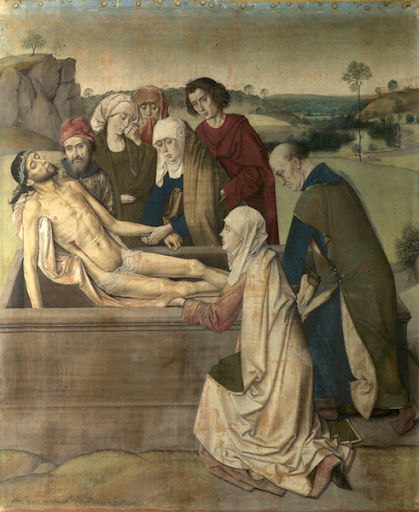
Malik then proceeds to sketch out a brief history of transcendence in philosophy and art, noting its roots in religious belief and proceeding to present attempts made to transplant it into humanist soil in the 15th century, e.g., by Dante Alighieri in his Divine Comedy and by Dirk Bouts, whose “The Entombment” (shown next) Malik analyzes to great effect, arguing that it is an example of a “changing conception of the sacred” that reveals a “humanising impulse.”

Bouts the entombment s

Malik is quick though to point out a “growing suspicion of the very idea of transcendence” in the post-Enlightenment period when “the very rootedness of the idea of transcendence in religious belief made it an uncomfortable concept.” These were accompanied by a gradual ebbing away of the “optimism about human capacities that had originally suffused the humanist impulse,” leading – through the horrors of 20th century history – to a “darkening perceptions of humans.” At the same time, that century also witnessed a “revolution in the way that artists were able to conceive of the human.” Here Malik points to “Olivier Messiaen’s Quartet for the End of Time to Mark Rothko’s paintings, from Barbara Hepworth’s figures to Pablo Neruda’s odes” as “astonishing works of art,” but proceeds to declare that “[i]t makes little sense to call such works of art “sacred”.”

What is curious though is that Malik next quotes Mark Rothko as saying: “The people who weep before my pictures are having the same religious experience as I had when I painted them,” but decides to consider Rhothko’s being religious merely a being “religious”:

“What Rothko calls “religious experience” is not what would traditionally be seen as such. It is rather an attempt to grasp the meaning of our humanness not in its immediacy, nor merely in its physicality, but, to borrow a religious term, in a more apophatic sense.”

If anything, saying that something is apophatic is to align it with the most traditional and deep-seated of religious intuitions about God’s otherness, put particularly starkly by Blessed Duns Scotus: “We do not know what God is. God Himself does not know what He is because He is not anything. Literally God is not, because He transcends being.” or by St. Cyril of Alexandria: “For we explain not what God is but candidly confess that we have not exact knowledge concerning Him. For in what concerns God to confess our ignorance is the best knowledge.” To Christians, God is – to borrow Malik’s words from a different context – “difficult to capture in a purely propositional form.” And this is not just the opinion of fringe elements or of eccentrics from a distant past – it is clearly stated in the Catholic Church’s current Catechism: “God transcends all creatures. We must therefore continually purify our language of everything in it that is limited, image-bound or imperfect, if we are not to confuse our image of God — “the inexpressible, the incomprehensible, the invisible, the ungraspable” — with our human representations. Our human words always fall short of the mystery of God.” (§42). If that’s not apophatic, then I don’t know what is …

The above is not an attempt at an “aha!” or a “gotcha” though – instead it is meant just to suggest that what Malik sees as an areligious or a meta-religious transcendence – a “break[ing of] the shackles of the sacred while maintaining the sense of the transcendent”, in fact has the hallmarks of what I would wholeheartedly label as religious.

What I’d like to take away from Malik’s thought is a very positive point though, which is that the transcendence understood very differently by Malik and myself nonetheless seems like the one transcendence to me that we both appreciate and relate to. In spite of Malik’s efforts to distance contemporary expressions of transcendence in art from any and all religious associations, that exact same art is to me deeply religious and connects to the scared when I view, hear or read it.

Ultimately Malik’s moves can also be seen as a mirror to Pope Benedict XVI’s quoting Simone Weil saying that “all art of the first order is, by its nature, religious.” I have to say I like this picture: atheists claiming religious art is not really religious but humanist, and religious people claiming that secular art is religious after all. To my mind these are both profound compliments and a source of joy :).