Patriarchal plan perplexity

1231

The other day I came across a series of blog posts by Phillip Cary, professor of philosophy at Eastern University, Yale Divinity alumnus and author of multiple books, three of which were even published by OUP. Given his credentials, my expectations were high and – after reading the posts – my subsequent disappointment, by their obvious lack of insight, commensurably deep.

The posts are an exegesis of the first chapters of Genesis regarding the relationship between man and woman, with the penultimate one focusing on Genesis 3:16 – the words God addresses to the woman after she and the man eat from the forbidden “tree of knowledge of good and evil”: “To the woman he said: I will intensify your toil in childbearing; in pain you shall bring forth children. Yet your urge shall be for your husband, and he shall rule over you.” Cary is “puzzled” here by the juxtaposition of the woman’s desire for her husband and his ruling over her and sets out to interpret the meaning of these words of Scripture from the perspective of being God’s plan for how man and woman are to relate:

“My assumption has been that God’s word in Genesis 3 aims at a justice that sets things right. So how does patriarchy, the rule of a man over his wife, set things right? […]

[T]he key point about this patriarchal framework [… is]: because the property of the patriarch consists fundamentally of living things, the increase of wealth and the blessing of procreation are nearly the same thing in Genesis. […]

[T]he man who rules over his wife has a deep economic interest in seeing that she lives well, is healthy and flourishes together with her children, being fruitful and multiplying.”

[And from the following post: T]hat is the framework within which I think we can begin to make sense of patriarchy, where procreation, wealth and the father’s rule of the household coincide. And that in turn is the initial framework we need to see the meaning of God’s word to the woman about her desire for her husband and his ruling over her.”

What I understand from the above is that Cary is saying the following: making the man rule over the woman, in response to their joint disobedience, is a way to re-introduce the value of life in a world where death has entered as a result of the Fall. Life is an economic good and by making procreation a contributor to its proliferation, the husband – who is in charge of the household – benefits and consequently treats his wife well, like he would any other profit-generating asset.

Charming.

Before we get sucked into a diatribe against such a view, let’s take a breath and rewind to Genesis 2:24,1 where man and woman are described before the Fall and where their relationship is one of profound unity: “a man leaves his father and mother and clings to his wife, and the two of them become one body.” In the “one body” there is no master versus slave, no ruler versus subject – there is only one union between man and woman. This is God’s plan for humanity, and, I believe, Cary’s basic mistake is in taking the punishment delivered to man and woman after their disobedience and mistaking it for how man and woman are meant to relate to each other, to the point of arguing for the economic benefits of a relationship that is instituted as punishment. This is like taking the punishing of a child by making them sit still and extolling the virtues of motionlessness in terms of its low carbon footprint.

In fact, Cary’s approach is also at odds with the interpretation Blessed Pope John Paul II makes of Genesis 3:16 in his Man and Woman He Created Them:2

“[T]he words of Genesis 3:16 signify above all a breach, a fundamental loss of the primeval community-communion of persons. This communion had been intended to make man and woman mutually happy through the search of a simple and pure union in humanity, through a reciprocal offering of themselves, that is, through the experience of the gift of the person expressed with soul and body.”

He even goes on to characterize the state instituted in Genesis 3:16 as being a “deformation” of the “original beatifying conjugal union of persons” before the Fall. And if any more evidence were needed for taking this verse not as God’s plan for humanity but as a description of what happens when that plan is corrupted, we only need to look as far as the second reading from the feast of the Holy Family nine days ago, where St. Paul has the following to say: “Wives, be subordinate to your husbands [… h]usbands, love your wives” (Colossians 3:18-19). The advice here is not for husbands to rule, but to love, which, incidentally, also means to self-empty, to subordinate oneself – the exact same thing also asked of wives. The result is a mutual subordination of husband and wife to each other, or – as John Paul II put it – “a reciprocal offering of themselves […] with soul and body.”


1 Just to avoid misunderstandings, speaking about the events described in Genesis does not presuppose considering them to be historical events. The opening chapters of Genesis are a myth, which does not mean to suggest that they are false, but instead that they speak about deep anthropological, psychological and ontological features in a more archaic form – by way of analogy instead of by description of events in this Universe.
2 For more on this book by John Paul II, see here.
Cognition by mutual reflection

Escher mobius

A paper I have been meaning to read since it was published in October is Dr. Callan Slipper’s “Towards a New Kind of Cognition,” in which he reviews a number of cognitive modes, characterizing not only an individual’s development, but also the evolution of the human species and of cultures and then introducing a new, social mode that has roots in the mystical experiences of Chiara Lubich.

As far as setting the scene and providing context, Slipper’s approach bears resemblance to Dr. Yuval Harari’s “A Brief History of Humanity,” both in that it goes back to the cognitive modes of hominids and that it considers both biological and cultural factors. Even Harari’s favorite device of “fiction” (quotes mine) is mirrored in Slipper’s references to myth as a cultural contributor to cognition.

Instead of attempting a summary of the already concentrated review of classical modes of cognition, where Slipper discusses Jean Piaget’s somatic, symbolic and theoretic modes of knowledge that can be observed in a child’s development and then proceeds to show how these are mirrored also in the evolution of the Hominidae family and the basis of rational enquiry into the present day, I’d instead recommend reading the excellent, full paper itself. Instead, what I’d like to do is focus on the new cognitive mode that Slipper’s paper culminates in.

To understand the novelty and otherness of the new cognitive mode, it is worth considering the following observations Slipper makes about the state at which the evolution of cognition has arrived in the present day, as an evolution of “mythic culture”:

Mythic culture employs symbolic representations in the context of narratives (mythos is Greek for story), and these give human subjects powerful instruments to interpret and interact with the environment. Mythic cognition is not static and it did progress, using its narrative and symbolic methodology, to be self-critical. […] The culture that emerged, which we are heir to today, can be called […] the culture of the logos. The logos is a form of knowing that attempts to achieve objectivity, that is, to see things without projections from the hopes, fears, fantasies, or preconditioning of the subject. It develops conceptual reasoning that produces theories, and so it corresponds to the acquisition of theoretical knowledge. But the logos-word can also be a word of command and so have ethical and existential implications. Furthermore, as the light of understanding it can also mean conscience or a profound spiritual intuition, which attempts to see things as they truly are. […] In Greece, for example, this was undertaken by theoretical discourse in the development of philosophy; the ethical-existential dimension was developed in the light of Transcendence by the Hebrew prophets; a transcendent spiritual intuition (bodhi) was at the root of the new conceptual thinking that arose with Buddhism.

The scene therefore is a cognitive culture that aims at objectivity and an abstraction of the individual’s bias from the cognitive process. It is against this cognitive background that Chiara Lubich’s experience and thought are set. It has as its central themes a focus on two of Jesus’ utterances: “where two or three are gathered together in my name, there am I in the midst of them.” (Matthew 18:20) and “My God, my God, why have you forsaken me?” (Matthew 27:46). The first here makes the subject of cognition a community and the second is the key for that community to transcend itself, by imitating Jesus’ self-emptying (kenosis) at the moment of his greatest suffering. It is this mutual loosing oneself out of love for another that is Lubich’s central insight – the fruit first of years of putting the Gospel into practice and then of a mystical, intellectual vision that started in 1949.1With the above, 10K mile view, let’s look at the consequences that Slipper spells out for cognition:

“The individual remains but it is now in a relationship of profound mutual involvement with other individuals, a form of recollection both within self and within the other person insofar as empathy, sensitivity, and attentive listening and communication (the apotheosis of the logos-word) will allow. […] In relation to the other person, everything can be reframed or rethought; even hard-won theories cannot be defended by the ego that generated them. Gesture, symbol, theory are all offered, not imposed, within the context of a deep meeting. In this way it is the very social nature of this process that offers the participants an intensified reflexivity, an extra possibility of using critical reasoning to challenge their presuppositions. Ideas are seen as instruments of a mutual reflection, engaged in together, so that out of the meeting of persons emerges a new act of cognition, one based on but not bound by any of the previous mental models. It thus has creative potential and is capable of thinking thoughts not had before in an act of cognition that is not closed and which, at least in principle, can be developed in further encounters.”

I have to say that I recognize the features of what Slipper speaks about here from personal experience. The attitude that “everything can be reframed or rethought,” that “gesture, symbol, theory are all offered, not imposed” and that “ideas are seen as instruments of a mutual reflection” is precisely what, I believe, allows for the “deep meeting” and “recollection both within self and within the other,” which has the potential for a “new act of cognition” to emerge. When all, who are engaged in jointly trying to understand something, bring this attitude of detachment (that mirrors Jesus’ self-emptying) to the table, the result is a transcendence of each individual (that mirrors Jesus’ promise of being present among his followers).

Slipper puts this very clearly and succinctly as follows:

Meeting together in a shared transcendent experience, the human subjects both feel themselves united with Jesus and find that they are seeing things (nature, humanity, indeed all creation), as it were, from Jesus.

To conclude, I would like to emphasize one aspect of the above, that to me personally is of great importance: this social, transcendent mode of cognition is open to all and is not contingent on Christian beliefs, even though I (like Dr. Slipper) experience, pose and believe it to be their consequence. And this is not some hypothetical speculation, but again an observation from my personal experience. I have experienced the above “deep meeting” with Christians, agnostics and atheists alike, since self-emptying, being open to the other and a going out of oneself to meet the other are all open to everyone. Whether the person I am thinking with believes this to be a participation in Jesus’ vision or not, is not a prerequisite to it. Wherever there is mutual love and detachment from one’s own ideas, it is possible for thought to become a social, self-transcendent experience and lead to insights, already interiorized by virtue of the process itself, that would otherwise be unlikely or impossible. In some sense it is a turning on its head of Jean-Paul Sartre’s being-for-others where the other objectifies me and, by taking something away from me, becomes my “hell.”


For the text of her notes on how that mystical experience started, see here and for a commentary here.

Kandinsky: innermost necessity of the soul

Kandinsky several circles website hd 5 13

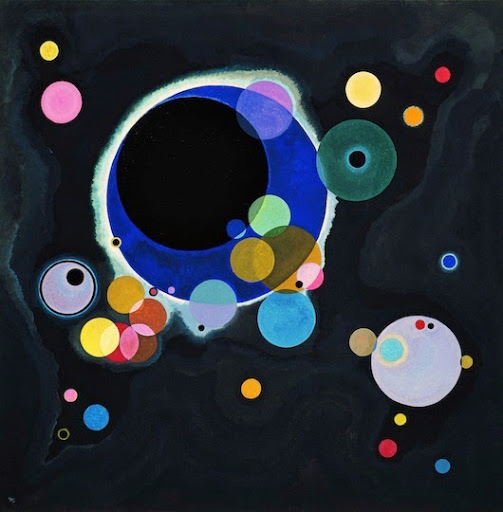
[Warning: long read :)] Wassily Kandinsky, the father of abstract painting, is among those artists whom I have greatest affinity to, not for some specific reason, but simply because of the persistent bond that I feel between his work and myself. Looking at a piece like “Composition VIII” or at “St George I,” a reproduction of which we have in our living room, is always an experience that is hard to describe and that I prefer to leave unverbalized.

A couple of days ago I then came across a video from 1926 of him painting, which was a completely unexpected treat (thanks, @openculture!) and which lead me to his book “Point and line to plane,” where he gives the following, stunning definition of the point:

“The geometric point is an invisible thing. Therefore, it must be defined as an incorporeal thing. Considered in terms of substance, it equals zero. Hidden in this zero, however, are various attributes which are “human” in nature. We think of this zero — the geometric point — in relation to the greatest possible brevity, i.e., to the highest degree of restraint which, nevertheless, speaks. Thus we look upon the geometric point as the ultimate and most singular union of silence and speech. […] In the flow of speech, the point symbolizes interruption, non-existence The (negative element), and at the same time it forms a bridge from one existence to another (positive element). In writing, this constitutes its inner significance.”

This is clearly neither a mathematical definition, nor a scientific one (invisible=incorporeal?), but a phenomenological, even spiritual one. It is more like what a close friend would say in a eulogy, and that is how I felt when reading this book: to Kandinsky the point, line and plane were not some hypothetical concepts, but intimate friends and collaborators. His writing about them at times sounds like a person’s memoirs, rather than detached rationalizations of a theorist. Needless to say, I was hooked, and then delighted when I came to reading the foreword to the book (which I don’t tend to do as a rule) and discovering that “Point and line to plane” was the sequel to “On the spiritual in art.” This fact alone pointed me to another interpretative key for the above passage about the point, and its parallels with the person of Jesus and indeed with the Trinity jumped out at me. The process of non-existence, while simultaneously bridging between existences is precisely the dynamic between the persons of the Trinity (each emptying themselves – becoming nothing1 – out of love for the other).

If you have any interest in art, I can’t recommend “On the spiritual in art” too highly – not only is it an insight into one of the greatest painters of all time, but, to my mind, it is of the order of Plato’s Republic in terms of foundation myths.

Kandinsky starts out by emphasizing the necessity to act in the present moment (much like Le Corbusier insisted too), instead of attempting to imitate the past, which he depicts in harsh terms:

“[E]very cultural period creates art of its own, which can never be repeated again. An effort to revive art-principles of the past, at best, can only result in works of art resembling a still-born child. […] The sculptor’s attempts to employ Greek principles can only achieve a similarity in form, while the work itself remains for all time without a soul.”

Within the space of a couple of pages from the beginning, Kandinsky then proceeds to present his view of the hierarchy of spiritual life, which he equates with that of artistic life, since “[the] grammar of painting [… are] the rules of the inner necessity […] of the soul.”:

“A large acute triangle divided into unequal segments, the narrowest one pointing upwards, is a schematically correct representation of spiritual life. The lower the segment the larger, wider, higher, and more embracing will be the other parts of the triangle. The entire triangle moves slowly, almost invisible, forward and upward and where the apex was “today,” the second segment is going to be “tomorrow,” that is to say, that which today can be understood only by the apex, and which to the rest of the triangle seems an incomprehensible gibberish, tomorrow forms the true and sensitive life of the second segment.

At the apex of the top segment, sometimes one man stands entirely alone. His joyous vision corresponds to a vast inner sorrow, and even those, who are closest to him, do not comprehend him. […] Artists are to be found in every segment of this imaginary triangle. Each one of these artists, who can see beyond the limits of his present stage, in this segment of spiritual evolution is a prophet to those surrounding him and helps to move forward the ever obstinate carload of humanity. However, one of those not possessed by such vision, or misusing it for base purposes and reasons, when he closes the triangle may be easily understood by his fellow men and even acclaimed. The larger the segment (that is, the lower it lies in the triangle), the greater is the number of people to comprehend the words of the artist. In spite of it and correspondingly every group consciously or unconsciously hungers for spiritual food.”

While the above is unquestionably elitist, there are several details to note, which, I believe, hint at a dichotomy with the universally-accessible. First, the interconnectedness of the entire universe of spiritual ascent and the impact of its protagonists on all (“where the apex was “today,” the second segment is going to be “tomorrow.””). Second, the positive view of everyone’s potential to comprehend advances in art, albeit with a delay (“[T]hat which today […] to the rest of the triangle seems an incomprehensible gibberish, tomorrow forms the true and sensitive life of the second segment.”). Third, the desire of all for genuine spiritual food, in spite of some contenting themselves with fakes. Added to the above pull towards democratization of the elite striving for spiritual/artistic progress is also his declaration that “[a]nyone, who absorbs the innermost hidden treasures of art, is an enviable partner in building the spiritual pyramid, which is meant to reach into heaven.”

This tension is further carried forward, when Kandinsky argues that there is only a single criterion for what makes eternal art – its “inner necessity” from the perspective of its author:

“The artist should be blind to the importance of “recognition” or “non-recognition” and deaf to the teachings and demands of the time. His eye should be directed to his inner life and his ear should harken to the words of the inner necessity. Then, he will resort with equal ease to every means and achieve his end. […] All means are sacred when called upon by innermost necessity.”

““[O]uter necessity” […] can never lead beyond the limits of the conventional, that is, traditional “beauty” only. The “inner necessity” does not know such limits and, for this reason, often creates results which are conventionally termed “ugly.” “Ugly” is, therefore, only a conventional term which continues to lead a sham life long after the inner necessity […] has been superseded. At that time, everything was considered ugly if it was not connected with the inner necessity of the time, and anything so connected was termed beautiful. Everything, which appeals to the inner necessity is already beautiful by its virtue, and will be recognized sooner or later.”

“As no “dissonant notes” exist in music, nor in painting “inharmony,” in these two art expressions every sound, whether harmony or discord, is beautiful (appropriate), if it results from inner need. The inner value of each and every movement will soon be felt, as the inner beauty replaces the sensuous aspect. Thus, “ugly” movements suddenly appear beautiful, from which an undreamed power and vital force will burst forth instantly.”

Rooting perfection in “inner necessity” also changes the criteria by which art is judged and the means that are justified for its pursuit:

“A “perfect drawing” is the one where nothing can be changed without destroying the essential inner life, quite irrespective of whether this drawing contradicts our conception of anatomy, botany, or other sciences.”

“Likewise, colours should be used not because they are true to nature but only because the colour harmony is required by the paintings individually. The artist is not only justified in using any form necessary for his purposes, but it is his very duty to do so. Neither anatomical correctness nor any basic overthrow of scientific statements are necessary, only the artist’s unlimited freedom in the selection of his means.”

“This unlimited freedom must be based on inner necessity (which is called honesty). This is not only the principle of art but of life. This principle is the great sword of the superman with which he fights the Philistines.”

More than anything, the above reminds me of St. Augustine’s most famous dictum: “Love and then what you will, do,” which we could put into Kandinsky’s mouth as “Be honest and then what you will, paint,” without incurring any contradiction with his own words.

I have to say that reading “On the spiritual in art” has made me feel even closer to Kandinsky and has armed me with new means, with which I can revisit his paintings (and those of others!) in an attempt to connect with the innermost necessity that lead to their creation.


1 This self-emptying – kenosis – is explicitly indicated in St. Paul’s letter to the Philippians (2:5-9) and beautifully explained also by Hans Urs von Balthasar: “The Father, in uttering and surrendering himself without reserve, does not lose himself. He does not extinguish himself by self-giving, just as he does not keep back anything of himself either. For in this self surrender he is the whole divine essence. Here we see both God’s infinite power and his powerlessness; he cannot be God in any other way but in this “kenosis” within the Godhead itself.” (Theo-Drama: Theological Dramatic Theory: The Action Vol 4).