Sign of contradiction

Contradictions

Imagine1 sitting on the terrace of a seaside hotel, coolly sipping afternoon drinks, and spotting a yacht heading straight towards you. On beaching the yacht, its sole passenger and captain – armed to the teeth and attempting to communicate with the holiday-makers by signs – persists in the conviction that she has reached a dangerous land, hitherto unknown to civilization, while actually having landed at another of her own homeland’s tourist destinations. You’d certainly feel for her and try to gently steer her in the right direction, but you couldn’t just play along with her delusion.

The above is exactly how I felt (minus the afternoon drink) when I saw a tweet two days ago pointing to “Project Reason” having triumphantly unmasked the shocking contradictions that addle the Bible, with the hope that it would finally bring those religious fanatics to their senses.

🙂

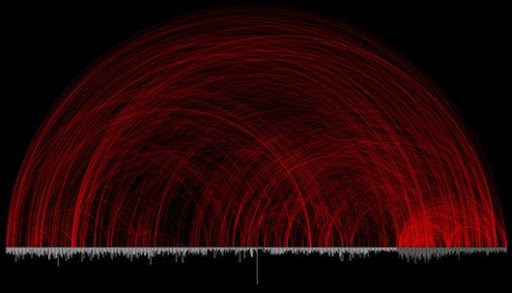
Having scoured the Bible end to end and connected verses that contradict each other, Project Reason have built – and rather beautifully visualized (see above) – a large database of intra-biblical contradictions. I am both grateful to them for this work and certain of the good that reading the Bible has done them (as it does anyone who reads it). What they haven’t done though is in any way question the Bible’s value or present someone who approaches scripture along Dei Verbum lines (i.e., “written under the inspiration of the Holy Spirit, they have God as their author,” but since they were written by men “[we] must investigate what meaning the sacred writer intended to express and actually expressed in particular circumstances by using contemporary literary forms in accordance with the situation of his own time and culture.”) with any challenge whatsoever.

Project Reason: “Aha! The Bible contains contradictions!”
Me: “Yeah, I know and am profoundly grateful for them!”
Project Reason: “?!” (plus an outsized bead of sweat, emblematic of certain Japanese cartoons, that appears during particularly awkward or embarrassing moments)

Let me try to explain why it is that I consider biblical contradictions a strength and source of comfort rather than a challenge or obstacle. The difficulty I have here is not how to do that, but which of the many parallel reasons to start with.

First, there is the angle that has nothing whatsoever to do with religion and that comes from the impossibility of simultaneously being complete and consistent, proven for formal systems by Kurt Gödel and discussed at some length in a previous post here. A system of axioms (rules) can either be consistent or complete, but not both – if it is consistent it has to be incomplete, while if it is complete it has to be inconsistent. Christians believe that revelation is complete in the person of Jesus, which makes inconsistency in his and the Church’s teachings be no surprise to those of us who have a fondness for formal systems and mathematics. That may sound weird, but it sure as Kurt is not unreasonable or irrational.

Second, Christianity (and Judaism too) is about the relationship with a person – God – not about following rules2 (as much as militant atheists would like to believe so). If anything, the contradictions in Scripture underline the necessity of seeking to personally relate to God, to listen to one’s conscience and to seek to live in every individual and unique moment in a way that is a participation in the life of God. In C. S. Lewis’ words: “Doctrines are not God: they are only a kind of map. But that map is based on the experience of people who really were in touch with God.” To which my bestie ML adds: “We should not mistake a map for the territory it describes. We do not turn to the page picturing the ocean in an atlas and expect our shoes to get wet.”

Third, there is the basic fact that different contexts require different words and actions to move them towards the same goal. When a child is very young (and I am thinking ~2 years) wouldn’t you exaggerate the dangers of them sticking anything into a power socket, while when they are older you can explain to them with greater precision what it is that would be dangerous and what wouldn’t (and introduce the whole topic of electricity, conductivity, etc.)? My favorite example of this type of “contradiction” is the “not with us = against us” versus “not against us = with us” case that Project Reason also picked up on. Here we have Jesus say “Whoever is not with me is against me” (Matthew 12:30) at one point and “For whoever is not against us is for us” (Mark 9:40) at another. A contradiction. Right? No, not really – in the first, Matthean case Jesus is referring to his driving out “demons” and this meaning that him and the demons are in opposition, while in the second, Marcan case Jesus is talking about someone who was driving out demons in his name and who his disciples were jealous of. Instead of being a contradiction, this example is actually fully consistent – Jesus is against demons and those who are also against demons are with him …

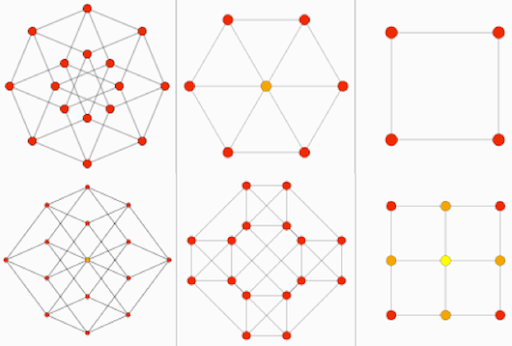
Fourth, if you believe that the Scriptures were “written under the inspiration of the Holy Spirit, [and] have God as their author” (Dei Verbum), then this immediately points to a necessary and vast mismatch in dimensionality between the source (God) and its representation/projection (human words and concepts during the first century AD). Like projections of even just a four-dimensional hypercube into 2D, which give rise to a myriad seemingly unrelated and “contradictory” shapes when considered only in 2D (e.g., how many vertices does this shape have? 4, 7, 16?):3
Tesseract

So too the projections of God’s words into human language necessarily result in apparent inconsistency and contradiction when considered only on the level of human language as opposed to seen as the reductions and conflations they are.

Fifth, to avoid giving the impression of all of the above just being post hoc attempts to explain a feature that the original authors of Scripture did not intend or were not aware of, it is worth noting that contradiction has been a strand in Christian theology that has its origins in the Gospels and that can be traced throughout the last two thousand years (with a recent peak in John Paul II’s thought). This can be seen from Simeon saying to Mary that Jesus “is destined for the fall and rise of many in Israel, and to be a sign that will be contradicted” (Luke 2:34) to St. Paul teaching that “For since in the wisdom of God the world did not come to know God through wisdom, it was the will of God through the foolishness of the proclamation [of the cross] to save those who have faith.” (1 Corinthians 1:21).

¡Viva la contradicción!


1 Thanks to G. K. Chesterton for this great image, borrowed from the opening paragraph of Orthodoxy.
2 But, wait! Didn’t your first point assume that Scripture was a formal system and you are now saying that it is not about rules. Aha! A contradiction! – Yes, I know … so? (see the third point).
3 For more detail see a previous post here.
Gödel, Church teaching, Holy Spirit

Gödel

One of the most disconcerting, but profoundly beautiful pieces of Mathematics are Kurt Gödel’s incompleteness theorems, which he proved in 1931 and which show that “no consistent system of axioms […] is capable of proving all truths about the relations of the natural numbers […]. For any such system, there will always be statements about the natural numbers that are true, but that are unprovable within the system [… and] that such a system cannot demonstrate its own consistency.”

Here axioms are a system’s premises or starting points that are taken for granted (as self-evident or as expressing a property of the entities the system refers to), and are not provable within that system, and theorems are statements derived from these axioms. Gödel’s theorems therefore say that no matter how complex a system of consistent axioms (i.e., axioms that cannot lead both to a theorem and its negation), the set of all possible theorems derived from it will not include all true statements about natural numbers. In other words, that there exists an arithmetic statement that is true but not provable within that system of axioms (i.e., not derivable from them). Gödel achieves this using an ingenious device – the so-called “Gödel sentence” – which in essence claims that it (the Gödel sentence) cannot be proved within a given, consistent axiomatic system.

If this theorem (the Gödel sentence) could be proved using a system’s axioms, then the system would contain a theorem that contradicts itself (i.e., the theorem stating that it cannot be proved would be proved). The system would therefore be inconsistent. However, since the axiomatic system is consistent, the theorem cannot be proved within it. The system’s consistency renders the theorem both true and outside the system. The system is therefore incomplete (not containing the true Gödel sentence) and provability-within-a-system-of-axioms is not the same as truth. This is the gist of the first of the two theorems, put in as plain language as I could manage.1

If you are still reading this, I guess you may be wondering “when do we get to the Church teaching bit?” and I apologize for the unusually lengthy preamble and for passing through the following de-tour, before attempting a bringing together of the strands I set out in the title. That detour regards the Theory of Everything (that I name-dropped in an earlier post) and the death-blow it was dealt by Gödel’s theorems. The Theory of Everything is “a putative theory of theoretical physics that fully explains and links together all known physical phenomena, and predicts the outcome of any experiment that could be carried out in principle.” While such a theory does not exist, for a long time it has been the goal that science has been striving for and that it believed to be progressing towards. One day it would arrive at a level of understanding of the universe that would allow it to predict any event and to do so using a single, unified theory.

Without going into to the varied arguments for the impossibility of such a theory, let me just quote Stephen Hawking:

“What is the relation between Gödel’s theorem, and whether we can formulate the theory of the universe, in terms of a finite number of principles. One connection is obvious. According to the positivist philosophy of science, a physical theory is a mathematical model. So if there are mathematical results that can not be proved, there are physical problems that can not be predicted. One example might be the Goldbach conjecture. Given an even number of wood blocks, can you always divide them into two piles, each of which can not be arranged in a rectangle. That is, it contains a prime number of blocks.

[…]

Some people will be very disappointed if there is not an ultimate theory, that can be formulated as a finite number of principles. I used to belong to that camp, but I have changed my mind. I’m now glad that our search for understanding will never come to an end, and that we will always have the challenge of new discovery. Without it, we would stagnate.”

So, what does all of this have to do with Church teaching or with the Holy Spirit? Well, if you look at any system of reasoning, where some statements are derived from others and where validity can be determined by comparing a statement with the system’s premises according to its rules of reasoning (themselves being premises), then such a system can be seen as having an underlying mathematical model, which thanks to Gödel is now forever revealed as incomplete. The Church’s teaching, as a set of premises (e.g., dogmas, Scripture, etc.) and statements derived from them, is therefore also subject to Gödel’s catch and, even from the perspective of logic alone, incapable of claiming to contain all truth.

Before you shout “Blasphemy!”,2 let me argue that this is neither negative nor new. The Church aims to proclaim the Good News of God’s love that Jesus brought both by his own teaching and – completely – in his own person. When Jesus says during the Last Supper: “I am in the Father and the Father is in me” (John 14:11) and that “[I have] been with you for so long a time and you still do not know me”, he is telling us that he – Jesus the person – is the message and that he cannot be reduced only to the teachings he explicitly shared with his disciples during those three short years of public ministry.

In fact, he proceeds to tell those assembled in the Upper Room that: “The Advocate, the holy Spirit that the Father will send in my name—he will teach you everything and remind you of all that [I] told you.” (John 14:26). During his last address to his followers, Jesus emphasizes the fact that the Church will, to use Hawking’s words “always have the challenge of new discovery,” thanks to the Holy Spirit, who will supply it with a continuous stream of inputs.3 Essentially, the Church can claim to have the Truth insofar as it is the Mystical Body of Jesus, who is its head, who is one with the Father and the Holy Spirit, who is God and who therefore is the fullness of Truth. As far as its explicit, finite set of teachings is concerned, it is subject to incompleteness. This is so not only because of the underlying limitations of any system that employs premises and statements derived from them (as Gödel’s theorems prove), but also because God, who is infinite, always-greater, cannot be encapsulated in a set of human-readable rules and statements. If we thought otherwise and viewed the Church’s teaching (qua teaching) as complete and comprehensive, “we would stagnate” (again borrowing Prof. Hawking’s words).

I believe the above is highly consistent with how Benedict XVI presented the aims of the Year of Faith that is currently in progress. Instead of calling the members of the Church to swat up on its rules and regulations, he invited them to “an encounter with a Person,” a “friendship with the Son of God.” This does not mean that knowledge of the understanding that the Church has gained since Jesus walked the Earth is not valuable (it is!), but that the Christian faith is “no theory.” To conclude, Benedict sums the centrality of the person of Jesus up as follows:

“The joy of love, the answer to the drama of suffering and pain, the power of forgiveness in the face of an offence received and the victory of life over the emptiness of death: all this finds fulfilment in the mystery of his Incarnation, in his becoming man, in his sharing our human weakness so as to transform it by the power of his resurrection.”


I would like to thank my überbestie, PM, for the sanity check, his Nihil Obstat and Transferitur.

1 For those of you who are mathematically inclined, the Wikipedia page on the incompleteness theorems both contains a sketch of the proof (including his beautiful arithmetization syntax, which allows for the Gödel sentence’s expression in arithmetic axiomatic systems) and points to more in-depth material. It also addresses how even adding the Gödel sentence to a set of axioms (i.e., making the Gödel sentence an axiom of a system) fails to defeat it :).
2 And proceed to purchase a small packet of gravel from Harry the Haggler.
3 E.g., see also the Second Vatican Council’s Dei Verbum saying: “Sacred tradition and Sacred Scripture form one sacred deposit of the word of God, committed to the Church.” and “This tradition […] comes from the Apostles [and is] develop[ed] in the Church with the help of the Holy Spirit.”

Does the word “infinity” make you uncomfortable?

The Dominoes Are Falling

I learned a lesson today: never read the parish newsletter before the start of mass. This morning I did and it just lead to regret as I spent the vast majority of mass being distracted1 by it and trying to reconstruct in my mind the reasons against an argument put forward in it. What is even worse is that this wasn’t just the regular newsletter that our parish priest prepares (and that has as yet lead neither to disappointment, nor elation), but a newsletter – “Our Faith on Sunday” – prepared by the company who provides the weekly mass sheets and who ought to know better.

The argument in question is that of Aristotle’s unmoved mover (or first cause), which is a form of the cosmological argument. The basic idea is the following: since all change (motion, temperature variation, …) is the result of a previous change, there are two possibilities: either a causal chain stretching back into an infinite past or a first, “unmoved mover” that triggered a finite chain of causal links leading to the present. The possibility of infinite regress is dismissed as ridiculous, ergo there had to be a first mover. So far Aristotle’s argument from over 2300 years ago, which at that time was unarguably brilliant and which has survived without chinks into the 18th century (this by itself being pretty impressive too!). So, Aristotle comes out pretty well from this incident. The same cannot be said about the nameless author, who not only sticks it into a parish newsletter in 2012 without attribution, but who – to add insult to injury – finishes the piece with saying that the “unmoved mover” is God.

No it ain’t! And that is just the start of a litany of complaints that flooded my mind this morning, with the following being the 800 pound gorillas:

  1. In this context, the gravest mistake is clearly to present a piece of philosophy (however good it may be) and to equate it with God. Not just to say: “Well, this concept gives us hints about some aspects of what God may be like,” but to say “Unmoved mover = God.” Not only is this entirely divorced from Christian theology (giving a false sense of being able to grasp God in His fullness, etc.) but it is positively counterproductive. In essence the argument postulates a God who is relegated to a distant past, who is far removed from us and who just plays the role of a snooker player, hitting the first ball that leads to a vast sequence of knock-ons – a true God of Gaps. This is not the God of Christianity. It is not the loving Father who sent his Son to become one of us and the Holy Spirit to guide us. It is not the God who’s three persons love one another to the point of being one and who invites us to partake in His innermost life. The “unmoved mover” is a cheap imitation and one that is rightly and thankfully the butt of atheist jokes.
  2. Next, taking a philosophical argument made over two thousand years ago and (presumably, hopefully!) not checking whether there have been any significant challenges made against it is pretty sloppy too. And an excuse of obscurity cannot be used here either as the cosmological argument (whose one variant this is) has been debated to death! Furthermore, its critics have included such giants of philosophy as David Hume, who challenged the notion of causation itself (arguing that our senses simply don’t have access to the necessary connection between supposed cause A and supposed effect B – instead, all we have are repeated experiences of event B following event A). With causation undermined, there is clearly no necessity for a “first cause.” Does that mean a disproof of God? No – just of the grotesque God of Gaps of the cosmological argument, and not a disproof as such (those live exclusively in the realm of mathematics or other formal systems – and even there are limited by incompleteness) but a counterargument instead.
  3. Finally, and this is a criticism that I cannot fairly level at the authors of the newsletter, there is also that recurring misunderstanding of infinity that hampers many a philosophical argument from centuries past. Before Georg Cantor’s groundbreaking work on set theory and the concept of cardinality and the subsequent advances in our understanding of infinite sets and their properties (with contributions by pioneers like David Hilbert), an arm-waving approach to infinity and blanket statements about its unintelligibility or impossibility (e.g., by Thomas Aquinas2) were all we could manage. Today these are just not good enough anymore. E.g., a good example of how the impossibility of an infinite sequence of causes can be refuted can be found in Peter Clark’s paper: “Consider the set of events with no first member but a last member: {… an … a4, a3, a2, a1, a0} [where] for every j (aj-1 causes aj). There is no logical contradiction in this supposition whatsoever. […] Every event in the above sequence is finitely accessible from each and every event preceding it.” What this means is that an infinite sequence stretching back in time does not imply the necessity for a member that is infinitely far in the past. No matter how far you go back in the sequence (i.e., an) – and remember that you can’t go back to the beginning, which does not exist – there is a finite number of steps that bring you to the present (i.e., a0). All the infinity of the sequence means is that there is no first member, without necessarily entailing members that are infinitely removed in the past. This may sounds counterintuitive, but presents no logical contradiction.3

So: lesson learned. Next time, I’ll defer reading the newsletter until after mass and especially its “Faith and Reason” section, where, ironically, Aristotle’s argument was plagiarized.


1 I almost missed this gem of a line from St. Paul’s letter to the Philippians: “And this is my prayer: that your love may increase ever more and more in knowledge and every kind of perception, to discern what is of value” (1:9-10), again pointing to an induction of orthodoxy from orthopraxy.
2 “The existence of an actual infinite multitude is impossible. For any set of things one considers must be a specific set. And sets of things are specified by the number of things in them. Now no number is infinite, for number results from counting through a set of units. So no set of things can actually be inherently unlimited, nor can it happen to be unlimited.” (Thomas Aquinas, Summa Theologica, Part 1, Question 7, Article 4).
3 I realize this paragraph barely scratches the topic of infinity, to which I hope to return in the future … Also, please, note that I am not advocating an argument for the universe having existed infinitely – I am merely pointing to the objection to an infinite causal chain being outdated.