Synod14: Truly love families in difficulty

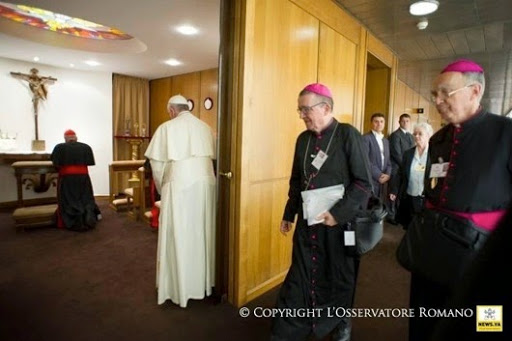
Francis at synod

Continuing with my coverage of the Extraordinary Synod on the Family (see the other posts here), today I’d like to pick out some passages from the Vatican’s official notes on the discussions of yesterday afternoon’s 2nd session of the Synod, where important points were made, first on the need to engage with the world as it is today, also adapting our language in response to it – and, I’d argue, also our understanding, since a simple rephrasing is not going to be sufficient, or even possible, since true dialogue alters all parties involved in it:

“[T]here has emerged the need to adapt the language of the Church, so that doctrine on the family, life and sexuality is understood correctly: it is necessary to enter into dialogue with the world, looking to the example offered by the Vatican Council, or rather with a critical but sincere openness. If the Church does not listen to the world, the world will not listen to the Church. And dialogue may be based on important themes, such as the equal dignity of men and women and the rejection of violence.”

The importance of sharing lived experiences of putting the Gospel into practice, instead of dry and dead theory, was emphasised next:

“The Gospel must not be explained, but rather shown – it was said in the Assembly – and above all, the lay faithful must be involved in the proclamation of the Good News, demonstrating the missionary charism. Evangelisation must not be a depersonalised theory, but must instead ensure that families themselves give concrete witness to the beauty and truth of the Gospel. […] The Church, instead, must be “magnetic”; it must work by attraction, with an attitude of friendship towards the world.”

Next, a point from the opening document was underlined, by returning to the importance of recognising the good there is in every situation, and making reference to the law of gradualness that Cardinal Kasper spoke about in his now-famous speech during the last consistory, that St. John Paul II also put forward in his Familiaris Consortio, and whose basic idea is to recognise the need to gradually approach a desired end state, as if following stepping stones from wherever a person or family is in the present:

“[E]ven imperfect situations must be considered with respect: for instance, de facto unions in which couples live together with fidelity and love present elements of sanctification and truth. It is therefore essential to look first and foremost at the positive elements, so that the Synod may infuse with courage and hope even imperfect forms of family, so that their value may be recognised, according to the principle of graduality. It is necessary to truly love families in difficulty.”

Worth noting is also the variant on the above that Fr. Rosica reported during the press conference, where he quoted a Synod Father as saying: “There are different expressions of what is family today and we have to be sensitive to that.”

Finally, the notes also addressed the need to present the good of sexuality: “[T]he essential value of sexuality within marriage was also considered: sexuality outside marriage is discussed so critically that married sexuality can appear almost as a concession to imperfection.”

The discussions from this morning’s session are then summed up in a separate note, where the fist point raised was a call for emphasising the positive and the vocational nature of marriage:

“The suggestion was to look not only towards remedies for failure of the conjugal union, but also to focus on the conditions that render it valid and fruitful. It is necessary to transmit a vision of marriage that does not regard it as a destination, but rather as a path to a higher end, a road towards the growth of the person and of the couple, a source of strength and energy. The decision to marry is a true vocation and as such requires fidelity and coherence in order to become a true locus for the growth and the protection of the human being.”

Next, the need for extensive preparation and accompaniment was stated, also with the consequences of failure bluntly put on the table:

“[M]arried couples must be accompanied throughout their path in life, by means of intense and vigorous family pastoral care. The path of preparation for the marriage sacrament, must therefore be long, personalised and also severe, without the fear of eventually leading to a reduction in the number of weddings celebrated in Church. Otherwise, there is the risk of filling the Tribunals with marriage cases.”

The importance of appropriate language and of dialogue surfaced again this morning:

“[T]he debate focused on the need to renew the language of the proclamation of the Gospel and the transmission of doctrine: the Church must be more open to dialogue, and must listen more frequently (and not only in exceptional cases) to the experiences of married couples, because their struggles and their failures cannot be ignored; on the other hand, they can be the basis of a real and true theology.”

To flesh out some of the above points, the press conference that followed at 1 pm Roman time included specific examples of what such a renewal of language needs to address. Fr. Rosica, the English language Vatican spokesperson, noted that terms like “Living in sin,” “intrinsically disordered,” and “contraceptive mentality” were singled out by the Synod Fathers as examples of “harsh language” where there was a need for change that would demonstrate the Church’s openness and love. Cardinal Nichols, who was also present at the press conference, characterized the atmosphere at the Synod as one where bishops are “speaking as priests, members of families, and not as academics,” adding that “It’s very lovely.” 🙂 On the same note, the Jesuit Fr. Antonio Spadaro – also a participant of the Synod – noted that “the attempts to paint a picture of fighting among cardinals melt like snow in the sun. At the Synod what is lived is an experience of Church …”
Kasper’s family: the domestic church

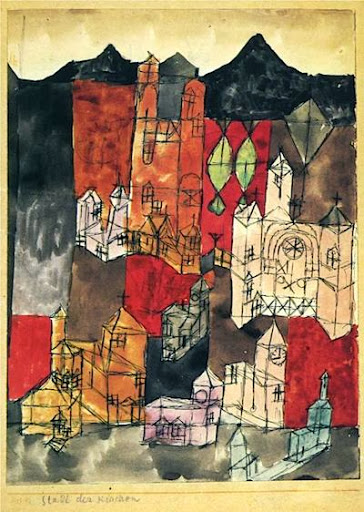
City of churches 1918 1 jpg HalfHD

[Warning: long read]

Even though I only meant to translate from and comment on the first half of Cardinal Kasper’s talk at the extraordinary consistory of cardinals two weeks’ ago, I realized that its middle part – where Kasper focuses on the sacrament of marriage and then speaks about the family as domestic Church – has not received much coverage either (with all attention being directed at the two scenarios he sketched out that constitute a 5% of what he said …). With that in mind – and assuming you are interested in what follows, I would recommend you to take a quick look at the previous post, which covers the general framework in which Kasper then gives thought to how the family could be better welcomed by the Church.

Following the presentation of the principles of how the Gospel is to be understood, how the concept of a gift is central and how God places trust in man and woman and of the subsequent Scriptural exegesis both of the ideal and reality of the family, covered before, Kasper moves on to discuss why marriage is indissoluble:

“[T]he doctrine of the indissolubility of the marital bond […] persists also where, humanly, marriage breaks down. Many today have trouble with understanding it. This doctrine cannot be understood as a kind of metaphysical hypostasis beside or above the personal love of the spouses; on the other hand it isn’t fully accounted for by reciprocal affective love and doesn’t die with it. It is Gospel, or definitive word and permanently valid promise. As such, it takes humans and their freedom seriously. It is precisely due to human dignity that definitive decisions can be taken. These belong in a permanent way to the history of a person; they characterize it in a lasting way; it is not possible to take them back and pretend as if they had never been made. When they are broken, a deep wound results. Wounds can be healed, but the scar remains and continues to trouble; but one can and must continue to live even if that requires effort. Similarly the good news of Jesus is that, thanks to the mercy of God, those who convert can be forgiven, healed and start anew.”

Wow! I have never heard the indissolubility of marriage tied to freedom in this way, or to mercy. It is an understanding of faith like this that makes Pope Francis’ choice of Kasper very clear …

Next comes the passage where the family – based on the indissoluble bond of marriage – is likened to the Church and where Kasper introduces the “law of gradualness” that he then builds on in later parts of his talk:

“Just like the Church is on a journey of conversion and renewal, so marriage too finds itself on the way of the cross and of resurrection, under the law of gradualness of continuing to grow in ever new ways and greater depth in the mystery of Christ. This law of gradualness1 seems to me something of great importance for the life and for the pastoral care of marriage and the family. It doesn’t mean a gradualness of the law, but a gradualness, which means growth, in the understanding and putting into practice of the law of the Gospel, which is a law of freedom (James 1:25, 2:12),2 but which has today become often difficult for many of the faithful. They require time and patient accompanying along their journey.”

Next, Kasper outlines what he sees as the sources of the current crisis of the family:

“[T]he nuclear family, which developed only during the 18th century from the extended family of the past, has ended up in a structural crisis. Modern conditions of work and accommodation have resulted in a separation between accommodation, places of work and places where free time is spent and therefore have lead to a break-up of the home as the social unit. For work reasons, fathers are often away from the family for prolonged periods; women too, for work reasons, are often only partly present in the family. Due to current conditions being hostile to the family, the modern nuclear family finds itself in difficulty.”

What is the answer to these challenges? Is Kasper suggesting some sort of return to the pre-18th-century model? Not quite (and this was to be expected given his thoughts in the opening parts of the talk):

“What we need are extended families of a new kind. For nuclear families to survive, they need to be inserted into new family units that span generations and in which it is above all the grandfathers and grandmothers who take on important roles, into inter-familiar circles of close ones and friends where children can find refuge in the absence of their parents and where single old people, the divorced and single parents can find a kind of home.”

Kasper suggests that the above extended families and “circles” have hints of a “domestic Church” that he further elaborates on next:

“How to define these domestic Churches? They are a Church in miniature inside the Church. They make the local Church present in the concrete life of the people. In fact, where two or three meet in the name of Christ, he is in their midst (Matthew, 18:20). […] Through the Holy Spirit, they have the sensus fidei, the sense of faith, an intuitive sense of faith and of living according to the Gospel. They are not only object but also subject of pastoral care for families. Above all by their example, they can help the Church to enter more deeply into the word of God and to put it into practice in a way that is more full of life. Since the Holy Spirit has been given to the Church in its entirety, they mustn’t isolate themselves in a sectarian way from the broader communion of the Church. This “catholic principle” preserves the Church from disintegrating into single, autonomous, free Churches. Through such unity in multiplicity, the Church is also a sacramental sign of unity in the world.”

One thing that strikes me as important in the above is also how Kasper positions the domestic Churches – families as being important for the Church as a whole – even in core aspects like the growing understanding of the word of God. It is not like the Church in its entirety is putting itself into a position where it knows best and is the source of support for families. Instead, the relationship is very much reciprocal, which is further highlighted in the following passage, where Kasper also returns to the importance of accompanying those who suffer from the break-down of the family:

“Families need the Church and the Church needs families for the sake of being present at the center of life, where modern life takes place. Without the domestic Churches the Church is a stranger to the concrete reality of life. Only through families can it be a home where people are at home. Its being understood as domestic Church is therefore fundamental for the future of the Church and for the new evangelization. Families are the first and best messengers of the Gospel of the family. They are they way of the Church. […] Thinking about the importance of the family for the future of the Church, the rapidly growing number of broken families appears as an even greater tragedy. There is a lot of suffering. [… W]e must change the paradigm and must – like the Good Samaritan (Luke 10:29-37) – look at the situation also from the point of view of those who suffer and ask for help.”

It is only at this point that Kasper starts talking about the challenges of divorce and re-marriage and proceeds to sketch out two scenarios of how the Church could handle them differently. But, that will have to remain for another time. For now, let me just flag up one of Pope Francis’ morning sermons (from last Friday), where he again emphasizes the key in this context:

“When [… the] leaving [of] one’s father and mother, and joining oneself to a woman, and going forward … when this love fails – because many times it fails – we have to feel the pain of the failure, we must accompany those people who have had this failure in their love. Do not condemn. Walk with them – and don’t practice casuistry on their situation.”


1 As far as I can tell, this “law of gradualness” comes from John Paul II’s Familiaris Consortio (§34): “Married people too are called upon to progress unceasingly in their moral life, with the support of a sincere and active desire to gain ever better knowledge of the values enshrined in and fostered by the law of God. They must also be supported by an upright and generous willingness to embody these values in their concrete decisions. They cannot however look on the law as merely an ideal to be achieved in the future: they must consider it as a command of Christ the Lord to overcome difficulties with constancy. “And so what is known as ‘the law of gradualness’ or step-by-step advance cannot be identified with ‘gradualness of the law,’ as if there were different degrees or forms of precept in God’s law for different individuals and situations. In God’s plan, all husbands and wives are called in marriage to holiness, and this lofty vocation is fulfilled to the extent that the human person is able to respond to God’s command with serene confidence in God’s grace and in his or her own will.”” Although I also found it in the I Ching here, where it says: “[The] principle of gradual development can be applied to other situations as well; it is always applicable where it is a matter of correct relationships of co-operation, as for instance in the appointment of an official. The development must be allowed to take its proper course. Hasty action would not be wise.”
2 “But the one who peers into the perfect law of freedom and perseveres, and is not a hearer who forgets but a doer who acts, such a one shall be blessed in what he does.” and “So speak and so act as people who will be judged by the law of freedom.”