Possessed by truth: a journey

Color of truth

[Warning: long read.]

One of the points made by Pope Francis in his letter to Eugenio Scalfari at the beginning of September regarded the nature of truth, which he likened to a relationship and which he argued “embraces and possesses us” instead of us possessing it. In this post, I would like to revisit this passage and look at it, and related statements made by Cardinal Gianfranco Ravasi, through the lens of philosophy.

The question of truth is one of the central concerns of philosophy and theories about it impact a vast variety of other aspects of rational enquiry. Since it is such a central theme, my attempt to look at Francis’ and Ravasi’s words from the point of view of philosophy will necessarily be in the form of a very roughly-ground lens1 indeed and all that I can hope to convey are blurry silhouettes. To keep the argument at a high level (as much as I would love to delve into the depths, e.g., of Alfred Tarski’s approach), I will mostly stick to summaries provided in the Stanford Encyclopedia’s “truth” entry and round it out by headlines from the “truth” entry in the Wikipedia.

With the caveats out of the way, let’s first look at the concept of truth most akin to what is typically meant by this word in “ordinary language” (i.e., language as used without the machinery of technical definitions – effectively the language spoken by “the man on the Clapham omnibus” to borrow an expression from English law). Here, an expression, statement, declaration, description, account, etc. is true if it matches how things actually are. If I say “there is a cat on the mat” and there actually is a cat on the mat then what I have said is true. What does philosophy make of the concept though and how does it deal with the pandora’s box that spills out left, right and center, when a basic idea like truth is subjected to scrutiny and deconstruction (in “ordinary language” terms).

As the King said to Alice, very gravely, let’s begin at the beginning – or at least reasonably close to it – and look at how Aristotle (who had something to say about pretty much everything) thought of the truth. In his Metaphysics, he declares: “to say of what is that it is, and of what is not that it is not, is true” (Book 4, Part 7). This, in fact, is close to the everyday meaning of the word and a variant of what today would be called the correspondence theory of truth – a theory still adhered to by many philosophers today and a theory (or class of theories) that I too consider to be best representative of my own understanding.

Put in more contemporary terms, “[a] belief is true if and only if it corresponds to a fact.” There is immediately a host of questions that spring up: is belief the only possible “truth-bearer” or are there others, what is the nature of correspondence, and what is a fact and can there be other “truth-makers”? Put in more generic terms, the above definition becomes: “a truth-bearer is true if and only if it corresponds to a truth-maker.” Here truth-bearers include entities like beliefs, propositions, sentences or utterances, truth-makers can be entities like a world that exists objectively (i.e., independently of the ways we think about it or describe it), electrodes connected to a brain’s nerve endings in a jar, states of a self’s consciousness and correspondence can refer to a match on the truth-bearer’s structure to the truth maker’s structure or just to convention (i.e., the “situationist” argument). As is obvious, a sprawling tree of choices grows from under our feet even just by enumerating some of the options, never mind engaging with them.

As should be obvious from the “truth is truth-bearer corresponding to truth-maker” way of posing of the correspondence theory of truth, the schema lends itself to modification and also to analysis using mathematical, formal languages methods (as Tarski did – more about that in a future post …). Still using my ultra-rough lens, let’s next look at G. E. Moore and Bertrand Russell’s identity theory of truth, where “corresponding” becomes “being identical to” – i.e. “a true proposition is identical to a fact […] Propositions are what are believed, and give the contents of beliefs. They are [..] the primary bearers of truth. When a proposition is true, it is identical to a fact, and a belief in that proposition is correct.” This is essentially a flavor of the correspondence theory, cutting out the bearer-maker dichotomy.

The most substantial competing theory of truth though is the coherence theory, whose basic idea can be put as: “A belief is true if and only if it is part of a coherent system of beliefs.” Truth here is not constrained to individual truth-bearers (instead whole systems of beliefs are the primary truth-bearers) and is “not simply a test or criterion for truth. Far from being a matter of whether the world provides a suitable object to mirror a proposition, truth is a matter of how beliefs are related to each-other. [… It] insists that truth is not a content-to-world relation at all; rather, it is a content-to-content, or belief-to-belief, relation.”

Extending the two basic concepts of correspondence versus coherence are a host of other, more recent approaches. Here pragmatist theories (e.g., as propagated by C. S. Peirce) make truth be about its practical value, since “[t]rue beliefs are guaranteed not to conflict with subsequent experience.” Verificationism instead “holds that a claim is correct just insofar as it is in principle verifiable, i.e., there is a verification procedure we could in principle carry out which would yield the answer that the claim in question was verified. [.. T]ruth just is verifiability.” Deflationist theories (e.g., as put forward by Gotlob Frege) argue that there is no property of something being true – that the concept is redundant. “[A]ppearances of the expression ‘true’ in our sentences are redundant, having no effect on what we express.” Constructivist theories instead hold “that truth is constructed by social processes, is historically and culturally specific, and that it is in part shaped through the power struggles within a community.” This is, e.g., the truth theory that underlies gender theory. A related, democratized, alternative is consensus theory where “truth is whatever is agreed upon.”

In summary, and in Cardinal Ravasi’s words:

“There are essentially two opposing approaches to the concept. The first is a relativistic, subjective view which sees Truth as a sort of Medusa‐like figure, constantly changing appearance depending on the circumstances. [… This view argues] that Truth does not in itself have any ontological basis and, for this reason, should be left free to follow the course of continual change.

The second approach to Truth […] holds that there is an objective – or rather, transcendent – Truth. [… Here] an emblematic image is provided in Plato’s Phaedrus, where the soul is likened to a chariot that flies across the plain of Truth. […] Adorno, in interpreting one of the aphorisms of Truth in his Minima Moralia, maintained that “one does not have [the Truth], but is in it.” Hence, humanity, finding itself within the womb of Truth, uses the mind to take it in, to become familiar with it, to investigate and illuminate it. There is clearly an attempt to combine the two aspects: on the one hand, a Truth which precedes us; on the other, a Truth which the individual must choose to enter. We read in Robert Musilʹs The Man Without Qualities that: “The Truth is not a precious stone to be kept in a casket, but a sea in which to immerse oneself”. This approach emphasizes the primacy – or precedence – of Truth, which is to be understood not as dominion but rather as illumination: a Truth more complex than mere rational knowledge.”

In fact, it is the above concepts – from a talk by Ravasi in 2009 – that, to my mind, underpin Pope Francis’ response to Eugenio Scalfari a couple of months ago and already the positioning of truth in Francis and Benedict XVI’s Lumen Fidei: “truth leads to humility, since believers know that, rather than ourselves possessing truth, it is truth which embraces and possesses us. Far from making us inflexible, the security of faith sets us on a journey; it enables witness and dialogue with all.”

With all of that under our belts, let’s take a fresh look at Francis’ response to Scalfari:

“I would not speak about “absolute” truths, even for believers, in the sense that absolute is that which is disconnected and bereft of all relationship. Truth, according to the Christian faith, is the love of God for us in Jesus Christ. Therefore, truth is a relationship. As such each one of us receives the truth and expresses it from within, that is to say, according to one’s own circumstances, culture and situation in life, etc. This does not mean that truth is variable and subjective, quite the contrary. But it does signify that it comes to us always and only as a way and a life. Did not Jesus himself say: “I am the way, the truth, and the life?” In other words, truth, being completely one with love, demands humility and an openness to be sought, received and expressed. Therefore, we must have a correct understanding of the terms and, perhaps, in order to overcome being bogged down by conflicting absolute positions, we need to redefine the issues in depth. I believe this is absolutely necessary in order to initiate that peaceful and constructive dialogue.”

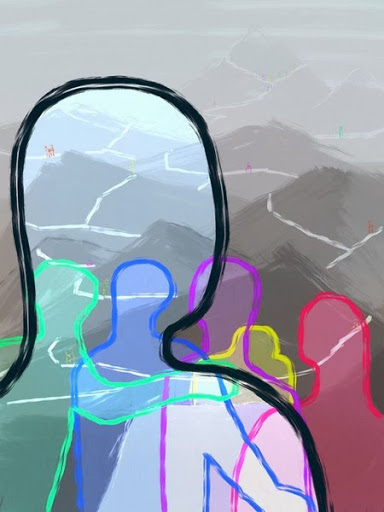
Armed with my rough, philosophical lens, the above looks to me very much like a correspondence theory: correspondence here is the relationship Francis speaks about, the truth-maker is God and his creation and the truth-bearer are my own, circumstance-, culture-, language-relative beliefs, thoughts and utterances. The truth-maker is absolute and objective, while the truth-bearer is ultimately its opposite: relative, in flux and existentially subjective. The image of a journey and of being embraced express the entities of this scheme in an intuitive way. On the one hand, the givenness and quiddity of the landscape, which envelops the traveller, and on the other hand, the subjective, observer-dependent experiences of it, had by the pilgrim (the “For now we see through a glass, darkly.” of St. Paul (1 Corinthians 13:12)). What makes this paradigm profoundly Christian though is what Francis points to when he identifies truth with “the love of God for us in Jesus Christ.” The truth-maker is reaching out to the truth-bearer across the absolute-relative chasm, placing himself in relationship with His creatures, who are to Him like a dimensionless point is to the unbounded hyper-dimensional space.

Before you change channels, just bear with me while I try to put the above in other, less faith-dependent words. The concept of truth presented by Francis, as I understand it, is one that maintains the realism2 of a classical correspondence theory of truth, while acknowledging elements of contemporary truth theories that point to the impact of social, historical, conventional, linguistic and individually-subjective factors on the truth-bearers. Unlike truth theories that are marked by an absence of realism (e.g., coherence, pragmatist, verificationist and constructivist ones), here the imperfect and inherently subjective truth-bearers are still in relationship with their truth-makers. Up to this point, the theory does not make recourse to Christian beliefs and could just as easily be held by an atheist, in my opinion. Where it diverges is then in the belief that the truth-maker is not only an objective reality but also a personal agent who actively seeks to relate to the subject owning the truth-bearers. I didn’t say I’d put it more simply 🙂


1 Apologies to my überbestie MR – a fully-qualified and practicing professional philosopher – for bringing the name of philosophy into disrepute. I am sure she could have done a far superior job of the following.
2 And by “realism” I mean that the truth-makers are posited to exist independently of the truth-bearer’s circumstances – not the typical, ordinary-language meanings of the term.

Science grows Church’s understanding

350px God the Geometer0

As was immediately clear from a first reading, “the” interview given by Pope Francis last Thursday to Jesuit magazines is a text rich both in spiritual and intellectual treasures and will be a prominent trigger of reflection for a long time to come.

Today I’d like to take a closer look at a passage from it that has immediately caught my eye, but that received little attention so far. It addresses the relationship between science and religion in a, to my mind, very positive way:

“[H]uman self-understanding changes with time and so also human consciousness deepens. Let us think of when slavery was accepted or the death penalty was allowed without any problem. So we grow in the understanding of the truth. Exegetes and theologians help the church to mature in her own judgment. Even the other sciences and their development help the church in its growth in understanding. There are ecclesiastical rules and precepts that were once effective, but now they have lost value or meaning. The view of the church’s teaching as a monolith to defend without nuance or different understandings is wrong.”

While the opposition between science and religion certainly does not apply to the Catholic Church – with Blessed Pope John Paul II’s landmark encyclical Fides et Ratio being a categorical statement of the mutual benefits of faith and reason and with Pope Benedict XVI having spoken of the necessity of dialogue between science and faith 1 – Francis’ positioning of science as “helping the church in its growth in understanding” is a significant move. Like with many of Francis’ statements, it could be argued that they contain nothing new (Fides et Ratio already saying that “science can purify religion from error and superstition”) or that they are only new in style – and in some sense that is true, since he is firmly rooted in the Church, but it would, I believe, also miss an important nuance.

While I have always read Fides et Ratio as positioning faith and reason as separate, but mutually “strengthening” entities,2 here I see Francis presenting theology and science as two activities whose results both help the Church, the former leading to mature judgment while the latter resulting in increased understanding. This is a picture that does not place theology in a privileged, internal position with regard to the Church, and science as an external, while admittedly positive, activity, but positions both as engines of progress that deepen our humanity.3

While the above is clearly my reading and attempted unpacking of Francis’ condensed thought, I believe it is compatible with another of the important points he makes in “the” interview, namely that the Church is the “faithful people of God,”4 and that “‘thinking with the church’ [does not mean] only thinking with the hierarchy of the church,” that it “does not concern theologians only.” Seen in this way, “[t]he church is the totality of God’s people” and is therefore formed as much by theology as by science. Science becomes an internal concern of the Church – the People of God – and its advances and insights form her teaching from within.5 In many ways this also reminds me of Francis’ address to Brazil’s “leaders of society” during his visit in July, where he emphasizes that Christianity “combines transcendence and incarnation” and “faith and reason unite, the religious dimension and the various aspects of human culture – art, science, labour, literature…”

The above sketch, which I don’t believe I am bolting on to Francis’ thought, strikes me as a natural evolution of the solid foundations that John Paul II laid down, and I am curious to see whether it will find support in his future teaching.


0 I don’t mean to distract, but note the fractal in this 13th century illuminated illustration!
1 “In the great human enterprise of striving to unlock the mysteries of man and the universe, I am convinced of the urgent need for continued dialogue and cooperation between the worlds of science and of faith in the building of a culture of respect for man, for human dignity and freedom, for the future of our human family and for the long-term sustainable development of our planet. Without this necessary interplay, the great questions of humanity leave the domain of reason and truth, and are abandoned to the irrational, to myth, or to indifference, with great damage to humanity itself, to world peace and to our ultimate destiny.” (Pope Benedict XVI, Address To The Pontifical Academy Of Sciences, 8 November 2012)
2 As Lumen Fidei puts it in §32.
3 Echoing the affirmation in Fides et Ratio that “Men and women have at their disposal an array of resources for generating greater knowledge of truth so that their lives may be ever more human.”
4 The definition presented in Lumen Gentium, as Francis points out.
5 This is not a conflation of the two – theology and science – but a recognition of their equal import for the Church’s progress.

Pope Francis’ letter to non-believers

Pope 2509845b

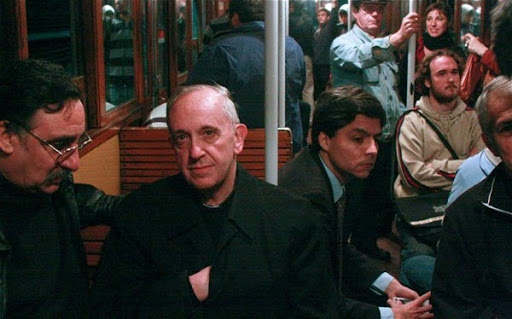
That Pope Francis cares deeply for non-believers1 is nothing new, with his previous declaration that Jesus has redeemed atheists too having lead both to very positive responses and to a great media muddle. In today’s issue of the Italian newspaper La Repubblica, Francis continues in this dialogue with non-believers by responding to questions sent to him by the atheist journalist Eugenio Scalfari regarding Francis’ encyclical Lumen Fidei, and I would like to share my favorite parts of his letter with you here.2

Francis starts out by arguing that dialogue between the followers of Jesus and non-believers is “necessary and valuable” today for two reasons: First, the paradox that “Christian faith, whose novelty and impact on human life have since the beginning been expressed through the symbol of light, has become branded as the darkness of superstition that is opposed to the light of reason,” resulting in an absence of communication between Christian and Enlightenment-based contemporary culture. Second, for those who seek “to follow Jesus in the light of faith, […] this dialogue is not a secondary accessory[, but …] an intimate and indispensable expression of faith instead.” This, Francis argues, is expressed by §34 of Lumen Fidei, from which he proceeds to quote:

“Clearly, then, faith is not intransigent, but grows in respectful coexistence with others. One who believes may not be presumptuous; on the contrary, truth leads to humility, since believers know that, rather than ourselves possessing truth, it is truth which embraces and possesses us. Far from making us inflexible, the security of faith sets us on a journey; it enables witness and dialogue with all.”

After a beautiful exposition of how Francis himself came to believe in God and how the Christian faith has Jesus’ incarnation and resurrection at its heart, through which all of humanity is shown God’s love and connectedness to each other – to every single human being,3 he proceeds to answering the three questions Scalfari put to him.

The first of Scalfari’s questions regards whether “the God of Christians forgives those who don’t believe and don’t seek faith.” Here Francis’s response, which I particularly like, is the following:

“Given that – and this is the fundamental point – the mercy of God has no limits if one turns to Him with a sincere and contrite heart, the question for those who don’t believe in God is about obeying one’s own conscience. Sin, also for those who don’t have faith, occurs when one goes against conscience. Listening and obeying to it means, in fact, taking decisions in the face of what becomes understood as good or as bad. And it is on the basis of this decision that the goodness or evil of our actions plays out.”

Wow! While this is in some sense nothing more than what the Catechism has been saying explicitly since Vatican II, having it presented in the above universal way is great. I have often argued in exactly these terms and have faced quizzical looks from other Catholics, who wouldn’t quite believe it. It also confirms me in the answer I have given to several of my best, atheist or agnostic friends when they have asked me whether they should want to believe in God, which was “no,” with the caveat of seeking to be honest in front of their consciences.

Scalfari’s second question asks whether “thinking that there is no absolute and therefore no absolute truth either, but only a series of relative and subjective truths, is a mistake or a sin.” Great question! 🙂 To this Francis responds by saying:

“To begin with, I wouldn’t talk, not even to those who believe, about “absolute” truth, in the sense that the absolute is that which is disconnected, which is devoid of any relation. Now, the truth, according to Christian faith, is the love of God for us in Jesus Christ. Therefore, the truth is a relationship! It is also true that each one of us takes it, the truth, and expresses it by departing from oneself: from one’s history and culture, the circumstances in which one lives, etc. This does not mean though that the truth is variable and subjective. Instead, it means that it gives itself to us always and only as a journey and a life. Didn’t maybe Jesus say the same: “I am the way and the truth and the life.”?4 In other words, truth, being ultimately all one with love, requires humility and openness when sought, accepted and expressed. Therefore, it is necessary to understand each other’s terminology better, and, maybe, to avoid the constraints of an opposition that is … absolute, deepen the framing of the question. I believe that this is absolutely necessary today, so that a serene and constructive dialogue can take place.”

Another fantastic answer! Anyone who has tried to pigeonhole Francis as a populist, as opposed to the thinker that Benedict XVI undoubtedly is, can proceed to eat their own words …

The third, and final of Scalfari’s questions asks whether “the disappearance of humans from Earth would also mean a disappearance of thought that is capable of thinking God.” Here, Francis’ answer, which I won’t translate in full, revolves around arguing that, in his experience and those of many others, God is not an idea, but a “reality with a capital ‘R’.” Instead of going into more detail here, I’d instead like to translate Francis’ closing thoughts, before which he expresses his hope that his reflections would be “received as a tentative and provisional response, but one that is sincere and faithful to the invitation of walking along a stretch of road together.”:

“The Church, believe me, in spite of all the slowness, the unfaithfulness, the mistakes and sins that it may have committed and may yet commit in those who compose it, has no other meaning and end than that of living and giving testimony to Jesus: Him who has been sent by the Father “to bring glad tidings to the poor, to proclaim liberty to captives and recovery of sight to the blind, to let the oppressed go free, and to proclaim a year acceptable to the Lord” (Luke 4:18-19).”

I have to say I am delighted by these words of Pope Francis – both the emphasis on conscience that I have held dear for a long time and the insights about truth as relationship and love – and I would be keen to hear from my atheist, agnostic, humanist (and even Christian 🙂 friends what they made of them.

UPDATE (12 Sept. 2013): This morning Vatican Radio broadcast a short interview with Cardinal Gianfranco Ravasi on the topic of Pope Francis’ letter discussed above (which is now available in an official English translation here). Ravasi, who leads the Pontifical Council for Culture and in its context the “Courtyard of the Gentiles” initiative, whose aim is dialogue with non-believers, naturally welcomed Francis’ letter with great positivity, including it among the initiatives foundational documents. He then also proceeds to elaborate on the, to my mind key, point Francis made about the truth being a relationship:

“Already Plato affirmed [that the truth is a relationship] when he said that the chariot of the soul runs along the plane of truth, which means that the truth is not a cold reality like a precious stone that you can put in your pocket. Instead, it is an immense plane, a horizon – or, to use another image by a writer from the last century5 – we can say that the truth is a sea that one enters and navigates. So, in this light, I believe that the concept of truth not as absolute, but personal, interpersonal, will be very fruitful for dialogue, without losing the dimension of objectivity, of identity in itself, typical of the truth.”


1 Picking what term to use to refer to those who do not believe in God is tricky and I am going with the term Francis is using himself, not necessarily because I believe it is the most appropriate one, but because my aim here is to share his message with you today. I am mindful though of Prof. Cox’s point about the undesirability of negative labels, but since the positive alternatives (e.g., humanist) may not be self-applied by all whom the Pope intends to address here, I am sticking with his terminology. If you belong to his target audience (and to some extent everyone does – including me, a Catholic) and have a suggestion for what term to use, please, let me know.
2 Since I haven’t found an English translation of this article yet, the following quotes are my own crude translations, for which I apologize in advance.
3 I’d like to return to this great synthesis of Christianity in a future post and, if you understand Italian, I’d wholeheartedly recommend reading the full letter to you straight-away.
4 John 14:6.
5 Ravasi refers to this quote in an earlier talk, where he attributes it to Musil’s The Man Without Qualities, although I couldn’t find it there.

Camus on dialogue, revolt, beauty and love

Camus

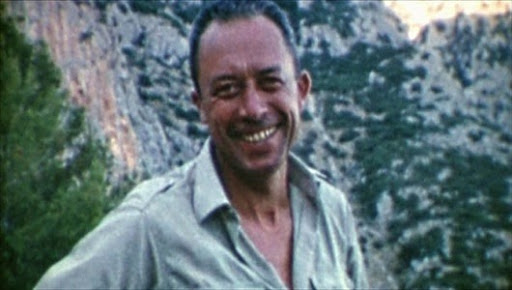
One of the features of Pope Francis’ first encyclical, Lumen Fidei, that stood out for me most is its constant reference to love, regardless of the specific subject of its reflection. This certainly is not surprising in the context of Christian theology – a theology that is all about God, who is Love – but it’s all-pervasiveness nonetheless made me think. In particular, it made me think about what someone who is not a Christian, who is an atheist or humanist, would say on the subject.

With these questions in mind, I turned to my “read later” reading list and my eyes landed on a piece by Cardinal Gianfranco Ravasi, where he speaks about how Albert Camus‘ thought is a confrontation with the same questions that Christianity grapples with. Questions of meaning, purpose, suffering, revolt, hope and love.

Ravasi there starts with quoting from a talk Camus gave to a group of Dominicans in 1948, where he says to his hosts that “the world of today needs Christians who remain Christians” and where he declares:

“I shall not, as far as I am concerned, try to pass myself off as a Christian in your presence. I share with you the same revulsion from evil. But I do not share your hope, and I continue to struggle against this universe in which children suffer and die.”

This directness and honesty of Camus has always been very attractive to me, which made me look for the full text of his talk to the Dominicans and I found a fairly extensive set of fragments from it here. What struck me there is how I find myself very much agreeing with him, where what he says is in fact a very powerful examination of conscience for Christianity and also for me personally.

From these fragments it is explicit that the Dominicans invited Camus to talk to them about what “unbelievers expect of Christians,” which makes me very impressed with them too, and for which Camus also acknowledged their “intellectual generosity.” He then proceeds to set out the following principles of dialogue:

that “if I allowed myself at the end of this statement to demand of you certain duties, these could only be duties that it is essential to ask of any man today, whether he is or is not a Christian.”

that “I shall never start from the supposition that Christian truth is illusory, but merely from the fact that I could not accept it.”

and that “I shall not try to change anything that I think or anything that you think (insofar as I can judge of it) in order to reach a reconciliation that would be agreeable to all. On the contrary, what I feel like telling you today is that the world needs real dialogue, that falsehood is just as much the opposite of dialogue as is silence, and that the only possible dialogue is the kind between people who remain what they are and speak their mind.”

These are an excellent set of principles: do to others as you would want them to do to you, the principle of charity and respect for the other being who they are, not setting out to change them. In fact, they seem to me to be very much in sync with what Pope Francis said on the same topic: “Dialogue is born of an attitude of respect towards another person, of a conviction that the other has something good to say; it requires that we make space in our heard their point of view, their opinion and their position.”

With these principles as the basis, Camus proceeds to spelling out his expectations:

“What the world expects of Christians is that Christians should speak out, loud and clear, and that they should voice their condemnation in such a way that never a doubt, never the slightest doubt, could rise in the heart of the simplest man. That they should get away from abstraction and confront the blood-stained face history has taken on today. The grouping we need is a grouping of men resolved to speak out clearly and to pay up personally. When a Spanish bishop blesses political executions, he ceases to be a bishop or a Christian; even a man; he is a dog just like the one who, backed by an ideology, orders that execution without doing the dirty work himself. We are still waiting, and I am waiting, for a grouping of all those who refuse to be dogs and are resolved to pay the price that must be paid so that man can be something more than a dog. […]

Perhaps we cannot prevent this world from being a world in which children are tortured. But we can reduce the number of tortured children. And if you don’t help us, who else in the world can help us do this? […]

But it may be […] that Christianity will insist on maintaining a compromise or else on giving its condemnations the obscure form of the encyclical. Possibly it will insist on losing once and for all the virtue of revolt and indignation that belonged to it long ago. In that case Christians will live and Christianity will die. In that case the others will in fact pay for the sacrifice. [… I]f Christians made up their minds to it, millions of voices—millions, I say—throughout the world would be added to the appeal of a handful of isolated individuals who, without any sort of affiliation, today intercede almost everywhere and ceaselessly for children and for men.”

When I read this, it really stopped me in my tracks. This is the kind of dialogue that we, Christians need – someone from the “outside” shaking us, pointing to our errors and doing so not for the sake of some propagandist point-scoring, but out of a genuine concern for our returning to our roots and maintaining our identity. In many ways, what Pope Francis is doing now from the “inside” is similar – the call to poverty, to the “existential peripheries” and to respect for and collaboration with atheists are all examples of it and I am deeply grateful to him and to Camus.

Returning to Ravasi’s discourse, he steers it to another very interesting point of common interest to Christianity and Camus, by quoting from “Helen’s Exile” and then from “The Rebel”:

“Man cannot do without beauty, and this is what our era pretends to want to disregard. It steels itself to attain the absolute and authority; it wants to transfigure the world before having exhausted it, to set it to rights before having understood it. Whatever it may say, our era is deserting this world.”

“Beauty, no doubt, does not make revolutions. But a day will come when revolutions will have need of beauty.”

Here the connection between beauty and the revolt Camus speaks about to the Dominicans is clear – both are set against an exploitation and ignoring of the world. Revolt is directed against suffering while beauty is aimed at appreciating existence.

Ravasi then makes the, to me at first surprising, summary of the above as being “the way of love.” To get a sense of why he may have interpreted it as such, Camus’ own words in “The Rebel” point to the key: “The procedure of beauty, which is to contest reality while endowing it with unity, is also the procedure of rebellion.” Rebellion and beauty bring about unity, which in turn is synonymous with love in Christianity – the Persons of the Trinity being One is their love for each other; Jesus-Love is present among his followers if they are united in his name (cf. Matthew 18:20), etc.

Finally, to underline the importance Camus gives to love, Ravasi quotes the following from his “Notebooks” from 1937:

“If someone told me to write a book on morality, it would have a hundred pages and ninety-nine of them would be blank. On the last page I would write, “I recognize only one duty and that is to love.” And as far as everything else is concerned, I say no.”

St. Augustine would be pleased, as am I 🙂

Lumen Fidei: Love and truth are inseparable

Pope 001 4 3 rx513 c680x510

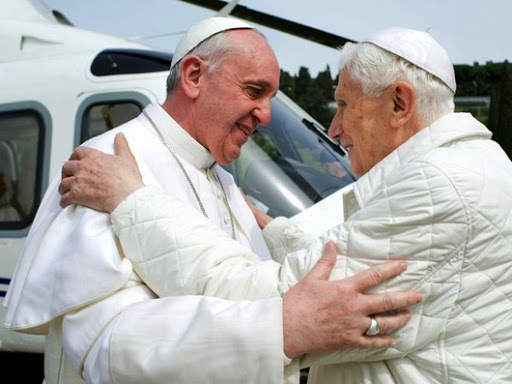
Pope Benedict XVI’s long-awaited encyclical on faith (completing the trilogy of encyclicals with those on love and hope) and Pope Francis’ equally eagerly awaited first encyclical are out – and they are one and the same – the encyclical entitled “Lumen Fidei” – “The Light of Faith.” As Francis puts it, “It’s an encyclical written with four hands, so to speak, because Pope Benedict began writing it and he gave it to me. It’s a strong document. I will say in it that I received it and most of the work was done by him and I completed it.”

I couldn’t agree more – it is a very strong document indeed, and one rich in insights that merit reflection and repeated analysis. It is a document that is beautifully written, in rich yet purposeful language, with razor-sharp logic and with a tremendous openness to the world as it is today. The references alone are worth highlighting, as they range from theological classics like the works of St. Augustine and St. Thomas Aquinas, through ancient non-Christian texts like the writings of Celsus, up to more recent and also critical voices like Nietzsche, Wittgenstein or T. S. Eliot. This is not a piece of propaganda, but a carefully thought out presentation of what faith means to a Christian, from a Catholic perspective, and how it relates not only to matters internal to the Church but to secular thought as well. As such, if you are not a Christian and curious about what we mean when way talk about faith, I would recommend a reading of Lumen Fidei (a recommendation I don’t make lightly).1

Since Lumen Fidei is a hefty document, and one where “padding” is minimal, I won’t even attempt an overview of the topics it touches upon and will instead just highlight the section where Benedict and Francis talk about how faith, truth, knowledge and love are related.

This train of thought starts already in the introductory chapter:

“Faith […] appear[s] to some as an illusory light, preventing mankind from boldly setting out in quest of knowledge. The young Nietzsche encouraged his sister Elisabeth to take risks, to tread “new paths… with all the uncertainty of one who must find his own way”, adding that “this is where humanity’s paths part: if you want peace of soul and happiness, then believe, but if you want to be a follower of truth, then seek”. Belief would be incompatible with seeking. From this starting point Nietzsche was to develop his critique of Christianity for diminishing the full meaning of human existence and stripping life of novelty and adventure. Faith would thus be the illusion of light, an illusion which blocks the path of a liberated humanity to its future.”

Faith is here portrayed as an illusion that at best can be an anxiolytic, but that is opposed to a seeking of truth and to free human fulfillment. This is certainly a view I have come across in person and I was pleased to see it be the position with which Lumen Fidei sets out to contrast it’s understanding, where it first declares what it understands by faith, before then considering its consequences:

“Christian faith is […] faith in a perfect love, in its decisive power, in its ability to transform the world and to unfold its history. “We know and believe the love that God has for us” (1 John 4:16). In the love of God revealed in Jesus, faith perceives the foundation on which all reality and its final destiny rest. […] Our culture has lost its sense of God’s tangible presence and activity in our world. We think that God is to be found in the beyond, on another level of reality, far removed from our everyday relationships. But if this were the case, if God could not act in the world, his love would not be truly powerful, truly real, and thus not even true, a love capable of delivering the bliss that it promises. It would make no difference at all whether we believed in him or not. Christians, on the contrary, profess their faith in God’s tangible and powerful love which really does act in history and determines its final destiny: a love that can be encountered, a love fully revealed in Christ’s passion, death and resurrection.”

To my mind the above does two important things: first, it underlines that faith is all about love and second, that this love is real here and now – that it is an incarnate, material, tangible love and not some ethereal, abstract, wholly otherness. Lumen Fidei goes on to underlining these important features of faith:

“Far from divorcing us from reality, our faith in the Son of God made man in Jesus of Nazareth enables us to grasp reality’s deepest meaning and to see how much God loves this world and is constantly guiding it towards himself. This leads us, as Christians, to live our lives in this world with ever greater commitment and intensity.”

Having established the focus of faith on love and on its incarnation in the world, Lumen Fidei, proceeds to linking it to truth:

“Faith without truth does not save, it does not provide a sure footing. It remains a beautiful story, the projection of our deep yearning for happiness, something capable of satisfying us to the extent that we are willing to deceive ourselves. Either that, or it is reduced to a lofty sentiment which brings consolation and cheer, yet remains prey to the vagaries of our spirit and the changing seasons, incapable of sustaining a steady journey through life. […] Only to the extent that love is grounded in truth can it endure over time, can it transcend the passing moment and be sufficiently solid to sustain a shared journey. If love is not tied to truth, it falls prey to fickle emotions and cannot stand the test of time. True love, on the other hand, unifies all the elements of our person and becomes a new light pointing the way to a great and fulfilled life. Without truth, love is incapable of establishing a firm bond; it cannot liberate our isolated ego or redeem it from the fleeting moment in order to create life and bear fruit.”

This, to me, is both a beautiful and a particularly lucid way of putting faith’s dependence on truth, knowledge and honesty. Looking back to the quote from Nietzsche’s letter to his sister, the above agrees with him on the deficiency of the kind of faith Nietzsche criticizes as being divorced from the truth and points to a (Hegelian dialectic) resolution of the initial, seeming opposition.

Lumen Fidei then goes further and emphasizes that it is not only “love [that] needs truth, [but that] truth also needs love.”:

“Love and truth are inseparable. Without love, truth becomes cold, impersonal and oppressive for people’s day-to-day lives. The truth we seek, the truth that gives meaning to our journey through life, enlightens us whenever we are touched by love. One who loves realizes that love is an experience of truth, that it opens our eyes to see reality in a new way, in union with the beloved. […] It is a relational way of viewing the world, which then becomes a form of shared knowledge, vision through the eyes of another and a shared vision of all that exists. [… F]aith-knowledge does not direct our gaze to a purely inward truth. The truth which faith discloses to us is a truth centred on an encounter with Christ, on the contemplation of his life and on the awareness of his presence. Saint Thomas Aquinas speaks of the Apostles’ oculata fides — a faith which sees! — in the presence of the body of the Risen Lord. With their own eyes they saw the risen Jesus and they believed.”

Since they derive from love, faith and truth are neither a private matter, nor are they oppressive, imposing or colonizing:

“But if truth is a truth of love, if it is a truth disclosed in personal encounter with the Other and with others, then it can be set free from its enclosure in individuals and become part of the common good. As a truth of love, it is not one that can be imposed by force; it is not a truth that stifles the individual. […] Clearly, then, faith is not intransigent, but grows in respectful coexistence with others. One who believes may not be presumptuous; on the contrary, truth leads to humility, since believers know that, rather than ourselves possessing truth, it is truth which embraces and possesses us. Far from making us inflexible, the security of faith sets us on a journey; it enables witness and dialogue with all.”

The above is a great manifesto not only for a Christian’s understanding of their own faith but of its inherent pointing outward towards others, with an openness and a welcoming disposition aimed at profound dialogue.2Unsurprisingly, the above faith sees science as a great good and sees itself as being a source of wonder that is also the motivational root cause of scientific endeavor, as readily agreed to by atheist and religious scientists alike:

“Nor is the light of faith, joined to the truth of love, extraneous to the material world, for love is always lived out in body and spirit; the light of faith is an incarnate light radiating from the luminous life of Jesus. It also illumines the material world, trusts its inherent order and knows that it calls us to an ever widening path of harmony and understanding. The gaze of science thus benefits from faith: faith encourages the scientist to remain constantly open to reality in all its inexhaustible richness. Faith awakens the critical sense by preventing research from being satisfied with its own formulae and helps it to realize that nature is always greater. By stimulating wonder before the profound mystery of creation, faith broadens the horizons of reason to shed greater light on the world which discloses itself to scientific investigation.”

I have barely scratched the surface of Lumen Fidei here, but what I have found has been a joy to read, reflect on and try to share with you here. Thank you, Benedict and Francis, for such a beautiful piece of thinking!


1 Plus, if you are interested, take a look at the second paragraph here for a suggestion of how to read both this blog and the Lumen Fidei encyclical.
2 I can’t not mention again one of Benedict XVI’s most astonishingly beautiful insights that is echoed here: “As far as preserving identity is concerned, it would be too little for the Christian, so to speak, to assert his identity in a such a way that he effectively blocks the path to truth. Then his Christianity would appear as something arbitrary, merely propositional. He would seem not to reckon with the possibility that religion has to do with truth. On the contrary, I would say that the Christian can afford to be supremely confident, yes, fundamentally certain that he can venture freely into the open sea of the truth, without having to fear for his Christian identity.” (Christmas Greetings to the Roman Curia, 2012)