Francis: God’s tenderness for man and woman

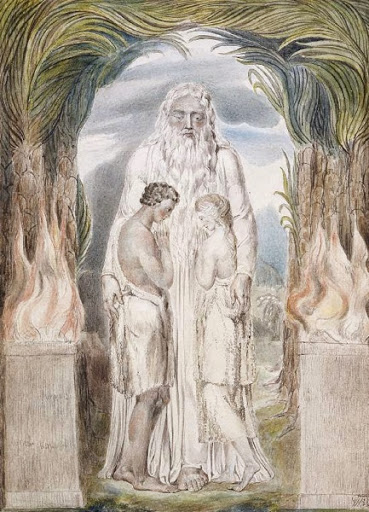
Blake divine presence

Pope Francis has dedicated two of his Wednesday General Audiences to the topic of men and women, their equal dignity, complementarity and the challenges they and their relationships face today. These two catecheses are set within the broader context of the family that he has been speaking about for several weeks now. However, since the question of how the complementarity of men and women is to be understood is close to my heart, I would like to offer a selection of passages from these two talks, which present a particularly clear and useful perspective.

Two weeks ago, Pope Francis started addressing this question by going back to its first treatment in the Bible, to the first creation account in Genesis, and underlining the joint value of man and woman:1

“As we all know, sexual differences are present in so many forms of life, in the long scale of the living. However, only in man and in woman does it bear in itself the image and likeness of God: the biblical text repeats it a good three times in two verses (Genesis 1:26-27): Man and woman are image and likeness of God! This tells us that not only man in himself is the image of God, not only woman in herself is the image of God, but also that man and woman, as a couple, are the image of God. The difference between man and woman is not for opposition, or for subordination, but for communion and creation, always in the image and likeness of God.”

Pope Francis then reflects on gender theory, which he rejects, and to which he offers an alternative, but whose roots he recognizes:

“I wonder […] if the so-called gender theory is not also an expression of a frustration and of a resignation, which aims to cancel the sexual difference because it no longer knows how to address it. Yes, we risk taking a step backward. The removal of the difference, in fact, is the problem, not the solution. To resolve their problems of relation, man and woman must instead talk more to one another, listen more to one another, know one another more, love one another more. They must relate to one another with respect and cooperate with friendship.”

Instead of a denial of differences, the key is respect, communication, friendship and love. However, the present problems are not to be laid equally at the feet of men and women:

“It is without doubt that we must do much more in favor of woman if we want to give back more strength to the reciprocity between men and women. In fact, it is necessary that women not only be more listened to, but that her voice has real weight, a recognized authoritativeness in society and in the Church. The way itself with which Jesus considered women – we read it in the Gospel, it is so! – in a context less favorable than ours, because in those times women were in fact in second place … and Jesus considered them in a way which gives a powerful light, which enlightens a path that leads far, of which we have only followed a small piece. We have not yet understood in depth what things the feminine genius can give us, which woman can give to society and also to us. Perhaps to see things with other eyes that complements the thoughts of men. It is a path to follow with more creativity and more audacity.”

While Pope Francis does not present a solution, he very clearly identifies the problem and sets the challenge of identifying ways that would lead to women having the place in society and the Church that they are due.

In the second catechesis this morning, Pope Francis returns to the question of reciprocity and equal dignity, and he takes the second creation account from Genesis as the starting point:

“[In the second chapter of Genesis] we read that the Lord, after having created heaven and earth, “formed man of dust from the ground, and breathed into his nostrils the breath of life; and man became a living being.” He is the pinnacle of creation. Then God put man in a most beautiful garden so that he would till and keep it. […] When […] God presents woman to him, man rejoices and recognizes that creature, and only that one, which is part of him: “bone of my bones and flesh of my flesh.” Finally, there is a reflection of himself, a reciprocity.”

While the second creation account establishes a closeness between man and woman, where woman is the “flesh of [man’s] flesh,” and which Pope Francis refers to in the same way in which the creed describes how God the Father and Jesus relate (as being consubstantial), he is quick also to emphasize that woman is created directly by God and not in some way by or through man:

“Woman is not a “replica” of man; she comes directly from the creative gesture of God. The image of the “rib” does not express inferiority or subordination but, on the contrary, that man and woman are of the same substance and are complementary. And the fact that – still in the parable – God formed woman while man slept, stresses in fact that she is in no way creature of man, but of God. And it also suggests something else: To find woman, and we can say to find love in woman, to find woman, man must first dream her and then he finds her.”

I particularly like the poetry of Pope Francis speaking about man dreaming woman to then find her and find love in her!

Francis then returns to the challenges facing men and women by reference to suspicion and mistrust and delusions of one’s omnipotence that we are all prone to:

“God’s trust in man and woman, to whom he entrusts the earth, is generous, direct and full. However, it is here where the Evil One introduces in his mind suspicion, incredulity, mistrust and finally disobedience to the commandment that protected them. They fall into that delirium of omnipotence that contaminates everything and destroys harmony. We also feel it within ourselves, so many times, all of us.”

From the general, Francis turns to denouncing injustice and violence committed against women as a result of patriarchal excesses, chauvinism and a turning of women into merchandise and a means:

“Sin generates mistrust and division between man and woman. Their relationship is threatened by thousands of ways of dishonesty and submission, of deceitful seduction and humiliating arrogance, even to the most dramatic and violent degrees. History bears their marks. Let us think, for instance, of the negative excesses of patriarchal cultures. Let us think of the many forms of chauvinism where woman is considered to be second class. Let us think of the instrumentalization and merchandising of the female body in current media culture.”

Next, he makes a pitch for a revival of an alliance between man and woman, whose absence leads to an uprooting of children from their maternal wombs:

“However, let us also think of the recent epidemic of mistrust, skepticism and even hostility that is spreading in our culture – in particular beginning with an understandable mistrust by women – in relation to an alliance between man and woman that would be able to, at the same time, improve the intimacy of communion and to protect the dignity of difference. If we do not find a jolt of sympathy for this alliance, that leads new generations to repairing mistrust and indifference, children will come into the world ever more uprooted from the maternal womb. The social devaluation of the stable and generative alliance of man and woman is certainly a loss for all. We must reassess marriage and the family!”

How so we go about such a reassessment though? Here Francis offers two indications. First, that marriage derives from a self-emptying for the sake of a new, joint journey where the spouses become all for each other (which is precisely the Trinitarian economy):

“And the Bible says a beautiful thing: man finds woman, they find one another, and man must leave something to find her fully. And for this, man will leave his father and his mother to go to her. It is beautiful! This means beginning a journey. Man is all for woman and woman is all for man.”

Second – and this should come as no surprise to anyone who has been following last year’s Synod on the Family or even just the Bull of indiction of the coming Jubilee of Mercy – that God is a tender, loving father to all, regardless of their shortcomings and that we too are called to treat others in exactly that same way. And Francis offers a surprising, beautiful reading of the motives behind Adam and Eve leaving Paradise clothed:2

“To care for this alliance of man and woman – even if they are sinners and wounded, confused and humiliated, mistrustful and uncertain – is therefore, for us believers, a challenging and exciting vocation, under present circumstances. The same account of creation and of sin, at its end, gives us a most beautiful icon: “And the Lord God made for Adam and for his wife garments of skins, and clothed them.” It is an image of tenderness to that sinful couple that leaves us with our mouth open: the tenderness of God for man and for woman. It is an image of paternal care of the human couple. God himself takes care of and protects his masterpiece.”


1 Note, that the English quotes from Pope Francis’ catecheses are mostly verbatim from the Zenith translations, except for a few passages that are adjusted based on the Italian original in an attempt of a more literal rendering.
2 Which turns out to be highly consonant with William Blake’s depiction of that scene, shown at the top of this post.


In continuous search of the other

Complementarity

Just under a month ago, from 17th to 19th November, the Humanum conference on the “Complementarity of Man and Woman” took place at the Vatican, hosted by the Congregation for the Doctrine of the Faith. There thirty speakers from around the world belonged to various religions, including Hinduism, Buddhism, Islam and Christianity of various kinds, and the talks were wide ranging in the aspects of the family they addressed, reaching far beyond the titular question of complementarity.

In this post I would, however, like to zoom in on things said specifically about complementarity itself (even at the expense of leaving out other, also very interesting content), since that is a topic close to my own heart. The following will therefore be a look at the highlights of what has been said there about how men and women relate, using the hermeneutic of complementarity.1, 2

Right at the start of the symposium, Pope Francis set the scene by rooting complementarity in the words of St. Paul and by panning out to show that it is a profound attribute of God, instead of only a device for thinking about men and women:

“You must admit that “complementarity” does not roll lightly off the tongue! Yet it is a word into which many meanings are compressed. It refers to situations where one of two things adds to, completes, or fulfills a lack in the other. But complementarity is much more than that. Christians find its deepest meaning in the first Letter to the Corinthians where Saint Paul tells us that the Spirit has endowed each of us with different gifts so that-just as the human body’s members work together for the good of the whole-everyone’s gifts can work together for the benefit of each. (cf. 1 Cor. 12). To reflect upon “complementarity” is nothing less than to ponder the dynamic harmonies at the heart of all Creation. This is a big word, harmony. All complementarities were made by our Creator, so the Author of harmony achieves this harmony.”

Having set the scene, Francis then bridges God’s intrinsic harmony and its being the modus operandi of the family, also projecting out its consequences:

“This complementarity is a root of marriage and family. For the family grounded in marriage is the first school where we learn to appreciate our own and others’ gifts, and where we begin to acquire the arts of cooperative living. For most of us, the family provides the principal place where we can aspire to greatness as we strive to realize our full capacity for virtue and charity.”

And finally, Francis warns against an oversimplification and a misunderstanding of complementarity, which, I believe, have plagued thinkers both aligned with the Church and opposed to it:

“When we speak of complementarity between man and woman in this context, let us not confuse that term with the simplistic idea that all the roles and relations of the two sexes are fixed in a single, static pattern. Complementarity will take many forms as each man and woman brings his or her distinctive contributions to their marriage and to the formation of their children — his or her personal richness, personal charisma. Complementarity becomes a great wealth. It is not just a good thing but it is also beautiful.”

The sketch presented by Pope Francis was then fleshed out by Cardinal Gerhard Müller, Prefect of the Congregation for the Doctrine of the Faith, whose analysis departs from the question of (in)completeness:

“One’s own male or female being is not sufficient to oneself. Each one of us feels needy and lacking in completion. [… W]e do not complete ourselves from our own selves, we are not totally self-sufficient. This simple consideration, clear to all, would suffice to demonstrate the inadequacy of the markedly individualistic trait so characteristic to the modern mentality.”

This inbuilt individual self-insufficiency is, Müller argues, positive, since it impels us to go beyond ourselves and since it is in this way that we are in God’s image:

“[I]n the Bible difference is the place of blessing, the exact place where God will make present His action and His image. In this way, we can comprehend that in Scripture, each of the two, Adam and Eve, are measured not only according to their mutual relation but above all from the starting point of their relationship with God. Indeed, in the singularity of each and not only in their union as a couple, we find inscribed the image of the One who has created them. Here, man and woman share the same humanity, the same incarnate condition, and sexual difference does not imply subordination one to the other: “both man and woman are human beings to an equal degree, both are created in God’s image” In this vein, Saint John Paul II said that male and female are as “two incarnations of the same metaphysical solitude before God and the world as two ways of being body and together [hu]man, who complete each other reciprocally.””

Next, Müller argues in a surprising twist that the union between man and woman has an unexpected consequence:

“[I]n the book of Genesis the union of man and woman does not lead to a fulfilment, does not close them within themselves, for it is precisely in uniting with each other that they open themselves to the greater presence of God. One might well say that in the very union of the two, man and woman render themselves needier, which makes increase in them the thirst of the mystery in the measure that their radical reference to the Creator God is revealed more clearly. The union sets off, therefore, a dynamic, a movement, as the Song of Songs recounts, in which the lover and beloved are at the same time in continuous search of the other and of God.”

Müller then arrives at considering the profound nature of complementarity and underlines it being anything but a polar stereotype:

“It is precisely the presence of God within the union between man and woman that helps us consider the meaning of their complementarity. This cannot be understood in a polar fashion, as if male and female were opposed realities who complete each other perfectly: active and passive, exterior and interior, so as to become a closed unity; rather, it is a matter of different ways of situating themselves in the world so that, when they come together, far from closing themselves in, these open the path towards the world and others, a path that leads above all to the encounter with God.”

The reality of children too can be seen from the perspective of incompleteness and of being directed towards God:

“The union of male and female is complementary not in the sense that from it ensues one complete in him or herself, but in the sense that their union demonstrates how both are a mutual help to journey towards the Creator. The way in which this union refers to itself always beyond itself becomes evident in the birth of a child. The union of the two, making themselves “one flesh,” is proven precisely in the one flesh of those generated by that union. Hence, we see confirmed how complementarity also means overabundance, an insurgence of novelty. From the presence of the child comes a light that can help us describe the complementarity of man and woman. The relationship of the parents with the baby, where both open out beyond themselves, is a privileged way to understand the difference between the man and the woman in their role as father and mother. Complementarity is not understood, therefore, when we consider man and woman in an isolated form, but when we consider them in the prospective of the mystery to which their union opens out and, in a concrete way, when we look at male and female in light of the relationship with the child.”

Finally, and only after an ample emphasis on the complexity, richness and God-centeredness of complementarity, does Müller speak about male and female characteristics, while again insisting that “male and female are dimensions that interconnect and exchange”:

“One might add that the female aspect is characterized by a constant presence, which accompanies always the child. Indeed, in German, when a woman is pregnant, we say that she “carries a baby beneath her heart” Contemporary philosophy has spoken of the feminine as a dwelling place, as presence that envelops man from the beginning and accompanies him along the way, as singular sensitivity for the person as gift and for his affirmation.

On the other hand, the male is characterized, in terms of the child, as the presence of someone “in the distance,”in a distance that attracts, and, therefore, helps in walking the journey of life.

Both male and female are necessary to transmit to the child the presence of the Creator,both as love that envelops and confirms the goodness of existence despite all else, and as a call that from afar invites one to grow. In this way, male and female are dimensions that interconnect and exchange, such that the woman enriches man and man the woman, because one participates in the property of the other and may transmit together to the child being in the image of God.”

In many ways, listening to Cardinal Müller reminds me of an, at first perplexing, but upon further reflection profound quote by the Marxist philosopher Slavoj Žižek: “The only way to the universal good is that we all become strangers to ourselves.”

Another speaker at the conference whose words shed light on complementarity is Henry B. Eyring, president of The Church of Jesus Christ of Latter-day Saints. His words have great beauty and can also be seen as a lived experience of the concepts Müller presented:

“Most remarkable to me has been the fulfillment of the hope I felt the day I met my wife. I have become a better person as I have loved and lived with her. We have been complementary beyond anything I could have imagined. Her capacity to nurture others grew in me as we became one. My capacity to plan, direct, and lead in our family grew in her as we became united in marriage. I realize now that we grew together into one—slowly lifting and shaping each other, year by year. As we absorbed strength from each other, it did not diminish our personal gifts. Our differences combined as if they were designed to create a better whole. Rather than dividing us, our differences bound us together.”

Wael Farouq, Visiting Professor of Islamic Studies at the Catholic University of Milano, extends the generative role of the male-female relationship to meaning and likens it to linguistic mechanisms:

“We can say that the complementarity of man and woman is an encounter which generates life and meaning not only in terms of children, but life and meaning which is at the heart of every encounter of man and woman in daily living.

The greatest danger the family faces today is its being emptied of all meaning, being turned into something that can be possessed, bought, and sold. […]

In Arabic, there is no word “to be” or “being” in the absolute. For this reason, one single word has neither meaning or grammatical function, unless it is located in a sentence. You can only understand this verb in relation to the other elements of the sentence. The word in a sentence is like the person in a family: is nothing, unless within a relationship.”

Finally, Lord Jonathan Sacks, the former Chief Rabbi of the United Kingdom, delivered an extraordinary speech, reflecting on a broad range of issues to do with the family. Focusing in just on the concept and role of complementarity, Sacks too emphasizes the importance of the relationship, of conversation:

“[T]ruth, beauty, goodness, and life itself, do not exist in any one person or entity but in the “between,” what Martin Buber called Das Zwischenmenschliche, the interpersonal, the counterpoint of speaking and listening, giving and receiving. Throughout the Hebrew Bible and the rabbinic literature, the vehicle of truth is conversation. In revelation God speaks and asks us to listen. In prayer we speak and ask God to listen. There is never only one voice. In the Bible the prophets argue with God. In the Talmud rabbis argue with one another. In fact I sometimes think the reason God chose the Jewish people was because He loves a good argument.”

Sacks then proceeds to revisit the value and purpose of otherness that Müller also emphasized, by providing a close reading of Genesis 3 where he links it to the desire for immortality and to the recognition of equal personhood:

“If we read [Genesis 3:19-21, the end of the story of Adam and Eve] carefully, we see that until now the first man had given his wife a purely generic name. He called her ishah, woman. […] For him she was a type, not a person. […] What is more he defines her as a derivative of himself: something taken from man. She is not yet for him someone other, a person in her own right. She is merely a kind of reflection of himself.

As long as the man thought he was immortal, he ultimately needed no one else. But now he knew he was mortal. He would one day die and return to dust. There was only one way in which something of him would live on after his death. That would be if he had a child. But he could not have a child on his own. For that he needed his wife. She alone could give birth. She alone could mitigate his mortality. And not because she was like him but precisely because she was unlike him. At that moment she ceased to be, for him, a type, and became a person in her own right. […]”

Finally, Sacks presents the consequences of man recognizing in woman a person in her own right, bound to him by love:

“At that moment, as they were about to leave Eden and face the world as we know it, a place of darkness, Adam gave his wife the first gift of love, a personal name. And at that moment, God responded to them both in love, and made them garments to clothe their nakedness, or as Rabbi Meir put it, “garments of light,” [since] the Hebrew word for “skin” is almost indistinguishable from the Hebrew word for “light.”

And so it has been ever since, that when a man and woman turn to one another in a bond of faithfulness, God robes them in garments of light, and we come as close as we will ever get to God himself, bringing new life into being, turning the prose of biology into the poetry of the human spirit, redeeming the darkness of the world by the radiance of love.”

Looking at the above thoughts in their totality – from Pope Francis’ broad strokes, via their profound elaboration by Cardinal Müller, through the personal witness of President Eyring and the Muslim perspective of Prof. Farouq, and being brought to fruition in the words of Rabbi Sacks – a picture emerges where complementarity is tightly linked to God Himself, more so than to men and women. Instead of having its roots in the differences between the two sexes, complementarity propels one person outside themselves and towards an other, towards a dynamic harmony. Instead of deriving from static differences between two parties, complementarity subsists imperfectly in the interpersonal and is fulfilled in the relationship between our finite selves and the infinite love of God. As such, instead of confining differences to their original owners, complementarity engenders their becoming gifts for the other – a mutual enriching and transfer of all that is good, beautiful and true. And while relationships between men and women are particularly suited for the coming about of complementarity, I believe that complementarity is a principle that acts in all human contact. Each one of us has distinctive contributions to make in our relationships with others, that can engage with what they lack and what they seek on the way to fulfillment, completeness and communion.


1For completeness sake, it is worth noting that, in addition to the speakers, whose thoughts on complementarity are covered here in detail, Sister M. Prudence Allen also spoke about it and did so in terms of four aspects of complementarity: equal dignity, significant difference, synergetic relation and intergenerational fruition.
2 Please, note that the following is not the order in which the talks were given.

Men and women: towards unity in diversity

Chagall adam and eve

[Warning: Long read.]

My personal experience of having many good friends among both men and women is leading me to believe that differences between the two genders are real, but that their nature is very complex and that any attempt to characterize one versus the other ends up in traits that span some of both genders’ populations. No matter what profile is devised with the intention to characterize what a man’s trademark traits are, there will be women I know who excel at some of them, and, equally, I can think of men who excel at traits that would be attributed to the archetypal woman.

Claims that women are more intuitive while men are more rational have always struck me as simplistic and reductive in terms of their predictive capacity in the face of meeting a new person of either gender, and – more importantly, I have found them to be unhelpful, or even obstructive, when it comes to building relationships. Yet, the view of resolving the question about the differences between men and women by means of two list of ‘typical’ traits is very popular, as can also be seen from best-sellers like “Men are from Mars, Women are from Venus” (the first book I read that compelled me to write a review on Amazon :).

To counter this trend, I would like to sketch out my understanding of how men and women compare, and do so from two perspectives: the first one being science (both neuroscience and psychology) and the second one religion (specifically Christianity, and even more specifically Catholic exegesis, the Theology of the Body of St. John Paul II and the intellectual visions of the Servant of God, Chiara Lubich).

From the perspective of science, there is a growing body of work on quantifying both the neurological/physiological and psychological differences between men and women, where certain physical as well as behavioral differences have been measured repeatedly and for which evidence is mounting.

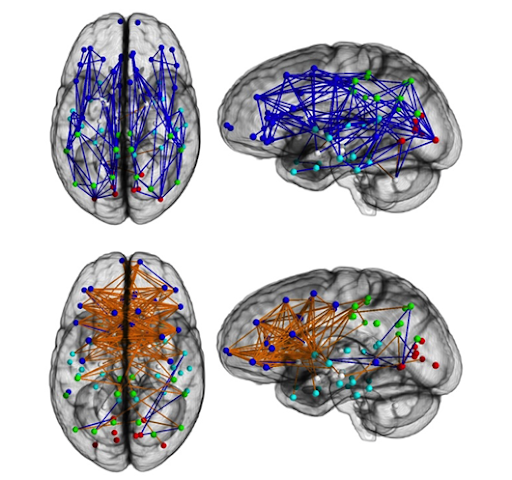
On the neurological and physiological side, there is strong evidence (obtained by a team from Oxford and Cambridge, who pooled together 126 studies, involving 43 000 subjects) to show that the brains of men are between 8% and 13% larger in volume than those of women. There is also evidence for there being significant differences between the relative volumes and densities of different regions in the brain between men and women. A recent example here is the work of Nopoulos et al. from the University of Iowa, who used functional Magnetic Resonance Imaging (fMRI) to study the ventral prefrontal cortex (VPC), a region involved in social cognition and interpersonal judgment. The findings, based on 30 men and 30 women, showed a relatively larger volume of this region in women, by 10%. In other words, relative to the total volume of a brain, the VPC region is 10% larger in women. Finally, there are not only volumetric differences between the brains of men and women, but also morphological ones. Here the most well-known, recent study is by Ingalhalikar et al., where the brains of 949 subjects (428 male and 521 female) were studied in terms of the nature of neural connections (connectome maps) between and within brain hemispheres (using diffusion tensor imaging). The results showed a systematic difference where male brains displayed a greater degree of intra-hemispherical synaptic connections (see top of following figure), while female brains had more prevalent inter-hemispherical links (see bottom of following figure). Interestingly, the authors of this study refer to the differences between the connectome maps of males and females as being a “complementarity” that makes them particularly suitable for collaboration …

Penn medicine

While there is strong evidence for systematic physiological differences between male and female brains, the question of what their consequences are remains far less clearly understood. E.g., taking the question of intelligence, there are studies whose results support all three of the possible outcomes: that there is no statistically significant difference, that men are more intelligent, or that women are more intelligent on average (e.g., see pp. 72 of the following paper). Even in the cases where a difference is shown, it tends to be small: 2-4 points in terms of the well known IQ test, and whether it is men or women who come out ahead depends on the specific test used. E.g., in a study involving 6780 subjects from Brazil, women came out ahead by 2 IQ points using Cambraia’s Attention Test, while men did better in Raven’s Standard Progressive Matrices test – by 1.8 IQ points. Similarly the behavioral consequences, from the perspective of differences between the sexes, of the VPC differences measured by Nopoulos et al., present a complex picture. There, no significant differences were found between men and women in terms of performing the Interpersonal Perception Task, which tests a subject’s ability to understand different types of social interaction. However, when the subjects were asked to complete a Personal Attributes Questionnaire (answering questions that lead to the subject’s self-perception in terms of two scales: “instrumentality” and “expressivity”, which are commonly taken to stand for masculinity and femininity and are used as a measure of gender identity), the resulting scores displayed strong correlation with the Interpersonal Perception Task outcomes.

The point of the above examples taken from recent findings in neuroscience and psychology, from studies that explore the differences between men and women, is to illustrate the complexity of the results obtained to date. On the one hand there is strong evidence for biological differences between male and female subjects, while on the other hand the specific nature of the differences and their impact on psychological traits or inclinations is complex and does not neatly divide along lines of a subject’s sex. While nature differs on average, an individual’s characteristics make them different from their sex’s average, with nurture and society further contributing to there being a continuum of states instead of a binary categorization of abilities, preferences, or traits. In my opinion, the psychology of personality, as opposed to that of gender, is a better means for understanding how one individual may differ from another in terms of their preferences and inclinations, which in turn can facilitate building mutually-fulfilling relationships.1

Turning to how the differences between men and women are understood in the context of Christianity, I would like to highlight three perspectives, as already mentioned at the beginning of this post.

First, there is St. John Paul II’s Theology of the Body, as set out in his “Men and Women He Created Them,” which I have already written about at length here. The only insight I’d like to point to here is John Paul II’s insistence on men and women being created “in the image of God” intrinsically referring to the communion of Persons in the Trinity. He makes this clear by saying that “man2 became the image of God not only through his own humanity, but also through the communion of persons, which man and woman form from the very beginning.” And it is in this context that the differences between men and women have a specific purpose, which is that these “two reciprocally completing ways of “being a body” [… are] complementary dimensions of self-knowledge and self-determination.” This in turn leads John Paul II to saying that a person’s “sex expresses an ever-new surpassing of the limit of man’s solitude [… and] always implies that in a certain way one takes upon oneself the solitude of the body of the second “I” as one’s own.” Men and women are different and complementary, but in profound, existential ways rather than as reducible to a trivial set of typical features or traits.

Second, the New Testament is rich in portraying different roles played by men versus women in the context of Jesus’ mission on Earth. Here Damiano Marzotto’s “Pietro e Maddalena” (mentioned by Pope Francis as being on his reading list), does a superb job of analyzing what these roles are in the Gospels, as a first step towards understanding how women could play the prominent role that they need to have in the Church, which they lack today. Marzotto summarizes his findings by first pointing out a greater propensity in women for welcoming Jesus’ teaching and making themselves available for a deepening and contemplation of his message (with men then acting on what the women understood). Mary’s keeping the events surrounding Jesus’ birth and “reflecting on them in her heart” (Luke 2:19) illustrates this very clearly. This places women in a position of welcoming novelty, of taking risks and of stepping out of line – traits not commonly associated with women in first century Palestine. The women of the Gospel, while having some common features, very much break the mold of societal stereotypes – another argument against characterizing men and women by sets of static, opposed features. The second aspect that Marzotto identifies in the women of the Gospel is an ability to anticipate Jesus’ actions and to provoke him or the apostles to action. Mary’s intervention at the wedding in Cana (John 2:1-12), or Mary Magdalene going to the apostles after meeting the risen Christ (John 20:1-3) are good examples here. Finally, Marzotto also argues that women have been responsible for a broadening of Jesus’ mission, for a greater universality of who it is addressed to. Here the woman suffering from hemorrhage (Mark 5:25-34), the Samaritan woman (John 4:4-42), the Canaanite woman (Matthew 15:21-28), or the widow of Nain (Luke 7:11-17) are great examples.

Third, the Servant of God, Chiara Lubich, in her intellectual visions (like those of Sts. Teresa of Ávila and Ignatius) during the summer of 1949 (referred to as the Paradise ’49), prefigures St. John Paul II’s interpreting the relationship between men and women from the perspective of the Trinity. As Giuseppe Maria Zanghí puts it, “this means that a meeting between the two “differences” requires, in each one of the two, a fullness of being: their synthesis is possible […] because, already before the two meet, each one of them is complete in themselves. Every form of weakness, every temptation of “subjection”, is overcome. […] True unity between man and woman can be achieved if each of the two realities is fulfilled in itself.” During her visions in 1949, Lubich recounts the following insight:

“The perfect man has the woman in him: he contains in his strength all of feminine sweetness, in his directness all of a woman’s suppleness. His character is unitarian, closed and severe like unity. But, if he is perfect (unitarian), he contains in himself the Trinity, who is a woman that is all open, caressing, loving. So the woman too, if she is perfect, encloses her open character in self-restraint that is reminiscent of the Madonna. She is man. Trinity in Unity.” (Paradise ’49, 1319-1320)3

The relationship between men and women, as understood also by Lubich in her mystical vision, is one of unity in distinction and distinction in unity, which is love. To reduce it only to distinction, and to a simplistic binary one at that, is to deny the Trinitarian image in which both men and women were made, and it is also to distort the complex and deeply beautiful picture that science is in the process of understanding as we speak.

[UPDATE on 17 November 2014:] Today Pope Francis opened a symposium on precisely the subject of how men and women relate, entitled “The Complementarity of Man and Woman in Marriage,” during which he had the following to say about the nature of differences between the sexes:

“Christians find [the] deepest meaning [of complementarity] in the first Letter to the Corinthians where Saint Paul tells us that the Spirit has endowed each of us with different gifts so that-just as the human body’s members work together for the good of the whole-everyone’s gifts can work together for the benefit of each. (cf. 1 Cor. 12). To reflect upon “complementarity” is nothing less than to ponder the dynamic harmonies at the heart of all Creation. […]

When we speak of complementarity between man and woman in this context, let us not confuse that term with the simplistic idea that all the roles and relations of the two sexes are fixed in a single, static pattern. Complementarity will take many forms as each man and woman brings his or her distinctive contributions to their marriage and to the formation of their children — his or her personal richness, personal charisma.”


1 But, we’ll have to leave that for another time …
2 “Man” here meaning the human person (as is clear from the context of the original text).
3 Apologies for the crude translation, the Italian original can be found in Zanghí’s “Leggendo un carisma” on pp. 149-150.

Patriarchal plan perplexity

1231

The other day I came across a series of blog posts by Phillip Cary, professor of philosophy at Eastern University, Yale Divinity alumnus and author of multiple books, three of which were even published by OUP. Given his credentials, my expectations were high and – after reading the posts – my subsequent disappointment, by their obvious lack of insight, commensurably deep.

The posts are an exegesis of the first chapters of Genesis regarding the relationship between man and woman, with the penultimate one focusing on Genesis 3:16 – the words God addresses to the woman after she and the man eat from the forbidden “tree of knowledge of good and evil”: “To the woman he said: I will intensify your toil in childbearing; in pain you shall bring forth children. Yet your urge shall be for your husband, and he shall rule over you.” Cary is “puzzled” here by the juxtaposition of the woman’s desire for her husband and his ruling over her and sets out to interpret the meaning of these words of Scripture from the perspective of being God’s plan for how man and woman are to relate:

“My assumption has been that God’s word in Genesis 3 aims at a justice that sets things right. So how does patriarchy, the rule of a man over his wife, set things right? […]

[T]he key point about this patriarchal framework [… is]: because the property of the patriarch consists fundamentally of living things, the increase of wealth and the blessing of procreation are nearly the same thing in Genesis. […]

[T]he man who rules over his wife has a deep economic interest in seeing that she lives well, is healthy and flourishes together with her children, being fruitful and multiplying.”

[And from the following post: T]hat is the framework within which I think we can begin to make sense of patriarchy, where procreation, wealth and the father’s rule of the household coincide. And that in turn is the initial framework we need to see the meaning of God’s word to the woman about her desire for her husband and his ruling over her.”

What I understand from the above is that Cary is saying the following: making the man rule over the woman, in response to their joint disobedience, is a way to re-introduce the value of life in a world where death has entered as a result of the Fall. Life is an economic good and by making procreation a contributor to its proliferation, the husband – who is in charge of the household – benefits and consequently treats his wife well, like he would any other profit-generating asset.

Charming.

Before we get sucked into a diatribe against such a view, let’s take a breath and rewind to Genesis 2:24,1 where man and woman are described before the Fall and where their relationship is one of profound unity: “a man leaves his father and mother and clings to his wife, and the two of them become one body.” In the “one body” there is no master versus slave, no ruler versus subject – there is only one union between man and woman. This is God’s plan for humanity, and, I believe, Cary’s basic mistake is in taking the punishment delivered to man and woman after their disobedience and mistaking it for how man and woman are meant to relate to each other, to the point of arguing for the economic benefits of a relationship that is instituted as punishment. This is like taking the punishing of a child by making them sit still and extolling the virtues of motionlessness in terms of its low carbon footprint.

In fact, Cary’s approach is also at odds with the interpretation Blessed Pope John Paul II makes of Genesis 3:16 in his Man and Woman He Created Them:2

“[T]he words of Genesis 3:16 signify above all a breach, a fundamental loss of the primeval community-communion of persons. This communion had been intended to make man and woman mutually happy through the search of a simple and pure union in humanity, through a reciprocal offering of themselves, that is, through the experience of the gift of the person expressed with soul and body.”

He even goes on to characterize the state instituted in Genesis 3:16 as being a “deformation” of the “original beatifying conjugal union of persons” before the Fall. And if any more evidence were needed for taking this verse not as God’s plan for humanity but as a description of what happens when that plan is corrupted, we only need to look as far as the second reading from the feast of the Holy Family nine days ago, where St. Paul has the following to say: “Wives, be subordinate to your husbands [… h]usbands, love your wives” (Colossians 3:18-19). The advice here is not for husbands to rule, but to love, which, incidentally, also means to self-empty, to subordinate oneself – the exact same thing also asked of wives. The result is a mutual subordination of husband and wife to each other, or – as John Paul II put it – “a reciprocal offering of themselves […] with soul and body.”


1 Just to avoid misunderstandings, speaking about the events described in Genesis does not presuppose considering them to be historical events. The opening chapters of Genesis are a myth, which does not mean to suggest that they are false, but instead that they speak about deep anthropological, psychological and ontological features in a more archaic form – by way of analogy instead of by description of events in this Universe.
2 For more on this book by John Paul II, see here.

Man and woman: the beginning

Woman

It has been a long time since I last read a text that filled me with excitement and admiration and lead me through a seemingly inexhaustible sequence of insights and profound realizations. The book I am talking about is John Paul II’s “Man and Woman He Created Them,” which presents his “Theology of the Body” – a term that I have heard mentioned on various blogs but that has meant little more to me than a buzz-word so far.

The book presents the content of a series of talks that Blessed John Paul II gave during his Wednesday general audiences between September 1979 and November 1984 (!) that closely track a manuscript he wrote before being elected pope. Instead of the usual pastoral material, typically presented at events like these, the first chapter already makes it crystal clear that the book is going to be technical and intellectually challenging material. To think that he shared it with the crowds who came to see him in Rome is astonishing to me by itself, as it is the polar opposite of the typical dumbing-down that so often informs pubic communication.

The starting point is the origin of the family in marriage, whose indissolubility Jesus categorically reaffirms when challenged by some Pharisees:

“Have you not read that from the beginning the Creator created them male and female and said, ‘For this reason a man will leave his father and his mother and unite with his wife, and the two will be one flesh’? So it is that they are no longer two, but one flesh. Therefore, what God has joined let man not separate.” (Matthew 19:4-6; emphasis by John Paul II)

Here John Paul II picks up on Jesus’ emphasis on “the beginning” and his quoting of verses from two separate chapters of Genesis. Instead of this passage from Matthew being only taken as a confirmation and reinforcement of the Genesis model of marriage, Jesus’ emphasis on “the beginning” triggers an analysis of the creation of humanity. In fact, John Paul II focuses on the specific features and complementary differences of the two Genesis accounts to look not only at the differences between male and female genders, but at key characteristics of what it means to be human.

The first account (which is chronologically more recent and which has more of a theological character) is that “God created man [hā’ādām, collective noun: “humanity”?] in his image, in the image of God he created him, man [zākār, male] and woman [neqēbāh, female] he created them.” (Genesis 1:27, John Paul II’s additions in []). In other words, the creation of man and woman is “a single act.” In contrast, in the second account (which is more ancient and has more of a mythical character), man’s creation (Genesis 2:5-7) precedes that of woman’s (Genesis 2:18-23). However, even here, the first human being is called “man” (’ādām), “while from the moment of the creation of the first woman, [Genesis] begins to call him “male,” îš, in relation to ’iššāh (“woman,” because she has been taken from the male = îš).”

While the above “single-act” creation of the sexes is an aspect of Genesis that I certainly was not aware of, the most impressive move in John Paul II’s analysis comes next and is the insight that the solitude of the pre–male-female differentiated “man,” – expressed in Genesis as “It is not good that the man should be alone” (2:18) – is a reference not only to an individual’s solitude (lacking a mate) but to a fundamental feature of every person’s nature. In Genesis, the first “man” is shown both as being separate from the rest of creation (being alone in spite of a multitude of other living beings already populating the world) and as searching for his identity (being asked by God to name “every living creature” but not “find[ing] a help similar to himself” (Genesis 2:19-20)).

This original solitude of the human person indicates self-consciousness and the commandment about not eating from the “tree of the knowledge of good and evil” introduces self-determination (free will) as a basic feature of humanity. These two together make the human person “created in the image of God” and a “partner of the Absolute.” Next, John Paul II argues that it is man’s (’ādām’s) body that is the source of his awareness of solitude. This body that could have made man place himself as equal among the other created bodies, instead gives him awareness of his otherness and solitude. This in turn makes it evident that “the “invisible” determines man more than the “visible”.”

Next, man’s body is also the means of his “cultivating the earth” (Genesis 2:5) and “subdu[ing] it” (1:28), as the Genesis account further states. As a result, the human body is not only involved in man’s awareness of his separateness from the rest of creation and his potential for self-determination, but also “permits him to be the author of genuinely human activity[, where] the body expresses the person.” The final ingredient that John Paul II identifies in the Genesis account is the introduction of the difference between death an immortality in the form of the mystery of the three of knowledge: “The LORD God gave the man this order: You are free to eat from any of the trees of the garden except the tree of knowledge of good and evil. From that tree you shall not eat; when you eat from it you shall die.” (Genesis 2:16-17).

With man’s features emerging as his self-consciousness, self-determination and, as their consequence, relating to God as a partner, John Paul II turns to taking a closer look at the meaning of the original unity of humanity. The starting point here is an argument for there being a distinction between “bodiliness and sexuality” whereby our being bodies is fundamental to the structure of our being personal subjects, even before differences between the male and female genders are considered. Being a body is fundamental to being human and is intrinsic to the nature of that humanity (as John Paul II argues above), while masculinity and femininity are “two ways in which [a] human being […] is a body.” These two ways of being human bodies – the “double unity as male and female” – are introduced as means of overcoming the solitude of the sexually undifferentiated human. From the Genesis account of how male and female are differentiated, John Paul II notes in particular two aspects: First, that the “second I” – the female – that emerges from the “torpor” of the undifferentiated man during which differentiation is created – is “also personal and equally related to the situation of original solitude.” Second, that man “shows joy and even exultation […] for the other human being, for the second “I”.”

The first 8 chapters, a high-level synthesis of which the above has attempted, take us to the point of the basic features of man and woman having been sketched out, which is then the starting point for looking at the nature of the marital relationship. What I found particularly impressive, beyond the actual content and the psychological and anthropological profile of the human person that John Paul II presents, is the method of analysis he applies to Genesis. Throughout this discourse he is very clear about considering that text to be of mythical character, which “does not refer to fictitious-fabulous content, but simply to an archaic way of expressing a deeper content.” And he goes on to say that “[w]ithout any difficulty, we discover that content under the stratum of the archaic narrative, truly marvelous in the quality and condensation of the truths contained there.” What a guy! While I certainly cannot echo the “without difficulty” qualifier, the marvelousness and “quality and condensation of the truths” that he manages to reveal in this ancient text is amazing. His approach strikes me as being categorically different both from a naive, literal reading of Genesis that leads some to highly irrational and a-scientific conclusions and from a superficial “this is just a story” approach that fails to uncover deeper meaning.