Celibacy and marriage

Counsels

On Monday I listened with growing disappointment to a BBC Radio 4 program that intended to shed light on celibacy from the perspective of different faiths. The program’s panel was composed of a muslim cleric, a Catholic nun and an academic, who provided Buddhist and Hindu perspectives. Instead of dissecting the program here,1 I would like to share my personal, very much Christian, reflection and invite you to let me know what you make of it.

The optics I’d like to apply here are those of vocation.2 And I’d like to think about celibacy and marriage in parallel, since they are each key comparators for one another, and since talking about one without referencing the other would be artificial and woefully incomplete. Note also that I won’t attempt to knot a customary net of references, and will instead aim to present a synthetic and condensed exposition of my take on this topic, which has occupied my mind for a good 20 years so far.

First, I’d like to suggest that there is only one Christian vocation, which is to say (and keep saying) “Yes!” in response to God’s call to follow, imitate and love Him, directly and in my neighbors, and to give Him primacy in my life. Just as God didn’t supply Samuel with a job description when He called him (1 Samuel 3:1-10), like “a light silent sound” (1 Kings 19:12), or as Jesus didn’t issue the apostles with detailed terms and conditions (cf. Luke 5:1-11, Matthew 4:18-22), so too the specifics of following Him are part of the journey He invites me on. This adventure can take a myriad forms, like the infinite variety and ever-evolving novelty of God’s love itself.

Second, any perfection attained as a consequence of responding to God’s call is a gift. It can be welcomed and facilitated by staying attentive to the Holy Spirit’s “inspiration” in every present moment, by being open to embracing Jesus in every suffering and welcoming him among those who love one another mutually, and by placing one’s childlike trust in our loving Father. Perfection is not a human product, as the lives of so many saints attest.

Third, responding to my vocation yields both challenges and joys, where the natures and sources of both depend on the specific path I follow. On the surface of it, some are more likely if you are celibate while others are more typical of married life. Ultimately though, difficulties (suffering, frustration, disappointment) and joys alike are a consequence of what God wills or allows for me to experience and how I respond to it. This has nothing whatsoever to do with celibacy or marriage and everything to do with looking for God and embracing His will, moment by moment. Both have equal capacity for sanctification and torment, to the extent to which they lead to experiencing union with or absence from God.

Fourth, celibacy is a great treasure. It is an expression of a person’s permanent commitment to follow God’s call in total self-giving. By imitating Jesus’ celibate life, they, like He, devote themselves to supporting, enriching and guiding the People of God and proclaiming the Good News of God’s love to all. They, with their communities around them, are witnesses to God’s love in the world and a beacon of His fatherly and motherly love. The essence of celibacy is not a foregoing of sexual joy and the delights that one’s own children bring, but a positive, total gift of oneself to God, who is not to be outdone in generosity.

Fifth, marriage is a great treasure. It is an expression of a person’s permanent commitment to follow God’s call in total self-giving. By imitating the life of the Trinity, husband and wife become one family – a small church, where God dwells among those who follow his word. By “follow[ing] Jesus closely,”3 a family supports, enriches and guides the People of God and proclaims the Good News of God’s love to all. Married persons follow the evangelical counsels of poverty, obedience and chastity in ways proper to their circumstances and are available for transmitting God’s love to all. The essence of marriage is not an avoidance of a total commitment to God, a holding back of something for oneself, but a positive, total gift of oneself to God, who is not to be outdone in generosity.

Sixth, as one discerns how to follow God’s call in celibacy or marriage, it is understandable that one considers one’s own calling to be superior to the alternative. Since both have great riches and are means for sharing in the most intimate life of God, they each provide an overflowing basis for being extolled as superior. I believe that arguments for either exceeding the other ought to be read in this light – through their proponent’s eyes, and appreciated for being signs of the value and beauty that those who have chosen them see in them.

Finally, I would like to thank all who guided me during the time of discerning my vocation – some of whom were celibate, others married, and all of whom made me experience the presence of Jesus among his disciples – and my spouse, who is the tabernacle of our family.


1 If you’d like to hear it for yourself, a recording is available here. I’d be curious to know whether you found it enlightening or frustrating …
2 Since this is going to be spiritual and personal as much as intellectual, you might want to check out my standard Thomas-Nagel-inspired disclaimer in the second paragraph here.
3 Speaking about marriage a couple of weeks ago, Pope Francis described it as “men and women who have left their homes to commit to a lifelong marriage, that is to follow Jesus closely!”
The church that can(not) change

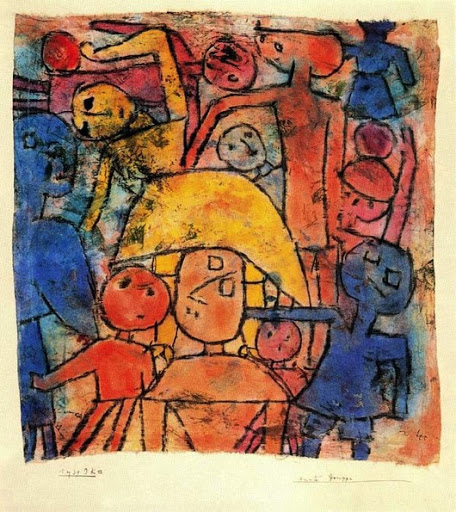
Paul Klee Colourful Group

A criticism frequently leveled at the Church is that it is set in its ways and that – unlike science – new inputs have no impact on its tenets. In a word, the Church comes across as static, in a world whose rate of change increases and that adapts and adjusts itself continuously. The end result is the appearance of mismatch and alienation, and Church representatives saying things like “These are the teachings of the church and they’re unchangeable truths.” does not help.

There is a very serious problem with statements like the above though and I am just saying so from the perspective of the Church itself, rather than as a criticism from outside. The problem is that such statements negate Jesus’ own words: “I have much more to tell you, but you cannot bear it now. But when he comes, the Spirit of truth, he will guide you to all truth.” (John 16:12-13). They deny “inspiration” received from the Holy Spirit and consider the Church’s teaching to be an immutable monolith obtained in one go rather than the gradual understanding of its full revelation in the person of Jesus. In fact Pope Francis himself reminds us that “throughout the history of salvation, whenever God reveals himself, He brings newness — God always brings newness — and demands our complete trust” and then goes on to challenge us:

“Are we open to God’s surprises? Or are we closed and fearful before the newness of the Holy Spirit? Do we have the courage to strike out along the new paths which God’s newness sets before us, or do we resist, barricaded in transient structures which have lost their capacity for openness to what is new?”

This is not to say that everything is open to change, but to be very clear about change being a core feature of Christian faith and consequently of the Church’s teaching too.

“OK,” you say “but does the Church actually change what it teaches?” Instead of answering that with a categorical “yes” and a lot of handwaving, let me present the following, very specific, example that I came across by accident some time ago. It concerns the question of “mixed marriages,” which here refers to marriages between one Catholic and one Christian, but non-Catholic spouse.

Let’s first look at how such marriages were spoken of in 1893, in Pope Leo XIII’s Constanti Hungarorum encyclical:

“[T]o remove the source of many evils, it is of utmost importance that pastors never cease to admonish their flocks to refrain as far as possible from entering into mixed marriages. Let the faithful correctly understand and resolutely remember that it is their duty to regard with horror such marriages, which the Church has always detested. They are to be abhorred for the reason which we emphasized in another letter, “They offer the opportunity for a forbidden sharing and participation in sacred things; they create a danger to the religion of the Catholic partner; they are an impediment to the virtuous education of children and very often cause them to become accustomed to viewing all religions as equal because they have lost the power of discriminating between the true and the false.” (Pope Leo XIII, Arcanum)”

Uff … “source of many evils,” “regard with horror,” “the Church has always detested,” “to be abhorred,” “impediment to the virtuous education of children [… who lose] the power of discriminating between the true and the false.” Sounds nasty!

Scroll ahead 100 years and look at what the 1993 Catechism of the Catholic Church says on the exact same subject (§1633-1637):

“[Mixed marriage] requires particular attention on the part of couples and their pastors. […] Difference of confession between the spouses does not constitute an insurmountable obstacle for marriage, when they succeed in placing in common what they have received from their respective communities, and learn from each other the way in which each lives in fidelity to Christ. But the difficulties of mixed marriages must not be underestimated. They arise from the fact that the separation of Christians has not yet been overcome. The spouses risk experiencing the tragedy of Christian disunity even in the heart of their own home. […] Through ecumenical dialogue Christian communities in many regions have been able to put into effect a common pastoral practice for mixed marriages. Its task is to help such couples live out their particular situation in the light of faith, overcome the tensions between the couple’s obligations to each other and towards their ecclesial communities, and encourage the flowering of what is common to them in faith and respect for what separates them.”

Hmm … “learn from each other the way in which each lives in fidelity to Christ,” “tragedy of Christian disunity […] in the heart of their own home,” “encourage the flowering of what is common to [the couple] in faith and respect for what separates them.” From abhorrently horrific, conscience-distorting evil to a challenging miniature laboratory of ecumenism where “fidelity to Christ” mutually enriches spouses – all in the space of 100 years. Not bad …

The identity of discernibles

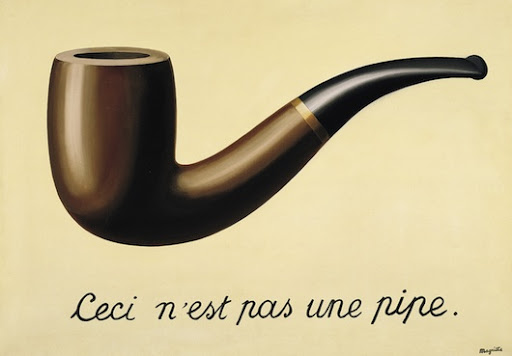
margritti-this-is-not-a-pipe_s.jpg

If two men or two women want to make a life-long commitment of love and support to one another, for better, for worse, for richer, for poorer, in sickness and in health, why shouldn’t that be called marriage? Why do many religious people have an issue with this and why don’t they just recognize and appreciate the love and commitment such couples have for one another? Doesn’t a lack of support for same-sex marriages show an elitism, judgment and discrimination that are foreign to Jesus’ message? As heterosexual couples can marry, why should that right be denied to homosexual ones? And why is it that same-sex marriage should be a threat to the very idea of marriage?

Questions like the above have, I believe, a great deal of profound Christian appeal: love, commitment, not judging, equality and taking the beam out of one’s own eye before proceeding to the splinter in another’s are all deeply Christian principles and when Christians are criticized for their seeming lack, they better take them seriously. Actually, when I say they, I mean me, so let me make this train of thought more personal. What do I think? Where do I stand?

First, let me be super clear about one thing: I believe God has a plan for every single human being and loves each one of us immensely. The late Patriarch Athenagoras saying that “God loves everyone equally, but secretly each one of us is his favorite,” Martin Luther saying “It is not because we are beautiful that God loves us, but because God loves us that we are beautiful,” John Paul II adding that “The person who does not decide to love forever will find it very difficult to really love for even one day,” and Benedict XVI tweeting yesterday that “Everything is a gift from God: it is only by recognizing this crucial dependence on the Creator that we will find freedom and peace,” sum it up for me. Everyone is loved by God, who sees beauty in them, and my love for all mustn’t be selective, jealous or fretting either. So, I believe God loves homosexual men and women and I too need to do the same to call myself a follower of Jesus.

I am therefore vehemently opposed to any lack of love shown towards homosexual persons and am strongly against homophobia, bullying, marginalization or any other respect and care that is not extended to them. Violence against homosexual men or women horrifies me, with cases where it is the state that fuels it (as in Uganda and countries where there are criminal penalties for homosexuality) being particularly abhorrent to me. This is a position that I hold beyond doubt and one in which I feel fully in line with the position and teaching of the Church.

The Catechism states clearly that homosexual persons “must be accepted with respect, compassion, and sensitivity. Every sign of unjust discrimination in their regard should be avoided. These persons are called to fulfill God’s will in their lives.” (Catechism of the Catholic Church, §2358). Several bishops have emphasized that there is good in relationships among homosexual men or women, such as Bishop Woelki of Berlin saying “I also try to acknowledge that they take responsibility for each other on a permanent basis, have promised each other faithfulness and want to look after each other,” the Bishops of England and Wales stating that “We also recognise that many same sex couples raise children in loving and caring homes,” or the late Cardinal Basil Hume affirming that “Homosexual people […] can, and often do, give a fine example of friendship and the art of chaste loving.” As recently as last Monday, there is also the determination by Archbishop Vincenzo Paglia, head of the Pontifical Council for the Family, for the Church to “do more to protect gays and lesbians from discrimination in countries where homosexuality is illegal. […] In the world there are 20 or 25 countries where homosexuality is a crime, […] I would like the church to fight against all this.”1

So, am I in favor of same sex marriage then? Actually, no … My reason for this is that marriage is a lifelong commitment of one woman and one man to each other. This commitment results in the birth of a family, which, at least in principle, is open to the procreation of children. As this is what the concept of marriage means, it is not applicable to same sex couples. But isn’t this discriminatory and doesn’t it fly in the face of everything I have said above? I honestly don’t think so, and I am fully in agreement with the Bishops of England and Wales, who say:

“We disagree that the signal that is sent currently, by restricting marriage to opposite sex couples, is one of disparagement of same sex relationships. The basic argument that is advanced in favour of same sex marriage is one of equality and fairness. But we suggest that this intuitively appealing argument is fundamentally flawed. Those who argue for same sex marriage do so on the basis that it is unjust to treat same sex and heterosexual relationships differently in allowing only heterosexual couples access to marriage. Our principal argument against this is that it is not unequal or unfair to treat those in different circumstances differently. Indeed, to treat them the same would itself be unjust.”

This to me is the crux of the argument: the outcome of even the commitment expressed by marriage vows results in two different states depending on whether it is done by two people of different sexes or the same sex. While there are similarities (i.e., the value and sincerity of the commitment and the love that it springs from and subsequently supports), there are categorical differences too (i.e., the possibility of bringing children into the world and the complementarity of the male and female sexes). Ignoring such differences is the beginning of a loss of clarity of thought and consequently of judgment and action. It is akin to suddenly deciding that we will call an ear an eye – they are both organs and result in sensory perception and surely the ear is just as good as the eye. It is certainly possible to do this, but it will result in confusion (were all the pre-ear=eye statements about eyes meant to apply to the new eye or only to eye-eyes and not ear-eyes?).

The motivation for extending marriage to same sex couples may in many cases be good and be underpinned by principles that I fully subscribe to, but the result is a delusion and a divorce from reality.

Nonetheless, I believe that many homosexual men and women do not feel welcomed by the Church, which to me is similar to the lack of unity among Christians – both pain me, but for both I place myself firmly inside the Church and try to understand what it is that I can do towards overcoming them. With Christian unity too we could decide from one day to the next that we will declare ourselves to be united, that we’ll just change the definition of a couple of terms so that they span previously exclusive concepts. But what would we achieve with that? Not only nothing, but it would be a step back, as it would hinder a true understanding of underlying reality and efforts to arrive at a loving solution that has its eyes wide open.2


1 Even though it is not the topic of this post and addressing it even just briefly would make it way too long, I can’t not mention the Church’s classification of homosexual relationships as “objectively disordered.” This, I have to say, is an unfortunate choice of words. Cardinal Hume felt the same and provided the following reflection:

“The word ”disordered” is a harsh one in our English language. It immediately suggests a sinful situation, or at least implies a demeaning of the person or even a sickness. It should not be so interpreted. First, the word is a term belonging to the vocabulary of traditional Catholic moral theology and philosophy. It is used to describe an inclination which is a departure from what is generally regarded to be the norm. The norm consists of an inclination towards a sexual relationship with a person of the opposite sex and not between persons of the same sex. Being a homosexual person is, then, neither morally good nor morally bad.”

This is an argument I do agree with: the sexual relationship between a man and a woman is constituent of what it means to be human, while such relationships between persons of the same sex are a departure from the inherent purpose of sexuality (without meaning to restrict it to its procreative function). I do believe this to be a fact, but that does not mean that homosexual men and women should not be welcomed by the Church in more effective and constructive ways than is the case today. What these ought to be is not clear to me, but I am convinced of their necessity.
2 Thanks to my überbesties KM, PM and MR for reviewing a draft of this post and for their great feedback!

Man and woman: the beginning

Woman

It has been a long time since I last read a text that filled me with excitement and admiration and lead me through a seemingly inexhaustible sequence of insights and profound realizations. The book I am talking about is John Paul II’s “Man and Woman He Created Them,” which presents his “Theology of the Body” – a term that I have heard mentioned on various blogs but that has meant little more to me than a buzz-word so far.

The book presents the content of a series of talks that Blessed John Paul II gave during his Wednesday general audiences between September 1979 and November 1984 (!) that closely track a manuscript he wrote before being elected pope. Instead of the usual pastoral material, typically presented at events like these, the first chapter already makes it crystal clear that the book is going to be technical and intellectually challenging material. To think that he shared it with the crowds who came to see him in Rome is astonishing to me by itself, as it is the polar opposite of the typical dumbing-down that so often informs pubic communication.

The starting point is the origin of the family in marriage, whose indissolubility Jesus categorically reaffirms when challenged by some Pharisees:

“Have you not read that from the beginning the Creator created them male and female and said, ‘For this reason a man will leave his father and his mother and unite with his wife, and the two will be one flesh’? So it is that they are no longer two, but one flesh. Therefore, what God has joined let man not separate.” (Matthew 19:4-6; emphasis by John Paul II)

Here John Paul II picks up on Jesus’ emphasis on “the beginning” and his quoting of verses from two separate chapters of Genesis. Instead of this passage from Matthew being only taken as a confirmation and reinforcement of the Genesis model of marriage, Jesus’ emphasis on “the beginning” triggers an analysis of the creation of humanity. In fact, John Paul II focuses on the specific features and complementary differences of the two Genesis accounts to look not only at the differences between male and female genders, but at key characteristics of what it means to be human.

The first account (which is chronologically more recent and which has more of a theological character) is that “God created man [hā’ādām, collective noun: “humanity”?] in his image, in the image of God he created him, man [zākār, male] and woman [neqēbāh, female] he created them.” (Genesis 1:27, John Paul II’s additions in []). In other words, the creation of man and woman is “a single act.” In contrast, in the second account (which is more ancient and has more of a mythical character), man’s creation (Genesis 2:5-7) precedes that of woman’s (Genesis 2:18-23). However, even here, the first human being is called “man” (’ādām), “while from the moment of the creation of the first woman, [Genesis] begins to call him “male,” îš, in relation to ’iššāh (“woman,” because she has been taken from the male = îš).”

While the above “single-act” creation of the sexes is an aspect of Genesis that I certainly was not aware of, the most impressive move in John Paul II’s analysis comes next and is the insight that the solitude of the pre–male-female differentiated “man,” – expressed in Genesis as “It is not good that the man should be alone” (2:18) – is a reference not only to an individual’s solitude (lacking a mate) but to a fundamental feature of every person’s nature. In Genesis, the first “man” is shown both as being separate from the rest of creation (being alone in spite of a multitude of other living beings already populating the world) and as searching for his identity (being asked by God to name “every living creature” but not “find[ing] a help similar to himself” (Genesis 2:19-20)).

This original solitude of the human person indicates self-consciousness and the commandment about not eating from the “tree of the knowledge of good and evil” introduces self-determination (free will) as a basic feature of humanity. These two together make the human person “created in the image of God” and a “partner of the Absolute.” Next, John Paul II argues that it is man’s (’ādām’s) body that is the source of his awareness of solitude. This body that could have made man place himself as equal among the other created bodies, instead gives him awareness of his otherness and solitude. This in turn makes it evident that “the “invisible” determines man more than the “visible”.”

Next, man’s body is also the means of his “cultivating the earth” (Genesis 2:5) and “subdu[ing] it” (1:28), as the Genesis account further states. As a result, the human body is not only involved in man’s awareness of his separateness from the rest of creation and his potential for self-determination, but also “permits him to be the author of genuinely human activity[, where] the body expresses the person.” The final ingredient that John Paul II identifies in the Genesis account is the introduction of the difference between death an immortality in the form of the mystery of the three of knowledge: “The LORD God gave the man this order: You are free to eat from any of the trees of the garden except the tree of knowledge of good and evil. From that tree you shall not eat; when you eat from it you shall die.” (Genesis 2:16-17).

With man’s features emerging as his self-consciousness, self-determination and, as their consequence, relating to God as a partner, John Paul II turns to taking a closer look at the meaning of the original unity of humanity. The starting point here is an argument for there being a distinction between “bodiliness and sexuality” whereby our being bodies is fundamental to the structure of our being personal subjects, even before differences between the male and female genders are considered. Being a body is fundamental to being human and is intrinsic to the nature of that humanity (as John Paul II argues above), while masculinity and femininity are “two ways in which [a] human being […] is a body.” These two ways of being human bodies – the “double unity as male and female” – are introduced as means of overcoming the solitude of the sexually undifferentiated human. From the Genesis account of how male and female are differentiated, John Paul II notes in particular two aspects: First, that the “second I” – the female – that emerges from the “torpor” of the undifferentiated man during which differentiation is created – is “also personal and equally related to the situation of original solitude.” Second, that man “shows joy and even exultation […] for the other human being, for the second “I”.”

The first 8 chapters, a high-level synthesis of which the above has attempted, take us to the point of the basic features of man and woman having been sketched out, which is then the starting point for looking at the nature of the marital relationship. What I found particularly impressive, beyond the actual content and the psychological and anthropological profile of the human person that John Paul II presents, is the method of analysis he applies to Genesis. Throughout this discourse he is very clear about considering that text to be of mythical character, which “does not refer to fictitious-fabulous content, but simply to an archaic way of expressing a deeper content.” And he goes on to say that “[w]ithout any difficulty, we discover that content under the stratum of the archaic narrative, truly marvelous in the quality and condensation of the truths contained there.” What a guy! While I certainly cannot echo the “without difficulty” qualifier, the marvelousness and “quality and condensation of the truths” that he manages to reveal in this ancient text is amazing. His approach strikes me as being categorically different both from a naive, literal reading of Genesis that leads some to highly irrational and a-scientific conclusions and from a superficial “this is just a story” approach that fails to uncover deeper meaning.

Lumen Gentium: The Laity

Emm

Chapter 4 of Lumen Gentium brings us to a presentation of the role of the laity – i.e., “all the faithful except those in holy orders [discussed at length in chapter 3] and those in the state of religious life [to be covered in detail later].” Like in previous posts about Vatican II documents, if you are not a Catholic, I would again encourage you to take a look at paragraph two of my post on Dei Verbum, where I propose an approach that might make reading the following more accessible.

The chapter on the laity starts with, and is run through by, repeated emphases on the unity and singularity of purpose of the whole Church, against the background of which any distinctions are to be read: “Everything that has been said [about] the People of God is intended for the laity, religious and clergy alike. [… The lay] faithful are by baptism made one body with Christ and are constituted among the People of God; they are in their own way made sharers in the priestly, prophetical, and kingly functions of Christ.” The specific aspect of the laity os that they “live in the ordinary circumstances of family and social life […] They are called there by God that by exercising their proper function and led by the spirit of the Gospel they may work for the sanctification of the world from within as a leaven.” The key here to me is that the laity is not some sort of “other” or “miscellaneous” category, but that its members are “called there by God” – being a lay person can be a calling like being a member of the church’s hierarchy or of a religious order.

The equality of the People of God (i.e., laity, clergy and religious all together) is then stated very explicitly:

“[T]he chosen People of God is one: “one Lord, one faith, one baptism”; sharing a common dignity as members from their regeneration in Christ, having the same filial grace and the same vocation to perfection; possessing in common one salvation, one hope and one undivided charity. There is, therefore, in Christ and in the Church no inequality on the basis of race or nationality, social condition or sex, because “there is neither Jew nor Greek: there is neither bond nor free: there is neither male nor female. For you are all ‘one’ in Christ Jesus”.”

Furthermore this equality of dignity extends not only across natural but also across spiritual categories: “And if by the will of Christ some are made teachers, pastors and dispensers of mysteries on behalf of others, yet all share a true equality with regard to the dignity and to the activity common to all the faithful for the building up of the Body of Christ.” A source for this equality can also be found in the mutual interdependence of the clergy and laity: “[P]astors and the other faithful are bound to each other by a mutual need. Pastors of the Church, following the example of the Lord, should minister to one another and to the other faithful. These in their turn should enthusiastically lend their joint assistance to their pastors and teachers.” This is further (and to my mind beautifully!) underlined as follows:

“Therefore, from divine choice the laity have Christ for their [brother] who though He is the Lord of all, came not to be served but to serve. They also have for their brothers those in the sacred ministry who by teaching, by sanctifying and by ruling with the authority of Christ feed the family of God so that the new commandment of charity may be fulfilled by all.”

St. Augustine then puts the difference between his being a Christian and a bishop in particularly clear terms: “What I am for you terrifies me; what I am with you consoles me. For you I am a bishop; but with you I am a Christian. The former is a duty; the latter a grace. The former is a danger; the latter, salvation.” Again it is the saints, whose words illuminate and breathe a heightened sense of life into the Church’s formal teaching.

Next, Lumen Gentium elaborates on the apostolic and prophetic roles of the laity and there is a clear sense here even just from the language that this is a blueprint for the future (e.g., by many sentences having the form of “let the laity …”), rather than a re-statement of well-established teaching, as is the case in some of the earlier parts of this document.

The apostolic role of the laity (to which they are commissioned “[t]hrough their baptism and confirmation”) is a call “to [making] the Church present and operative in those places and circumstances where only through them can it become the salt of the earth.” The apostolate of the laity (i.e., it’s spreading of the Gospel) is not restricted only to such conditions where the hierarchy would be less effective or appropriate. Instead, it “can also be called in various ways to a more direct form of cooperation in the apostolate of the Hierarchy. This was the way certain men and women assisted Paul the Apostle in the Gospel. […] Further, they have the capacity to assume from the Hierarchy certain ecclesiastical functions.” The model here is very much one of co-operation rather than exclusive leadership by the hierarchy. This does not in any way diminish the leadership of the hierarchy, but, to my mind, it expresses a desire to reflect the emphasis on equality in the preceding paragraphs. It shows a desire for spreading of the Gospel in a way where the talents of all are put to good use.

The way the laity spread the Gospel, “by a living testimony as well as by the spoken word, takes on a specific quality and a special force in that it is carried out in the ordinary surroundings of the world. […] For all their works, prayers and apostolic endeavors, their ordinary married and family life, their daily occupations, their physical and mental relaxation, if carried out in the Spirit, and even the hardships of life, if patiently borne—all these become “spiritual sacrifices acceptable to God through Jesus Christ”.” What strikes me as key here is that a lay person is called to follow Jesus 24/7 and that even when they rest, that is an opportunity to bear witness to God’s love for all. This is very explicitly the opposite of the unhealthy compartmentalization that can creep into anyone’s life, where their Christianity is manifest only in some contexts but not in all. Finally, the part on the laity’s apostolic role concludes with the profound statement that “the laity consecrate the world itself to God.”

Turning to the prophetic aspect, Lumen Gentium states that “Christ […] continually fulfills His prophetic office […] not only through the hierarchy who teach in His name and with His authority, but also through the laity whom He made His witnesses and to whom He gave understanding of the faith (sensu fidei).” Here I was immediately struck by the attribution of a rational and reflexive function to the laity, which again does not detract from the authority of the hierarchy, but which places the lay person in a position of intellectual engagement rather than blind obedience. This is again underlined by the exhortation to “let the laity devotedly strive to acquire a more profound grasp of revealed truth, and let them insistently beg of God the gift of wisdom.”

Then comes a bit of a surprise to me:

“In connection with the prophetic function is that state of life which is sanctified by a special sacrament […], namely, married and family life. […] In such a home husbands and wives find their proper vocation in being witnesses of the faith and love of Christ to one another and to their children. The Christian family loudly proclaims both the present virtues of the Kingdom of God and the hope of a blessed life to come. […] They must assist each other to live holier lives even in their daily occupations. In this way the world may be permeated by the spirit of Christ and it may more effectively fulfill its purpose in justice, charity and peace. The laity have the principal role in the overall fulfillment of this duty.”

This places the sacrament of marriage in a position not only of a commitment of the spouses to each other and to their children – for their individual good, but also makes it a foretaste of things to come and a source from which Jesus’ love is to be brought to the whole world so that “justice, charity and peace” may be brought about. Such projection into the world has its challenges though and the laity is reminded that:

“[T]he faithful should learn how to distinguish carefully between those rights and duties which are theirs as members of the Church, and those which they have as members of human society. Let them strive to reconcile the two, remembering that in every temporal affair they must be guided by a Christian conscience, since even in secular business there is no human activity which can be withdrawn from God’s dominion.”

The relationship of the laity and the hierarchy is then introduced as follows:

“The laity […] should openly reveal to [the hierarchy] their needs and desires with that freedom and confidence which is fitting for children of God and brothers in Christ. They are, by reason of the knowledge, competence or outstanding ability which they may enjoy, permitted and sometimes even obliged to express their opinion on those things which concern the good of the Church.”

This again underlines the need for active, rational participation of the laity in the life of the Church and even the obligation to escalate concerns to its leadership, but it also requires that “[t]he laity [… then] accept in Christian obedience decisions of their spiritual shepherds, since they are representatives of Christ as well as teachers and rulers in the Church.”

In summary, “[e]ach individual layman must stand before the world as a witness to the resurrection and life of the Lord Jesus and a symbol of the living God. All the laity as a community and each one according to his ability must nourish the world with spiritual fruits. They must diffuse in the world that spirit which animates the poor, the meek, the peace makers—whom the Lord in the Gospel proclaimed as blessed.”

As a lay person I found this part of Lumen Gentium particularly encouraging as it shows very clearly that in Vatican II the hierarchy of the Church (since all of these documents’ authors were part of it!) calls for greater participation by all members of the Church in its life. The hierarchy does not shirk away from its responsibilities (and I don’t believe it should), but it makes it clear that it desires dialogue among equals. Even though a bishop is placed at the head of his local church, he is the brother of all the faithful he leads and this brotherhood, pioneered by Jesus himself outranks any hierarchical distinctions. I know full well that this is often not what happens even today – 50 years after Vatical II, but I am pleased to see at least that this is the blueprint, even if the boat is still under construction.

Serving the Church

Christ calling Deaconesses to serve the Church

I am starting from scratch after having written a lengthy post on this topic already and realizing – after talking to my besties YYM1 and PM – that I was approaching the topic all wrong. I can still use all the research, but the tone had to change from the playful and partly sarcastic to what I am going to try next.

I feel that my being married, working at a tech company and being a lay person allows me to seek God without limits, to fully participate in the life of the Church and to have the path to sanctity wide open to me. At the same time I realize though that some of my Catholic sisters suffer from feeling the call to the priesthood and being faced with (a now final) barrier to it:

“I declare that the Church has no authority whatsoever to confer priestly ordination on women and that this judgment is to be definitively held by all the Church’s faithful.” (Ordinatio Sacerdotalis, §4)

At first sight (and maybe even after repeated reading) this might sound like an aspect of Church teaching that is simply out of date, that needs to catch up with the times and that can be summed up with the following:

“[T]here is an urgent need to achieve real equality in every area: equal pay for equal work, protection for working mothers, fairness in career advancements, equality of spouses with regard to family rights and the recognition of everything that is part of the rights and duties of citizens in a democratic State.” (Letter to Women, §4)

Now, maybe this will come as a surprise, but the author of both of the above quotes is the same person: Blessed Pope John Paul II, and you may ask yourself how he can at the same time talk about women’s rights and slam the door shut on the question of women priests. I believe the answer lies in the following (and, yes, it too is by John Paul II):

“If Christ […] entrusted only to men the task of being an “icon” of his countenance as “shepherd” and “bridegroom” of the Church through the exercise of the ministerial priesthood, this in no way detracts from the role of women, or for that matter from the role of the other members of the Church who are not ordained to the sacred ministry, since all share equally in the dignity proper to the “common priesthood” based on Baptism.” (Letter to Women, §11)

When I first saw this, a light went on in my mind after I read the words “an “icon” of his countenance.” Priests are Jesus’ proxies and transmit to us his presence in the Church and his being the source of the sacraments. When I attend mass, I experience a man saying the words that bring about the Eucharist, like I would have, had I been at the Last Supper; when I go to confession, I speak to a man, as I would have, had I been among Jesus’ disciples. Jesus having come into the world as a man rather than a woman is not an accident, nor is it a consequence of social conventions. I believe, that God became flesh as a baby boy, to use the male gender in a specific way, just like he sought consent from a girl to become His mother, again because of the specifics of the female gender. To read this as in any way discriminatory against women is incomprehensible to my mind, but I’ll leave that to another post.

Let me now put my last card on the table with regard to the priesthood. God’s call is ultimately the same for all of us: to choose Him as the first priority in our lives and to follow his new commandment of love. Placing something above a love for one’s neighbor and for God is a mistake, even if that something is the priesthood. If love for God and neighbor are missing, the priesthood becomes a millstone (“The road to hell is paved with the skulls of erring priests, with bishops as their signposts.” St. John Chrysostom) and if they are present, then it becomes secondary and one seeks specifics with humility. To come at the argument from a perspective of rights is also a category mistake. No one has the right to be made a priest, whether man or woman, and it is in all cases a gift that is received rather than an entitlement that can be claimed.

For now, let it suffice that my argument is this: the priesthood is only open to men, because Jesus was a man and because he indicated to us from the very beginning that it was through men that he wanted certain aspects of his ministry to be perpetuated. In this way, his ministers’ being male is integral to their being Jesus’ proxies and no matter what social or other developments ensue, the priesthood in the Catholic Church is going to remain restricted to them.

This is not the end of the story though, since we are ultimately all being called to be Jesus’ proxies: to be the means by which He can show His love to all. As a married, lay person I don’t feel in any way limited in the extent to which I can strive to imitate Jesus’ love for humanity, even if I don’t become a priest. But, and there is a but, there is a variety of other ways in which Jesus can be imitated and and in which Catholics can serve the Church (which is fundamentally also what the priesthood is about: service). Two of these, which today are not open to women, are the diaconate and the office of cardinal, and I would like to argue that they may both one day (hopefully soon) be conferred on women.

Bishop Emil Wcela has just published a very interesting article (that I recommend in full), entitled “Why not women?” It starts where the final word on women priests in the Catholic Church ends: by making a case for exploring the possibility of ordaining women as deacons. Wcela presents a compelling case, starting with evidence for deaconesses dating back right to the time of the apostles (giving the example of St. Phoebe, whom St. Paul calls a diakonos in his letter to the Romans (16:1) – although the meaning of the term is disputed) and dotted through the history of the church (including Pope Benedict VIII writing to the bishop of Porto to give him authority to ordain deaconesses). He the proceeds to give the example of deaconesses in other Christian churches, but is also clear about the fact that this is not the case in the Catholic Church at present.

Nonetheless, there has been a desire to explore its possibility since the Second Vatican Council, including a raising of the issue by the US bishops in a pastoral letter from 1992. 2009 then saw an important change to Canon law, which differentiates between the nature of the priestly and episcopal order and that of deacons, stating that bishops and priests “receive the mission and capacity to act in the person of Christ the Head; deacons, however, are empowered to serve the People of God in the ministries of the liturgy, the word and charity.” (Canon 1009 of the Code of Canon Law). This change removes the constraints that previous legislation placed on the diaconate and historical precedent further supports a future change in this area. Bishop Wcela finally notes that women already participate extensively in the Church’s ministry and that ordaining them as deacons would provide greater official recognition, confer the grace of the sacrament on them and give them access to ecclesiastical offices that require ordination. The article ends with a call to raising awareness of this opportunity and I would personally like to add my voice to it.

On a related note, Cardinal Timothy Dolan stated in an interview last March, that the office of cardinal is in principle open to women, since it does not require priestly or episcopal orders. He then proceeded to tell the story of how someone once suggested to Pope John Paul II to make Mother Teresa a cardinal, to which he replied: “I asked her – she doesn’t want to be one.” While the John Paul II – Mother Teresa story may be little more than an anecdote, it nonetheless expresses both the Church’s newfound openness and Mother Teresa’s humility beautifully. What is key here is the acknowledgement by one of the cardinals that his office is in principle not restricted to women.

I hope it is clear what I am getting at: the role of women in the Church is certainly not what it ought to be, but I see clear signs of a desire to change that, including at the highest levels. What it won’t be is an opening of the priesthood to women, but the diaconate and the office of cardinal are both on the horizon (hopefully even in my own lifetime). One point I would like to emphasize though is that the role of women in the Church needs to be all-pervasive and not only constrained to “women’s issues.” When one of the 23 women present at the Second Vatican Council – one of the Council Mothers – was asked what topics were discussed that related to women, she responded “We are now interested in everything.” As Fr. Fabio Ciardi, who was taught by Rosemary Goldie (another Council Mother) during his time at the Lateran University, said: “The temptation is to constrain women in the Church to dealing with topics that are about women, not knowing that all topics are about them and that they have a contribution to make to all of them.”


1 Thanks to YYM also for giving me probably the most acceptable label: “progressive orthodox.” It may sound like an oxymoron, but I shall wear it with pride :).

Marriage and the family

Rothko3

I am married and am immensely grateful for being part of several families: the family I was born into (since, even though I am a first child, my parents were a family already before I was born or even conceived), multiple extended families, and the family my spouse and I form with our children. And that’s only as far as biological ties go. I am also a member of the Church – the family of Jesus and (some of) his followers. In many ways I also consider the relationship I have with close friends to be like that with brothers, sisters or parents and I strive to extend this circle whenever and with whomever possible.

What is it that is so special about the family? I believe it is the fact that it mimics the relationships of the persons of the Trinity, where each loves the others without limits and with complete self-noughting,1 to the extent that the three become one. In my families I have often experienced love that is selfless, self-sacrificing, generous, gratuitous and unconditional and that invokes Jesus’s promise: “For where two or three are gathered together in my name, there am I in the midst of them” (Matthew, 18:20). This love makes the family a place of peace, trust, safety, stability, openness, growth and joy and a place where I can most fully be myself. I can rely on the support and love of other family members and also on their desiring only the best for me. I don’t have to look out for myself, as it is the others who look out for me and I can instead focus on them and on others. My families have also been safe havens that have protected me from state-organized oppression, from the negative influence of others, from erroneous tendencies of my own and that have also looked after me in illness, bad moods, uncertainty and fatigue.

Is this to say that there are no challenges with living in a family? Certainly not, since even though the model is perfect, its instances are often not, even to the point of breaking. Does that make the model any less worthy of following? I don’t think so, since even when not lived to perfection, the ideal of the family provides a clear direction of what to aim for.

For me, as a Christian (and for others too), the foundation of a family – its birth, is in marriage, where the spouses each make an indissoluble gift of themselves to one another, which they do in front of God and which they aim to sustain with His help and in His presence. The day I got married was one of the sacred, lived in great simplicity (I remember polishing shoes in the morning and sending a couple of emails to close friends who couldn’t be with us and being filled with great joy and a delicious lightness of being,2 not even to mention the rest of the day that you would expect to be joyous). The years that then followed and persist into the present have been filled both with everything I said about the ideal of the family and with challenges, trials, difficulties and suffering. To me, as a Christian, these too are very much part of being married and of living in a family, just like they were very much part of Jesus’ life. They are always an opportunity to recognize Jesus’ presence and to start again to seek forgiveness, forgive and love and I am deeply grateful to God for my spouse, children, parents, siblings and all with whom I have family-like relationships.

There would be a lot more to say, but I believe I managed to give an idea of why marriage and the family matter to me. This reflection was very directly motivated by many recent pronouncements by different representatives of the Church who have spent paragraphs upon paragraphs talking about what threatens the family and how it needs to be opposed and which have always left me wondering: ‘But what is it about the family that you see worth protecting? How do you see the things you oppose as threatening? [beyond stating them as such] And what positive proposal can you make as an alternative to the ones you oppose?’ I am not saying that opposition alone isn’t worthwhile, but it is very much a level zero approach and I was certainly hoping for more. The closest I have seen to an acknowledgement of this trend is a statement made two days ago by Archbishop Diarmuid Martin:

“The Church’s social doctrine must always be animated with charity and must be accompanied by charity and will only really be understood through the lens of charity. When the Church’s organizations simply become lobbying bodies alongside other lobby organizations or social commentators alongside other social commentators then they loose their real originality and therefore their original contribution to the debate about the formation of society.”

This is exactly what I have been looking to hear from many others and I hope that Archbishop Martin will follow up this call to a focus on love and apply it to the various issues being so hotly debated these days.

Lest I be misunderstood in a way that is most repulsive to me, let me be explicit about one thing: I believe there is the potential for good in all human relationships, regardless of who their protagonists are or what their status is. What I have said about the family and about marriage was in no way meant as suggesting that the things which I value about it cannot also take place under other circumstances. In no way do I mean to suggest that the family built on marriage has a monopoly on all the good that it is capable of. Compassion, commitment, selflessness, caring, support and love are the potential of any human relationship and my seeking them in the context of my family, and the marriage it is built on, is in no way a declaration of inferiority or inadequacy with respect to other forms of life.

Finally, I do see a big challenge that the Church (i.e., me too!) faces, which is to find a way for all, who want to, to participate in its life. Cardinal Martini in his last interview gave a clear example: “A woman is abandoned by her husband and finds a new companion who is concerned for her and her three children. The second love succeeds. If this family is discriminated against, not only the woman, but her children, too, will be cut off.” Cardinal Woelki said that he tries to “acknowledge that [homosexuals] take responsibility for each other on a permanent basis, have promised each other faithfulness and want to look after each other, even though [he] cannot endorse their life choices.” And there are many others like them! What is very positive in my eyes is that there are representatives of the Church, who feel the presence of gaps that ought not be there and even though I don’t see how the gaps will be closed (without throwing the baby out with the bathwater either), I trust God will help us find a way to make everyone feel welcome in His Church.


1 Thanks to my bestie, CS, for coining this term, which I believe expresses the extent of the love the Persons of the Trinity have for one another spot on.
2 The antithesis of its unbearable variant, so beautifully described by Kundera though.