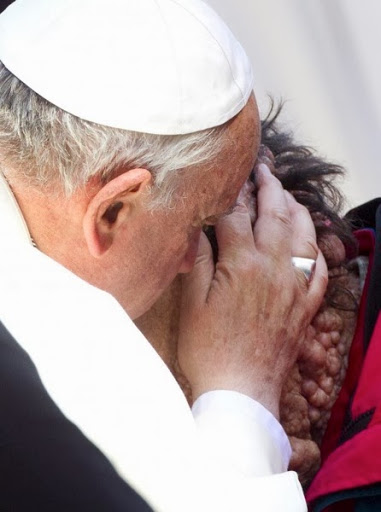
This is what the Gospel looks like

Pope disfigured man

Pope Francis has given another interview – this time to Andrea Tornielli (a contributor to the always up-to-date Vatican Insider blog) at the Italian La Stampa newspaper – and the following are some of my favorite passages:1

“[Christmas] speaks to us of tenderness and hope. When God meets us, he tells us two things. The first one is: have hope. God always opens doors, he never closes them. He is the dad who opens doors for us. Second: don’t be afraid of tenderness. When Christians forget about hope and tenderness, they become a cold Church that doesn’t know where to go and that entangles itself into ideologies, into worldly attachments. Instead, God’s simplicity tells you: go forward, I am a Father who caresses you. I am scared when Christians lose hope and the capacity to embrace and caress.”

Christmas is about hope and warmth, fueled by and in imitation of God and directed towards others.

“What we read in the Gospels is an announcement of joy. The evangelists have described a joy. No consideration is given to the unjust world, to how God could be born into such a world. All this is the fruit of our own contemplations: the poor, the child that has to be born in uncertainty. is born into a precarious situation. Christmas was not a condemnation of social injustice, of poverty; instead, it was an announcement of joy. Everything else are conclusions that we draw. Some are correct, others are less so, and others still are ideologized. Christmas is joy, religious joy, God’s joy, interior, luminous, of peace.”

Christmas is, first and foremost, joy. Let’s not rush to its implications at the expense of overlooking that deep joy that it heralds.

“A teacher of life for me has been Dostoevskij, and a question of his, both explicit and implicit, has always gone around in my heart: “Why do children suffer?” There is no explanation. […] In front of a suffering child, the only prayer that comes to me is the prayer why. Why, Lord? He doesn’t explain anything to me. But I feel that he is looking at me. So I can say: You know the why, I don’t it and You don’t tell me, but You are looking at me and I trust You, Lord, I trust your gaze.”

Suffering can’t – and mustn’t! – be explained away, but it can be lived while trusting in God’s loving gaze.

“The other day at the Wednesday General Audience, there was a young mother with her baby that was only a few months old, behind one of the barriers. As I passed by, the baby cried a lot. The mother was caressing it. I said to her: madam, I think the little one is hungry. She replied: Yes, it’s probably time … I responded: But, give it something to eat, please! She was shy and didn’t want to breastfeed in public, while the Pope was passing. So, I wish to say the same to humanity: give something to eat! That woman had milk to give to her child, in the world we have enough food to feed everyone.”

There is food for everyone – let’s not make our shyness an obstacle for it to get to its rightful recipient.

“Marxist ideology is wrong. But in my life I have met many Marxists who are good people, so I don’t feel offended.”

Don’t conflate ideology with its adherents. Even wrong ideologies have good people following then.

“During these first nine months, I have received visits from many Orthodox brothers, Bartholomew, Hilarion, the theologian Zizioulas, the Copt Tawadros: this last one is a mystic, he’d enter the chapel, remove his shoes and go to pray. I felt like their brother. They have apostolic succession, I received them as brother bishops. It is painful that we are not yet able to celebrate the Eucharist together, but there is friendship. I believe that the way forward is this: friendship, common work, and prayer for unity. We blessed each other, one brother blesses the other, one brother is called Peter and the other Andrew, Mark, Thomas …”

I have no comment to add – only to say how it warms my heart to hear Francis refer to the Orthodox patriarchs as his brothers and liken their relationship to those among the apostles. This is very much in continuation of the tremendous advances made by John Paul II and Benedict XVI, but I am moved by the beauty of the simplicity with which Francis puts the situation.

“I knew a parish priest in Hamburg who was dealing with the beatification cause of a Catholic priest guillotined by the Nazis for teaching children the catechism. After him, in the line of condemned individuals, was a Lutheran pastor who was killed for the same reason. Their blood became mixed. That parish priest told me he had gone to the bishop and said to him: “I will continue to deal with the cause, but for both of them, not just the Catholic priest’s.” This is the ecumenism of blood.”

That we are followers of Jesus, regardless of what Church we belong to is a matter that goes to the bone, into our blood. There we are already one.

“We must try to facilitate people’s faith, rather than control it. Last year in Argentina, I condemned the attitude of some priests who would not baptize the children of unmarried mothers. This is a sick mentality.”

We are not gate-keepers, but each other’s brothers and sisters instead.

“A few months ago, an elderly cardinal said to me: “You have already started the reform of the Curia with your daily masses at St. Martha’s.” This made me think: reform always begins with spiritual and pastoral initiatives rather than with structural changes.”

Structures must be a consequence of life and the best leadership is by example. This point of Pope Francis’ is also in sync with my previous criticisms of his actions being explained away as only “pastoral” and with comments made by Fr. Antonio Spadaro in the New Yorker interview, where he says, when asked about the style-versus-substance debate concerning Pope Francis: “Style is not just the cover of the book. It’s the book itself! Style is the message. The substance is the Gospel. This is what the Gospel looks like.”


1 Please, note that the following quotes are close to the official English translation, but that I have modified them here and there based on the Italian original – not necessarily in the belief of making them “better” – only with the aim of preserving some of the nuances of how Pope Francis expresses himself.
Liberation Theology rehabilitated

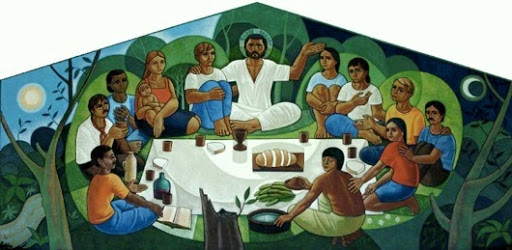
Santa cena teologia liberacion

Pope Francis is about to meet with the founder of Liberation Theology, Fr. Gustavo Gutiérrez, thanks to the current head of the Congregation for the Doctrine of the Faith (CDF) – Archbishop Gerhard Ludwig Müller, which – on the face of it – is a 180° turn versus its past condemnations by the Vatican. Taken superficially, it is a meeting between Francis and a proponent of a theology that has been categorically denounced both by Blessed Pope John Paul II and his successor, Pope Benedict XVI.

A closer look reveals quite a different picture though:

  1. Fr. Gutiérrez, unlike other teachers of Liberation Theology (e.g., Leonardo Boff), has never been censured by the Vatican.
  2. John Paul II and Benedict XVI never condemned Liberation Theology as such, but only those variants of it that placed Marxist analysis at their cores and thereby de-Christified it. In fact, Benedict XVI (then then-Cardinal Ratzinger) is quite clear about the distinction in the “instruction” he published in 1984 as the head of the CDF:

    “The aspiration for ‘liberation’, as the term itself suggests, repeats a theme which is fundamental to the Old and New Testaments. In itself, the expression “theology of liberation” is a thoroughly valid term: it designates a theological reflection centered on the biblical theme of liberation and freedom, and on the urgency of its practical realization. […] The warning against the serious deviations of some “theologies of liberation” must not be taken as some kind of approval, even indirect, of those who keep the poor in misery, who profit from that misery, who notice it while doing nothing about it, or who remain indifferent to it. The Church, guided by the Gospel of mercy and by the love for mankind, hears the cry for justice and intends to respond to it with all her might.”

  3. Instead of this being a change brought in by Francis, the re-visiting of the position taken with respect to Liberation Theology escalated when Benedict XVI appointed Müller as the head of the CDF in 2011 – Müller, who was known to be a personal friend of Gutiérrez, whom he considered as his mentor and whose summer lectures he has been attending annually since 1998 in Peru.
  4. While the new attitude is a change version previous positions, it is not a change as far as Marxist-based flavors of Liberation Theology go. Instead, it is a sign of support for those strands of Liberation Theology that have presented social justice and a focus on the poor on a wholly Christian basis. Fr. Juan Carlos Scannone, one of Pope Francis’ former professors puts it as follows: “In the Argentinean Liberation Theology, social Marxist analysis is not used, but rather a historical-cultural analysis, not based on class warfare as a determining principle for the interpretation of society and history.”

To get a sense of why Müller, who is clearly the catalyst behind the rehabilitation of some strands of Liberation Theology, took an interest in it, it is worth taking a look at the speech1 he gave at the Pontifical Catholic University of Peru in 2008, when it awarded him an honorary doctorate.

There, Müller starts by admitting that he had read expositions of Liberation Theology as well as their criticisms by the CDF, before meeting Gutiérrez, but that his engagement with them was purely theoretical. His initial attitude was one of skepticism and concern about both a danger of leading to violence and a naïveté with regard to the application of Marxist principles. Attending a seminar lead by Gutiérrez then turned him “from academic reflection on a new theological concept to experience with the men and women for whom this theology had been developed.” From the start, Gutiérrez emphasized that Liberation Theology was about theology and not politics, with the aim “to understand the world, history and society and transform them in light of the God’s own supernatural revelation as savior and liberator of man.” The “point of departure” is very clearly put by Müller as follows:

“How one can speak of God in the face of human suffering, of the poor who don’t have sustenance for their children, or the right to medical assistance, or access to education, who are excluded from social and cultural life, marginalized and considered a burden and a threat to the lifestyle of the wealthy few.

These poor are not an anonymous mass. Each one of them has a face. How can I as a Christian, priest or layman, whether through evangelization or scientific theological work, talk about God and His Son who became man and died for us on the cross and bear witness to Him, if I don’t want to build another theological system in addition to the existing one, except by saying to the specific poor person face to face: God loves you and your inalienable dignity is rooted in God. How does one make Biblical considerations real in individual and collective life, when human rights originate in the creation of man in the image and likeness of God.”

Müller then moves on to what I believe is the core of his message, when he speaks about not only attending courses about Liberation Theology in various Latin American countries, but also their being accompanied by:

“long weeks of pastoral work in the Andean region, especially in Lares in the Archdiocese of Cuzco. There the faces acquired names and became personal friends, this experience of universal Communion in the love of God and neighbor, which must be the essence of the Catholic Church. Finally it was a deep joy for me when in 2003, in Lares, in the Archdiocese of Cuzco, being already a bishop, I could administer the sacrament of Confirmation to young people whose parents I had already known for a long time and whom I myself had baptized.

Hence I have not been speaking of liberation theology in an abstract and theoretical way, much less ideologically to flatter progressive church groups. Similarly I have no fear that this may be interpreted as a lack of orthodoxy. Gustavo Gutiérrez’s theology, regardless of which angle you look at it from, is orthodox because it is orthopractic and teaches us proper Christian action because it comes from true faith.”

Müller’s assessment of Liberation Theology comes not only from a reading of and reflection on its teachings, but from him personally having put it into practice and experienced its fruits. It is these fruits that reinforce the truth of its principles, whose flowing from “true faith” can be inferred from them. It is a “see, judge, act” process, which Müller says “has been decisive in my own theological development” and which follows Jesus’ own words as regards orthopraxy:

“Beware of false prophets, who come to you in sheep’s clothing, but underneath are ravenous wolves. By their fruits you will know them. Do people pick grapes from thornbushes, or figs from thistles? Just so, every good tree bears good fruit, and a rotten tree bears bad fruit. A good tree cannot bear bad fruit, nor can a rotten tree bear good fruit. Every tree that does not bear good fruit will be cut down and thrown into the fire. So by their fruits you will know them.” (Matthew 7:15-20).

UPDATE (13 September 2013): The Catholic New Service has just tweeted that the Vatican has confirmed that a meeting between Pope Francis and Fr. Gutiérrez took place two days ago.


1 The original, Spanish version can be found here. Note that the English text used above includes my adjustments based on this original (e.g., at one point “imperdible” is translated as “amazing” in the English referred to above, while I render it as “inalienable”).