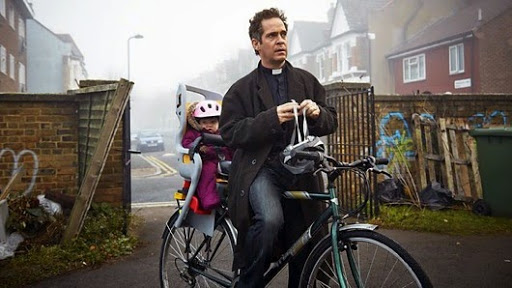
The BBC’s Rev: Christian or “just” nice?

Rev

One of my favorite TV series of all time is Rev – the BBC comedy about an Anglican priest in a London inner-city parish, with a minuscule congregation of misfits, and facing a barrage of trials both internal and from within and outwith the Anglican Church. The casting and acting are superb, the story lines varied, the contrast between the Rev’s psychology and the supporting cast’s caricatures comedic and the insightfulness of observation razor sharp.

Unlike other religiously-themed comedies, like the legendary Father Ted, Rev is not only about laughs, but very much also about a portrayal of a man’s sincere desire to love God and his fellow men and women. It is a love that falters and falls, but a love that is sincere and persistent.

In one episode we see the Rev go out of his way to be welcoming to a sinner (a sex offender just released from prison) in spite of his entire congregation’s opposition and his own revulsion. In another episode he struggles with his Church’s and his own views on homosexuality while going out of his way to be welcoming of his gay friends. In yet another episode he goes out of his way to work with the local Imam in spite of the humiliation that their financial imbalance brings him.

In fact, the formula of a Rev episode is a going out of one’s way, in pursuit of the excluded, the peripheral, the needy, regardless of the cost to oneself. And throughout these trials and adventures, the Rev converses with Jesus, with whom he pleads, to whom he complains, but in whom he trusts and whom he loves. In many ways, Rev expands on Blessed Mother Teresa’s saying: “God does not require that we be successful, only that we be faithful.”

Why, you may ask yourself, have I gone to the trouble of writing the above, albeit short, review of Rev? The reason is simple – an article in yesterday’s Telegraph, where Rev is denounced as un-Christian by reducing Christianity to being merely “nice” and leaving out “that Christians do nice things not just because they are nice people but because they are commanded to by scripture.” The article’s author then proceeds to list 8 “against”s that Christians need to be, and concludes with the following, peculiar piece of moral theology: “Christians who fail to point out these sins are surely as culpable as the people who commit them.”

However, the most offensive aspect of this article is not so much its twisted view of Christianity, but the following anti-atheist statement: “Nice atheists don’t have to [tell people when they’re going wrong] because there’s no commandment to rescue others from themselves.” This is offensive not only because it suggests that Christians only do what they do because they are commanded to do so – rather than because they (like all men and women!) are made in the image of God and have a deep-seated call to participate in the Trinity’s life of mutual self-giving – but also because it suggests that atheists don’t have a desire to correct wrongs. This is absurd, offensive and factually incorrect. Rather than try to build an extensive case, let me just point to a single counterexample: Albert Camus speaking to Dominicans about what atheists expect of Christians, showing great concern for them and being an exemplary “external” conscience for them.

In an attempt to bolster its credibility, the article also refers to Archbishop Justin Welby, who “disagrees with the show’s depiction of Anglican life because he notes that many churches are growing.” That is quite true – and a point I wholeheartedly agree with. However, it conveniently fails to mention that – in the same piece by the Archbishop – he also says that it is “great viewing.” Furthermore, the former Archbishop of Canterbury – Dr. Rowan Williams says that it tells us “something about the continuing commitment of the church to run-down and challenging areas. It also shows us someone who prays honestly.”

Finally, let me put one more card on the table – Pope Francis’ ever-versatile Evangelii Gaudium, where he has the following to say:

“[A] missionary style is not obsessed with the disjointed transmission of a multitude of doctrines to be insistently imposed. […] What counts above all else is “faith working through love” (Galatians 5:6). Works of love directed to one’s neighbour are the most perfect external manifestation of the interior grace of the Spirit: “The foundation of the New Law is in the grace of the Holy Spirit, who is manifested in the faith which works through love”. (St. Thomas Aquinas, Summa Theologica, I-II, q. 108, a. 1.)” (§35, §37)

Lumen Gentium: The Religious

Obedience

In an effort to get at least to the end of the second of the Vatican II documents that I would like to read during this Year of Faith, let me now turn to chapter six of Lumen Gentium, which talks about the religious. After its first two chapters set out who the church is and how it lives, the next pair present its hierarchy and laity and chapter five speaks about a universal call to holiness, this chapter is about, what in contemporary organizations would be called, a horizontal group.1

The logic of presenting the religious after the universal call to holiness in chapter five is very clear in that the religious take a specific commitment to the evangelical counsels of “chastity dedicated to God, poverty and obedience” that are presented to all the Church as means for attaining holiness. The distinguishing feature of the religious is that they “bind themselves to the three aforesaid counsels either by vows, or by other sacred bonds, which are like vows in their purpose.” In this context, the Church’s hierarchy has the role of “interpreting these evangelical counsels, of regulating their practice and finally to build on them stable forms of living.” These “forms of living” include “community life, as well as various religious families,” yet:

“the religious state of life is not an intermediate state between the clerical and lay states. But, rather, the faithful of Christ are called by God from both these states of life so that they might enjoy this particular gift in the life of the Church.”

The purpose of the vows that the religious profess is “to free [themselves] from those obstacles, which might draw [them] away from the fervor of charity and the perfection of divine worship.” As a result, “[t]he evangelical counsels […] lead to charity [and] join their followers to the Church and its mystery in a special way. [… T]he spiritual life of [the religious] should then be devoted to the welfare of the whole Church.” In other words, the vows of chastity, obedience and poverty are aids to living with greater love for the good of the whole Church.

A particularly beautiful insight is shared next: “[the] purpose [of the religious state] is to free its members from earthly cares, [which] more fully manifests to all believers the presence of heavenly goods already possessed here below. […] Christ proposed to His disciples this form of life, which He, as the Son of God, accepted in entering this world to do the will of the Father.” Instead of being directed at the benefit only of the religious, their withdrawal from some aspects of natural life serves the purpose of highlighting a foretaste of heaven that is to be had already here and now. I believe this foretaste is the love that they show the Church and the world, and based on the religious I know, this is certainly something many of them radiate! Just to avoid any misunderstanding, I don’t believe the religious have a monopoly on accessing the “heavenly goods already possessed here below” – we can all do so (and this is not even restricted only to Christians or other people of faith), but it is the religious who give them particular visibility due to their relinquishing certain aspects of everyday life.

As a consequence of their “duty […] to care for the People of God,” the hierarchy “regulate the practice of the evangelical counsels by law,” just like they do the practice of the priesthood and marriage. The impetus are always “rules presented by outstanding men and women” (such as St. Francis, St. Benedict, Bl. Mother Teresa, Chiara Lubich, etc.), which the hierarchy then receives “following with docility the prompting of the Holy Spirit” and, after possible adjustments, approves. The resulting religious orders, communities or movements (called “institutes of perfection”) can then either be under the direct authority of the pope or of a local bishop, to whom they owe obedience. Incorporated in the Church in this way, the religious show Jesus “to believers and non-believers alike[, … portraying Him] in contemplation on the mountain, in His proclamation of the kingdom of God to the multitudes, in His healing of the sick and maimed, in His work of converting sinners to a better life, in His solicitude for youth and His goodness to all men, always obedient to the will of the Father who sent Him.”

To conclude its brief presentation of the religious, Lumen Gentium takes care to be clear about the nature of the renunciation and withdrawal that the evangelical counsels entail:

“Let no one think that religious have become strangers to their fellowmen or useless citizens of this earthly city by their consecration. For even though it sometimes happens that religious do not directly mingle with their contemporaries, yet in a more profound sense these same religious are united with them in the heart of Christ and spiritually cooperate with them.”

Finally, the religious are summed up as “Brothers and Sisters, who in monasteries, or in schools and hospitals, or in the missions, adorn the Bride of Christ by their unswerving and humble faithfulness in their chosen consecration and render generous services of all kinds to mankind.” Again the emphasis is on service to all and on a transmission of Jesus’ love to them, which has been a focus throughout the presentation of the hierarchy and laity in previous chapters too. From personal experience, I am deeply grateful for the gifts I have received thanks to those “Brothers and Sisters” of mine who have bound themselves to the evangelical counsels and who are shining beacons of God’s love.


1 If you have read previous “Lumen Gentium” posts on this blog, you will be familiar with my pointing to a caveat for non-Catholic readers, in paragraph 2 of this post.