Mary Magdalene: eyewitness of the resurrection

Noli me tangere fresco by Fra Angelico

On Wednesday is the feast of St. Mary of Magdala, who was one of Jesus’ disciples and the first eyewitness of His resurrection. Because of this, and because it was her who brought the news of the resurrection to the apostles, St. Thomas Aquinas called her “apostolorum apostola”1 – “apostle of the apostles.”

St. John Paul II also highlighted her importance in his 1988 apostolic letter Mulieris Dignitatem, where he argued that Christ “entrust[ed] divine truths to women as well as men” and that His “attitude to women confirms and clarifies, in the Holy Spirit, the truth about the equality of man and woman.” There John Paul II writes:

“The Gospel of John (cf. also Mk 16:9) emphasizes the special role of Mary Magdalene. She is the first to meet the Risen Christ. At first she thinks he is the gardener; she recognizes him only when he calls her by name: “Jesus said to her, ‘Mary.’ She turned and said to him in Hebrew, ‘Rabbuni’ (which means Teacher). Jesus said to her, “Do not hold me, for I have not yet ascended to the Father, but go to my brethren and say to them, I am ascending to my Father and to your Father, to my God and your God.” Mary Magdalene went and said to the disciples, “I have seen the Lord”; and she told them that he had said these things to her” (Jn 20:16-18). Hence she came to be called “the apostle of the Apostles.” Mary Magdalene was the first eyewitness of the Risen Christ, and for this reason she was also the first to bear witness to him before the Apostles.”

But who was Mary Magdalene, and how well does her image of a repentant prostitute actually agree with the Gospels? Here, let’s turn to a great article by Cardinal Gianfranco Ravasi, who – as a professional biblical scholar – provides a clear scriptural analysis of this disciple of Jesus and debunks distortions that have been introduced later and for a variety of ignoble motives. Ravasi starts out by providing some background on her origin, her first mention in the Gospels and the source of an early misidentification with another, anonymous character:2

“Magdala (from the Hebrew “migdol” – “tower”) [was] a village located on the west coast of the Sea of ​​Galilee, at the time a center of the fishing trade, to the point where in Greek it was called Tarichea, that is, “salted fish”. What we know about it has been revealed by archeology, although the village itself today is sunk beneath the waters of the lake.

Well, from this location, Mary suddenly emerges in the Gospel of Luke (8:1-3), in a list of disciples of Christ. Her portrait is sketched out with a single brush stroke, “Mary, called Magdalene, from whom seven demons had gone out.”

The “demon” in the language of the Gospel is not only the root of moral evil but also of physical ailment that can pervade a person. ‘Seven’, then, is the number symbolic of fullness.

We cannot, therefore, know much about the grave evil, moral or psychological or physical, that struck Mary and that Jesus had eliminated. Popular tradition, however, had no hesitation in later centuries to call Mary Magdalene a prostitute. But why? The answer is simple: on the previous page, in chapter 7 of the Gospel of Luke there is the story of an anonymous “sinful woman in the (unnamed) city.” Making the connection was easy but unfounded: this public “sinful woman” had to be Mary Magdalene, presented a few lines later! She was, then, attributed the whole story told by the evangelist that followed. Having learned of the presence of Jesus at a banquet at the house of a prominent Pharisee, she had made a gesture of reverence and love that was especially appreciated by Christ: she anointed with perfumed oil the feet of the rabbi of Nazareth, she bathed them with her tears and dried them with her hair.”

Ravasi also presents a number of other misidentifications of Mary Magdalen with others, including Mary, the sister of Martha and Lazarus, Mary the mother of Jesus, and even with Wisdom, as her personification. Instead of reviewing the details – and refutations – of these as presented by Cardinal Ravasi, let me just focus on the profile he presents that is based on the Gospel accounts:

“All the evangelists are, in fact, agreed on indicating her presence at the crucifixion and burial of Christ. And it is right next to that tomb in the still-pale dawn light of Easter that the Gospel of John (20:11-18) places the famous meeting between Christ and Mary of Magdala.

As is known, Mary confuses the Christ with the guardian of the cemetery. Now, such “blindness” is typical of some appearances of the Risen One: just think of the disciples of Emmaus who are walking together with him for hours without recognizing him (Luke 24:13-35). Naturally, the significance is theological: although still Jesus of Nazareth, the glorious Christ transcends human, historical and physical coordinates. To be able to “recognize” him, one need to get oneself onto a channel of transcendent knowledge, that of faith. That’s why it is only when she feels called by name in personal dialogue, that Mary “recognizes” him and calls him Rabbuní, “my teacher” in Aramaic. […]

Fortunately the only one who called her by name, Mary, and who recognized her and confirmed her as his disciple was Jesus of Nazareth, her Teacher, the Rabbuní. And it is precisely on the basis of that Easter meeting that her presence reappears each year in the Catholic liturgy in the beautiful Gregorian melody of Victimae paschali and in that Latin dialogue that we’ll exempt from translating:

«Dic nobis, Maria, quid vidisti in via?»
«Surrexit Christus spes mea!»3


1Note the grammatical gender of “apostola” being female.
2 Note that the above quotes are from two versions of essentially the one article – one available here, and the other here – and their English translation is mine.
3 While Cardinal Ravasi’s original audience may have been
au fait with Latin, let us exempt ourselves from that translating exemption and look at an English rendition of those two lines:
“Tell us, Mary, what did you see on the road?”
“Christ my hope is arisen.”
Mary is more important than the apostles

Mary queen of apostles

That the role of women in the Church is lacking, is a failing that Pope Francis has spoken about repeatedly and for which he is seeking a solution. As he stated during the impromptu interview on the flight back from the World Youth Day in Rio last summer, and again during “the” interview given to Jesuit publications, the role of women needs to be revised and they need to be part of the decision making processes in the Church. The points made during those interviews are incorporated and elaborated again in Pope Francis’ apostolic exhortation Evangelii Gaudium – a magisterial document of the Catholic Church, where he sums the situation up as follows in paragraphs 103 and 104:

“The Church acknowledges the indispensable contribution which women make to society through the sensitivity, intuition and other distinctive skill sets which they, more than men, tend to possess. I think, for example, of the special concern which women show to others, which finds a particular, even if not exclusive, expression in motherhood. I readily acknowledge that many women share pastoral responsibilities with priests, helping to guide people, families and groups and offering new contributions to theological reflection. But we need to create still broader opportunities for a more incisive female presence in the Church. Because “the feminine genius is needed in all expressions in the life of society, the presence of women must also be guaranteed in the workplace” and in the various other settings where important decisions are made, both in the Church and in social structures.

Demands that the legitimate rights of women be respected, based on the firm conviction that men and women are equal in dignity, present the Church with profound and challenging questions which cannot be lightly evaded. The reservation of the priesthood to males, as a sign of Christ the Spouse who gives himself in the Eucharist, is not a question open to discussion, but it can prove especially divisive if sacramental power is too closely identified with power in general. It must be remembered that when we speak of sacramental power “we are in the realm of function, not that of dignity or holiness”. The ministerial priesthood is one means employed by Jesus for the service of his people, yet our great dignity derives from baptism, which is accessible to all. The configuration of the priest to Christ the head – namely, as the principal source of grace – does not imply an exaltation which would set him above others. In the Church, functions “do not favour the superiority of some vis-à-vis the others”. Indeed, a woman, Mary, is more important than the bishops. Even when the function of ministerial priesthood is considered “hierarchical”, it must be remembered that “it is totally ordered to the holiness of Christ’s members”. Its key and axis is not power understood as domination, but the power to administer the sacrament of the Eucharist; this is the origin of its authority, which is always a service to God’s people. This presents a great challenge for pastors and theologians, who are in a position to recognize more fully what this entails with regard to the possible role of women in decision-making in different areas of the Church’s life.”

I’d sum the key points up as follows:

  1. Men and women are of equal dignity.
  2. Sacramental power is a function, not a source of prestige, dignity or holiness.
  3. Sacramental power being too closely tied to power in general is a source of division.
  4. Women already share some responsibilities with priests in pastoral, guidance and theological terms.
  5. Women need to be present where important decisions are made in society and in the Church.
  6. How to include women in the Church’s decision-making process and have them hold positions of responsibility and power is a great challenge.

To my mind, Pope Francis’ is a very clear and transparent account of the current status and his desire to change it is obvious from every occasion when he speaks about it.

In an attempt to get a sense of what a solution might look like, an Italian newspaper, Corriere della Sera, went to interview Maria Voce, the president of the 2.5 million member Focolare Movement – the only lay movement in the Catholic Church headed by a woman. The interview kicks off with the most obvious – and good – question about whether Voce is unhappy that she cannot become a priest1:

“Look, I know female Evangelical pastors, who are my friends and exceptional women and who do very well for their churches, but I have never thought that the possibility of becoming a priest would increase the dignity of women. It would just be an additional service. Because, the point is another: as women, what we need, it seems to me, is to see a recognition of equal dignity, of equal opportunity in the Catholic Church. Service and not servitude, as Pope Francis himself says.”

The point here is clear – the priesthood is a service to the Church, while what women need is dignity and opportunity. On a related note, Voce was also asked about the question of female cardinals, to which she responded:

“A female cardinal could be a sign for humanity, but not for me or for other women, I believe. It does not interest me. She would be an exceptional person to be made a cardinal. OK, but then? The great female figures, saints and doctors of the church, have always been valued. But it is the woman as such who doesn’t find her place. What needs to be recognized is the female genius in the everyday.”

Again, this makes great sense – the point is about an all-pervasive presence of women in the church – at all levels of responsibility and service, and not only the appreciation for exceptional individuals, who have already been well dealt with for centuries. But what would this recognition and presence look like? Here Voce has several suggestions:

“Women could lead departments of the Vatican curia […] I don’t understand why, for example, the department on the family necessarily has to be lead by a cardinal. It could very well be a couple of lay persons who live their marriage in a Christian way […] The same could apply to other departments too. It seems normal to me.

I am also thinking of the general Congregations before a conclave. The mother superiors of large orders could participate and maybe also elected representatives of dioceses. […]

[Regarding the council of eight cardinals advising the pope] I don’t envisage a group of only women that would be added. It would be more useful to have a mixed group, with women and other lay persons who together with the cardinals could provide the necessary information and perspectives. I’d be very enthusiastic about that.”

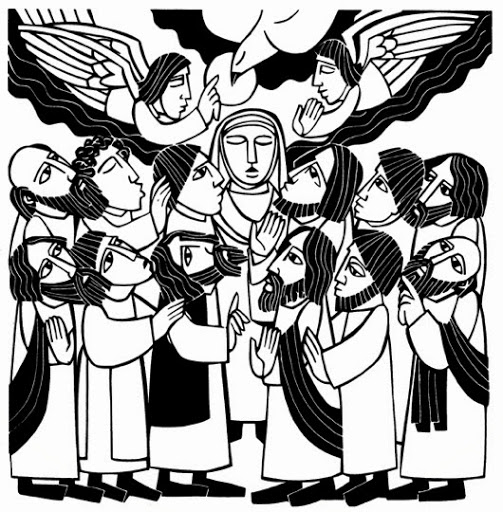
The final topic of the interview was the question of the “theology of women” that Pope Francis referred to as being absent but very much needed. Here, Voce identified Francis’ statement that “Mary is greater than the apostles” as being the Leitmotiv of such a theology. She also suggested that this direction, given by the Pope, points both to complementarity and to women also participating in the Church’s magisterium, it’s teaching and leadership role, in some way:

“Chiara [Lubich]2 thought of Mary as the blue sky that contains the sun, the moon and the stars. In this vision, if the sun is God and the stars are the saints, Mary is the sky that contains them, that contains also God: by God’s own will who has incarnated himself in her womb. The woman in the Church is this, needs to have this function, which can only exist in complementarity with the Petrine charism. It can’t be only Peter guiding the Church, there needs to be Peter with the apostles and sustained and enveloped by the embrace of this woman-mother who is Mary.”

This image of Mary enveloping the apostles is filled with profound beauty to my mind, and is such an intuitive way of putting the need for complementarity between the Petrine, apostolic aspect of the Church and the Marian aspect, which is about reciprocating God’s love for us. In fact, the Catechism of the Catholic Church – drawing on John Paul II’s apostolic letter Mulieris Dignitatem – puts this very clearly:

““[The Church’s] structure is totally ordered to the holiness of Christ’s members. And holiness is measured according to the ‘great mystery’ in which the Bride responds with the gift of love to the gift of the Bridegroom.” Mary goes before us all in the holiness that is the Church’s mystery as “the bride without spot or wrinkle.” This is why the “Marian” dimension of the Church precedes the “Petrine.””

The challenge now is to put it into practice!


1 For more on this subject, see a previous post.
2 For more about Chiara Lubich – the founder of the Focolare Movement, see previous posts and for some background on the image referred to by Voce see this particular one.