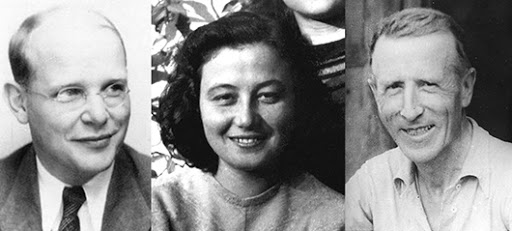
Bonhoeffer, Lubich, Teilhard: A world luminous from within

Bonhoeffer lubich teilhard s

Sixty eight years ago yesterday, in the Flossenbürg concentration camp, the Lutheran pastor and theologian Dietrich Bonhoeffer was martyred. His opposition to Nazi euthanasia and genocide directed against the Jewish people, born of his discipleship of Jesus, earned him the gallows. While I have long been an admirer of Bonhoeffer’s witness and theology, I have only now come across the following passage from his Letters and Papers from Prison, where he points particularly lucidly to the alternative to the God of Gaps caricature still popular today:

“How wrong it is to use God as a stop-gap for the incompleteness of our knowledge. If in fact the frontiers of knowledge are being pushed further and further back (and that is bound to be the case), then God is being pushed back with them, and is therefore continually in retreat. We are to find God in what we know, not in what we don’t know.”

This emphasis on the presence of God in what we know made me think of Chiara Lubich’s mystical experience that started during the summer of 1949.1 There, before the start of the actual “intellectual visions,” she recounts the following:

“[N]ature seemed to me to be enveloped totally by the sun; it already was physically, but it seemed to me that an even stronger sun enveloped it, saturated it, so that the whole of nature appeared to me as being “in love.” I saw things, rivers, plants, meadows, grass as linked to one another by a bond of love in which each one had a meaning of love with regard to the others. […] I had seemed to see the blossom of a horse chestnut tree alive with a higher life that sustained it from beneath so that it seemed to be coming out towards me.” (Paradise ’49)

How is it though that one comes to seeing God “in what we know,” as “sustain[ing everything] from beneath”? Here, in the paragraphs preceding the above quote, Lubich says that “[for about five years w]e had been trying with great intensity to live [… communion] with Jesus in the Eucharist, with our brother or sister, with the Word of God […] constantly in the present moment.” Her answer then is that this experience of God “enveloping” all has for her and her companions followed a putting of the Gospel into practice.

This in turn made me think of Pierre Teilhard de Chardin’s “The Divine Milieu,” where he sets out “a way of teaching how to see” and starts by posing a challenge:

“God is as pervasive and perceptible as the atmosphere in which we are bathed. He encompasses us on all sides, like the world itself. What prevents you, then, from enfolding him in your arms? Only one thing: your inability to see him.”

Reflecting on the above near the end of his life, Teilhard shares the following:

“Throughout my life, by means of my life, the world has little by little caught fire in my sight until, aflame all around me, it has become almost completely luminous from within. … Such has been my experience in contact with the earth — the diaphany of the Divine at the heart of the universe on fire … Christ; his heart; a fire: capable of penetrating everywhere and, gradually, spreading everywhere.”

Again the vision of God illuminating the world “from within” follows a life focused on seeking Him, as Teilhard says in “The Divine Milieu,” both in what we do and what happens to us – both the active and the passive, and therefore in life as a whole:

“It is the whole of human life, down to its most “natural” zones, which, the Church teaches, can be sanctified. […] “So whether you eat or drink, or whatever you do, do everything for the glory of God.” (1 Corinthians 10:31).”


1 For previous mentions of “Paradise ’49” see the following posts here and here.

A man the color of a sapphire

Meister des Hildegardis Codex 003

Tomorrow is the feast day of St. Hildegard of Bingen, a great 12th century German mystic who was a Benedictine Abbess, poet and composer and all round intellectual (having contributed not only to theology but also to medicine and science as well). Even though she has been venerated as a saint for centuries, she has only been formally canonized last May by Pope Benedict XVI, who also spoke about her in several of his sermons. There he emphasized her as a role model for spiritual leadership, since “she inspired holy emulation in the practice of good to such an extent that, as time was to tell, both the mother and her daughters competed in mutual esteem and in serving each other.”

Also with regard to her mystic visions he praised here humility, which at first made her doubt them and only when they received approval first from St. Bernard of Clairvaux and later from Pope Eugene III did she share them with her followers and the public. “The person endowed with supernatural gifts never boasts of them, never flaunts them and, above all, shows complete obedience to the ecclesial authority.” As far as she herself was concerned, this is how she described her visions:

“The vision fascinates my whole being: I do not see with the eyes of the body but it appears to me in the spirit of the mysteries…. I recognize the deep meaning of what is expounded on in the Psalter, in the Gospels and in other books, which have been shown to me in the vision. This vision burns like a flame in my breast and in my soul and teaches me to understand the text profoundly” (Epistolarium pars prima I-XC: CCCM 91).

From among her extensive visions that touched on virtually all aspects of Christianity, I would just like to pick out her vision of the Trinity, which struck me as particularly beautiful:

“Then I saw a bright light, and in this light the figure of a man the color of sapphire, which was all blazing with a gentle glowing fire. And that bright light bathed the whole of the glowing fire, and the glowing fire bathed the bright light; and the bright light and the glowing fire poured over the whole human figure, so that the three were one light in one power of potential.” (Scivias 2.2, quoted in Anne Hunt’s The Trinity: Insights from the Mystics, pp. 38).

In fact, the image at the top of the post is a representation of this vision from an early illuminated printed version. St. Hildegard explains this vision as follows:

“You see a bright light, which without any flaw of illusion, deficiency or deception designates the Father; and in this light the figure of a man the color of a sapphire, which without any flaw of obstinacy, envy or iniquity designates the Son, Who was begotten of the Father in Divinity before time began, and then within time was incarnate in the world in Humanity; which is all blazing with a gentle glowing fire, which fire without any flaw of aridity, mortality or darkness designates the Holy Spirit, by Whom the Only-Begotten of God was conceived in the flesh and born of the Virgin within time and poured the true light into the world.” (Scivias, 2.2.2, quoted in ibid).

What I find very attractive about St. Hildegard is the visual and allegorical nature of her mystical experiences (which she is careful to describe as spiritual rather than ocular) and their subtle beauty that is particularly clear in the above example.