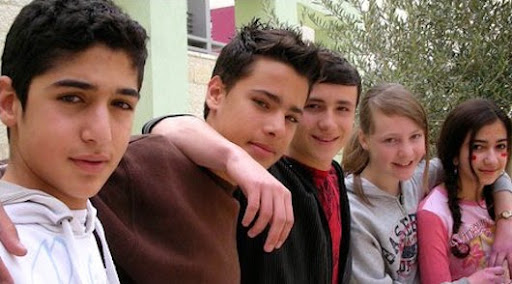
Catholics? Christians? “Good” people?
No.
In total disagreement with the author of yesterday’s “Thoughts on today’s Mass,” distributed in my parish, who said that “we are not naturally children of God: we become so by baptism, when God adopts us as his own. Otherwise to call God our Father would be a bold presumption,” I would like to show that the Catholic Church teaches that every single human being is a child of God. Using the idea of being God’s child as the basis of separation, the basis of an “us,” as opposed to a ”them,” is perverse and absolutely not what the Catholic Church teaches, in spite of the official-looking material handed out in some of its parishes.
To begin with, Jesus – the Son of God – himself recognizes familial status universally, when he says that “whoever does the will of my heavenly Father is my brother, and sister, and mother” (Matthew 12:50) and St. Paul too picks up on the key being adherence to God’s will: “For those who are led by the Spirit of God are children of God” (Romans 8:14).
That such adherence to the will of God is open to everyone – whether they believe in God or not – and that it is at the heart of what the Catholic Church believes, is very clear from Nostra Aetate, the declaration issued during the Second Vatican Council by Pope Paul VI, which says in its closing paragraph:
“We cannot truly call on God, the Father of all, if we refuse to treat in a brotherly way any man, created as he is in the image of God. Man’s relation to God the Father and his relation to men his brothers are so linked together that Scripture says: “He who does not love does not know God” (1 John 4:8).
No foundation therefore remains for any theory or practice that leads to discrimination between man and man or people and people, so far as their human dignity and the rights flowing from it are concerned.
The Church reproves, as foreign to the mind of Christ, any discrimination against men or harassment of them because of their race, color, condition of life, or religion. On the contrary, following in the footsteps of the holy Apostles Peter and Paul, this sacred synod ardently implores the Christian faithful to “maintain good fellowship among the nations” (1 Peter 2:12), and, if possible, to live for their part in peace with all men, so that they may truly be sons of the Father who is in heaven.”
And this is also reflected in what the Catechism teaches about the opening words of the Our Father, the prayer Jesus taught:
“God’s love has no bounds, neither should our prayer. Praying “our” Father opens to us the dimensions of his love revealed in Christ: praying with and for all who do not yet know him, so that Christ may “gather into one the children of God.” God’s care for all men and for the whole of creation has inspired all the great practitioners of prayer; it should extend our prayer to the full breadth of love whenever we dare to say “our” (§2793)
Note in particular the thought-provoking idea in the above of Catholics praying with those who don’t know Jesus. Even in a fundamentally religious act the desire of Catholics is to be united with those who don’t share their beliefs!
And if the above weren’t enough to categorically declare that Catholics consider every human being to be a child of God and therefore also their brother or sister, let’s see what the last three popes had to say on the subject:
- “We must never forget that every person, from the moment of conception to the last breath, is a unique child of God and has a right to life.” Pope Saint John Paul II (Address at the Ceremony of the Anointing Of The Sick, Southwark’s Cathedral, London, 28 May 1982)
- “God is the origin of the existence of every creature, and the Father in a unique way of every human being: he has a unique, personal relationship with him or her.” Pope Benedict XVI (Sunday Angelus address, 8 January 2012)
- “Since many of you are not members of the Catholic Church, and others are not believers, I cordially give this blessing silently, to each of you, respecting the conscience of each, but in the knowledge that each of you is a child of God. May God bless you!” Pope Francis (Audience to Representatives of the Communications Media, 16th March 2013 – the day after his election!)
- “Every human being is a child of God! He or she bears the image of Christ! We ourselves need to see, and then to enable others to see, that migrants and refugees do not only represent a problem to be solved, but are brothers and sisters to be welcomed, respected and loved.” Pope Francis (Message for the World Day of Migrants and Refugees, 5 August 2013)
I rest my case.
 eyebeleave