
Divorced from reality

Simulacrum

[Warning: long read, again :)]1

Starting this post is turning out to be more difficult than I anticipated, so, please, forgive my meta-cop-out for its opening line. I have now deleted four alternative openings – all failed attempts at arriving at the question that has been occupying me during the last several weeks. In fact, as framing the question (which tends to be halfway to answering it anyway) is the problem, I’ll tell you about its history for me instead.

One of my very best friends, SH, has once asked me (during the course of about a year’s worth of the most fantastic, enlightening – at least for me – and profound conversations) whether he, an agnostic, ought to want to believe in God. My immediate intuition at the time – and a view I still hold – was: “No.” I felt that it would be insincere to make oneself want to believe (if such a thing were even possible) and I was instead convinced that my friend was already living a life that was following Jesus’ example and if he were to become a believer it would not be as a result of setting out to do so. Put in other terms, I was not worried about my fiend and in fact considered him to be an example to me in orthopraxy (even with his lack of orthodoxy). This is the first marker in the landscape I would like to sketch out for you – an agnostic who lives by the Gospel.

Next, I’d like to bring in another strand that leads to my central question today. For a long time now I have felt a keen sense that the Church (i.e., me included!) must be open to all, welcoming of all, transmitting what Pope Francis refers to as the “warming of hearts” that Jesus’ presence effects. As a consequence, I have been very pleased by the Church’s openness towards atheists and agnostics (e.g., see Franics’ letter to Scalfari), by Her fresh attempts at engaging with homosexual persons (e.g. in Francis’ interview with Jesuit magazines) and by Her apparent concern for all who today are at Her periphery, including divorced and re-married persons (e.g., see Francis’ impromptu interview during the flight back from the Rio World Youth Day). All of this is a great source of joy to me and its opposites, which sadly still exist in the Church, pain me.

The third strand that leads to what I would like to talk about today is the perennial tension in the Church between safeguarding Jesus’ original, explicit teaching and listening to the Holy Spirit’s ever-new guidance in every present moment. Being a Christian is not about taking a piece of 2000-year-old text and solitarily reading it as a self-help book. Instead, it is membership in a body that has Jesus as its head and a vast throng of individuals – both alive today and already past their earthly pilgrimage – as its members. Starting from the apostles themselves, who saw, touched and lived with Jesus, through their followers and their followers’ followers down to the present day, this body – animated by the Holy Spirit – is the Church through whom Jesus walks the Earth today. What Jesus’ message is in 2013, is to be found here – in the Church. This means both that it is alive and dynamic and that it is – simultaneously – the same, one message that Jesus shared with his followers 2000 years ago: love your neighbors as yourself and God above all else (cf. Mark 12:30-31), give your life for your friends (John 15:13), feed the hungry, quench their thirst, clothe the naked, welcome strangers, visit prisoners (cf. Mathew 25:35-36), be peacemakers, merciful, meek (cf. Matthew 5:3-12), be shrewd as serpents and innocent as doves (Matthew 10:16).

The fourth strand is another tension that is part of the very fabric of the Church: Her perfection set against the flaws and failings of Her members. Here it is neither my weakness that makes aiming high futile, nor the holiness of Jesus that makes Him inaccessible. Instead I can choose to allow God’s love into my life without deluding myself into taking credit for its effects or thinking of myself as superior in any way. Dr. Sylvie Barnay put this beautifully in the opening chapter of the book “La grande meretrice” (co-authored with 6 other female historians and looking at the history of the criticisms typically leveled at the Church):2

“The Church remains […] on a journey towards sanctity, a sinner by nature, with the potential for being made perfect by grace. She is therefore neither the Church of the pure, nor a prostitute Church. She is the human Church who hopes to become divine.”

The fifth strand then is a specific confluence of the above four and gets at the specific topic that triggered this post: the challenge of how a person who got married, divorced and then (civilly) re-married participates in the life of the Church. They are not free to receive the Eucharist in the Catholic Church, since they are in a state inconsistent with the indissolubility of marriage that Jesus himself taught explicitly and categorically. As such they don’t live according to, or share with the Church in terms of, an important aspect of what it means to follow Jesus. As a consequence they cannot participate in the sacrament that is both the expression of and means to the unity of the Church. This is a very painful situation for remarried divorcees who desire union with the Church in its most profound gift – the Eucharist – as it is for the whole Church, and Pope Francis has dedicated the first synod of bishops of his pontificate to it and the topic of the pastoral care of families in general.

Francis’ attention to the suffering of remarried divorcees has already lead to a lot of discussion and even to the misinterpretation of a German diocese’s contribution to this discussion as an actual permission for remarried divorcees to receive the Eucharist (immediately followed by the Vatican calling for patience ahead of the coming synod). A couple of days later, Archbishop Müller (head of the Congregation for the Doctrine of the Faith) published an extensive treatise on the subject in L’Osservatore Romano. The gist of the argument is a categorical “no” to the idea of remarried divorcees receiving the Eucharist, and not only that, but a systematic closing-down of a number of potential counter-arguments and loop-holes. Müller essentially says: marriage is indissoluble as Jesus himself told us so directly and unambiguously. As such, those who act as if the sacrament of marriage were dissoluble are objectively at odds with the Church and can not participate in the sacrament that “effects and signifies” Her unity.

At first I was quite puzzled by Müller’s piece (while simultaneously being hugely impressed by the beauty of the argument’s exposition and the clarity of his thinking!) – not because I disagreed with it, on the contrary, everything he says is (as befits his job) highly orthodox and I am in full agreement with him, but because it – prima facie – flies in the face of Francis’ consistent message on this subject.

As is often the case with at-first-sight appearances, there is typically more beneath the surface. As I read Müller’s arguments, I started realizing what he is doing – he is crystalizing what the sacrament of marriage is, exposing its rock-solid foundations and being categorical about its value and centrality to Jesus’ teaching. Between the lines I hear him insisting: “The sacrament of marriage is indissoluble. Don’t look for answers to warming the hearts of remarried divorcees here. Look elsewhere!” To come up with an innovative solution, which the next synod will be devoted to and on which I believe both him and Francis are already at work, it is first essential to ensure that we don’t throw out the baby with the bath water, that we don’t dilute Jesus’ teaching and the immeasurable treasures it contains.

In fact, reading Müller more closely also shows that he is very much concerned for remarried divorcees and for all at the Church’s periphery:

“Clearly, the care of remarried divorcees must not be reduced to the question of receiving the Eucharist. It involves a much more wide-ranging pastoral approach, which seeks to do justice to to the different situations. It is important to realize that there are other ways, apart from sacramental communion, of being in fellowship with God. One can draw close to God by turning to him in faith, hope and charity, in repentance and prayer. God can grant his closeness and his salvation to people on different paths, even if they find themselves in a contradictory life situation.”

Far from just slamming a door shut, Müller calls for a broader view of the situation, which is also in line with another of Pope Francis’ hints on the subject. In his interview on the flight from Rio he quoted his predecessor in Buenos Aires, Cardinal Quarracino, as saying: “I consider half of today’s marriages to be invalid because people get married without realising it means forever. They do it out of social convenience, etc …” In other words, the sacrament of marriage is indissoluble, but not all that looks like sacramental marriage is – or indeed ever was – sacramental marriage. In light of this angle, Müller’s demarcation of marriage and reinforcement of its absolute indissolubility make great sense, as part to a new approach to determining whether in a given instance marriage was ever entered into or not.

I have to say I feel greatly encouraged by all of the above developments and by other statements that Pope Francis has made recently, underlining the sacramental, vocational nature and profound value of marriage. In fact, speaking to a group of young people in Assisi about a month ago, he was very explicit: “[Marriage] is a true and authentic vocation, as are the priesthood and the religious life.” I wholeheartedly agree, but I also think that this statement points to an elephant in the room: if marriage is a vocation like the priesthood and religious life, how come there is such a vast gap between how one prepares for it versus the other vocations. Entering a religious order involves years spent in preparation, passing through various forms of novitiate, being followed by a spiritual director, with the outcome not being a guaranteed admission to the order. Preparation for the priesthood is equally lengthy, with years of study, practical and spiritual preparation and discernment being exercised both by the candidate and the Church’s hierarchy. Marriage instead can be had within a matter of weeks (months at most – if we include the challenges of booking the reception venue :|) and after attending a variable number of “preparation” sessions with a total duration in single digit hours. Yet, once the sacrament is enacted, it is binding for life! No surprise that great suffering can come from such a lopsided and inadequate process.

I clearly don’t mean to say that no couple properly prepares for the sacrament of marriage, since I know many who have, but only that if it does, it is so independently of the marriage preparation provided by the Church. Maybe it would be better for fewer marriages to be entered into and for these to be the result of a couple’s response to a call from God to follow Him as a family, instead of the easy access + heavy penalties model in place today. While writing this, I hear alarm bells in my head though, reminding me that it is imperative for the Church to be open and welcoming to all and the challenge remains of how to achieve such openness while following the path Jesus has shown us.


1 Many thanks to my überbestie, PM, for the great chats we have had about this and related topics.
2 The crude translation from Italian here is all mine, as the book is, sadly, not available in English.
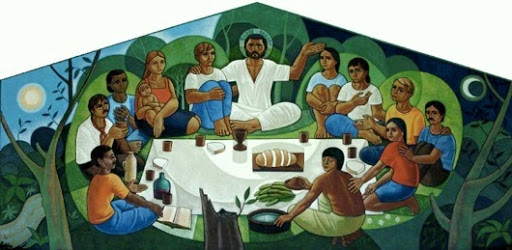

Liberation Theology rehabilitated

Santa cena teologia liberacion

Pope Francis is about to meet with the founder of Liberation Theology, Fr. Gustavo Gutiérrez, thanks to the current head of the Congregation for the Doctrine of the Faith (CDF) – Archbishop Gerhard Ludwig Müller, which – on the face of it – is a 180° turn versus its past condemnations by the Vatican. Taken superficially, it is a meeting between Francis and a proponent of a theology that has been categorically denounced both by Blessed Pope John Paul II and his successor, Pope Benedict XVI.

A closer look reveals quite a different picture though:

  1. Fr. Gutiérrez, unlike other teachers of Liberation Theology (e.g., Leonardo Boff), has never been censured by the Vatican.
  2. John Paul II and Benedict XVI never condemned Liberation Theology as such, but only those variants of it that placed Marxist analysis at their cores and thereby de-Christified it. In fact, Benedict XVI (then then-Cardinal Ratzinger) is quite clear about the distinction in the “instruction” he published in 1984 as the head of the CDF:

    “The aspiration for ‘liberation’, as the term itself suggests, repeats a theme which is fundamental to the Old and New Testaments. In itself, the expression “theology of liberation” is a thoroughly valid term: it designates a theological reflection centered on the biblical theme of liberation and freedom, and on the urgency of its practical realization. […] The warning against the serious deviations of some “theologies of liberation” must not be taken as some kind of approval, even indirect, of those who keep the poor in misery, who profit from that misery, who notice it while doing nothing about it, or who remain indifferent to it. The Church, guided by the Gospel of mercy and by the love for mankind, hears the cry for justice and intends to respond to it with all her might.”

  3. Instead of this being a change brought in by Francis, the re-visiting of the position taken with respect to Liberation Theology escalated when Benedict XVI appointed Müller as the head of the CDF in 2011 – Müller, who was known to be a personal friend of Gutiérrez, whom he considered as his mentor and whose summer lectures he has been attending annually since 1998 in Peru.
  4. While the new attitude is a change version previous positions, it is not a change as far as Marxist-based flavors of Liberation Theology go. Instead, it is a sign of support for those strands of Liberation Theology that have presented social justice and a focus on the poor on a wholly Christian basis. Fr. Juan Carlos Scannone, one of Pope Francis’ former professors puts it as follows: “In the Argentinean Liberation Theology, social Marxist analysis is not used, but rather a historical-cultural analysis, not based on class warfare as a determining principle for the interpretation of society and history.”

To get a sense of why Müller, who is clearly the catalyst behind the rehabilitation of some strands of Liberation Theology, took an interest in it, it is worth taking a look at the speech1 he gave at the Pontifical Catholic University of Peru in 2008, when it awarded him an honorary doctorate.

There, Müller starts by admitting that he had read expositions of Liberation Theology as well as their criticisms by the CDF, before meeting Gutiérrez, but that his engagement with them was purely theoretical. His initial attitude was one of skepticism and concern about both a danger of leading to violence and a naïveté with regard to the application of Marxist principles. Attending a seminar lead by Gutiérrez then turned him “from academic reflection on a new theological concept to experience with the men and women for whom this theology had been developed.” From the start, Gutiérrez emphasized that Liberation Theology was about theology and not politics, with the aim “to understand the world, history and society and transform them in light of the God’s own supernatural revelation as savior and liberator of man.” The “point of departure” is very clearly put by Müller as follows:

“How one can speak of God in the face of human suffering, of the poor who don’t have sustenance for their children, or the right to medical assistance, or access to education, who are excluded from social and cultural life, marginalized and considered a burden and a threat to the lifestyle of the wealthy few.

These poor are not an anonymous mass. Each one of them has a face. How can I as a Christian, priest or layman, whether through evangelization or scientific theological work, talk about God and His Son who became man and died for us on the cross and bear witness to Him, if I don’t want to build another theological system in addition to the existing one, except by saying to the specific poor person face to face: God loves you and your inalienable dignity is rooted in God. How does one make Biblical considerations real in individual and collective life, when human rights originate in the creation of man in the image and likeness of God.”

Müller then moves on to what I believe is the core of his message, when he speaks about not only attending courses about Liberation Theology in various Latin American countries, but also their being accompanied by:

“long weeks of pastoral work in the Andean region, especially in Lares in the Archdiocese of Cuzco. There the faces acquired names and became personal friends, this experience of universal Communion in the love of God and neighbor, which must be the essence of the Catholic Church. Finally it was a deep joy for me when in 2003, in Lares, in the Archdiocese of Cuzco, being already a bishop, I could administer the sacrament of Confirmation to young people whose parents I had already known for a long time and whom I myself had baptized.

Hence I have not been speaking of liberation theology in an abstract and theoretical way, much less ideologically to flatter progressive church groups. Similarly I have no fear that this may be interpreted as a lack of orthodoxy. Gustavo Gutiérrez’s theology, regardless of which angle you look at it from, is orthodox because it is orthopractic and teaches us proper Christian action because it comes from true faith.”

Müller’s assessment of Liberation Theology comes not only from a reading of and reflection on its teachings, but from him personally having put it into practice and experienced its fruits. It is these fruits that reinforce the truth of its principles, whose flowing from “true faith” can be inferred from them. It is a “see, judge, act” process, which Müller says “has been decisive in my own theological development” and which follows Jesus’ own words as regards orthopraxy:

“Beware of false prophets, who come to you in sheep’s clothing, but underneath are ravenous wolves. By their fruits you will know them. Do people pick grapes from thornbushes, or figs from thistles? Just so, every good tree bears good fruit, and a rotten tree bears bad fruit. A good tree cannot bear bad fruit, nor can a rotten tree bear good fruit. Every tree that does not bear good fruit will be cut down and thrown into the fire. So by their fruits you will know them.” (Matthew 7:15-20).

UPDATE (13 September 2013): The Catholic New Service has just tweeted that the Vatican has confirmed that a meeting between Pope Francis and Fr. Gutiérrez took place two days ago.


1 The original, Spanish version can be found here. Note that the English text used above includes my adjustments based on this original (e.g., at one point “imperdible” is translated as “amazing” in the English referred to above, while I render it as “inalienable”).

LCWR "systems thinking" – the good, the bad and the ugly

Good bad ugly

The Leadership Conference of Women Religious (LCWR) is an umbrella organization founded in 1956 by the Vatican and counting the leaders of 1500 congregations of women religious in the US as its members (spanning over 80% of all nuns and sisters in the country). Between April 2008 and July 2011 it has been under investigation by the Congregation for the Doctrine of the Faith (CDF), which has found “serious doctrinal problems” and “a diminution of the fundamental Christological center and focus of religious consecration which leads, in turn, to a loss of a “constant and lively sense of the Church” among some Religious.” In other words, the CDF are saying that the LCWR are taking Christ out of Christianity …

Among the multiple changes mandated by the CDF, the withdrawal of the LCWR’s “Systems Thinking Handbook” was one that particularly caught my eye, also because there are multiple references to it in the CDF’s doctrinal assessment and because its title alone makes me nervous. And as soon as I started reading it, my expectations were not only met but, sadly, exceeded and I very soon came to reading the text not with a question about whether the CDF were hounding the poor LCWR, but about why they haven’t enforced changes already. Roundabout the same point on my way through the “handbook,” I remembered my Aristotle professor and his admonition to apply the principle of charity when faced with another’s thoughts and it is that alone, which resulted in my take including a “the good” section.1

So, let me start with the slimmest slice from the pie that is this Handbook – the good. Here what I am taking away from having read the 26-page publication is that its motives are good and that the intention behind the methods and attitudes presented in it is to bring about change that goes to the root causes of suffering and injustice:

“This is why it is necessary not only to feed the hungry or house the homeless but also to address the systemic relationships that result in social ills like poverty, homelessness, and hunger.”

Next, let’s move on to the bad (yes, that was it as far as the good is concerned), where the text unfortunately offers far richer pickings.

First, there is a ideologization already of the basic concept of “system” that is at the heart of this Handbook (an odd fact by itself, given the prominence of this text in an organization with canonical status):

“A ‘system’ is an entity that maintains its existence and functions as a whole through the interaction of its parts. The behavior of a system depends on the total structure. The interrelationship among the parts of a system, therefore, must be continually sustained for the system to exist. Systems are purposeful, open, counterintuitive, multidimensional, and have emergent properties not found in any of the parts by themselves. … systems thinking will prevent us from unconsciously employing the same mental models that are causing the problems we want to solve.”

While the first three sentences are pretty vanilla, and essentially paraphrase the opening paragraph of the Wikipedia definition, there is an immediate investment of the term with adjectives like “open” (what about closed systems) and “counterintuitive” (what about a simple system, like that of tea brewing: tea leaves + boiling water –> tea). The paragraph then concludes with an oxymoronic flourish: “systems thinking will prevent us from unconsciously employing the same mental models that are causing the problems we want to solve,” which Freud would have had a lot of fun with.2

Second, there are frequent counterpositions of “Western thought” on the one hand and “Organic thought” on the other, where the former is introduced thus:

“The limits of a short article do not allow for an adequate overview of the development of Western thought. We can safely say, however, that for almost a thousand years, Western thought has interpreted reality from the perspective of a worldview characterized by dualism and hierarchy. […] The ultimate result was a learned inability to think in any other than linear, dualistic, and hierarchical ways when dealing with problems, organizing ideas or work, and in structuring society, church, or our religious congregations. […] This way of seeing reality thus became an unconscious filter for the Western mind, a filter that made it easy to judge immediately what fit or did not fit a particular situation […] The world was stable and sure, a machine-like structure of predetermined and fixed relationships. The human mind could comprehend the universe in its entirety.”

The fault for the above blinkered and recalcitrant nature of “Western thought” is laid at the feet of Plato and Aristotle and all who followed them until the 1960s. The solution put forward by the LCWR is “Organic thought”:

“Th[e] “Organic” mental model prefers to look at wholes instead of parts, at processes instead of substances. [… T]he “Organic” mental model values chaos, connectedness, process, inclusivity, relationship, and a non-linear expression of authority.”

Commenting on the above is quite a stress test for my desire to apply the principle of charity, as a result of which I’d like to suggest that it is dramatically ill-informed and epically naïve. To suggest that Plato (i.e., mostly Plato’s Socrates; not to mention over two millennia of thinkers following him) had a sense of certainty, of the universe being “machine-like” and of “comprehend[ing] the universe in its entirety” is a claim that can only be made in the absence of any direct experience of his and his successors’ thought. In his Apology, Plato’s Socrates famously says “I do not believe that I know anything,” and even the concept of “system,” so central to the LCWR handbook, is extensively dealt with already by Aristotle.3 This is not to mention the importance attributed to the whole and its interrelationships in Christian sources, starting from St. Paul (cf. 1 Corinthians 12:12-26), via St. Hildegard (“God has arranged all things in the world in consideration of everything else.”) and St. Francis (who sings of fraternal relationships with creation) to Teilhard de Chardin’s noosphere. To argue that pre-late-20th-century thought was linear, deterministic and endowed with a sense of its own omniscience is simply false and divorced from facts.

Third, there is an attempt to anchor the Hadbook’s approach to Vatican II and specifically to it’s Lumen Gentium, which – it is claimed – “consciously grounded ecclesiology in the holistic image of the “People of God,” rather than in the “top down” definitions of the past […] defined by dualism and hierarchy.” With the principle of charity at breaking point, I can at best see this statement as being an ultra-selective reading of Lumen Gentium that essentially omits its extensive third chapter (“On Hierarchical Structure”) and all of its numerous references to the role of the Church’s hierarchy not only in Lumen Gentium but also in all of the other Vatican II documents. No matter how hard I try, I cannot even chalk this up to the authors of the Handbook having missed some subtle in-between-the-lines content, as Lumen Gentium states quite directly that: “Bishops […] presid[e] in place of God over the flock, whose shepherds they are, as teachers for doctrine, priests for sacred worship, and ministers for governing. […] In the bishops, therefore [… Jesus], is present in the midst of those who believe.” Pretty hard to read this as a “holistic,” a-hierarchical twist versus the preceding 2000 years of the Church’s nature.

Finally, let’s turn to the “ugly,” where, I’m afraid, my threadbare principle–of–charity gloves may not be too effective anymore. While the above is confused and both theologically and philosophically lacking both in breadth and comprehension, the most serious issue with the Handbook is the following passage:

“[Sisters g]rounded in [“Western mind”] theology […] believe that the celebration of Eucharist is the summit of worship and at the core of what holds us together as a group. [… Sisters] situated within [an “Organic” mental model] believe that the celebration of Eucharist is so bound up with a church structure caught in negative aspects of the Western mind they can no longer participate with a sense of integrity [… and] believe that as long as men control women’s lives, there will be no justice. […]

Since so much of our identity is bound up with shared theological assumptions manifested in group behaviors and practices, who we are as a group can be called into question if we do not believe the same things. The function of ritual is to bring to visibility our deepest beliefs through symbolic word and action. Tension over which symbolic acts and words to use reveals differences at the level of belief. Such differences call into question our identity at the core of who we are. They push us to ask, “Is there something at the heart of who we are which is beyond a common Eucharistic theology and which holds us together?””

Err … No! For a Catholic to suggest that there may be something beyond the Eucharist as a means of bringing about unity is simply nonsensical. The Church is (as in identity) the Mystical Body of Christ and “[r]eally partaking of the body of the Lord in the breaking of the Eucharistic bread, we are taken up into communion with Him and with one another. “Because the bread is one, we though many, are one body, all of us who partake of the one bread”. In this way all of us are made members of His Body, “but severally members one of another”.” At least that is how Lumen Gentium (the only magisterial document referred to by the LCWR) puts it. And, no, it doesn’t then go on to say “or whatever else you might like to do instead” …

The above passage does another, worrying thing – i.e., it suggests that a problem with the Eucharist is that it is an instance of “men control[ling] women’s lives.” Would the authors of the Handbook have objected to receiving the Eucharist out of Jesus’ hands at the Last Supper? Would they have turned to him and said: “Sorry, mate, we won’t let you control us and deprive us of justice!” Maybe …

The ugly thing here, to my mind, is not so much that the LCWR leadership publishes a text like this Handbook, but that it considers their views to be consistent with “the Gospel of Jesus,” justified by Vatican II teaching and acceptable in the context of a Vatican-incorporated body. While their intentions are good, their reasoning is deeply flawed and their beliefs about the Eucharist are categorically not Catholic. This is unquestionably not a case of the CDF oppressing nuns, but instead a crystal clear case of an institution with canonical status having gone off the rails and placed their beliefs outside the Church (and done so with some margin). I sincerely hope that the women religious they claim to represent either leave the LCWR (if they don’t share its beliefs) or openly declare their loss of Catholic orthodoxy.


1 In what follows, I will only reflect on the content of this publication and I have no intention to make inferences about the work of women religious in the US, about the doctrinal positions of the congregations whose leaders are members of the LCWR or about how the CDF have managed their investigation.
2 The rest of the Handbook is peppered with plentiful displays of naïveté, such as a section entitled “The Need to See Things as They Really Are” or the list of the “Laws of Systems Thinking” of which I’d just pick out these three: “6. Faster is slower,” “9. Dividing an elephant in half does not produce two small elephants,” and “10. There is no blame” :|.
3 E.g., see the following quote from his Politics: “the whole is of necessity prior to the part; for example, if the whole body be destroyed, there will be no foot or hand, except in an equivocal sense, as we might speak of a stone hand; for when destroyed the hand will be no better than that.”