Finding beauty in ugliness

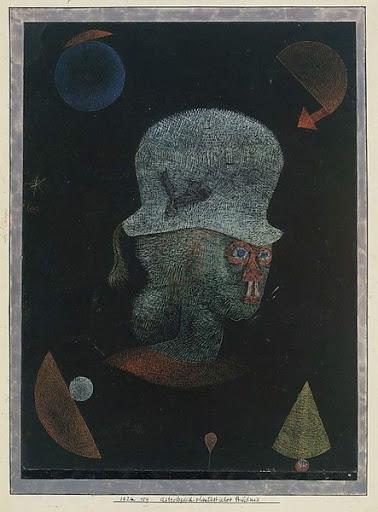
Klee fantasy

1515 words, 8 min read

Last Saturday, Cardinal Gianfranco Ravasi addressed a meeting entitled “Beauty will save the world, let us save beauty,” organized by Earth Day Italia, that took place in the Vatican’s church of St Stephen of the Abyssinians. In his talk, Cardinal Ravasi spoke about the etymology of the word for beauty in Hebrew, Greek and Italian, pointing to the fact that in all these languages the word either directly refers both to beauty and goodness, or at least has roots that do. After the Q&A that followed, Cardinal Ravasi then added a few words in defense of a certain kind of ugliness, lest beauty be misunderstood as aestheticizing. What follows is my translated transcript of the talk:


I would like to start from a thing that is the most material possible, the most limiting possible, which, however, is always fundamental for humanity: that is, the vocabulary, words. […] In the Bible, both the Old and New Testaments, using two completely different languages – Hebrew and Greek, and we are still at the point of vocabulary, words, which, on the other hand are the fundamental instruments of communication, we have a single word that contemporaneously expresses two realities that are different for us. In fact, in Hebrew there is the word ‘tov’ (טוֹב) that at the same time means good and beautiful. And in the New Testament, predominantly when a prominent figure or a significant act is to be described, the Greek word kalos (καλός) is used, which in the New Testament means good.
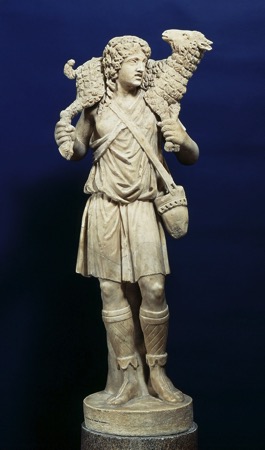
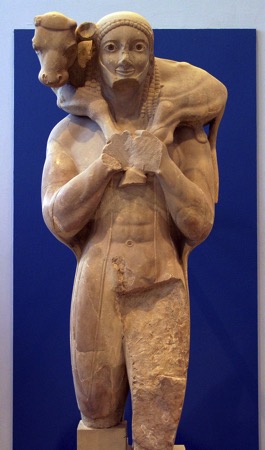
Vatican good shepherd800px ACMA Moschophoros

Let me give you an example that you all have in mind but about which you maybe do not have the idea of its original Greek basis. How does Jesus define himself in John’s Gospel? I am the good shepherd. I am sure you all have the famous statue of the good shepherd from the Vatican museums in mind, which is a Christian transcription of a Greek statue of the moscophoros. So, in Greek we have – listen! – “egō eimi ho poimēn ho kalos” (ἐγώ εἰμι ὁ ποιμὴν ὁ καλός.) “Ho kalos” – I am the beautiful shepherd, because these two realities must interweave among us.

With this background, let’s look at Italian. […] In Italian we have this word “bello”. Now, probably only few among you know […] that it has nothing to do with Latin. What does “bellum” mean in Latin? War. That has nothing to do with it. Think about the fact that the word “bello” is a deformation – or the synthesis, the portmanteau, if you will – of a late mediaeval Latin word which sounded like this: “bonicellus” which means good, pleasant, nice and which gradually became first bonellus and then bellum, but in Italian and not in Latin. So, you can see, that at the basis of the Italian word beautiful (“bello”) there is the word “good.”

Let’s now pass to another word, which is antipodean to the word beauty, which is “brutto” (ugly). In Italian there are two words that bud from it and these two other words have the same basis but are not synonymous with it, even if we may use them in an undifferentiated manner. We have the words “bruttezza” (ugliness) and the word “bruttura” (nastiness). The word “bruttezza” indicates an aesthetic quality while the word “bruttura” an ethical one. Imagine for a moment, without wishing to give offense since this applies to many other cities too, that we are going to a district at the peripheries of Rome. A dilapidated district, a district where there is exploitation and rampant overdevelopment, where blocks of flats are built on top of each other in all their ugliness (bruttezza). Such spaces also tend to become the sites of moral degeneration and of social degeneration. And so we arrive at the dimension of nastiness (bruttura).

This is why I am saying that the aesthetic question is also relevant to the ethical and social question. Imagine a kid, one of our kids, who comes out of one of these quarters, where he always sees a gray and rundown block of flats, a flowerbed – if there is one – that is always scruffy, streets that are littered with garbage … and he comes to the center and sees the splendor of architecture, of monuments, … What does he do? He slashes them. They mean nothing to him. Because, with the ethical dimension he has also lost the aesthetic one.
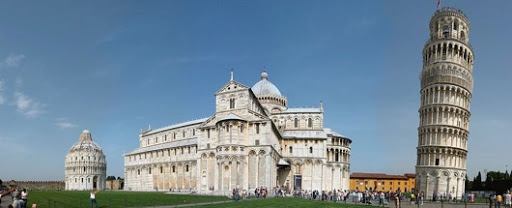
Piazza miracoli

Instead, let’s imagine a kid in the 14th century, who’d leave his house in Siena, would enter the Square of Miracles and walk around in that quarter. Evidently here aesthetics in some way influenced a lifestyle. Naturally, subject to the limits of the weakness and the wickedness also of the human creature.

I conclude and would just like to remember [… a message from the bishops at the Second Vatican Council to artists that reflected on the despair caused by ugliness and nastiness] but in that same message there was also another consideration […] whose basis was that art and faith – both authentic: authentic art and authentic faith – are sisters. Why? And I’d like to answer that with the words of a great painter, Paul Klee, who wrote a very important definition of art: “Art does not represent the visible, but the invisible that is in the visible.” Transcendence. And what is it that religion does if not the same job? […] And finally I would like to quote a writer who is far from Christianity and who is also immoral in the eyes of Christianity: Henry Miller, who wrote Tropic of Cancer, Tropic of Capricorn. In a short essay, The Wisdom of the Heart, […] he wrote the following phrase: “Art, like faith, is good for nothing, other than to show the meaning of life.” And that is not little.

[… at the end of the Q&A that followed, Cardinal Ravasi added:]

I would like to conclude by speaking about ugliness. Let’s say straightaway that squalor is squalor and there is ugliness that is ugly. And we need the courage to say it. We have to say that we are being assaulted by ugliness and nastiness. But, having said this, I would now like to present an defense of ugliness, but of a particular ugliness. For many, and that is why I don’t like this expression that “beauty will save the world” so much, it has become a generally aestheticizing phrase.

We can see, and these are often the victims, with women that feminine beauty has become thought of exclusively as the fruit of an artificial operation applied to a person. To the point of having created an entire medical discipline whose criteria are aestheticizing ones, at times in the form of an external lucidity that, however, isn’t a profound transparency. I remember a beautiful poem by John Donne, this great 17th century English poet, which should be read in English. What does he do? He dedicates beautiful verses to the face of his wife, which by then is marked by a web of wrinkles. To this he says – and I agree fully, “I haven’t seen a season as beautiful as autumn.”1 Imagine what Roman autumn is like. It is infinitely more beautiful than summer.

This is why I said that I would like to present a sort of defense of ugliness. […] Beauty is not smoothness. It is not a dictation formed by beautiful words searched for in a dictionary, as Sunday poets often do. It is, instead, the capacity to capture the transcendent, to capture that which is not seen, but that which is the soul of reality. So, when you go and see an exhibition […] of Caravaggio, you can’t come out from it indignant because Caravaggio also touches evil.
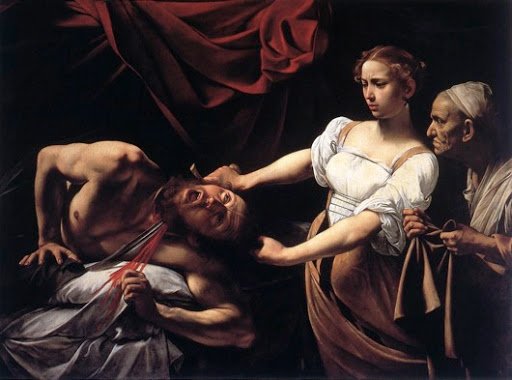
Caravaggio Judith Beheading Holofernes

Without reflecting on evil, and evil is ugly, we wouldn’t have 60-70% of literature. It would not exist. We’d have to get rid of virtually all of Dostoyevsky. This is why I say that it is important to remember that the beautiful is also the groundwork, the pilgrimage, the entrance to the substratum, the underground (to use Dostoyevsky), the entering into a nest of vipers (to quote Mauriac) that represent humanity. When Rilke, who is one of the great poets that I love alongside Eliot, writes the Duino Elegies, how does he define beauty? He defines it as “the beginning of terror.” This is an impressive theophany that torments. Not being a writer or a poet I’ll give my voice to Virginia Woolf, when she too defines beauty saying: “Beauty has two faces, one of joy, one of anguish, both cutting, wounding the heart.” That is, beauty offends, disturbs, disconcerts, also. Let’s think of the Divine Comedy. The best part, they say paradoxically, is the Inferno. And this is precisely because the song wants to enter … and it is also right that we be able to see in something ugly, that may represent humanity’s breath of pain, that we try to look even there for what is truly beautiful that, in the end, however, redeems even evil. It is transfiguration. It is liberation.


1 I guess Cardinal Ravasi is referring to Elegy IX: The Autumnal.
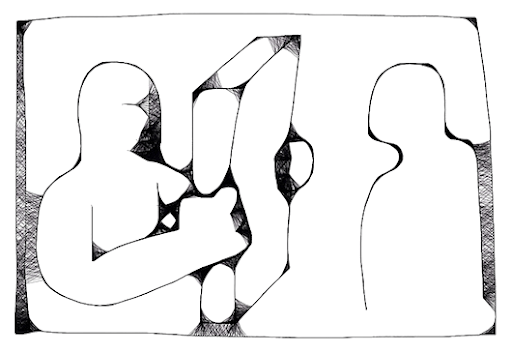
A(rt)ppreciation

Artppreciate

Imagine waking up one morning, walking into your kitchen and finding the table set with your favorite breakfast, beautifully laid out and ready for you to enjoy. What would be your first reaction? Delight? Surprise? Curiosity? Gratitude? And what about when you started eating the food? Would you be savoring its flavors? Would you enjoy the taste?

Or, would the sight of this unforeseen setup stop you dead in your tracks, even preventing you from crossing the kitchen’s threshold? Would you be wondering who prepared the breakfast? What their motivation was? What recipe they followed? How they learned to cook? Where they sourced the ingredients? What other breakfasts they prepared? Who else prepared breakfasts? What they were trying to tell you by making breakfast for you? And would your inability to answer all of these questions put you off so much that you wouldn’t even sit down and eat?

The above scenario might sound very far-fetched and contrived – and it is! – but I’d like to argue that it is an analogy1 of how a growing number of my friends approach art. And I don’t mean to ridicule them here at all – their approach is eminently reasonable, but just to share my own experience2 of relating to art and appreciating it,3 that side-steps (but in some cases defers) what I see as my friends’ inhibitors to sharing in the same enjoyment that I receive.

Over the last couple of years I have, on separate occasions, visited galleries with close friends and have spent some time discussing questions like: “What did the artist want to say with this piece?,” “Is this really art?,” “What do you see in this?” and “What do you know about this artist / the period / the technique / etc.?” As far as I can, I try to dismiss such questions, since I believe them all to be of secondary importance at best.

In the first instance, I find that it pays to try and allow for an encounter between me and a piece of art, which is actually an encounter with a person – its creator – by proxy. And just like when being in the presence of another person, this is all about emptying myself of expectations, prejudices, stereotypes and allowing for the other to express themselves and speak to me. In some cases a connection is established – and it is worth letting it breathe before proceeding to anything else – while in others not – the same applies for art as for people. As Grayson Perry put it – “you don’t have to like it all.”

Second, in case a connection is in place – in case a piece of art has elicited a reaction from me, I can reflect on it and make its effects on me explicit to myself. I can think about how this piece of art fits into my world – what it makes me feel, think, remember, wish for, …

Third, I can share my experience of this encounter with someone else, who is there with me, whom I speak or write to later, … And this sharing can also be in the form of creating new art, that others can engage with without my immediate presence.

And, fourth, I may be compelled to learn more about the piece, it’s author, the technique, it’s context, it’s symbolism, it’s history, which in turn can allow for the sequence to restart and to take a different course, compared to this first, “uninformed” encounter.

A key idea here, at least one that helps me engage with a piece of art, is also to realize that not everything has a verbal equivalent – not everything is just an alternative to verbalized thought and the resolution of every encounter is not a verbalized thought. When looking at a painting by Paul Klee (to give a recent example), my great friend NP asked me: “What was he thinking when he painted this?” To which I hesitatingly and apologetically replied “This!,” while pointing at the painting. I didn’t believe that it was a visual translation of preexisting verbalized thought any more than a piece of music is. And while the answer was awkward, I believed it to be correct. Certainly, words can be said in response to visual art, but – at least in the case of great art, I don’t believe any amount of words can fully capture it, just like they couldn’t a person, whose expression art is.

Finally, I would also like to anticipate a likely objection: “Alright, what you say may be OK, but it doesn’t lead to an understanding of what the artist wanted to say – only to a subjective and potentially unrelated experience by a viewer. Aren’t you missing the point?” Here I’d like to argue that two scenarios are possible: first, that the artist wasn’t trying to communicate – they were “only” expressing themselves (if they wanted to communicate verbal content, they could have used more unambiguous means), in which case a quest to identify a message is futile and, second, that the artist was well aware of the the inherent disjointedness of the process, where the content they intended to embody in a piece of art may not be accessible to some (or even any) viewer, in which case an effort to cross the chasm, that is the piece of art itself, is likely to have arbitrary success.

A third scenario is possible though, I hear you say: that the artist has also written or spoken about what their intentions were when creating a piece. Then, if I am unaware of this proclamation, my viewing of their work will be incomplete and my lack of knowledge an obstacle to getting what they intended by their work. That may well be true, but even if it is, this only impacts the fourth stage of engaging with a piece of art as outlined above – a risk I am happy to take, especially since most artists I know of detested or flatly refused supplying such crutches for the viewing of their work.


1 Please note a key feature of analogy, which is its incompleteness – I don’t mean to suggest that art is the same as food (although it can have a nourishing effect) and I am intentionally staying away from the trap of trying to define what art is – only to argue that there may be a particular way to engage with it.
2 I am making no claims of universality or excellence of method here – this is only my attempt at introspection and sharing of what goes on when I come across a piece of art, in case it may be of some interest or help to someone else.
3 Just a word of warning – if you google “appreciating art,” you are far more likely to find junk – including statements like: “Visiting an art gallery or museum is a low-cost way to spend time with friends or a date.” or “Appreciating art is very easy once you understand art history.” from sources I won’t even link to …

Beauty wounds

Give or take

The latest in a series of “Courtyard of the Gentiles” events took place in Berlin this week and I have to say that I have been very impressed with the little of it that I have managed to follow via its livestreaming. The discussion between Profs. Joas and Schnädelbach (masterfully moderated by Prof. Markschies) was a particular gem, to which I definitely hope to return at a later date (with a highlight being Joas’s call for a confederacy of the “ethically universalist”1 – very much along a previous post here). If you understand German, I very much recommend the recordings of the event, as they represent a, to my mind, exemplary instance of dialogue between Christians and non-believers.

In this post, however, I’d like to share some of my favorite parts of Cardinal Gianfranco Ravasi’s opening address of the “Religion on stage” session that took place at the Deutsches Theater Berlin and where he spoke about beauty, a topic that is very close to my own heart. The text of his talk is available both in German and Italian on-line and the following excerpts will be my own, crude translations from both versions combined.

Ravasi opens by pointing to Judeo-Christian religions representing God Himself by analogy to the aesthetic and to drama,2 which can be seen in the Old Testament in the book of Wisdom: “For from the greatness and the beauty of created things their original author, by analogy, is seen.” (13:5) and already in Genesis, where “God saw that it was good.” (1:10) when looking at what he has created. Here Ravasi makes an important observation about the Genesis text, where the Hebrew adjective tôb, which is rendered as “good,” has not only ethical and utilitarian, but also aesthetic meaning. This would allow for the phrase to be put also as “God saw that it was beautiful.” His final Old Testament reference with regard to this idea is my favorite and points to the book of Proverbs, where God’s creative Wisdom is represented as a girl who “was his delight day by day, playing before him all the while, Playing over the whole of his earth, having my delight with human beings.” (8:30-31). I like this image very much since it ties together creativity, wisdom, play and joy and since already as an image – beyond its metaphorical content – it is beautiful.

The above leads Ravasi to the realization that faith and art are sisters by nature, since – in the words of Paul Klee about art – “they don’t represent the visible, but the invisible that is in the visible.”3 Another dichotomy that is at play both in life and in art (specifically the theater) is that of suffering and joy – of drama and comedy, which Fyodor Dostoyevsky explains by saying: “tragedy and satire [comedy] are sisters, who walk hand in hand and who together are called truth.” To this, Ravasi adds that “authentic art seeks to express also the dark side of this truth,” which he then expands on by first quoting Rainer Maria Rilke: “The beautiful is nothing but the beginning of the terrifying” and then Virginia Woolf: “The beauty of the world has two edges, one of laughter, one of anguish, cutting the heart asunder.” Finally, this line of reasoning is pushed even further through the words of the then-Cardinal Ratzinger from 1992: “beauty wounds, but precisely by doing so, it awakens man to his highest calling.”

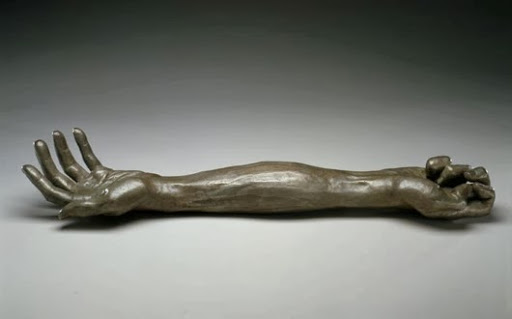
This emphasis on the integrity and comprehensiveness of art with respect to the full spectrum of human emotion is an important move away from the backward-looking, formulaic, stylized or solely artisanal nature of sacral “art” that Ravasi bemoans (and he is equally critical of contemporary attempts that result in “sacral garages where God is parked and the faithful are lined up”). Such failures lead to the divorce between art and faith that has been the case since the last century and that Ravasi has clearly spoken about already during the announcement of the Vatican pavilion a this year’s Venice Biennale. In contrast to its pathologies, Ravasi points to the importance of the cuts that authentic art can inflict and emphasizes that they can be “slits that open onto the infinite and eternal, the absolute, the mystery and the divine,” regardless of the faith of the artist, e.g., as with Lucio Fontana’s – a contemporary of Marcel Duchamp – “Tagli” or “Concetto spaziale” pieces, and – in my opinion – in a less literal way in the work of Louise Bourgeois (e.g., see her “Give or Take”).

Ravasi notes that the separation between art and faith has also, naturally, lead to a shelving of the themes, symbols and narratives of the Bible, which, e.g., Chagall held in very high regard: “For centuries painters dipped their brushes into this colorful alphabet, that of the Holy Scriptures.” Next, Ravasi makes the – to me – most interesting move by a virtuoso application of the principle of charity: “Even certain desecrating and blasphemous expressions4 that have recently elicited strong responses ultimately show not only the strong impact that religious symbols and themes maintain even in a secularized society, but perhaps they also manifest a nostalgia for the signs and images that have been such an extraordinary source of art and culture for two millennia.”

To sum up, I’d like to take advantage of Prof. Dr. Hans Joas’ words from his remarks of the opening session of the Berlin Courtyard of the Gentiles, where he called for “curiosity with regard to the other and humility with regard to oneself,” as a basis for authentic dialogue. I believe Cardinal Ravasi has taken great steps towards a new relationship between the Catholic Church and contemporary art, both in the practical move of participating in the Venice Biennale earlier this year, and in his clear attempts to recognize value and goodness even in art that at first sight is opposed to faith and in being explicit about the breadth of expression that authentic art requires.


1 As opposed to an “ethical particularism” that distinguishes between religious and secular ethics.
2 E.g., for a recent example, see also Hans Urs von Balthasar’s five-volume work “Theo-Drama: Theological Dramatic Theory.”
3 This seems to be related to the following, more extensive quote: “Art does not reproduce the visible; rather, it makes visible…. My aim is always to get hold of the magic of reality and to transfer this reality into painting – to make the invisible visible through reality. It may sound paradoxical, but it is, in fact, reality which forms the mystery of our existence.”
4 Characterized as “desecrating and blasphemous,” the most obvious example that springs to mind is Andres Serrano’s photograph [view at your own discretion].