Ceaselessly re-expressing the universal

Trinity

For several years now I have kept coming across articles by George Weigel, the US author and political and social activist, all of which have to my mind been misguided and lacking in insight. This undoubtedly makes me biased, which may be why I have not responded to his writings here before, and his latest piece – “The deeper issue at the Synod” – was destined to join that growing rank of articles to which I turned with silence. It is not like his latest feuilleton is any more objectionable than its predecessors, but, since it addresses a point that I do agree is pivotal for the upcoming Synod on the Family, and now that I have put my cards clearly on the table, I will spell out my disagreement in this case.

Weigel in this piece starts with recalling opposing positions before Paul VI issued Humanae Vitae, where the losers “argued, moral choices should be judged by a “proportional” calculation of intention, act, and consequence” while the winners – who upheld “tradition” – “held that some things were always and everywhere wrong, in and of themselves.” He then cites John Paul II’s Veritatis Splendor as reinforcing this position and moves on to recounting an analysis of the pre-Synod battle-lines by Prof. Thomas Stark, likely from this article – although without referring to it directly, where he argues that the real opposition at the Synod will be between two camps. The first, who, like Cardinal Walter Kasper, effectively believe that there are no “sacred givens”:

“Professor Stark argues that, for Kasper, the notion of what we might call “sacred givens” in theology has been displaced by the idea that our perceptions of truth are always conditioned by the flux of history – thus there really are no “sacred givens” to which the Church is accountable. To take a relevant example from last year’s Synod: on Kasper’s theory, the Lord Jesus’s teaching on the indissolubility of marriage, seemingly “given” in Scripture, should be “read” through the prism of the turbulent historical experience of the present, in which “marriage” is experienced in many different ways and a lot of Catholics get divorced.”

This, in Weigel’s reading of Stark results in Kasper denying human nature or there even being “Things As They Are”, since the attitude they attribute to Kasper is one where “what happens in history does not happen atop, so to speak, a firm foundation of Things As They Are; there are no Things As They Are.”

The second camp, instead believes that “the “truth of the Gospel” is a gift to the Church and the world from Jesus Christ: a “sacred given.”” Weigel then concludes that Kasper “absolutizes history to the point that it relativizes and ultimately demeans revelation – the “sacred givens” that are the permanent structure of Christian life.” The opposition, in Weigel’s view, is between an absolutization of history at the expense of relativizing revelation and tradition, versus a – in Weigel’s view – appropriate absolutization of the latter.

Instead of retracing Weigel’s steps through Stark’s article, which quotes from Kasper’s 1972 (!) book, An Introduction to Christian Faith, let me instead look at how well invoking John Paul II’s Veritatis Splendor as a rod for Kasper’s back holds up, and then proceed to argue for Weigel’s point being built on category mistakes.

Let’s begin by looking at Veritatis Splendor though, and test the strength of Weigel citing it as an argument for “sacred givens” and for “Things [Being] As They Are” as opposed to historical interpretation [I am sure St. John Paul II is slowly shaking his head in disbelief, looking down on this spectacle from the Father’s house.]

In Veritatis Splendor John Paul II kicks off with the following preamble:

“The splendour of truth shines forth in all the works of the Creator and, in a special way, in man, created in the image and likeness of God (cf. Gen 1:26). Truth enlightens man’s intelligence and shapes his freedom, leading him to know and love the Lord. Hence the Psalmist prays: “Let the light of your face shine on us, O Lord” (Ps 4:6).”

From the get go he speaks about a process: Truth leading to knowledge and love of God, rather than “givens” no matter how “sacred” they may be. Not a good start for the “Things As They Are” team.

Already in the second paragraph, John Paul II presents the teaching of the Church to be not words, but the Word – a person:

“Christ is “the way, and the truth, and the life” (Jn 14:6). Consequently the decisive answer to every one of man’s questions, his religious and moral questions in particular, is given by Jesus Christ, or rather is Jesus Christ himself.”

Then comes the killer (and we are still just in paragraph 2 of this 45K word gem of clear thinking by one of the 20th century’s greatest minds):

“The Church remains deeply conscious of her “duty in every age of examining the signs of the times and interpreting them in the light of the Gospel, so that she can offer in a manner appropriate to each generation replies to the continual human questionings on the meaning of this life and the life to come and on how they are related” (Gaudium et Spes, 4).”

Oh … “interpreting … in every age” … “manner appropriate to each generation” …

But, let’s take a closer look at how John Paul II thinks about permanence versus historicity, by reading the opening lines of §25:1

“Jesus’ conversation with the rich young man [Mt 19:16-21] continues, in a sense, in every period of history, including our own. The question: “Teacher, what good must I do to have eternal life?” arises in the heart of every individual, and it is Christ alone who is capable of giving the full and definitive answer. The Teacher who expounds God’s commandments, who invites others to follow him and gives the grace for a new life, is always present and at work in our midst, as he himself promised: “Lo, I am with you always, to the close of the age” (Mt 28:20). Christ’s relevance for people of all times is shown forth in his body, which is the Church. For this reason the Lord promised his disciples the Holy Spirit, who would “bring to their remembrance” and teach them to understand his commandments (cf. Jn 14:26), and who would be the principle and constant source of a new life in the world (cf. Jn 3:5-8; Rom 8:1-13).”

Jesus, who is alive in His Church today, continues to converse with us and continues to supply us both with reminders of what He has already told us and with “new life” too through the Holy Spirit. Jesus’ words today are not mere mindless, mechanical repetitions of what he said 2000 years ago, but instead His continuing and evolving desire to lead us to an understanding and love of Himself, who is Truth, Goodness and Beauty.

To avoid giving a distorted impression about what John Paul II is saying here, it is important not to confuse the above process of renewal, of being up to date, of – as he himself later says – “doctrinal development” and “renewal of moral theology” (§28), with some giving in to the World. No, this being in the presence of the living Christ and under guidance from the Holy Spirit also means not to be “conformed to this world” (Rom 12:2):

“Assisted by the Holy Spirit who leads her into all the truth (cf. Jn 16:13), the Church has not ceased, nor can she ever cease, to contemplate the “mystery of the Word Incarnate”, in whom “light is shed on the mystery of man”. [… The Church needs to undertake] discernment capable of acknowledging what is legitimate, useful and of value in [contemporary tendencies], while at the same time pointing out their ambiguities, dangers and errors.”

John Paul II also speaks directly about how the divine and the human interplay in this context:

“The teaching of the Council emphasizes, on the one hand, the role of human reason in discovering and applying the moral law: the moral life calls for that creativity and originality typical of the person, the source and cause of his own deliberate acts. On the other hand, reason draws its own truth and authority from the eternal law, which is none other than divine wisdom itself. At the heart of the moral life we thus find the principle of a “rightful autonomy” of man, the personal subject of his actions. The moral law has its origin in God and always finds its source in him: at the same time, by virtue of natural reason, which derives from divine wisdom, it is a properly human law.”

Human reason discovers (imperfect historical process) divine wisdom (perfect atemporal). This leads us directly to the question of immutability that Weigel sees threatened by Kasper. Here John Paul II first insists on the reality of “permanent structural elements”:

“To call into question the permanent structural elements of man which are connected with his own bodily dimension would not only conflict with common experience, but would render meaningless Jesus’ reference to the “beginning”, precisely where the social and cultural context of the time had distorted the primordial meaning and the role of certain moral norms (cf. Mt 19:1-9). This is the reason why “the Church affirms that underlying so many changes there are some things which do not change and are ultimately founded upon Christ, who is the same yesterday and today and for ever”. Christ is the “Beginning” who, having taken on human nature, definitively illumines it in its constitutive elements and in its dynamism of charity towards God and neighbour.” (§53)

However, the very next lines distinguish the above, permanent structure from how it is expressed:

“Certainly there is a need to seek out and to discover the most adequate formulation for universal and permanent moral norms in the light of different cultural contexts, a formulation most capable of ceaselessly expressing their historical relevance, of making them understood and of authentically interpreting their truth. This truth of the moral law — like that of the “deposit of faith” — unfolds down the centuries: the norms expressing that truth remain valid in their substance, but must be specified and determined “eodem sensu eademque sententia” [“with the same meaning and the same judgment”] in the light of historical circumstances by the Church’s Magisterium.”

And John Paul II proceeds to refer to John XXIII’s words at the opening of the Second Vatican Council, saying that:

“This certain and unchanging teaching (i.e., Christian doctrine in its completeness), to which the faithful owe obedience, needs to be more deeply understood and set forth in a way adapted to the needs of our time.” (L’Osservatore Romano, October 12, 1962, p. 2.)

Looking back over St. John Paul II’s words and those of George Weigel, the funny aftertaste that the latter left in my mind crystalizes and, I believe, boils down to the following: a confusion of being with knowing and a mistaken assumption that attributes of the latter transfer to beliefs about the former. Weigel, taring with a broad brush, effortlessly transposes Kasper’s talking about a historicity of knowing (“perceptions of truth … conditioned … by history”) to an alleged historicity, or indeed total absence, of being (“there really are no “sacred givens””). This, even with a strained desire to apply the Principle of Charity, is a fundamental category mistake. Epistemological constraints do not ontological ones make.

Accepting an evolving, changing understanding and expression of Truth, as is consistent with John Paul II’s teaching, also has a corollary that may have irked Weigel, which is that past expressions and understanding have use-by dates and expiring validity in the present (without this implying a change of underlying reality). In one of the passages that Stark quotes from Kasper’s 1972 book, and identifies as a serious problem, Kasper expresses this situation as follows:

“Whoever believes that in Jesus Christ hope has been revealed for us and for all mankind, and whoever ventures on that basis to become in real terms a figure of hope for others, is a Christian. He holds in a fundamental sense the whole Christian faith, even though he does not consciously accept all the deductions which in the course of almost two thousand years the Church has made from this message.”

Yes, what was the best the Church could do to understand and express the Truth in the past may no longer be the best it can do today. And, just in case this interpretation of the renewal argument sounds dodgy or misguided, let’s hear it also from Pius XII, who has the following to say about his own teaching in view of his successors’ words, in his Mediator Dei:

“Clearly no sincere Catholic can refuse to accept the formulation of Christian doctrine more recently elaborated and proclaimed as dogmas by the Church, under the inspiration and guidance of the Holy Spirit with abundant fruit for souls, because it pleases him to hark back to the old formulas.”

“Old formulas” are no guarantee of holding on to “sacred givens,” whose expressions today need instead to be sought by living with the Jesus who walks among us today. A less obvious and easily testable answer to what doing the right thing means and one that requires courage, but one that leads to the Truth, however imperfectly we understand Her or adhere to Her.


1 Note that the italics in quotes from Veritatis Splendor are John Paul II’s own, who liked to use them for emphasis in all his writings.

The broken bread, shared and eaten

Child12

On 26th June this year, the Spanish priest and writer Pablo d’Ors (appointed consultor to the Pontifical Council for Culture by Pope Francis) published an essay entitled “Will anyone in the Church dare?” in the magazine Vida Nueva, because of which he has since been accused of heresy and condemned by no less than three Spanish bishops.

Let’s first take a look at the essay in question (rendered in my own, crude translation):

The sacraments of the Church now mean virtually nothing to the vast majority of those who still participate in them. A sign that no longer signifies isn’t a sign anymore, but a game of magic. Christian rites, and the symbols in which their foundations lie, have degenerated, for the majority of believers, into pure magic. Of course men and women today still need magic, that is, words and gestures that in an automatic and irrational way connect us with the transcendent. But that’s not the point.

I argue that many of the behaviors of priests and lay people during the Eucharistic celebration are fundamentally magical, not religious. Can you imagine the apostles kneeling before the bread or Jesus collecting crumbs from a plate? These behaviors reflect our attitude towards the sacramental sign being much more magical than religious.

For them to convey meaning, signs have to be understood. The doctrine of ex opere operato, which postulates that the sacrament is effective irrespective of the understanding of the recipient, has disconnected the sign from the subject and has degenerated and objectified it. The sacraments need to be understood, at least to some extent. Otherwise, they sacramentalize nothing, which is what is happening today in our temples. Nobody understands anything. What our masses remind me of most is Beckett’s theater of the absurd.

Let’s take the example of the Eucharist, whose symbols are bread and wine. Bread is, of course, something everyday, soft and nutritious. That bread is a symbol of God means that God is something everyday, that God is soft, that God is nutritious. But if the symbol is the bread, the sign or sacrament is the broken bread, shared and eaten. So that what it is about is to break and share the bread consciously; to lift it to one’s mouth consciously; to, consciously, chew it and swallow it.

Consciously means knowing that it is not just about giving bread to others, but about be being bread for them, to turn yourself into the food that relieves their need. Eating of this Bread gives us the strength to be bread. In the same vein, the sign is not simply the wine, but the wine shared and drunk. Drinking from this Wine enables us to be wine for others. And wine is blood, that is, life: to be life for others.

And storing the Eucharist in a tabernacle, what’s that about? Have we not said that the true sign is sharing it? A proof of our mentality being magical is that we think that God is more in the tabernacle than outside it. But that … is absurd! It is not as if he were more there than elsewhere. It is that he is there to … show us that he is everywhere, so that we may remember it. God is everywhere, we say, but then we endeavor to put him into a box. Enclose him in a few theories we call theology and symbols that we call sacraments, but that do not sacramentalize anything.

There is only one solution: to explain everything as if it had never been explained before, because maybe that’s the situation; and it is, of course, to be all done as if for the first time, perhaps because it is the truth. We will see then, in wonder, the power of our symbols, we will save our rites, we will discover, at last, their transformative power for the human soul.

But will anyone in the Church dare? Will anyone present these symbols and rites not only as those in which the most genuine Christian identity is encoded, but as symbols and rites of universal value, suitable for everyone, Christian or not? Will someone, finally, present Christianity as a religion that includes humanism, not one that excludes it or is exclusive?

Respect for difference from other spiritual traditions must not make us lose sight of Christianity as a universal humanizing proposition. I detect in my contemporaries not only a hunger for spirituality, but a desire to recover, in an understandable and contemporary way, the religious tradition we come from. Care for silence, a sensibility that is growing, will bring with itself a care for the word and the gesture. But, will there be anyone in the Church who dares? Where will be the prophets who’ll make us understand that the only possible fidelity to the past comes from creativity and renewal in the present?

And now, for completeness’ sake, let’s look at the criticism leveled at it by José Rico Pavés, one of the three Spanish bishops who have condemned this essay as heretical (again in my own translation and only focusing on the passages that specifically address d’Ors’ text):

[I have] read the article by Pablo d’Ors entitled ‘Will there be anyone in the Church who dares?’ with sadness and concern. Sadness, because of finding, in so little space, such a vast number of doctrinal errors whose consequences are dramatic for Christian life. Concern, noting that the article’s author is a writer and priest, and since not long ago, a consultant to the Pontifical Council for Culture.

Without offering any proof beyond his own perception, the author affirms in a way that exudes absolute certainty that “The sacraments of the Church now mean virtually nothing to the vast majority of those who still participate in them”; he argues that “many of the behaviors of priests and lay people during the Eucharistic celebration are fundamentally magical, not religious”; and, as an argument, ask the reader whether they can imagine “the apostles kneeling before the bread or Jesus collecting crumbs from a plate” (sic); he blames the doctrine of ex opere operato for disconnecting the subject and the sign, objectifying and degenerating it; he explains the Eucharist departing from the bread as “a symbol of God”, whose meaning is “to break and share the bread consciously”, from which he deduces that the Eucharistic reservation in the tabernacle becomes meaningless, and he considers it a proof of our magical mentality to think that God is more present in the tabernacle than outside it.

The author proposes to “explain everything as if it had never been explained before,” and to present the sacraments as “symbols and rites of universal value, suitable for everyone, Christian or not” showing “Christianity as a religion that includes humanism, not one that excludes it or is exclusive”. But, he asks finally, will someone in the Church dare to implement this solution?

To find in so few lines so much nonsense results in a great weight. Does the author know what the Catholic Church means by sacrament? Does he ignore the difference versus magical rites? Does he know that the sacred character of the sacraments does not lie primarily in the meaning that we give them, but in being born of the salvific will of Christ to communicate his Life to us? Why doesn’t he mention even once the word faith and the verb to believe? Does he think that the sacraments can be understood without faith? Does he maybe not know the teaching of the Church on the permanent presence of Christ in the Eucharist, on the eucharistic reservation and worship due to this Sacrament of Love outside of the Holy Mass?

How is it possible that almost 50 years after the encyclical Mysterium Fidei (03/09/1965), the same weak proposals concerning the Eucharist and the sacraments, which were already rejected by Pope Paul VI, continue to spread today? In these times, it may be that the only thing that we need to dare is this: ​​believing with the Church, believing in the bosom of the Church.

So, here we have two texts: an essay on the popular lack of understanding of the sacraments and a call for their revival, and a refutation of that essay. But, you could ask, why should I care about a Spanish argument between a priest and a bishop? Well, I can certainly tell you why I care: because this is one of the few examples I have seen so far of a theologian accepting Pope Francis’ invitation from paragraph 49 of Evangelii Gaudium:

“I prefer a Church which is bruised, hurting and dirty because it has been out on the streets, rather than a Church which is unhealthy from being confined and from clinging to its own security. I do not want a Church concerned with being at the centre and which then ends by being caught up in a web of obsessions and procedures. If something should rightly disturb us and trouble our consciences, it is the fact that so many of our brothers and sisters are living without the strength, light and consolation born of friendship with Jesus Christ, without a community of faith to support them, without meaning and a goal in life. More than by fear of going astray, my hope is that we will be moved by the fear of remaining shut up within structures which give us a false sense of security, within rules which make us harsh judges, within habits which make us feel safe, while at our door people are starving and Jesus does not tire of saying to us: “Give them something to eat” (Mk 6:37).”

When I read d’Ors’ essay, what I see is someone who is concerned for the good of the Church, who sees his “brothers and sisters […] living without the strength, light and consolation born of friendship with Jesus Christ” and who identifies an anachronistic and life-detached exposition of the sacraments as a barrier and as a source of degeneration. He perceives a perversion of the sacraments to the point of being confused with magic – not in the good way of Arthur C. Clarke’s: “Any sufficiently advanced technology is indistinguishable from magic”, but by deforming a gift from God that builds on faith but that does not suppress reason into a mere irrational, “God-spray” gimmick. A danger that has a reminder built into the very vocabulary of magic, where the term “hocus-pocus” itself is likely a corruption of Jesus’ words at the last supper: “Hoc est corpus meum.”

d’Ors then offers readings of the Eucharist that are simple, broadly understandable and that powerfully underline its being gift, communion and source of life. He finally makes a call for a new language, a new explanation, explicit (very much like last year’s Synod on the Family), points to the latent hunger for transcendence in the world (a need also recognized by atheists) that the Church is called to sate, and closes with an exhortation to continuity through renewal (wholly in-line with Benedict XVI’s ““hermeneutic of reform”, of renewal in the continuity of the one subject-Church”).

Yes, d’Ors is critical of the doctrine of “ex opere operato,” but he does not deny it, only attributing negative consequences to it (or – arguably – its misuse). He also speaks about God’s presence in the tabernacle pointing to His presence outside it, which is in fact in line with how the Catechism speaks about it: “God, who reveals his name as “I AM,” reveals himself as the God who is always there, present to his people in order to save them.” (§207) and – incidentally, quoting from Paul VI’s Mysterium Fidei:

“The mode of Christ’s presence under the Eucharistic species is unique. It raises the Eucharist above all the sacraments as “the perfection of the spiritual life and the end to which all the sacraments tend.” (St. Thomas Aquinas, STh III, 73, 3c.) In the most blessed sacrament of the Eucharist “the body and blood, together with the soul and divinity, of our Lord Jesus Christ and, therefore, the whole Christ is truly, really, and substantially contained.” (Council of Trent (1551)) “This presence is called ‘real’—by which is not intended to exclude the other types of presence as if they could not be ‘real’ too, but because it is presence in the fullest sense: that is to say, it is a substantial presence by which Christ, God and man, makes himself wholly and entirely present.” (Paul VI, Mysterium Fidei 39)” (§1374)

d’Ors’ sentiment about the tabernacle pointing to God’s presence all around us is also very much along the lines of St. John Chrysostom’s homily on the Gospel of Matthew where he too warns against false formalism and where he calls for a harmony between Eucharistic adoration and – to borrow Pope Francis’ words – a care for His flesh in the poor:

“God does not want golden vessels but golden hearts. […] Of what use is it to weigh down Christ’s table with golden cups, when he himself is dying of hunger? First, fill him when he is hungry; then use the means you have left to adorn his table. Will you have a golden cup made but not give a cup of water? What is the use of providing the table with cloths woven of gold thread, and not providing Christ himself with the clothes he needs? What profit is there in that? Tell me: If you were to see him lacking the necessary food but were to leave him in that state and merely surround his table with gold would he be grateful to you or rather would he not be angry? What if you were to see him clad in worn-out rags and stiff from the cold, and were to forget about clothing him and instead were to set up golden columns for him, saying that you were doing it in his honour? Would he not think he was being mocked and greatly insulted?”

I do not wish to dissect Bishop Pavés’ words or speculate about the motives of his choice of what to focus on or why he transferred the lack of understanding that d’Ors describes and laments among the faithful to a supposed lack of d’Ors’ understanding of Church teaching. Instead I would like to close with appreciating d’Ors’ clear desire to see the sacraments understood and brought closer to the lives of the faithful today and to extend their gifts to all, whether they be in the Church or beyond it.

Who are children of God?

45460002 aboud mustafa jamie areen avery2

Catholics? Christians? “Good” people?

No.

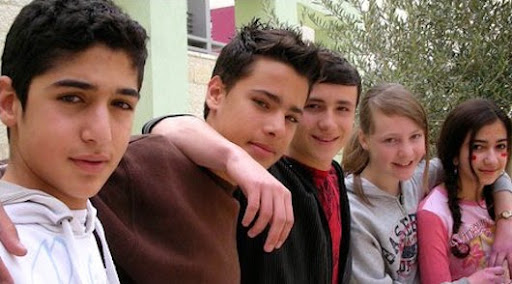
In total disagreement with the author of yesterday’s “Thoughts on today’s Mass,” distributed in my parish, who said that “we are not naturally children of God: we become so by baptism, when God adopts us as his own. Otherwise to call God our Father would be a bold presumption,” I would like to show that the Catholic Church teaches that every single human being is a child of God. Using the idea of being God’s child as the basis of separation, the basis of an “us,” as opposed to a ”them,” is perverse and absolutely not what the Catholic Church teaches, in spite of the official-looking material handed out in some of its parishes.

To begin with, Jesus – the Son of God – himself recognizes familial status universally, when he says that “whoever does the will of my heavenly Father is my brother, and sister, and mother” (Matthew 12:50) and St. Paul too picks up on the key being adherence to God’s will: “For those who are led by the Spirit of God are children of God” (Romans 8:14).

That such adherence to the will of God is open to everyone – whether they believe in God or not – and that it is at the heart of what the Catholic Church believes, is very clear from Nostra Aetate, the declaration issued during the Second Vatican Council by Pope Paul VI, which says in its closing paragraph:

“We cannot truly call on God, the Father of all, if we refuse to treat in a brotherly way any man, created as he is in the image of God. Man’s relation to God the Father and his relation to men his brothers are so linked together that Scripture says: “He who does not love does not know God” (1 John 4:8).

No foundation therefore remains for any theory or practice that leads to discrimination between man and man or people and people, so far as their human dignity and the rights flowing from it are concerned.

The Church reproves, as foreign to the mind of Christ, any discrimination against men or harassment of them because of their race, color, condition of life, or religion. On the contrary, following in the footsteps of the holy Apostles Peter and Paul, this sacred synod ardently implores the Christian faithful to “maintain good fellowship among the nations” (1 Peter 2:12), and, if possible, to live for their part in peace with all men, so that they may truly be sons of the Father who is in heaven.”

And this is also reflected in what the Catechism teaches about the opening words of the Our Father, the prayer Jesus taught:

“God’s love has no bounds, neither should our prayer. Praying “our” Father opens to us the dimensions of his love revealed in Christ: praying with and for all who do not yet know him, so that Christ may “gather into one the children of God.” God’s care for all men and for the whole of creation has inspired all the great practitioners of prayer; it should extend our prayer to the full breadth of love whenever we dare to say “our” (§2793)

Note in particular the thought-provoking idea in the above of Catholics praying with those who don’t know Jesus. Even in a fundamentally religious act the desire of Catholics is to be united with those who don’t share their beliefs!

And if the above weren’t enough to categorically declare that Catholics consider every human being to be a child of God and therefore also their brother or sister, let’s see what the last three popes had to say on the subject:

  1. “We must never forget that every person, from the moment of conception to the last breath, is a unique child of God and has a right to life.” Pope Saint John Paul II (Address at the Ceremony of the Anointing Of The Sick, Southwark’s Cathedral, London, 28 May 1982)
  2. “God is the origin of the existence of every creature, and the Father in a unique way of every human being: he has a unique, personal relationship with him or her.” Pope Benedict XVI (Sunday Angelus address, 8 January 2012)
  3. “Since many of you are not members of the Catholic Church, and others are not believers, I cordially give this blessing silently, to each of you, respecting the conscience of each, but in the knowledge that each of you is a child of God. May God bless you!” Pope Francis (Audience to Representatives of the Communications Media, 16th March 2013 – the day after his election!)
  4. “Every human being is a child of God! He or she bears the image of Christ! We ourselves need to see, and then to enable others to see, that migrants and refugees do not only represent a problem to be solved, but are brothers and sisters to be welcomed, respected and loved.” Pope Francis (Message for the World Day of Migrants and Refugees, 5 August 2013)

I rest my case.

Just war?

Ploughshares

[Warning: long read :)]

Jesus was a pacifist. To deny this in the face of his own words – “But I say to you, whoever is angry with his brother will be liable to judgment.” (Matthew 5:22), “But I say to you, love your enemies, and pray for those who persecute you.” (Matthew 5:44), “But I say to you, offer no resistance to one who is evil. When someone strikes you on (your) right cheek, turn the other one to him as well.” (Matthew 5:39) and “Put your sword back into its sheath, for all who take the sword will perish by the sword.” (Matthew 26:52) – would be sheer dishonesty.

How about the Church though, has it stuck to Jesus’ pacifist position? Let’s see what it says in the Catechism:

“(§2304) Respect for and development of human life require peace. Peace is not merely the absence of war, and it is not limited to maintaining a balance of powers between adversaries. Peace cannot be attained on earth without safeguarding the goods of persons, free communication among men, respect for the dignity of persons and peoples, and the assiduous practice of fraternity.

(§2307) The fifth commandment forbids the intentional destruction of human life. Because of the evils and injustices that accompany all war, the Church insistently urges everyone to prayer and to action so that the divine Goodness may free us from the ancient bondage of war.

(§2308) All citizens and all governments are obliged to work for the avoidance of war. However, “as long as the danger of war persists and there is no international authority with the necessary competence and power, governments cannot be denied the right of lawful self-defense, once all peace efforts have failed.” (Gaudium et Spes, 79 § 4)

(§2309) The strict conditions for legitimate defense by military force require rigorous consideration. The gravity of such a decision makes it subject to rigorous conditions of moral legitimacy. At one and the same time:

  • the damage inflicted by the aggressor on the nation or community of nations must be lasting, grave, and certain;
  • all other means of putting an end to it must have been shown to be impractical or ineffective;
  • there must be serious prospects of success;
  • the use of arms must not produce evils and disorders graver than the evil to be eliminated.

The power of modern means of destruction weighs very heavily in evaluating this condition. These are the traditional elements enumerated in what is called the “just war” doctrine. The evaluation of these conditions for moral legitimacy belongs to the prudential judgment of those who have responsibility for the common good.

(§2314) “Every act of war directed to the indiscriminate destruction of whole cities or vast areas with their inhabitants is a crime against God and man, which merits firm and unequivocal condemnation.” (Gaudium et Spes, 80 § 3)”

While the above does talk about circumstances under which war is justified, it is a last resort, acceptable under the simultaneous satisfaction of specific conditions listed above, and has self-defense as its purpose, with indiscriminate destruction and the devastating effects of modern means of warfare ringing alarm bells. During the progress of such self-defense (the only possible trigger for just military action), the Catechism further emphasizes that “The Church and human reason both assert the permanent validity of the moral law during armed conflict. “The mere fact that war has regrettably broken out does not mean that everything becomes licit between the warring parties.” (Gaudium et Spes, 79 § 4)” and proceeds to warn against the abuses so endemic in war and against the accumulation of arms. Finally, the Catechism draws attention to the root causes, of which war can be a symptom, and calls for their treatment:

“(§2317) Injustice, excessive economic or social inequalities, envy, distrust, and pride raging among men and nations constantly threaten peace and cause wars. Everything done to overcome these disorders contributes to building up peace and avoiding war.”

And Pope Francis, where does he stand? There can be no doubt here that he, like Jesus, is an absolute pacifist:

“War is madness. It is the suicide of humanity. It is an act of faith in money, which for the powerful of the earth is more important than the human being. For behind a war there are always sins. [… War] is the suicide of humanity, because it kills the heart, it kills precisely that which is the message of the Lord: it kills love! Because war comes from hatred, from envy, from desire for power, and – we’ve seen it many times – it comes from that hunger for more power.” (Homily at Domus Sanctae Marthae, 2 June 2013).

“We have perfected our weapons, our conscience has fallen asleep, and we have sharpened our ideas to justify ourselves. As if it were normal, we continue to sow destruction, pain, death! Violence and war lead only to death, they speak of death! Violence and war are the language of death! […]

My Christian faith urges me to look to the Cross. How I wish that all men and women of good will would look to the Cross if only for a moment! There, we can see God’s reply: violence is not answered with violence, death is not answered with the language of death. In the silence of the Cross, the uproar of weapons ceases and the language of reconciliation, forgiveness, dialogue, and peace is spoken. […]

violence and war are never the way to peace! Let everyone be moved to look into the depths of his or her conscience and listen to that word which says: Leave behind the self-interest that hardens your heart, overcome the indifference that makes your heart insensitive towards others, conquer your deadly reasoning, and open yourself to dialogue and reconciliation. Look upon your brother’s sorrow and do not add to it, stay your hand, rebuild the harmony that has been shattered; and all this achieved not by conflict but by encounter! […]

Let the words of Pope Paul VI resound again: “No more one against the other, no more, never! … war never again, never again war!” (Address to the United Nations, 1965).” (Prayer Vigil for Peace, 7 September 2013)

And Francis is not alone is his radical stance against war, Blessed Pope John Paul II said that “War should belong to the tragic past, to history: it should find no place on humanity’s agenda for the future” and that “Humanity should question itself, once more, about the absurd and always unfair phenomenon of war, on whose stage of death and pain only remain standing the negotiating table that could and should have prevented it.” Benedict XVI too was clear about war being a failure: “War, with its aftermath of bereavement and destruction, has always been deemed a disaster in opposition to the plan of God, who created all things for existence and particularly wants to make the human race one family.”

So, you may ask, what is the point of writing about the attitude of Jesus, the Church and recent popes with regard to war, when it is so obviously pacifist and admitting of military self-defense only under almost theoretical, extreme conditions and applying to specific parts of an armed conflict? Sadly there are other, vocal proponents of a very different take on this topic, who – to my mind unbelievably – present their positions as Catholic and who tend to trace them to statements like the following one by George Weigel, who feels supported by Sts. Augustine and Thomas Aquinas:

“Thus those scholars, activists, and religious leaders who claim that the just war tradition “begins” with a “presumption against war” or a “presumption against violence” are quite simply mistaken. It does not begin there, and it never did begin there. To suggest otherwise is not merely a matter of misreading intellectual history (although it is surely that). To suggest that the just war tradition begins with a “presumption against violence” inverts the structure of moral analysis in ways that inevitably lead to dubious moral judgments and distorted perceptions of political reality.”

With Jesus and the Church’s position having been stated with such force and clarity over the last decades, I won’t even go to the trouble of addressing positions like Weigel’s point-by-point and would just like to note that they are akin to reading St. Paul and arguing in favor of slavery today. Positions that may be textually consistent with the source they claim justifies them, but that both miss the original author’s intentions (just think about what slavery would be like if “master” and “slave” followed St. Paul’s advice1) and the fact that the Church is the living Mystical Body of Jesus that has considerably matured over the last 2000 years.


1 “Slaves, be obedient to your human masters with fear and trembling, in sincerity of heart, as to Christ, not only when being watched, as currying favor, but as slaves of Christ, doing the will of God from the heart, willingly serving the Lord and not human beings, knowing that each will be requited from the Lord for whatever good he does, whether he is slave or free. Masters, act in the same way toward them, and stop bullying, knowing that both they and you have a Master in heaven and that with him there is no partiality.” (Ephesians 6:5-9) A classic “infiltrate and destroy from within” tactic if ever I saw one.

Francis’ “grammar of simplicity”

Dsm01

Yesterday the 28th World Youth Day has come to a close in Rio de Janeiro and there would undoubtedly be a lot to say about it. Instead, I would like to look at a different, yet related, topic today, which is that of Pope Francis’ daily morning sermons, delivered at the Domus Sanctæ Marthæ (DSM). Since his election in March, Francis has been inviting different groups of Vatican staff and other visitors to join him for morning mass at his residence of choice, during which he’d deliver a short, off-the-cuff-style reflection, inspired by the day’s readings. Since these morning masses, and the homilies they contained, have now been suspended for the summer months, one can consider their first season, so to speak, as complete, and reflect on them as a whole. These, by my count 123, homilies form a corpus that is not only important in terms of the themes that it addresses, but also as a body of linguistic content, and it is both of these aspects that I would like to reflect on here.

Before proceeding to the DSM homilies, it is worth hearing the following point made by Francis on Saturday, during a lunch with Brazilian bishops, since it is the key to unlocking their language:

“Another lesson which the Church must constantly recall is that she cannot leave simplicity behind; otherwise she forgets how to speak the language of Mystery. Not only does she herself remain outside the door of the mystery, but she proves incapable of approaching those who look to the Church for something which they themselves cannot provide, namely, God himself. At times we lose people because they don’t understand what we are saying, because we have forgotten the language of simplicity and import an intellectualism foreign to our people. Without the grammar of simplicity, the Church loses the very conditions which make it possible “to fish” for God in the deep waters of his Mystery.”

With the above in mind, let’s turn to the DSM homilies. According to the Vatican’s spokesman, Fr. Federico Lombardi, the morning homilies are spontaneous instead of delivered from a prepared written text and a “‘complete’ publication, therefore, would necessarily entail a transcription and a reworking of the text at various points, given that the written form is different from the spoken one, which in this case is the original form chosen intentionally by the Holy Father.” The result would be “‘something else’, which isn’t what the Holy Father intends to do [with his daily homily] each morning.” As a result of this primarily spoken and spontaneous form of the morning homilies, only summaries and quotes from them are available, instead of full transcripts. These summaries, furthermore, include notes on who was present at the individual masses, on what the readings of the day were and addenda like “the Holy Father said,” “pope Francis noted,” etc.

As a direct linguistic analysis of the summaries would be skewed by the above additions, I first parsed the 123 summaries and removed from them any text that went beyond a transcript or paraphrasing of Pope Francis. The end result are 27K words, resulting in an average of 220 words per sermon, which corresponds to about half a page of written text. The end result are only snippets of what Francis said and a degree of separation between his full, albeit short, sermons and the record available publicly is inevitable, and indeed in accord with Francis’ own wishes.

Running a textual analysis on the above corpus yields very interesting results, which make plain the simplicity of the language Francis employs:

  1. The total of 27,132 words result from using only 4,118 different ones, which is less than the typical vocabulary of a 6-year-old.
  2. The Gunning fog readability score of the text, which derives from the number of words per sentence and the percentage of complex words used, is 6.6. This is at the very bottom end of the scale and matches that of the Bible (with popular novels coming in at 8-10 and academic texts at 15-20).
  3. The average sentence length here is 13 words, where 17 is typical and 11-13 is considered easy.
  4. Word length too is at the low end of the scale, with an average of 1.49 syllables per word (as compared with typical language having 1.66).

That Francis speaks simply can easily be seen when listening to him and the above just underlines how consistently and persistently he does so during his morning sermons.

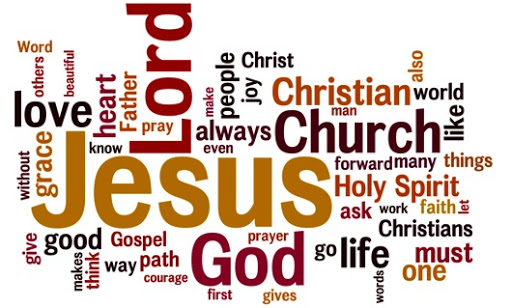
Turning to the content of his homilies, the word cloud at the top of this post shows the 50 most frequently used words, where font size is proportional to frequency. As can be seen immediately, “Jesus” is the word that Francis uses by far most often (2.3% of the time), followed by “Lord” (1.5%), where the two top words are in fact synonyms in this context. Comparing this to an analysis of his first sermons after being elected pope, it can be seen that his focus on the person of Jesus is a constant feature of his preaching. If we combine these two words, the second most frequent word becomes “our,” which, to my mind, underlines the sense one gets of Francis being one of us, referring to issues and ideas applicable to an “us” that includes him, rather than a “you” that he is removed from. Worth noting is also that the highest-ranked verb among the 4K words used in these homilies is “love” (7th among all words). A final point to pick up on in terms of word frequency is that of the top 50 words, only two imply obstacles or prohibition by themselves: “cannot” (48th) and “without” (49th). Looking at four word phrases, the most frequent one is “the word of God” (used 41 times in these 123 homilies) and in third place comes “the name of Jesus.” Francis continuously stays close to the person of Jesus, even just from the perspective of the vocabulary he employs, stays close to the congregation he addresses and is overwhelmingly positive.

Since I have already written at length about some of Francis’ DSM homilies in earlier posts, I would here just like to highlight some of the aspects that stood out to me while editing the text of these 123 sermons:

  1. Francis uses the term “pope” quite generously: he refers to the apostle Paul by saying that he “is a Pope, a builder of bridges.” and he also refers to Tawadros II in the same way, and has the following to say about him to the morning mass congregation: “Today there’s a good reason for joy in this house, where we are hosting the Pope of Alexandria, the Patriarch of the See of St Mark. He is a brother who has come to visit the Church of Rome to talk and to make a journey together.”
  2. Similes are a great favorite of Francis’, and he uses them liberally: “The confessional is not a laundromat,” “To solve the problems of life it is necessary to look reality in the face, ready like the goalkeeper of a football team to grab the ball whatever side it comes from,” that God is “not an indefinite God dispersed in the air like a spray”, that Jesus is “like an engineer, like an architect; He tells them what He will do: ‘I am going to prepare a place, in my Father’s house is my dwelling’,” that the Church is like a mother (“How would you feel if someone said: she’s a domestic administrator? ‘No, I am the mother!’ And the Church is Mother.”) and that some Christians are like pickled peppers (“Sometimes these melancholy Christians faces have more in common with pickled peppers than the joy of having a beautiful life”) are just a couple of examples.
  3. Francis draws inspiration from a very broad range of sources, including his grandmother (who’d tell him and other children in the family: ‘Look he is dead, but tomorrow he will be Risen!,’ when visiting the tomb on Good Friday), a man who worked for the diocese of Buenos Aires (“before going to do any of the things he had to do, he would always whisper to himself: ‘Jesus!’”), Pope Paul VI (who “said that you cannot advance the Gospel with sad, hopeless, discouraged Christians”), the martyrs of Nagasaki (“each one helped the other, they struggled mightily and spoke of Jesus as they awaited the moment of their death”), the garment factory collapse in Dhaka (which “killed hundreds of workers who were being exploited and who worked without the proper safety preoccupations. It is a title, which struck me the day of the tragedy in Bangladesh: ‘How to die for 38 euros a month’”), an electrician who prayed for his daughter’s recovery (“Miracles do happen. But we need to pray with our hearts: A courageous prayer, that struggles to achieve a miracle, not prayers of courtesy”) and a priest, who, when he was appointed bishop worried about his unworthiness (to which his confessor told him: “But do not worry. If after the mess Peter made of things, they made him Pope, then you go ahead!”).

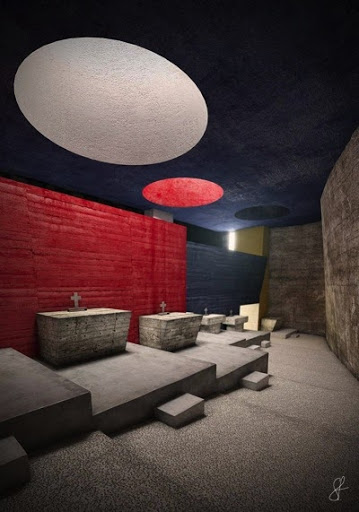
Le Corbusier: the sacred cubic centimeter

Le corbusier

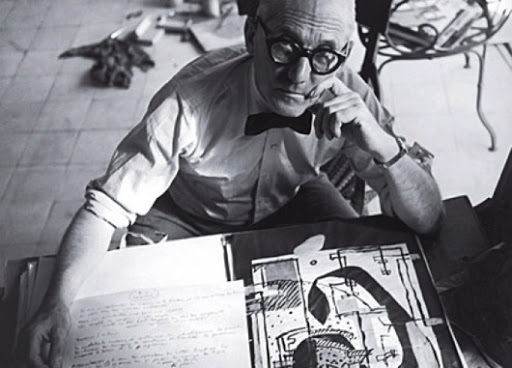
Having come across yet another profoundly misguided piece on church architecture, and not feeling like rehashing previous posts on the subject,1 I instead set out to learn more about Le Corbusier, whose name the aforementioned piece took in vain.

Le Corbusier defined architecture as “giving living form to dead material” and elaborated on its dual nature of construction and art as follows:

“You employ stone, wood and concrete, and with these materials you build houses and palaces. That is construction. Ingenuity is at work. But suddenly you touch my heart, you do me good, I am happy and I say: “This is beautiful.” That is Architecture. Art enters in.”

Even before turning to church architecture, there is a great sense of focus not only on beauty but also on the sacred in Le Corbusier’s thought:

“One preoccupation has concerned me compulsively; to introduce into the home a sense of the sacred; to make the home the temple of the family. From that moment on, everything changed. A cubic centimetre of housing was worth gold, represented possible happiness. With such an idea of dimension and purpose, today you can build a temple to meet family needs beside the very cathedrals.” (Mise Au Point)2

How does one infuse matter with life, introduce the sacred into every cubic centimeter of a home? Again, Le Corbusier’s thoughts are illuminating:

“I am not faultless or simple, I am filled with turmoil and undercurrents. When pondering and working out a project (town planning, architecture or painting), always a long process, I bring into focus, I realise, I come to the point. I have made an immense effort without a word spoken; over the drawing boards of my office […] I do not speak; my private office (used for patient research) […] is opened to no one. There I am alone. Never in my life have I “explained” a painting. The painting will go out and will be loved or hated, understood or not. Do you think that bothers me! (How could it bother me?)” (The Chapel at Ronchamp, 1957)

Ronchamp chapelle le Corbusier
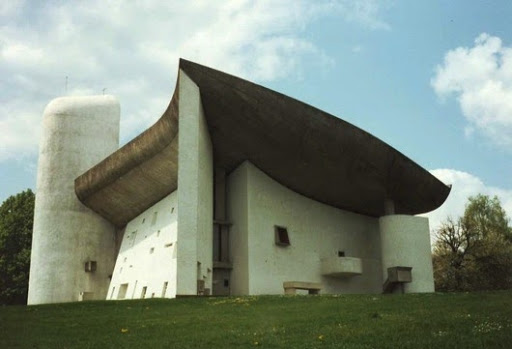
This attitude of infusing matter with purpose, with intention, and doing so in a subtle, hinting rather than overpowering way comes to the fore again when Le Corbusier inaugurates one of his greatest masterpieces – the Chapel of Our Lady of the Height in Ronchamp:

This is “a project difficult, meticulous, primitive, made strong by the resources brought into play, but sensitive and informed by all-embracing mathematics which is the creator of that space which cannot be described in words. A few scattered symbols, a few written words telling the praises of the Virgin. The cross – the true cross of suffering – is raised up in this space; the drama of Christianity has taken possession of the place from this time onwards. […] I give you this chapel of dear, faithful concrete, shaped perhaps with temerity but certainly with courage in the hope that it will seek out in you (as in those who will climb the hill) an echo of what we have drawn into it.” (Le Corbusier’s dedication speech at the chapel’s inauguration, June 25 1955)

To my mind all of the above exudes a profound love of beauty and of the sacred, and a desire to offer it to others in a way that is inviting instead of imposing. Yet, in the course of reading about Le Corbusier, I kept coming across two criticisms leveled against his work. First, that it is inferior to renaissance and antique architecture and that this inferiority stems from ignorance. It is an argument that baffled me from the start, and that I see directly countered when reading about Le Corbusier’s reaction to the Acropolis:

“In 1910 I spent six weeks at the Parthenon. At the age of 23 my consciousness had determined its future direction. “Laborious hours in the revealing light of the Acropolis. Perilous hours which brought a distressing doubt about the (real) strength of our strength, the (real) art of our art. Those who, practising the art of architecture, find themselves at a point in their career,their brain empty, and heart broken with doubt in face of the task of giving living form to dead material, will realise the despondency of soliloquies amongst the ruins. Very often I left the Acropolis, my shoulders bowed with heavy foreboding, not daring to face the fact that one day I would have to practise. The Parthenon is a drama …”” (The Chapel at Ronchamp, 1957)

The second criticism is even more ad hominem and one that I find deeply repugnant. It is an objection to Le Corbusier’s lack of faith and adherence to Catholicism, put forward as a disqualifying obstacle regarding his involvement in church architecture. Such an attitude is exemplified by the following criticism directed at the Dominican3 Fr. Marie-Alain Couturier, O.P., who commissioned Le Corbusier’s work on the Monastery of Sainte-Marie-de-La-Tourette:

“By mistaking the “spirit of the age,” or Zeitgeist, for the Holy Spirit, Couturier assisted in the production of structures by famous modernist architects at the expense of the essential features of Catholic artistic work. […] Couturier placed his trust in artists, believing that all true art revealed something of the sacred. Since true art could only be revealed by true artists, he therefore sought the services of the masters of his time, Catholic or not, to reach the sacred through the production of a supposedly “true” art.”

I couldn’t disagree more! Like Fr. Couturier, and, incidentally, Pope Paul VI,4 I too firmly believe that “all true art reveal[s] something of the sacred.”

La tourette

In response to these criticisms, it is worth noting two aspects to Le Corbusier, the first of which is his directness and honesty about his beliefs:

“I am not a churchgoer myself, but one thing I do know is that every man has the religious consciousness of belonging to a greater mankind, to a greater or lesser degree, but in the end he is part of it. Into my work I bring so much effusion and intense inner life that it becomes something almost religious. […] People were at first surprised to see me participating in a sacred art. I am not a pagan. Ronchamp is a response to a desire that one occasionally has to extend beyond oneself, and to seek contact with the unknown.”

To leave a reflection on Le Corbusier’s compatibility with Christianity there would be unfair though and could leave a sense of vagueness and hand-waving. Instead, let me conclude by sharing with you the following passage from his book, “When Cathedrals Were White”:

“But those of us who live intensely in the present moment of modem times,[…] have extended our sympathy to all the world and to all times. We have rediscovered life and the axis of all human marvels and agonies. We are far from the theatrical stage which tries to place events of qualitative interest above and outside of human labors. We plunge into daily realities, are face to face with consciousness itself. […] Life bursts forth everywhere, outside the studios where art is “made,” outside of the small circles where it is talked about, outside of the writings in which the spirit of quality is isolated, localized, and disintegrated. […] Every day, every hour, the Earth sees splendors surging up which are truths and present-day beauty. Ephemeral perhaps! Tomorrow, new truths and new beauties bloom. The day after tomorrow, etc. … Thus life is replenished, full. Life is beautiful! We do not have-do we?-any intention or claim to fix the destiny of the eternal things of the future? Everything, at every hour, is only the work of the present moment. The present moment is creative, creating with an unheard-of intensity.”

If that is not Christian thought (albeit thought by a non-Christian), then I don’t know what is, and to support my claim I only need to look as far as Jesus’ own words:

“Therefore I tell you, do not worry about your life, what you will eat [or drink], or about your body, what you will wear. […] Look at the birds in the sky; they do not sow or reap, they gather nothing into barns, yet your heavenly Father feeds them. Are not you more important than they? Can any of you by worrying add a single moment to your life-span? Why are you anxious about clothes? Learn from the way the wild flowers grow. They do not work or spin. But I tell you that not even Solomon in all his splendor was clothed like one of them. If God so clothes the grass of the field, which grows today and is thrown into the oven tomorrow, will he not much more provide for you, O you of little faith? So do not worry and say, ‘What are we to eat?’ or ‘What are we to drink?’ or ‘What are we to wear?’ […] But seek first the kingdom (of God) and his righteousness, and all these things will be given you besides. Do not worry about tomorrow; tomorrow will take care of itself.” (Matthew 6:25-34)


1 The only point I’ll allow myself to make on account of refuting the ludicrous idea that church architecture has had a golden age in some past centuries is to quote from a great post on the Idle Speculations blog, which presents the killer argument that “[i]n Roman times, the early Roman basilicas were of course based on the public buildings of ancient Rome.” The tradition of church architecture is to be contemporary and not a saccharine pastiche of past forms, like the examples touted as successful by blogs like the one that triggered the present post.
2 A great source on Le Corbusier has for me been the excellent “Le Corbusier in Detail” by Flora Samuel, where this quote too can be found.
3 I am becoming quite a fan of the Dominicans, given also their links with Camus, mentioned here before.
4 “[T]he Church of the council declares to you through our voice: if you are friends of genuine art, you are our friends.” (Council Closing Messages December 8, 1965 By Pope Paul To Council Fathers)