The emptiness of manufactured allure

South beach

Visiting South Beach in Miami a couple of days ago has provided me with one of the saddest experiences of recent times. A few brief moments there stunned me and left me unable to relate freely to the friends I was with. Since this event has had such a strong impact on me, I would like to use this post to try and make sense of it for myself, but also to share this, in itself negative, experience with you, in the spirit of completeness and openness.

Let me start by giving an account of what happened.

Last week I spent five days in North Miami on business, with PM and JMGR – two of my very best friends. One evening, for the sake of a change of environment from the conference hotel, we thought of heading out to do a bit of local sightseeing. The day before, some colleagues recommended a visit to South Beach and, without looking into what the destination had to offer, the three of us set out there.

After a lengthy and costly taxi ride, we were dropped off in front of Versace’s house (a destination that held no appeal to any of us, but one that the taxi driver considered de rigueur for tourists, which we obviously were) and set off down Ocean Drive, towards its southernmost tip. The first offering of local culture was a group of inebriated chaps, whose most extensive member immediately launched into what can politely be labelled as an invitation to a mano-a-mano, urban skirmish (with an unusually high frequency of references to mothers). Having spent years in large cities (thank you, London), this was no big deal, and a smile, shrug and feigned incomprehension dealt with the matter successfully.

What came next unsettled me deeply though. While, at first sight it was just a 15-20 second walk through an on-street restaurant, my experience of it was anything but a simple traversal of that space. Instead, I passed through a gauntlet. At the restaurant’s entrance I was met by a woman of approximately my own age, dressed in thigh-high boots and a skirt and top of microscopic square-inchage, counterbalanced by bucket-fulls of makeup and hair extensions reaching down to the top of her boots. The dagger to my heart then came from the expression in her eyes that met me as I tried to smile at her. It was an ashen look of resignation. An emptiness and absence so deep it made me flinch.

As painful as that welcome was, I tried to shake it off, while feeling deeply sorry for this woman. Instead, the rest of the walk through the establishment just kept dragging me deeper and deeper into its oppressive morass. I met three more employees, all wearing variants of the first one’s outfit – nominally with the intention to entice, allure and excite, but each making me more and more concerned for their wellbeing and worried about their mental health.

Walking out at the other end of this pavement-gripping setup left me unable to carry on the light conversation we have been having with my friends and made me a dour companion for the rest of the night (which we, thankfully, spent in a Cuban restaurant a couple of streets away from Ocean Drive – a place whose down-to-earth-ness would normally not be my kettle of fish, but whose normality was a welcome change from the void of Ocean Drive).

Where am I going with all of this though? First of all, I wanted to share a disturbing experience with you, since disturbing experiences tend to be opportunities. I don’t yet know what consequences to draw from it, but it has been undoubtedly unsettling and therefore important, even if in an as yet unclear way. This was also underlined for me yesterday when I saw Pope Francis tweet the following: “How good it is for us when the Lord unsettles our lukewarm and superficial lives.”

Thinking about these words, I can certainly see that the experience was good for me – in spite of it’s great negativity for all involved, and me wishing that that place didn’t exist – it shook me and gave me a heightened sensitivity to the wellbeing of those around me, who thankfully weren’t in distress like the waitresses of the South Beach restaurant, but who nonetheless each had their expectations and needs.

To conclude, let me just address what might otherwise seem like an implicit prudishness. What disturbed me about the women in the restaurant wasn’t at all what they were wearing. It wouldn’t be what I’d choose, but who am I to tell them how to dress. Neither was it about them exposing extensive parts of their anatomy. The human body is full of beauty, made even to God’s own liking (“God looked at everything he had made, and found it very good.” Genesis 1:31). And neither did I feel any resentment towards these four women. They were very likely in a position of limited choice and in existential need of income – some probably supporting families. Instead, I felt a deep rage against the owners of the establishment, who – to my mind – unquestionably exploited their staff and tried to turn them into cheap merchandise.

Jesus hidden in these wounds

Noli

During these last days I have been in a daze. Ever since the news on Tuesday morning, that my little sister needed to have some ominous tests done, I felt like someone who is permanently in a state of freshly having been slapped. I can’t quite get away from worrying about my little sister, no matter what I do, and I keep thinking about whether enough time has passed before I can call her or someone else in my family again to see whether there are “news.” Clearly, this is not about news, but about needing to stay close, even at a distance.

Later that same day – last Tuesday – I then read the interview with Pope Francis, and one passage in particular stuck in my mind:

“A teacher of life for me has been Dostoevskij, and a question of his, both explicit and implicit, has always gone around in my heart: “Why do children suffer?” There is no explanation. […] In front of a suffering child, the only prayer that comes to me is the prayer why. Why, Lord? He doesn’t explain anything to me. But I feel that he is looking at me. So I can say: You know the why, I don’t it and You don’t tell me, but You are looking at me and I trust You, Lord, I trust your gaze.”

In many ways my little sister, who is 12 years younger than me, is still like a child to me – even though she is an adult and, as a medical doctor, knows incomparably more about what is going on with her than I ever could. Maybe that is why Pope Francis’ words had such a particular resonance for me. Looking at my little sister, I just keep asking “Why?”

Since his words seemed to fit my situation so intimately, I set out to look at what else he has said about the subject of suffering and illness and I found a couple of other, deeply insightful words by him.

First, how Jesus is particularly present in those who are sick and that this is connatural with his presence in the Eucharist. Those who are sick are essentially tabernacles:

“On the altar we adore the Flesh of Jesus; in the people we find the wounds of Jesus. Jesus hidden in the Eucharist and Jesus hidden in these wounds. […] The Christian adores Jesus, the Christian seeks Jesus, the Christian knows how to recognize the wounds of Jesus. […] Jesus is present among [those who are sick], it is the Flesh of Jesus: the wounds of Jesus are present in [those who are sick].”

This is not meant as an explaining away of illness, but simply as in identification of our suffering with that of Jesus and with Jesus himself. That this is not a matter of explanation, but instead of vicinity and of believing to be looked upon with love, is also clear from Francis’ (and Benedict XVI’s) words in Lumen Fidei:

“To those who suffer, God does not provide arguments which explain everything; rather, his response is that of an accompanying presence, a history of goodness which touches every story of suffering and opens up a ray of light. In Christ, God himself wishes to share this path with us and to offer us his gaze so that we might see the light within it. Christ is the one who, having endured suffering, is “the pioneer and perfecter of our faith” (Hebrews 12:2).”

Finally, in one of his morning homilies, Francis also spoke about three features of how I have felt during these last days: lamenting my little sister’s illness, feeling restless and praying viscerally:

“To lament before God is not a sin. A priest I know once said to a woman who lamented to God about her misfortune: ‘But, madam, that is a form of prayer. Go ahead with it.’ The Lord hears, He listens to our complaints. Think of the greats, of Job, when in chapter three (he says): ‘Cursed be the day I came into the world,’ and Jeremiah, in the twentieth chapter: ‘Cursed be the day’ – they complain even cursing, not the Lord, but the situation, right? It is only human.

Pray for [those who are sick]. They must come into my heart, they must be a cause of restlessness for me: my brother is suffering, my sister suffers. Here is the mystery of the communion of saints: pray to the Lord, ‘But, Lord, look at that person: he cries, he is suffering. Pray, let me say, with the flesh: that our flesh pray. Not with ideas. Praying with the heart.”

Dear Jesus, please, take this cross away from my little sister; help us always feel your loving gaze.

The diamond

Manfred

This morning, after nearly two years since the diagnosis of an incurable and aggressive brain tumor, my friend, Manfred, has died. While I cried after I received the news, I also felt a deep gratitude to God for the privilege of having one of his Son’s true followers among my friends. And I don’t mean to say that my relationship with Manfred has always been rosy – on the contrary, at times I felt like we had nothing in common and I thought that we weren’t even meant to be friends. If we had just met at some random event, we may well have said hello, but our conversation would not have lasted and we would have gone our separate ways.

Instead, Manfred was truly my friend. At difficult moments, he had words of encouragement for me, while at moments of indecision, a sentence from him could shake me from hesitation and set me on the right path – the path of loving my neighbors and through them God, instead of getting side-tracked into the trivial. I am also profoundly grateful that my ten-year-old son met Manfred earlier this year and was witness to Manfred’s choice of God in the midst of the final stages of his holy journey on this Earth.

As a focolarino, Manfred has said his “yes” to God and devoted his life to making Jesus’ last testament – that we all may be one – a reality among those around him. His love was practical, selfless and direct, throughout a life during which he was at one moment present at the birth of new realities within the Church, at others putting the Gospel into practice while living – literally! – within shooting-distance of the Berlin wall, at others making his Christian faith inform his senior positions of responsibility within the prison service and at yet others being a bridge through which countless young people encountered Jesus.

During his illness, he continued being deeply generous, also with sharing his inner life. A whole community of his friends from various backgrounds and contexts hung onto his every word on Facebook and on his blog, where he shared his moments of joy and suffering and where he freely offered the spiritual gifts that crystalized through his love for Jesus, suffering and abandoned on the cross.

Since I hope he would have liked it, I have picked out some of my favorite passages from his writings during these last two years and would like to share them with you next. They are in reverse chronological order and start from among the last posts he put up before his condition deteriorated to the point where writing was no longer an option.

9 August 2013: “Today I have the impression that time for me have my sight is deteriorating out as it takes longer to get to normal! I can read, but my peripheral vision is sort of rainbow haze! As if I was tripping! Perhaps I’m! At first it was an hour, then three, then five, and finally today is the first whole day. But there I discovered many signs! I am less distracted when someone talks to me! I discover the beauty of listening. Another diamond I still read and type! Today is also the first day of physical pain, in joints, muscles, on the skin, but hey, patience is the watch word! The gift is to slow down!”

13 July 2013: “Today I have rediscovered the immense value of living the present moment. I went with a friend to my GP to plan some practical steps in case of my rapid decline. He gave me a “just in case” prescription of various medicines. When we left the surgery I couldn’t face losing my life! But then I realised why: because I don’t trust in God’s love AND because I wasn’t living in the present moment, loving the person next to me. Often, in the past I said to God: here is my life, it’s yours, but soon I found out it is not just a formula! He takes me seriously! But he never leaves me alone and gives me all the help I need. It is like Mary under the cross who offered her son, who died! And besides God never says “no”. He says “no” to our desires because they are in many ways focussed on loving ourselves [rather] than the other. I discovered that it is ok to complain to God.”

6 July 2013: “In these past two or three days some important things that happened to me, showing me how the Holy Spirit puts the spanner in the works of my daily routine! I was so tired that I could not sleep during the night, which meant that I could not meditate or pray. Now I have to get used to living in a wheelchair, that I can not climb stairs. Therefore I changed my room. I felt that I did not live well! My “routine” has changed!”

22nd June 2013: “Do not allow myself to fall into activism and the illusion that I must “do” things and for them to take your place!”

21 June 2013: “In the last few days I realized that my trust in the Father is rather lacking! For a loving father who wants my good, I ask for one thing or the other as if God was not aware of my needs! Yet Jesus tells us that the Father knows what I need before I ask, because He is love! Then I realized that I see God in human dimensions, that is, I have my lists of wants and needs and I asked many people to pray for the same thing, as if we should “persuade” God to “change” idea! That to me does not sound [like] true prayer! True prayer is union with God, who knows everything, and because He is love, does not need to pay attention to my needs! It is I who constantly needs [to] entrust confidently my life to Him, knowing that all is his love.”

20 June 2013: “The nature of the tumour is such that it does adapt very well to the latest medication. I wonder whether it would adapt to a miracle! I understood that I only have the present moment! I need to discover the love of God in that moment as if the was my last! I understood that I only have the present moment! I need to discover the diamonds in that moment as if [it] was my last!”

17 June 2013: “My life is no longer mine, it has never been mine!”

31 May 2013: “Today’s reflection by the Pope made me look again at welcoming my suffering as a gift of God’s love! Everything points to me being outside myself, in the way that love is! Love is totally giving, not thinking of itself, being nothing! That’s the root of joy!”

8 May 2013: “How many tribulations, little niggles, discomforts do we come across during our day! Today I don’t want to have [anything] standing between my neighbour and me! All is love of the Father for us!”

30 April 2013: “It is sometimes difficult knowing how to wait! We have all our unique gifts and we rush to show them, thinking they are ours! Once I realise yet again that they are God’s love for our neighbour, they will shine in the right moment, not before and not after! For that I need patience!”

29 April 2013: “How quick am I to pounce if my neighbour makes a mistake! How quickly do I pass judgement without even knowing the full facts! How quick do I call someone who holds different opinion, political or otherwise, a liar or a cheat, or somebody who is not honest whilst putting me in the best possible light of honesty and integrity! Fool me: by doing this I have become the very person I condemn in the other! Jesus asks me time and again to love with his love, which puts all categories to one side in order to be always with the person next to me: There is no obstacle, because love conquers all, and that love is always concrete, is full of action! […] I can start again despite all that has happened, all the mistakes I made. So if God allows me to start again I must allow my neighbour to start again!”

15 April 2013: “This is real challenge: how to lose my thoughts, what is most dear to me out of love for my neighbour! In my thoughts Mary at the foot of the cross came to mind as the perfect example that perhaps I overlook many a time. […] This will be my “model” that points to the essential in my everyday life. Every time I find it difficult to lose, I have to ask myself: Does it matter (DIM)? Is it more important than my dialogue with God in my neighbour?”

12 April 2013: “Today I reflect [on] how easy it is to break relationships! A word or the lack of a word; a gesture or the lack of an expression, a thought, an assumption, an expectation! I understood that our relationships are really very fragile!”

17 February 2013: “It so easy to become self-absorbed both as individuals and as groups! On an individual level I wake up every morning wondering what the tumour will bring today, how am I, what is happening for me. Then my morning prayers put me in the right attitude of thanksgiving to God for another opportunity to love him, for the health I have, for the neighbours to love in the present moment!”

6 February 2013: “12 months ago today I collapsed at work and was diagnosed with the brain tumour! What a year it has been! Full of graces, full of gifts, full of signs of God’s love for me. But there are also temptations and sufferings, such as getting fixated with dates. At the beginning I was told the prognosis is on average 14 month which gives me another 8 weeks. That is a very limited way of looking at thing, because whether that is true or not does not depend on me or anybody, but on the plan God has for me. So in the meantime live fully in the present moment. Today’s motto then is to build peace in the present moment by loving my neighbour!”

16 January 2013: “We know how easy it is to confuse our own opinions and desires with the inner voice of the Spirit, how easy it is, therefore, to fall into arbitrariness and subjectivity. I must never forget that the Reality is within me. I must silence everything within in order to discover the voice of God there. And I need to draw it out as if I were extracting a diamond from the mud: polish it up, highlight it and allow it to guide me. Then I can be a guide for others as well, because this subtle voice of God which urges on and enlightens, this lymph which rises up from the depths of the soul, is wisdom, it is love, and love is meant to be given.”

31 December 2012: “Because Jesus died on the Cross he transformed pain and suffering into love. Where I see suffering and joy, God sees love in both. I can begin again now in this present moment and every moment because God never ceases to love me. What a wonderful gift to receive, because it means that all those moments of pain and suffering in the past year I can fill with one act of love making a parcel of all those things and give them as a gift to Jesus on the Cross. My year becomes his and it is a year full of the God’s love for us. Today I dedicate to giving all my past year to Jesus on the Cross as a gift of love.”

23 December 2012: “Often I put God in a box, I see him as static, I want him to be the same, confining him to religion, church and liturgy. And yes God is the same yesterday, today and tomorrow, but at the same time he is also always new, a person who changes always and is life! He never loves us in the same way, because if I respond to his love his love for me will be different from before! Isn’t that a great gift? Today I want to dedicate to a special intention and giving all my love to him in every person I meet!”

1 December 2012: “Jesus Forsaken by the Father, who cries out: “My God, my God, why have you forsaken me?” is the one alongside me! What a privilege to have a brother like that. And so in these days he asks all the “whys” contained in that big why. Why do I remain so full of myself, attached to a pair of slippers when I am asked to give my life to God? Why is it such an effort for me to be rather than to do? Why am at this stage in my life? What is going to happen next?”

26 November 2012: “So, today it is meant all happen. I am waiting for the call from the hospital and then, wait a minute! Do I put my life on hold for a phone call. No, so back to the present! Yes, I am a little anxious perhaps, but all can be lived for something. Thinking of others who are really suffering, with no way out.”

23 November 2012: “After a beautiful period of light and insight during which I have come to understand many things in my relationship with God now another part of the same trip seems to open up, very much full of temptations, temptations to retreat within myself thus excluding God.”

6 November 2012: “I see that just because I try put God at the centre of my life I am not immune to the feeling and worried of what might happen. The big difference for me is that I know that my lifelong friend Jesus on the cross is always with me.”

24th August 2012: “I was thinking that living in the present is a bit like being on a conveyor belt lighting candles that come past. If I concentrate on each candle I can light it. The more candles I light the more there is light. But every now and again I get distracted by the shape of the candle, or its colour. So I miss the next one. If I run after it, I will miss even more and there is less light! So, I have to stay put and starting again I light every candle that comes past me. Is that not living the present well? If we failed one moment, let’s not worry. Does it matter, or short DIM? I got this from a friend who is well practised in this. Any time she and her husband are at risk of worrying, or missing something, or getting worked up about something, DIM does the job. […] If I have chosen the greatest thing on earth, i.e., God who is love, is there anything that matters more than that? Promptly I am put to the test with some not so good news about a friend. I cannot do anything practical in my condition, except worry. Or I can make sure I light those candle every moment for her, to root for her, to live my life for her! Loving the other means also to offer my little suffering as a token of my love for Jesus Forsaken.

Dearest Manfred, you who are now with our heavenly Father, enveloped by the Holy Spirit, by the side of our brother Jesus and our mother Mary, thank you for all the love you have shown me!
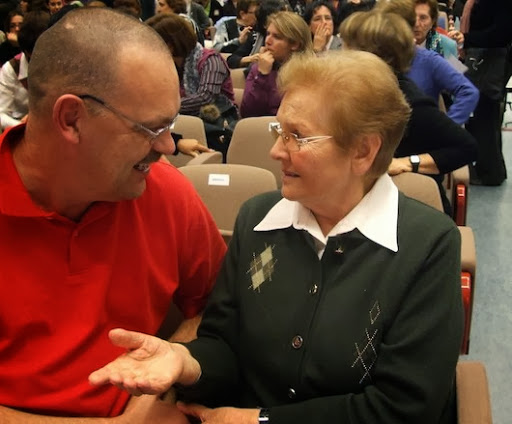
The photo at the top of this post shows Manfred Kochinky with Graziella De Luca, one of the first companions of Chiara Lubich, the founder of the Focolare Movement.

Bátyóka

20101220 Voskereweni Vladimir

In Hungarian there are separate words for older versus younger brother or sister and only a word for sibling and the – from a Hungarian perspective – generic “brother” and “sister” are rarely used. There are also words for up to the eleventh ancestors and tenth descendants and such granularity is something I haven’t seen in other languages. A further quirk of Hungarian is the application of “aunt” and “uncle” to senior acquaintances who are not blood-relations and the use of “my son” with reference to any person for whom one cares – I was always struck by the tenderness with which my grandad lovingly addressed my grandmother in this way. And finally, there is the generous use of diminutive suffixes, sometimes of multiple levels, expressing affection – e.g., “apa” – father, “apuka” – daddy, “apucika” – little daddy. All of these features of granularity and attribution of universality to intra-familiar relationships in the Hungarian language, I believe, underline their importance already by virtue of how one speaks about them. Universal brotherhood and specificity of relating to an individual person are hardwired and latent even before one opens one’s mouth or formulates a thought.

As a result of the above, a single word – “bátyóka” (“little older brother”) – suffices to express great love and affection, and my uncle, who completed his earthly pilgrimage yesterday evening, was universally known not only as “bátyóka” but as “Bátyóka.” Being the older brother who is considered with great love and warmth has become his name and all of us in our large, extended family only ever referred to him as such.

Bátyóka has lived a heroic life during tumultuous periods of the 20th century and has been the beloved elder brother not only to his biological family, but also to the countless people he served, guided and protected as a priest during decades of absurd oppression by a criminal Communist regime. His parishes always seemed to me, as a child, like oases and even at a young age it was crystal-clear to me that the way his parishioners related to him was by a bond of love rather than obedience or respect.

Meeting Bátyóka, you’d never have guessed that he had a doctorate in theology from Rome, as it would be his kindness and genuine interest for you as an individual that would strike you immediately. If the conversation turned to topics of faith or reason, his sharp intellect and vast knowledge would almost surprise you, as it wouldn’t have been him to steer the conversation in their direction.

Others could tell you much more about Bátyóka’s life, but all you’d learn from it are the details of the following fact: he was a follower of Jesus par excellence. This I knew from a very early age and continued experiencing on every occasion of meeting him since.

As I write this, on the day after Bátyóka completed his earthly life, I have tears in my eyes. They are not tears for Bátyóka though, who is now united even more closely with Jesus, the love of his life, and more than ever alive and closer to me as a member of Jesus’ Mystical Body, but for me, as I will miss seeing him, laughing at his incessant stream of jokes, being struck by the wisdom he so liberally shared with all and having him around as my “little older brother.”

Celibacy and marriage

Counsels

On Monday I listened with growing disappointment to a BBC Radio 4 program that intended to shed light on celibacy from the perspective of different faiths. The program’s panel was composed of a muslim cleric, a Catholic nun and an academic, who provided Buddhist and Hindu perspectives. Instead of dissecting the program here,1 I would like to share my personal, very much Christian, reflection and invite you to let me know what you make of it.

The optics I’d like to apply here are those of vocation.2 And I’d like to think about celibacy and marriage in parallel, since they are each key comparators for one another, and since talking about one without referencing the other would be artificial and woefully incomplete. Note also that I won’t attempt to knot a customary net of references, and will instead aim to present a synthetic and condensed exposition of my take on this topic, which has occupied my mind for a good 20 years so far.

First, I’d like to suggest that there is only one Christian vocation, which is to say (and keep saying) “Yes!” in response to God’s call to follow, imitate and love Him, directly and in my neighbors, and to give Him primacy in my life. Just as God didn’t supply Samuel with a job description when He called him (1 Samuel 3:1-10), like “a light silent sound” (1 Kings 19:12), or as Jesus didn’t issue the apostles with detailed terms and conditions (cf. Luke 5:1-11, Matthew 4:18-22), so too the specifics of following Him are part of the journey He invites me on. This adventure can take a myriad forms, like the infinite variety and ever-evolving novelty of God’s love itself.

Second, any perfection attained as a consequence of responding to God’s call is a gift. It can be welcomed and facilitated by staying attentive to the Holy Spirit’s “inspiration” in every present moment, by being open to embracing Jesus in every suffering and welcoming him among those who love one another mutually, and by placing one’s childlike trust in our loving Father. Perfection is not a human product, as the lives of so many saints attest.

Third, responding to my vocation yields both challenges and joys, where the natures and sources of both depend on the specific path I follow. On the surface of it, some are more likely if you are celibate while others are more typical of married life. Ultimately though, difficulties (suffering, frustration, disappointment) and joys alike are a consequence of what God wills or allows for me to experience and how I respond to it. This has nothing whatsoever to do with celibacy or marriage and everything to do with looking for God and embracing His will, moment by moment. Both have equal capacity for sanctification and torment, to the extent to which they lead to experiencing union with or absence from God.

Fourth, celibacy is a great treasure. It is an expression of a person’s permanent commitment to follow God’s call in total self-giving. By imitating Jesus’ celibate life, they, like He, devote themselves to supporting, enriching and guiding the People of God and proclaiming the Good News of God’s love to all. They, with their communities around them, are witnesses to God’s love in the world and a beacon of His fatherly and motherly love. The essence of celibacy is not a foregoing of sexual joy and the delights that one’s own children bring, but a positive, total gift of oneself to God, who is not to be outdone in generosity.

Fifth, marriage is a great treasure. It is an expression of a person’s permanent commitment to follow God’s call in total self-giving. By imitating the life of the Trinity, husband and wife become one family – a small church, where God dwells among those who follow his word. By “follow[ing] Jesus closely,”3 a family supports, enriches and guides the People of God and proclaims the Good News of God’s love to all. Married persons follow the evangelical counsels of poverty, obedience and chastity in ways proper to their circumstances and are available for transmitting God’s love to all. The essence of marriage is not an avoidance of a total commitment to God, a holding back of something for oneself, but a positive, total gift of oneself to God, who is not to be outdone in generosity.

Sixth, as one discerns how to follow God’s call in celibacy or marriage, it is understandable that one considers one’s own calling to be superior to the alternative. Since both have great riches and are means for sharing in the most intimate life of God, they each provide an overflowing basis for being extolled as superior. I believe that arguments for either exceeding the other ought to be read in this light – through their proponent’s eyes, and appreciated for being signs of the value and beauty that those who have chosen them see in them.

Finally, I would like to thank all who guided me during the time of discerning my vocation – some of whom were celibate, others married, and all of whom made me experience the presence of Jesus among his disciples – and my spouse, who is the tabernacle of our family.


1 If you’d like to hear it for yourself, a recording is available here. I’d be curious to know whether you found it enlightening or frustrating …
2 Since this is going to be spiritual and personal as much as intellectual, you might want to check out my standard Thomas-Nagel-inspired disclaimer in the second paragraph here.
3 Speaking about marriage a couple of weeks ago, Pope Francis described it as “men and women who have left their homes to commit to a lifelong marriage, that is to follow Jesus closely!”