A self thinking thoughts that are (or, an invitation to epistemic honesty)

Gormley

Language.

Thought.

Being.

Self.

A much more honest kick-off to a quest for reliable knowledge than René’s “cogito ergo sum.” But where to go next? With a self thinking thoughts that are, how do we get to knowledge of a world beyond? I believe I can’t, or rather, that I can’t know. All I have access to is my self. How about sensory experiences though? Well, those are still only parts of me – the stream of images, sounds, smells, textures, temperatures, pressures, movements are nothing but events internal to me. Are they caused by a world beyond me? Just from what I have to go on, there is no way of telling.

You say though that you see the same moon, trees and world as I describe, so it must be other than both you and I. But, no … I only have my own experiences of you at my disposal and you may as easily be entirely part of me as an independent inhabitant of an external universe.

And, invoking Occam’s blade won’t get you anywhere either: surely a universe where only I, with my complex imagination, exist is simpler (but, I am not saying more believable) than one where myriads of entities inhabit a material world.

Admittedly, many have set out down this route (Descartes and Russell being only two of my many fellow travelers – needless to say, known to me only as parts of my self) but none, to my knowledge, have stayed true to their initial rigor.

The insurmountable epistemic chasm between the self and anything potentially beyond it is precisely that: an chasm insurmountable by knowledge. All I will ever have access to is me: whether it prima facie looks like you or an external world or not. With epistemic honesty no secunda facie is accessible and, I have to say that both René and Bertie have let themselves be blindsided by ‘reasonable’ arguments that made them fudge the chasm and build magnificent edifices of knowledge on air.

Maybe you’ll want to call my bluff (à la Camus’ Myth of Sisyphus, where he challenges all who truly believe life to be absurd to commit suicide) and either say: “Come on, old girl, you’ve had your fun. Surely you can’t believe this. Look around you: how could all this just be in your head?!” to which the answer should be obvious from the above.

Or, you could try a different, more subtle, line of attack: “If you really don’t think there is anything beyond yourself, why bother doing anything. Doesn’t it make progress, compassion, love and the suffering of others meaningless?” To which I’d admonish you with a quick: “Check yourself before you wreck yourself.” Why should the events that I only have access to via my own experiences be any less seriously confronted in the absence of knowledge of their origin? Experiencing what appears as someone else’s suffering is an experiencing of suffering and cries out for remedy and consolation. If anything, it makes all suffering my suffering and therefore gives its resolution heightened urgency and immediacy. All this is to address only a misinterpretation of what I have said though. Stating that nothing beyond the self can be known (since I only ever have access to myself) does not mean that beliefs cannot (or even ought not) be held about the existence of others or a shared world (or that reason cannot be applied to structuring, explaining and predicting experiences consistent with an external world). All it means is that these beliefs, if held, are not derived from experience but additional (though not contrary) to it.

I don’t see any reason to break with epistemic honesty and deny the epistemic inescapability of the self so that questions beyond the self can be addressed. All it takes is being honest about involving beliefs or at least assumptions.

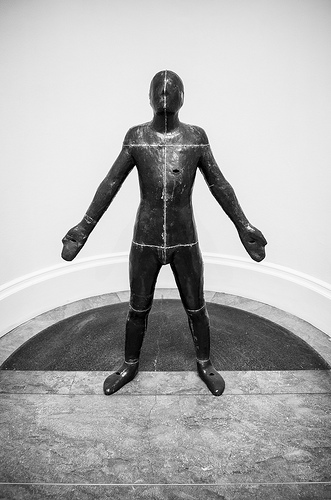
UPDATE (24/09/2012): Having just listened to Antony Gormley’s talk at the latest TED conference, I am delighted to see that his approach to sculpture very much parallels the above epistemological argument. Unlike ancient Greek sculptors, who tried to get at a sculpture trapped in a block of marble, so to speak from the outside, Gormley’s approach is the opposite. He starts from the “darkness of the body,” which he invites us to explore as follows:

“Do you mind if we do something completely different? Can we all just close our eyes for a minute? Now, this isn’t going to be freaky. It isn’t some cultic thing. (Laughter) It’s just, it’s just, I just would like us all to go there. So I’m going to do it too. We’ll all be there together.

So close your eyes for a minute. Here we are, in a space, the subjective, collective space of the darkness of the body. I think of this as the place of imagination, of potential, but what are its qualities? It is objectless. There are no things in it. It is dimensionless. It is limitless. It is endless.

Okay, open your eyes.

That’s the space that I think sculpture – which is a bit of a paradox, sculpture that is about making material propositions – but I think that’s the space that sculpture can connect us with.”

Gormley’s “darkness of the body” is where epistemic honesty needs to start and where it remains even when we open our eyes.
Gang up on the green!

Temple gardens

The last week has seen a discouraging pair of shots being fired between the religious and atheists camps in the form of an article in the Catholic Herald by Fr. Alexander Lucie-Smith and a response to it by the biologist Prof. Jerry A. Coyne.1

I will leave it to you to read the two articles for yourself and won’t attempt to challenge the many individual shots fired by the two sides, as tempting as that is. The problem of evil, Nietzsche’s philosophy, nihilism, alternative theories of meaning, the nature of empirical observation, inference, theoretical parsimony and (lack of) evidence for God are all used as bullets, but without any attention paid to attempting a meeting of minds and certainly without any effort made to apply the principle of charity by either side.

Instead of going into the pair of arguments point–by–point, I would just like to throw the following into the mix (one each as criticisms of the two protagonists):

  1. Prof. Coyne, isn’t it the case that a given set of empirical data can be the basis of multiple, alternative inferences? Stating that the character of our universe being the opposite of what would be expected given a loving and powerful god is an “inference from evidence” is all well and good, but I’d argue that so would be the inference that our universe is exactly what would be expected given a loving and powerful god. What is inferred from evidence does not derive from it in a causal way (seeing a dropping apple does not cause a specific theory of gravity to be posited by an observer) and neither does a given (set of) evidence only lend itself to the definition of a single, specific theory to be inferred from it. Just looking at the playing filed of contemporary physics (or probably any other field of rational enquiry) ought to be enough to settle this point. Please, don’t take this as me saying that scientific theories are feelings or that they are arbitrary. That is not what I believe at all. I have a deep admiration for science, derive great satisfaction from participating in its advancement (admittedly in a minuscule way as far as my contribution goes) and fully subscribe to its enormous value. While I wholeheartedly agree with Prof. Dawkins and you that we can all be moral without a belief in god, I would also like to suggest that the religious views you attack are caricatures, assuming no intelligence on the part of those who hold them – not a great basis for dialogue.
  2. Fr. Lucie–Smith, isn’t it the case that the feeling of indifference, the unanswered call for justice and the lack of clarity of purpose that you attribute to atheists is precisely what Jesus felt in his abandonment on the cross (“My God, my God, why have you forsaken me?” Mathew 27:45)? And isn’t it then more fitting to engage in a dialogue with atheists that seeks to tease out the common ground between what is accessible to us without the benefit of a faith, which we, Catholics, believe to be a gift (“Faith is an entirely free gift that God makes to man.” Catechism of the Catholic Church, §162)? Please, don’t take this the wrong way, but what did you seek to achieve with your article, beyond ridiculing a ridiculous interpretation of another’s words?

So, potentially having made two fresh enemies, let me suggest that we are looking at the wrong battle lines altogether! The fight ought not to be between atheists and religious but between the rational atheists and religious on the one hand and those who act without employing reason or who abuse reason for selfish and immoral ends on the other – and those come in both flavors. Let me just give two examples that shocked and saddened me recently: first the ‘Christian’ idiot who killed seven at a Sikh gurdwara in Milwaukee and second the ‘atheist’ Chinese state whose officials have performed a forced abortion on a 7–month–old foetus. And these are just two outrageous and reprehensible events picked almost at random from the last two weeks.

For us, who do clearly have differences that I don’t mean to belittle, but who subscribe to both rationality and morality, to squabble with each other is both an offense to reason and to God and I wish that we would learn from the inhabitants of Sir Terry Pratchett’s Discworld, where “[b]lack and white lived in perfect harmony and ganged up on green.”


1 Thanks to Luke Coppen for his excellent daily ‘Catholic must-reads’ and Twitter feed, where I first read about these articles.

Does science require beliefs?

Rembrandt anatomy

I am not talking about a belief in God, or anything whatsoever to do with religion. All I am asking is whether the practice of science requires the holding of beliefs or not. If you ask most scientists, engineers or even random members of the public, you are likely to get a negative answer (for a vigorously atheist answer see here). Science, after all, is about knowledge and repeatable process. The scientific method delivers predictive, explanatory models of the universe, that are derived from, and agree with, hard facts – measured data. We know there is gravity from repeatable experiments and we have models that let us make predictions about how it acts. Therefore, we have no need for beliefs to explain that an object lifted off the ground drops when let go.

That does sounds pretty convincing. Given a law of nature we can explain how the entities and events it refers to interact and we can make predictions about how they will behave under some new, future conditions. This requires no beliefs.

Or does it? If you were to ask Max Planck (yes, the Nobel prize winning author of quantum theory and the guy after whom the Planck constant is named), he’d promptly admonish you as follows:

“We have no right to assume that any physical laws exist, or if they have existed up until now, that they will continue to exist in a similar manner in the future.”

No amount of past data is grounds for expecting the same, previously observed relationships to hold into the future (whether under past or new conditions), for which – by definition – we have no data. Making predictions fundamentally relies on the belief that the laws of Nature are constant and will persist as observed and deduced previously. Now, you might argue that this is a reasonable belief to hold, and I’d agree with you, but you’d be hard pressed not to concede that it is a belief rather than a (scientific) fact. Almost as an aside, there is some evidence though that puts a question mark over the belief that the laws of nature are constant (e.g., see this article in the journal Nature or reports like the one in ABC Science).

The above is just a specific application of the more general problem of induction, whereby we “[p]resuppos[e] that a sequence of events in the future will occur as it always has in the past.” A great, more recent thought experiment to illustrate the problem has been proposed by Goodman in the form of the purpose-built predicate “grue.” “Something is grue if and only if it has been observed to be green before a certain time or blue after that time.” Therefore all emeralds that have ever been observed are not only green, but also grue and we have no basis for assuming that after some future time T we will find green but not grue emeralds. Coming back with saying that emeralds have always been green is beside the point …

As you may have noticed, the above reasoning deliberately took shortcuts and did not explore other instances of belief in science, which may well be rectified in future blog posts (we just can’t tell yet).

Finally, it is worth noting that the ideas presented above are in no way an attack on science! Science, on the basis of its underlying beliefs and assumptions, sheds light on how the world around us may work, allows us to make predictions (which for some phenomena have so far always come true), lets us harness the potential of materials around us for the benefit of humanity and dramatically demonstrates the advances that human intelligence is capable of. This makes science greatly valuable and something to be proud of, but let us not delude ourselves into thinking that it is devoid of belief.

The Principle of Charity

Cholmondeley I first came across the “principle of charity” thanks to one of the lecturers on the MA in Philosophy that I attended (but sadly not completed) at Sheffield. In the first lecture of the Aristotle module, where we were going to cover Book 9 of the Metaphysics, Dr. Stephen Makin* put something like the following idea to his students:

Aristotle wrote the Metaphysics in the 4th century BC, using the language of the day and firmly set in the cultural, scientific and political context of the time. If we approach this text without an attempt at looking for something positive, valuable or meaningful, we will very quickly come to dismiss it, as it is very easy to find it dated, set it superseded modes of thinking or irrelevant. This would be a great shame though, as it would keep Aristotle’s insights hidden from us. Instead, let’s adopt the principle of charity and look for the most favorable interpretation of Aristotle’s words – the interpretation that would give his statements the greatest value, the most sense.

As you can imagine, I was super enthusiastic about this attitude, since it struck me both as very sensible and like exactly the kind of angle that the Gospels would take, had they addressed the topic of hermeneutics. While looking into the background of this principle, I came across the following example of its application in the context of religion that I found particularly positive:

“The next [human representation of the ideal of divine love] is what is known as Vatsalya, loving God not as our Father but as our Child. This may look peculiar, but it is a discipline to enable us to detach all ideas of power from the concept of God. … [T]he Christian and the Hindu can realize [this idea of God as Child] easily, because they have the baby Jesus and the baby Krishna.”

Swami Vivekanda (1863–1902)

Not only does Vivekanda shed light on an aspect of Christian revelation from a new angle, but he uses it to draw parallels with Hinduism, thereby making both religions’ insights accessible to each other’s followers. In this context it is particularly rewarding to see how this same point is emphasized in a recent homily of Pope Benedict XVI:

“God’s sign is simplicity. God’s sign is the baby. God’s sign is that he makes himself small for us. This is how he reigns. He does not come with power and outward splendor. He comes as a baby – defenseless and in need of our help. He does not want to overwhelm us with his strength. He takes away our fear of his greatness.”

Just to avoid the ever-lurking accusation of syncretism when considering inter-religious questions, I don’t read Vivekanda as equating Jesus with Krishna or proposing their co–existence or merging, but instead as pointing to principles expressed with similarity in both traditions.

If only the principle of charity were more broadly applied both in secular and religious discourse …


I can’t mention Dr. Makin without sharing the following anecdote: One morning Dr. Makin arrives late to give his lecture and with indignation exclaims: “I have been asked to do some administrative work! Can you imagine a professional administrator being asked to write a book about Aristotle?!” I often feel the same (but still have to do it :).