[Warning: long read – again]
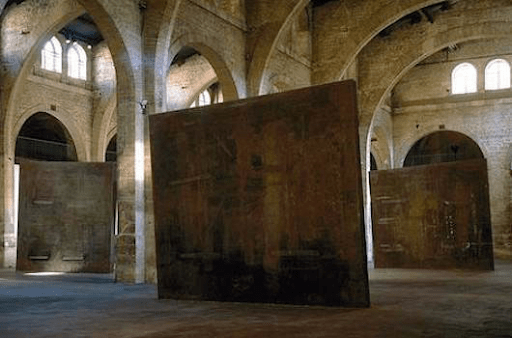
It might seem strange to start a post about the sculptor Richard Serra by referring to Pope Francis’ homily from last Friday morning, but I hope you’ll bear with me while I do it anyway and that you won’t interpret it as an attempt to imbue Serra’s work with religious motives, which I believe it does not have. Instead, my reason for starting out with the following quote is that I believe both Richard Serra and Pope Francis give great importance to physicality, as is apparent from the examination of conscience proposed here by the pope and as I will try to spell out in greater detail with regard to Serra’s work:
“Am I embarrassed by the flesh of my brother or sister? When I give alms, do I let the coins fall without touching his hand? And if by chance I touch him, do I do this? [he asked mimicking a gesture of repulsion with his hand] When I give alms, do I look my brother or sister in the eyes? When I know a person is sick do I visit him or her? Do I greet them with tenderness?”
That the pope emphasizes physicality – using the word “flesh” 13 times last Friday morning – is, I believe, motivated by a desire to counter the ever-recurrent dualist distortion of Christianity that considers only the spirit to be good while equating matter with evil. This is categorically not Jesus’ message and, to my mind, Serra’s work is a great way also for a Christian (and everyone else too) to understand why, in an experiential rather than a moral or intellectual way.
What Richard Serra does, in my opinion, is to heighten the potential for an immediate experience of space, mass, scale, orientation and matter in a way that is difficult to be had directly in nature, where these experiences are admixed with those of other properties or qualities. The result can be awe and an experience of profound beauty (that is not to be sought only in the superficially aesthetic), which – while, as far as I can tell, not intended by their author – make Richard Serra’s work precisely what the composer James MacMillan pinpointed as the key feature of art: “a window on to the mind of God.”
To begin with, speaking about Richard Serra’s work faces the same challenges as appreciating any piece of art, in that no verbal account is going to suffice as a surrogate for direct experience. In fact, Serra himself argues this point very starkly, when asked to describe his “Delineator” (shown next):1
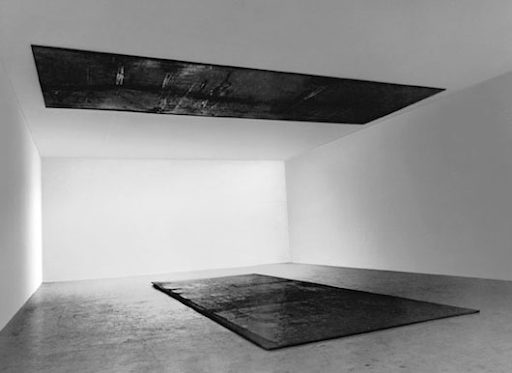
“What happens with Delineator is that the only way to understand this work is to experience the place physically, and you can’t have an experience of space outside of the place and the space you’re in. Any linguistic mapping or reconstruction by analogy, or any verbalization or interpretation or explanation, even of this kind, is a linguistic debasement, in a sense, because it isn’t even true in a parallel way.”
Nonetheless, Serra does say more about Delineator elsewhere, which highlights some of his concerns and the mental model he uses for thinking about his own work:
“The sculpture defines a definite space inside the room. […] The juxtaposition of steel plates forming this open cross generates a volume of space which has an inside and an outside, openings and directions, aboves, belows, rights, lefts – coordinates to your body that you understand when you walk through it. Noe you might say that that sounds quite esoteric. Well, one of the things that you get into as you become more in tune with articulating space is that space systems are different than linguistic systems in that they are nondescriptive. The conclusion I’ve come to is that philosophy and science are descriptive disciplines, whereas art and religion are not.”
So, if you haven’t seen any of his work and tried to circumnavigate and “inhabit” it, I would very much encourage you to try to do so, if you get a chance. Personally, I have had experiences akin to what Serra speaks about above, when I saw his “Seven plates, six angles” (below) at the Gagosian in New York. The overwhelming sensation I had was of a heightened awareness of scale, volume and proportion, but also – unexpectedly – of space and mass. In some sense, my extensive use of photos in this post is futile – like showing you images of alien foodstuffs that you have not tasted, so, please, consider them tokens or bookmarks – i.e., pointers for your own future experience.
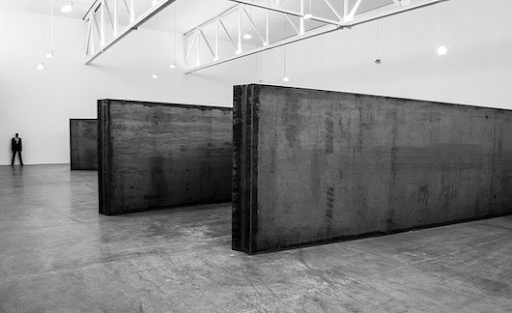
When asked about the relation of one of his pieces, shown at the Tate in London, to the building it was exhibited in, Serra made another important observation about what his work intends to be (and one that rang very true to me in retrospect):
“I did not want to enter into an affirmative dialogue with the building. I did not want to mirror face-value language, the physiognomy of the architecture. I wanted to deal with the volume, weight, mass and directionality of the space. [… I] wanted to make a sculpture out of the whole volume […] I wanted to make the volume of the space tangible, so that it is understood immediately, physically, by your body.”
The idea that the sculpture is not solely the object Serra created, but that it is that object in relation to the space it is situated in, is a paradigm shift and the key to understanding his insistence on making site-specific work even in the case of indoor sculptures. And even when a piece is shown in multiple locations over time, its placement in every one of those spaces results in multiple sculptures involving the one Serra-made object (that naïvely might be identified as the sculpture in full).
Beyond the paradigm shift from objects to entire spaces, Serra also broadens the palette of sculptural considerations:
“There’s a difference between walking into a telephone booth and a football stadium. If you take those two extremes and make the idea very subtle, then you can say there’s a difference between walking to the left and walking to the right, between the experience of the concave and convex, between something leaning right and something leaning left. How do you know that to be a different experience in terms of your daily life? And if it is, is it meaningful? The degree of meaningfulness depends on the limitations of the viewer. I think it is very difficult to introduce large-scale works into the public arena inasmuch as I am not interested in complicity or affirmation.
[…]
Compared to that of vertical sculpture, the ideas of sculpture existing horizontally are basically different concepts about construction, are basically different concepts about how we live in the world. On a simple, perceptual level, a modular unit extending above your eye-level becomes foreshortened as it rises, while the horizontal modular unit implies an infinite vanishing point. […] The cultural symbolic iconography of verticality versus horizontality is most apparent in the cross, where the vertical expresses transcendence and the horizontal expresses materiality.”
While Serra is clear about his interests being “nonutilitarian, nonfunctional” and declaring that “any use [of sculpture] is a misuse,” as well as anticipating limited audience appreciation (likening it to “poetry and experimental film” :)), he at the same time has a profound message behind his work:
“We are all restrained and condemned by the weight of gravity. […] The constructive process, the daily concentration and effort appeal to me more than the light fantastic, more than the quest for the ethereal. Everything we choose in life for its lightness soon reveals its unbearable weight. We face the fear of unbearable weight of repression, the weight of constriction, the weight of government, the weight of tolerance, the weight of resolution, the weight of responsibility, the weight of destructions, the weight of suicide, the weight of history which dissolves weight and erodes meaning to a calculated construction of palpable lightness.”
In many ways, the above strikes me as having affinities with Christianity, where Serra’s “Everything we choose in life for its lightness soon reveals its unbearable weight.” can be seen as a complement of Jesus’ “But seek first the kingdom of God and his righteousness, and all these things will be given you besides.” (Matthew 6:33).
A further aspect of Serra’s weight versus lightness statement (made in 1988) is its echoing of Milan Kundera’s novel “The Unbearable Lightness of Being ,” published only four years earlier, where its author too makes a play for weight over lightness:2
“The heaviest of burdens is therefore simultaneously an image of life’s most intense fulfillment. The heavier the burden, the closer our lives come to the earth, the more real and truthful they become. Conversely, the absolute absence of burden causes man to be lighter than air, to soar into heights, take leave of the earth and his earthly being, and become only half real, his movements as free as they are insignificant. What then shall we choose? Weight or lightness?”
What, you may ask, is my point though? I hope that the above highlighted a couple of aspects of Serra’s work, which I have found to be deeply engaging and appealing. First, that he has invented a whole new concept of sculpture whose building blocks are not only form, texture, composition and proportion, but also mass, space, directionality and orientation, rendering an entire space a sculpture. Second, that his work is deeply rooted in the entirety of art and philosophy, without these being prerequisites for its appreciation and experience. Third, that experiencing his work, which explicitly shuns religious motives, does shed light on deeply Christian concepts and is therefore also of spiritual value to a Christian viewer at least.
As such, it shouldn’t come as a surprise to you, when I tell you that Richard Serra is probably my favorite sculptor (alongside Michelangelo, Rodin and Giacometti) and I hope that you will appreciate his work too when you next see one of his pieces.
1 All Richard Serra quotes here are from “Writings/Interviews .”
.”
2 Both, probably, derived from Nietzsche’s concept of eternal recurrence, where the permanent (heavy) is contrasted against the fleeting (light).
 eyebeleave