Mary is more important than the apostles

Mary queen of apostles

That the role of women in the Church is lacking, is a failing that Pope Francis has spoken about repeatedly and for which he is seeking a solution. As he stated during the impromptu interview on the flight back from the World Youth Day in Rio last summer, and again during “the” interview given to Jesuit publications, the role of women needs to be revised and they need to be part of the decision making processes in the Church. The points made during those interviews are incorporated and elaborated again in Pope Francis’ apostolic exhortation Evangelii Gaudium – a magisterial document of the Catholic Church, where he sums the situation up as follows in paragraphs 103 and 104:

“The Church acknowledges the indispensable contribution which women make to society through the sensitivity, intuition and other distinctive skill sets which they, more than men, tend to possess. I think, for example, of the special concern which women show to others, which finds a particular, even if not exclusive, expression in motherhood. I readily acknowledge that many women share pastoral responsibilities with priests, helping to guide people, families and groups and offering new contributions to theological reflection. But we need to create still broader opportunities for a more incisive female presence in the Church. Because “the feminine genius is needed in all expressions in the life of society, the presence of women must also be guaranteed in the workplace” and in the various other settings where important decisions are made, both in the Church and in social structures.

Demands that the legitimate rights of women be respected, based on the firm conviction that men and women are equal in dignity, present the Church with profound and challenging questions which cannot be lightly evaded. The reservation of the priesthood to males, as a sign of Christ the Spouse who gives himself in the Eucharist, is not a question open to discussion, but it can prove especially divisive if sacramental power is too closely identified with power in general. It must be remembered that when we speak of sacramental power “we are in the realm of function, not that of dignity or holiness”. The ministerial priesthood is one means employed by Jesus for the service of his people, yet our great dignity derives from baptism, which is accessible to all. The configuration of the priest to Christ the head – namely, as the principal source of grace – does not imply an exaltation which would set him above others. In the Church, functions “do not favour the superiority of some vis-à-vis the others”. Indeed, a woman, Mary, is more important than the bishops. Even when the function of ministerial priesthood is considered “hierarchical”, it must be remembered that “it is totally ordered to the holiness of Christ’s members”. Its key and axis is not power understood as domination, but the power to administer the sacrament of the Eucharist; this is the origin of its authority, which is always a service to God’s people. This presents a great challenge for pastors and theologians, who are in a position to recognize more fully what this entails with regard to the possible role of women in decision-making in different areas of the Church’s life.”

I’d sum the key points up as follows:

  1. Men and women are of equal dignity.
  2. Sacramental power is a function, not a source of prestige, dignity or holiness.
  3. Sacramental power being too closely tied to power in general is a source of division.
  4. Women already share some responsibilities with priests in pastoral, guidance and theological terms.
  5. Women need to be present where important decisions are made in society and in the Church.
  6. How to include women in the Church’s decision-making process and have them hold positions of responsibility and power is a great challenge.

To my mind, Pope Francis’ is a very clear and transparent account of the current status and his desire to change it is obvious from every occasion when he speaks about it.

In an attempt to get a sense of what a solution might look like, an Italian newspaper, Corriere della Sera, went to interview Maria Voce, the president of the 2.5 million member Focolare Movement – the only lay movement in the Catholic Church headed by a woman. The interview kicks off with the most obvious – and good – question about whether Voce is unhappy that she cannot become a priest1:

“Look, I know female Evangelical pastors, who are my friends and exceptional women and who do very well for their churches, but I have never thought that the possibility of becoming a priest would increase the dignity of women. It would just be an additional service. Because, the point is another: as women, what we need, it seems to me, is to see a recognition of equal dignity, of equal opportunity in the Catholic Church. Service and not servitude, as Pope Francis himself says.”

The point here is clear – the priesthood is a service to the Church, while what women need is dignity and opportunity. On a related note, Voce was also asked about the question of female cardinals, to which she responded:

“A female cardinal could be a sign for humanity, but not for me or for other women, I believe. It does not interest me. She would be an exceptional person to be made a cardinal. OK, but then? The great female figures, saints and doctors of the church, have always been valued. But it is the woman as such who doesn’t find her place. What needs to be recognized is the female genius in the everyday.”

Again, this makes great sense – the point is about an all-pervasive presence of women in the church – at all levels of responsibility and service, and not only the appreciation for exceptional individuals, who have already been well dealt with for centuries. But what would this recognition and presence look like? Here Voce has several suggestions:

“Women could lead departments of the Vatican curia […] I don’t understand why, for example, the department on the family necessarily has to be lead by a cardinal. It could very well be a couple of lay persons who live their marriage in a Christian way […] The same could apply to other departments too. It seems normal to me.

I am also thinking of the general Congregations before a conclave. The mother superiors of large orders could participate and maybe also elected representatives of dioceses. […]

[Regarding the council of eight cardinals advising the pope] I don’t envisage a group of only women that would be added. It would be more useful to have a mixed group, with women and other lay persons who together with the cardinals could provide the necessary information and perspectives. I’d be very enthusiastic about that.”

The final topic of the interview was the question of the “theology of women” that Pope Francis referred to as being absent but very much needed. Here, Voce identified Francis’ statement that “Mary is greater than the apostles” as being the Leitmotiv of such a theology. She also suggested that this direction, given by the Pope, points both to complementarity and to women also participating in the Church’s magisterium, it’s teaching and leadership role, in some way:

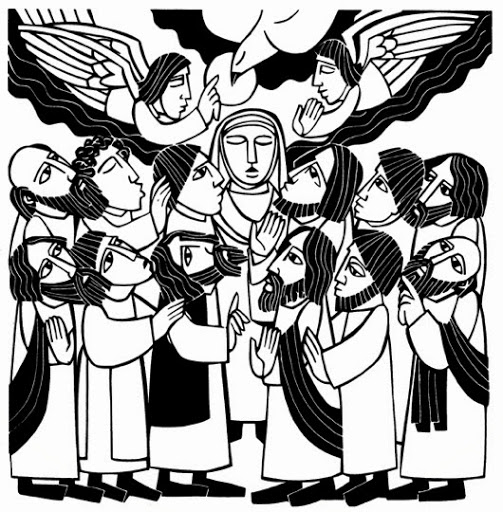
“Chiara [Lubich]2 thought of Mary as the blue sky that contains the sun, the moon and the stars. In this vision, if the sun is God and the stars are the saints, Mary is the sky that contains them, that contains also God: by God’s own will who has incarnated himself in her womb. The woman in the Church is this, needs to have this function, which can only exist in complementarity with the Petrine charism. It can’t be only Peter guiding the Church, there needs to be Peter with the apostles and sustained and enveloped by the embrace of this woman-mother who is Mary.”

This image of Mary enveloping the apostles is filled with profound beauty to my mind, and is such an intuitive way of putting the need for complementarity between the Petrine, apostolic aspect of the Church and the Marian aspect, which is about reciprocating God’s love for us. In fact, the Catechism of the Catholic Church – drawing on John Paul II’s apostolic letter Mulieris Dignitatem – puts this very clearly:

““[The Church’s] structure is totally ordered to the holiness of Christ’s members. And holiness is measured according to the ‘great mystery’ in which the Bride responds with the gift of love to the gift of the Bridegroom.” Mary goes before us all in the holiness that is the Church’s mystery as “the bride without spot or wrinkle.” This is why the “Marian” dimension of the Church precedes the “Petrine.””

The challenge now is to put it into practice!


1 For more on this subject, see a previous post.
2 For more about Chiara Lubich – the founder of the Focolare Movement, see previous posts and for some background on the image referred to by Voce see this particular one.

Slovak bishops celebrate Opposite Day

Ryanoppositeday 15

1The most plausible explanation that I can think of for the letter that the bishops of Slovakia have addressed to their flock yesterday is that they must think of the last nine months – since the election of Pope Francis – as one, long Opposite Day. In fact, they must be under the impression that it has been Opposite Day for much longer than that, since their message just reads like the polar opposite of where the Church has been heading at the very least since Vatican II.

Be that as it may, let me set out how the Slovak bishops’ letter points away from both Pope Francis’ words and deeds:

  1. There is not a single use of the words “Jesus” or “Christ” in the entire document. The closest, and single reference to Him is their saying that Advent “reminds us of the arrival of God’s Son on Earth.” And that’s Jesus taken care of. In contrast, “Jesus” is the single most frequently used word in Pope Francis’ morning sermons and at the very top of the frequency tables in all his other speeches and writings. For Pope Francis, Jesus is the be all and end all of his mission – the Slovak bishops don’t even mention him by name.
  2. There is a single reference to Scripture in the Slovak bishops’ letter – a “cf. John 10:10” in reference to the “Son of God’s” coming being for the sake of our lives’ fullness. Pope Francis – and all of his predecessors and their collaborators – instead takes ample advantage of maintaining a close link to Scripture, which he therefore also copiously refers to. And, please, don’t take these first two points as being about form – they are deeply about substance. A close adherence and frequent reference to Jesus and his words are an integral part of what it means to be His followers and their absence then leads to failures like the letter under scrutiny here.
  3. How about the poor and marginalized? The divorced and remarried, single mothers, the sick, those who suffer from discrimination? How do they, who are so central to Pope Francis’ message, fare in the letter? Not very well, actually … There is no mention whatsoever of the poor, in a letter about the season during which we remember Jesus’ coming into the world under circumstances of clear poverty. And how about the divorced or those who suffer from the breakdown of the family? Do they get a look in? Yes, but not in the way you’d expect: “God wants for every person to come into the world in loving, well-ordered family communities. If that is not the case, it is either a misfortune or human failure.” Let’s see what Pope Francis has to say instead:

    “Think about a single mother who goes to church, in the parish and to the secretary she says: ‘I want my child baptized’. And then this Christian, this Christian says: ‘No, you cannot because you’re not married!’. But look, this girl who had the courage to carry her pregnancy and not to return her son to the sender, what is it? A closed door! This is not zeal! It is far from the Lord! It does not open doors! […] Jesus is indignant when he sees these things because those who suffer are his faithful people, the people that he loves so much.”

    I know whose side I am on! And I don’t mean to deny any of the beauty and value of the family – the same family that the Slovak bishops, presumably, have in mind. What I do distance myself from is the tone and content of their letter where all who are not in “well-ordered,” “responsible” families are opponents of God’s laws and the order of the universe.

  4. And what about homosexuals? They are branded as being proponents of a “culture of death” and enactors of a “sodomite caricature that is opposed to God’s will and awaits God’s punishment.” How well is this aligned with Pope Francis’ words? Judge for yourself:

    “A person once asked me, in a provocative manner, if I approved of homosexuality. I replied with another question: ‘Tell me: when God looks at a gay person, does he endorse the existence of this person with love, or reject and condemn this person?’ We must always consider the person. Here we enter into the mystery of the human being. In life, God accompanies persons, and we must accompany them, starting from their situation. It is necessary to accompany them with mercy. When that happens, the Holy Spirit inspires the priest to say the right thing.”

    Hm … not quite on the same page … Mercy and accompanying instead of caricature and punishment. Hey, that sounds familiar – how about: “Go and learn the meaning of the words, ‘I desire mercy, not sacrifice.’ I did not come to call the righteous but sinners.” (Jesus, in Matthew 9:13).

  5. Finally, just to round out the entertainment value of this post, the letter also contains an interesting set of nouns with regard to men: “man, husband, father, knight, gentleman” (did anyone say “museum-piece Christians” – actually, yes, it was Pope Francis again …) and women: “woman, wife, mother” (did anyone say “Bazinga!”?). No comment.

There’d be plenty more to say, but I believe the above gives a sense of how categorically misaligned the Slovak bishops’ Advent pastoral letter is with Pope Francis. There is no sense of joy, mercy, love or a care for the poor or those at the peripheries, who are Pope Francis’ central concern and who, unsurprisingly, were Jesus’ own preferred company.

Just so that I don’t leave a sense of complete disagreement and pure criticism in the air, let me say though that I share the Slovak bishops’ concerns with regard to “gender theory.” Instead of reproducing their own words, let me make recourse to Pope Benedict XVI’s, who can put the central problem far more lucidly and rationally than I or the Slovak bishops could:

“[T]he very notion of being – of what being human really means – is being called into question. […] Simone de Beauvoir [saying] “one is not born a woman, one becomes so” (on ne naît pas femme, on le devient) [lays] the foundation for what is put forward today under the term “gender” as a new philosophy of sexuality. According to this philosophy, sex is no longer a given element of nature, that man has to accept and personally make sense of: it is a social role that we choose for ourselves, while in the past it was chosen for us by society. The profound falsehood of this theory and of the anthropological revolution contained within it is obvious. People dispute the idea that they have a nature, given by their bodily identity, that serves as a defining element of the human being. They deny their nature and decide that it is not something previously given to them, but that they make it for themselves. […] Man calls his nature into question. From now on he is merely spirit and will. The manipulation of nature, which we deplore today where our environment is concerned, now becomes man’s fundamental choice where he himself is concerned. From now on there is only the abstract human being, who chooses for himself what his nature is to be.”

There are certainly contentious and very serious issues on the table, but they need to be considered in an atmosphere of respect, dialogue and mercy and in a way that shows their balance against other issues, such as poverty, injustice, oppression, exploitation and violence.


1 Many thanks to my überbestie PM, whose reactions to the letter are incorporated here too.

Science in Evangelii Gaudium

The apostolic exhortation published by Pope Francis yesterday has received widespread scrutiny already, with two foci being its critique of unbridled market capitalism and its equally sharp-tongued critique of the Church’s shortcomings and a call to greater mercy and closeness to all. Both of these topics are close to my heart and I hope to return to them in due course.

Instead, I’d here like to focus on the references to science that Francis made in Evangelii Gaudium – effectively as a follow-on to an analogous analysis I applied to his interview given to Jesuit publications some months ago. As I noted there, Francis placed science on par with theology, both as informing the Church from within, and I was curious to see how that – to my mind daring – positioning would hold up in this formal exposition of his vision for the Church.

The first mention of science comes up early on in the document and is well in line with the sketch from “the” interview:

“The Church […] needs to grow in her interpretation of the revealed word and in her understanding of truth. It is the task of exegetes and theologians to help “the judgment of the Church to mature”. The other sciences also help to accomplish this, each in its own way.”

Science – in fact, “the sciences” – is placed explicitly among the sources of understanding that the Church needs to take advantage of, even in the context of making sense of revelation. Francis follows this up by stating that:

“Differing currents of thought in philosophy, theology and pastoral practice, if open to being reconciled by the Spirit in respect and love, can enable the Church to grow, since all of them help to express more clearly the immense riches of God’s word. For those who long for a monolithic body of doctrine guarded by all and leaving no room for nuance, this might appear as undesirable and leading to confusion. But in fact such variety serves to bring out and develop different facets of the inexhaustible riches of the Gospel.”

The sciences and their “differing currents of thought” are shown here to lead to a nuanced, varied understanding of a multi-faceted reality. In fact, towards the end of the exhortation, Francis makes a very important point about the Gospel – and by extension reality too – being like a polyhedron:

“Here our model is not the sphere, which is no greater than its parts, where every point is equidistant from the centre, and there are no differences between them. Instead, it is the polyhedron, which reflects the convergence of all its parts, each of which preserves its distinctiveness.”

Returning to the presentation of science in Evangelii Gaudium, the strongest point is made about half-way through the document, where science is even positioned as “an instrument of the Spirit for enlightening and renewing the world,” in the context of its capacity to shed light on Jesus’ message. This is very strong stuff and, I believe, part of a much broader move by Francis to emphasize the ubiquity of God’s speaking to us. Also in the context of inter-religious dialogue, Francis proclaims that non-Christian religions too “can be channels which the Holy Spirit raises up” – again a very bold claim, like in the case of science. In effect, Francis is saying not to look for God only in the zones explicitly demarcated for it, but to realize that He can be accessed in many more ways. In fact, his words about non-believers round out this picture very clearly: “We consider [all who sincerely seek the truth, goodness and beauty] as precious allies in the commitment to defending human dignity, in building peaceful coexistence between peoples and in protecting creation.”

Next, Francis returns to the key point from “the” interview – that theology and science need to work in tandem:

“It is not enough that evangelizers be concerned to reach each person, or that the Gospel be proclaimed to the cultures as a whole. A theology […] which is in dialogue with other sciences and human experiences is most important for our discernment on how best to bring the Gospel message to different cultural contexts and groups.”

However, it is a relationship among equals that he is after – among all the sciences and rational modes of equiry and thought, which is in contrast with an absolutization of positivist science in the form of scientism:

“Dialogue between science and faith also belongs to the work of evangelization at the service of peace. Whereas positivism and scientism “refuse to admit the validity of forms of knowledge other than those of the positive sciences”, the Church proposes another path, which calls for a synthesis between the responsible use of methods proper to the empirical sciences and other areas of knowledge such as philosophy, theology, as well as faith itself, which elevates us to the mystery transcending nature and human intelligence. Faith is not fearful of reason; on the contrary, it seeks and trusts reason, since “the light of reason and the light of faith both come from God” and cannot contradict each other.”

Again, this is not a new position – drawing explicitly on John Paul II’s Fides et Ratio – but an important facet of Francis’ vision of how science is part of a Christian world-view.

Finally, Francis re-iterates the fundamental compatibility of Christianity and science, by underlining the goodness of scientific progress. At the same time he warns against an ideologisation of science too and against a jumping to conclusions or an overconfidence in emerging theories:

“The Church has no wish to hold back the marvellous progress of science. On the contrary, she rejoices and even delights in acknowledging the enormous potential that God has given to the human mind. Whenever the sciences – rigorously focused on their specific field of inquiry – arrive at a conclusion which reason cannot refute, faith does not contradict it. Neither can believers claim that a scientific opinion which is attractive but not sufficiently verified has the same weight as a dogma of faith. At times some scientists have exceeded the limits of their scientific competence by making certain statements or claims. But here the problem is not with reason itself, but with the promotion of a particular ideology which blocks the path to authentic, serene and productive dialogue.”

In summary, I find Francis’ views on science deeply positive and see them as both building on his predecessors’ emphasis on rationality and going beyond even the extent to which they saw science as a good. To declare science as an instrument of the Holy Spirit is to give it the highest possible accolade.

The Joy of the Gospel – an Anthology

Evangelium gaudii

[Very long read – but way shorter than the full Evangelii Gaudium :)]

Pope Francis has published his first extensive piece of writing as pope today – the apostolic exhortation “Evangelii Gaudium” – “The Joy of the Gospel.”1 It is a 48K+ word text, written originally in Spanish and hailed by many already as the blueprint for his papacy, and all I’d like to do for now is just share with you some of my favorite parts of this text, to which I am sure to return many more times. I will not attempt to be comprehensive and will certainly skip also important parts of this document, which I encourage you to read in full. Instead, the following will be an anthology – a collection of flowers – that most immediately spoke to me.

Whenever our interior life becomes caught up in its own interests and concerns, there is no longer room for others, no place for the poor. God’s voice is no longer heard, the quiet joy of his love is no longer felt, and the desire to do good fades. (§2)

There are Christians whose lives seem like Lent without Easter. I realize of course that joy is not expressed the same way at all times in life, especially at moments of great difficulty. Joy adapts and changes, but it always endures, even as a flicker of light born of our personal certainty that, when everything is said and done, we are infinitely loved. (§6)

Sometimes we are tempted to find excuses and complain, acting as if we could only be happy if a thousand conditions were met. (§7)

The heart of [the Gospel] message will always be the same: the God who revealed his immense love in the crucified and risen Christ. (§11)

Christians have the duty to proclaim the Gospel without excluding anyone. Instead of seeming to impose new obligations, they should appear as people who wish to share their joy, who point to a horizon of beauty and who invite others to a delicious banquet. It is not by proselytizing that the Church grows, but “by attraction”. (§14)

[I don’t] believe that the papal magisterium should be expected to offer a definitive or complete word on every question which affects the Church and the world. It is not advisable for the Pope to take the place of local Bishops in the discernment of every issue which arises in their territory. In this sense, I am conscious of the need to promote a sound “decentralization”. (§16)

Let us try a little harder to take the first step and to become involved. Jesus washed the feet of his disciples. The Lord gets involved and he involves his own, as he kneels to wash their feet. He tells his disciples: “You will be blessed if you do this” (Jn 13:17). An evangelizing community gets involved by word and deed in people’s daily lives; it bridges distances, it is willing to abase itself if necessary, and it embraces human life, touching the suffering flesh of Christ in others. (§24)

Since I am called to put into practice what I ask of others, I too must think about a conversion of the papacy. It is my duty, as the Bishop of Rome, to be open to suggestions which can help make the exercise of my ministry more faithful to the meaning which Jesus Christ wished to give it and to the present needs of evangelization. (§32)

Pastoral ministry in a missionary style is not obsessed with the disjointed transmission of a multitude of doctrines to be insistently imposed. [… To] reach everyone without exception or exclusion, the message has to concentrate on the essentials, on what is most beautiful, most grand, most appealing and at the same time most necessary. The message is simplified, while losing none of its depth and truth, and thus becomes all the more forceful and convincing. (§35)

[I]t needs to be said that in preaching the Gospel a fitting sense of proportion has to be maintained. This would be seen in the frequency with which certain themes are brought up and in the emphasis given to them in preaching. For example, if in the course of the liturgical year a parish priest speaks about temperance ten times but only mentions charity or justice two or three times, an imbalance results, and precisely those virtues which ought to be most present in preaching and catechesis are overlooked. The same thing happens when we speak more about law than about grace, more about the Church than about Christ, more about the Pope than about God’s word. (§38)

The Church is herself a missionary disciple; she needs to grow in her interpretation of the revealed word and in her understanding of truth. It is the task of exegetes and theologians to help “the judgment of the Church to mature”. The other sciences also help to accomplish this, each in its own way. (§40)

[T]oday’s vast and rapid cultural changes demand that we constantly seek ways of expressing unchanging truths in a language which brings out their abiding newness. “The deposit of the faith is one thing… the way it is expressed is another”. There are times when the faithful, in listening to completely orthodox language, take away something alien to the authentic Gospel of Jesus Christ, because that language is alien to their own way of speaking to and understanding one another. With the holy intent of communicating the truth about God and humanity, we sometimes give them a false god or a human ideal which is not really Christian. In this way, we hold fast to a formulation while failing to convey its substance. This is the greatest danger. Let us never forget that “the expression of truth can take different forms. The renewal of these forms of expression becomes necessary for the sake of transmitting to the people of today the Gospel message in its unchanging meaning”. (§41)

Often it is better simply to slow down, to put aside our eagerness in order to see and listen to others, to stop rushing from one thing to another and to remain with someone who has faltered along the way. (§46)

Everyone can share in some way in the life of the Church; everyone can be part of the community, nor should the doors of the sacraments be closed for simply any reason. This is especially true of the sacrament which is itself “the door”: baptism. The Eucharist, although it is the fullness of sacramental life, is not a prize for the perfect but a powerful medicine and nourishment for the weak. (§47)

I prefer a Church which is bruised, hurting and dirty because it has been out on the streets, rather than a Church which is unhealthy from being confined and from clinging to its own security. […] More than by fear of going astray, my hope is that we will be moved by the fear of remaining shut up within structures which give us a false sense of security, within rules which make us harsh judges, within habits which make us feel safe, while at our door people are starving and Jesus does not tire of saying to us: “Give them something to eat” (Mk 6:37). (§49)

Just as the commandment “Thou shalt not kill” sets a clear limit in order to safeguard the value of human life, today we also have to say “thou shalt not” to an economy of exclusion and inequality. Such an economy kills. How can it be that it is not a news item when an elderly homeless person dies of exposure, but it is news when the stock market loses two points? This is a case of exclusion. Can we continue to stand by when food is thrown away while people are starving? This is a case of inequality. Today everything comes under the laws of competition and the survival of the fittest, where the powerful feed upon the powerless. (§53)

True faith in the incarnate Son of God is inseparable from self-giving, from membership in the community, from service, from reconciliation with others. The Son of God, by becoming flesh, summoned us to the revolution of tenderness. (§88)

A supposed soundness of doctrine or discipline leads instead to a narcissistic and authoritarian elitism, whereby instead of evangelizing, one analyzes and classifies others, and instead of opening the door to grace, one exhausts his or her energies in inspecting and verifying. […] In some people we see an ostentatious preoccupation for the liturgy, for doctrine and for the Church’s prestige, but without any concern that the Gospel have a real impact on God’s faithful people and the concrete needs of the present time. In this way, the life of the Church turns into a museum piece or something which is the property of a select few. In others, this spiritual worldliness lurks behind a fascination with social and political gain, or pride in their ability to manage practical affairs, or an obsession with programmes of self-help and self-realization. It can also translate into a concern to be seen, into a social life full of appearances, meetings, dinners and receptions. It can also lead to a business mentality, caught up with management, statistics, plans and evaluations whose principal beneficiary is not God’s people but the Church as an institution. The mark of Christ, incarnate, crucified and risen, is not present; closed and elite groups are formed. (§94-95)

[W]e waste time talking about “what needs to be done” – in Spanish we call this the sin of “habriaqueísmo” – like spiritual masters and pastoral experts who give instructions from on high. We indulge in endless fantasies and we lose contact with the real lives and difficulties of our people. (§96)

God save us from a worldly Church with superficial spiritual and pastoral trappings! This stifling worldliness can only be healed by breathing in the pure air of the Holy Spirit who frees us from self-centredness cloaked in an outward religiosity bereft of God. Let us not allow ourselves to be robbed of the Gospel! (§97)

The Church must be a place of mercy freely given, where everyone can feel welcomed, loved, forgiven and encouraged to live the good life of the Gospel. (§114)

When properly understood, cultural diversity is not a threat to Church unity. The Holy Spirit, sent by the Father and the Son, transforms our hearts and enables us to enter into the perfect communion of the blessed Trinity, where all things find their unity. He builds up the communion and harmony of the people of God. The same Spirit is that harmony, just as he is the bond of love between the Father and the Son. It is he who brings forth a rich variety of gifts, while at the same time creating a unity which is never uniformity but a multifaceted and inviting harmony. (§117)

We cannot demand that peoples of every continent, in expressing their Christian faith, imitate modes of expression which European nations developed at a particular moment of their history, because the faith cannot be constricted to the limits of understanding and expression of any one culture. It is an indisputable fact that no single culture can exhaust the mystery of our redemption in Christ. (§118)

A theology […] which is in dialogue with other sciences and human experiences is most important for our discernment on how best to bring the Gospel message to different cultural contexts and groups. (§133)

[B]oth [the faithful] and their ordained ministers suffer because of homilies: the laity from having to listen to them and the clergy from having to preach them! (§135)

If the homily goes on too long, it will affect two characteristic elements of the liturgical celebration: its balance and its rhythm. When preaching takes place within the context of the liturgy, it is part of the offering made to the Father and a mediation of the grace which Christ pours out during the celebration. This context demands that preaching should guide the assembly, and the preacher, to a life-changing communion with Christ in the Eucharist. This means that the words of the preacher must be measured, so that the Lord, more than his minister, will be the centre of attention. (§138)

Dialogue is much more than the communication of a truth. It arises from the enjoyment of speaking and it enriches those who express their love for one another through the medium of words. This is an enrichment which does not consist in objects but in persons who share themselves in dialogue. A preaching which would be purely moralistic or doctrinaire, or one which turns into a lecture on biblical exegesis, detracts from this heart-to-heart communication which takes place in the homily and possesses a quasi-sacramental character. […] In the homily, truth goes hand in hand with beauty and goodness. Far from dealing with abstract truths or cold syllogisms, it communicates the beauty of the images used by the Lord to encourage the practise of good. (§142)

Whenever we stop and attempt to understand the message of a particular text, we are practising “reverence for the truth”. (§146)

If a text was written to console, it should not be used to correct errors; if it was written as an exhortation, it should not be employed to teach doctrine; if it was written to teach something about God, it should not be used to expound various theological opinions; if it was written as a summons to praise or missionary outreach, let us not use it to talk about the latest news. (§147)

In catechesis too, we have rediscovered the fundamental role of the first announcement or kerygma, which needs to be the centre of all evangelizing activity and all efforts at Church renewal. The kerygma is trinitarian. The fire of the Spirit is given in the form of tongues and leads us to believe in Jesus Christ who, by his death and resurrection, reveals and communicates to us the Father’s infinite mercy. On the lips of the catechist the first proclamation must ring out over and over: “Jesus Christ loves you; he gave his life to save you; and now he is living at your side every day to enlighten, strengthen and free you.” (§164)

Every form of catechesis would do well to attend to the “way of beauty” (via pulchritudinis). Proclaiming Christ means showing that to believe in and to follow him is not only something right and true, but also something beautiful, capable of filling life with new splendour and profound joy, even in the midst of difficulties. Every expression of true beauty can thus be acknowledged as a path leading to an encounter with the Lord Jesus. (§167)

To believe in a Father who loves all men and women with an infinite love means realizing that “he thereby confers upon them an infinite dignity”. To believe that the Son of God assumed our human flesh means that each human person has been taken up into the very heart of God. To believe that Jesus shed his blood for us removes any doubt about the boundless love which ennobles each human being. Our redemption has a social dimension because “God, in Christ, redeems not only the individual person, but also the social relations existing between men”. To believe that the Holy Spirit is at work in everyone means realizing that he seeks to penetrate every human situation and all social bonds: “The Holy Spirit can be said to possess an infinite creativity, proper to the divine mind, which knows how to loosen the knots of human affairs, even the most complex and inscrutable”. Evangelization is meant to cooperate with this liberating work of the Spirit. The very mystery of the Trinity reminds us that we have been created in the image of that divine communion, and so we cannot achieve fulfilment or salvation purely by our own efforts. (§178)

We know that God wants his children to be happy in this world too, even though they are called to fulfilment in eternity, for he has created all things “for our enjoyment” (1 Tim 6:17), the enjoyment of everyone. (§182)

Solidarity is a spontaneous reaction by those who recognize that the social function of property and the universal destination of goods are realities which come before private property. The private ownership of goods is justified by the need to protect and increase them, so that they can better serve the common good; for this reason, solidarity must be lived as the decision to restore to the poor what belongs to them. These convictions and habits of solidarity, when they are put into practice, open the way to other structural transformations and make them possible. Changing structures without generating new convictions and attitudes will only ensure that those same structures will become, sooner or later, corrupt, oppressive and ineffectual. (§189)

The entire history of our redemption is marked by the presence of the poor. Salvation came to us from the “yes” uttered by a lowly maiden from a small town on the fringes of a great empire. The Saviour was born in a manger, in the midst of animals, like children of poor families; he was presented at the Temple along with two turtledoves, the offering made by those who could not afford a lamb (cf. Lk 2:24; Lev 5:7); he was raised in a home of ordinary workers and worked with his own hands to earn his bread. When he began to preach the Kingdom, crowds of the dispossessed followed him, illustrating his words: “The Spirit of the Lord is upon me, because he has anointed me to preach good news to the poor” (Lk 4:18). He assured those burdened by sorrow and crushed by poverty that God has a special place for them in his heart: “Blessed are you poor, yours is the kingdom of God” (Lk 6:20); he made himself one of them: “I was hungry and you gave me food to eat”, and he taught them that mercy towards all of these is the key to heaven (cf. Mt 25:5ff.). (§197)

No one must say that they cannot be close to the poor because their own lifestyle demands more attention to other areas. This is an excuse commonly heard in academic, business or professional, and even ecclesial circles. While it is quite true that the essential vocation and mission of the lay faithful is to strive that earthly realities and all human activity may be transformed by the Gospel, none of us can think we are exempt from concern for the poor and for social justice: “Spiritual conversion, the intensity of the love of God and neighbour, zeal for justice and peace, the Gospel meaning of the poor and of poverty, are required of everyone”. (§201)

As long as the problems of the poor are not radically resolved by rejecting the absolute autonomy of markets and financial speculation and by attacking the structural causes of inequality, no solution will be found for the world’s problems or, for that matter, to any problems. Inequality is the root of social ills. (§202)

We can no longer trust in the unseen forces and the invisible hand of the market. Growth in justice requires more than economic growth, while presupposing such growth: it requires decisions, programmes, mechanisms and processes specifically geared to a better distribution of income, the creation of sources of employment and an integral promotion of the poor which goes beyond a simple welfare mentality. I am far from proposing an irresponsible populism, but the economy can no longer turn to remedies that are a new poison, such as attempting to increase profits by reducing the work force and thereby adding to the ranks of the excluded. (§204)

If anyone feels offended by my words, I would respond that I speak them with affection and with the best of intentions, quite apart from any personal interest or political ideology. My words are not those of a foe or an opponent. I am interested only in helping those who are in thrall to an individualistic, indifferent and self-centred mentality to be freed from those unworthy chains and to attain a way of living and thinking which is more humane, noble and fruitful, and which will bring dignity to their presence on this earth. (§208)

I have always been distressed at the lot of those who are victims of various kinds of human trafficking. How I wish that all of us would hear God’s cry: “Where is your brother?” (Gen 4:9). Where is your brother or sister who is enslaved? Where is the brother and sister whom you are killing each day in clandestine warehouses, in rings of prostitution, in children used for begging, in exploiting undocumented labour. Let us not look the other way. (§211)

Frequently, as a way of ridiculing the Church’s effort to defend their lives, attempts are made to present her position as ideological, obscurantist and conservative. Yet this defence of unborn life is closely linked to the defence of each and every other human right. It involves the conviction that a human being is always sacred and inviolable, in any situation and at every stage of development. Human beings are ends in themselves and never a means of resolving other problems. Once this conviction disappears, so do solid and lasting foundations for the defence of human rights, which would always be subject to the passing whims of the powers that be. Reason alone is sufficient to recognize the inviolable value of each single human life. (§213)

[T]ime is greater than space. This principle enables us to work slowly but surely, without being obsessed with immediate results. It helps us patiently to endure difficult and adverse situations, or inevitable changes in our plans. It invites us to accept the tension between fullness and limitation, and to give a priority to time. One of the faults which we occasionally observe in sociopolitical activity is that spaces and power are preferred to time and processes. Giving priority to space means madly attempting to keep everything together in the present, trying to possess all the spaces of power and of self-assertion; it is to crystallize processes and presume to hold them back. Giving priority to time means being concerned about initiating processes rather than possessing spaces. (§222-223)

The whole is greater than the part, but it is also greater than the sum of its parts. […] Here our model is not the sphere, which is no greater than its parts, where every point is equidistant from the centre, and there are no differences between them. Instead, it is the polyhedron, which reflects the convergence of all its parts, each of which preserves its distinctiveness. (§235-236)

Faith is not fearful of reason; on the contrary, it seeks and trusts reason, since “the light of reason and the light of faith both come from God” and cannot contradict each other.(§242)

As believers, we also feel close to those who do not consider themselves part of any religious tradition, yet sincerely seek the truth, goodness and beauty which we believe have their highest expression and source in God. We consider them as precious allies in the commitment to defending human dignity, in building peaceful coexistence between peoples and in protecting creation. (§257)

Often it seems that God does not exist: all around us we see persistent injustice, evil, indifference and cruelty. But it is also true that in the midst of darkness something new always springs to life and sooner or later produces fruit. On razed land life breaks through, stubbornly yet invincibly. However dark things are, goodness always re-emerges and spreads. Each day in our world beauty is born anew, it rises transformed through the storms of history. Values always tend to reappear under new guises, and human beings have arisen time after time from situations that seemed doomed. Such is the power of the resurrection. (§276)

On the cross, when Jesus endured in his own flesh the dramatic encounter of the sin of the world and God’s mercy, he could feel at his feet the consoling presence of his mother and his friend. At that crucial moment, before fully accomplishing the work which his Father had entrusted to him, Jesus said to Mary: “Woman, here is your son”. Then he said to his beloved friend: “Here is your mother” (Jn 19:26-27). These words of the dying Jesus are not chiefly the expression of his devotion and concern for his mother; rather, they are a revelatory formula which manifests the mystery of a special saving mission. Jesus left us his mother to be our mother. Only after doing so did Jesus know that “all was now finished” (Jn&nbsp 19:28). (§285)

Blessed Isaac of Stella: “Christ dwelt for nine months in the tabernacle of Mary’s womb. He dwells until the end of the ages in the tabernacle of the Church’s faith. He will dwell forever in the knowledge and love of each faithful soul”. (§285)

Whenever we look to Mary, we come to believe once again in the revolutionary nature of love and tenderness. In her we see that humility and tenderness are not virtues of the weak but of the strong who need not treat others poorly in order to feel important themselves. (§288)
There will be much to reflect on here,2 but for now, let me just say: Thank you, Pope Francis!


1 Note, that his previous encyclical – Lumen Fidei – was mostly written by Benedict XVI.
2 For now, let me just make one observation: I’d say at least 80% of what is here is either directly from Francis’ morning sermons at the Domus Sanctæ Marthæ or very much an elaboration on them. If you ever needed any more reasons to follow them, it’s this: they are previews of his future encyclicals.

Death and resurrection

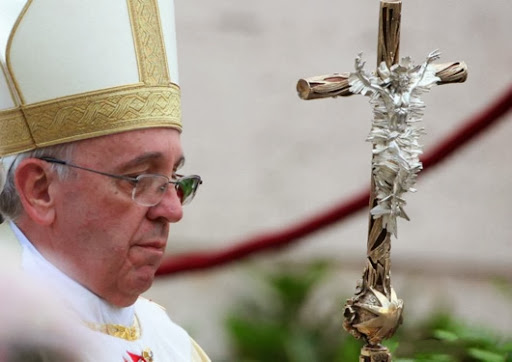
FrancisFerula3 zpsc3324b49

Imagine what the most offensive, sacrilegious and vile depiction of Jesus could be. Now look at the staff (a “ferula”) that Pope Francis holds in the above photo. Is that what you expected? I hope not, but if you googled “pope francis new ferula,” all you’d find is outrage, offence and adjectives like “misconceived,” “bizarre,” “ugly,” “offensive,” “nasty” and “profane.” Not only would these be outliers further down the search results, but it would be literally all you’d find – and I spent a couple of days trying to find anything positive at all about this new liturgical object used by Pope Francis.

So, why is it that this staff causes so much offense? If you abstract away the, sadly, harsh language of the reactions published so far, by sources who self-apply the “traditionalist” label, the root of the outrage is the depiction of the risen Christ instead of the crucified one. In most cases this is presented as being self-evidently an aberration, and one of the sources points to an encyclical by Pope Pius XII and quotes the following fragment:

““…one would be straying from the straight path … were he to order the crucifix so designed that the divine Redeemer’s body shows no trace of His cruel sufferings” (Pius XII, Encyclical Mediator Dei, par. 62).”

When I saw this, I immediately thought: “Great! Finally something specific and something that is likely to be usable against the new staff’s detractors.” As with most fanatics, their quoting of scriptures or other texts tends to be very selective and even just the immediate neighborhood of their snippets is likely to be their undoing. The same scenario applies here, if you look at the expanded quote below, still just staying within paragraph 62 and the opening sentence of paragraph 63 of Pius XII’s Mediator Dei:

“Assuredly it is a wise and most laudable thing to return in spirit and affection to the sources of the sacred liturgy. For research in this field of study, by tracing it back to its origins, contributes valuable assistance towards a more thorough and careful investigation of the significance of feast-days, and of the meaning of the texts and sacred ceremonies employed on their occasion. But it is neither wise nor laudable to reduce everything to antiquity by every possible device. Thus, to cite some instances, one would be straying from the straight path were he to wish the altar restored to its primitive tableform; were he to want black excluded as a color for the liturgical vestments; were he to forbid the use of sacred images and statues in Churches; were he to order the crucifix so designed that the divine Redeemer’s body shows no trace of His cruel sufferings […] Clearly no sincere Catholic can refuse to accept the formulation of Christian doctrine more recently elaborated and proclaimed as dogmas by the Church, under the inspiration and guidance of the Holy Spirit with abundant fruit for souls, because it pleases him to hark back to the old formulas.”

Before looking at the point about crucifixes that vexes Francis’ detractors, let’s just look at Pius XII’s categorical denunciation of traditionalism! The Holy Spirit is constantly active in the Church and more recent elaborations of teaching supersede older ones. By his own words, Pius XII is setting the scope of his own teaching to expire upon being superseded by that of his successors, so even if his words had been in conflict with Francis’ staff, Francis actions would take precedent and would do so by Pius XII’s own teaching.

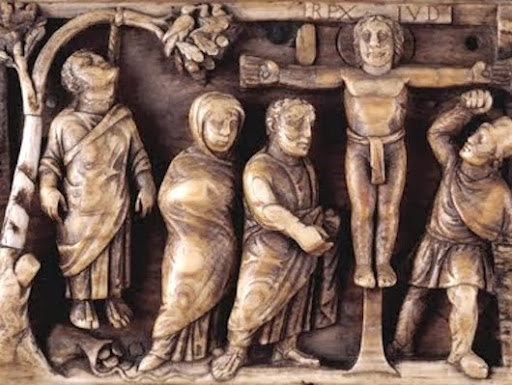
Now, let’s think about what Pius XII actually said about crucifixes, where he objects to them being “so designed that the divine Redeemer’s body shows no trace of His cruel sufferings.” Is he saying that the risen Christ mustn’t be depicted? Not at all. Only that the corpus shall show the traces of crucifixion torture, which early crucifixes did not show. Up until the early 5th century, only crosses and not crucifixes (i.e., crosses with a corpus) were used – and even those only sparsely. The next period then saw depictions of Jesus’ body on crosses, but in the form of unrealistic representations, like the following one, which is among the earliest ones:

Crucifixion earliest narrative rep ivory casket 420 30 rome brit museum

Here Jesus is upright, looking ahead, showing strength. What is Pius XII saying though? That our 5th century brothers and sisters were “straying from the straight path”? Certainly not! Only that if we imitated them in the misguided belief of the past having been a truer, purer, more genuine Christianity, we would be the ones straying and denying the Holy Spirit.

So, my reading of Pius XII is that we are to be open to the Holy Spirit now and that he underlined the importance of depicting the signs of the crucifixion horrors in crucifixes. Let’s now take a closer look at Francis’ new staff – the “crux gloriosa” and examine more closely the choices made by its author, the Roman sculptor Maurizio Lauri:

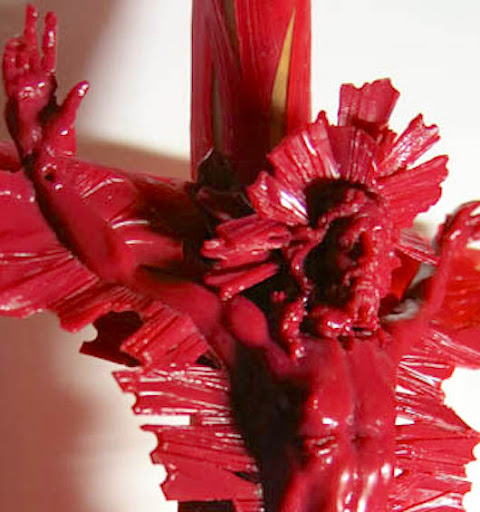
Papa francesco croce cimasa cera 3

From the above wax cast of the staff, it can clearly be seen that Jesus’ body bears the “trace[s] of His cruel sufferings” – his wrists are pierced,1 his side shows a swollen stab wound, his hands look mangled. This is not the Christus victor depiction of the first nine centuries, but instead a form that incorporates the “Christus mortuus” features whose importance Pius XII insisted upon too.

I believe the crucifix on Pope Francis’ new ferula displays a great degree of continuity with the last two millennia of depicting Jesus’ passion (incidentally, in a particular way with the San Damiano cross through which St. Francis heard Jesus speak to him). While clearly showing that Jesus’ execution on the cross was barbaric and crushing, it also depicts the inexorable link between this suffering, which Jesus underwent out of love, and the resurrection that followed it and that engenders mercy, hope and joy. Rather than in any way negating the monumental scale of Jesus’ suffering, the Lauri ferula projects it towards the resurrection that followed His excruciating death. It seems to me like Lauri was giving form to St. Paul saying: “we do see Jesus crowned with glory and honor because he suffered death” (Hebrews 2:9).

Finally, I have also been struck by the provenance of the materials used for making the Lauri ferula. The staff and crucifix atop it are made of mahogany, bronze and silver, where the metals were mined by Goldlake – an Italian company operating in Honduras and working to explicitly ethical standards, in partnership with local churches in both countries. During the presentation of the ferula to Franics, the CEO of Goldlake – Giuseppe Colaiacovo, explained: “Your holiness […] we would like to present you with this object, made from the materials of the earth, which therefore are poor materials, but which then become transformed by the artistic spirit.” Not only do I see a tremendously orthodox and historically grounded theology behind the form of the ferula, but its material provenance itself bears a positive message in itself.


1 A fact worthy of note by itself, since it is in agreement with recent research that shows how Jesus was nailed to the cross not by his palms, as is typical in depictions of the crucifixion, but by his wrists.

Divorced from reality

Simulacrum

[Warning: long read, again :)]1

Starting this post is turning out to be more difficult than I anticipated, so, please, forgive my meta-cop-out for its opening line. I have now deleted four alternative openings – all failed attempts at arriving at the question that has been occupying me during the last several weeks. In fact, as framing the question (which tends to be halfway to answering it anyway) is the problem, I’ll tell you about its history for me instead.

One of my very best friends, SH, has once asked me (during the course of about a year’s worth of the most fantastic, enlightening – at least for me – and profound conversations) whether he, an agnostic, ought to want to believe in God. My immediate intuition at the time – and a view I still hold – was: “No.” I felt that it would be insincere to make oneself want to believe (if such a thing were even possible) and I was instead convinced that my friend was already living a life that was following Jesus’ example and if he were to become a believer it would not be as a result of setting out to do so. Put in other terms, I was not worried about my fiend and in fact considered him to be an example to me in orthopraxy (even with his lack of orthodoxy). This is the first marker in the landscape I would like to sketch out for you – an agnostic who lives by the Gospel.

Next, I’d like to bring in another strand that leads to my central question today. For a long time now I have felt a keen sense that the Church (i.e., me included!) must be open to all, welcoming of all, transmitting what Pope Francis refers to as the “warming of hearts” that Jesus’ presence effects. As a consequence, I have been very pleased by the Church’s openness towards atheists and agnostics (e.g., see Franics’ letter to Scalfari), by Her fresh attempts at engaging with homosexual persons (e.g. in Francis’ interview with Jesuit magazines) and by Her apparent concern for all who today are at Her periphery, including divorced and re-married persons (e.g., see Francis’ impromptu interview during the flight back from the Rio World Youth Day). All of this is a great source of joy to me and its opposites, which sadly still exist in the Church, pain me.

The third strand that leads to what I would like to talk about today is the perennial tension in the Church between safeguarding Jesus’ original, explicit teaching and listening to the Holy Spirit’s ever-new guidance in every present moment. Being a Christian is not about taking a piece of 2000-year-old text and solitarily reading it as a self-help book. Instead, it is membership in a body that has Jesus as its head and a vast throng of individuals – both alive today and already past their earthly pilgrimage – as its members. Starting from the apostles themselves, who saw, touched and lived with Jesus, through their followers and their followers’ followers down to the present day, this body – animated by the Holy Spirit – is the Church through whom Jesus walks the Earth today. What Jesus’ message is in 2013, is to be found here – in the Church. This means both that it is alive and dynamic and that it is – simultaneously – the same, one message that Jesus shared with his followers 2000 years ago: love your neighbors as yourself and God above all else (cf. Mark 12:30-31), give your life for your friends (John 15:13), feed the hungry, quench their thirst, clothe the naked, welcome strangers, visit prisoners (cf. Mathew 25:35-36), be peacemakers, merciful, meek (cf. Matthew 5:3-12), be shrewd as serpents and innocent as doves (Matthew 10:16).

The fourth strand is another tension that is part of the very fabric of the Church: Her perfection set against the flaws and failings of Her members. Here it is neither my weakness that makes aiming high futile, nor the holiness of Jesus that makes Him inaccessible. Instead I can choose to allow God’s love into my life without deluding myself into taking credit for its effects or thinking of myself as superior in any way. Dr. Sylvie Barnay put this beautifully in the opening chapter of the book “La grande meretrice” (co-authored with 6 other female historians and looking at the history of the criticisms typically leveled at the Church):2

“The Church remains […] on a journey towards sanctity, a sinner by nature, with the potential for being made perfect by grace. She is therefore neither the Church of the pure, nor a prostitute Church. She is the human Church who hopes to become divine.”

The fifth strand then is a specific confluence of the above four and gets at the specific topic that triggered this post: the challenge of how a person who got married, divorced and then (civilly) re-married participates in the life of the Church. They are not free to receive the Eucharist in the Catholic Church, since they are in a state inconsistent with the indissolubility of marriage that Jesus himself taught explicitly and categorically. As such they don’t live according to, or share with the Church in terms of, an important aspect of what it means to follow Jesus. As a consequence they cannot participate in the sacrament that is both the expression of and means to the unity of the Church. This is a very painful situation for remarried divorcees who desire union with the Church in its most profound gift – the Eucharist – as it is for the whole Church, and Pope Francis has dedicated the first synod of bishops of his pontificate to it and the topic of the pastoral care of families in general.

Francis’ attention to the suffering of remarried divorcees has already lead to a lot of discussion and even to the misinterpretation of a German diocese’s contribution to this discussion as an actual permission for remarried divorcees to receive the Eucharist (immediately followed by the Vatican calling for patience ahead of the coming synod). A couple of days later, Archbishop Müller (head of the Congregation for the Doctrine of the Faith) published an extensive treatise on the subject in L’Osservatore Romano. The gist of the argument is a categorical “no” to the idea of remarried divorcees receiving the Eucharist, and not only that, but a systematic closing-down of a number of potential counter-arguments and loop-holes. Müller essentially says: marriage is indissoluble as Jesus himself told us so directly and unambiguously. As such, those who act as if the sacrament of marriage were dissoluble are objectively at odds with the Church and can not participate in the sacrament that “effects and signifies” Her unity.

At first I was quite puzzled by Müller’s piece (while simultaneously being hugely impressed by the beauty of the argument’s exposition and the clarity of his thinking!) – not because I disagreed with it, on the contrary, everything he says is (as befits his job) highly orthodox and I am in full agreement with him, but because it – prima facie – flies in the face of Francis’ consistent message on this subject.

As is often the case with at-first-sight appearances, there is typically more beneath the surface. As I read Müller’s arguments, I started realizing what he is doing – he is crystalizing what the sacrament of marriage is, exposing its rock-solid foundations and being categorical about its value and centrality to Jesus’ teaching. Between the lines I hear him insisting: “The sacrament of marriage is indissoluble. Don’t look for answers to warming the hearts of remarried divorcees here. Look elsewhere!” To come up with an innovative solution, which the next synod will be devoted to and on which I believe both him and Francis are already at work, it is first essential to ensure that we don’t throw out the baby with the bath water, that we don’t dilute Jesus’ teaching and the immeasurable treasures it contains.

In fact, reading Müller more closely also shows that he is very much concerned for remarried divorcees and for all at the Church’s periphery:

“Clearly, the care of remarried divorcees must not be reduced to the question of receiving the Eucharist. It involves a much more wide-ranging pastoral approach, which seeks to do justice to to the different situations. It is important to realize that there are other ways, apart from sacramental communion, of being in fellowship with God. One can draw close to God by turning to him in faith, hope and charity, in repentance and prayer. God can grant his closeness and his salvation to people on different paths, even if they find themselves in a contradictory life situation.”

Far from just slamming a door shut, Müller calls for a broader view of the situation, which is also in line with another of Pope Francis’ hints on the subject. In his interview on the flight from Rio he quoted his predecessor in Buenos Aires, Cardinal Quarracino, as saying: “I consider half of today’s marriages to be invalid because people get married without realising it means forever. They do it out of social convenience, etc …” In other words, the sacrament of marriage is indissoluble, but not all that looks like sacramental marriage is – or indeed ever was – sacramental marriage. In light of this angle, Müller’s demarcation of marriage and reinforcement of its absolute indissolubility make great sense, as part to a new approach to determining whether in a given instance marriage was ever entered into or not.

I have to say I feel greatly encouraged by all of the above developments and by other statements that Pope Francis has made recently, underlining the sacramental, vocational nature and profound value of marriage. In fact, speaking to a group of young people in Assisi about a month ago, he was very explicit: “[Marriage] is a true and authentic vocation, as are the priesthood and the religious life.” I wholeheartedly agree, but I also think that this statement points to an elephant in the room: if marriage is a vocation like the priesthood and religious life, how come there is such a vast gap between how one prepares for it versus the other vocations. Entering a religious order involves years spent in preparation, passing through various forms of novitiate, being followed by a spiritual director, with the outcome not being a guaranteed admission to the order. Preparation for the priesthood is equally lengthy, with years of study, practical and spiritual preparation and discernment being exercised both by the candidate and the Church’s hierarchy. Marriage instead can be had within a matter of weeks (months at most – if we include the challenges of booking the reception venue :|) and after attending a variable number of “preparation” sessions with a total duration in single digit hours. Yet, once the sacrament is enacted, it is binding for life! No surprise that great suffering can come from such a lopsided and inadequate process.

I clearly don’t mean to say that no couple properly prepares for the sacrament of marriage, since I know many who have, but only that if it does, it is so independently of the marriage preparation provided by the Church. Maybe it would be better for fewer marriages to be entered into and for these to be the result of a couple’s response to a call from God to follow Him as a family, instead of the easy access + heavy penalties model in place today. While writing this, I hear alarm bells in my head though, reminding me that it is imperative for the Church to be open and welcoming to all and the challenge remains of how to achieve such openness while following the path Jesus has shown us.


1 Many thanks to my überbestie, PM, for the great chats we have had about this and related topics.
2 The crude translation from Italian here is all mine, as the book is, sadly, not available in English.

The tyranny of absolutism

Stalin

Walking home this evening I felt like Douglas Hofstadter may have felt when coming up with the central idea of his spectacular Gödel, Escher, Bach book. Unlike his realization about a “golden braid” linking the thoughts of Kurt Gödel, M. C. Escher and Johann Sebastian Bach, which all shed light on infinity, I felt like I saw a way to connect the seemingly opposed words of Popes Benedict XVI and Francis with regard to relativism.

Benedict XVI famously attacked relativism in his sermon during the opening mass of the conclave that elected him, saying:

“To have a clear faith, according to the creed of the Church, is often labeled as fundamentalism. While relativism, that is, allowing oneself to be carried about with every wind of “doctrine,” seems to be the only attitude that is fashionable. A dictatorship of relativism is being constituted that recognizes nothing as absolute and which only leaves the “I” and its whims as the ultimate measure.”

The message here is very clear – the arbiter of truth and falsehood as well as good and evil has become the individual, with no intrinsic meaning left for these concepts beyond what each person chooses to invest them with for themselves. It is not only a relativity of meaning but also a solitude – I have my truth and you yours and that is the end of the story. In his book-length interview with Benedict XVI (“Light Of The World”), Peter Seewald, gets Benedict to elaborate on the above idea, when he says:

“It is obvious that the concept of truth has become suspect. Of course it is correct that it has been much abused. Intolerance and cruelty have occurred in the name of truth. To that extent people are afraid when someone says, “This is the truth”, or even “I have the truth.” We never have it; at best it has us. No one will dispute that one must be careful and cautious in claiming the truth. But simply to dismiss it as unattainable is really destructive.

A large proportion of contemporary philosophies, in fact, consist of saying that man is not capable of truth. But viewed in that way, man would not be capable of ethical values, either. Then he would have no standards. Then he would only have to consider how he arranged things reasonably for himself, and then at any rate the opinion of the majority would be the only criterion that counted. History, however, has sufficiently demonstrated how destructive majorities can be, for instance, in systems such as Nazism and Marxism, all of which also stood against truth in particular.

[…] That is why we must have the courage to dare to say: Yes, man must seek the truth; he is capable of truth. It goes without saying that truth requires criteria for verification and falsification. It must always be accompanied by tolerance, also. But then truth also points out to us those constant values which have made mankind great. That is why the humility to recognize the truth and to accept it as a standard has to be relearned and practiced again.”

Essentially, Benedict says that just because we cannot possess the truth, it does not mean that “the” truth does not exist. Our access to it is imperfect and tolerance and caution are called for, but denying its existence (just because of our epistemological constraints) is a dangerous path to follow. The picture from the above is very clear – relativism (making one’s “I” the ultimate arbiter of truth) is a tyranny and a reliance of one’s self is dangerous.

Fast-forward to this morning’s interview1 with Pope Francis talking to Eugenio Scalfari and take a look at what he has to say on the subject:

“Scalfari: Your Holiness, is there is a single vision of the Good? And who determines it?

Francis: Each of us has their own vision of Good and also of Evil. We have to encourage him to proceed towards that which he thinks is Good.

Scalfari: Your Holiness, you have already written it in the letter you addressed to me. Conscience is autonomous, you said, and everyone must obey their own conscience. I think that’s one of the most courageous passages spoken by a Pope.

Francis: And I repeat it here. Each one has their own idea of Good and of Evil and must choose to follow Good and fight Evil as they understand them. This would suffice to make the world a better place.”

“Each one has their own idea of Good and Evil […] as they understand them.” But, this sounds precisely like the relativism (the “I” being arbiter of truth) that Benedict denounced and declared a destructive danger. Are Francis and Benedict disagreeing here? Is Francis changing Church teaching?

I don’t think so. Instead, I believe, that their apparent opposition flows from the different perspectives from which they speak about truth and good and evil. Benedict describes what you’d see from God’s perspective: truth is absolute and denying its existence and substituting one’s whims for it, just because humans can’t access it, is a mistake. Francis, instead looks at the picture from the perspective of the individual: trust your conscience’s discernment between good and evil and choose good. Each human has a conscience by means of which they can discern (to varying degrees of faithfulness – “At present we see indistinctly, as in a mirror” as St. Paul says in 1 Corinthians 13:12) a reflection of the absolute truth. It is the same landscape, but Benedict looks down from the mountaintop while Francis looks up from the valley.

Applying this to myself, I can simultaneously believe in absolute truth and goodness, while being aware of my own inability to grasp them fully (or even with a known level of (in)accuracy). This epistemic constraint in no way undoes the meaningfulness of pursuing goodness and truth and instead makes tolerance and dialogue necessary. It also means that – as Francis said in the same interview – “Proselytism is pompous foolishness that has no sense. We must get to know each other and listen to each other and grow our understanding of the world around us.” I believe we are all accessing fragments of the one Truth,2 which makes me want to know what you have understood as much as deepening my understanding of my own faith.


1 The English translation sadly has some serious issues at the time of this post’s writing (the tile itself being seriously mistranslated), as a result of which I started from it but made adjustments based on reading the Italian original.
2 This is consonant with Francis saying, still in this same interview that “I believe in God. Not a Catholic God, there is no Catholic God, there is God.”

Just war?

Ploughshares

[Warning: long read :)]

Jesus was a pacifist. To deny this in the face of his own words – “But I say to you, whoever is angry with his brother will be liable to judgment.” (Matthew 5:22), “But I say to you, love your enemies, and pray for those who persecute you.” (Matthew 5:44), “But I say to you, offer no resistance to one who is evil. When someone strikes you on (your) right cheek, turn the other one to him as well.” (Matthew 5:39) and “Put your sword back into its sheath, for all who take the sword will perish by the sword.” (Matthew 26:52) – would be sheer dishonesty.

How about the Church though, has it stuck to Jesus’ pacifist position? Let’s see what it says in the Catechism:

“(§2304) Respect for and development of human life require peace. Peace is not merely the absence of war, and it is not limited to maintaining a balance of powers between adversaries. Peace cannot be attained on earth without safeguarding the goods of persons, free communication among men, respect for the dignity of persons and peoples, and the assiduous practice of fraternity.

(§2307) The fifth commandment forbids the intentional destruction of human life. Because of the evils and injustices that accompany all war, the Church insistently urges everyone to prayer and to action so that the divine Goodness may free us from the ancient bondage of war.

(§2308) All citizens and all governments are obliged to work for the avoidance of war. However, “as long as the danger of war persists and there is no international authority with the necessary competence and power, governments cannot be denied the right of lawful self-defense, once all peace efforts have failed.” (Gaudium et Spes, 79 § 4)

(§2309) The strict conditions for legitimate defense by military force require rigorous consideration. The gravity of such a decision makes it subject to rigorous conditions of moral legitimacy. At one and the same time:

  • the damage inflicted by the aggressor on the nation or community of nations must be lasting, grave, and certain;
  • all other means of putting an end to it must have been shown to be impractical or ineffective;
  • there must be serious prospects of success;
  • the use of arms must not produce evils and disorders graver than the evil to be eliminated.

The power of modern means of destruction weighs very heavily in evaluating this condition. These are the traditional elements enumerated in what is called the “just war” doctrine. The evaluation of these conditions for moral legitimacy belongs to the prudential judgment of those who have responsibility for the common good.

(§2314) “Every act of war directed to the indiscriminate destruction of whole cities or vast areas with their inhabitants is a crime against God and man, which merits firm and unequivocal condemnation.” (Gaudium et Spes, 80 § 3)”

While the above does talk about circumstances under which war is justified, it is a last resort, acceptable under the simultaneous satisfaction of specific conditions listed above, and has self-defense as its purpose, with indiscriminate destruction and the devastating effects of modern means of warfare ringing alarm bells. During the progress of such self-defense (the only possible trigger for just military action), the Catechism further emphasizes that “The Church and human reason both assert the permanent validity of the moral law during armed conflict. “The mere fact that war has regrettably broken out does not mean that everything becomes licit between the warring parties.” (Gaudium et Spes, 79 § 4)” and proceeds to warn against the abuses so endemic in war and against the accumulation of arms. Finally, the Catechism draws attention to the root causes, of which war can be a symptom, and calls for their treatment:

“(§2317) Injustice, excessive economic or social inequalities, envy, distrust, and pride raging among men and nations constantly threaten peace and cause wars. Everything done to overcome these disorders contributes to building up peace and avoiding war.”

And Pope Francis, where does he stand? There can be no doubt here that he, like Jesus, is an absolute pacifist:

“War is madness. It is the suicide of humanity. It is an act of faith in money, which for the powerful of the earth is more important than the human being. For behind a war there are always sins. [… War] is the suicide of humanity, because it kills the heart, it kills precisely that which is the message of the Lord: it kills love! Because war comes from hatred, from envy, from desire for power, and – we’ve seen it many times – it comes from that hunger for more power.” (Homily at Domus Sanctae Marthae, 2 June 2013).

“We have perfected our weapons, our conscience has fallen asleep, and we have sharpened our ideas to justify ourselves. As if it were normal, we continue to sow destruction, pain, death! Violence and war lead only to death, they speak of death! Violence and war are the language of death! […]

My Christian faith urges me to look to the Cross. How I wish that all men and women of good will would look to the Cross if only for a moment! There, we can see God’s reply: violence is not answered with violence, death is not answered with the language of death. In the silence of the Cross, the uproar of weapons ceases and the language of reconciliation, forgiveness, dialogue, and peace is spoken. […]

violence and war are never the way to peace! Let everyone be moved to look into the depths of his or her conscience and listen to that word which says: Leave behind the self-interest that hardens your heart, overcome the indifference that makes your heart insensitive towards others, conquer your deadly reasoning, and open yourself to dialogue and reconciliation. Look upon your brother’s sorrow and do not add to it, stay your hand, rebuild the harmony that has been shattered; and all this achieved not by conflict but by encounter! […]

Let the words of Pope Paul VI resound again: “No more one against the other, no more, never! … war never again, never again war!” (Address to the United Nations, 1965).” (Prayer Vigil for Peace, 7 September 2013)

And Francis is not alone is his radical stance against war, Blessed Pope John Paul II said that “War should belong to the tragic past, to history: it should find no place on humanity’s agenda for the future” and that “Humanity should question itself, once more, about the absurd and always unfair phenomenon of war, on whose stage of death and pain only remain standing the negotiating table that could and should have prevented it.” Benedict XVI too was clear about war being a failure: “War, with its aftermath of bereavement and destruction, has always been deemed a disaster in opposition to the plan of God, who created all things for existence and particularly wants to make the human race one family.”

So, you may ask, what is the point of writing about the attitude of Jesus, the Church and recent popes with regard to war, when it is so obviously pacifist and admitting of military self-defense only under almost theoretical, extreme conditions and applying to specific parts of an armed conflict? Sadly there are other, vocal proponents of a very different take on this topic, who – to my mind unbelievably – present their positions as Catholic and who tend to trace them to statements like the following one by George Weigel, who feels supported by Sts. Augustine and Thomas Aquinas:

“Thus those scholars, activists, and religious leaders who claim that the just war tradition “begins” with a “presumption against war” or a “presumption against violence” are quite simply mistaken. It does not begin there, and it never did begin there. To suggest otherwise is not merely a matter of misreading intellectual history (although it is surely that). To suggest that the just war tradition begins with a “presumption against violence” inverts the structure of moral analysis in ways that inevitably lead to dubious moral judgments and distorted perceptions of political reality.”

With Jesus and the Church’s position having been stated with such force and clarity over the last decades, I won’t even go to the trouble of addressing positions like Weigel’s point-by-point and would just like to note that they are akin to reading St. Paul and arguing in favor of slavery today. Positions that may be textually consistent with the source they claim justifies them, but that both miss the original author’s intentions (just think about what slavery would be like if “master” and “slave” followed St. Paul’s advice1) and the fact that the Church is the living Mystical Body of Jesus that has considerably matured over the last 2000 years.


1 “Slaves, be obedient to your human masters with fear and trembling, in sincerity of heart, as to Christ, not only when being watched, as currying favor, but as slaves of Christ, doing the will of God from the heart, willingly serving the Lord and not human beings, knowing that each will be requited from the Lord for whatever good he does, whether he is slave or free. Masters, act in the same way toward them, and stop bullying, knowing that both they and you have a Master in heaven and that with him there is no partiality.” (Ephesians 6:5-9) A classic “infiltrate and destroy from within” tactic if ever I saw one.

Benedict XVI – Odifreddi: searching for Truth, with gloves off

Boxing gloves

[Warning: long read :)]1

If you are even remotely interested in the dialogue between faith and reason, between religion and science, the last fortnight has to be among the most electrifying periods in the history of mankind. Not only did it kick-off with the beautifully sincere and profound move by Pope Francis in his letter to the atheist journalist Eugenio Scalfari, but it saw the publication of “the” interview that Pope Francis gave to Jesuit media and in which he spoke about science in terms that, to my mind, take the Church’s appreciation of science further than ever before. And if that wasn’t enough, today saw the publication of extracts from an 11-page letter that Pope Emeritus Benedict XVI wrote to the Italian atheist mathematician Prof. Piergiorgio Odifreddi, in response to his book “Caro Papa ti scrivo: Un matematico ateo a confronto con il papa teologo” (“Dear Pope, I write to you: An atheist mathematician confronting the theologian pope”).

Looking at the two letters (or, more precisely, the extracts from Benedict’s versus the full text of Francis’), Francis’ and Scalfari’s style is like a polite, yet illuminating, exchange between two gentlemen over a cup of tea, while Benedict’s and Odifreddi’s exchange is like a bare-knuckle fist-fight between a pair of prize-winning boxers who in the end sincerely shake hands and respect each other, but without giving an inch during the fight itself.

To begin with, let’s take a quick look at Odifreddi’s opening move – his 204-page book, addressed to Benedict as “between colleagues” – from a maths to a theology professor. Early on, Odifreddi identifies a point in common with Benedict’s thought, by pointing to the following passage from Benedict’s Regensburg address:

“the experience […] of the fact that despite our specializations which at times make it difficult to communicate with each other, we made up a whole, working in everything on the basis of a single rationality with its various aspects and sharing responsibility for the right use of reason”

While Odifreddi identifies this – the adherence to reason – as a common point of departure, he quickly objects to Benedict’s excessive use of it (“your almost obsessive use of the word “reason,” repeated around forty times, akin to a musical motif or continuous base”) and to the “scandalous” words from Benedict’s sermon before the conclave that elected him:

“[H]aving a clear faith based on the Creed of the Church is often labeled as fundamentalism. Whereas relativism, that is, letting oneself be “tossed here and there, carried about by every wind of doctrine”, seems the only attitude that can cope with modern times. We are building a dictatorship of relativism that does not recognize anything as definitive and whose ultimate goal consists solely of one’s own ego and desires.”

While being critical of Benedict’s words, Odifreddi argues that “both religion and science are perceived as antidemocratic and absolutist” as a result of their focus on “ultimate truths” and then proceeds to arguing against a series of passages from Benedict’s “Introduction To Christianity” and his Jesus of Nazareth trilogy.

Since it is the full, fine detail that is key to understanding the nature of what is going on between Odifreddi and Benedict, let me just pick out a single point of contention (from among many important and interesting ones that I hope to return to soon!),2 which Benedict objected to most forcefully and which the following passage from Odifreddi’s book sums up nicely:

“There is little to say about the historical Jesus, literally, because there are virtually no traces of him in the official history of the period. In total, there are only few tens of lines about him in the works of Pliny, Tacitus, Suetonius and Flavius Josephus. Some are of uncertain interpretation, like the “Chrestus” of Suetonius. Others are of dubious authenticity, like the interpolation of Flavius Josephus. […] If, therefore, Jesus truly existed, he must have been irrelevant to his contemporaries, beyond the narrow circle of his relatives, friends and followers.”

Odifreddi further accuses Benedict of side-stepping questions of fact by saying to him: “you seem uninterested in (or seem interested in not) discussing the historicity of the Gospels and the facts that they report” and attributes to him an opposition to historical-critical methods of Biblical interpretation, by quoting Benedict as saying that they “can effectively become an instrument of the Antichrist.”

Benedict’s response here is as sharp as the jab he received:

“What you say about the figure of Jesus is not worthy of your scientific status. If you put the question as if nothing were, ultimately, known about Jesus, as a historical figure, as if nothing were ascertainable, then I can only firmly invite you to become more competent from a point of view of history. To this end I particularly recommend to you the four volumes that Martin Hengel (exegete at the Protestant Faculty of Theology of Tübingen) has published with Maria Maria Schwemer: it is an excellent example of historical precision and of vast breadth of historical information. […] Further I have to forcefully reject your affirmation (pp. 126) according to which I have presented historical-critical exegesis as an instrument of the Antichrist. Discussing the account of Jesus’ temptations, I have only recalled Soloviev’s thesis, according to whom historical-critical exegesis may also be used by the Antichrist – which is an unquestionable fact. At the same time, however, I have always – and in particular in the foreword to the first volume of my book on Jesus of Nazareth – made it evidently clear that historical-critical exegesis is necessary for a faith that does not propose myths using historical images, but demands true historicity and therefore has to present historical reality in its affirmations also in a scientific way. Because of this, it is not correct either that you say that I have been interested only in meta-history: on the contrary, all my efforts have had as their objective to show that the Jesus described in the Gospels is also the real, historical Jesus; that it is a matter of history that really took place.”

Uff … I have to be honest and admit that I was at first a bit uneasy about the tone of both Odifreddi and Benedict, neither of whom are pulling punches and both of whom are blunt to say the least. Looking more closely though, and reflecting on my professional experience as a scientist, I recognize that this is the tone and strength of academic argument and doing anything less would be dishonest on the part of both the professor and the ex-professor. This is a very different context from the Francis-Scalfari one and it demands the unforgiving rigor, precision and detail of the quotes shown above. Treating Benedict like any other academic shows Odifreddi’s respect for him (which he is explicit about when saying “Having read his Introduction to Christianity, […] I realized that the faith and doctrine of Benedict XVI, unlike that of others, were sufficiently solid and fierce that they could very well face and sustain frontal attack.”) Benedict is equally complimentary about Odifreddi, when he tells him that he “considers very positively the fact that you […] have sought such an open dialogue with the faith of the Catholic Church and that, in spite of all the differences, in the central themes, there is no lack of convergence at all.”

What this, academic, dialogue is truly about is put best – and to my mind beautifully lucidly – by Odifreddi, who says that:

“[The aim], obviously, was not to try and “convert the Pope,” but instead to honestly present to him the perplexity, and at times incredulity, of a mathematician with regard to faith. Analogously, the letter from Benedict XVI does not try to “convert the atheist,” but to direct at him his own, honest, symmetrical perplexity, and at time incredulity, of a very special believer with regard to atheism. The result is a dialogue between faith and reason, which, as Benedict XVI notes, has allowed both of us to confront each other frankly, and at times also bluntly, in the spirit of the Courtyard of the Gentiles that he himself has initiated in 2009. […] Divided in almost everything, but joined by at least one objective: the search for Truth, with a capital “T”.”

Wow! I have to say I am very impressed with Odifreddi (having come to this clearly as Benedict XVI fan) and I look forward to seeing his next steps in this full-contact dialogue. In many ways, I believe, that the most important thing to take away from this first encounter is the seriousness and complete transparency, with which both parties approached the challenge of dialogue – a dialogue that is not a watering-down or a “playing nice” but a striving for Truth, regardless of how vast the abyss may appear between its opposing cliffs. It would be a mistake to get stuck on whether I happen to agree with one side or the other, as it would miss the masterclass in serious dialogue that we have just witnessed. In many ways, I read Odifreddi’s closing thoughts as a transposition – from an intra-Christian to a Christian-atheist setting – of Francis’ call to an ecumenism that starts now, while there are clear differences between the parties, when he says in “the” interview: “We must walk united with our differences: there is no other way to become one. This is the way of Jesus.”


1 Apologies, again, for the rough translation from Italian – once “official” translations are available, I’ll point you to them.
2 I can’t not mention the following zinger from Benedict, which points to the widespread use of “science fiction” in science, in response to Odifreddi’s claiming that it was religion that practiced the genre. Benedict here says, referring to Heisenberg and Schrödinger’s theories, and adding Dawkins’ “selfish gene” to the list, that “I’d call them “science fiction” too, in the good sense: they are visions and anticipations, to arrive at true knowledge, but they are, indeed, only imagination with which we try to get closer to reality.” 🙂 I agree and I’ll definitely pick this line up in a future post.

Science grows Church’s understanding

350px God the Geometer0

As was immediately clear from a first reading, “the” interview given by Pope Francis last Thursday to Jesuit magazines is a text rich both in spiritual and intellectual treasures and will be a prominent trigger of reflection for a long time to come.

Today I’d like to take a closer look at a passage from it that has immediately caught my eye, but that received little attention so far. It addresses the relationship between science and religion in a, to my mind, very positive way:

“[H]uman self-understanding changes with time and so also human consciousness deepens. Let us think of when slavery was accepted or the death penalty was allowed without any problem. So we grow in the understanding of the truth. Exegetes and theologians help the church to mature in her own judgment. Even the other sciences and their development help the church in its growth in understanding. There are ecclesiastical rules and precepts that were once effective, but now they have lost value or meaning. The view of the church’s teaching as a monolith to defend without nuance or different understandings is wrong.”

While the opposition between science and religion certainly does not apply to the Catholic Church – with Blessed Pope John Paul II’s landmark encyclical Fides et Ratio being a categorical statement of the mutual benefits of faith and reason and with Pope Benedict XVI having spoken of the necessity of dialogue between science and faith 1 – Francis’ positioning of science as “helping the church in its growth in understanding” is a significant move. Like with many of Francis’ statements, it could be argued that they contain nothing new (Fides et Ratio already saying that “science can purify religion from error and superstition”) or that they are only new in style – and in some sense that is true, since he is firmly rooted in the Church, but it would, I believe, also miss an important nuance.

While I have always read Fides et Ratio as positioning faith and reason as separate, but mutually “strengthening” entities,2 here I see Francis presenting theology and science as two activities whose results both help the Church, the former leading to mature judgment while the latter resulting in increased understanding. This is a picture that does not place theology in a privileged, internal position with regard to the Church, and science as an external, while admittedly positive, activity, but positions both as engines of progress that deepen our humanity.3

While the above is clearly my reading and attempted unpacking of Francis’ condensed thought, I believe it is compatible with another of the important points he makes in “the” interview, namely that the Church is the “faithful people of God,”4 and that “‘thinking with the church’ [does not mean] only thinking with the hierarchy of the church,” that it “does not concern theologians only.” Seen in this way, “[t]he church is the totality of God’s people” and is therefore formed as much by theology as by science. Science becomes an internal concern of the Church – the People of God – and its advances and insights form her teaching from within.5 In many ways this also reminds me of Francis’ address to Brazil’s “leaders of society” during his visit in July, where he emphasizes that Christianity “combines transcendence and incarnation” and “faith and reason unite, the religious dimension and the various aspects of human culture – art, science, labour, literature…”

The above sketch, which I don’t believe I am bolting on to Francis’ thought, strikes me as a natural evolution of the solid foundations that John Paul II laid down, and I am curious to see whether it will find support in his future teaching.


0 I don’t mean to distract, but note the fractal in this 13th century illuminated illustration!
1 “In the great human enterprise of striving to unlock the mysteries of man and the universe, I am convinced of the urgent need for continued dialogue and cooperation between the worlds of science and of faith in the building of a culture of respect for man, for human dignity and freedom, for the future of our human family and for the long-term sustainable development of our planet. Without this necessary interplay, the great questions of humanity leave the domain of reason and truth, and are abandoned to the irrational, to myth, or to indifference, with great damage to humanity itself, to world peace and to our ultimate destiny.” (Pope Benedict XVI, Address To The Pontifical Academy Of Sciences, 8 November 2012)
2 As Lumen Fidei puts it in §32.
3 Echoing the affirmation in Fides et Ratio that “Men and women have at their disposal an array of resources for generating greater knowledge of truth so that their lives may be ever more human.”
4 The definition presented in Lumen Gentium, as Francis points out.
5 This is not a conflation of the two – theology and science – but a recognition of their equal import for the Church’s progress.