The devil

Liardet2

Beyond his great humility, simplicity, personal poverty, warmth and approachability, what struck me about Pope Francis have also been his frequent references to the devil. He mentioned him as early as his first full day in office and keeps bringing him up at least on a weekly, if not a more frequent, basis in his sermons.

Since the devil is not part of what consciously constitutes my spiritual life, I have at first just glossed over his mentions, but I am now growing curious about why it is that Francis so frequently refers to him. It is not that I have an issue with the devil being referred to – it is more that I just haven’t given him much thought. The Christianity I try to practice is about love rather than the avoidance of sin, about following Jesus rather than combatting the devil and about seeking to encounter goodness, truth and beauty rather than learning how to recognize evil. It is not that I don’t care about avoiding evil, but I believe that to be a necessary side-effect of seeking good.

The problem of evil is unquestionably challenging though and its manifestations in the world are a source of horror and sorrow for me, which does make me want to understand why it is that Francis speaks so often about the devil. In fact, I have been reading Steven Pinker’s excellent The Better Angels of Our Nature precisely for the sake of gaining a better understanding of how it is that we, humans, are capable of the shocking atrocities that we keep perpetrating on each other. While Pinker is certainly critical of religion and opposed to the idea of the devil, he makes two points that I think are relevant here: first, that “[we] need to make the case that [our inner demons] exist, because there is a resistance in modern intellectual life to the idea that human nature embraces any motives that incline us toward violence at all,”1 and second that “[violence] is not a single motive, let alone a mounting urge. It is the output of several psychological systems that differ in their environmental triggers, their internal logic, their neurobiological basis, and their social distribution.” In other words, Pinker argues both that there is a tendency to deny the ubiquity of the capacity for violence and that its origins and manifestations are complex.

These two points are in fact a great bridge from contemporary psychology and anthropology to the Church’s teaching about evil and the devil. In its most recent (1975) review of the subject of the devil, the Congregation of the Doctrine of the Faith starts with the same kind of realization as Pinker makes in the context of violence – that “the very existence of the devil is frankly called into question.” On the point of complexity too, it calls for caution and reason: “The many forms of superstition [and] obsessional preoccupation with Satan […] have always been condemned by the Church. […] Reserve and prudence are in fact demanded. [… O]ne must exercise discernment. And one must leave room for research and its findings.” Finally, it also dispells a potential misunderstanding, where the devil could be used as an excuse and a barrier to seeking scientific understanding: “It is clear that [the Church] has never allowed man to rid himself of his responsibility by attributing his faults to the devil. The Church did not hesitate to oppose such escapism when the latter manifested itself, saying with St. John Chrysostom: “It is not the devil but men’s own carelessness which causes all their falls and all the ills of which they complain.””

So, why is it that the Church speaks about the devil? By far the most obvious and compelling answer is that Jesus himself did so – calling him “tempter” (Matthew 4:3), “accuser” (Revelation 12:10), “father of lies” and “murderer” (John 8:44). Who is this devil though, whom Jesus speaks about? Jesus himself describes him as follows: “He was a murderer from the beginning and does not stand in truth, because there is no truth in him.” (John 8:44). Two things are important here: first, that the devil has been present “from the beginning,” which the Catechism explains by saying that ““[t]he devil and the other demons were indeed created naturally good by God, but they became evil by their own doing.” Scripture speaks of a sin of these angels. This “fall” consists in the free choice of these created spirits, who radically and irrevocably rejected God.” (§391-392). This means that the devil is God’s creature, rather than an equivalent but opposed being, which in turn leaves God as having created only what is good and the devil opposing him out of pride and his free choice. The second part of Jesus’ profile of the devil is equally key: the devil has “no truth in him” – his temptations are lies and the sufferings they lead to are a consequence of an opposition to the truth.

Coming back to Pope Francis, let me just pick out a couple of his references to the devil:

  1. In his very first sermon after being elected pope, Francis quotes the French poet Léon Bloy: “Whoever does not pray to God, prays to the devil.” I read this as him pointing to there being no middle ground between truth and falsehood.
  2. During one of his morning masses in the Domus Sanctae Marthae, he points to the seriousness of falsehood: “We are all sinners; all of us. We all commit sins. But calumny is something else. It is of course a sin, too, but it is something more. Calumny aims to destroy the work of God, and calumny comes from a very evil thing: it is born of hatred. And hate is the work of Satan. Calumny destroys the work of God in people, in their souls. Calumny uses lies to get ahead. And let us be in no doubt, eh?: Where there is calumny, there is Satan himself.”
  3. On another occasion he places the impulse to gossip at the feet of the devil: “When we prefer to gossip, gossip about others, criticize others- these are everyday things that happen to everyone, including me – these are the temptations of the evil one who does not want the Spirit to come to us and bring about peace and meekness in the Christian community.”
  4. Finally, he also warns that “the devil, lead[s] us to believe that ghosts, fantasies, are reality,” again underlining how it is the absence of truth that is the root from which evil springs.

As you can see, the above is just my attempt to structure some first notes rather than an exposition of some clear insight. I am at the point of trying to begin to make sense of why it is that Francis keeps bringing up the devil and trying to understand why it is that Jesus, and subsequently the Church, speaks about him. The picture I am getting is one that certainly makes sense in the bigger context of creation and has the following as its core idea: The truth presented to a free recipient can be rejected out of pride, where subsequent lies result in evil and suffering. To have this rejection of the truth be the act of a creature, albeit spiritual, rather than “just” an abstract concept or principle is again consistent with the personal nature of the Trinity and the ultimate superiority of good to evil.


1 This reminded me of the following line from The Usual Suspects (delivered by the character Keyser Söze), which comes from Charles Baudelaire’s Le spleen de Paris: “The finest trick of the devil is to persuade you that he does not exist.”

Joy and humility, instead of rules and political correctness

Francis cast

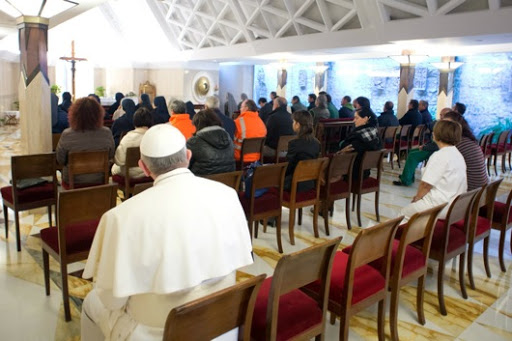
What would it be like if the Pope were just a simple parish priest, saying daily morning masses in a small side-chapel and addressing a few simple words to his small flock. Well, that is precisely what has been going on since around a month ago in the Domus Sanctae Marthae – the Vatican guest house, where Pope Francis choses to reside and where he says daily morning mass. He invites various small groups of Vatican employees and addresses short sermons to them that are always rooted in the mass readings of the day and that have an immediately accessible style. Reading excerpts from these short homilies has been a daily joy for me over these last weeks and I would here like to share my favorite bits with you. If you’d like to follow these very short sermons yourself, the quickest way is to look at the Vatican Radio website, where they get published a couple of hours after their delivery.

Instead of trying to be in any way comprehensive, let me just pick out a few gems and leave you to follow up on their context if you wish. First, here are a couple of excerpts that show Francis’ take on what it means to be a Christian:

  1. Wonder and joy: “Wonder is a great grace, the grace that God gives us in our encounter with Jesus Christ. It is something that draws us outside of ourselves with joy … it is not a mere enthusiasm like that of sports fans when their favorite team wins, but it’s something deeper. Of course we cannot live forever in a state of wonder, but it is the beginning which leads to spiritual consolation. It is the consolation of those who have encountered Jesus Christ.”
  2. God spray: “Faith is not an impalpable presence, like an essence of mist that spreads around without really knowing what it is. God is a concrete ‘Person,’ and therefore faith in Him comes from a living encounter, which we experience as tangible. We believe in God who is Father, who is the Son, who is the Holy Spirit. We believe in people, and when we talk to God we talk to People: I speak with the Father, with the Son or with the Holy Spirit. And this is the faith. But faith is a gift, the Father gives it. This faith that makes us strong, it makes us joyful, this faith that always begins with the encounter with Jesus.”
  3. Facing difficulties: “When there are difficulties, we need to look closely at them, and confront them and speak about them. But never hide them. We must not be afraid of problems: Jesus himself said to his disciples: ‘It is I. Do not be afraid’. In life’s difficulties, with problems, with new things that we must face: the Lord is always with us. We may make mistakes, certainly, but he is always with us and says: ‘You made a mistake, now get back on the right path.’ Masquerading life, disguising life, is not a very good way to behave: no no. Life is what it is, that’s the reality. It’s exactly as God wants it to be, or as God allows it to be, it is what it is, and we have to accept it as it is.”
  4. Gossip: “When we prefer to gossip, gossip about others, criticize others – these are everyday things that happen to everyone, including me – these are the temptations of the evil one who does not want the Spirit to come to us and bring about peace and meekness in the Christian community. These struggles always exist in the parish, in the family, in the neighborhood, among friends. Instead, keep quiet and if you have something to say, say it to the interested parties, to those who can remedy the situation, but not to the entire neighborhood.”
  5. Love instead of rules: “The Lord saves us by His love: not with a letter, nor with a decree, but with his love, a love so great that it led him to send his Son, who, became one of us, walked with us, and this saves us. We are worthy, we are men and women of hope: this is what it means to be saved by love. The problem is that sometimes we want to save ourselves, and we believe we can do it, for example basing our security on money – and we think: ‘I have money, I am secure, I have it all, there are no worries, I have dignity: the dignity of a rich person.’ This is not enough. Think of the parable of the Gospel, of the man who had the full granary, who said, ‘I’ll make another to get more, and then I’ll sleep soundly,’ and the Lord says, ‘You fool! This evening you will die.’ That salvation is wrong, it is a temporary salvation, it is also only apparent salvation.”
  6. Normality, not magic: “God does not act like a fairy with a magic wand. Rather, he gives grace and says, as he said to all those he healed, ‘Go, walk.’ He says the same to us: ‘Move forward in your life, witness to everything the Lord does with us.’ Triumphalism is not of the Lord. The Lord came to Earth humbly; he lived his life for 30 years; he grew up like a normal child; he experienced the trial of work and the trial of the Cross. Then, in the end, he rose from the dead. The life of the Christian consists of a normality that is lived daily with Christ.”
  7. Forgiveness: “St. Paul said that his glory was Christ crucified in his sins. Why? Because he, in his sins, found Christ crucified who forgave him. In the middle of the ‘night,’ the many ‘nights,’ the many sins that we commit, because we are sinners, there is always the embrace of the Lord that helps us say: ‘This is my glory. I am a poor sinner, but You are my Savior.’ We think of how nice it is to be saints, but also how nice it is to be forgiven.”
  8. Peace: “Even in the most painful tests, a Christian never loses the peace and presence of Jesus. With a little courage we can pray: ‘Lord, grant me this grace which is the hallmark of our encounter with you: spiritual consolation and peace.’ A peace that we cannot lose because it is ours, it is the Lord’s true peace that cannot be bought or sold. It is a gift from God.”

Francis also presents are very beautiful view of the Church, both by pointing to its treasures and by warning against its pitfalls:

  1. Taming the Holy Spirit: “The Holy Spirit upsets us because it moves us, it makes us walk, it pushes the Church forward. We wish to calm down the Holy Spirit, we want to tame it and this is wrong. The Holy Spirit gives us the strength to go forward but many find this upsetting and prefer the comfort of the familiar. Nowadays everybody seems happy about the presence of the Holy Spirit, but it’s not really the case and there is still that temptation to resist it. The Second Vatican council was a beautiful work of the Holy Spirit. But 50 years later, have we done everything the Holy Spirit was asking us to do during the Council? The answer is ‘No.’ We celebrate this anniversary, we put up a monument but we don’t want it to upset us. We don’t want to change and what’s more there are those who wish to turn the clock back. This is called stubbornness and wanting to tame the Holy Spirit. The same thing happens in our personal life. The Spirit pushes us to take a more evangelical path but we resist this.”
  2. Saints v. ideologues: “The Word of Jesus goes to the heart because it is the Word of love, it is a beautiful word and brings love, makes us to love. But, ideologues cut off the road of love, and also that of beauty. And when ideology enters into the Church, when ideology enters into our understanding of the Gospel, no authentic comprehension is possible. And these ideologues, on the road of duty, load everything on the shoulders of the faithful. The ideologues falsify the gospel. Every ideological interpretation, wherever it comes from – is a falsification of the Gospel. And these ideologues – as we have seen in the history of the Church – end up being intellectuals without talent, ethicists without goodness – and let us not so much as mention beauty, of which they understand nothing. Rather, the path of love, the way of the Gospel, is simple: it is the road that the Saints understood. The saints are those who lead the Church forward! The road of conversion, the way of humility, of love, of the heart, the way of beauty …”
  3. The Church dormant: “The early Christians had nothing but the power of baptism that gave them their apostolic courage, the strength of the Spirit. I think of us, the baptized: do we really have this strength – and I wonder – do we really believe in this? Is Baptism enough? Is it sufficient for evangelization? Or do we rather ‘hope’ that the priest should speak, that the bishop might speak … and what of us? Then, the grace of baptism is somewhat closed, and we are locked in our thoughts, in our concerns. Or do we sometimes think: ‘No, we are Christians, I was baptized, I made Confirmation, First Communion … I have my identity card alright. And now, go to sleep quietly, you are a Christian.’ But where is this power of the Spirit that carries us forward? We need to be faithful to the Spirit, to proclaim Jesus with our lives, through our witness and our words. When we do this, the Church becomes a mother church that produces children and more children, because we, the children of the Church, we carry that. But when we do not, the Church is not the mother, but the babysitter, that takes care of the baby – to put the baby to sleep. It is a Church dormant. Let us reflect on our Baptism, on the responsibility of our Baptism.”
  4. Mother, not domestic administrator: “We, the women and men of the Church, we are in the middle of a love story: each of us is a link in this chain of love. And if we do not understand this, we have understood nothing of what the Church is. The Church does not grow by human strength. Some Christians have gone wrong for historical reasons, they have taken the wrong path, they have raised armies, they have waged wars of religion: that is another story, that is not the story of love. Yet we learn, with our mistakes, how the story of love goes. But how does it increase? Jesus said simply: like the mustard seed, it grows like yeast in the flour, without noise. The Church is not just another organization: she is Mother. How would you feel if someone said: she’s a domestic administrator? ‘No, I am the mother!’ And the Church is Mother. And we are in the middle of a love story that continues thanks to the power of the Holy Spirit. All of us together are a family in the Church, who is our Mother.”
  5. Humility, not conquest: “The style of evangelical preaching should have this attitude: humility, service, charity, brotherly love. ‘But … Lord, we must conquer the world!’ That word, conquer, doesn’t work. We must preach in the world. The Christian must not be like soldiers who when they win the battle make a clean sweep of everything. The Christian proclaims the Gospel with his witness, rather than with words. As St. Thomas Aquinas says: “A great soul that is not afraid of great things, that moves forward towards infinite horizons, and the humility to take into account the small things.” This is divine, it is like a tension between the great and the small. The triumph of the Church is the Resurrection of Jesus. But there is first the Cross. Today we ask the Lord to become missionaries in the Church, apostles in the Church but in this spirit: a great magnanimity and also a great humility. So be it.”

Synthetic life: out of bounds or cause for optimism?

Synthetic dna s

Take bottles of the chemicals that constitute living organisms and by following a process that does not involve re-using parts of living beings arrive at a new, living creature. That would the the synthetic creation of life from scratch.1

The pioneer of this strand of scientific endeavor is the biologist Dr. J. Craig Venter, who was among the first to sequence the human genome, and who is now seemingly nearing the first synthetic creation of life from fully non-living components. A prequel to this upcoming breakthrough has been the 2010 insertion of synthetic, man-made DNA into a bacteria, which resulted in the first living organism with an entirely artificial genome. While this had elements of being synthetic life, it was only partially so and Dr. Venter’s team is continuing in their quest. Last year they then passed the landmark of the first software simulation of an entire organism, and only last month Dr. Venter announced that his team is close to creating a living being from scratch. Their initial aim is to use the process for positive ends by creating artificial life that can “eat pollution and generate energy.”

While the scientific achievement of synthesizing life would unquestionably be a huge success (and the steps taken by Dr. Venter’s team already are!), there are also important ethical questions to consider, with multiple experts offering their assessments, from among which I would just like to offer two perspectives, at first introduced only anonymously:

Statement A: “All available evidence goes to show that there is no unmediated passage from non-life to life. [… A]ll living beings receive their life from a principle outside themselves, which is itself capable of infusing life; this we call God.”

Statement B: “If it is used to promote the good, to treat pathologies, we can only be positive[. …] If it turns out not to be [used] to respect the dignity of the person, then our judgment would change. [… Dr Venter’s work is a] further sign of intelligence, God’s gift to understand creation and be able to better govern it.”

The first statement is a classic “God of Gaps” stance, infused both with a lack of scientific understanding (i.e., missing the importance of the steps already made towards synthetic life and underestimating the likelihood of their ultimate success) and with a mistaking of a purely philosophical construct for the personal God of Abraham, Jesus and the Church. Statement A’s god is banished into ever-narrower, farther-removed spheres and serves a strictly soulless, utilitarian end. This god is now a workaround for the specter of infinite causal chains and now for the magical-seeming wafer-thin sliver wedged between not-life and life. If you have read this blog, you will know where Statement A comes from, and if not then I just apologize that I will not revealed its source, which I have already afforded more than its fair share of publicity. All I will say is that it is taken from a “catholic” newsletter that is broadly distributed in the UK.

I believe the best way to show how un-Christian the above is, is to contrast it with what Pope Francis said during the sermon of last Thursday’s morning mass in the chapel of the Domus Sanctae Marthae, where he is staying and where he has been inviting various groups working at the Vatican to celebrate mass with him:2

“But who is this God you believe in? An ‘all over the place – god’, a ‘god-spray’ so to speak, who is a little bit everywhere but who no-one really knows anything about? We believe in God who is Father, who is Son, who is Holy Spirit. We believe in Persons, and when we talk to God we talk to Persons: or I speak with the Father, or I speak with the Son, or I speak with the Holy Spirit. And this is the faith.”

You can just picture it: a storeroom somewhere, with a spray bottle with “life” written on it in black Sharpie, a box on another shelf with the “first mover” label beginning to peel, a pair of jars in the corner – one labelled “irresistible force,” the other “immovable object” – lids screwed tightly in place. All waiting to kick into action whenever necessary.

Let’s turn to Statement B, which directs its gaze to the good that synthetic life could do, while being conscious of its dangers, and which categorizes the intelligence that has lead to it as a good whose source is God. The source of this statement is a combination of what Archbishop Rino Fisichella, the then president of the Pontifical Academy for Life, and Cardinal Angelo Bagnasco, president of the Italian Bishops’ Conference, had to say when Dr. Venter announced the incorporation of fully synthetic DNA in a bacteria in 2010. It is a statement that views scientific progress as a means for greater good, as a way of deepening our understanding of how the universe that God created and sustains in its entirety operates, and as a licit use of the gift of reason, which also springs from God. The possibility of man-made, synthetic life is placed wholly inside God and seen as having a clear potential for good when used responsibly.


1 Although not “from scratch” in the Carl Sagan sense: “If you wish to make an apple pie from scratch, you must first invent the universe.”
2 This time it was the turn of the Italian State Police who serve the Vatican area.

Skin and heart, not antiques or novelties

Past present future 3 john kennard

Where does Pope Francis stand on the perennial question of reform versus continuity, progress versus tradition? His sermon during yesterday morning’s Chrism mass made it very clear – like Benedict XVI, who referred to it as “reform in continuity,” Francis too rejects a focus on tradition alone (calling it “antiques”) as well as on progress alone (“novelties”) and instead calls us to “put [our] own skin and [our] own heart on the line” and to live in the midst of our communities, sharing the life of our neighbors. Another way of reading the popes’ position is to cast it in terms of past, present and future, with a firm focus on living in the present moment instead of a nostalgia for a past Golden Age or a putting off of life until a bright future dawns.

While it contains a clear position on where Francis’ priorities lie, yesterday morning’s sermon – which I recommend highly in full – will, in my opinion, go down as the founding moment of a renewal of the priesthood, with the following being its key moments:

“[T]he anointing that [priests] receive is meant in turn to anoint God’s faithful people, whose servants they are; they are anointed for the poor, for prisoners, for the oppressed.[…]

A good priest can be recognized by the way his people are anointed. This is a clear test. When our people are anointed with the oil of gladness, it is obvious: for example, when they leave Mass looking as if they have heard good news. Our people like to hear the Gospel preached with “unction”, they like it when the Gospel we preach touches their daily lives, when it runs down like the oil of Aaron to the edges of reality, when it brings light to moments of extreme darkness, to the “outskirts” where people of faith are most exposed to the onslaught of those who want to tear down their faith. […]

We need to “go out”, then, in order to experience our own anointing, its power and its redemptive efficacy: to the “outskirts” where there is suffering, bloodshed, blindness that longs for sight, and prisoners in thrall to many evil masters. It is not in soul-searching or constant introspection that we encounter the Lord[…]

Those who do not go out of themselves, instead of being mediators, gradually become intermediaries, managers. We know the difference: the intermediary, the manager, “has already received his reward”, and since he doesn’t put his own skin and his own heart on the line, he never hears a warm, heartfelt word of thanks. This is precisely the reason why some priests grow dissatisfied, become sad priests, lose heart and become in some sense collectors of antiques or novelties – instead of being shepherds living with “the smell of the sheep”, shepherds in the midst of their flock, fishers of men. […]

It is not a bad thing that reality itself forces us to “put out into the deep”, where what we are by grace is clearly seen as pure grace, out into the deep of the contemporary world, where the only thing that counts is “unction” – not function – and the nets which overflow with fish are those cast solely in the name of the One in whom we have put our trust: Jesus.”

Wow! What a wake up call! And before you think: “Yeah! Them priests better get their act together,” let me just remind you (as I remind myself) that we all share in Jesus’ royal priesthood! When I heard Pope Francis say these words, I felt that he was addressing me. Do I share in the life of those around me? Do I live in their midst or am I withdrawn into introspection? These are undoubtedly great challenges, but ones that, I believe, will help all of us Christians to be more faithful followers of Jesus.

As is his trademark, Pope Francis proceeded to put his model of the priesthood into practice straight-away, by celebrating the Maundy Thursday mass in a juvenile detention center. Not only that, but he chose – against present liturgical law!1 – to wash the feet not of 12 men (which in the case of the popes’ Maundy Thursday masses have been priests), but of a group of youths, among whom were women as well as men and Muslims as well as Christians. This a shepherd in the midst of his flock, a fisherman putting “out into the deep”!

Not only his actions, but his words too, during the sermon of the same Maundy Thursday mass, illustrate his closeness and adaptation to the specific people he is with. The message he shares is universal, accessible to all and obviously comes from his heart:

“Help one another. This is what Jesus teaches us. This is what I do. And I do it with my heart. I do this with my heart because it is my duty, as a priest and bishop I must be at your service. But it is a duty that comes from my heart and a duty I love. I love doing it because this is what the Lord has taught me. But you too must help us and help each other, always. And thus in helping each other we will do good for each other.

Now we will perform the ceremony of the Washing of the Feet and we must each one of us think, Am I really willing to help others? Just think of that. Think that this sign is Christ’s caress, because Jesus came just for this, to serve us, to help us.”

This universality and at the same time specificity of his approach also shines through in his inviting ten parish priests from around Rome for lunch earlier that same day. One of the guests – the parish priest of the San Giacomo church in central Rome – reports:

“At first there was a bit of awkwardness – he is the pope after all – but he put everyone at ease. […] He didn’t want us to kiss his hand – instead he kissed each one of us. We asked him whether we could tell our parishioners that we had lunch with him and Francis told us to greet and bless them in his name. […] He also had a word of advice for each one of us. Since my parish is an inner city one, he invited me to keep my church open, as he already said during Wednesday’s general audience: “how sad to see closed churches!”. He told me that if the door is open, when someone passes by, they may enter and if they they also find a priest who is ready to hear their confession, it becomes an occasion for meeting Jesus and the Church.”


1 Although, personally and individually being the Catholic Church’s supreme and ultimate legislator, this is a moot point.

To the existential peripheries!

Rhee

Last week my überbestie PM and I were talking about Pope Francis and trying to come up with what the one new thing would be that we’d like him to do. After a run through the obvious candidates of married priests, female deacons and visible unity with other Christian communities (all of which merit consideration), we arrived at the following: for the Church to open herself so that anyone who wanted to could find themselves at home in her. While the Church needs to be faithful to transmitting the perfection and holiness of Jesus, she (i.e., including me!) also needs to love all and embrace all – again as Jesus did.

There are many aspects here that come to mind, from ways to be more inclusive towards those who are divorced and re-married and towards homosexual persons, via greater clarity about the rationality of our faith (which has been taught very clearly by both John Paul II and Benedict XVI, but which may not have percolated through all of the Church’s statements at the local level), to being more explicit about how it is that the Church positions herself with respect to secular society (a topic already touched upon by Francis in these first days of his pontificate). Quite how this is to be done is not clear to me, but what we arrived at with PM is that this is what we would like to see Pope Francis address. (Not that we are in a position of advising the pope, but it is still good to be clear to oneself where one sees the greatest wounds in the Church.)

Then something extraordinary happened yesterday: Cardinal Jaime Lucas Ortega y Alamino (the archbishop of Havana) published a text that I never believed would see the light of day – the notes of Cardinal Bergoglio’s pre-conclave speech. In the context of the Church’s openness, this is undoubtedly a major milestone. The discussions during the pre-conclave meetings of the cardinals are held under strictest secrecy and it is really only thanks to the pope’s explicit permission (given as pope) that Cardinal Ortega y Alamino could do what he did.

The full text is well worth reading and I would here like to emphasize just two passages.1 The first is about the kind of outreach Pope Francis has in mind:

“The Church is called to come out of herself and to go to the peripheries not only in the geographic sense but also the existential peripheries: those of the mystery of sin, of pain, of injustice, of ignorance, of doing without religion, of thought and of all misery.”

What struck me here is the focus on what is just beyond the scope of the Church today and that Francis looks at it very broadly – not only the partly-physical dimensions of pain, misery and injustice, but also the mental dimensions of ignorance and thought and the spiritual dimensions of sin and absence of religion. His obvious focus on and love of the poor that has stood out since the get go is clearly a part of a much broader vision of the peripheries.

The second passage that spoke to me is about the Church’s inward-looking degeneration:

“In Revelation [3:20], Jesus says that he is at the door and knocks. Evidently the text refers to his knocking from outside in order to enter but I think of the times in which Jesus knocks from within so that we will let him come out. The self-referent Church keeps Jesus Christ within herself and does not let him come out. When the Church is self-referent without realizing it, she believes she has her own light.”

Wow! This is a very serious self-accusation to make for the Church – that she is in the way for Jesus to reach out to humanity – i.e., the polar opposite of her raison d’être! Two things give me great hope here: first, that Pope Francis has such a stark view of what the Church needs to do and second, that it was him whom the college of cardinals elected pope! In a recent interview (where he refused to comment on its content since he was sworn to secrecy), Cardinal Tomko said that this pre-conclave speech of Cardinal Bergoglio’s was “very short, but had such a strong effect that everyone was stunned. It was very profound.” That the cardinals went for someone whose words were so far from the typical political shmoozing that we are used to from pre-election rallies is a great credit to them.

Finally, if there had been any doubt about these notes, today’s general audience address by Pope Franics surely lays them to rest:

“Jesus enters Jerusalem in order to give himself completely. He gives us his body and his blood, and promises to remain with us always. He freely hands himself over to death in obedience to the Father’s will, and in this way shows how much he loves us. We are called to follow in his footsteps. Holy Week challenges us to step outside ourselves so as to attend to the needs of others: those who long for a sympathetic ear, those in need of comfort or help. We should not simply remain in our own secure world, that of the ninety-nine sheep who never strayed from the fold, but we should go out, with Christ, in search of the one lost sheep, however far it may have wandered.”

To conclude, I would like to quote another sentence from Pope Francis’ talk this morning: “Holy Week is not so much a time of sorrow, but rather a time to enter into Christ’s way of thinking and acting.” and wish you all a great Holy Week!


1 But I can’t not mention his quoting the opening words of the Vatican II Dei Verbum document that is among my favourites and that he presents as the motto of the outgoing Church he wants to see: “Dei Verbum religiose audiens et fidente proclamans.” (“Hearing the word of God with reverence and proclaiming it with faith.”).

Pope Francis: Beauty, Goodness, Truth

Pope francis at back

As you many not have the time to follow all of Pope Francis’ talks during these first days of his pontificate, I have compiled the following links to them and my favorite quotes from each one of them – consider it a taster menu if you like:

  1. Patriarch Bartholomew I’s address to Pope Francis on behalf of the religious leaders meeting him after his installation mass on Tuesday:

    “This world is the domain where we realize [the] spiritual way of life, where we achieve our integration into the body of Christ, and where we are brought through Him into eternal life. [… W]e travel this way of truth, acquiring the heavenly through the earthly.”

  2. Pope Francis’ address to the religious leaders then affirmed his commitment both to ecumenism and inter-religious dialogue and he also took advantage of the occasion to emphasize again the importance of aligning ourselves also with those who hold no religious beliefs:

    “[W]e feel the closeness also of those men and women who, while not belonging to any religious tradition, feel, however the need to search for the truth, the goodness and the beauty of God, and who are our precious allies in efforts to defend the dignity of man, in the building of a peaceful coexistence between peoples and in the careful protection of creation.”

    If you are an agnostic or atheist, please, don’t read the above as the Pope imposing a search for God on you. I believe it only refers to a “search for […] truth, […] goodness and […] beauty” since in the Pope’s (and my!) eyes, these all point to God whether you are looking for him through them or not.

  3. During this morning’s mass with Vatican gardeners and cleaners, Pope Francis shared the following insight during his short, impromptu homily (with reference to today’s Gospel reading (John 10:31-42), where Jesus is facing an angry mob that is on the verge of stoning him).

    “When we have a heart of stone it happens that we pick up real stones and stone Jesus Christ in the person of our brothers and sisters, especially the weakest of them.”

  4. Later this morning, Pope Francis then met with the diplomatic corps, again returning to the topics of fraternity, poverty and peace that have been a constant throughout these first days of his being in office and he again underlined the importance of cordial relationships with all – whether they hold religious beliefs of not – and placed this also at the heart of our relationship with God:

    “It is not possible to build bridges between people while forgetting God. But the converse is also true: it is not possible to establish true links with God, while ignoring other people. […] And it is also important to intensify outreach to non-believers, so that the differences which divide and hurt us may never prevail, but rather the desire to build true links of friendship between all peoples, despite their diversity.”

Have a good weekend! 🙂

Tenderness

Father holding his newborn baby pavlo kolotenko

Pope Francis’ words and actions during yesterday’s inaugural mass are rich in inspiration, where one could reflect on his adherence to the readings of the day’s feast of St. Joseph instead of those intended for a Pope’s installation, his choice to depart from custom and have the Gospel sung in Greek as opposed to Latin (surely in honor of Patriarch Bartholomew I – the first Orthodox Patriarch to be at a pope’s inaugural mass since 1054!), his nods both to Benedict XVI and John Paul II, and his insistence on “authentic power [being] service.” Of all the aspects of the day, it is the following passage from his sermon that spoke to me most:

“[L]et us be “protectors” of creation, protectors of God’s plan inscribed in nature, protectors of one another and of the environment. […] Being protectors […] also means keeping watch over our emotions, over our hearts, because they are the seat of good and evil intentions: intentions that build up and tear down! We must not be afraid of goodness or even tenderness!

[… C]aring, protecting, demands goodness, it calls for a certain tenderness. In the Gospels, Saint Joseph appears as a strong and courageous man, a working man, yet in his heart we see great tenderness, which is not the virtue of the weak but rather a sign of strength of spirit and a capacity for concern, for compassion, for genuine openness to others, for love. We must not be afraid of goodness, of tenderness!”

Taken together with the other things Pope Francis said since his election (and before it!), I see a very clear call both to making a serious commitment – a commitment that has its eyes on the cross, that understands suffering as participation in Jesus’ passion, that is concerned about the truth and that exercises control over oneself, one’s emotions and impulses – and to transmitting the warmth, compassion and tenderness that God has for us to our brothers and sisters. While it was his emphasis on tenderness that caught my eye here, I have also been thinking about his positioning it in the context of protection, which seems to have these two sides: one of strength and effort on the side of the protector and the other of gentleness shown to the protected. In many ways this mirrors John Paul II’s dictum: “Be strict to yourself and generous to others.”

In my personal experience I have had several friends who have come to the – to my mind erroneous – conclusion that a spiritual life ought to suppress what they saw as a purely human need for warmth, for tenderness, for personal connection. This has always been an attitude that has made me concerned for their wellbeing and sadly in many cases has lead them to deep crises and disillusionment, which for some resulted even in an abandonment of their erstwhile ideals. At the heart of such an assumed spiritual-affective opposition is, in my opinion, a fundamental misunderstanding of what it is to be human – a person made in God’s image.

God being three persons who love each other to the point of being one means that we too are made for communion, for closeness, for togetherness – a point also highlighted by John Paul II saying: “God is One, but not alone”. The tenderness that Pope Francis talks about is therefore not something outside what it means to be a Christian, a follower of Jesus, and a human being made in God’s image, but very much at its heart. Even just a cursory glance at the Bible reveals that it is brimming over with God’s tenderness, where the following are just a couple of my favorite examples:

  1. “For God will hide me in his shelter
    in time of trouble,
    He will conceal me in the cover of his tent;
    and set me high upon a rock.” (Psalm 27:5)
  2. “Like a shepherd he feeds his flock; in his arms he gathers the lambs, Carrying them in his bosom, leading the ewes with care.” (Isaiah 40:11)
  3. ““Amen, I say to you, whoever does not accept the kingdom of God like a child will not enter it.” Then he embraced them and blessed them, placing his hands on them.” (Mark 10:15-16)
  4. “When Mary came to where Jesus was and saw him, she fell at his feet and said to him, “Lord, if you had been here, my brother would not have died.” When Jesus saw her weeping and the Jews who had come with her weeping, he became perturbed and deeply troubled, and said, “Where have you laid him?” They said to him, “Sir, come and see.” And Jesus wept. So the Jews said, “See how he loved him.”” (John 11:32-36)
  5. “Come to me, all you who labor and are burdened, and I will give you rest. Take my yoke upon you and learn from me, for I am meek and humble of heart; and you will find rest for your selves. For my yoke is easy, and my burden light.” (Matthew 11:28-30)
  6. “Jerusalem, Jerusalem, you who kill the prophets and stone those sent to you, how many times I yearned to gather your children together, as a hen gathers her young under her wings, but you were unwilling!” (Matthew 23:37)
  7. “Standing by the cross of Jesus were his mother and his mother’s sister, Mary the wife of Clopas, and Mary of Magdala. When Jesus saw his mother and the disciple there whom he loved, he said to his mother, “Woman, behold, your son.” Then he said to the disciple, “Behold, your mother.”” (John 19:25-17)

At the same time as placing tenderness at the heart of his message, Pope Francis also emphasizes that it – as well as the self-sacrifice implied by being protectors of the universe and of our brothers and sisters – is open to all: “The vocation of being a “protector”, however, is not just something involving us Christians alone; it also has a prior dimension which is simply human, involving everyone.” Where the Pope, and with him the whole Church, believes that every human “is a child of God.”

Pope Francis’ first week: Jesus

Francis pectoral cross s

In spite of the very short period of time that Pope Francis has been in office, one thing is clear – all he cares about is to put Jesus first and to introduce him to all in a gentle and warm way. This is a thread I see running through everything he does and I would like to share with you the highlights of the talks he has given in addition to his greeting immediately after being elected and his address to the cardinals the next day that I already wrote about (and that also form part of this Christocentric theme).

  1. “We can walk as much as we want, we can build many things, but if we do not profess Jesus Christ, things go wrong. We may become a charitable NGO, but not the Church, the Bride of the Lord.” (Missa pro Ecclesia with the Cardinal-Electors, 14th March)
    Instead of this being a dig at NGOs, as some media outlets interpreted it, it is instead an underlining of who the Church is and that her actions are a consequence of her fundamental nature. Even if we perform charitable actions, whose goodness is not questioned here, but fall silent about Jesus, we cease to be his Church.
  2. “When we journey without the Cross, when we build without the Cross, when we profess Christ without the Cross, we are not disciples of the Lord, we are worldly: we may be bishops, priests, cardinals, popes, but not disciples of the Lord.” (Missa pro Ecclesia)
    Pope Francis here makes it clear what the “professing Jesus” that he insisted on earlier means – it means following Jesus also in suffering and sacrifice and not only in what is “nice,” easy and comfortable. This is a temptation that St. Peter himself succumbed to, when, after Jesus told the disciples that he will “suffer greatly […] and be killed and on the third day be raised,” he then took him to one side and said: “God forbid, Lord! No such thing shall ever happen to you.” (Matthew 16:21-22) What I found particularly meaningful here were not only the above words but also the emphasis with which Francis said them and the time he took to address these words very personally to the cardinals.
  3. “Christ is the Church’s Pastor, but his presence in history passes through the freedom of human beings; from their midst one is chosen to serve as his Vicar, the Successor of the Apostle Peter. Yet Christ remains the centre, not the Sucessor of Peter: Christ, Christ is the centre. Christ is the fundamental point of reference, the heart of the Church. Without him, Peter and the Church would not exist or have reason to exist.” (Audience to representatives of the media, 16th March)
    Here I particularly like how Francis brings two aspects of being Jesus’ followers together: first that it is through us that Jesus’ presence persists in the world and second that this presence is not an imposition or an over-ride, but that it respects our freedom. Also, he again uses his election as an opportunity to put Jesus in the foreground.
  4. “[T]he Church exists to communicate precisely this: Truth, Goodness and Beauty in person.” (Audience to representatives of the media)
    Again Francis emphasizes that it is all about Jesus, who is Truth, Goodness and Beauty personified. Here the official transcript of his address has “in person” in quotation marks, while I believe – also from having listened carefully to him saying this sentence – that the meaning was not meant to be different from what “in person” ordinarily means. Jesus is Truth, Goodness and Beauty incarnate – i.e., in person.
  5. “Since many of you are not members of the Catholic Church, and others are not believers, I cordially give this blessing silently, to each of you, respecting the conscience of each, but in the knowledge that each of you is a child of God. May God bless you!” (Audience to representatives of the media)
    Seemingly an afterthought, Pope Francis adds these words in Spanish at the end of the audience, which he already concluded by saying “I cordially impart to all of you my blessing.” in Italian. Yet again he puts himself in second place, is concerned about the freedom and dignity of his audience and at the same time is clear about his beliefs. To my mind all of this radiates his concern and love for those to whom he speaks.
  6. “[God] has the ability to forget, [which is] special: He forgets [our sins], He kisses you, He embraces you, and He says to you, ‘Neither do I condemn you. Go, and from now, on, sin no more.’ [John 8:11] Only that counsel does He give you.” (Mass at St. Anne’s – the parish church of Vatican City, March 17th)
  7. “[W]e do not hear words of contempt, we do not hear words of condemnation [from Jesus], but only words of love, of mercy, that invite us to conversion.” (Angelus, 17th March)
    Here Francis continues with the theme of forgiveness and openness of Jesus towards all that he already sketched out during the morning mass and he again emphasizes Jesus’ love and invitation to a free conversion as opposed to condemnation or coercion.
  8. “In these days, I have been able to read a book by […] Cardinal Kasper, a talented theologian, a good theologian—on mercy. And it did me such good, […] so much good…”
    “I wanted to ask her[, the woman in her eighties who came to me to hear her confession and who told me “If the Lord didn’t forgive everyone, the world would not exist.”]: “Tell me, have you studied at the Gregorian [Pontifical University]?”, because that is the wisdom that the Holy Spirit gives: the inner wisdom of God’s mercy.”
    Finally, I also wanted to pick out the above moments from the Angelus address: first, Pope Francis choosing to highlight the thoughts of one of his cardinals instead of putting his own thoughts first and second, recognizing God’s wisdom in the words of a simple parishioner and sharing it with the world.

Pope Francis: Jesus in the Church and in every person

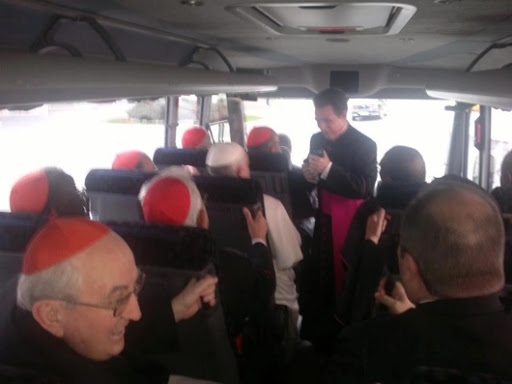
Francis on coach

Earlier today Pope Francis addressed the cardinals and I would just like to share with you the points from his talk that most stood out for me:

  1. Referring to the period culminating in the conclave, Pope Francis said: “In this very cordial atmosphere our reciprocal knowledge of one another and mutual openness to one another, grew. And this is good because we are brothers. [… W]e are that community, that friendship, that closeness, that will do good for every one of us.” To my mind he yet again places himself among, not above the cardinals, just as he did immediately after his election when he refused to sit on the raised papal throne and instead welcomed the cardinals’ pledge of obedience standing at their level.
  2. Emphasizing the role of the Holy Spirit. he said: “He, the Paraclete, is the supreme protagonist of every initiative and manifestation of faith. It’s interesting and it makes me think. The Paraclete creates all the differences in the Church and seems like an apostle of Babel. On the other hand, the Paraclete unifies all these differences – not making them equal – but in harmony with one another.” Here I was particularly pleased to see Pope Francis’ underlining of the concept of unity in diversity (rather than identity) that Benedict XVI also pointed to repeatedly.
  3. “Stimulated by the Year of Faith, all together, pastors and faithful, we will make an effort to respond faithfully to the eternal mission: to bring Jesus Christ to humanity, and to lead humanity to an encounter with Jesus Christ: the Way, the Truth and the Life, truly present in the Church and, at the same time, in every person.” Jesus is in every person, within and outwith the Church, and it is for us to to facilitate for others to encounter him. This is an all-inclusive and non-imposing stance that I derive great joy from.
  4. Pope Francis then returned to the Holy Spirit, who “is the soul of the Church, with His life-giving and unifying strength. Of many He makes a single body – the mystical Body of Christ. Let us never give in to pessimism, to that bitterness that the devil tempts us with every day.” Aside from his reference to the devil, which already in the few speeches since his election seems to me more prominent than it was in Benedict’s language – but even with it, this is again a very positive, hope-filled and forward-looking take on the challenges ahead.

I look forward to getting a better grasp on Pope Francis’ mindset, but I am greatly encouraged by everything I have heard so far!

Pope Francis: "Brothers and sisters, good evening!"

Pope francis

Habemus Papam!

Jorge Mario Cardinal Bergoglio of the Society of Jesus, born in Argentina of Italian parents, is Pope Francis. His election fills me with joy and a great desire to find out as much about him as possible and to support him with my prayers and actions.

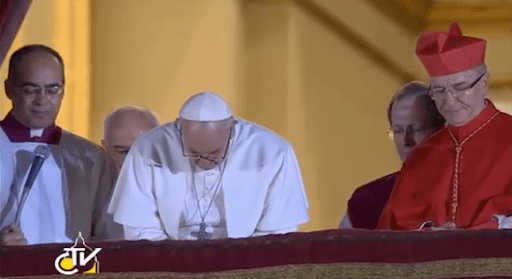
Already the words he shared from the balcony of St. Peter’s this evening are a joy to receive (and, please, do stay away from the ghastly BBC translation that obscures the humility, immediacy and ease of his words – their original being here in Italian and the following containing my own, crude translation):

  1. He starts with a simple greeting: “Brothers and sisters, good evening!” No pomp and circumstance – just a plain, fraternal greeting.
  2. Then: a joke! “You know that the job of the Conclave was to provide Rome with a bishop. It seems as if my brother cardinals went almost to the ends of the earth to get him …”
  3. Next, a call to prayer for Pope emeritus Benedict XVI – and not just a call but an actual prayer! Pope Francis leads those present in St. Peter’s square and all following him live over the internet by reciting the Our Father, the Hail Mary and the Glory Be there and then
  4. What follows then is the core message of his greeting: “And now we begin this journey: bishop and people. This journey of the Church of Rome, which presides in charity over all the Churches. A journey of fraternity, of love, of trust among us. We always pray for each other. We pray for the whole world, so that fraternity may grow in it.” Journey. Fraternity. Churches. World.
  5. What comes next is a masterclass in humility and in being serious about the fraternity which his very first words expressed and which punctuated his message: “I would like to ask you for a favor: before the bishop blesses the people, I ask you that you pray to the Lord that He bless me: the prayer of the people, asking a blessing for its bishop. In silence, lets make this prayer of you over me.” Pope Francis then bows his head for a good 15 seconds to receive the blessing he requested.
  6. Only then does Pope Francis turn to the expected “Urbi et Orbi” blessing after which he shares is plans for tomorrow: to pray to Mary for the protection of Rome.

In an attempt to learn more about Pope Francis, and wanting to do so from his own words as opposed to journalistic analyses or lists of dates, places and offices held, I first had to get past the myriad permutations of his biography now flooding the web (a particularly good and extensive one being here, and a more telegraphic one here).

The first source I arrived at are his homilies and pastoral messages as the Archbishop of Buenos Aires, whose archive is available here in Spanish. Here, let me just pick out a couple of passages from his Lenten message, dated 13th Februray 2013 and therefore serving as a very recent glimpse of his mindset. These lines seem to me to give a sense both of his concerns and of his style (translation again mine – apologies for its crudeness):

“Bit by bit we are getting used to hearing and seeing, through the mass media, the dark chronicles of contemporary society, presented almost with perverted joy, and we are getting used to touching and feeling it in our environment and in our own flesh. […] We live with murderous violence that destroys families and intensifies wars and conflicts in so many of the world’s countries. We live with envy, hatred, slander, worldliness in our heard. The suffering of the innocent and peaceful keeps slapping us; the contempts for the rights of the most fragile persons and countries are not far from us; the rule of money with its demonic effects like drugs, corruption, human trafficking – including of children – together with material and moral misery are currency. The destruction of decent work, painful emigrations and the lack of a future also join this symphony. Our errors and sins as Church aren’t left out of this large panorama either. [… All of this] speaks to us about our limitations, about our weakness and about our incapacity to transform this endless list of destructive realities.

The trap of powerlessness makes us think: Does it make sense to try and change all of this? Can we do something in the face of this situation? Is it worth trying, if the world continues its carnival dance that masks everything for a while? Nevertheless, when the mask slips, the truth appears and, in spite of it sounding anachronistic to many, sin appears again, which wounds our flesh with all its destructive force and twists the destinies of the world and of history.

Lent presents itself to us as a cry of truth and of hope, certain to answer a yes to the possibility of no longer putting on make-up and painting on plastic smiles as if nothing was going on. Yes, it is possible for everything to become new and different because God continues to be “rich in goodness and mercy, always ready to forgive” and encourages us to start again. Today we are invited again to undertake a Paschal journey towards Life, a journey that includes the cross and renunciation, that will be uncomfortable but not in vain. We are invited to recognize that something is not right in ourselves, in society or in the Church, to change, to turn, to convert ourselves.”

The second source I’d like to just mention is a book he co-authored with Rabbi Abraham Skorka, head of the Latin-American Rabbinical School, entitled “On Heaven and Earth,” where the two discuss a variety of topics from Christian and Jewish perspectives, seeking common ground while each remaining faithful to their own religion. In many ways this reminds me of Cardinal Martini and Umberto Eco’s dialogue, which I am a great fan of. For now, let me just pick out the following passage from this very promising book:

“Dialogue is born of an attitude of respect towards another person, of a conviction that the other has something good to say; it requires that we make space in our heard their point of view, their opinion and their position. Dialoguing involves a heartfelt welcome and not prior condemnation. To dialogue, one has to lower ones defenses, open the doors of one’s home and offer human warmth.”

Viva il Papa!