The broken bread, shared and eaten

Child12

On 26th June this year, the Spanish priest and writer Pablo d’Ors (appointed consultor to the Pontifical Council for Culture by Pope Francis) published an essay entitled “Will anyone in the Church dare?” in the magazine Vida Nueva, because of which he has since been accused of heresy and condemned by no less than three Spanish bishops.

Let’s first take a look at the essay in question (rendered in my own, crude translation):

The sacraments of the Church now mean virtually nothing to the vast majority of those who still participate in them. A sign that no longer signifies isn’t a sign anymore, but a game of magic. Christian rites, and the symbols in which their foundations lie, have degenerated, for the majority of believers, into pure magic. Of course men and women today still need magic, that is, words and gestures that in an automatic and irrational way connect us with the transcendent. But that’s not the point.

I argue that many of the behaviors of priests and lay people during the Eucharistic celebration are fundamentally magical, not religious. Can you imagine the apostles kneeling before the bread or Jesus collecting crumbs from a plate? These behaviors reflect our attitude towards the sacramental sign being much more magical than religious.

For them to convey meaning, signs have to be understood. The doctrine of ex opere operato, which postulates that the sacrament is effective irrespective of the understanding of the recipient, has disconnected the sign from the subject and has degenerated and objectified it. The sacraments need to be understood, at least to some extent. Otherwise, they sacramentalize nothing, which is what is happening today in our temples. Nobody understands anything. What our masses remind me of most is Beckett’s theater of the absurd.

Let’s take the example of the Eucharist, whose symbols are bread and wine. Bread is, of course, something everyday, soft and nutritious. That bread is a symbol of God means that God is something everyday, that God is soft, that God is nutritious. But if the symbol is the bread, the sign or sacrament is the broken bread, shared and eaten. So that what it is about is to break and share the bread consciously; to lift it to one’s mouth consciously; to, consciously, chew it and swallow it.

Consciously means knowing that it is not just about giving bread to others, but about be being bread for them, to turn yourself into the food that relieves their need. Eating of this Bread gives us the strength to be bread. In the same vein, the sign is not simply the wine, but the wine shared and drunk. Drinking from this Wine enables us to be wine for others. And wine is blood, that is, life: to be life for others.

And storing the Eucharist in a tabernacle, what’s that about? Have we not said that the true sign is sharing it? A proof of our mentality being magical is that we think that God is more in the tabernacle than outside it. But that … is absurd! It is not as if he were more there than elsewhere. It is that he is there to … show us that he is everywhere, so that we may remember it. God is everywhere, we say, but then we endeavor to put him into a box. Enclose him in a few theories we call theology and symbols that we call sacraments, but that do not sacramentalize anything.

There is only one solution: to explain everything as if it had never been explained before, because maybe that’s the situation; and it is, of course, to be all done as if for the first time, perhaps because it is the truth. We will see then, in wonder, the power of our symbols, we will save our rites, we will discover, at last, their transformative power for the human soul.

But will anyone in the Church dare? Will anyone present these symbols and rites not only as those in which the most genuine Christian identity is encoded, but as symbols and rites of universal value, suitable for everyone, Christian or not? Will someone, finally, present Christianity as a religion that includes humanism, not one that excludes it or is exclusive?

Respect for difference from other spiritual traditions must not make us lose sight of Christianity as a universal humanizing proposition. I detect in my contemporaries not only a hunger for spirituality, but a desire to recover, in an understandable and contemporary way, the religious tradition we come from. Care for silence, a sensibility that is growing, will bring with itself a care for the word and the gesture. But, will there be anyone in the Church who dares? Where will be the prophets who’ll make us understand that the only possible fidelity to the past comes from creativity and renewal in the present?

And now, for completeness’ sake, let’s look at the criticism leveled at it by José Rico Pavés, one of the three Spanish bishops who have condemned this essay as heretical (again in my own translation and only focusing on the passages that specifically address d’Ors’ text):

[I have] read the article by Pablo d’Ors entitled ‘Will there be anyone in the Church who dares?’ with sadness and concern. Sadness, because of finding, in so little space, such a vast number of doctrinal errors whose consequences are dramatic for Christian life. Concern, noting that the article’s author is a writer and priest, and since not long ago, a consultant to the Pontifical Council for Culture.

Without offering any proof beyond his own perception, the author affirms in a way that exudes absolute certainty that “The sacraments of the Church now mean virtually nothing to the vast majority of those who still participate in them”; he argues that “many of the behaviors of priests and lay people during the Eucharistic celebration are fundamentally magical, not religious”; and, as an argument, ask the reader whether they can imagine “the apostles kneeling before the bread or Jesus collecting crumbs from a plate” (sic); he blames the doctrine of ex opere operato for disconnecting the subject and the sign, objectifying and degenerating it; he explains the Eucharist departing from the bread as “a symbol of God”, whose meaning is “to break and share the bread consciously”, from which he deduces that the Eucharistic reservation in the tabernacle becomes meaningless, and he considers it a proof of our magical mentality to think that God is more present in the tabernacle than outside it.

The author proposes to “explain everything as if it had never been explained before,” and to present the sacraments as “symbols and rites of universal value, suitable for everyone, Christian or not” showing “Christianity as a religion that includes humanism, not one that excludes it or is exclusive”. But, he asks finally, will someone in the Church dare to implement this solution?

To find in so few lines so much nonsense results in a great weight. Does the author know what the Catholic Church means by sacrament? Does he ignore the difference versus magical rites? Does he know that the sacred character of the sacraments does not lie primarily in the meaning that we give them, but in being born of the salvific will of Christ to communicate his Life to us? Why doesn’t he mention even once the word faith and the verb to believe? Does he think that the sacraments can be understood without faith? Does he maybe not know the teaching of the Church on the permanent presence of Christ in the Eucharist, on the eucharistic reservation and worship due to this Sacrament of Love outside of the Holy Mass?

How is it possible that almost 50 years after the encyclical Mysterium Fidei (03/09/1965), the same weak proposals concerning the Eucharist and the sacraments, which were already rejected by Pope Paul VI, continue to spread today? In these times, it may be that the only thing that we need to dare is this: ​​believing with the Church, believing in the bosom of the Church.

So, here we have two texts: an essay on the popular lack of understanding of the sacraments and a call for their revival, and a refutation of that essay. But, you could ask, why should I care about a Spanish argument between a priest and a bishop? Well, I can certainly tell you why I care: because this is one of the few examples I have seen so far of a theologian accepting Pope Francis’ invitation from paragraph 49 of Evangelii Gaudium:

“I prefer a Church which is bruised, hurting and dirty because it has been out on the streets, rather than a Church which is unhealthy from being confined and from clinging to its own security. I do not want a Church concerned with being at the centre and which then ends by being caught up in a web of obsessions and procedures. If something should rightly disturb us and trouble our consciences, it is the fact that so many of our brothers and sisters are living without the strength, light and consolation born of friendship with Jesus Christ, without a community of faith to support them, without meaning and a goal in life. More than by fear of going astray, my hope is that we will be moved by the fear of remaining shut up within structures which give us a false sense of security, within rules which make us harsh judges, within habits which make us feel safe, while at our door people are starving and Jesus does not tire of saying to us: “Give them something to eat” (Mk 6:37).”

When I read d’Ors’ essay, what I see is someone who is concerned for the good of the Church, who sees his “brothers and sisters […] living without the strength, light and consolation born of friendship with Jesus Christ” and who identifies an anachronistic and life-detached exposition of the sacraments as a barrier and as a source of degeneration. He perceives a perversion of the sacraments to the point of being confused with magic – not in the good way of Arthur C. Clarke’s: “Any sufficiently advanced technology is indistinguishable from magic”, but by deforming a gift from God that builds on faith but that does not suppress reason into a mere irrational, “God-spray” gimmick. A danger that has a reminder built into the very vocabulary of magic, where the term “hocus-pocus” itself is likely a corruption of Jesus’ words at the last supper: “Hoc est corpus meum.”

d’Ors then offers readings of the Eucharist that are simple, broadly understandable and that powerfully underline its being gift, communion and source of life. He finally makes a call for a new language, a new explanation, explicit (very much like last year’s Synod on the Family), points to the latent hunger for transcendence in the world (a need also recognized by atheists) that the Church is called to sate, and closes with an exhortation to continuity through renewal (wholly in-line with Benedict XVI’s ““hermeneutic of reform”, of renewal in the continuity of the one subject-Church”).

Yes, d’Ors is critical of the doctrine of “ex opere operato,” but he does not deny it, only attributing negative consequences to it (or – arguably – its misuse). He also speaks about God’s presence in the tabernacle pointing to His presence outside it, which is in fact in line with how the Catechism speaks about it: “God, who reveals his name as “I AM,” reveals himself as the God who is always there, present to his people in order to save them.” (§207) and – incidentally, quoting from Paul VI’s Mysterium Fidei:

“The mode of Christ’s presence under the Eucharistic species is unique. It raises the Eucharist above all the sacraments as “the perfection of the spiritual life and the end to which all the sacraments tend.” (St. Thomas Aquinas, STh III, 73, 3c.) In the most blessed sacrament of the Eucharist “the body and blood, together with the soul and divinity, of our Lord Jesus Christ and, therefore, the whole Christ is truly, really, and substantially contained.” (Council of Trent (1551)) “This presence is called ‘real’—by which is not intended to exclude the other types of presence as if they could not be ‘real’ too, but because it is presence in the fullest sense: that is to say, it is a substantial presence by which Christ, God and man, makes himself wholly and entirely present.” (Paul VI, Mysterium Fidei 39)” (§1374)

d’Ors’ sentiment about the tabernacle pointing to God’s presence all around us is also very much along the lines of St. John Chrysostom’s homily on the Gospel of Matthew where he too warns against false formalism and where he calls for a harmony between Eucharistic adoration and – to borrow Pope Francis’ words – a care for His flesh in the poor:

“God does not want golden vessels but golden hearts. […] Of what use is it to weigh down Christ’s table with golden cups, when he himself is dying of hunger? First, fill him when he is hungry; then use the means you have left to adorn his table. Will you have a golden cup made but not give a cup of water? What is the use of providing the table with cloths woven of gold thread, and not providing Christ himself with the clothes he needs? What profit is there in that? Tell me: If you were to see him lacking the necessary food but were to leave him in that state and merely surround his table with gold would he be grateful to you or rather would he not be angry? What if you were to see him clad in worn-out rags and stiff from the cold, and were to forget about clothing him and instead were to set up golden columns for him, saying that you were doing it in his honour? Would he not think he was being mocked and greatly insulted?”

I do not wish to dissect Bishop Pavés’ words or speculate about the motives of his choice of what to focus on or why he transferred the lack of understanding that d’Ors describes and laments among the faithful to a supposed lack of d’Ors’ understanding of Church teaching. Instead I would like to close with appreciating d’Ors’ clear desire to see the sacraments understood and brought closer to the lives of the faithful today and to extend their gifts to all, whether they be in the Church or beyond it.

Francis: all is from You, all is free gift

Francis latin america 15

On Monday, pope Francis returned from a week-long visit to Ecuador, Bolivia and Paraguay, and I would again like to share my favorite parts of that trip with you next.

As soon as Francis landed in Ecuador, he pointed to the source of light that the Church is called to reflect:

“We Christians identify Christ with the sun, and the moon with the Church; the moon does not have its own light, indeed if it hides from the sun it will be enveloped by darkness. The sun is Jesus Christ and if the Church moves away or hides from him, she will be in darkness and no longer able to offer witness. May the coming days make all of us ever more clearly aware of how close the sun is that “dawns upon us from on high”. May each of us be a true reflection of his light and his love.”

The next day, on Monday 6th July, Pope Francis went on to present Mary as the role model for every Christian in a homily about the wedding at Cana given during a mass for families:

“Let us make room for Mary, “the Mother” as the evangelist calls her. Let us journey with her now to Cana. Mary is attentive, she is attentive in the course of this wedding feast, she is concerned for the needs of the newlyweds. She is not closed in on herself, worried only about her little world. Her love makes her “outgoing” towards others. She does not seek her friends to say what is happening, to criticize the poor organization of the wedding feast. And since she is attentive, she discretely notices that the wine has run out. Wine is a sign of happiness, love and plenty. How many of our adolescents and young people sense that these is no longer any of that wine to be found in their homes? How many women, sad and lonely, wonder when love left, when it slipped away from their lives? How many elderly people feel left out of family celebrations, cast aside and longing each day for a little love, from their sons and daughters, their grandchildren, their great grandchildren? This lack of this “wine” can also be due to unemployment, illness and difficult situations which our families around the world may experience. Mary is not a “demanding” mother, nor a mother-in-law who revels in our lack of experience, our mistakes and the things we forget to do. Mary, quite simply, is a Mother! She is there, attentive and concerned.”

Francis then proceeds with elaborating on what Mary does next, after having been attentive to those around her:

“But Mary, at the very moment she perceives that there is no wine, approaches Jesus with confidence: this means that Mary prays. She goes to Jesus, she prays. She does not go to the steward, she immediately tells her Son of the newlyweds’ problem. The response she receives seems disheartening: “What does it have to do with you and me? My hour has not yet come” (v. 4). But she nonetheless places the problem in God’s hands. Her deep concern to meet the needs of others hastens Jesus’ hour. And Mary was a part of that hour, from the cradle to the cross. She was able “to turn a stable into a home for Jesus, with poor swaddling clothes and an abundance of love” (Evangelii Gaudium, 286). She accepted us as her sons and daughters when the sword pierced her heart. She teaches us to put our families in God’s hands; she teaches us to pray, to kindle the hope which shows us that our concerns are also God’s concerns. […]

And finally, Mary acts. Her words, “Do whatever he tells you” (v. 5), addressed to the attendants, are also an invitation to us to open our hearts to Jesus, who came to serve and not to be served. Service is the sign of true love. Those who love know how to serve others. We learn this especially in the family, where we become servants out of love for one another. In the heart of the family, no one is rejected; all have the same value. I remember once how my mother was asked which of her five children – we are five brothers – did she love the most. And she said: it is like the fingers on my hand, if I prick one of them, then it is as if the others are pricked also. A mother loves her children as they are. And in the family, children are loved as they are. None are rejected. “In the family we learn how to ask without demanding, to say ‘thank you’ as an expression of genuine gratitude for what we have been given, to control our aggressivity and greed, and to ask forgiveness when we have caused harm, when we quarrel, because in all families there are quarrels. The challenge is to then ask for forgiveness. These simple gestures of heartfelt courtesy help to create a culture of shared life and respect for our surroundings” (Laudato Si’, 213). The family is the nearest hospital; when a family member is ill, it is in the home that they are cared for as long as possible. The family is the first school for the young, the best home for the elderly. The family constitutes the best “social capital”. It cannot be replaced by other institutions. It needs to be helped and strengthened, lest we lose our proper sense of the services which society as a whole provides. Those services which society offers to its citizens are not a type of alms, but rather a genuine “social debt” with respect to the institution of the family, which is foundational and which contributes to the common good.”

The next day, in Quito’s Bicentennial Park, Francis reflects on Jesus’ testament:

““Father, may they be one… so that the world may believe”. This was Jesus’ prayer as he raised his eyes to heaven. This petition arose in a context of mission: “As you sent me into the world, so I have sent them into the world”. At that moment, the Lord experiences in his own flesh the worst of this world, a world he nonetheless loves dearly. Knowing full well its intrigues, its falsity and its betrayals, he does not turn away, he does not complain. We too encounter daily a world torn apart by wars and violence. It would be facile to think that division and hatred only concern struggles between countries or groups in society. Rather, they are a manifestation of that “widespread individualism” which divides us and sets us against one another (cf. Evangelii Gaudium, 99), they are a manifestation of that legacy of sin lurking in the heart of human beings, which causes so much suffering in society and all of creation. But is it precisely this troubled world, with its forms of egoism, into which Jesus sends us. We must not respond with nonchalance, or complain we do not have the resources to do the job, or that the problems are too big. Instead, we must respond by taking up the cry of Jesus and accepting the grace and challenge of being builders of unity.”

Next, he presents an approach to evangelization that is built on humility and respect:

“Evangelization does not consist in proselytizing, for proselytizing is a caricature of evangelization, but rather evangelizing entails attracting by our witness those who are far off, it means humbly drawing near to those who feel distant from God in the Church, drawing near to those who feel judged and condemned outright by those who consider themselves to be perfect and pure. We are to draw near to those who are fearful or indifferent, and say to them: “The Lord, with great respect and love, is also calling you to be a part of your people” (cf. Evangelii Gaudium, 113). Because our God respects us even in our lowliness and in our sinfulness. This calling of the Lord is expressed with such humility and respect in the text from the Book of Revelations: “Look, I am at the door and I am calling; do you want to open the door?” He does not use force, he does not break the lock, but instead, quite simply, he presses the doorbell, knocks gently on the door and then waits. This is our God!”

And, finally, he speaks about what the unity that Jesus asks the Father for looks like:

“Intimacy with God, in itself incomprehensible, is revealed by images which speak to us of communion, communication, self-giving and love. For that reason, the unity to which Jesus calls us is not uniformity, but rather a “multifaceted and inviting harmony” (Evangelii Gaudium, 117). The wealth of our differences, our diversity which becomes unity whenever we commemorate Holy Thursday, makes us wary of all temptations that suggest extremist proposals akin to totalitarian, ideological or sectarian schemes. The proposal offered by Jesus is a concrete one and not a notion. It is concrete: “Go and do the same” he tells that man who asked “who is my neighbor?” After having told the parable of the Good Samaritan, Jesus says, “Go and do the same”. Nor is this proposal of Jesus something we can fashion as we will, setting conditions, choosing who can belong and who cannot; the religiosity of the ‘elite’. Jesus prays that we will all become part of a great family in which God is our Father, in which all of us are brothers and sisters. No one is excluded; and this is not about having the same tastes, the same concerns, the same gifts. We are brothers and sisters because God created us out of love and destined us, purely of his own initiative, to be his sons and daughters (cf. Eph 1:5). We are brothers and sisters because “God has sent the Spirit of his Son into our hearts, crying “Abba! Father!” (Gal 4:6). We are brothers and sisters because, justified by the blood of Christ Jesus (cf. Rom 5:9), we have passed from death to life and been made “coheirs” of the promise (cf. Gal 3:26-29; Rom 8:17). That is the salvation which God makes possible for us, and which the Church proclaims with joy: to be part of that “we” which leads to the divine “we”.”

During the afternoon, Pope Francis then addressed educators at the Pontifical Catholic University of Ecuador, picking up the theme of that shared “we” with God that he spoke about to families:

“Our world is a gift given to us by God so that, with him, we can make it our own. God did not will creation for himself, so he could see himself reflected in it. On the contrary: creation is a gift to be shared. It is the space that God gives us to build up with one another, to build a “we”. The world, history, all of time – this is the setting in which we build this “we” with God, with others, with the earth. This invitation is always present, more or less consciously in our life; it is always there.”

Francis then presents his model for an education that leads to open, critically-thinking and dialogue-ready people:

“My question to you, as educators, is this: Do you watch over your students, helping them to develop a critical sense, an open mind capable of caring for today’s world? A spirit capable of seeking new answers to the varied challenges that society sets before humanity today? Are you able to encourage them not to disregard the world around them, what is happening all over? Can you encourage them to do that? To make that possible, you need to take them outside the university lecture hall; their minds need to leave the classroom, their hearts must go out of the classroom. Does our life, with its uncertainties, its mysteries and its questions, find a place in the university curriculum or different academic activities? Do we enable and support a constructive debate which fosters dialogue in the pursuit of a more humane world? Dialogue, that bridge word, that word which builds bridges.”

Later that same day, Francis addressed politicians and representatives of civic authority, speaking to them about “gratuitousness”:

“Gratuitousness is a necessary requisite of justice. Who we are, and what we have, has been given to us so that we can place it at the service of others; freely we have received, freely we must give. Our task is to make it bear fruit in good works. The goods of the earth are meant for everyone, and however much someone may parade his property, which is legitimate, it has a social mortgage – always. In this way we move beyond purely economic justice, based on commerce, towards social justice, which upholds the fundamental human right to a dignified life. […] As stewards of these riches which we have received, we have an obligation towards society as a whole and towards future generations. We cannot bequeath this heritage to them without proper care for the environment, without a sense of gratuitousness born of our contemplation of the created world. […] We received this world as an inheritance from past generations, but we must also remember that we received it as a loan from our children and from future generations, to whom we will have to return it! And we will have to return it in a better off state – that is gratuitousness!”

Finally, Francis returned to the importance of dialogue, when referring to the importance of subsidiarity:

“To recognize that our choices are not necessarily the only legitimate ones is a healthy exercise in humility. In acknowledging the goodness inherent in others, even with their limitations, we see the richness present in diversity and the value of complementarity. Individuals and groups have the right to go their own way, even though they may sometimes make mistakes. In full respect for that freedom, civil society is called to help each person and social organization to take up its specific role and thus contribute to the common good. Dialogue is needed and is fundamental for arriving at the truth, which cannot be imposed, but sought with a sincere and critical spirit. In a participatory democracy, each social group, indigenous peoples, Afro-Ecuadorians, women, civic associations and those engaged in public service are all indispensable participants in that dialogue, not spectators. The walls, patios and cloisters of this city eloquently make this point: rooted in elements of Incan and Caranqui culture, beautiful in their proportions and shapes, boldly and strikingly combining different styles, the works of art produced by the “Quito school” sum up that great dialogue, with its successes and failures, which is Ecuador’s history. Today we see how beautiful it is. If the past was marked by errors and abuses – how can we deny it, even in our own lives? – we can say that the amalgamation which resulted radiates such exuberance that we can look to the future with great hope.”

Wednesday morning then saw the last event of Francis’ stay in Ecuador – a meeting with clergy, religious and seminarians, where he again returned to the importance of gratuitousness.

“Women and men religious, priests and seminarians, I ask you to retrace your steps back to the time God gratuitously chose you. You did not buy a ticket to enter the seminary, to enter consecrated life. You were not worthy. If some religious brother, priest, seminarian or nun here today thinks that they merited this, raise your hands. It is all gratuitousness. And the entire life of a religious brother and sister, priest and seminarian must walk that path, and here why not add bishops as well. It is the path that leads to gratuitousness, the path we must follow each day: “Lord, today I did this, I did this thing well, I had this difficulty, all this but … all is from you, all is free gift”. That is gratuitousness. We are those who receive God’s gratuitousness. If we forget this, then slowly we begin to see ourselves as more important: “Look at these works you are doing”, or “Look at how they made this man a bishop of such and such a place… how important”, or “this man they made a Monsignor”, and so on. With this way of thinking we gradually move away from what is fundamental, what Mary never moved away from: God’s gratuitousness. Permit me as a brother to offer you some advice: every day, perhaps night time is better, before going to sleep, look at Jesus and say to him: “All you have given me is a free gift”, and then go back to what you were doing. As a result, then, when I am asked to move or when there is some difficulty, I do not complain, because everything is free gift, I merit nothing. This is what Mary did.”

During a mass on Thursday, the second day in Bolivia, Pope Francis speaks with great clarity about how Jesus’ example of feeding a crowd with just a handful of bread and fish leads from a culture of waste and discarding to one of communion, and he does so by zooming in on three actions – taking, blessing and giving:

“What [Jesus] does can be summed up in three words. He takes a little bread and some fish, he blesses them and then gives them to his disciples to share with the crowd. And this is how the miracle takes place. It is not magic or sorcery. With these three gestures, Jesus is able to turn a mentality which discards others into a mindset of communion, a mindset of community. I would like briefly to look at each of these actions.

Taking. This is the starting-point: Jesus takes his own and their lives very seriously. He looks at them in the eye, and he knows what they are experiencing, what they are feeling. He sees in those eyes all that is present in the memory and the hearts of his people. He looks at it, he ponders it. He thinks of all the good which they can do, all the good upon which they can build. But he is not so much concerned about material objects, cultural treasures or lofty ideas. He is concerned with people. The greatest wealth of a society is measured by the lives of its people, it is gauged by its elderly, who pass on their knowledge and the memory of their people to the young. Jesus never detracts from the dignity of anyone, no matter how little they possess or seem capable of contributing. He takes everything as it comes.

Blessing. Jesus takes what is given him and blesses his heavenly Father. He knows that everything is God’s gift. So he does not treat things as “objects”, but as part of a life which is the fruit of God’s merciful love. He values them. He goes beyond mere appearances, and in this gesture of blessing and praise he asks the Father for the gift of the Holy Spirit. Blessing has this double aspect: thanksgiving and transformative power. It is a recognition that life is always a gift which, when placed in the hands of God, starts to multiply. Our Father never abandons us; he makes everything multiply.

Giving. With Jesus, there can be no “taking” which is not a “blessing”, and no blessing which is not also a “giving”. Blessing is always mission, its purpose is to share what we ourselves have received. For it is only in giving, in sharing, that we find the source of our joy and come to experience salvation. Giving makes it possible to refresh the memory of God’s holy people, who are invited to be and to bring the joy of salvation to others. The hands which Jesus lifts to bless God in heaven are the same hands which gave bread to the hungry crowd. We can imagine now how those people passed the loaves of bread and the fish from hand to hand, until they came to those farthest away. Jesus generated a kind of electrical current among his followers, as they shared what they had, made it a gift for others, and so ate their fill. Unbelievably, there were even leftovers: enough to fill seven baskets. A memory which is taken, a memory which is blessed and a memory which is given, always satisfies people’s hunger.”

Later that day, Francis met with clergy, religious and seminarians and spoke to them about the Gospel passage where the blind beggar, Bartimaeus sat on the roadside as Jesus and his disciples passed him by and cried out to them. Francis then proceeds with reflecting on the three reactions that Bartimaeus received – two from the disciples – whom Francis identifies with bishops, priests, sisters, seminarians, the committed lay faithful – and one from Jesus:

“1. “They passed by”. Some of those who passed by did not even hear his shouting. They were with Jesus, they looked at Jesus, they wanted to hear him. But they were not listening. Passing by is the response of indifference, of avoiding other people’s problems because they do not affect us. It is not my problem. We do not hear them, we do not recognize them. Deafness. Here we have the temptation to see suffering as something natural, to take injustice for granted. And yes, there are people like that: I am here with God, with my consecrated life, chosen by God for ministry and yes, it is normal that there are those who are sick, poor, suffering, and it is so normal that I no longer notice the cry for help. To become accustomed. We say to ourselves, “This is nothing unusual; this were always like this, as long as it does not affect me”. It is the response born of a blind, closed heart, a heart which has lost the ability to be touched and hence the possibility to change. How many of us followers of Christ run the risk of losing our ability to be astonished, even with the Lord? That wonder we had on the first encounter seems to diminish, and it can happen to anyone. Indeed it happened to the first Pope: “Whom shall we go to Lord? You have the words of eternal life”. And then they betray him, they deny him, the wonder fades away. It happens when we get accustomed to things. The heart is blinded. A heart used to passing by without letting itself be touched; a life which passes from one thing to the next, without ever sinking roots in the lives of the people around us, simply because it is part of the elite who follow the Lord.

We could call this “the spirituality of zapping”. It is always on the move, but it has nothing to show for it. There are people who keep up with the latest news, the most recent best sellers, but they never manage to connect with others, to strike up a relationship, to get involved, even with the Lord whom they follow, because their deafness gets worse.

You may say to me, “But those people in the Gospel were following the Master, they were busy listening to his words. They were intent on him.” I think that this is one of the most challenging things about Christian spirituality. The Evangelist John tells us, “How can you love God, whom you do not see, if you do not love your brother whom you do see?” (1 Jn 4:20). They believed that they were listening to the Master, but they also made their own interpretation, and the words of the Master are distilled by their blinded hearts. One of the great temptations we encounter on the path as we follow Jesus is to separate these two things, listening to God and listening to our brothers and sisters, both of which belong together. We need to be aware of this. The way we listen to God the Father is how we should listen to his faithful people. If we do not listen in the same way, with the same heart, then something has gone wrong.

To pass by, without hearing the pain of our people, without sinking roots in their lives and in their world, is like listening to the word of God without letting it take root and bear fruit in our hearts. Like a tree, a life without roots is a one which withers and dies.

2. The second phrase: “Be quiet”. This is the second response to Bartimaeus’ cry: “Keep quiet, don’t bother us, leave us alone, for we are praying as a community, we are in heightened state of spirituality. Don’t bother us. Unlike the first response, this one hears, acknowledges, and makes contact with the cry of another person. It recognizes that he or she is there, but reacts simply by scolding. It is the bishops, priests, sisters, popes, who point their finger threateningly. In Argentina we say of teachers who point their fingers in this way: “This is like the teacher from the time of Yrigoyen who used particularly strict methods”. And the poor faithful people of God, how often are they tested, either by the bad temper or the personal situation of a follower of Christ. It is the attitude of some leaders of God’s people; they continually scold others, hurl reproaches at them, tell them to be quiet. Please give them something to do, listen to them, tell them that Jesus loves them. “No, you can’t do that”. “Madam, take your crying child out of the church as I am preaching”. As if the cries of a child were not a sublime homily.

This is the drama of the isolated consciousness, of those disciples who think that the life of Jesus is only for those deserve it. There is an underlying contempt for the faithful people of God: “This blind man who has to interfere with everything, let him stay where he is”. They seem to believe there is only room for the “worthy”, for the “better people”, and little by little they separate themselves, become distinct, from the others. They have made their identity a badge of superiority. That identity which makes itself superior, is no longer proper to the pastor but rather to a foreman: “I made it here, now you wait in line”. Such persons no longer listen; they look, but they cannot see. Let me tell you an anecdote, something I experienced around 1975 in your Archdiocese. I had made a promise to Nuestro Señor de los Milagros to go to Salta on pilgrimage if he blessed us with 40 novices. He sent forty-one. After a concelebrated Mass – as at all important sanctuaries, there were many Masses, confessions, and you don’t stop – I was walking up with a another priest who was with me and had come with me, and a lady came up to us, almost at the top, with an image of a saint. She was a simple woman, maybe from Salta itself, or perhaps she had come from another place, as so often happens when people take a few days to reach the capital for the Feast of the Lord of Miracles. She said to the priest who was accompanying me, “Father, please bless this image”. He replied, “Lady, you were at Mass”. “Yes, Father”. “Well then, the blessing of God, the presence of God there blesses everything”. “Yes Father, Yes Father” came the reply. At that moment another priest came up, a friend of the priest that had just spoken, but they hadn’t seen each other so he says, “Oh, you’re here!”. He turned away and the woman – I do not know her name, we’ll call her the “Yes Father Lady” – looked at me and said: “Father, please bless it”. Those who always put up barriers between themselves and the people of God, push them away. They hear, but they don’t listen. They deliver a sermon, but look without seeing. The need to show that they are different has closed their heart. Their need to tell themselves, consciously or subconsciously, “I am not like that person, like those people”, not only cuts them off from the cry of their people, from their tears, but most of all from their reasons for rejoicing. Laughing with those who laugh, weeping with those who weep; all this is part of the mystery of a priestly heart and the heart of a consecrated person. Sometimes there are elite groups that are created by not listening and seeing, and we distance ourselves. […]

3. The third word: “Take heart and get up”. This is the third response. It is not so much a direct response to the cry of Bartimaeus as a reaction of people who saw how Jesus responded to the pleading of the blind beggar. In other words, those who gave no importance to the beggar, those who did not let him pass, or those who told him to be quiet… when they see Jesus’ reaction they change their attitude: “Get up, he is calling you”. In those who told him to take heart and get up, the beggar’s cry issued in a word, an invitation, a new and changed way of responding to God’s holy and faithful People.

Unlike those who simply passed by, the Gospel says that Jesus stopped and asked what was happening. “What is happening here?” “Who is making noise?” He stopped when someone cried out to him. Jesus singled him out from the nameless crowd and got involved in his life. And far from ordering him to keep quiet, he asked him, “Tell me, what do you want me to do for you?” Jesus didn’t have to show that he was different, somehow apart, and he didn’t give the beggar a sermon; he didn’t decide whether Bartimaeus was worthy or not before speaking to him. He simply asked him a question, looked at him and sought to come into his life, to share his lot. And by doing this he gradually restored the man’s lost dignity, the man who was on the side of the path and blind; Jesus included him. Far from looking down on him, Jesus was moved to identify with the man’s problems and thus to show the transforming power of mercy. There can be no compassion – and I mean compassion and not pity – without stopping. If you do not stop, you do not suffer with him, you do not have divine compassion. There is no “com-passion” that does not listen and show solidarity with the other. Compassion is not about zapping, it is not about silencing pain, it is about the logic of love, of suffering with. A logic, a way of thinking and feeling, which is not grounded in fear but in the freedom born of love and of desire to put the good of others before all else. A logic born of not being afraid to draw near to the pain of our people. Even if often this means no more than standing at their side and praying with them.

This is the logic of discipleship, it is what the Holy Spirit does with us and in us. We are witnesses of this. One day Jesus saw us on the side of the road, wallowing in our own pain and misery, our indifference. Each one knows his or her past. He did not close his ear to our cries. He stopped, drew near and asked what he could do for us. And thanks to many witnesses, who told us, “Take heart; get up”, gradually we experienced this merciful love, this transforming love, which enabled us to see the light. We are witnesses not of an ideology, of a recipe, of a particular theology. We are not witnesses of that. We are witnesses to the healing and merciful love of Jesus. We are witnesses of his working in the lives of our communities.

And this is the pedagogy of the Master, this is the pedagogy which God uses with his people. It leads us to passing from distracted zapping to the point where we can say to others: “Take heart; get up. The Master is calling you” (Mk 10:49). Not so that we can be special, not so that we can be better than others, not so that we can be God’s functionaries, but only because we are grateful witnesses to the mercy which changed us. When we live like this, there is joy and delight, and we can identify ourselves with the testimony given by the religious sister who made her own Saint Augustine’s counsel, “Sing and walk”. This is the joy that comes from witnessing to the mercy that transforms.”

In the evening of that same day, Pope Francis spoke to members of popular movements and, after emphasizing the need for structural change, presented a critique of the current profit-driven system and asked what those who suffer from it can do about it:

“Time, my brothers and sisters, seems to be running out; we are not yet tearing one another apart, but we are tearing apart our common home. Today, the scientific community realizes what the poor have long told us: harm, perhaps irreversible harm, is being done to the ecosystem. The earth, entire peoples and individual persons are being brutally punished. And behind all this pain, death and destruction there is the stench of what Basil of Caesarea – one of the first theologians of the Church – called “the dung of the devil”. An unfettered pursuit of money rules. This is the “dung of the devil”. The service of the common good is left behind. Once capital becomes an idol and guides people’s decisions, once greed for money presides over the entire socioeconomic system, it ruins society, it condemns and enslaves men and women, it destroys human fraternity, it sets people against one another and, as we clearly see, it even puts at risk our common home, sister and mother earth.

I do not need to go on describing the evil effects of this subtle dictatorship: you are well aware of them. Nor is it enough to point to the structural causes of today’s social and environmental crisis. We are suffering from an excess of diagnosis, which at times leads us to multiply words and to revel in pessimism and negativity. Looking at the daily news we think that there is nothing to be done, except to take care of ourselves and the little circle of our family and friends.

What can I do, as collector of paper, old clothes or used metal, a recycler, about all these problems if I barely make enough money to put food on the table? What can I do as a craftsman, a street vendor, a trucker, a downtrodden worker, if I don’t even enjoy workers’ rights? What can I do, a farmwife, a native woman, a fisher who can hardly fight the domination of the big corporations? What can I do from my little home, my shanty, my hamlet, my settlement, when I daily meet with discrimination and marginalization? What can be done by those students, those young people, those activists, those missionaries who come to a neighborhood with their hearts full of hopes and dreams, but without any real solution for their problems? They can do a lot. They really can. You, the lowly, the exploited, the poor and underprivileged, can do, and are doing, a lot. I would even say that the future of humanity is in great measure in your own hands, through your ability to organize and carry out creative alternatives, through your daily efforts to ensure the three “L’s” – do you agree? – (labor, lodging, land) and through your proactive participation in the great processes of change on the national, regional and global levels. Don’t lose heart!”

Next, Francis spells out his vision of an economy that is oriented towards the common good:

“The economy should not be a mechanism for accumulating goods, but rather the proper administration of our common home. This entails a commitment to care for that home and to the fitting distribution of its goods among all. It is not only about ensuring a supply of food or “decent sustenance”. Nor, although this is already a great step forward, is it to guarantee the three “L’s” of land, lodging and labor for which you are working. A truly communitarian economy, one might say an economy of Christian inspiration, must ensure peoples’ dignity and their “general, temporal welfare and prosperity”.[1] (Pope John XXIII spoke this last phrase fifty years ago, and Jesus says in the Gospel that whoever freely offers a glass of water to one who is thirsty will be remembered in the Kingdom of Heaven.) All of this includes the three “L’s”, but also access to education, health care, new technologies, artistic and cultural manifestations, communications, sports and recreation. A just economy must create the conditions for everyone to be able to enjoy a childhood without want, to develop their talents when young, to work with full rights during their active years and to enjoy a dignified retirement as they grow older. It is an economy where human beings, in harmony with nature, structure the entire system of production and distribution in such a way that the abilities and needs of each individual find suitable expression in social life. You, and other peoples as well, sum up this desire in a simple and beautiful expression: “to live well”, which is not the same as “to have a good time”.

Such an economy is not only desirable and necessary, but also possible. It is no utopia or chimera. It is an extremely realistic prospect. We can achieve it. The available resources in our world, the fruit of the intergenerational labors of peoples and the gifts of creation, more than suffice for the integral development of “each man and the whole man”. The problem is of another kind. There exists a system with different aims. A system which, in addition to irresponsibly accelerating the pace of production, and using industrial and agricultural methods which damage Mother Earth in the name of “productivity”, continues to deny many millions of our brothers and sisters their most elementary economic, social and cultural rights. This system runs counter to the plan of Jesus, against the Good News that Jesus brought.

Working for a just distribution of the fruits of the earth and human labor is not mere philanthropy. It is a moral obligation. For Christians, the responsibility is even greater: it is a commandment. It is about giving to the poor and to peoples what is theirs by right. The universal destination of goods is not a figure of speech found in the Church’s social teaching. It is a reality prior to private property. Property, especially when it affects natural resources, must always serve the needs of peoples. And those needs are not restricted to consumption. It is not enough to let a few drops fall whenever the poor shake a cup which never runs over by itself. Welfare programs geared to certain emergencies can only be considered temporary and incidental responses. They could never replace true inclusion, an inclusion which provides worthy, free, creative, participatory and solidary work.”

Finally, Pope Francis also took advantage of speaking about the injustice of exploitative systems to apologize for mistakes made by the Church:

“Let us say NO, then, to forms of colonialism old and new. Let us say YES to the encounter between peoples and cultures. Blessed are the peacemakers. Here I wish to bring up an important issue. Some may rightly say, “When the Pope speaks of colonialism, he overlooks certain actions of the Church”. I say this to you with regret: many grave sins were committed against the native peoples of America in the name of God. My predecessors acknowledged this, CELAM, the Council of Latin American Bishops, has said it, and I too wish to say it. Like Saint John Paul II, I ask that the Church – I repeat what he said – “kneel before God and implore forgiveness for the past and present sins of her sons and daughters”.[6] I would also say, and here I wish to be quite clear, as was Saint John Paul II: I humbly ask forgiveness, not only for the offenses of the Church herself, but also for crimes committed against the native peoples during the so-called conquest of America. Together with this request for forgiveness and in order to be just, I also would like us to remember the thousands of priests and bishops who strongly opposed the logic of the sword with the power of the Cross. There was sin, a great deal of it, for which we did not ask pardon. So for this, we ask forgiveness, I ask forgiveness. But here also, where there was sin, great sin, grace abounded through the men and women who defended the rights of indigenous peoples.”

The next morning, on Friday 10th July, Pope Francis visited the Santa Cruz-Palmasola Rehabilitation Center, where he presented himself to the prisoners there as a sinner:

“You may be asking yourselves: “Who is this man standing before us?”. I would like to reply to that question with something absolutely certain about my own life. The man standing before you is a man who has experienced forgiveness. A man who was, and is, saved from his many sins. That is who I am. I don’t have much more to give you or to offer you, but I want to share with you what I do have and what I love. It is Jesus Christ, the mercy of the Father.”

Next, he shared with them the good news of Jesus’ closeness to us all on the cross:

“When Jesus becomes part of our lives, we can no longer remain imprisoned by our past. Instead, we begin look to the present, and we see it differently, with a different kind of hope. We begin to see ourselves and our lives in a different light. We are no longer stuck in the past, but capable of shedding tears and finding in them the strength to make a new start. If there are times when we experience sadness, when we’re in a bad way, when we’re depressed or have negative feelings, I ask you to look at Christ crucified. Look at his face. He sees us; in his eyes there is a place for us. We can all bring to Christ our wounds, our pain, our mistakes, our sins, and all those things which perhaps we got wrong. In the wounds of Jesus, there is a place for our own wounds. Because we are all wounded, in one way or another. And so we bring our wounds to the wounds of Jesus. Why? So that there they can be soothed, washed clean, changed and healed. He died for us, for me, so that he could stretch out us his hand and lift us up. Speak to the priests who come here, talk to them! Speak to the brothers and sisters who come, speak to them. Speak to everyone who comes here to talk to you about Jesus. Jesus wants to help you get up, always.”

The morning after arriving in Paraguay, on Saturday 11th July, Pope Francis went to visit a pediatric hospital, where he spoke to the children receiving treatment there:

“Dear children, I want to ask you a question; maybe you can help me. They tell me that you are all very intelligent, and so I want to ask you: Did Jesus ever get annoyed? … Do you remember when?

If this seems like a difficult question, let me help you. It was when they wouldn’t let the children come to him. That is the only time in the entire Gospel of Mark when we hear that he was “annoyed” (cf. Mk 10:13-15). We would say that he was really “ticked off”.

Do you get annoyed every now and then? Jesus felt that way when they wouldn’t let the children come to him. He was really mad. He loved children. Not that he didn’t like adults, but he was really happy to be with children. He enjoyed their company, he enjoyed being friends with them. But not only. He didn’t just want to have them around, he wanted something else: he wanted them to be an example. He told his disciples that “unless you become like children, you will never enter the Kingdom of Heaven” (Mt 18:3).”

Still that morning, Francis then celebrated mass at the Marian Shrine of Caacupé and during the homily he again spoke at length about Mary – this time focusing on the difficult moments of her life and on her being mother of the Church:

“1. The first moment: the birth of Jesus. There was no room for them. They had no house, no dwelling to receive her Son. There was no place where she could give birth. They had no family close by; they were alone. The only place available was a stall of animals. Surely she remembered the words of the angel: “Rejoice, Mary, the Lord is with you”. She might well have asked herself: “Where is he now?”.

2. The second moment: the flight to Egypt. They had to leave, to go into exile. Not only was there no room for them, no family nearby, but their lives were also in danger. They had to depart to a foreign land. They were persecuted migrants, on account of the envy and greed of the King. There too she might well have asked: “What happened to all those things promised by the angel?”.

3. The third moment: Jesus’ death on the cross. There can be no more difficult experience for a mother than to witness the death of her child. It is heartrending. We see Mary there, at the foot of the cross, like every mother, strong, faithful, staying with her child even to his death, death on the cross. There too she might well have asked: “What happened to all those things promised to me by the angel?”. Then we see her encouraging and supporting the disciples.

We contemplate her life, and we feel understood, we feel heard. We can sit down to pray with her and use a common language in the face of the countless situations we encounter each day. We can identify with many situations in her own life. We can tell her what is happening in our lives, because she understands.

Mary is the woman of faith; she is the Mother of the Church; she believed. Her life testifies that God does not deceive us, that God does not abandon his people, even in moments or situations when it might seem that he is not there. Mary was the first of her Son’s disciples and in moments of difficulty she kept alive the hope of the apostles. With probably more than one key, they were locked in the upper room, due to fear. A woman attentive to the needs of others, she could say – when it seemed like the feast and joy were at an end – “see, they have no wine” (Jn 2:3). She was the woman who went to stay with her cousin “about three months” (Lk 1:56), so that Elizabeth would not be alone as she prepared to give birth. That is our mother, so good and so kind, she who accompanies us in our lives.”

In the afternoon, Francis met with representatives of Paraguayan civil society, where he again spoke at length about dialogue, with identity and openness being its prerequisites:

“Dialogue is not easy. There exists also a “theatrical dialogue” by which I mean that we rehearse dialogue, play out the conversation, but it is subsequently all forgotten. If you do not say what you really feel when you dialogue with another person, what you think, and if you are not truly interested in what the other person is saying and adapting to their way of expressing themselves, then it is not a real dialogue but simply a painting, a work of art. Now it is true that dialogue is not easy and that there are many difficulties to be overcome, and sometimes it seems as if we are intent on only make things even harder. Dialogue must be built on something, an identity.

For example, I think about that dialogue we have in the Church, interreligious dialogue, where different representatives of religions speak to each other. We sometimes meet to speak and share our points of view, and everyone speaks on the basis of their own identity: “I’m Buddhist, I’m Evangelical. I’m Orthodox, I’m Catholic.” Each one explains their identity. They do not negotiate their identity. This means that, for there to be dialogue, that fundamental basis of identity must exist. And what is the identity of a country? – and here we are speaking about a social identity – to love the nation. The nation first, and then my business! The nation comes first! That is identity. That is the basis upon which I will dialogue. If I am to speak without that basis, without that identity, then dialogue is pointless. Moreover, dialogue presupposes and demands that we seek a culture of encounter; an encounter which acknowledges that diversity is not only good, it is necessary. Uniformity nullifies us, it makes us robots. The richness of life is in diversity. For this reason, the point of departure cannot be, “I’m going to dialogue but he’s wrong”. No, no, we must not presume that the other person is wrong. I dialogue with my identity but I’m going to listen to what the other person has to say, how I can be enriched by the other, who makes me realize my mistakes and see the contribution I can offer. It is a going out and a coming back, always with an open heart. If I presume that the other person is wrong, it’s better to go home and not dialogue, would you not agree?

Dialogue is for the common good and the common good is sought by starting from our differences, constantly leaving room for new alternatives. In other words, look for something new. When dialogue is authentic, it ends up with – allow me to use the word and to use it in a noble way – a new agreement, in which we all agree on something. Are there differences? They remain to one side, to be looked at again later. But on those things that we are agreed, we are committed and we defend them. This is one step forward. This is the culture of encounter. Dialogue is not about negotiating. Negotiating is trying to get your own slice of the cake. To see if I can get my own way. If you go with this intention, don’t dialogue, don’t waste your time. Dialogue is about seeking the common good. Discuss, think, and discover together a better solution for everybody. Many times this culture of encounter can involve conflict. To put it another way, we saw a beautiful ballet recently. Everything was coordinated and the orchestra was a veritable symphony of concordance. Everything was perfect. Everything went well. But during dialogue, it’s not always the case, for it is not a perfect ballet or a coordinated orchestra. During dialogue there is conflict. This is logical and even desirable. Because if I think in one way and you in another and we walk together, there will be conflict. But we mustn’t fear it, we mustn’t ignore it. On the contrary, we are invited to embrace conflict. If we don’t embrace conflict, saying to ourselves “this is a headache, let him go home with his ideas, and I’ll go back to mine with my ideas”, then we will never be able to dialogue. This means that we have to “face conflict head on, to resolve it and to make it a link in the chain of a new process” (Evangelii Gaudium 227).

Let us dialogue. Where there is conflict, I embrace it, I transform it, and it is a necessary element of a new process. It is a beginning that will help us greatly. “Unity is greater than conflict” (ibid., 228). Conflict exists: we have to embrace it, we have to try and resolve it as far as possible, but with the intention of achieving that unity which is not uniformity, but rather a unity in diversity. A unity which does not cancel differences, but experiences them in communion through solidarity and understanding. By trying to understand the thinking of others, their experiences, their hopes, we can see more clearly our shared aspirations. This is the basis of encounter: all of us are brothers and sisters, children of the same heavenly Father, and each of us, with our respective cultures, languages and traditions, has much to contribute to the community. Am I ready to receive this? If I am ready to receive and to dialogue with this, then I am up to the task of dialogue; but if I am not ready then it is better not to waste time. True cultures are never closed in on themselves – cultures would die if they closed in on themselves – but are called to meet other cultures and to create new realities. When we study history we find ancient cultures that no longer exist. They have died, and for many reasons. But one of them is having closed themselves in. Without this essential presupposition, without this basis of fraternity, it will be very difficult to arrive at dialogue. If someone thinks that there are persons, cultures, or situations which are second, third or fourth class… surely things will go badly, because the bare minimum, a recognition of the dignity of the other, is lacking. There are no first, second, third, fourth categories of persons: they are all of the same lineage.”

The last morning of Francis’ trip started with a visit to Bañado Norte, a poor, frequently-flooded neighborhood of the city of Asunción, where he spoke about solidarity and neighborliness:

“Faith awakens our commitment to others, faith awakens our solidarity: it is a virtue, human and Christian, which you possess and which many possess, a virtue that we must learn. The birth of Jesus changes our lives. A faith which does not draw us into solidarity is a faith which is dead, it is deceitful. “No, I am a very Catholic man; I am a very Catholic woman, and I go to Mass every Sunday”. But I ask you this, “what is going on in Bañados?”. You reply, “Oh I don’t know, I know that there are people there, but I don’t know…”. No matter how many Sunday Masses, if your heart does not reach out to others, if you do not know what is happening to your people, your faith is weak, unhealthy, or dead. It is a faith without Christ; faith without solidarity is faith without Christ, it is faith without God, faith without brothers and sisters. There is a saying, and I hope I remember it accurately. It describes the problem of faith without solidarity: “A God without people, a people without brothers and sisters, a people without Jesus”. That is faith without solidarity. And God entered into the heart of the people he chose to accompany, and he sent his Son to that same people to bring them salvation and help. He sent his Son to that people, and Jesus did not hesitate to come down, to humble himself, to abase himself, to the point of dying for each one of us, to express brotherly solidarity, a solidarity which comes from his love for the Father and from his love for us. Remember, when faith shows no solidarity, or when it is weak, sick, or dead, it is not the faith of Jesus. As I was saying to you, the first to show this solidarity was our Lord, who chose to live in our midst.”

Later that Sunday morning, Francis celebrated mass at Campo Grande, still in the city of Asunción, where he gave a homily about the Gospel passage where Jesus send out his disciples in pairs to spread the good news:

“Jesus does not send them out as men of influence, landlords, officials armed with rules and regulations. Instead, he makes them see that the Christian journey is simply about changing hearts. One’s own heart first all, and then helping to transform the hearts of others. It is about learning to live differently, under a different law, with different rules. It is about turning from the path of selfishness, conflict, division and superiority, and taking instead the path of life, generosity and love. It is about passing from a mentality which domineers, stifles and manipulates to a mentality which welcomes, accepts and cares.

These are two contrasting mentalities, two ways of approaching our life and our mission.

How many times do we see mission in terms of plans and programs. How many times do we see evangelization as involving any number of strategies, tactics, maneuvers, techniques, as if we could convert people on the basis of our own arguments. Today the Lord says to us quite clearly: in the mentality of the Gospel, you do not convince people with arguments, strategies or tactics. You convince them by simply learning how to welcome them.

The Church is a mother with an open heart. She knows how to welcome and accept, especially those in need of greater care, those in greater difficulty. The Church, as desired by Jesus, is the home of hospitality. And how much good we can do, if only we try to speak this language of hospitality, this language of receiving and welcoming. How much pain can be soothed, how much despair can be allayed in a place where we feel at home! This requires open doors, especially the doors of our heart. Welcoming the hungry, the thirsty, the stranger, the naked, the sick, the prisoner (Mt 25:34-37), the leper and the paralytic. Welcoming those who do not think as we do, who do not have faith or who have lost it. And sometimes, we are to blame. Welcoming the persecuted, the unemployed. Welcoming the different cultures, of which our earth is so richly blessed. Welcoming sinners, because each one of us is also a sinner.”

Before returning to Rome, Francis met with young people and spoke to them first about freedom:

“Freedom is a gift that God gives us, but we have to know how to accept it. We have to be able to have a free heart, because we all know that in the world there are so many things that bind our hearts and prevent them from being free. Exploitation, lack of means to survive, drug addiction, sadness, all those things take away our freedom. And so we can all thank Orlando for having asked for this blessing of having a free heart, a heart that can say what it thinks, that can express what it feels, and can act according to how it thinks and feels. That is a free heart!”

Then he shared a prayer for freedom with them:

“Lord Jesus,
give me a heart that is free,
that I may not be a slave to all the snares in the world.
That I may not be a slave to comfort and deception.
That I may not be a slave to the good life.
That I may not be a slave to vice.
That I may not be a slave to a false freedom,
which means doing what I want at every moment”

Finally, Pope Francis again gave an in-flight interview to the journalists who accompanied him on the trip and were returning with him to Rome. Of the 14 questions he answered, I would just like to pick out three. First, in a response to a question about criticisms of his own criticism of the global economic system, Francis shows what dialogue means for him personally:

“I heard that there were some criticisms from the United States. I heard about it, but I haven’t read [them], I haven’t had the time to study [them] well, because every criticism must be received, studied, and then dialogue must ensue. You ask me what I think. If I have not had a dialogue with those who criticize, I don’t have the right to state an opinion, isolated from dialogue, no?”

Second, when asked why he speaks so little about the middle class, Francis’ reply starts with a direct admission of having made a mistake and humbly accepts the journalist’s question as a correction:

“Thank you so much. It’s a good correction, thanks. You are right. It’s an error of mine not to think about this. I will make a comment, but not to justify myself. You’re right. I have to think a bit.

The world is polarized. The middle class becomes smaller. The polarization between the rich and the poor is big. This is true. And, perhaps this has brought me not to take account of this, no? Some nations are doing very well, but in the world in general the polarization is seen. And the number of poor is large. And why do I speak of the poor? Because they’re at the heart of the Gospel. And I always speak from the Gospel on poverty, no? It’s not that it’s sociological. Then on the middle class, there are some words that I’ve said, but a little in passing. But the common people, the simple people, the worker, that is a great value, no? But, I think you’re telling me about something I need to do. I need to do delve further into this magisterium.”

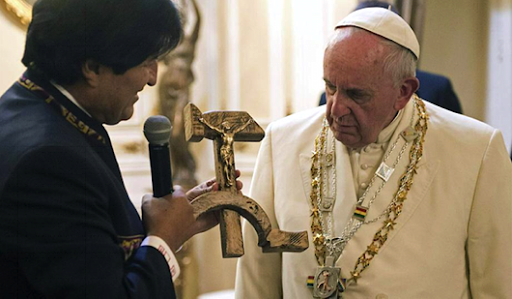
Third, his response to a question about the statue of Christ on a hammer and sickle that the Bolivian president Evo Morales gave him, and that he obviously disliked (see the photo below) is also an example of how to engage with cultural expressions that are contrary to his own tastes and preferences – note the lengths he goes to to understand what was behind this piece:

“It’s curious, I didn’t know [it], nor did I know that Fr. Espinal was a sculptor and also a poet. I learned this in these days. I saw it and for me it was a surprise. Secondly, you can qualify it in the genre of “protest art” – for example in Buenos Aires, some years ago, there was an exhibit of a good sculptor, creative, Argentine, who is now dead. It was protest art, and I recall one, it was a crucified Christ on a bomber that was falling down, no? It’s Christianity, but a criticism that, let’s say, Christianity allied with imperialism, which is the bomber. The genre that first I didn’t know, and secondly, I would qualify it as protest art, which in some cases can be offensive, in some cases. Thirdly, in this concrete case, Fr Espinal was killed in 1980. It was a time when liberation theology had many different branches. One of the branches was with Marxist analysis of reality. Fr Espinal belonged to this, this. Yes, I knew because I was in those years rector of the theology faculty and we talked a lot about it, about the different branches and who were the representatives, no? In the same year, the general of the Society (of Jesus), Fr. Arrupe, wrote a letter to the whole Society on the Marxist analysis of reality in theology. Stopping on this point saying, “it’s no good, these are different things, it’s not right, it’s not correct.” And, four years later in 1984, the Congregation for the Doctrine of the Faith published the first small volume, the first declaration on liberation theology that criticizes this. Then comes the second, which opens to a more Christian perspective. I’m simplifying, no? Let’s do the hermeneutic of that time: Espinal was an enthusiast of this Marxist analysis of the reality, but also of theology using Marxism. From this, he came up with this work. Also the poetry of Espinal was of this kind of protest. But, it was his life, it was his thought. He was a special man, with so much human geniality, who fought in good faith, no? Making a hermeneutic like this, I understand this work. For me it wasn’t an offense, but I had to do this hermeneutic, and I say it to you so that there aren’t any wrong opinions.”

Hammer sickle christ

Sin and faith: the gift of Christian identity

Ged quinn felix culpa s

A couple of weeks ago, Cardinal Walter Kasper gave an interview to EWTN during which he displayed great patience in the face of persistently being misunderstood (or willfully misrepresented?) by his interviewer. Why do I bring this up? Because, in the course of that interview, in a moment of exasperation, Cardinal Kasper presented the following, beautiful synthesis of how the Church needs to be a sacrament – i.e., sign and instrument – of mercy, which he derived from Jesus’ self-sacrifice having been in response to a rejection by his people:

“[M]arriage is an icon, an image of the alliance of God with his people. And notice that in Holy Scripture, how often the people of God abandoned him … And also Jesus was rejected by his people. He substituted himself [for them], went to the cross, g[a]ve them a chance. And before he went on Easter Eve he […] gave the Church, his apostles, the authority to forgive or not to forgive, to bind and to loose [cf. Matthew 18:18]. And all this, this is also a sign of mercy. It is not only the category of human justice you can apply here. You must, the Church must, act according to the action of God and God’s mercy, and the Church is sacrament of mercy. It means sign and instrument of the mercy of God. That’s our Catholic understanding of the Church. And if God gives, acts in this way, the Church can do it also.”

That Jesus gave his disciples the authority both to impose and abolish what the Church is to do and not do, to believe and not believe, to denounce and to value, is not just a turn of phrase to illustrate the completeness of passing “power of attorney” to His followers, members of His mystical body, but an imperative to keep her teaching be a means to union with Him in every present moment. Kasper prefixing the above reminder of Matthew 18:18 with a spelling out of the fact that even at the pinnacle of His love for us, at the moment of his loving self-sacrifice, Jesus was rejected by his people, is no accident either and, to my mind, serves as a stark reminder that the goods that the Church gives access to in the name of her head are not rewards, addressed to those who fully comply with her teaching, but expressions of His gratuitous, wholly undeserved and merciful self-giving.

As I kept returning to delighting in and thinking about Cardinal Kasper’s words, Pope Francis (five days later) chose the question of Christian identity (which is implicit in Kasper’s reasoning) during a morning homily at Santa Marta. Note also that identity is a key prerequisite to dialogue for Francis.

The angle chosen by Francis that day was that “sin is part of our identity,” that we are “sinners, but sinners with faith in Jesus Christ,” and that “it is God who gives us this identity as a gift.” Saying that sin is integral to our identity – an identity given to us by God as a gift – struck me as a rather stark claim (though one that immediately made me think of the “felix culpa” of the Easter Vigil liturgy). Placing it alongside Cardinal Kasper’s thoughts, it seemed to me that it is the key to understanding not only the idea of a Christianity that needs to go out and be prepared to get hurt in the process, which Pope Francis spoke about also in Evangelii Gaudium (§49), but also to the centrality that mercy has in Francis’ teaching.

Before going any further, let’s look at Pope Francis’ words in more detail in terms of what constitutes Christian identity:1

“We too must traverse a long journey during our lives, so that this Christian identity may be strong, so that we may give witness. It is a journey which we can defined as being from ambiguity to true identity.

It’s true, there is sin, and sin makes us fall, but we have the Lord’s strength to get up and proceed with our identity. But I would also say that sin is part of our identity: we are sinners, but sinners with faith in Jesus Christ. It is not only a faith of understanding, no. It’s a faith that is a gift from God and that entered us from God. It is God himself who confirms us in Christ. And he has anointed us, he has impressed his seal in us, he has given us the down payment, the pledge of the Spirit in our hearts. It is God who gives us this gift of identity.

It is essential to be faithful to this Christian identity and to let the Holy Spirit, who is precisely the guarantee, the pledge in our hearts, to bring us forward in life. We are not people who follow a philosophy; we are anointed and have the guarantee of the Spirit.

Ours is a beautiful identity that shows itself in witness. It is because of this that Jesus speaks of witness as the language of our Christian identity. And this is so even though Christian identity, since we are sinners, is being tempted, will be tempted; temptations always come and our identity can weaken and can be lost.”

Pope Francis describing himself as a sinner since the very beginning of this pontificate is not some humble-bragging, but a reminder that sin, weakness, failure are intrinsic to what it is to be human. It is also central to what it means to be Christian. We are not perfect, flawless, wholly-compliant, but addled with sin, with failure, with imperfection. What Pope Francis points out though in the above homily is that these flaws are not a source of resignation or pessimism, something that ought to trouble us, or something to be denied, but instead a basis for being open to God’s merciful love. I am a sinner, someone who gives in to temptation, who fails to love, who makes mistakes, but I know that I am loved by God and I entrust myself to Him and give space to him so that he may lead me – with all my flaws – ever closer to Himself.

This is in stark contrast to a position that seems to, at least implicitly, underlie the thought processes of many who oppose openness to all, regardless of their closeness to the Church’s teaching, and who seem to be operating on the assumption that participation in the life of the Church has perfection as a prerequisite. Failure here is a personal weakness that disqualifies one from participating in the mystical body of Christ and that needs to be overcome before re-integration can take place. Here the Church is an association of the flawless and of the self-sufficient.

This is not a Church I recognize, and neither is this the Church that presents herself in the Catechism. Already the Gospel is characterized there as “the revelation in Jesus Christ of God’s mercy to sinners” (§1846), which is followed by declaring that ““You shall call his name Jesus, for he will save his people from their sins.” The same is true of the Eucharist, the sacrament of redemption”. Next, sin is presented as undeniably part of us, and its recognition in oneself as a precursor to mercy:

“To receive his mercy, we must admit our faults. “If we say we have no sin, we deceive ourselves, and the truth is not in us. If we confess our sins, he is faithful and just, and will forgive our sins and cleanse us from all unrighteousness.”” (§1847)

And St. Paul goes even further, by correlating grace with sin:

“As St. Paul affirms, “Where sin increased, grace abounded all the more.” But to do its work grace must uncover sin so as to convert our hearts and bestow on us “righteousness to eternal life through Jesus Christ our Lord.” Like a physician who probes the wound before treating it, God, by his Word and by his Spirit, casts a living light on sin: Conversion requires convincing of sin; it includes the interior judgment of conscience, and this, being a proof of the action of the Spirit of truth in man’s inmost being, becomes at the same time the start of a new grant of grace and love: “Receive the Holy Spirit.” Thus in this “convincing concerning sin” we discover a double gift: the gift of the truth of conscience and the gift of the certainty of redemption. The Spirit of truth is the Consoler.” (§1848)

Truth, recognizing our sinfulness, is followed by God’s merciful action and His gift of redemption, which as Cardinal Kasper stated so clearly, the Catechism too links to the pinnacle of Jesus’ loving self-sacrifice:

“It is precisely in the Passion, when the mercy of Christ is about to vanquish it, that sin most clearly manifests its violence and its many forms: unbelief, murderous hatred, shunning and mockery by the leaders and the people, Pilate’s cowardice and the cruelty of the soldiers, Judas’ betrayal—so bitter to Jesus, Peter’s denial and the disciples’ flight. However, at the very hour of darkness, the hour of the prince of this world,the sacrifice of Christ secretly becomes the source from which the forgiveness of our sins will pour forth inexhaustibly.” (§1851)

A recognition of my sinfulness is no guilt-ridden pessimism, but instead a source of joy, since God’s love exceeds whatever flaws I have and envelops me, all of my brothers and sisters and the whole of creation. My flaws are an invitation to be merciful to all, regardless of their beliefs or way of life, since they are loved by God just as much as I am.

O felix culpa!


1 Since the quotes from Pope Francis homily were much more extensive in the Italian account that day, the following is my, crude translation of that text, rather than the official English text by Vatican Radio.

Our Sister, Mother Earth

Klimt

Pope Francis’ much anticipated encyclical on the environment, entitled “Praised Be” (“Laudato Si’”) after the opening line of St. Francis’ canticle, starts by personifying our planet, calling her our sister and mother, and lamenting the violence we have visited on her, with whom we are one, who lives in us and who sustains us:

““Laudato si’, mi’ Signore” – “Praise be to you, my Lord”. In the words of this beautiful canticle, Saint Francis of Assisi reminds us that our common home is like a sister with whom we share our life and a beautiful mother who opens her arms to embrace us. “Praise be to you, my Lord, through our Sister, Mother Earth, who sustains and governs us, and who produces various fruit with coloured flowers and herbs”.1

This sister now cries out to us because of the harm we have inflicted on her by our irresponsible use and abuse of the goods with which God has endowed her. We have come to see ourselves as her lords and masters, entitled to plunder her at will. The violence present in our hearts, wounded by sin, is also reflected in the symptoms of sickness evident in the soil, in the water, in the air and in all forms of life. This is why the earth herself, burdened and laid waste, is among the most abandoned and maltreated of our poor; she “groans in travail” (Rom 8:22). We have forgotten that we ourselves are dust of the earth (cf. Gen 2:7); our very bodies are made up of her elements, we breathe her air and we receive life and refreshment from her waters.”

Already the above, opening paragraphs of this encyclical are worth pausing over, and before even proceeding with reflecting on its remaining 183 pages, I would like to pick up on the idea that the earth ought to be thought of as another person, instead of “just” as some inanimate matter that is alien to the human race. In fact, Pope Francis decries such an attitude towards our planet later on in Laudato si’ by quoting Romano Guardini (§115):

“[T]he technological mind sees nature as an insensate order, as a cold body of facts, as a mere ‘given’, as an object of utility, as raw material to be hammered into useful shape; it views the cosmos similarly as a mere ‘space’ into which objects can be thrown with complete indifference.”

To get a sense of the origin and nature of St. Francis’ broad use of personification when addressing not only the Earth as sister and mother, but all of creation too, let us take a look at the circumstances of his writing the Canticle of Brother Sun that Pope Francis quotes. In a profound analysis of the Canticle, Ilia Delio, O.S.F. recounts the circumstances of its writing in the spring or summer of 1225 (some 6-10 months after St. Francis received the stigmata), quoting from the Legenda perugina:

“He could no longer see in the daytime the light of day, nor at night the light of the fire, but always remained in the house and in the little cell in darkness. Moreover, he had great pain in his eyes day and night so that at hight he could scarcely rest or sleep, which was very bad for him and greatly aggravated the sickness of his eyes and his other infirmities.”

St. Francis was at a low point in the midst of this suffering and he cried out to God for help: “Lord, come to my help and look on my infirmities so that I may bear them patiently.” He then heard a voice promising him eternal happiness in the kingdom of heaven, expressed via an image in which the earth transformed into gold (still in the Legenda perugina):

“Tell me brother: if anyone were to give you for your infirmities and tribulations such a great and precious treasure that, if the whole earth were pure gold, all stones were precious stones, and all water were balsam, yet you would consider all this as nothing, and these substances as earth, stones, and water in comparison with the great and precious treasure given to you, surely you would rejoice greatly?”

To this St. Francis replied:

“That would be a great treasure, Lord, and worth seeking, truly precious and greatly to be loved and desired.”

The voice then said to him:

“Therefore, brother, rejoice, and rather be glad in your infirmities and tribulations, since henceforth you are as secure as if you were already in my kingdom.”

The next morning, St. Francis awoke, wrote the Canticle of Brother Sun and sent his fellow friars out to sing it “as minstrels of the Lord.”

What seems particularly significant to me here is that the Canticle was not the result of some euphoric lyricising, but instead the response to having received consolation from God in response to St. Francis placing his trust in Him in the midst of suffering and distress.

Beyond the circumstances of its writing, it is important to note what St. Francis’ disciple, St. Bonaventure though of the motives behind Francis’ personification of the created. The following are passages Delio quotes from Bonaventure’s Legenda maior:

“When he considered the primordial source of all things, he was filled with even more abundant piety, calling creatures, no matter how small, by the name of brother or sister, because he knew they had the same source as himself.

[…]

With a feeling of unprecedented devotion he savored in each and every creature – as in so many rivulets – that Goodness which is their fountain source … and like the prophet David sweetly exhorted them to praise the Lord.”

St. Francis called the Earth sister and mother because both she and he share the one origin: God. Since we and all of creation share the one Father, we are all siblings – not only among members of the human race, but also in relation to all of creation, from the simplest forms of inanimate matter to lifeforms most similar to us: a worldview also highly consistent with that of Pierre Teilhard de Chardin, whom Pope Francis also refers to in Laudato Si’ (§83).

St. Francis tracing brotherhood and sisterhood with the Earth and with all of creation to a shared source in God is also very closely related to the intellectual visions of the Servant of God, Chiara Lubich, who in 1949 experienced insights into the life of the Trinity. There, Lubich saw the following image of how all creation proceeds from God:

“When God created, He created all things from nothing because He created them from Himself: from nothing signifies that they did not pre-exist because He alone pre-existed (but this way of speaking is inexact as in God there is no before and after). He drew them out from Himself because in creating them He died (of love), He died in love, He loved and therefore He created.

As the Word, who is the Idea of the Father, is God, analogously the ideas of things, that “ab aeterno” are in the word, are not abstract, but they are real: word within the Word.

The Father projects them — as with divergent rays — “outside Himself,” that is, in a different and new, created dimension, in which he gives to them “the Order that is Life and Love and Truth.” Therefore, in them there is the stamp of the Uncreated, of the Trinity.”

All of creation is a projection of the Word (words within the Word) “outside” of the Father, where these words (ideas) are the models, laws or forms of things, as Dr. Callan Slipper explains in an analysis of Lubich’s visions of creation. While all of creation is viewed in the above terms, consonant with St. Francis, Lubich also sees differences between the relationship that humans have with the Word (Jesus) and the relationship that the rest of creation has:

“At the end of time (and already now for God) the model of each pine tree, that is beneath each pine tree, will come into light and both the particular and the universal will be seen contemporaneously. Now the head is on High, and together with the other models, in the Word of God. […]

The plants that we see now, for instance the pine trees, are “members” of the model pine tree [that is, various forms of the model pine tree, Lubich explains] that is in the Word and thus destined to be Word. Here too is the mystery of the Mystical Body in nature. […]

Human beings, instead, because they are immortal, will return into the Word: son in the Son, but they will also be distinct from the Son as another son of God. Having however in themselves the whole of the Word they too will be a mirror of the Universe that is in the Word. […]

[I]n each human being [Jesus] sees the Human Being, that is Himself, the model of humanity, likewise He already sees beneath other creatures (as the pine tree for example) the Idea, the Word, that is then part (= the whole) of Himself. The human being (made in the image of God) is the whole of Himself; the plant is part of Himself (but = to Himself and it says: humanity—its God—is greater than me).”

While every created entity has its source in God, human beings each are both particular instances of a word-idea and the whole of the Word (Jesus); the rest of creation too has its source in the Word, but in a way that only partly expresses Him. Instead of suggesting superiority, the relationships between God (Word), human beings (particular instances of the whole Word) and the rest of creation (particular instances of the partial Word), place human beings in a position of containing the rest of creation (being “mirrors of the Universe”) by being instances of the Word that is their source and destination. This particular nature of humanity is also addressed in Laudato si’, where Pope Francis highlights both the need for treating all living beings responsibly and the greater dignity of the human person that is particularly, and most perversely, violated by other humans:

“At times we see an obsession with denying any pre-eminence to the human person; more zeal is shown in protecting other species than in defending the dignity which all human beings share in equal measure. Certainly, we should be concerned lest other living beings be treated irresponsibly. But we should be particularly indignant at the enormous inequalities in our midst, whereby we continue to tolerate some considering themselves more worthy than others.” (§90)

I believe that the personification of creation that St. Francis used as a means for acknowledging that all of creation has the same Father as each one of us, that Chiara Lubich’s vision of the life of the Trinity clarified with even greater nuance, and that Pope Francis placed at the basis of his call for a new culture of relating to each other and to nature is a perspective that immediately brings with it a deep sense of clarity. Thinking of nature as a sibling rather than as the “mere given” that Pope Francis criticized is a great token for investing it with a whole architecture of care and affection that other mental models would struggle to bring about. And it is a perspective that was easily accessible even to my 7 and 12 year old sons, who understood what it meant as soon as I told them about it and who immediately saw that it makes sense.


1 Just because of its beauty, here is the original in St. Francis’ own, Umbrian words: «Laudato si’, mi’ Signore, per sora nostra matre Terra, la quale ne sustenta et governa, et produce diversi fructi con coloriti flori et herba.»

Dare to turn world’s suffering into our own

St francisbanner

Pope Francis’ second encyclical, «Laudato si’» (“Praised be”) finally came out on Thursday and I would here just like to share my favorite passages from its 186 pages [everything that follows are direct quotes from it; if you can, I would very much like to encourage you to read the full 41K words instead of my pick of 9K that follow]:

“Laudato si’, mi’ Signore” – “Praise be to you, my Lord”. In the words of this beautiful canticle, Saint Francis of Assisi reminds us that our common home is like a sister with whom we share our life and a beautiful mother who opens her arms to embrace us. “Praise be to you, my Lord, through our Sister, Mother Earth, who sustains and governs us, and who produces various fruit with coloured flowers and herbs”. (§1)

This sister now cries out to us because of the harm we have inflicted on her by our irresponsible use and abuse of the goods with which God has endowed her. We have come to see ourselves as her lords and masters, entitled to plunder her at will. The violence present in our hearts, wounded by sin, is also reflected in the symptoms of sickness evident in the soil, in the water, in the air and in all forms of life. This is why the earth herself, burdened and laid waste, is among the most abandoned and maltreated of our poor; she “groans in travail” (Rom 8:22). We have forgotten that we ourselves are dust of the earth (cf. Gen 2:7); our very bodies are made up of her elements, we breathe her air and we receive life and refreshment from her waters. (§2)

[F]aced as we are with global environmental deterioration, I wish to address every person living on this planet. […] I would like to enter into dialogue with all people about our common home. (§3)

Authentic human development has a moral character. It presumes full respect for the human person, but it must also be concerned for the world around us and “take into account the nature of each being and of its mutual connection in an ordered system”. Accordingly, our human ability to transform reality must proceed in line with God’s original gift of all that is. (§5)

[Benedict XVI] observed that the world cannot be analyzed by isolating only one of its aspects, since “the book of nature is one and indivisible”, and includes the environment, life, sexuality, the family, social relations, and so forth. It follows that “the deterioration of nature is closely connected to the culture which shapes human coexistence”. (§6)

[Patriarch Bartholomew:] As Christians, we are also called “to accept the world as a sacrament of communion, as a way of sharing with God and our neighbours on a global scale. It is our humble conviction that the divine and the human meet in the slightest detail in the seamless garment of God’s creation, in the last speck of dust of our planet.” (§9)

Just as happens when we fall in love with someone, whenever [St. Francis] would gaze at the sun, the moon or the smallest of animals, he burst into song, drawing all other creatures into his praise. He communed with all creation, even preaching to the flowers, inviting them “to praise the Lord, just as if they were endowed with reason”. His response to the world around him was so much more than intellectual appreciation or economic calculus, for to him each and every creature was a sister united to him by bonds of affection. That is why he felt called to care for all that exists. His disciple Saint Bonaventure tells us that, “from a reflection on the primary source of all things, filled with even more abundant piety, he would call creatures, no matter how small, by the name of ‘brother’ or ‘sister’”. Such a conviction cannot be written off as naive romanticism, for it affects the choices which determine our behaviour. If we approach nature and the environment without this openness to awe and wonder, if we no longer speak the language of fraternity and beauty in our relationship with the world, our attitude will be that of masters, consumers, ruthless exploiters, unable to set limits on their immediate needs. By contrast, if we feel intimately united with all that exists, then sobriety and care will well up spontaneously. The poverty and austerity of Saint Francis were no mere veneer of asceticism, but something much more radical: a refusal to turn reality into an object simply to be used and controlled. (§11)

[St.] Francis asked that part of the friary garden always be left untouched, so that wild flowers and herbs could grow there, and those who saw them could raise their minds to God, the Creator of such beauty. Rather than a problem to be solved, the world is a joyful mystery to be contemplated with gladness and praise. (§12)

I urgently appeal, then, for a new dialogue about how we are shaping the future of our planet. We need a conversation which includes everyone, since the environmental challenge we are undergoing, and its human roots, concern and affect us all. The worldwide ecological movement has already made considerable progress and led to the establishment of numerous organizations committed to raising awareness of these challenges. Regrettably, many efforts to seek concrete solutions to the environmental crisis have proved ineffective, not only because of powerful opposition but also because of a more general lack of interest. Obstructionist attitudes, even on the part of believers, can range from denial of the problem to indifference, nonchalant resignation or blind confidence in technical solutions. We require a new and universal solidarity. (§14)

Although change is part of the working of complex systems, the speed with which human activity has developed contrasts with the naturally slow pace of biological evolution. Moreover, the goals of this rapid and constant change are not necessarily geared to the common good or to integral and sustainable human development. Change is something desirable, yet it becomes a source of anxiety when it causes harm to the world and to the quality of life of much of humanity. (§18)

Our goal is not to amass information or to satisfy curiosity, but rather to become painfully aware, to dare to turn what is happening to the world into our own personal suffering and thus to discover what each of us can do about it. (§19)

Some forms of pollution are part of people’s daily experience. Exposure to atmospheric pollutants produces a broad spectrum of health hazards, especially for the poor, and causes millions of premature deaths. People take sick, for example, from breathing high levels of smoke from fuels used in cooking or heating. There is also pollution that affects everyone, caused by transport, industrial fumes, substances which contribute to the acidification of soil and water, fertilizers, insecticides, fungicides, herbicides and agrotoxins in general. Technology, which, linked to business interests, is presented as the only way of solving these problems, in fact proves incapable of seeing the mysterious network of relations between things and so sometimes solves one problem only to create others. (§20)

The earth, our home, is beginning to look more and more like an immense pile of filth. (§21)

The climate is a common good, belonging to all and meant for all. At the global level, it is a complex system linked to many of the essential conditions for human life. A very solid scientific consensus indicates that we are presently witnessing a disturbing warming of the climatic system. […] It is true that there are other factors (such as volcanic activity, variations in the earth’s orbit and axis, the solar cycle), yet a number of scientific studies indicate that most global warming in recent decades is due to the great concentration of greenhouse gases (carbon dioxide, methane, nitrogen oxides and others) released mainly as a result of human activity.(§23)

If present trends continue, this century may well witness extraordinary climate change and an unprecedented destruction of ecosystems, with serious consequences for all of us. A rise in the sea level, for example, can create extremely serious situations, if we consider that a quarter of the world’s population lives on the coast or nearby, and that the majority of our megacities are situated in coastal areas. (§24)

Many of the poor live in areas particularly affected by phenomena related to warming, and their means of subsistence are largely dependent on natural reserves and ecosystemic services such as agriculture, fishing and forestry. They have no other financial activities or resources which can enable them to adapt to climate change or to face natural disasters, and their access to social services and protection is very limited. For example, changes in climate, to which animals and plants cannot adapt, lead them to migrate; this in turn affects the livelihood of the poor, who are then forced to leave their homes, with great uncertainty for their future and that of their children. There has been a tragic rise in the number of migrants seeking to flee from the growing poverty caused by environmental degradation. They are not recognized by international conventions as refugees; they bear the loss of the lives they have left behind, without enjoying any legal protection whatsoever. Sadly, there is widespread indifference to such suffering, which is even now taking place throughout our world. Our lack of response to these tragedies involving our brothers and sisters points to the loss of that sense of responsibility for our fellow men and women upon which all civil society is founded. (§25)

One particularly serious problem is the quality of water available to the poor. Every day, unsafe water results in many deaths and the spread of water-related diseases, including those caused by microorganisms and chemical substances. Dysentery and cholera, linked to inadequate hygiene and water supplies, are a significant cause of suffering and of infant mortality. Underground water sources in many places are threatened by the pollution produced in certain mining, farming and industrial activities, especially in countries lacking adequate regulation or controls. It is not only a question of industrial waste. Detergents and chemical products, commonly used in many places of the world, continue to pour into our rivers, lakes and seas. (§29)

[A]ccess to safe drinkable water is a basic and universal human right, since it is essential to human survival and, as such, is a condition for the exercise of other human rights. Our world has a grave social debt towards the poor who lack access to drinking water, because they are denied the right to a life consistent with their inalienable dignity. (§30)

Each year sees the disappearance of thousands of plant and animal species which we will never know, which our children will never see, because they have been lost for ever. The great majority become extinct for reasons related to human activity. Because of us, thousands of species will no longer give glory to God by their very existence, nor convey their message to us. We have no such right. (§33)

[A] sober look at our world shows that the degree of human intervention, often in the service of business interests and consumerism, is actually making our earth less rich and beautiful, ever more limited and grey, even as technological advances and consumer goods continue to abound limitlessly. We seem to think that we can substitute an irreplaceable and irretrievable beauty with something which we have created ourselves. (§34)

Human beings too are creatures of this world, enjoying a right to life and happiness, and endowed with unique dignity. So we cannot fail to consider the effects on people’s lives of environmental deterioration, current models of development and the throwaway culture. (§43)

We were not meant to be inundated by cement, asphalt, glass and metal, and deprived of physical contact with nature.(§44)

In some places, rural and urban alike, the privatization of certain spaces has restricted people’s access to places of particular beauty. In others, “ecological” neighbourhoods have been created which are closed to outsiders in order to ensure an artificial tranquillity. Frequently, we find beautiful and carefully manicured green spaces in so-called “safer” areas of cities, but not in the more hidden areas where the disposable of society live. (§45)

True wisdom, as the fruit of self-examination, dialogue and generous encounter between persons, is not acquired by a mere accumulation of data which eventually leads to overload and confusion, a sort of mental pollution. Real relationships with others, with all the challenges they entail, now tend to be replaced by a type of internet communication which enables us to choose or eliminate relationships at whim, thus giving rise to a new type of contrived emotion which has more to do with devices and displays than with other people and with nature. Today’s media do enable us to communicate and to share our knowledge and affections. Yet at times they also shield us from direct contact with the pain, the fears and the joys of others and the complexity of their personal experiences. (§47)

The human environment and the natural environment deteriorate together; we cannot adequately combat environmental degradation unless we attend to causes related to human and social degradation. In fact, the deterioration of the environment and of society affects the most vulnerable people on the planet: “Both everyday experience and scientific research show that the gravest effects of all attacks on the environment are suffered by the poorest”. (§48)

Today, however, we have to realize that a true ecological approach always becomes a social approach; it must integrate questions of justice in debates on the environment, so as to hear both the cry of the earth and the cry of the poor. (§49)

To blame population growth instead of extreme and selective consumerism on the part of some, is one way of refusing to face the issues. It is an attempt to legitimize the present model of distribution, where a minority believes that it has the right to consume in a way which can never be universalized, since the planet could not even contain the waste products of such consumption. Besides, we know that approximately a third of all food produced is discarded, and “whenever food is thrown out it is as if it were stolen from the table of the poor”. (§50)

The foreign debt of poor countries has become a way of controlling them, yet this is not the case where ecological debt is concerned. In different ways, developing countries, where the most important reserves of the biosphere are found, continue to fuel the development of richer countries at the cost of their own present and future. The land of the southern poor is rich and mostly unpolluted, yet access to ownership of goods and resources for meeting vital needs is inhibited by a system of commercial relations and ownership which is structurally perverse. […] We need to strengthen the conviction that we are one single human family. There are no frontiers or barriers, political or social, behind which we can hide, still less is there room for the globalization of indifference. (§52)

It is remarkable how weak international political responses have been. The failure of global summits on the environment make it plain that our politics are subject to technology and finance. There are too many special interests, and economic interests easily end up trumping the common good and manipulating information so that their own plans will not be affected. […] Consequently the most one can expect is superficial rhetoric, sporadic acts of philanthropy and perfunctory expressions of concern for the environment, whereas any genuine attempt by groups within society to introduce change is viewed as a nuisance based on romantic illusions or an obstacle to be circumvented.(§54)

It is foreseeable that, once certain resources have been depleted, the scene will be set for new wars, albeit under the guise of noble claims. War always does grave harm to the environment and to the cultural riches of peoples, risks which are magnified when one considers nuclear arms and biological weapons. (§57)

For all our limitations, gestures of generosity, solidarity and care cannot but well up within us, since we were made for love. (§58)

As often occurs in periods of deep crisis which require bold decisions, we are tempted to think that what is happening is not entirely clear. Superficially, apart from a few obvious signs of pollution and deterioration, things do not look that serious, and the planet could continue as it is for some time. Such evasiveness serves as a licence to carrying on with our present lifestyles and models of production and consumption. This is the way human beings contrive to feed their self-destructive vices: trying not to see them, trying not to acknowledge them, delaying the important decisions and pretending that nothing will happen. (§59)

On many concrete questions, the Church has no reason to offer a definitive opinion; she knows that honest debate must be encouraged among experts, while respecting divergent views. But we need only take a frank look at the facts to see that our common home is falling into serious disrepair. Hope would have us recognize that there is always a way out, that we can always redirect our steps, that we can always do something to solve our problems. Still, we can see signs that things are now reaching a breaking point, due to the rapid pace of change and degradation; these are evident in large-scale natural disasters as well as social and even financial crises, for the world’s problems cannot be analyzed or explained in isolation. There are regions now at high risk and, aside from all doomsday predictions, the present world system is certainly unsustainable from a number of points of view, for we have stopped thinking about the goals of human activity. “If we scan the regions of our planet, we immediately see that humanity has disappointed God’s expectations”. (§61)

Why should this document, addressed to all people of good will, include a chapter dealing with the convictions of believers? I am well aware that in the areas of politics and philosophy there are those who firmly reject the idea of a Creator, or consider it irrelevant, and consequently dismiss as irrational the rich contribution which religions can make towards an integral ecology and the full development of humanity. Others view religions simply as a subculture to be tolerated. Nonetheless, science and religion, with their distinctive approaches to understanding reality, can enter into an intense dialogue fruitful for both. (§62)

If the simple fact of being human moves people to care for the environment of which they are a part, Christians in their turn “realize that their responsibility within creation, and their duty towards nature and the Creator, are an essential part of their faith”. It is good for humanity and the world at large when we believers better recognize the ecological commitments which stem from our convictions. (§64)

We are not God. The earth was here before us and it has been given to us. This allows us to respond to the charge that Judaeo-Christian thinking, on the basis of the Genesis account which grants man “dominion” over the earth (cf. Gen 1:28), has encouraged the unbridled exploitation of nature by painting him as domineering and destructive by nature. This is not a correct interpretation of the Bible as understood by the Church. Although it is true that we Christians have at times incorrectly interpreted the Scriptures, nowadays we must forcefully reject the notion that our being created in God’s image and given dominion over the earth justifies absolute domination over other creatures. The biblical texts are to be read in their context, with an appropriate hermeneutic, recognizing that they tell us to “till and keep” the garden of the world (cf. Gen 2:15). “Tilling” refers to cultivating, ploughing or working, while “keeping” means caring, protecting, overseeing and preserving. This implies a relationship of mutual responsibility between human beings and nature. Each community can take from the bounty of the earth whatever it needs for subsistence, but it also has the duty to protect the earth and to ensure its fruitfulness for coming generations. “The earth is the Lord’s” (Ps 24:1); to him belongs “the earth with all that is within it” (Dt 10:14). Thus God rejects every claim to absolute ownership: “The land shall not be sold in perpetuity, for the land is mine; for you are strangers and sojourners with me” (Lev 25:23). (§67)

[T]he Bible has no place for a tyrannical anthropocentrism unconcerned for other creatures. (§68)

The universe did not emerge as the result of arbitrary omnipotence, a show of force or a desire for self-assertion. Creation is of the order of love. God’s love is the fundamental moving force in all created things: “For you love all things that exist, and detest none of the things that you have made; for you would not have made anything if you had hated it” (Wis 11:24). Every creature is thus the object of the Father’s tenderness, who gives it its place in the world. Even the fleeting life of the least of beings is the object of his love, and in its few seconds of existence, God enfolds it with his affection. Saint Basil the Great described the Creator as “goodness without measure”, while Dante Alighieri spoke of “the love which moves the sun and the stars”. Consequently, we can ascend from created things “to the greatness of God and to his loving mercy”. (§77)

God is intimately present to each being, without impinging on the autonomy of his creature, and this gives rise to the rightful autonomy of earthly affairs.50 His divine presence, which ensures the subsistence and growth of each being, “continues the work of creation”. The Spirit of God has filled the universe with possibilities and therefore, from the very heart of things, something new can always emerge: “Nature is nothing other than a certain kind of art, namely God’s art, impressed upon things, whereby those things are moved to a determinate end. It is as if a shipbuilder were able to give timbers the wherewithal to move themselves to take the form of a ship”. (§80)

The ultimate destiny of the universe is in the fullness of God, which has already been attained by the risen Christ, the measure of the maturity of all things. (Against this horizon we can set the contribution of Fr Teilhard de Chardin). (§83)

The entire material universe speaks of God’s love, his boundless affection for us. Soil, water, mountains: everything is, as it were, a caress of God. The history of our friendship with God is always linked to particular places which take on an intensely personal meaning; we all remember places, and revisiting those memories does us much good. Anyone who has grown up in the hills or used to sit by the spring to drink, or played outdoors in the neighbourhood square; going back to these places is a chance to recover something of their true selves. (§84)

The bishops of Japan, for their part, made a thought-provoking observation: “To sense each creature singing the hymn of its existence is to live joyfully in God’s love and hope”. This contemplation of creation allows us to discover in each thing a teaching which God wishes to hand on to us, since “for the believer, to contemplate creation is to hear a message, to listen to a paradoxical and silent voice”. We can say that “alongside revelation properly so-called, contained in sacred Scripture, there is a divine manifestation in the blaze of the sun and the fall of night”. Paying attention to this manifestation, we learn to see ourselves in relation to all other creatures: “I express myself in expressing the world; in my effort to decipher the sacredness of the world, I explore my own”. (§85)

A sense of deep communion with the rest of nature cannot be real if our hearts lack tenderness, compassion and concern for our fellow human beings. It is clearly inconsistent to combat trafficking in endangered species while remaining completely indifferent to human trafficking, unconcerned about the poor, or undertaking to destroy another human being deemed unwanted. This compromises the very meaning of our struggle for the sake of the environment. It is no coincidence that, in the canticle in which Saint Francis praises God for his creatures, he goes on to say: “Praised be you my Lord, through those who give pardon for your love”. Everything is connected. Concern for the environment thus needs to be joined to a sincere love for our fellow human beings and an unwavering commitment to resolving the problems of society. (§91)

We have only one heart, and the same wretchedness which leads us to mistreat an animal will not be long in showing itself in our relationships with other people. Every act of cruelty towards any creature is “contrary to human dignity”. We can hardly consider ourselves to be fully loving if we disregard any aspect of reality: “Peace, justice and the preservation of creation are three absolutely interconnected themes, which cannot be separated and treated individually without once again falling into reductionism”. Everything is related, and we human beings are united as brothers and sisters on a wonderful pilgrimage, woven together by the love God has for each of his creatures and which also unites us in fond affection with brother sun, sister moon, brother river and mother earth. (§92)

The natural environment is a collective good, the patrimony of all humanity and the responsibility of everyone. If we make something our own, it is only to administer it for the good of all. If we do not, we burden our consciences with the weight of having denied the existence of others. That is why the New Zealand bishops asked what the commandment “Thou shalt not kill” means when “twenty percent of the world’s population consumes resources at a rate that robs the poor nations and future generations of what they need to survive”. (§95)

Jesus lived in full harmony with creation, and others were amazed: “What sort of man is this, that even the winds and the sea obey him?” (Mt 8:27). His appearance was not that of an ascetic set apart from the world, nor of an enemy to the pleasant things of life. Of himself he said: “The Son of Man came eating and drinking and they say, ‘Look, a glutton and a drunkard!’” (Mt 11:19). He was far removed from philosophies which despised the body, matter and the things of the world. Such unhealthy dualisms, nonetheless, left a mark on certain Christian thinkers in the course of history and disfigured the Gospel. Jesus worked with his hands, in daily contact with the matter created by God, to which he gave form by his craftsmanship. It is striking that most of his life was dedicated to this task in a simple life which awakened no admiration at all: “Is not this the carpenter, the son of Mary?” (Mk 6:3). In this way he sanctified human labour and endowed it with a special significance for our development. As Saint John Paul II taught, “by enduring the toil of work in union with Christ crucified for us, man in a way collaborates with the Son of God for the redemption of humanity”. (§98)

Technology has remedied countless evils which used to harm and limit human beings. How can we not feel gratitude and appreciation for this progress, especially in the fields of medicine, engineering and communications? How could we not acknowledge the work of many scientists and engineers who have provided alternatives to make development sustainable? (§102)

Valuable works of art and music now make use of new technologies. So, in the beauty intended by the one who uses new technical instruments and in the contemplation of such beauty, a quantum leap occurs, resulting in a fulfilment which is uniquely human. (§103)

Never has humanity had such power over itself, yet nothing ensures that it will be used wisely, particularly when we consider how it is currently being used. We need but think of the nuclear bombs dropped in the middle of the twentieth century, or the array of technology which Nazism, Communism and other totalitarian regimes have employed to kill millions of people, to say nothing of the increasingly deadly arsenal of weapons available for modern warfare. In whose hands does all this power lie, or will it eventually end up? It is extremely risky for a small part of humanity to have it. (§104)

[H]uman beings are not completely autonomous. Our freedom fades when it is handed over to the blind forces of the unconscious, of immediate needs, of self-interest, and of violence. In this sense, we stand naked and exposed in the face of our ever-increasing power, lacking the wherewithal to control it. We have certain superficial mechanisms, but we cannot claim to have a sound ethics, a culture and spirituality genuinely capable of setting limits and teaching clear-minded self-restraint. (§105)

[T]he idea of infinite or unlimited growth […] is based on the lie that there is an infinite supply of the earth’s goods, and this leads to the planet being squeezed dry beyond every limit. It is the false notion that “an infinite quantity of energy and resources are available, that it is possible to renew them quickly, and that the negative effects of the exploitation of the natural order can be easily absorbed”. (§106)

Modern anthropocentrism has paradoxically ended up prizing technical thought over reality, since “the technological mind sees nature as an insensate order, as a cold body of facts, as a mere ‘given’, as an object of utility, as raw material to be hammered into useful shape; it views the cosmos similarly as a mere ‘space’ into which objects can be thrown with complete indifference”. (§115)

Our openness to others, each of whom is a “thou” capable of knowing, loving and entering into dialogue, remains the source of our nobility as human persons. A correct relationship with the created world demands that we not weaken this social dimension of openness to others, much less the transcendent dimension of our openness to the “Thou” of God. Our relationship with the environment can never be isolated from our relationship with others and with God. Otherwise, it would be nothing more than romantic individualism dressed up in ecological garb, locking us into a stifling immanence. (§119)

Since everything is interrelated, concern for the protection of nature is also incompatible with the justification of abortion. How can we genuinely teach the importance of concern for other vulnerable beings, however troublesome or inconvenient they may be, if we fail to protect a human embryo, even when its presence is uncomfortable and creates difficulties? “If personal and social sensitivity towards the acceptance of the new life is lost, then other forms of acceptance that are valuable for society also wither away”. (§120)

The culture of relativism is the same disorder which drives one person to take advantage of another, to treat others as mere objects, imposing forced labour on them or enslaving them to pay their debts. The same kind of thinking leads to the sexual exploitation of children and abandonment of the elderly who no longer serve our interests. It is also the mindset of those who say: Let us allow the invisible forces of the market to regulate the economy, and consider their impact on society and nature as collateral damage. In the absence of objective truths or sound principles other than the satisfaction of our own desires and immediate needs, what limits can be placed on human trafficking, organized crime, the drug trade, commerce in blood diamonds and the fur of endangered species? Is it not the same relativistic logic which justifies buying the organs of the poor for resale or use in experimentation, or eliminating children because they are not what their parents wanted? This same “use and throw away” logic generates so much waste, because of the disordered desire to consume more than what is really necessary. We should not think that political efforts or the force of law will be sufficient to prevent actions which affect the environment because, when the culture itself is corrupt and objective truth and universally valid principles are no longer upheld, then laws can only be seen as arbitrary impositions or obstacles to be avoided. (§123)

To ensure economic freedom from which all can effectively benefit, restraints occasionally have to be imposed on those possessing greater resources and financial power. To claim economic freedom while real conditions bar many people from actual access to it, and while possibilities for employment continue to shrink, is to practise a doublespeak which brings politics into disrepute. Business is a noble vocation, directed to producing wealth and improving our world. It can be a fruitful source of prosperity for the areas in which it operates, especially if it sees the creation of jobs as an essential part of its service to the common good. (§129)

Human creativity cannot be suppressed. If an artist cannot be stopped from using his or her creativity, neither should those who possess particular gifts for the advancement of science and technology be prevented from using their God-given talents for the service of others. We need constantly to rethink the goals, effects, overall context and ethical limits of this human activity, which is a form of power involving considerable risks. (§131)

The respect owed by faith to reason calls for close attention to what the biological sciences, through research uninfluenced by economic interests, can teach us about biological structures, their possibilities and their mutations. Any legitimate intervention will act on nature only in order “to favour its development in its own line, that of creation, as intended by God”. (§132)

Ecology studies the relationship between living organisms and the environment in which they develop. This necessarily entails reflection and debate about the conditions required for the life and survival of society, and the honesty needed to question certain models of development, production and consumption. It cannot be emphasized enough how everything is interconnected. Time and space are not independent of one another, and not even atoms or subatomic particles can be considered in isolation. Just as the different aspects of the planet – physical, chemical and biological – are interrelated, so too living species are part of a network which we will never fully explore and understand. A good part of our genetic code is shared by many living beings. It follows that the fragmentation of knowledge and the isolation of bits of information can actually become a form of ignorance, unless they are integrated into a broader vision of reality. (§138)

When we speak of the “environment”, what we really mean is a relationship existing between nature and the society which lives in it. Nature cannot be regarded as something separate from ourselves or as a mere setting in which we live. We are part of nature, included in it and thus in constant interaction with it. […] We are faced not with two separate crises, one environmental and the other social, but rather with one complex crisis which is both social and environmental. Strategies for a solution demand an integrated approach to combating poverty, restoring dignity to the excluded, and at the same time protecting nature. (§139)

Culture is more than what we have inherited from the past; it is also, and above all, a living, dynamic and participatory present reality, which cannot be excluded as we rethink the relationship between human beings and the environment. (§143)

There is a need to respect the rights of peoples and cultures, and to appreciate that the development of a social group presupposes an historical process which takes place within a cultural context and demands the constant and active involvement of local people from within their proper culture. Nor can the notion of the quality of life be imposed from without, for quality of life must be understood within the world of symbols and customs proper to each human group. (§144)

Given the interrelationship between living space and human behaviour, those who design buildings, neighbourhoods, public spaces and cities, ought to draw on the various disciplines which help us to understand people’s thought processes, symbolic language and ways of acting. It is not enough to seek the beauty of design. More precious still is the service we offer to another kind of beauty: people’s quality of life, their adaptation to the environment, encounter and mutual assistance. Here too, we see how important it is that urban planning always take into consideration the views of those who will live in these areas. (§150)

It is important that the different parts of a city be well integrated and that those who live there have a sense of the whole, rather than being confined to one neighbourhood and failing to see the larger city as space which they share with others. Interventions which affect the urban or rural landscape should take into account how various elements combine to form a whole which is perceived by its inhabitants as a coherent and meaningful framework for their lives. Others will then no longer be seen as strangers, but as part of a “we” which all of us are working to create. (§151)

Human ecology is inseparable from the notion of the common good, a central and unifying principle of social ethics. The common good is “the sum of those conditions of social life which allow social groups and their individual members relatively thorough and ready access to their own fulfilment”. (§156)

Interdependence obliges us to think of one world with a common plan. Yet the same ingenuity which has brought about enormous technological progress has so far proved incapable of finding effective ways of dealing with grave environmental and social problems worldwide. A global consensus is essential for confronting the deeper problems, which cannot be resolved by unilateral actions on the part of individual countries. Such a consensus could lead, for example, to planning a sustainable and diversified agriculture, developing renewable and less polluting forms of energy, encouraging a more efficient use of energy, promoting a better management of marine and forest resources, and ensuring universal access to drinking water. (§164)

We know that technology based on the use of highly polluting fossil fuels – especially coal, but also oil and, to a lesser degree, gas – needs to be progressively replaced without delay. (§165)

Some strategies for lowering pollutant gas emissions call for the internationalization of environmental costs, which would risk imposing on countries with fewer resources burdensome commitments to reducing emissions comparable to those of the more industrialized countries. Imposing such measures penalizes those countries most in need of development. A further injustice is perpetrated under the guise of protecting the environment. Here also, the poor end up paying the price. (§170)

Enforceable international agreements are urgently needed, since local authorities are not always capable of effective intervention. Relations between states must be respectful of each other’s sovereignty, but must also lay down mutually agreed means of averting regional disasters which would eventually affect everyone. Global regulatory norms are needed to impose obligations and prevent unacceptable actions, for example, when powerful companies dump contaminated waste or offshore polluting industries in other countries. (§173)

What is needed, in effect, is an agreement on systems of governance for the whole range of so-called “global commons”. (§174)

There are certain environmental issues where it is not easy to achieve a broad consensus. Here I would state once more that the Church does not presume to settle scientific questions or to replace politics. But I am concerned to encourage an honest and open debate so that particular interests or ideologies will not prejudice the common good. (§188)

Politics must not be subject to the economy, nor should the economy be subject to the dictates of an efficiency-driven paradigm of technocracy. (§189)

Once more, we need to reject a magical conception of the market, which would suggest that problems can be solved simply by an increase in the profits of companies or individuals. Is it realistic to hope that those who are obsessed with maximizing profits will stop to reflect on the environmental damage which they will leave behind for future generations? Where profits alone count, there can be no thinking about the rhythms of nature, its phases of decay and regeneration, or the complexity of ecosystems which may be gravely upset by human intervention. (§190)

A strategy for real change calls for rethinking processes in their entirety, for it is not enough to include a few superficial ecological considerations while failing to question the logic which underlies present-day culture. (§197)

It cannot be maintained that empirical science provides a complete explanation of life, the interplay of all creatures and the whole of reality. This would be to breach the limits imposed by its own methodology. If we reason only within the confines of the latter, little room would be left for aesthetic sensibility, poetry, or even reason’s ability to grasp the ultimate meaning and purpose of things.141 I would add that “religious classics can prove meaningful in every age; they have an enduring power to open new horizons… Is it reasonable and enlightened to dismiss certain writings simply because they arose in the context of religious belief?”142 It would be quite simplistic to think that ethical principles present themselves purely in the abstract, detached from any context. Nor does the fact that they may be couched in religious language detract from their value in public debate. The ethical principles capable of being apprehended by reason can always reappear in different guise and find expression in a variety of languages, including religious language. (§199)

The majority of people living on our planet profess to be believers. This should spur religions to dialogue among themselves for the sake of protecting nature, defending the poor, and building networks of respect and fraternity. Dialogue among the various sciences is likewise needed, since each can tend to become enclosed in its own language, while specialization leads to a certain isolation and the absolutization of its own field of knowledge. This prevents us from confronting environmental problems effectively. An open and respectful dialogue is also needed between the various ecological movements, among which ideological conflicts are not infrequently encountered. The gravity of the ecological crisis demands that we all look to the common good, embarking on a path of dialogue which requires patience, self-discipline and generosity, always keeping in mind that “realities are greater than ideas”. (§201)

Many things have to change course, but it is we human beings above all who need to change. We lack an awareness of our common origin, of our mutual belonging, and of a future to be shared with everyone. This basic awareness would enable the development of new convictions, attitudes and forms of life. A great cultural, spiritual and educational challenge stands before us, and it will demand that we set out on the long path of renewal. (§202)

When people become self-centred and self-enclosed, their greed increases. The emptier a person’s heart is, the more he or she needs things to buy, own and consume. It becomes almost impossible to accept the limits imposed by reality. In this horizon, a genuine sense of the common good also disappears. As these attitudes become more widespread, social norms are respected only to the extent that they do not clash with personal needs. So our concern cannot be limited merely to the threat of extreme weather events, but must also extend to the catastrophic consequences of social unrest. Obsession with a consumerist lifestyle, above all when few people are capable of maintaining it, can only lead to violence and mutual destruction. (§204)

We are always capable of going out of ourselves towards the other. Unless we do this, other creatures will not be recognized for their true worth; we are unconcerned about caring for things for the sake of others; we fail to set limits on ourselves in order to avoid the suffering of others or the deterioration of our surroundings. Disinterested concern for others, and the rejection of every form of self-centeredness and self-absorption, are essential if we truly wish to care for our brothers and sisters and for the natural environment. These attitudes also attune us to the moral imperative of assessing the impact of our every action and personal decision on the world around us. If we can overcome individualism, we will truly be able to develop a different lifestyle and bring about significant changes in society. (§208)

“[T]e relationship between a good aesthetic education and the maintenance of a healthy environment cannot be overlooked”.150 By learning to see and appreciate beauty, we learn to reject self-interested pragmatism. If someone has not learned to stop and admire something beautiful, we should not be surprised if he or she treats everything as an object to be used and abused without scruple. If we want to bring about deep change, we need to realize that certain mindsets really do influence our behaviour. (§215)

“The external deserts in the world are growing, because the internal deserts have become so vast”. For this reason, the ecological crisis is also a summons to profound interior conversion. It must be said that some committed and prayerful Christians, with the excuse of realism and pragmatism, tend to ridicule expressions of concern for the environment. Others are passive; they choose not to change their habits and thus become inconsistent. So what they all need is an “ecological conversion”, whereby the effects of their encounter with Jesus Christ become evident in their relationship with the world around them. Living our vocation to be protectors of God’s handiwork is essential to a life of virtue; it is not an optional or a secondary aspect of our Christian experience. (§217)

This conversion calls for a number of attitudes which together foster a spirit of generous care, full of tenderness. First, it entails gratitude and gratuitousness, a recognition that the world is God’s loving gift, and that we are called quietly to imitate his generosity in self-sacrifice and good works: “Do not let your left hand know what your right hand is doing… and your Father who sees in secret will reward you” (Mt 6:3-4). It also entails a loving awareness that we are not disconnected from the rest of creatures, but joined in a splendid universal communion. As believers, we do not look at the world from without but from within, conscious of the bonds with which the Father has linked us to all beings. By developing our individual, God-given capacities, an ecological conversion can inspire us to greater creativity and enthusiasm in resolving the world’s problems and in offering ourselves to God “as a living sacrifice, holy and acceptable” (Rom 12:1). We do not understand our superiority as a reason for personal glory or irresponsible dominion, but rather as a different capacity which, in its turn, entails a serious responsibility stemming from our faith. (§220)

[S]obriety, when lived freely and consciously, is liberating. It is not a lesser life or one lived with less intensity. On the contrary, it is a way of living life to the full. In reality, those who enjoy more and live better each moment are those who have given up dipping here and there, always on the look-out for what they do not have. They experience what it means to appreciate each person and each thing, learning familiarity with the simplest things and how to enjoy them. So they are able to shed unsatisfied needs, reducing their obsessiveness and weariness. Even living on little, they can live a lot, above all when they cultivate other pleasures and find satisfaction in fraternal encounters, in service, in developing their gifts, in music and art, in contact with nature, in prayer. Happiness means knowing how to limit some needs which only diminish us, and being open to the many different possibilities which life can offer. (§223)

[N]o one can cultivate a sober and satisfying life without being at peace with him or herself. An adequate understanding of spirituality consists in filling out what we mean by peace, which is much more than the absence of war. Inner peace is closely related to care for ecology and for the common good because, lived out authentically, it is reflected in a balanced lifestyle together with a capacity for wonder which takes us to a deeper understanding of life. Nature is filled with words of love, but how can we listen to them amid constant noise, interminable and nerve-wracking distractions, or the cult of appearances? Many people today sense a profound imbalance which drives them to frenetic activity and makes them feel busy, in a constant hurry which in turn leads them to ride rough-shod over everything around them. This too affects how they treat the environment. An integral ecology includes taking time to recover a serene harmony with creation, reflecting on our lifestyle and our ideals, and contemplating the Creator who lives among us and surrounds us, whose presence “must not be contrived but found, uncovered”. (§225)

Saint Therese of Lisieux invites us to practise the little way of love, not to miss out on a kind word, a smile or any small gesture which sows peace and friendship. An integral ecology is also made up of simple daily gestures which break with the logic of violence, exploitation and selfishness. In the end, a world of exacerbated consumption is at the same time a world which mistreats life in all its forms. (§230)

The universe unfolds in God, who fills it completely. Hence, there is a mystical meaning to be found in a leaf, in a mountain trail, in a dewdrop, in a poor person’s face. [Footnote: The [Sufi] spiritual writer Ali al-Khawas stresses from his own experience the need not to put too much distance between the creatures of the world and the interior experience of God. As he puts it: “Prejudice should not have us criticize those who seek ecstasy in music or poetry. There is a subtle mystery in each of the movements and sounds of this world. The initiate will capture what is being said when the wind blows, the trees sway, water flows, flies buzz, doors creak, birds sing, or in the sound of strings or flutes, the sighs of the sick, the groans of the afflicted…”]. (§233)

Saint John of the Cross taught that all the goodness present in the realities and experiences of this world “is present in God eminently and infinitely, or more properly, in each of these sublime realities is God”.161 This is not because the finite things of this world are really divine, but because the mystic experiences the intimate connection between God and all beings, and thus feels that “all things are God”.162 Standing awestruck before a mountain, he or she cannot separate this experience from God, and perceives that the interior awe being lived has to be entrusted to the Lord: “Mountains have heights and they are plentiful, vast, beautiful, graceful, bright and fragrant. These mountains are what my Beloved is to me. Lonely valleys are quiet, pleasant, cool, shady and flowing with fresh water; in the variety of their groves and in the sweet song of the birds, they afford abundant recreation and delight to the senses, and in their solitude and silence, they refresh us and give rest. These valleys are what my Beloved is to me”. (§234)

The Eucharist joins heaven and earth; it embraces and penetrates all creation. The world which came forth from God’s hands returns to him in blessed and undivided adoration: in the bread of the Eucharist, “creation is projected towards divinization, towards the holy wedding feast, towards unification with the Creator himself”.167 Thus, the Eucharist is also a source of light and motivation for our concerns for the environment, directing us to be stewards of all creation. (§236)

The Father is the ultimate source of everything, the loving and self-communicating foundation of all that exists. The Son, his reflection, through whom all things were created, united himself to this earth when he was formed in the womb of Mary. The Spirit, infinite bond of love, is intimately present at the very heart of the universe, inspiring and bringing new pathways. The world was created by the three Persons acting as a single divine principle, but each one of them performed this common work in accordance with his own personal property. Consequently, “when we contemplate with wonder the universe in all its grandeur and beauty, we must praise the whole Trinity”. (§238)

For Christians, believing in one God who is trinitarian communion suggests that the Trinity has left its mark on all creation. Saint Bonaventure went so far as to say that human beings, before sin, were able to see how each creature “testifies that God is three”. The reflection of the Trinity was there to be recognized in nature “when that book was open to man and our eyes had not yet become darkened”.170 The Franciscan saint teaches us that each creature bears in itself a specifically Trinitarian structure, so real that it could be readily contemplated if only the human gaze were not so partial, dark and fragile. In this way, he points out to us the challenge of trying to read reality in a Trinitarian key. (§239)

Mary, the Mother who cared for Jesus, now cares with maternal affection and pain for this wounded world. Just as her pierced heart mourned the death of Jesus, so now she grieves for the sufferings of the crucified poor and for the creatures of this world laid waste by human power. Completely transfigured, she now lives with Jesus, and all creatures sing of her fairness. She is the Woman, “clothed in the sun, with the moon under her feet, and on her head a crown of twelve stars” (Rev 12:1). Carried up into heaven, she is the Mother and Queen of all creation. In her glorified body, together with the Risen Christ, part of creation has reached the fullness of its beauty. She treasures the entire life of Jesus in her heart (cf. Lk 2:19,51), and now understands the meaning of all things. Hence, we can ask her to enable us to look at this world with eyes of wisdom. (§241)

At the end, we will find ourselves face to face with the infinite beauty of God (cf. 1 Cor 13:12), and be able to read with admiration and happiness the mystery of the universe, which with us will share in unending plenitude. Even now we are journeying towards the sabbath of eternity, the new Jerusalem, towards our common home in heaven. Jesus says: “I make all things new” (Rev 21:5). Eternal life will be a shared experience of awe, in which each creature, resplendently transfigured, will take its rightful place and have something to give those poor men and women who will have been liberated once and for all. (§243)

In the meantime, we come together to take charge of this home which has been entrusted to us, knowing that all the good which exists here will be taken up into the heavenly feast. In union with all creatures, we journey through this land seeking God, for “if the world has a beginning and if it has been created, we must enquire who gave it this beginning, and who was its Creator”. Let us sing as we go. May our struggles and our concern for this planet never take away the joy of our hope. (§244)

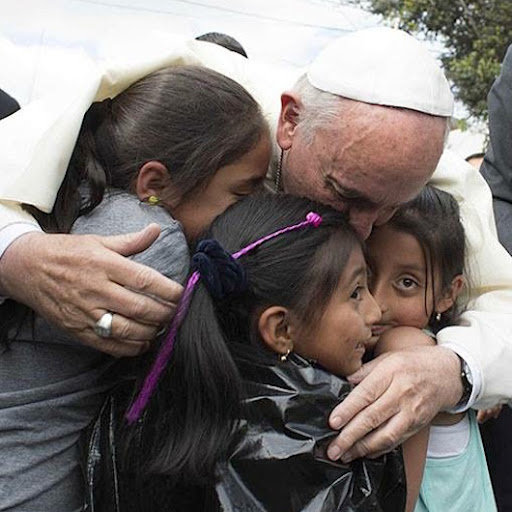
Let yourself cross the bridges that you build

Bosnia Pope Visit JPEG 027fc c0 276 3726 2447 s561x327

Last weekend, Pope Francis spent a day in Sarajevo, where he met with secular authorities, youth and representatives of different religions and where he powerfully spoke out against war and called for all to become “artisans of peace.” In this post I would just like to share what to me where the highlights of that day.

Right at the start of the day, when addressing the authorities, Francis called for an opposition to those who promote violence and for a uniting of “different voices”:

“In order to successfully oppose the barbarity of those who would make of every difference the occasion and pretext for further unspeakable violence, we need to recognize the fundamental values of human communities, values in the name of which we can and must cooperate, build and dialogue, pardon and grow; this will allow different voices to unite in creating a melody of sublime nobility and beauty, instead of the fanatical cries of hatred.”

Next, during mass at Sarajevo’s Koševo Stadium he spoke about how one works for peace in practice:

“So how does one do this, how do we build peace? The prophet Isaiah reminds us succinctly: “The effect of righteousness will be peace” (32:17). Opus justitiae pax (“the work of justice is peace”), from the Vulgate version of Scripture, has become a famous motto, even adopted prophetically by Pope Pius XII. Peace is a work of justice. Here too: not a justice proclaimed, imagined, planned… but rather a justice put into practice, lived out. The Gospel teaches us that the ultimate fulfilment of justice is love: “You shall love your neighbour as yourself” (Mt 22:39; Rm 13:9). When, by the grace of God, we truly follow this commandment, how things change! Because we ourselves change! Those whom I looked upon as my enemy really have the same face as I do, the same heart, the same soul. We have the same Father in heaven. True justice, then, is doing to others what I would want them to do to me, to my people (cf. Mt 7:12).

Saint Paul, in the second reading, shows us the attitude needed to make peace: “Put on then… compassion, kindness, lowliness, meekness and patience, forbearing one another and, if one has a complaint against another, forgiving each other; as the Lord has forgiven you, so you also must forgive” (Col 3:12-13).”

Following the mass, and after hearing the testimonies of priests and religious who were tortured during the Bosnian war, Pope Francis spoke off-the-cuff instead of following his prepared text:

“Another thing that struck me in their talks was mention of the one hundred and twenty days spent in the concentration camp. How many times the spirit of the world makes us forget our ancestors, the sufferings of our forebears! Those days are counted, not in days, but by the minute, because every minute, every hour is torture. To live together like this, dirty, with no food or water, in the heat and cold – and for a long time! And we, who complain when we have a toothache, or who want to have a television in our comfortable rooms, or who whisper behind the back of our Superior when the meals are not so good… Do not forget, I beg of you, the witness of your ancestors. Think of how much these persons have suffered; think of the six litres of blood that this priest had to receive – he, the first one who spoke – in order to survive. Conform your lives worthily to the Cross of Christ.

Worldly sisters, priests, bishops, and seminarians are a caricature, and are of no use to the Church. They do not remember the martyrs. They have lost the memory of Jesus Christ crucified, our only glory.

Another thing that comes to mind is the story of the soldier who gave a pear to the Sister; and that Muslim woman who now lives in America, who brought something to eat… We are all brothers and sisters. Even the cruel man has thought… well, I don’t know what he thought, but he felt the Holy Spirit in his heart and perhaps he thought of his mother and said, “Have this pear and say nothing to anyone”. And the Muslim woman who reached out beyond her own religious tradition: she loved. She believed in God and she did good.

Look for the good of everyone. Each person has potential, the seed of goodness. We are all children of God.”

From the meeting with representatives of different religions and Christian denominations, where Pope Francis agains spoke about dialogue and peace, what struck me was the prayer he said there together by Muslim, Jewish and Christian faithful:

“Almighty and eternal God,
good and merciful Father;
Creator of heaven and earth, of all that is visible and invisible;
God of Abraham, God of Isaac, God of Jacob,
King and Lord of the past, of the present and of the future;
sole judge of every man and woman,
who reward your faithful with eternal glory!
We, the descendants of Abraham according to our faith in you, the one God,
Jews, Christians and Muslims,
humbly stand before you
and with trust we pray to you
for this country, Bosnia and Herzegovina,
that men and women, followers of different religions, nations and cultures
may live here in peace and harmony.
We pray to you, O Father,
that it may be so in every country of the world!
Strengthen in each of us faith and hope,
mutual respect and sincere love
for all of our brothers and sisters.
Grant that we may dedicate ourselves
courageously to building a just society,
to being men and women of good will,
filled with mutual understanding and forgiveness,
patient artisans of dialogue and peace.
May each of our thoughts, words and actions
be in harmony with your holy will.
May everything be to your glory and honour and for our salvation.
Praise and eternal glory to you, our God!
Amen.”

Next, Pope Francis met with young people, where he again put his prepared speech aside and answered their questions instead, where two fragments stood out for me:

“It is not a case of “them and us”, but rather of “we”. We want to be “us”, to not destroy our homeland, to not ruin our country. You are a Muslim, you are a Jew, you are Orthodox, you are Catholic… but we are “us”. This is how to make peace.

[…]

Everyone speaks of peace: some world leaders speak of peace, and say beautiful things about peace, but behind it all they still sell weapons. From you, I expect honesty, coherence between what you think, what you feel and what you do: these three things together. The contrary is called hypocrisy.

[…]

Be united, build bridges, but also let yourselves cross the bridges that you build. This is brotherhood.”

Finally, as is now customary with Pope Francis’ trips abroad, there was a press conference during the flight back. There, one of the journalists asked him to elaborate on what he meant by referring to world leaders who speak openly of peace while selling weapons, to which he replied:

“Sure: there’s always hypocrisy! Thus I said that it is not enough just to talk about peace, one must also work for peace! And the one who only talks about peace but doesn’t work for it is contradicts himself; and the one who speaks of peace while promoting war, for example, through the selling of weapon, is a hypocrite. It’s that simple…”

At the end of the press conference, a French journalist jumped in to ask the pope about whether he would come to France in spite of problems with the French government, which may have been a reference to the stand-off about the candidate they put forward as ambassador to the Vatican, who is gay. After reassuring the journalist that he would come to France, Pope Francis said what was my favorite line of the whole trip:

“As for problems: little problems are not problems!”

Francis: God’s tenderness for man and woman

Blake divine presence

Pope Francis has dedicated two of his Wednesday General Audiences to the topic of men and women, their equal dignity, complementarity and the challenges they and their relationships face today. These two catecheses are set within the broader context of the family that he has been speaking about for several weeks now. However, since the question of how the complementarity of men and women is to be understood is close to my heart, I would like to offer a selection of passages from these two talks, which present a particularly clear and useful perspective.

Two weeks ago, Pope Francis started addressing this question by going back to its first treatment in the Bible, to the first creation account in Genesis, and underlining the joint value of man and woman:1

“As we all know, sexual differences are present in so many forms of life, in the long scale of the living. However, only in man and in woman does it bear in itself the image and likeness of God: the biblical text repeats it a good three times in two verses (Genesis 1:26-27): Man and woman are image and likeness of God! This tells us that not only man in himself is the image of God, not only woman in herself is the image of God, but also that man and woman, as a couple, are the image of God. The difference between man and woman is not for opposition, or for subordination, but for communion and creation, always in the image and likeness of God.”

Pope Francis then reflects on gender theory, which he rejects, and to which he offers an alternative, but whose roots he recognizes:

“I wonder […] if the so-called gender theory is not also an expression of a frustration and of a resignation, which aims to cancel the sexual difference because it no longer knows how to address it. Yes, we risk taking a step backward. The removal of the difference, in fact, is the problem, not the solution. To resolve their problems of relation, man and woman must instead talk more to one another, listen more to one another, know one another more, love one another more. They must relate to one another with respect and cooperate with friendship.”

Instead of a denial of differences, the key is respect, communication, friendship and love. However, the present problems are not to be laid equally at the feet of men and women:

“It is without doubt that we must do much more in favor of woman if we want to give back more strength to the reciprocity between men and women. In fact, it is necessary that women not only be more listened to, but that her voice has real weight, a recognized authoritativeness in society and in the Church. The way itself with which Jesus considered women – we read it in the Gospel, it is so! – in a context less favorable than ours, because in those times women were in fact in second place … and Jesus considered them in a way which gives a powerful light, which enlightens a path that leads far, of which we have only followed a small piece. We have not yet understood in depth what things the feminine genius can give us, which woman can give to society and also to us. Perhaps to see things with other eyes that complements the thoughts of men. It is a path to follow with more creativity and more audacity.”

While Pope Francis does not present a solution, he very clearly identifies the problem and sets the challenge of identifying ways that would lead to women having the place in society and the Church that they are due.

In the second catechesis this morning, Pope Francis returns to the question of reciprocity and equal dignity, and he takes the second creation account from Genesis as the starting point:

“[In the second chapter of Genesis] we read that the Lord, after having created heaven and earth, “formed man of dust from the ground, and breathed into his nostrils the breath of life; and man became a living being.” He is the pinnacle of creation. Then God put man in a most beautiful garden so that he would till and keep it. […] When […] God presents woman to him, man rejoices and recognizes that creature, and only that one, which is part of him: “bone of my bones and flesh of my flesh.” Finally, there is a reflection of himself, a reciprocity.”

While the second creation account establishes a closeness between man and woman, where woman is the “flesh of [man’s] flesh,” and which Pope Francis refers to in the same way in which the creed describes how God the Father and Jesus relate (as being consubstantial), he is quick also to emphasize that woman is created directly by God and not in some way by or through man:

“Woman is not a “replica” of man; she comes directly from the creative gesture of God. The image of the “rib” does not express inferiority or subordination but, on the contrary, that man and woman are of the same substance and are complementary. And the fact that – still in the parable – God formed woman while man slept, stresses in fact that she is in no way creature of man, but of God. And it also suggests something else: To find woman, and we can say to find love in woman, to find woman, man must first dream her and then he finds her.”

I particularly like the poetry of Pope Francis speaking about man dreaming woman to then find her and find love in her!

Francis then returns to the challenges facing men and women by reference to suspicion and mistrust and delusions of one’s omnipotence that we are all prone to:

“God’s trust in man and woman, to whom he entrusts the earth, is generous, direct and full. However, it is here where the Evil One introduces in his mind suspicion, incredulity, mistrust and finally disobedience to the commandment that protected them. They fall into that delirium of omnipotence that contaminates everything and destroys harmony. We also feel it within ourselves, so many times, all of us.”

From the general, Francis turns to denouncing injustice and violence committed against women as a result of patriarchal excesses, chauvinism and a turning of women into merchandise and a means:

“Sin generates mistrust and division between man and woman. Their relationship is threatened by thousands of ways of dishonesty and submission, of deceitful seduction and humiliating arrogance, even to the most dramatic and violent degrees. History bears their marks. Let us think, for instance, of the negative excesses of patriarchal cultures. Let us think of the many forms of chauvinism where woman is considered to be second class. Let us think of the instrumentalization and merchandising of the female body in current media culture.”

Next, he makes a pitch for a revival of an alliance between man and woman, whose absence leads to an uprooting of children from their maternal wombs:

“However, let us also think of the recent epidemic of mistrust, skepticism and even hostility that is spreading in our culture – in particular beginning with an understandable mistrust by women – in relation to an alliance between man and woman that would be able to, at the same time, improve the intimacy of communion and to protect the dignity of difference. If we do not find a jolt of sympathy for this alliance, that leads new generations to repairing mistrust and indifference, children will come into the world ever more uprooted from the maternal womb. The social devaluation of the stable and generative alliance of man and woman is certainly a loss for all. We must reassess marriage and the family!”

How so we go about such a reassessment though? Here Francis offers two indications. First, that marriage derives from a self-emptying for the sake of a new, joint journey where the spouses become all for each other (which is precisely the Trinitarian economy):

“And the Bible says a beautiful thing: man finds woman, they find one another, and man must leave something to find her fully. And for this, man will leave his father and his mother to go to her. It is beautiful! This means beginning a journey. Man is all for woman and woman is all for man.”

Second – and this should come as no surprise to anyone who has been following last year’s Synod on the Family or even just the Bull of indiction of the coming Jubilee of Mercy – that God is a tender, loving father to all, regardless of their shortcomings and that we too are called to treat others in exactly that same way. And Francis offers a surprising, beautiful reading of the motives behind Adam and Eve leaving Paradise clothed:2

“To care for this alliance of man and woman – even if they are sinners and wounded, confused and humiliated, mistrustful and uncertain – is therefore, for us believers, a challenging and exciting vocation, under present circumstances. The same account of creation and of sin, at its end, gives us a most beautiful icon: “And the Lord God made for Adam and for his wife garments of skins, and clothed them.” It is an image of tenderness to that sinful couple that leaves us with our mouth open: the tenderness of God for man and for woman. It is an image of paternal care of the human couple. God himself takes care of and protects his masterpiece.”


1 Note, that the English quotes from Pope Francis’ catecheses are mostly verbatim from the Zenith translations, except for a few passages that are adjusted based on the Italian original in an attempt of a more literal rendering.
2 Which turns out to be highly consonant with William Blake’s depiction of that scene, shown at the top of this post.

The face of mercy

Arcabas prodigal son

On Saturday evening, on the eve of Mercy Sunday, Pope Francis proclaimed the opening of the Extraordinary Jubilee of Mercy that will run from 8th December 2015 until 20th November 2016 by presenting the bull of indiction, Misericordiae Vultus – “The face of mercy.” At 9.5K words some have called it “Evangelii Gaudium II” already, and in terms of significance of content, it is not hard to see why. If you have the time and inclination, I would very much like to encourage you to read it in full, but, if you prefer, the following is my selection of key passages from this important statement.

To begin with, Francis identifies mercy with Jesus and its recipients with all of humanity:

“Jesus Christ is the face of the Father’s mercy. These words might well sum up the mystery of the Christian faith. Mercy has become living and visible in Jesus of Nazareth, reaching its culmination in him.” (§1)

“How much I desire that the year to come will be steeped in mercy, so that we can go out to every man and woman, bringing the goodness and tenderness of God! May the balm of mercy reach everyone, both believers and those far away, as a sign that the Kingdom of God is already present in our midst!” (§6)

A love that to God is “visceral,” fatherly and motherly is then presented as the motivation for mercy:

“[T]he mercy of God is not an abstract idea, but a concrete reality through which he reveals his love as that of a father or a mother, moved to the very depths out of love for their child. It is hardly an exaggeration to say that this is a “visceral” love. It gushes forth from the depths naturally, full of tenderness and compassion, indulgence and mercy.” (§6)

Several parables are then pointed to as examples of Jesus explaining what mercy means, with a particularly poignant one being the parable of the ruthless servant in which mercy becomes “a criterion for ascertaining who his true children are”:

“In the parables devoted to mercy, Jesus reveals the nature of God as that of a Father who never gives up until he has forgiven the wrong and overcome rejection with compassion and mercy. We know these parables well, three in particular: the lost sheep, the lost coin, and the father with two sons (cf. Lk 15:1-32). In these parables, God is always presented as full of joy, especially when he pardons. In them we find the core of the Gospel and of our faith, because mercy is presented as a force that overcomes everything, filling the heart with love and bringing consolation through pardon. […]

“[In the parable of the “ruthless servant,” (Matthew 18:21-35)] Jesus affirms that mercy is not only an action of the Father, it becomes a criterion for ascertaining who his true children are. In short, we are called to show mercy because mercy has first been shown to us. Pardoning offences becomes the clearest expression of merciful love, and for us Christians it is an imperative from which we cannot excuse ourselves. At times how hard it seems to forgive! And yet pardon is the instrument placed into our fragile hands to attain serenity of heart. To let go of anger, wrath, violence, and revenge are necessary conditions to living joyfully. Let us therefore heed the Apostle’s exhortation: “Do not let the sun go down on your anger” (Eph 4:26). Above all, let us listen to the words of Jesus who made mercy as an ideal of life and a criterion for the credibility of our faith: “Blessed are the merciful, for they shall obtain mercy” (Mt 5:7): the beatitude to which we should particularly aspire in this Holy Year.” (§9)

Having set out the centrality of mercy in Jesus’ teaching and identified it with Him, Pope Francis places it at the basis of the Church and insists that “nothing in her preaching and in her witness to the world can be lacking in mercy”:

“Mercy is the very foundation of the Church’s life. All of her pastoral activity should be caught up in the tenderness she makes present to believers; nothing in her preaching and in her witness to the world can be lacking in mercy. The Church’s very credibility is seen in how she shows merciful and compassionate love. The Church “has an endless desire to show mercy.” Perhaps we have long since forgotten how to show and live the way of mercy. The temptation, on the one hand, to focus exclusively on justice made us forget that this is only the first, albeit necessary and indispensable step. But the Church needs to go beyond and strive for a higher and more important goal. On the other hand, sad to say, we must admit that the practice of mercy is waning in the wider culture. It some cases the word seems to have dropped out of use. However, without a witness to mercy, life becomes fruitless and sterile, as if sequestered in a barren desert. The time has come for the Church to take up the joyful call to mercy once more. It is time to return to the basics and to bear the weaknesses and struggles of our brothers and sisters. Mercy is the force that reawakens us to new life and instils in us the courage to look to the future with hope.” (§10)

Next, two complementary points are made about language and silence: the need for merciful expression and for silence so as to hear God’s Word:

“It is absolutely essential for the Church and for the credibility of her message that she herself live and testify to mercy. Her language and her gestures must transmit mercy, so as to touch the hearts of all people and inspire them once more to find the road that leads to the Father.” (§12)

“The Evangelist reminds us of the teaching of Jesus who says, “Be merciful just as your Father is merciful” (Lk 6:36). It is a programme of life as demanding as it is rich with joy and peace. Jesus’s command is directed to anyone willing to listen to his voice (cf. Lk 6:27). In order to be capable of mercy, therefore, we must first of all dispose ourselves to listen to the Word of God. This means rediscovering the value of silence in order to meditate on the Word that comes to us. In this way, it will be possible to contemplate God’s mercy and adopt it as our lifestyle.” (§13)

To complement the positive expressions of mercy, Pope Francis also sets out a negative one (negative in the sense that it proscribes rather than prescribes) that echoes his “Who am I to judge?” that so many have downplayed since it was pronounced in an interview rather than an official, magisterial document:

“The Lord asks us above all not to judge and not to condemn [cf. (Luke 6:37-38)]. If anyone wishes to avoid God’s judgement, he should not make himself the judge of his brother or sister. Human beings, whenever they judge, look no farther than the surface, whereas the Father looks into the very depths of the soul. How much harm words do when they are motivated by feelings of jealousy and envy! To speak ill of others puts them in a bad light, undermines their reputation and leaves them prey to the whims of gossip. To refrain from judgement and condemnation means, in a positive sense, to know how to accept the good in every person and to spare him any suffering that might be caused by our partial judgment and our presumption to know everything about him. But this is still not sufficient to express mercy. Jesus asks us also to forgive and to give. To be instruments of mercy because it was we who first received mercy from God. To be generous with others, knowing that God showers his goodness upon us with immense generosity.” (§14)

Pope Francis then links mercy to the Father’s self-giving that he characterizes using the hallmarks of the life of the Trinity:

“Merciful like the Father, therefore, is the “motto” of this Holy Year. In mercy, we find proof of how God loves us. He gives his entire self, always, freely, asking nothing in return. He comes to our aid whenever we call upon him.” (§14)

Leading his exposition of mercy to practical measures, Francis points to the corporal and spiritual acts of mercy that the Church has advocated since its beginning:

“Jesus introduces us to these works of mercy in his preaching so that we can know whether or not we are living as his disciples. Let us rediscover these corporal works of mercy: to feed the hungry, give drink to the thirsty, clothe the naked, welcome the stranger, heal the sick, visit the imprisoned, and bury the dead. And let us not forget the spiritual works of mercy: to counsel the doubtful, instruct the ignorant, admonish sinners, comfort the afflicted, forgive offences, bear patiently those who do us ill, and pray for the living and the dead.

We cannot escape the Lord’s words to us, and they will serve as the criteria upon which we will be judged: whether we have fed the hungry and given drink to the thirsty, welcomed the stranger and clothed the naked, or spent time with the sick and those in prison (cf. Mt 25:31-45). Moreover, we will be asked if we have helped others to escape the doubt that causes them to fall into despair and which is often a source of loneliness; if we have helped to overcome the ignorance in which millions of people live, especially children deprived of the necessary means to free them from the bonds of poverty; if we have been close to the lonely and afflicted; if we have forgiven those who have offended us and have rejected all forms of anger and hate that lead to violence; if we have had the kind of patience God shows, who is so patient with us; and if we have commended our brothers and sisters to the Lord in prayer. In each of these “little ones,” Christ himself is present. His flesh becomes visible in the flesh of the tortured, the crushed, the scourged, the malnourished, and the exiled … to be acknowledged, touched, and cared for by us. Let us not forget the words of Saint John of the Cross: “as we prepare to leave this life, we will be judged on the basis of love.”” (§15)

That mercy is not about following rules, but about a going out towards those who are in need of it and a respect for their dignity, is put clearly next:

“For his part, Jesus speaks several times of the importance of faith over and above the observance of the law. It is in this sense that we must understand his words when, reclining at table with Matthew and other tax collectors and sinners, he says to the Pharisees raising objections to him, “Go and learn the meaning of ‘I desire mercy not sacrifice.’ I have come not to call the righteous, but sinners.” (Mt 9:13). Faced with a vision of justice as the mere observance of the law that judges people simply by dividing them into two groups – the just and sinners – Jesus is bent on revealing the great gift of mercy that searches out sinners and offers them pardon and salvation. One can see why, on the basis of such a liberating vision of mercy as a source of new life, Jesus was rejected by the Pharisees and the other teachers of the law. In an attempt to remain faithful to the law, they merely placed burdens on the shoulders of others and undermined the Father’s mercy. The appeal to a faithful observance of the law must not prevent attention from being given to matters that touch upon the dignity of the person.” (§20)

Pope Francis then goes on to situating mercy in an inter-religious context, with a particular focus on Judaism and Islam, and with a call to open-mindedness, respect and peacefulness:

“There is an aspect of mercy that goes beyond the confines of the Church. It relates us to Judaism and Islam, both of which consider mercy to be one of God’s most important attributes. Israel was the first to receive this revelation which continues in history as the source of an inexhaustible richness meant to be shared with all mankind. As we have seen, the pages of the Old Testament are steeped in mercy, because they narrate the works that the Lord performed in favour of his people at the most trying moments of their history. Among the privileged names that Islam attributes to the Creator are “Merciful and Kind.” This invocation is often on the lips of faithful Muslims who feel themselves accompanied and sustained by mercy in their daily weakness. They too believe that no one can place a limit on divine mercy because its doors are always open.

I trust that this Jubilee year celebrating the mercy of God will foster an encounter with these religions and with other noble religious traditions; may it open us to even more fervent dialogue so that we might know and understand one another better; may it eliminate every form of closed-mindedness and disrespect, and drive out every form of violence and discrimination.” (§23)

The next day – on Mercy Sunday, Pope Francis returned to the starting point of Misericordiae Vultus, where he identifies mercy with Jesus and went on to spell out the basis of that identity:


“[T]he Lord shows us, through the Gospel, his wounds.  They are wounds of mercy.  It is true: the wounds of Jesus are wounds of mercy. […]

Jesus invites us to behold these wounds, to touch them as Thomas did, to heal our lack of belief.  Above all, he invites us to enter into the mystery of these wounds, which is the mystery of his merciful love. Through these wounds, as in a light-filled opening, we can see the entire mystery of Christ and of God: his Passion, his earthly life – filled with compassion for the weak and the sick – his incarnation in the womb of Mary.

Faced with the tragic events of human history we can feel crushed at times, asking ourselves, “Why?”.  Humanity’s evil can appear in the world like an abyss, a great void: empty of love, empty of goodness, empty of life.  And so we ask: how can we fill this abyss?  For us it is impossible; only God can fill this emptiness that evil brings to our hearts and to human history.  It is Jesus, God made man, who died on the Cross and who fills the abyss of sin with the depth of his mercy.”

Judaism and Christianity: A common heritage

Chagall jacobs dream

A very good friend of mine (CA) lent me a great book about Judaism, entitled “What is a Jew?” and aimed at providing an introduction to a broad variety of aspects of what it means to be Jewish. The book is structured in the form of questions and answers and its tone exudes warmth and a desire to share rather than to impose or indoctrinate. Even before I started reading the book, I was looking forward to learning more about Judaism, both because of a desire to have a better understanding of the religion of several friends of mine, and because of the heightened insistence on a rediscovery of Judaism made by the Catholic Church since Vatican II.

John Paul II was famously the first pope to visit a synagogue, during which visit he spoke with clarity and warmth about the relationship between Christianity and Judaism:

“The Jewish religion is not ‘extrinsic’ to us, but in a certain way is ‘intrinsic’ to our own religion. […] With Judaism, therefore, we have a relationship which we do not have with any other religion. You are our dearly beloved brothers, and, in a certain way, it could be said that you are our elder brothers.”

Benedict XVI went on to maintain very strong relationships with Judaism, both acknowledging the Church’s past wrongs and expressing its gratitude and debt to the Jewish people:

“Abraham, father of the people of Israel, father of faith, has become the source of blessing, for in him ‘all the families of the earth shall call themselves blessed.’ The task of the Chosen People is therefore to make a gift of their God – the one true God – to every other people. In reality, as Christians we are the inheritors of their faith in the one God. Our gratitude therefore must be extended to our Jewish brothers and sisters who, despite the hardships of their own history, have held on to faith in this God right up to the present and who witness to it…”

Finally, Pope Francis has not only continued along the direction indicated by his predecessors, but has also benefitted from close personal friendships with the Jewish community. An example of this is the book – “On Heaven and Earth” that he co-authored with Rabbi Abraham Skorka, who also accompanied him on his recent visit to Israel and who has been a frequent visitor at the Vatican. Pope Francis has also reiterated, in his apostolic exhortation Evangelii Gaudium, the brotherly relationship that his predecessors have stressed:
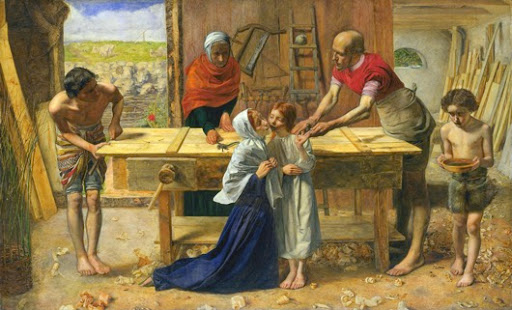
“We hold the Jewish people in special regard because their covenant with God has never been revoked, for “the gifts and the call of God are irrevocable” (Rom 11:29). The Church, which shares with Jews an important part of the sacred Scriptures, looks upon the people of the covenant and their faith as one of the sacred roots of her own Christian identity (cf. Rom 11:16-18). As Christians, we cannot consider Judaism as a foreign religion; nor do we include the Jews among those called to turn from idols and to serve the true God (cf. 1 Thes 1:9). With them, we believe in the one God who acts in history, and with them we accept his revealed word. Dialogue and friendship with the children of Israel are part of the life of Jesus’ disciples. […] While it is true that certain Christian beliefs are unacceptable to Judaism, and that the Church cannot refrain from proclaiming Jesus as Lord and Messiah, there exists as well a rich complementarity which allows us to read the texts of the Hebrew Scriptures together and to help one another to mine the riches of God’s word. We can also share many ethical convictions and a common concern for justice and the development of peoples.” (§247-9)

Against this background I was particularly pleased to see the relationship between Christianity and Judaism described by Rabbi Morris Kertzer in “What is a Jew?” as follows:

“[The] German dramatist, Gotthold Ephraim Lessing, caught the essence of this common heritage [of Judaism and Christianity] in a play called Nathan, the Wise. One of the most memorable scenes depicts a meeting between a friar and the Jew Nathan. Moved by the beauty of Nathan’s character, the friar exclaims, “Nathan! Nathan! You are a Christian!” His friend replies, “We are of one mind, for that which makes me, in your eyes, a Christian, makes you, in my eyes, a Jew!”” (pp. 279)

I have to say that this paragraph from the last pages of the book very much rang true for me and expressed with accuracy the feeling I had as I made my way through the whole book. To give you a sense of what triggered such a recognition of what I believe to be very much mine in Rabbi Kertzer’s description of Judaism, I will share a number of excerpts from it next.

To begin with, the mystical tradition in Judaism, and its propensity to expressing itself by means of short stories reminded me immediately of the stories told about the Desert Fathers (and also about Zen kōans and the stories of the Sufi Mullah Nasrudin):

““Rabbi,” one of the disciples complained, “some of the congregants are gossiping in the midst of prayer!” “How wonderful are your people, O God,” The rabbi retorted. “Even in the midst of gossip, they devote a few moments to prayer!”

“Can you tell me, Rabbi, why the wicked are always looking for companions while the righteous are not?” “The answer is simple: The wicked walk in darkness, so are anxious for company. Good people walk in the light of God; they don’t mind walking alone.”” (pp. 21-22)

Next, I was struck by a repeated insistence on orthopraxy, which has a strong tradition in Christianity too:

“Jews are urged to put their religion into action. “Talking is not the main thing; action is,” goes a talmudic maxim, and action includes not just activity within the confines of the Jewish world, but working for the welfare of the larger society in which we live. We call this tikkun olam, meaning the “reparation of world.”” (pp. 30)

And Rabbi Kertzer goes on to recounting the same story about the building of the Tower of Babel that Pope Francis reflects on in his above-mentioned book, and then to presenting a synthesis of principles that resonate very strongly with Christianity too:

“The Rabbis used telling parables to illustrate this point. Why did the Tower of Babel crumble? Because the leaders of the project were more interested in the work than in the workers. When a brick fell to earth, they would pause to bewail its loss; when a worker fell they would urge the others to keep on building. The brick was more important than the human being. So God destroyed the imposing edifice. […]

Basic to Judaism are these fundamental principles, which are also basic to democracy: 1) God recognizes no distinction among us  on the basis of creed, color, gender, or class; all of us are equal in God’s sight. 2) We are all our brother’s and sister’s keepers; we bear responsibility for our neighbors’ failings as well as for their needs. 3) All of us, being made in God’s image, have infinite capacity for doing good; therefore the job of society is to evoke the best that is in each of us. 4) Freedom is to be prized above all things; the very first words of the Ten Commandments depict God as the Great Liberator: “I am the Eternal your God who brought you out of the land of Egypt.”” (pp. 31)

A couple of questions later, Kertzer then sets out an understanding of Scripture that could have come from the Vatican II dogmatic constitution Dei Verbum:

“[M]ost Jews look upon the accounts of miracles as inspiring literature, rather than as actual historical events. That is to say, we do not necessarily accept older interpretations of their significance, since an important lesson for the fifth century may be unimportant in the face of today’s spiritual questions; but we do use these tales as sources of inspiration ourselves, trying to draw religious lessons from the text, even the text of an event that may not be literally true. God did not create the world in precisely six days, just as the biblical text insists, but we can learn lessons for our lives from such stories as the Garden of Eden or the Tower of Babel.” (pp. 45)

On the subject of death and the Kaddish prayer, the book presents a profoundly beautiful reflection by Rabbi Steinberg:

“It is easier for me to let go of life with all its treasures, because these things are not and never have been mine. They belong to the Universe and the God who stands behind it. True, I have been privileged to enjoy them for an hour but they were always a loan to be recalled.

And I let go of them the more easily because I know that as parts of the divine economy they will not be lost. The sunset, the bird’s song, the baby’s smile, the thunder of music, the surge of great poetry, the dreams of the heart, and my own being—all these I can well trust to the God who made them. There is a poignancy and regret about giving them up, but no anxiety. When they slip from my hands they will pass to hands better, stronger, and wiser than mine.

Life is dear; let us then hold it tight while yet we may. But we must hold it loosely also! It is at once infinitely precious and yet a thing lightly to be surrendered. Because of God, we clasp the world, but with relaxed hands; we embrace it, but with open arms.” (pp. 67)

The juxtaposition of an enjoyment of the beauty of the universe and a detachment from it leads to an experiencing of everything in relationship with and gratitude to God:

“Because of its innate trust in both God and God’s world, Judaism affirms the value of life and life’s pleasures. It is therefore a religion that urges us to pay attention to the wonderful universe about us. To help us do so, it provides blessings for all of life’s bounties: seeing a rainbow; experiencing a thunderstorm; observing the first blossoms of springtime; putting on new clothes; even eating our first garden produce, as each crop ripens year after year.” (pp. 85)

That the above relationship with God is not simply an individual matter is shown clearly through the concept of minyan, which also reminded me of Jesus’ promise of his presence where “two or three” are gathered together in his name:

“Personal prayer between the individual and God may take place anywhere, any time, and with no one present but God and the individual worshiper. Public services, however, have traditionally required what is known as a minyan, that is, the presence of at least ten adult worshipers. […] Behind the idea of a minimum number is the notion that Jewish spirituality is in some sense communal. We all received the Torah together on Mount Sinai. We are all part of the people Israel.” (pp. 86)

Kertzer then goes on to presenting a simultaneous openness to diversity and faithfulness to God, that has echoes in the Church’s desire for “unity in diversity”:

“Our experience with diverse cultures has enriched our religion in many ways. Above all, perhaps, has been our hospitality to differences. Every question of Jewish law contains both an austere interpretation and a liberal one, and the Rabbis ruled that “both opinions are the word of the living God.” […] One famous rabbinic aphorism pictures God as saying, in effect, “As long as Jews do My will, they need not believe in Me.” That is an exaggeration, of course. Judaism does teach some beliefs, among them the firm conviction that God is real: a real presence in the lives of men and women, children and adults. We can know that reality as surely as we know the beauty of love, the satisfaction of faithfulness, or the buoyancy of hope.” (pp. 108)

In more specific terms, the three pillars of the Jewish faith are presented next, and unity among them is declared:

“We believe, then, in God: a personal God whose ways may be beyond our comprehension, but whose reality makes the difference between a world that has purpose and one that is meaningless.

We believe all human beings are made in God’s image; our role in the universe is thus uniquely important, and despite the failings that spring from our mortality, we are endowed with infinite potential for goodness and greatness.

We believe too that human beings actualize their potential as part of a community. The people Israel is such a community, harking back to Sinai, existing despite all odds from then until now, and still the source of satisfaction for Jews who wish to pursue a life of purpose grounded in the age-old wisdom we call Torah.

And we believe in Torah, therefore, as a continuing source of revelation.

It has been said that you can sum up Jewish belief in these three words, God, Torah, Israel. As the mystics used to say, “God, Torah, and Israel are all one.” If we lose our faith in any one of them, the others quickly perish. […]

In antiquity, it was common for scholars to distill the essence of religion in a simple formula. Thus, Hillel, the great Rabbi and scholar of the first century B.C.E., was asked to sum up Judaism while the questioner stood on one foot! Hillel replied: “Certainly! What is hateful to you, do not do to your neighbor. That is all there is in the Torah. All the rest is mere commentary. I suggest you study the commentary.”” (pp. 109)

The transcendence of God, the universal access to following Him and its being rooted in a putting into practice of His qualities brings the exposition of the Jewish faith to completion:

“Jews believe in the existence of a God who cannot be accurately conceived, described, or pictured. But God is a real presence in the universe at large; and the lives of each of us in particular. We believe also that we most genuinely show God honor when we imitate the qualities that are godly: As God is merciful, so we must be compassionate; as God is just, so we must deal justly with out neighbor; as God is slow to anger, so we must be tolerant in our judgment.” (pp. 110)

“It is the recognition of the reality of God, and the basic moral virtues, such as kindliness, justice, and integrity, that we regard as eternal verities. But we claim no monopoly on these verities, for we recognize that every great religious faith has discovered them. That is what Rabbi Meir meant some eighteen centuries ago, when he said that a non-Jew who follows the Torah is as good as our high priest.” (pp. 113)

Finally, Kertzer also speaks very powerfully about the necessity of remembering the horrors of the Shoah:

“[T]he moral reason [to remember the Shoah] may be the most important one. When the mass murderer Adolf Eichmann was on trial, the Israelis informed the world that the motive behind the judicial proceedings was not vengeance but the moral education of contemporary women and men. The striking thing about Eichmann was precisely that he was so ordinary, a living symbol of what historian Hannah Arendt called “the banality of evil.” Contemplating the events of the Nazi era, we came to see that the sin of omission on the part of the decent peoples of the world was the sin of silence, the refusal to believe that a highly enlightened people like the Germans could permit themselves to be led by a madman into acts of national depravity that culminated in the events of Auschwitz and the other death camps. We had to learn to readjust our vision and take evil seriously once again.” (pp. 161)

Not only is it essential to pursue the doing of good, but so is a taking seriously of evil and a standing up to it, since omission and silence too are grave sins – insights that are of acute relevance today and that were at the time of the Shoah also shared by Christians. The Lutheran theologian Dietrich Bonhoeffer, whose anniversary of being murdered in the Flossenbürg concentration camp in 1945 was yesterday, said:

“Silence in the face of evil is itself evil:
God will not hold us guiltless.
Not to speak is to speak.
Not to act is to act.”

A marriage and family questionnaire

John Everett Millais Christ in the House of His Parents `The Carpenter s Shop Google Art Project s

Ahead of this October’s Synod on the Family, the Bishops of England and Wales have published a questionnaire about marriage and the family, in line with the recommendations issued at the end of last year’s Extraordinary Synod on the same subject. If you reside in England or Wales, I would very much encourage you to complete it, and if you live elsewhere, you might like to find out whether your local bishops’ conference is doing something similar.

Finally, in case you are interested, I would also like to share my own responses to this questionnaire, which I found to be a good opportunity for stopping and reflecting (although not in one go, obviously – I wrote these lines while taking a break from a basketball game with my sons, later while having a couple of minutes to myself before a supper and finally while waiting for a flight – continuity, sadly, is the stuff of fairytales :).

What are your joys and hopes of marriage and family life today?

To me the greatest source of joy with regard both to the family and marriage is the warmth and tenderness that can be experienced there. The family is where all its members can be free to express themselves unreservedly, to share their joys and sorrows, to develop their love for others and to know that their welcome by all in the family is unconditional. It is a place where difficulties can be overcome without judgment and where successes can be shared without envy. Above all though, marriage and the family are an openness to participating in the life of the Trinity: in mutual self-giving, in loving and being loved, that invite Jesus’ presence among those gathered together in His name

What are your struggles and fears of marriage and family life today?

The struggles and challenges that each member of a family faces individually are also a challenge for the family as a whole. Self-centeredness, isolation, indifference, consumerism, a lack of concern for the poor and a tendency to see what distinguishes at the expense of what unites are all prominent dangers. What makes them worse is if they are faced individually and without the benefit of the family or the relationship between spouses. And what makes them even more serious is if a family closes itself, instead of sharing its warmth and tenderness with those around it, if it only looks inside, instead of recognising the presence of God in all around them. These are the greatest dangers and fears I see today. 

How can we better understand marriage as a vocation?

By first understanding and responding to the vocation that follows from baptism and that consists in participation in Christ’s priestly, prophetic and royal nature. Only then can the membership in the mystical body of Christ that the Eucharist gives life to and the access to the Holy Spirit that follows from confirmation be understood and lived. And only on the basis of a conscious experience of these sacraments can an understanding of the sacramentality and vocational nature of marriage be understood and its choice, instead of the choice of other vocations, be discerned and made in alignment with the will of God. Both the putting into practice of the Gospel and a life-long learning of the faith are indispensable here.

  How does your marriage enrich you?

This is a question akin to asking about the benefits derived from oxygen. Getting married is an existential transformation that is followed by a new, joint being where the spouses are one. It is a monologue becoming dialogue, an individual participating in communion and a one that is not alone. It is a complementarity that is not self-sufficient or self-fulfilling but oriented towards God and neighbours instead. 

How does your family life enrich those around you?

This question would better be addressed to those around my family, while for us it is more of an examination of conscience. I hope those around us feel welcomed by us as they are and feel that we understand and don’t judge them. If we keep Jesus’ words and He makes His home with us, I hope we are able to share Him with those whom we meet. 

In what way, through the abiding presence of God, is your family “salt of the earth and light to the world,” and a place of and for handing on our faith?

By placing the Gospel at the heart of our family’s life: as a guiding light and explicit interpretative key for the events in our family and the world at large, as the motivation for our actions, as a mirror in which to identify our failings and as the inspiration for starting again and again with putting it into practice. 

Do you have any other comments?

I would like to express my wholehearted agreement with and support for Pope Francis’ words at the close of last year’s Extraordinary Synod on the Family, where he emphasised the need for the Church to be open to all, not ashamed of the wounds of our fallen brothers and sisters, and be “[t]he Church that has doors wide open to receive the needy, the repentant and not only the righteous or those who think they are perfect!”